REVIEW 3 major objections 4 minor 84 references
Dual contextual states let a video agent answer from long-term memory in one forward pass instead of iterative detective reasoning.
Reviewed by Pith at T0; open to challenge. T0 means a machine referee read the full paper against a public rubric. the ladder, T0–T4 →
T0 review · grok-4.5
2026-07-11 06:33 UTC pith:IWBW3ZOA
load-bearing objection Solid systems paper: dual-state design (hierarchical global script + single-pass latent controller) delivers real latency wins and solid accuracy on long-video agents; synthetic Gemini supervision is the main caveat, not a collapse of the claim. the 3 major comments →
Light-Omni: Reflex over Reasoning in Agentic Video Understanding with Long-Term Memory
The pith
A machine-rendered reading of the paper's core claim, the machinery that carries it, and where it could break.
Core claim
The paper establishes that a hierarchical non-parametric global state (Sg) consolidated from episodic memory, together with a parametric latent state (Sl) that jointly decides actions and produces a rectified retrieval embedding, is enough to close the query–memory semantic gap and drive accurate, low-latency video understanding without multi-turn reasoning.
What carries the argument
Dual contextual states: a resolution-decaying hierarchical global script Sg (merge factor k=8) plus a soft-prompt latent state Sl that is decoded into action probabilities and a retrieval embedding added to the query representation.
Load-bearing premise
That a synthetic interactive training set (responses and intermediate signals generated by a commercial model on public videos) plus light multi-LoRA fine-tuning is enough for the learned latent embeddings and hierarchical merge to close the real query–memory gap without iterative reasoning.
What would settle it
On the same long-video benchmarks, replace the latent-state retrieval embedding with ordinary text-query embeddings (or disable hierarchical merging of Sg) while keeping every other component fixed; if accuracy and noise robustness fall back to ordinary RAG levels and the claimed speed/accuracy gains disappear, the dual-state claim fails.
Editorial analysis
A structured set of objections, weighed in public.
Referee Report
Summary. Light-Omni is a multimodal agent framework for long-horizon video understanding that replaces multi-step “detective-style” iterative reasoning with dual contextual states computed in a single forward pass. A non-parametric global state Sg is a finite multimodal script obtained by resolution-decaying hierarchical merging (capacity factor k) of episodic memory; a parametric latent state Sl, produced from soft prompts conditioned on Sg, simultaneously triggers actions (search/speech) via Bernoulli heads and supplies a rectified retrieval embedding that is added to the query embedding. The system is built on a three-component long-term memory (user profile, semantic, episodic), trained with multi-LoRA adapters and a hybrid NTP + contrastive objective on a 43–46 k synthetic interactive dataset, and is evaluated for accuracy, latency and memory footprint on VideoMME-long, LVBench, HippoVlog and OVO-Bench, with additional plug-in experiments on other MLLMs.
Significance. If the dual-state design truly closes the query–memory semantic gap without iterative reasoning, the work offers a practical route to near-constant-latency agentic video understanding and a reusable memory module that improves both accuracy and efficiency of existing MLLMs. The reported gains (approximately +2.4 % accuracy / 12.1 imes speedup / 2.6 imes memory reduction versus M3-Agent, and larger gains versus the 7 B backbone) together with noise-robustness matrices, latency-versus-duration curves and hierarchical-merge scalability plots constitute concrete, falsifiable evidence that would be of clear interest to the long-video and agent communities. The explicit multi-LoRA skill split, hierarchical consolidation algorithm and open project page further strengthen reproducibility.
major comments (3)
- [§3.3, Eq. (4), Appendix B] The central “reflex-over-reasoning” claim (Abstract, §1, §3.2–3.3) rests on the premise that latent embeddings trained with contrastive loss L2 (Eq. 4) on Gemini-generated topics, actions and positive keys (§3.3, Appendix B) close the real query–memory gap. Because the same commercial model supplies both the supervisory signals and the target distribution that Sl is optimized to match, the observed alignment (Figs. 5–6, SNR improvement) may be an artifact of the synthetic teacher rather than a general solution to noisy, coreferential queries on VideoMME-long / LVBench / HippoVlog. A load-bearing experiment is missing: either a human-annotated interactive subset, a cross-teacher transfer test, or an explicit comparison of retrieval precision when positives are taken from a different model family. Without such evidence the accuracy and latency claims versus iterative agents remain only par
- [Table 1, Table 2, Fig. 4] Table 1 and Table 2 compare Light-Omni (Qwen2.5-Omni-7B) with M3-Agent (Qwen3-32B) and WorldMM-8B (which uses GPT-5-mini for memory construction). While the efficiency numbers are unambiguous, the 2.4 % average accuracy edge is confounded by backbone scale and external API quality. A controlled ablation that freezes the same 7 B backbone for both the dual-state agent and a multi-turn reasoning baseline (or reports M3-Agent numbers with a 7 B backbone) is required before the accuracy superiority can be attributed solely to the dual-state design.
- [Eq. (2), Fig. 7–8, §4.2] The hierarchical merge (Eq. 2, k = 8) and default retrieval counts (Ns = 12, Ne = 4) are free parameters whose sensitivity is only partially explored (Fig. 7). Fig. 8 shows that the topic count stays bounded, yet no ablation quantifies how accuracy or retrieval SNR degrades when k is varied or when the merge is replaced by a simple FIFO buffer of equal token budget. Because Sg is claimed to be the essential global context that enables single-pass retrieval, a short sensitivity table for k and for the merge operator itself is needed to confirm that the reported gains are not an artifact of a carefully tuned capacity factor.
minor comments (4)
- [Fig. 1, Fig. 9] Fig. 1 caption and the right-hand plot claim “near-constant latency regardless of video duration,” yet Fig. 9 still shows a mild upward trend; a quantitative slope or O-notation statement would avoid over-claiming.
- [§3.3, Algorithm 1] The multi-LoRA design is described only at a high level; the exact adapter-switching logic at inference time (which adapter is active for topic generation versus response versus reaction) should be stated in Algorithm 1 or a short paragraph in §3.3.
- [References] Several citations appear as arXiv preprints without venue or year (e.g., [29], [52]); standardizing them would improve readability.
- [Table 3] In Table 3 the “Vanilla” baseline already reaches 63.11 %; clarifying whether this baseline still uses the same synthetic-trained retrieval head would make the +2.99 % gain of Sg easier to interpret.
Circularity Check
No circularity: empirical systems paper whose dual-state claims and benchmark gains are measured externally, not forced by construction or self-citation.
full rationale
Light-Omni is an empirical multimodal agent paper. Its central claims (dual contextual states Sg hierarchical merge + Sl latent embeddings close the query–memory gap, enabling single-pass reflexive retrieval/action that beats M3-Agent by ~2.4% accuracy / 12.1× speed / 2.6× memory on VideoMME-long, LVBench, etc.) rest on (i) an engineered architecture (Eqs. 1–3, hierarchical merge with capacity k, soft-prompt latent heads, multi-LoRA), (ii) a synthetic training set of ~43–46k samples whose intermediate signals and responses are generated by Gemini, and (iii) standard contrastive + CE losses (Eq. 4). Accuracy, latency, and memory footprint are then measured on public external benchmarks against independent baselines. Nothing in the derivation chain reduces by algebraic identity, definitional tautology, or load-bearing self-citation to its own inputs: the hierarchical merge is a design choice (not a uniqueness theorem), the latent embeddings are optimized against synthetic positives but evaluated on held-out real videos, and reported gains are not forced by the fit. Mild distribution-shift risk from synthetic teacher data exists but is a generalization concern, not circularity. Per the rules, a self-contained empirical paper scored against external benchmarks receives 0.
Axiom & Free-Parameter Ledger
free parameters (5)
- hierarchical merge factor k =
8
- contrastive loss weight λ =
2
- default retrieval counts Ns, Ne =
Ns=12, Ne=4
- visual token compression ratio r_comp =
0.25
- LoRA rank / alpha / multi-adapter split =
r=64, α=128
axioms (4)
- domain assumption Heavy multi-step reasoning in video agents mainly compensates for missing global context and query–memory distribution mismatch rather than being intrinsically required for the task.
- domain assumption Hierarchical resolution-decaying merge of episodic scripts preserves enough temporal coherence for global reasoning while bounding context size.
- ad hoc to paper Synthetic interactive videos with commercial-LMM-generated responses and intermediate memory/action labels are adequate supervision for real long-video benchmarks.
- domain assumption Standard next-token prediction + cross-entropy action loss + InfoNCE-style retrieval alignment on soft-prompt hidden states yields transferable latent retrieval embeddings.
invented entities (3)
-
Dual contextual states (global state Sg + latent state Sl)
no independent evidence
-
Resolution-decaying hierarchical multimodal script merge
no independent evidence
-
Multi-LoRA agent skill split (memorization / generation / reaction)
no independent evidence
read the original abstract
Agentic video understanding equips models with long-term memory to autonomously process and respond to continuous, long-horizon multimodal streams. However, advanced video agents often rely on ``detective-style'' iterative reasoning for action control (e.g., $\mathtt{search}$) and evidence aggregation, incurring prohibitive costs and latency. We argue that such heavy reasoning primarily compensates for the lack of global context and semantic misalignment in retrieval. This paper introduces Light-Omni, a multimodal agent framework for reflexive and lightweight video understanding. It achieves this through dual contextual states that instantly build the required context in a single forward pass. First, we maintain a global state, a finite-sized multimodal script continuously consolidated from episodic memory, serving as the global context for Light-Omni. Through hierarchical merging, it preserves recent details while summarizing past events. Second, conditioned on this global context, we generate a parametric latent state that directly drives autonomous actions and produces retrieval embeddings, with minimal latency. Benefiting from this coupled design, Light-Omni achieves semantically aligned retrieval and reflexive responses while avoiding iterative reasoning. Extensive experiments validate the effectiveness of Light-Omni across multiple video benchmarks. Notably, it outperforms M3-Agent with an average 2.4% accuracy gain, a 12.1$\times$ speedup, and a 2.6$\times$ improvement in GPU memory efficiency. Furthermore, it serves as a memory system to enhance both the performance and efficiency of existing MLLMs. Project page: https://clare-nie.github.io/Light-Omni.
Figures




Reference graph
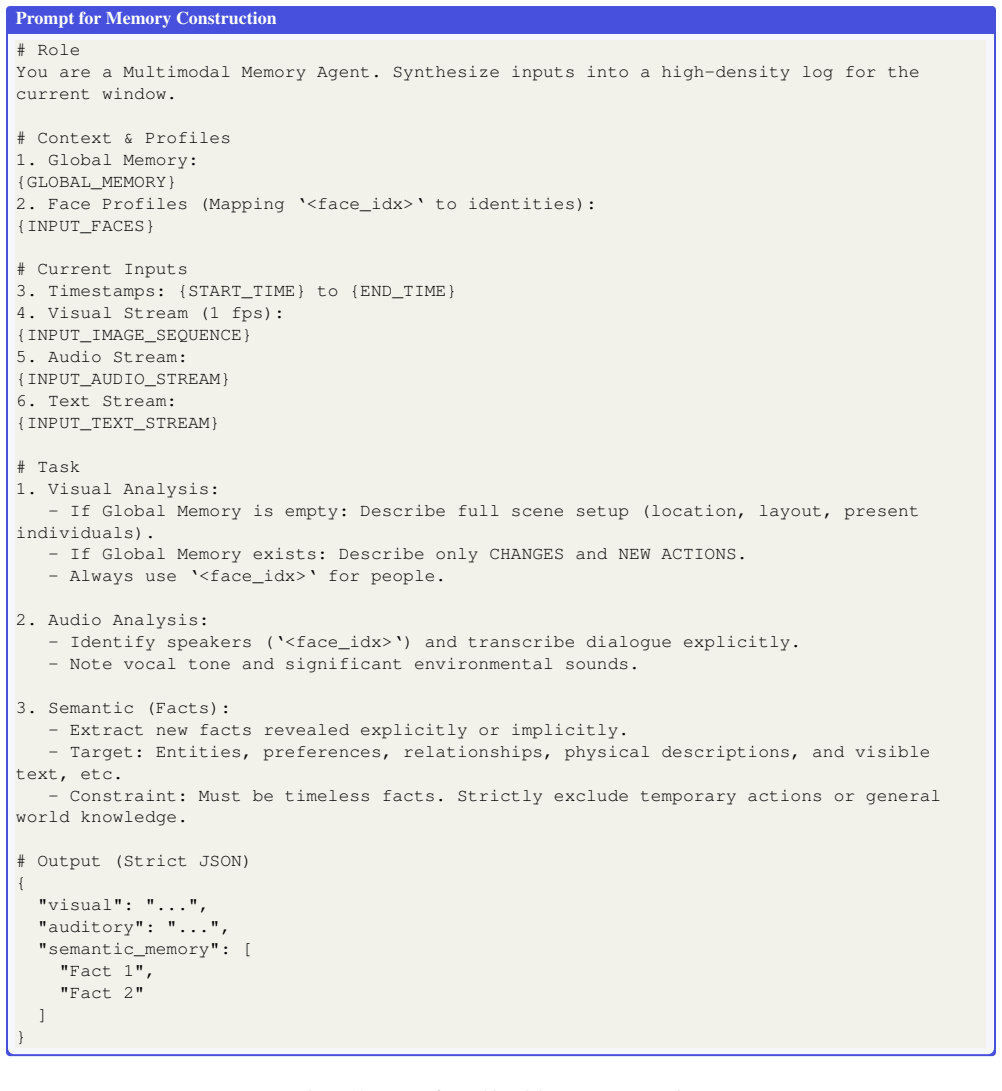
Works this paper leans on
-
[1]
Divprune: Diversity-based visual token pruning for large multimodal models
Saeed Ranjbar Alvar, Gursimran Singh, Mohammad Akbari, and Yong Zhang. Divprune: Diversity-based visual token pruning for large multimodal models. InCVPR, 2025
2025
-
[2]
Qwen3-vl technical report.arXiv preprint arXiv:2511.21631, 2025
Shuai Bai, Yuxuan Cai, Ruizhe Chen, Keqin Chen, Xionghui Chen, Zesen Cheng, Lianghao Deng, Wei Ding, Chang Gao, Chunjiang Ge, et al. Qwen3-vl technical report.arXiv preprint arXiv:2511.21631, 2025
Pith/arXiv arXiv 2025
-
[3]
Shuai Bai, Keqin Chen, Xuejing Liu, Jialin Wang, Wenbin Ge, Sibo Song, Kai Dang, Peng Wang, Shijie Wang, Jun Tang, et al. Qwen2. 5-vl technical report.arXiv preprint arXiv:2502.13923, 2025
Pith/arXiv arXiv 2025
-
[4]
Language models are few-shot learners
Tom Brown, Benjamin Mann, Nick Ryder, Melanie Sub- biah, Jared D Kaplan, Prafulla Dhariwal, Arvind Neelakantan, Pranav Shyam, Girish Sastry, Amanda Askell, et al. Language models are few-shot learners. InNeurIPS, 2020
2020
-
[5]
Chi-Min Chan, Chunpu Xu, Ruibin Yuan, Hongyin Luo, Wei Xue, Yike Guo, and Jie Fu. Rq-rag: Learning to refine queries for retrieval augmented generation.arXiv preprint arXiv:2404.00610, 2024
Pith/arXiv arXiv 2024
-
[6]
Videollm-online: Online video large language model for streaming video
Joya Chen, Zhaoyang Lv, Shiwei Wu, Kevin Qinghong Lin, Chenan Song, Difei Gao, Jia-Wei Liu, Ziteng Gao, Dongxing Mao, and Mike Zheng Shou. Videollm-online: Online video large language model for streaming video. InCVPR, 2024
2024
-
[7]
Evolu- tion and prospects of foundation models: From large language models to large multimodal models.Computers, Materials & Continua, 2024
Zheyi Chen, Liuchang Xu, Hongting Zheng, Luyao Chen, Amr Tolba, Liang Zhao, Keping Yu, and Hailin Feng. Evolu- tion and prospects of foundation models: From large language models to large multimodal models.Computers, Materials & Continua, 2024
2024
-
[8]
Gheorghe Comanici, Eric Bieber, Mike Schaekermann, Ice Pasupat, Noveen Sachdeva, Inderjit Dhillon, Marcel Blistein, Ori Ram, Dan Zhang, Evan Rosen, et al. Gemini 2.5: Pushing the frontier with advanced reasoning, multimodality, long con- text, and next generation agentic capabilities.arXiv preprint arXiv:2507.06261, 2025
Pith/arXiv arXiv 2025
-
[9]
Zhihao Du, Qian Chen, Shiliang Zhang, Kai Hu, Heng Lu, Yexin Yang, Hangrui Hu, Siqi Zheng, Yue Gu, Ziyang Ma, et al. Cosyvoice: A scalable multilingual zero-shot text- to-speech synthesizer based on supervised semantic tokens. arXiv preprint arXiv:2407.05407, 2024
Pith/arXiv arXiv 2024
-
[10]
Video-mme: The first-ever comprehensive evaluation benchmark of multi-modal llms in video analysis
Chaoyou Fu, Yuhan Dai, Yongdong Luo, Lei Li, Shuhuai Ren, Renrui Zhang, Zihan Wang, Chenyu Zhou, Yunhang Shen, Mengdan Zhang, et al. Video-mme: The first-ever comprehensive evaluation benchmark of multi-modal llms in video analysis. InCVPR, 2025
2025
-
[11]
Cognitive neuroscience of human memory
John DE Gabrieli. Cognitive neuroscience of human memory. Annual review of psychology, 1998
1998
-
[12]
Precise zero-shot dense retrieval without relevance labels
Luyu Gao, Xueguang Ma, Jimmy Lin, and Jamie Callan. Precise zero-shot dense retrieval without relevance labels. In Proceedings of the 61st Annual Meeting of the Association for Computational Linguistics (Volume 1: Long Papers), 2023
2023
-
[13]
Nolan’s memento, memory, and recognition
Adrian Gargett. Nolan’s memento, memory, and recognition. CLCWeb: Comparative Literature and Culture, 2002
2002
-
[14]
Lightrag: Simple and fast retrieval-augmented gener- ation.arXiv preprint arXiv:2410.05779, 2024
Zirui Guo, Lianghao Xia, Yanhua Yu, Tian Ao, and Chao Huang. Lightrag: Simple and fast retrieval-augmented gener- ation.arXiv preprint arXiv:2410.05779, 2024
Pith/arXiv arXiv 2024
-
[15]
Shailja Gupta, Rajesh Ranjan, and Surya Narayan Singh. A comprehensive survey of retrieval-augmented generation (rag): Evolution, current landscape and future directions. arXiv preprint arXiv:2410.12837, 2024
Pith/arXiv arXiv 2024
-
[16]
Shibo Hao, Sainbayar Sukhbaatar, DiJia Su, Xian Li, Zhiting Hu, Jason Weston, and Yuandong Tian. Training large lan- guage models to reason in a continuous latent space.arXiv preprint arXiv:2412.06769, 2024
Pith/arXiv arXiv 2024
-
[17]
Memory matters: The need to improve long-term memory in llm-agents
Kostas Hatalis, Despina Christou, Joshua Myers, Steven Jones, Keith Lambert, Adam Amos-Binks, Zohreh Dannen- hauer, and Dustin Dannenhauer. Memory matters: The need to improve long-term memory in llm-agents. InAAAI, 2023
2023
-
[18]
Lora: Low-rank adaptation of large language models
Edward J Hu, Yelong Shen, Phillip Wallis, Zeyuan Allen-Zhu, Yuanzhi Li, Shean Wang, Liang Wang, Weizhu Chen, et al. Lora: Low-rank adaptation of large language models. In ICLR, 2022
2022
-
[19]
Memory in the age of ai agents.arXiv preprint arXiv:2512.13564, 2025
Yuyang Hu, Shichun Liu, Yanwei Yue, Guibin Zhang, Boyang Liu, Fangyi Zhu, Jiahang Lin, Honglin Guo, Shihan Dou, Zhiheng Xi, et al. Memory in the age of ai agents.arXiv preprint arXiv:2512.13564, 2025
Pith/arXiv arXiv 2025
-
[20]
Gpt-4o system card.arXiv preprint arXiv:2410.21276, 2024
Aaron Hurst, Adam Lerer, Adam P Goucher, Adam Perelman, Aditya Ramesh, Aidan Clark, AJ Ostrow, Akila Welihinda, Alan Hayes, Alec Radford, et al. Gpt-4o system card.arXiv preprint arXiv:2410.21276, 2024
Pith/arXiv arXiv 2024
-
[21]
Memory-based augmen- tation network for video captioning.IEEE Transactions on Multimedia, 2023
Shuaiqi Jing, Haonan Zhang, Pengpeng Zeng, Lianli Gao, Jingkuan Song, and Heng Tao Shen. Memory-based augmen- tation network for video captioning.IEEE Transactions on Multimedia, 2023
2023
-
[22]
Billion-scale similarity search with gpus.IEEE Transactions on Big Data, 2019
Jeff Johnson, Matthijs Douze, and Hervé Jégou. Billion-scale similarity search with gpus.IEEE Transactions on Big Data, 2019
2019
-
[23]
Thinking, fast and slow.Farrar, Straus and Giroux, 2011
Daniel Kahneman. Thinking, fast and slow.Farrar, Straus and Giroux, 2011
2011
-
[24]
Mem- ory os of ai agent.arXiv preprint arXiv:2506.06326, 2025
Jiazheng Kang, Mingming Ji, Zhe Zhao, and Ting Bai. Mem- ory os of ai agent.arXiv preprint arXiv:2506.06326, 2025
Pith/arXiv arXiv 2025
-
[25]
Minsoo Kim, Kyuhong Shim, Jungwook Choi, and Simyung Chang. Infinipot-v: Memory-constrained kv cache com- pression for streaming video understanding.arXiv preprint arXiv:2506.15745, 2025
arXiv 2025
-
[26]
Hippomm: Hippocampal-inspired mul- timodal memory for long audiovisual event understanding
Yueqian Lin, Qinsi Wang, Hancheng Ye, Yuzhe Fu, Hai Li, Yiran Chen, et al. Hippomm: Hippocampal-inspired mul- timodal memory for long audiovisual event understanding. arXiv preprint arXiv:2504.10739, 2025
arXiv 2025
-
[27]
Longvideoagent: Multi-agent rea- soning with long videos.arXiv preprint arXiv:2512.20618, 2025
Runtao Liu, Ziyi Liu, Jiaqi Tang, Yue Ma, Renjie Pi, Jipeng Zhang, and Qifeng Chen. Longvideoagent: Multi-agent rea- soning with long videos.arXiv preprint arXiv:2512.20618, 2025
arXiv 2025
-
[28]
Yanming Liu, Xinyue Peng, Jiannan Cao, Yanxin Shen, Tianyu Du, Sheng Cheng, Xun Wang, Jianwei Yin, and Xuhong Zhang. Bridging context gaps: Leveraging coref- erence resolution for long contextual understanding.arXiv preprint arXiv:2410.01671, 2024
Pith/arXiv arXiv 2024
-
[29]
Seeing, listening, remem- bering, and reasoning: A multimodal agent with long-term memory
Lin Long, Yichen He, Wentao Ye, Yiyuan Pan, Yuan Lin, Hang Li, Junbo Zhao, and Wei Li. Seeing, listening, remem- bering, and reasoning: A multimodal agent with long-term memory. InICLR, 2026
2026
-
[30]
Yongdong Luo, Xiawu Zheng, Guilin Li, Shukang Yin, Haojia Lin, Chaoyou Fu, Jinfa Huang, Jiayi Ji, Fei Chao, Jiebo Luo, et al. Video-rag: Visually-aligned retrieval-augmented long video comprehension.arXiv preprint arXiv:2411.13093, 2024
arXiv 2024
-
[31]
Query rewriting in retrieval-augmented large language models
Xinbei Ma, Yeyun Gong, Pengcheng He, Hai Zhao, and Nan Duan. Query rewriting in retrieval-augmented large language models. InProceedings of the 2023 Conference on Empirical Methods in Natural Language Processing, 2023
2023
-
[32]
Personavlm: Long-term personalized multi- modal llms
Chang Nie, Chaoyou Fu, Yifan Zhang, Haihua Yang, and Caifeng Shan. Personavlm: Long-term personalized multi- modal llms. InCVPR, 2026
2026
-
[33]
Ovo-bench: How far is your video-llms from real-world online video understanding? InCVPR, 2025
Junbo Niu, Yifei Li, Ziyang Miao, Chunjiang Ge, Yuanhang Zhou, Qihao He, Xiaoyi Dong, Haodong Duan, Shuangrui Ding, Rui Qian, et al. Ovo-bench: How far is your video-llms from real-world online video understanding? InCVPR, 2025
2025
-
[34]
Dispider: Enabling video llms with active real-time interaction via dis- entangled perception, decision, and reaction
Rui Qian, Shuangrui Ding, Xiaoyi Dong, Pan Zhang, Yuhang Zang, Yuhang Cao, Dahua Lin, and Jiaqi Wang. Dispider: Enabling video llms with active real-time interaction via dis- entangled perception, decision, and reaction. InCVPR, 2025
2025
-
[35]
Openai gpt-5 system card.arXiv preprint arXiv:2601.03267, 2025
Aaditya Singh, Adam Fry, Adam Perelman, Adam Tart, Adi Ganesh, Ahmed El-Kishky, Aidan McLaughlin, Aiden Low, AJ Ostrow, Akhila Ananthram, et al. Openai gpt-5 system card.arXiv preprint arXiv:2601.03267, 2025
Pith/arXiv arXiv 2025
-
[36]
Moviechat: From dense token to sparse memory for long video understanding
Enxin Song, Wenhao Chai, Guanhong Wang, Yucheng Zhang, Haoyang Zhou, Feiyang Wu, Haozhe Chi, Xun Guo, Tian Ye, Yanting Zhang, et al. Moviechat: From dense token to sparse memory for long video understanding. InCVPR, 2024
2024
-
[37]
Adaptive keyframe sampling for long video understanding
Xi Tang, Jihao Qiu, Lingxi Xie, Yunjie Tian, Jianbin Jiao, and Qixiang Ye. Adaptive keyframe sampling for long video understanding. InCVPR, 2025
2025
-
[38]
Keda Tao, Wenjie Du, Bohan Yu, Weiqiang Wang, Jian Liu, and Huan Wang. Omniagent: Audio-guided active percep- tion agent for omnimodal audio-video understanding.arXiv preprint arXiv:2512.23646, 2025
arXiv 2025
-
[39]
Gemini 1.5: Unlocking mul- timodal understanding across millions of tokens of context
Gemini Team, Petko Georgiev, Ving Ian Lei, Ryan Burnell, Libin Bai, Anmol Gulati, Garrett Tanzer, Damien Vincent, Zhufeng Pan, Shibo Wang, et al. Gemini 1.5: Unlocking mul- timodal understanding across millions of tokens of context. arXiv preprint arXiv:2403.05530, 2024
Pith/arXiv arXiv 2024
-
[40]
Silero vad: pre-trained enterprise-grade voice ac- tivity detector (vad), number detector and language classifier
Silero Team. Silero vad: pre-trained enterprise-grade voice ac- tivity detector (vad), number detector and language classifier. GitHub repository, 2024
2024
-
[41]
Shulin Tian, Ruiqi Wang, Hongming Guo, Penghao Wu, Yuhao Dong, Xiuying Wang, Jingkang Yang, Hao Zhang, Hongyuan Zhu, and Ziwei Liu. Ego-r1: Chain-of-tool- thought for ultra-long egocentric video reasoning.arXiv preprint arXiv:2506.13654, 2025
Pith/arXiv arXiv 2025
-
[42]
Lvbench: An extreme long video understanding benchmark
Weihan Wang, Zehai He, Wenyi Hong, Yean Cheng, Xiaohan Zhang, Ji Qi, Ming Ding, Xiaotao Gu, Shiyu Huang, Bin Xu, et al. Lvbench: An extreme long video understanding benchmark. InProceedings of the IEEE/CVF International Conference on Computer Vision, 2025
2025
-
[43]
Videoagent: Long-form video understanding with large language model as agent
Xiaohan Wang, Yuhui Zhang, Orr Zohar, and Serena Yeung- Levy. Videoagent: Long-form video understanding with large language model as agent. InEuropean Conference on Computer Vision. Springer, 2024
2024
-
[44]
M+: Extending memoryllm with scalable long-term memory.arXiv preprint arXiv:2502.00592, 2025
Yu Wang, Dmitry Krotov, Yuanzhe Hu, Yifan Gao, Wangchunshu Zhou, Julian McAuley, Dan Gutfreund, Roge- rio Feris, and Zexue He. M+: Extending memoryllm with scalable long-term memory.arXiv preprint arXiv:2502.00592, 2025
Pith/arXiv arXiv 2025
-
[45]
Next-gpt: Any-to-any multimodal llm
Shengqiong Wu, Hao Fei, Leigang Qu, Wei Ji, and Tat-Seng Chua. Next-gpt: Any-to-any multimodal llm. InForty-first International Conference on Machine Learning, 2024
2024
-
[46]
Efficient streaming language models with attention sinks.arXiv preprint arXiv:2309.17453, 2023
Guangxuan Xiao, Yuandong Tian, Beidi Chen, Song Han, and Mike Lewis. Efficient streaming language models with attention sinks.arXiv preprint arXiv:2309.17453, 2023
Pith/arXiv arXiv 2023
-
[47]
Qwen2.5-omni technical report.arXiv preprint arXiv:2503.20215, 2025
Jin Xu, Zhifang Guo, Jinzheng He, Hangrui Hu, Ting He, Shuai Bai, Keqin Chen, Jialin Wang, Yang Fan, Kai Dang, et al. Qwen2.5-omni technical report.arXiv preprint arXiv:2503.20215, 2025
Pith/arXiv arXiv 2025
-
[48]
Qwen3-omni technical report.arXiv preprint arXiv:2509.17765, 2025
Jin Xu, Zhifang Guo, Hangrui Hu, Yunfei Chu, Xiong Wang, Jinzheng He, Yuxuan Wang, Xian Shi, Ting He, Xinfa Zhu, Yuanjun Lv, Yongqi Wang, Dake Guo, He Wang, Linhan Ma, Pei Zhang, Xinyu Zhang, Hongkun Hao, Zishan Guo, Baosong Yang, Bin Zhang, Ziyang Ma, Xipin Wei, Shuai Bai, Keqin Chen, Xuejing Liu, Peng Wang, Mingkun Yang, Dayiheng Liu, Xingzhang Ren, Bo ...
Pith/arXiv arXiv 2025
-
[49]
Long video understanding with learnable retrieval in video-language models.IEEE Transactions on Multimedia, 2026
Jiaqi Xu, Cuiling Lan, Wenxuan Xie, Xuejin Chen, and Yan Lu. Long video understanding with learnable retrieval in video-language models.IEEE Transactions on Multimedia, 2026
2026
-
[50]
A-mem: Agentic memory for llm agents.arXiv preprint arXiv:2502.12110, 2025
Wujiang Xu, Zujie Liang, Kai Mei, Hang Gao, Juntao Tan, and Yongfeng Zhang. A-mem: Agentic memory for llm agents.arXiv preprint arXiv:2502.12110, 2025
Pith/arXiv arXiv 2025
-
[51]
Qwen3 technical report.arXiv preprint arXiv:2505.09388, 2025
An Yang, Anfeng Li, Baosong Yang, Beichen Zhang, Binyuan Hui, Bo Zheng, Bowen Yu, Chang Gao, Chengen Huang, Chenxu Lv, et al. Qwen3 technical report.arXiv preprint arXiv:2505.09388, 2025
Pith/arXiv arXiv 2025
-
[52]
Worldmm: Dynamic multimodal memory agent for long video reasoning
Woongyeong Yeo, Kangsan Kim, Jaehong Yoon, and Sung Ju Hwang. Worldmm: Dynamic multimodal memory agent for long video reasoning. 2026
2026
-
[53]
Haoji Zhang, Yiqin Wang, Yansong Tang, Yong Liu, Jiashi Feng, Jifeng Dai, and Xiaojie Jin. Flash-vstream: Memory- based real-time understanding for long video streams.arXiv preprint arXiv:2406.08085, 2024
Pith/arXiv arXiv 2024
-
[54]
Thinking with videos: Multimodal tool- augmented reinforcement learning for long video reasoning
Haoji Zhang, Xin Gu, Jiawen Li, Chixiang Ma, Sule Bai, Chubin Zhang, Bowen Zhang, Zhichao Zhou, Dongliang He, and Yansong Tang. Thinking with videos: Multimodal tool- augmented reinforcement learning for long video reasoning. arXiv preprint arXiv:2508.04416, 2025
Pith/arXiv arXiv 2025
-
[55]
Pan Zhang, Xiaoyi Dong, Yuhang Cao, Yuhang Zang, Rui Qian, Xilin Wei, Lin Chen, Yifei Li, Junbo Niu, Shuangrui Ding, et al. Internlm-xcomposer2. 5-omnilive: A comprehen- sive multimodal system for long-term streaming video and audio interactions.arXiv preprint arXiv:2412.09596, 2024
Pith/arXiv arXiv 2024
-
[56]
Shaolei Zhang, Shoutao Guo, Qingkai Fang, Yan Zhou, and Yang Feng. Stream-omni: Simultaneous multimodal interac- tions with large language-vision-speech model.arXiv preprint arXiv:2506.13642, 2025
Pith/arXiv arXiv 2025
-
[57]
Xiaoyi Zhang, Zhaoyang Jia, Zongyu Guo, Jiahao Li, Bin Li, Houqiang Li, and Yan Lu. Deep video discovery: Agentic search with tool use for long-form video understanding.arXiv preprint arXiv:2505.18079, 2025
arXiv 2025
-
[58]
Yanzhao Zhang, Mingxin Li, Dingkun Long, Xin Zhang, Huan Lin, Baosong Yang, Pengjun Xie, An Yang, Dayiheng Liu, Junyang Lin, et al. Qwen3 embedding: Advancing text embedding and reranking through foundation models.arXiv preprint arXiv:2506.05176, 2025
Pith/arXiv arXiv 2025
-
[59]
Retrieval-augmented generation for ai- generated content: A survey.Data Science and Engineering, 2026
Penghao Zhao, Hailin Zhang, Qinhan Yu, Zhengren Wang, Yunteng Geng, Fangcheng Fu, Ling Yang, Wentao Zhang, Jie Jiang, and Bin Cui. Retrieval-augmented generation for ai- generated content: A survey.Data Science and Engineering, 2026
2026
-
[60]
Siyun Zhao, Yuqing Yang, Zilong Wang, Zhiyuan He, Luna K Qiu, and Lili Qiu. Retrieval augmented generation (rag) and beyond: A comprehensive survey on how to make your llms use external data more wisely.arXiv preprint arXiv:2409.14924, 2024
Pith/arXiv arXiv 2024
-
[61]
Memorybank: Enhancing large language models with long-term memory
Wanjun Zhong, Lianghong Guo, Qiqi Gao, He Ye, and Yanlin Wang. Memorybank: Enhancing large language models with long-term memory. InProceedings of the AAAI Conference on Artificial Intelligence, 2024
2024
-
[62]
[start_timestamp]-[end_timestamp]: content
Yujia Zhou, Yan Liu, Xiaoxi Li, Jiajie Jin, Hongjin Qian, Zheng Liu, Chaozhuo Li, Zhicheng Dou, Tsung-Yi Ho, and Philip S Yu. Trustworthiness in retrieval-augmented gener- ation systems: A survey.arXiv preprint arXiv:2409.10102, 2024. Supplementary Material for Light-Omni: Reflex over Reasoning in Agentic Video Understanding with Long-Term Memory This sup...
Pith/arXiv arXiv 2024
-
[68]
Text Stream: {INPUT_TEXT_STREAM} # Task
-
[69]
- If Global Memory exists: Describe only CHANGES and NEW ACTIONS
Visual Analysis: - If Global Memory is empty: Describe full scene setup (location, layout, present individuals). - If Global Memory exists: Describe only CHANGES and NEW ACTIONS. - Always use ‘<face_idx>‘ for people
-
[70]
- Note vocal tone and significant environmental sounds
Audio Analysis: - Identify speakers (‘<face_idx>‘) and transcribe dialogue explicitly. - Note vocal tone and significant environmental sounds
-
[71]
visual":
Semantic (Facts): - Extract new facts revealed explicitly or implicitly. - Target: Entities, preferences, relationships, physical descriptions, and visible text, etc. - Constraint: Must be timeless facts. Strictly exclude temporary actions or general world knowledge. # Output (Strict JSON) { "visual": "...", "auditory": "...", "semantic_memory": [ "Fact 1...
-
[72]
Semantic Memory: {RETRIEVED_SEMANTIC_MEMORY}
-
[73]
Episodic Memory: {RETRIEVED_EPISODIC_MEMORY} # Context & Profiles
-
[74]
Global Memory: {GLOBAL_MEMORY}
-
[75]
Face Profiles (Mapping ‘<face_idx>‘ to identities): {INPUT_FACES} # Current Inputs
-
[76]
Timestamps: {START_TIME} to {END_TIME}
-
[77]
Visual Stream (1 fps): {INPUT_IMAGE_SEQUENCE}
-
[78]
Audio Stream: {INPUT_AUDIO_STREAM}
-
[79]
Figure 13
Text Stream: {INPUT_TEXT_STREAM} # Output Based on the retrieved long-term memories and current context, provide a direct response to the input. Figure 13. Prompt for response generation. Prompt for Updating the User Profile # Role User Profiling Agent: Update existing individual profiles using new memory logs. # Data
-
[80]
Current Profiles: {CURRENT_PROFILES}
-
[81]
Memory Logs: {MEMORY_LOG_SEQUENCE} # Task & Rules
-
[82]
Current Profiles
Target Only: Update ONLY the ‘<face_idx>‘ keys present in "Current Profiles". Do not add new individuals
-
[83]
If no update, omit the key
Sparse Update: Only output keys for individuals who have *new* information. If no update, omit the key
-
[84]
Explicit Facts: Extract only explicitly seen/heard facts: - Identity (Name, age, gender) - Persona (Preferences, habits, personality traits) - Context (Occupation, roles)
-
[85]
Keyword Style: Use only comma-separated keywords or short phrases (max 3 words per fact)
discussion (0)
Sign in with ORCID, Apple, or X to comment. Anyone can read and Pith papers without signing in.