REVIEW 2 major objections 6 minor 1 cited by
GaussFusion: Towards Multimodal 3D Gaussian Pretraining
T0 review · 2 major / 6 minor · reviewed 2026-07-08 · glm-5.2
Pith's one-line read Adding image and text supervision to 3D Gaussian pretraining
desk verdict Solid incremental work on Gaussian pretraining with one real concern about category leakage from text supervision. read the letter →
The pith
A machine-rendered reading of the paper's core claim, the machinery that carries it, and where it could break.
The reading
What carries the argument
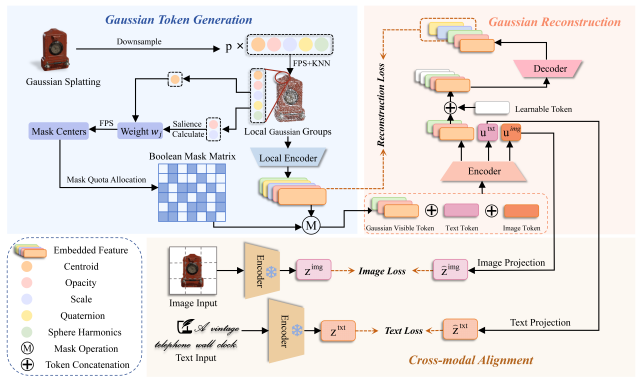
Two learnable alignment tokens (image and text) prepended to a Gaussian Transformer encoder sequence, aligned via Smooth L1 loss to frozen ViT and CLIP outputs; GSHM masking using opacity-scale salience scores, salience-weighted farthest-point sampling for hole centers, and per-hole scale perturbation for multi-scale spatially continuous masks; joint loss combining Gaussian attribute reconstruction (Chamfer Distance for xyz, L1 for other attributes) with image and text alignment losses.
What would settle it
If the alignment tokens learn to predict frozen image/text features through a shortcut that depends only on global object shape (e.g., overall bounding-box proportions visible from a single viewpoint), then removing the alignment tokens at fine-tuning time would yield no improvement over Gaussian-MAE on tasks requiring local geometric discrimination, such as part segmentation on categories with thin structures. A direct test: pre-train with alignment tokens but evaluate part-segmentation IoU per category; if gains concentrate on categories whose parts are distinguishable by global shape alone,
Extended reading notes
Core claim
The central claim is that a 3D Gaussian encoder can absorb category-level and appearance-level semantics from frozen 2D vision-language models during pre-training through two learnable alignment tokens, and that this cross-modal supervision is more effective when the masking strategy produces spatially coherent, salience-weighted holes rather than random scattered masks. The mechanism carrying the argument is the combination of (1) prepended image/text query tokens that collect 3D context via self-attention and are aligned to external frozen features, and (2) GSHM, which uses opacity-and-scale salience scores with farthest-point sampling to build multi-scale contiguous masked regions adapted
Load-bearing premise
The paper assumes that compressing all visible Gaussian tokens into two single alignment tokens (one for image, one for text) preserves enough 3D geometric information for the alignment loss to teach meaningful structural semantics rather than just category-level labels. If the self-attention aggregation into two tokens is too lossy, the cross-modal supervision may only improve coarse classification without genuinely enriching the local 3D representations that downstream part
Editorial extensions
If this is right
- If cross-modal alignment tokens can inject semantic priors into a Gaussian encoder without any inference-time cost, the same prepended-token alignment design could extend to other 3D representations such as point clouds, voxels, or neural radiance fields, turning any frozen vision-language model into a zero-cost teacher for 3D pre-training.
- GSHM's salience-guided masking principle could generalize beyond Gaussians to any representation with non-uniform information density, such as adaptive meshes or sparse voxel octrees, where random masking similarly wastes capacity on low-information regions.
- The finding that ViT image features and CLIP text features are more complementary than using CLIP for both suggests that diversity of teacher feature spaces matters more than alignment of teacher feature spaces for cross-modal 3D supervision.
- The gains being largest on the hardest ScanObjectNN split and in few-shot settings imply that multimodal pre-training primarily helps robustness and data efficiency rather than ceiling performance on clean data, which would narrow the practical scope of the method to resource-constrained or noisy deployment scenarios.
Editorial analysis
A structured set of objections, weighed in public.
Referee Report
Summary. The paper proposes GaussFusion, a multimodal self-supervised pre-training framework for 3D Gaussian Splatting (3DGS) representations. The method extends masked Gaussian modeling (as in Gaussian-MAE) by introducing (1) cross-modal semantic alignment, where learnable image and text query tokens aggregate 3D Gaussian features via self-attention and are aligned to frozen ViT and CLIP text encoder outputs, and (2) Gaussian Salience-guided Multi-scale Hole Masking (GSHM), which constructs spatially continuous masked regions based on opacity and scale salience at multiple scales. Experiments on ScanObjectNN, ModelNet40, ShapeNetPart, and few-shot classification show consistent improvements over Gaussian-MAE, with the largest gain on the PB-T50-RS split (+3.85%). The ablation study (Table 5) isolates the contributions of image supervision, text supervision, and GSHM. The central claim—that integrating image and text supervision with salience-guided masking improves transferability of Gaussian representations—is defensible and supported by the experiments.
Significance. The paper addresses a timely problem: extending 3DGS pre-training beyond pure reconstruction to incorporate semantic supervision from frozen vision-language models. The GSHM masking strategy is a reasonable adaptation for the non-uniform distribution of Gaussian primitives, and the ablation in Table 5 provides useful isolation of each component. The use of learnable query tokens (rather than direct feature injection) for cross-modal alignment is a clean design choice that allows the Gaussian encoder to operate without multimodal inputs at inference time. The experimental gains over Gaussian-MAE are consistent across tasks. However, the comparison is limited to a single direct baseline, and the magnitude of gains on fine-grained tasks (part segmentation: +0.78 mIoU_C) is much smaller than on classification (+3.85% on PB-T50-RS), which raises questions about what is being learned that the paper does not fully address.
major comments (2)
- Section 4.1 states that text descriptions are 'composed of category names and templated attribute phrases.' The downstream tasks (ModelNet40, ScanObjectNN) are category classification tasks. If ShapeSplat's object categories overlap with these downstream categories, the text branch is effectively providing category-level supervision during pre-training that directly benefits classification. The paper does not report category overlap between ShapeSplat and the downstream datasets, nor does it include an ablation with non-category text (e.g., attribute-only descriptions). This is load-bearing for the central claim that cross-modal alignment improves 'transferable semantic structure,' because the gains may partly reflect category-label transfer rather than genuine representation learning. An analysis of category overlap and/or an ablation with attribute-only text would substantially clarify
- The direct comparison is limited to Gaussian-MAE as the sole Gaussian-representation baseline. While the paper acknowledges a performance gap with point cloud methods (Section 4.2.1), the absence of comparison with other cross-modal 3D methods (e.g., ACT, ReCon, ULIP) adapted to the Gaussian setting, or with SceneSplat, makes it difficult to assess whether the gains come from the specific design choices in Section 3.2 or simply from adding any external semantic supervision. At minimum, the paper should discuss why these baselines were not included and whether the gains are expected to hold relative to them.
minor comments (6)
- Section 4.1: The paper does not specify which viewpoints are used for rendering images during pre-training (16 viewpoints are mentioned but not how many are sampled per object per epoch). Clarifying this would aid reproducibility.
- Table 3: The improvement on part segmentation is modest (+0.78 mIoU_C) and GaussFusion underperforms Gaussian-MAE on several categories (bag, car, e-phone, laptop, pistol, table). The paper briefly attributes this to 'simple categories' but does not explain which categories are affected or why.
- References [16]–[21], [26] appear to be by overlapping author groups and several are dated 2025–2026. These should be verified for availability and properly contextualized, especially if they are concurrent work.
- Equation (3): The salience score uses the geometric mean of scale parameters, but it is unclear whether scales are in the original or log space. This should be stated explicitly.
- Figure 2: The caption mentions 'frozen image and text encoders' but the figure itself does not clearly indicate which components are frozen vs. trainable. Adding freeze symbols would improve clarity.
- Section 3.3, Eq. (17): The reconstruction loss is listed as a sum of five terms, then Eq. (18) rewrites it as L_xyz + L_attr. This is slightly redundant; consider merging.
Simulated Author's Rebuttal
We thank the referee for the careful reading and constructive feedback. Both major comments raise legitimate concerns about the strength of the evidence supporting our central claim. Below we address each point.
read point-by-point responses
-
Referee: Category overlap between ShapeSplat and downstream datasets may mean the text branch provides category-level supervision that inflates classification gains. Requests category overlap analysis and/or ablation with attribute-only text.
Authors: The referee raises a valid and important concern. We acknowledge that ShapeSplat's object categories (drawn from ShapeNetCore and other sources) do overlap with categories in ModelNet40, ScanObjectNN, and ShapeNetPart — for example, chairs, tables, airplanes, and lamps appear in both pre-training and downstream data. Because our text descriptions include category names, the text alignment branch does provide some degree of category-level semantic supervision during pre-training, and it is possible that part of the classification gains reflects category-label transfer rather than purely generalizable representation learning. We agree that the current manuscript does not adequately address this confound. To clarify the contribution of the text branch, we will add the following in the revision: (1) A quantitative analysis of category overlap between ShapeSplat and each downstream dataset, reported in the pre-training setup section. (2) An ablation experiment using attribute-only text descriptions (i.e., templated attribute phrases without category names) as the text supervision target, compared against the current category+attribute text. This will directly isolate whether category-name transfer is the primary driver of the text branch's gains. We note that even if some gains are attributable to category-level transfer, the image-only ablation row in Table 5 (85.89% vs. 84.30% baseline) shows that non-category visual supervision also contributes, and the part segmentation gains (+0.78 mIoU_C), while smaller, are consistent with the text branch providing structural rather than purely categorical information. Nevertheless, we agree the attribute-only ablation is necessary to make the central claim precise, and we will include it. revision: yes
-
Referee: Direct comparison limited to Gaussian-MAE; no comparison with other cross-modal 3D methods (ACT, ReCon, ULIP) adapted to the Gaussian setting, or with SceneSplat.
Authors: We agree that the comparison is narrower than ideal and that additional baselines would strengthen the paper. We offer the following clarifications and commit to partial revisions. Regarding SceneSplat: SceneSplat operates at the scene level and uses a different pre-training data regime (scene-level Gaussian splats rather than object-level). A direct comparison on object-level downstream tasks (ScanObjectNN, ModelNet40, ShapeNetPart) would require retraining SceneSplat on object-level ShapeSplat data, which is not its intended setting. We will add a discussion of this distinction and clarify why a direct comparison is not straightforward. Regarding ACT, ReCon, and ULIP: these methods are designed for point cloud inputs and rely on point-cloud-specific architectures (e.g., Point-MAE or Point-BERT backbones) and point-cloud-specific cross-modal alignment objectives. Adapting them to the Gaussian setting would require non-trivial modifications: replacing the point cloud encoder with a Gaussian encoder, redefining the masking and reconstruction targets for Gaussian attributes, and re-engineering the cross-modal alignment to operate over Gaussian tokens rather than point patches. This adaptation is itself a research question rather than a straightforward baseline reproduction. That said, we recognize that the absence of such comparisons limits the reader's ability to assess whether our specific design choices (learnable query tokens, GSHM) are necessary or whether any cross-modal supervision would suffice. To partially address this, we will: (1) Add a discussion in the experiments section explaining why these baselines were not directly included and what modifications would be required. (2) If feasible within the revision period, implement a simplified cross-modal baseline — revision: partial
Circularity Check
No significant circularity: the derivation chain uses external frozen models and standard benchmarks; self-citations are not load-bearing for the central claim.
full rationale
The paper's central claim is that integrating image and text supervision into masked Gaussian modeling via cross-modal semantic alignment, combined with GSHM masking, improves transferability on downstream tasks. The derivation chain is self-contained against external benchmarks: (1) The cross-modal alignment (Eqs. 9-20) uses frozen external encoders (ViT [15], CLIP [14]) as supervision targets, not self-cited models. (2) The GSHM masking strategy (Eqs. 3-8) computes salience directly from Gaussian attributes (opacity, scale) without fitting parameters to downstream targets. (3) Evaluation is on standard external datasets (ScanObjectNN, ModelNet40, ShapeNetPart) against an external baseline (Gaussian-MAE [12]). (4) While the paper cites several self-references ([16]-[21], [23], [26], [34], [35]), none are load-bearing for the central methodological derivation or the uniqueness of the approach. The self-citations appear in related work and reference baselines, not as premises that define the conclusion. The skeptic's concern about category overlap between ShapeSplat and downstream datasets is a validity/generalization concern, not a circularity issue — the text descriptions used during pre-training are not the downstream labels themselves, and the improvement is measured on held-out downstream tasks. No step in the derivation chain reduces to its own inputs by construction.
Assumptions & free parameters
free parameters (6)
- mask_ratio (rho) =
0.6
- salience_mixing_coefficient =
0.7
- multi-scale_jitter_coefficient (gamma) =
0.35
- lambda_img =
1.0
- lambda_text =
1.0
- number_of_hole_centers (H) =
4
assumptions (3)
- domain assumption Gaussian opacity and scale are valid proxies for visual salience and structural importance.
- domain assumption Frozen 2D image and text features provide useful semantic supervision for 3D Gaussian representations.
- domain assumption Learnable query tokens can effectively aggregate 3D contextual information for cross-modal alignment.
Cite this review
Pith. "Pith review of GaussFusion: Towards Multimodal 3D Gaussian Pretraining." pith.science (2026). https://pith.science/paper/GLVG73GJ
@misc{pith2026260705906,
  author       = {Pith},
  title        = {Pith review of: GaussFusion: Towards Multimodal 3D Gaussian Pretraining},
  year         = {2026},
  howpublished = {\url{https://pith.science/paper/GLVG73GJ}},
  note         = {Machine review of arXiv:2607.05906}
}
read the original abstract
3D Gaussian Splatting provides an explicit representation that jointly models geometry and appearance, serving as a scalable foundation for 3D representation learning. Existing pre-training methods for Gaussian representations, such as masked Gaussian reconstruction, primarily capture local structures but offer limited semantic supervision. In this paper, we propose GaussFusion, a multimodal pre-training framework for 3D Gaussian representations. GaussFusion integrates image and text supervision into masked Gaussian modeling through cross-modal semantic alignment, enabling the Gaussian encoder to learn both visual and language-level semantic information during pre-training. To better adapt masked modeling to the non-uniform distribution of Gaussian primitives, we further propose Gaussian Salience-guided Multi-scale Hole Masking (GSHM). GSHM constructs spatially continuous masked regions based on Gaussian salience. By applying hole masks at multiple scales, GSHM encourages the encoder to capture both fine-grained local patterns and broader structural dependencies. Extensive experiments on downstream tasks demonstrate that GaussFusion improves the transferability of Gaussian representations. Notably, GaussFusion outperforms Gaussian-MAE on ModelNet40 and ScanObjectNN (PB-T50-RS) by 0.61\% and 3.85\%, respectively.
Figures


Figures from the paper (3 more)


Forward citations
Cited by 1 Pith paper
-
Parameter-Efficient Fine-Tuning for Spiking Point Cloud Models
SpikePEFT matches or beats full fine-tuning on spiking point-cloud benchmarks while updating only ~5% of parameters via neuron-dynamics and silent-state adapters.
Reference graph
Works this paper leans on
-
[1]
ACM Transactions on Graphics42(4), 1–14 (Aug 2023).https://doi.org/10.1145/3592433
B. Kerbl, G. Kopanas, T. Leimkühler, G. Drettakis, 3d gaussian splatting for real-time radiance field rendering, ACM Transactions on Graphics 42 (4) (2023) 139:1–139:14. doi:10.1145/3592433
-
[2]
C. R. Qi, H. Su, K. Mo, L. J. Guibas, Pointnet: Deep learning on point sets for 3d classification and segmentation, in: Proceedings of the IEEE conference on computer vision and pattern recognition, 2017, pp. 652–660. 25
work page 2017
-
[3]
C. R. Qi, L. Yi, H. Su, L. J. Guibas, Pointnet++: Deep hierarchical feature learning on point sets in a metric space, in: Advances in Neural Information Processing Systems, V ol. 30, 2017
work page 2017
-
[4]
J. L. Schönberger, J.-M. Frahm, Structure-from-motion revisited, in: Proceed- ings of the IEEE Conference on Computer Vision and Pattern Recognition (CVPR), 2016, pp. 4104–4113
work page 2016
-
[5]
B. Mildenhall, P. P. Srinivasan, M. Tancik, J. T. Barron, R. Ramamoorthi, R. Ng, NeRF: Representing scenes as neural radiance fields for view synthesis, in: Eu- ropean Conference on Computer Vision (ECCV), Springer, 2020, pp. 405–421
work page 2020
- [6]
-
[7]
X. Yu, L. Tang, Y . Rao, T. Huang, J. Zhou, J. Lu, Point-bert: Pre-training 3d point cloud transformers with masked point modeling, in: Proceedings of the IEEE/CVF Conference on Computer Vision and Pattern Recognition (CVPR), 2022, pp. 19313–19322
work page 2022
-
[8]
Y . Pang, W. Wang, F. E. H. Tay, W. Liu, Y . Tian, L. Yuan, Masked autoencoders for point cloud self-supervised learning, in: European Conference on Computer Vision (ECCV), Springer, 2022, pp. 604–621
work page 2022
Show all 53 references
-
[9]
Afham, I
M. Afham, I. Dissanayake, D. Dissanayake, A. Dharmasiri, K. Thilakarathna, R. Rodrigo, Crosspoint: Self-supervised cross-modal contrastive learning for 3d point cloud understanding, in: Proceedings of the IEEE/CVF conference on computer vision and pattern recognition, 2022, pp...
2022
-
[10]
R. Dong, Z. Qi, L. Zhang, J. Zhang, J. Sun, Z. Ge, L. Yi, K. Ma, Autoencoders as cross-modal teachers: Can pretrained 2d image transformers help 3d repre- sentation learning?, in: International Conference on Learning Representations (ICLR), 2023. 26
2023
-
[11]
Z. Qi, R. Dong, G. Fan, Z. Ge, X. Zhang, K. Ma, L. Yi, Contrast with reconstruct: Contrastive 3d representation learning guided by generative pretraining, in: Pro- ceedings of the 40th International Conference on Machine Learning, V ol. 202 of Proceedings of Machine Learning R...
2023
-
[12]
Q. Ma, Y . Li, B. Ren, N. Sebe, E. Konukoglu, T. Gevers, L. Van Gool, D. P. Paudel, A large-scale dataset of gaussian splats and their self-supervised pre- training, in: 2025 International Conference on 3D Vision (3DV), IEEE, 2025, pp. 145–155. doi:10.1109/3DV66043.2025.00019
2025 doi
-
[13]
Y . Li, Q. Ma, R. Yang, H. Li, M. Ma, B. Ren, N. Popovic, N. Sebe, E. Konukoglu, T. Gevers, L. Van Gool, M. R. Oswald, D. P. Paudel, Scenesplat: Gaussian splatting-based scene understanding with vision-language pretraining, in: Pro- ceedings of the IEEE/CVF International Confe...
2025
-
[14]
Radford, J
A. Radford, J. W. Kim, C. Hallacy, A. Ramesh, G. Goh, S. Agarwal, G. Sastry, A. Askell, P. Mishkin, J. Clark, G. Krueger, I. Sutskever, Learning transferable visual models from natural language supervision, in: Proceedings of the 38th International Conference on Machine Learni...
2021
-
[15]
Dosovitskiy, L
A. Dosovitskiy, L. Beyer, A. Kolesnikov, D. Weissenborn, X. Zhai, T. Un- terthiner, M. Dehghani, M. Minderer, G. Heigold, S. Gelly, J. Uszkoreit, N. Houlsby, An image is worth 16x16 words: Transformers for image recogni- tion at scale, in: International Conference on Learning ...
2021
-
[16]
Y . Wang, Y . Sun, Q. Wang, P. Li, C. Lu, D. Zhang, Pointrft: Explicit reinforce- ment fine-tuning for point cloud few-shot learning, in: IEEE International Con- ference on Multimedia and Expo (ICME2026), 2026
2026
-
[17]
Zhang, Y
D. Zhang, Y . Wang, Y . Sun, H. Xu, P. Fan, J. Zhu, Cmhanet: A cross-modal hybrid attention network for point cloud registration, Neurocomputing (2026). 27
2026
-
[18]
X. Han, Y . Sun, C. Lu, Rethinking regressor in 3d gaussian pretraining, in: Pat- tern Recognit. Comput. Vis., 2026, pp. 177–190
2026
-
[19]
Y . Sun, J. Zhu, H. Cheng, C. Lu, Z. Yang, L. Chen, Y . Wang, Align then adapt: Rethinking parameter-efficient transfer learning in 4d perception, IEEE Trans. Multimedia (2026)
2026
-
[20]
Y . Sun, H. Cheng, C. Lu, Z. Li, M. Wu, H. Lu, J. Zhu, Hyperpoint: Multimodal 3d foundation model in hyperbolic space, Pattern Recognit. 173 (2026) 112800
2026
-
[21]
P. Li, Y . Sun, H. Cheng, Pointdico: Contrastive 3d representation learning guided by diffusion models, arXiv preprint arXiv:2512.08330 (2025)
2025
-
[22]
Zhang, Z
R. Zhang, Z. Guo, P. Gao, R. Fang, B. Zhao, D. Wang, Y . Qiao, H. Li, Point-m2ae: Multi-scale masked autoencoders for hierarchical point cloud pre- training, in: Advances in Neural Information Processing Systems, V ol. 35, 2022, pp. 27061–27074
2022
-
[23]
Cheng, J
H. Cheng, J. Zhu, N. Hu, J. Chen, W. Yan, PTM: Torus masking for 3d rep- resentation learning guided by robust and trusted teachers, IEEE Transactions on Circuits and Systems for Video Technology 34 (12) (2024) 12158–12170. doi:10.1109/TCSVT.2024.3430904
2024 doi
-
[24]
J. Zhou, Y . Song, C. Chiu, Y . Xiong, Y . Luo, S. Song, CPG: Contrastive patch- graph learning for 3d point cloud, Pattern Recognition 169 (2026) 111954. doi:10.1016/j.patcog.2025.111954
2026 doi
-
[25]
Liang, X
D. Liang, X. Zhou, W. Xu, X. Zhu, Z. Zou, X. Ye, X. Tan, X. Bai, Point- mamba: A simple state space model for point cloud analysis, in: Advances in Neural Information Processing Systems, V ol. 37, 2024, pp. 32653–32677. doi:10.52202/079017-1026
2024 doi
- [26]
-
[27]
Guédon, V
A. Guédon, V . Lepetit, SuGaR: Surface-aligned gaussian splatting for efficient 3d mesh reconstruction and high-quality mesh rendering, in: Proceedings of the IEEE/CVF Conference on Computer Vision and Pattern Recognition (CVPR), 2024, pp. 5354–5363
2024
-
[28]
J. C. Lee, D. Rho, X. Sun, J. H. Ko, E. Park, Compact 3d gaussian representation for radiance field, in: Proceedings of the IEEE/CVF Conference on Computer Vision and Pattern Recognition, 2024, pp. 21719–21728
2024
-
[29]
S. Zhou, H. Chang, S. Jiang, Z. Fan, Z. Zhu, D. Xu, P. Chari, S. You, Z. Wang, A. Kadambi, Feature 3dgs: Supercharging 3d gaussian splatting to enable dis- tilled feature fields, in: Proceedings of the IEEE/CVF Conference on Computer Vision and Pattern Recognition, 2024, pp. 2...
2024
-
[30]
M. Qin, W. Li, J. Zhou, H. Wang, H. Pfister, Langsplat: 3d language gaussian splatting, in: Proceedings of the IEEE/CVF Conference on Computer Vision and Pattern Recognition, 2024, pp. 20051–20060
2024
-
[31]
X. Zhu, R. Zhang, B. He, Z. Guo, Z. Zeng, Z. Qin, S. Zhang, P. Gao, Pointclip v2: Prompting clip and gpt for powerful 3d open-world learning, in: Proceedings of the IEEE/CVF International Conference on Computer Vision (ICCV), 2023, pp. 2639–2650
2023
-
[32]
Huang, X
R. Huang, X. Pan, H. Zheng, H. Jiang, Z. Xie, C. Wu, S. Song, G. Huang, Joint representation learning for text and 3d point cloud, Pattern Recognition 147 (2024) 110086. doi:10.1016/j.patcog.2023.110086
2024 doi
-
[33]
Zhang, L
H. Zhang, L. Yu, G. Wang, S. Tian, Z. Yu, W. Li, X. Ning, Cross-modal knowl- edge transfer for 3d point clouds via graph offset prediction, Pattern Recognition 162 (2025) 111351. doi:10.1016/j.patcog.2025.111351
2025 doi
-
[34]
Cheng, X
H. Cheng, X. Han, P. Shi, J. Zhu, Z. Li, Multi-trusted cross-modal informa- tion bottleneck for 3d self-supervised representation learning, Knowledge-Based Systems 283 (2024) 111217. doi:10.1016/j.knosys.2023.111217. 29
2024 doi
-
[35]
N. Hu, H. Cheng, Y . Xie, P. Shi, J. Zhu, Hyperbolic image-and-pointcloud con- trastive learning for 3d classification, in: 2024 IEEE/RSJ International Confer- ence on Intelligent Robots and Systems (IROS), IEEE, 2024, pp. 4973–4979. doi:10.1109/IROS58592.2024.10802543
2024 doi
-
[36]
L. Xue, M. Gao, C. Xing, R. Martín-Martín, J. Wu, C. Xiong, R. Xu, J. C. Niebles, S. Savarese, Ulip: Learning a unified representation of language, im- ages, and point clouds for 3d understanding, in: Proceedings of the IEEE/CVF conference on computer vision and pattern recogn...
2023
-
[37]
Vaswani, N
A. Vaswani, N. Shazeer, N. Parmar, J. Uszkoreit, L. Jones, A. N. Gomez, L. Kaiser, I. Polosukhin, Attention is all you need, in: Advances in Neural Infor- mation Processing Systems, V ol. 30, 2017, pp. 5998–6008
2017
-
[38]
M. A. Uy, Q.-H. Pham, B.-S. Hua, T. Nguyen, S.-K. Yeung, Revisiting point cloud classification: A new benchmark dataset and classification model on real- world data, in: Proceedings of the IEEE/CVF International Conference on Com- puter Vision (ICCV), 2019, pp. 1588–1597
2019
-
[39]
Z. Wu, S. Song, A. Khosla, F. Yu, L. Zhang, X. Tang, J. Xiao, 3d shapenets: A deep representation for volumetric shapes, in: Proceedings of the IEEE Con- ference on Computer Vision and Pattern Recognition (CVPR), 2015, pp. 1912– 1920
2015
-
[40]
L. Yi, V . G. Kim, D. Ceylan, I.-C. Shen, M. Yan, H. Su, C. Lu, Q. Huang, A. Sheffer, L. Guibas, A scalable active framework for region annotation in 3d shape collections, ACM Transactions on Graphics 35 (6) (2016) 210:1–210:12
2016
-
[41]
Y . Xu, T. Fan, M. Xu, L. Zeng, Y . Qiao, Spidercnn: Deep learning on point sets with parameterized convolutional filters, in: Proceedings of the European Conference on Computer Vision (ECCV), 2018, pp. 87–102
2018
-
[42]
Y . Wang, Y . Sun, Z. Liu, S. E. Sarma, M. M. Bronstein, J. M. Solomon, Dynamic graph cnn for learning on point clouds, ACM Transactions on Graphics (tog) 38 (5) (2019) 146:1–146:12. doi:10.1145/3326362. 30
2019 doi
-
[43]
Y . Li, R. Bu, M. Sun, W. Wu, X. Di, B. Chen, Pointcnn: Convolution on x- transformed points, in: Advances in Neural Information Processing Systems, V ol. 31, 2018
2018
-
[44]
X. Han, Y . Tang, Z. Wang, X. Li, Mamba3d: Enhancing local features for 3d point cloud analysis via state space model, in: Proceedings of the 32nd ACM International Conference on Multimedia, 2024, pp. 4995–5004. doi:10.1145/3664647.3681173
2024 doi
-
[45]
Atzmon, H
M. Atzmon, H. Maron, Y . Lipman, Point convolutional neural networks by ex- tension operators, ACM Transactions on Graphics 37 (4) (2018) 71:1–71:12
2018
-
[46]
Komarichev, Z
A. Komarichev, Z. Zhong, J. Hua, A-cnn: Annularly convolutional neural net- works on point clouds, in: Proceedings of the IEEE/CVF Conference on Com- puter Vision and Pattern Recognition (CVPR), 2019, pp. 7421–7430
2019
-
[47]
X. Yan, C. Zheng, Z. Li, S. Wang, S. Cui, Pointasnl: Robust point clouds pro- cessing using nonlocal neural networks with adaptive sampling, in: Proceed- ings of the IEEE/CVF Conference on Computer Vision and Pattern Recognition (CVPR), 2020, pp. 5589–5598
2020
-
[48]
Q. Wu, Q. Zhang, C. Tan, Y . Zhou, C. Sun, Point-to-spike residual learn- ing for energy-efficient 3d point cloud classification, in: Proceedings of the AAAI Conference on Artificial Intelligence, V ol. 38, 2024, pp. 6092–6099. doi:10.1609/aaai.v38i6.28425
2024 doi
-
[49]
Zhang, H
T. Zhang, H. Yuan, L. Qi, J. Zhang, Q. Zhou, S. Ji, S. Yan, X. Li, Point cloud mamba: Point cloud learning via state space model, in: Proceedings of the AAAI Conference on Artificial Intelligence, V ol. 39, 2025, pp. 10121–10130. doi:10.1609/aaai.v39i10.33098
2025 doi
-
[50]
H. Wang, Q. Liu, X. Yue, J. Lasenby, M. J. Kusner, Unsupervised point cloud pre-training via occlusion completion, in: Proceedings of the IEEE/CVF Inter- national Conference on Computer Vision (ICCV), 2021, pp. 9782–9792. 31
2021
-
[51]
H. Bao, L. Dong, S. Piao, F. Wei, BEiT: BERT pre-training of image transform- ers, in: International Conference on Learning Representations (ICLR), 2022
2022
-
[52]
K. He, X. Zhang, S. Ren, J. Sun, Deep residual learning for image recognition, in: Proceedings of the IEEE Conference on Computer Vision and Pattern Recog- nition (CVPR), 2016, pp. 770–778
2016
-
[53]
Z. Liu, Y . Lin, Y . Cao, H. Hu, Y . Wei, Z. Zhang, S. Lin, B. Guo, Swin trans- former: Hierarchical vision transformer using shifted windows, in: Proceedings of the IEEE/CVF International Conference on Computer Vision (ICCV), 2021, pp. 10012–10022. 32
2021
Reviewed July 8, 2026 · model on record in the stance chip above.
Discussion (0). Continue with ORCID to comment.