REVIEW 3 major objections 3 minor 89 references
For any affine diffusion path, an intermediate state plus its velocity already determines the clean endpoint, so generation can stop early and decode instead of integrating to the end.
Reviewed by Pith at T0; open to challenge. T0 means a machine referee read the full paper against a public rubric. the ladder, T0–T4 →
T0 review · deepseek-v4-flash
2026-08-04 04:25 UTC pith:U2AOOUPI
load-bearing objection A sound but overstated formalization of an early-exit trick: the algebra is right, the 'curvature-independence' claim does not survive contact with learned model error. the 3 major comments →
x-Prediction Is All You Need:Training-Free Accelerated Generation via Endpoint Decodability
The pith
A machine-rendered reading of the paper's core claim, the machinery that carries it, and where it could break.
Core claim
For any non-degenerate affine probability path xt = αt x0 + σt ε with nonzero path determinant Δt = α̇t σt − αt σ̇t, the intermediate state and path velocity recover the clean endpoint through the closed-form decoder x0 = (σt ut − σ̇t xt)/Δt. At Bayes optimality under the usual ℓ2 flow-matching objective, this algebraic decoder coincides with the minimum-MSE estimator E[x0 | xt]. Consequently, stopping the ODE at an early time t* and returning the decoded estimate—Truncated Jump Sampling—has error E[||et*||²] + U(t*), where U(t*) is the irreducible endpoint uncertainty, and neither term depends on trajectory curvature. The paper verifies this across six model families, reporting 20–70% NFE r
What carries the argument
The central object is endpoint decodability: a property of affine probability paths that holds exactly when the path determinant Δt = α̇t σt − αt σ̇t is nonzero. The carrying identity is the Cramer's-rule decoder x0 = (σt ut − σ̇t xt)/Δt, which at Bayes optimality equals E[x0 | xt]. The error analysis then splits TJS error into model error plus irreducible uncertainty U(t*) = E[Tr Var(x0 | xt*)], with no curvature term; this decomposition is what turns early exit into a principled inference strategy rather than an ad hoc heuristic.
Load-bearing premise
The practical claims rest on the premise that a real trained model's velocity error stays small enough at the early-exit time that the decoded endpoint remains semantically and aesthetically acceptable; the theory bounds this model error only abstractly, and the paper itself flags slow U(t) decay for complex data as a primary limitation.
What would settle it
Measure the squared error of the endpoint decoder against true held-out samples for a pretrained flow-matching model at every early-exit time t*, and compare it with the error of the full ODE; if the decoded error at the recommended t* is not close to the full-ODE error, the practical claim fails. A more targeted check is to run TJS at a fixed early-exit fraction on a model with a curved noise schedule and confirm that FID or human preference does not degrade more than the theory's curvature-independent bound allows.
If this is right
- Any pretrained diffusion or flow-matching checkpoint with a standard affine schedule encodes an endpoint predictor, so TJS works without retraining, distillation, or architecture changes.
- TJS reduces NFE by 20–70% with near-matched quality across six model families, including on an already-distilled model where it adds further savings.
- All four standard prediction parameterizations—x0, velocity, noise, and score—are equivalent at optimality, so existing checkpoints can be used directly with the appropriate decoder.
- Because TJS error is curvature-independent, straightening the trajectory is sufficient but not necessary for accurate endpoint prediction, directly challenging the premise of trajectory-straightening acceleration methods.
- Quality improves strictly monotonically with integration depth, and the stopping point can be reasoned about through the decay of U(t), which is tied to the information gain rate with respect to signal-to-noise ratio.
Where Pith is reading between the lines
- If endpoint decodability holds as broadly as claimed, it provides a universal no-training acceleration layer that can be layered on top of any future affine-path generative model without touching weights.
- The curvature-independence result suggests that trajectory straightening and endpoint decoding address different bottlenecks; distillation compresses the informative trajectory while TJS trims the redundant tail, so the two savings could multiply rather than compete.
- The information-theoretic characterization of U(t) points toward an adaptive stopping rule: estimate the remaining endpoint uncertainty per sample or per prompt and exit when the marginal gain drops below a threshold, rather than using a fixed exit fraction.
- The non-affine counterexample suggests that nonlinear paths, while not globally endpoint-decodable, may still admit local endpoint decoding via iterative inversion—a testable extension for interpolants beyond the affine family.
Editorial analysis
A structured set of objections, weighed in public.
Referee Report
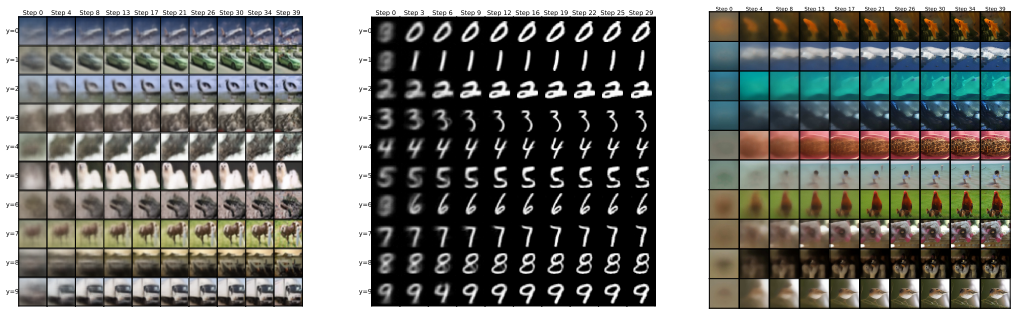
Summary. The paper proposes Truncated Jump Sampling (TJS), an inference-only acceleration scheme for diffusion and flow-matching models. For affine probability paths x_t = α_t x_0 + σ_t ε, the paper observes that (x_t, u_t) uniquely determines x_0 whenever the path determinant Δ_t = α̇_t σ_t − α_t σ̇_t is nonzero, with the closed-form decoder x_0 = (σ_t u_t − σ̇_t x_t)/Δ_t (Theorem 5). Under the standard ℓ2 flow-matching objective, plugging the Bayes-optimal velocity into this decoder yields the MMSE estimator E[x_0 | x_t] (Theorem 6). TJS stops the ODE at an early time t* and returns this decoded estimate, avoiding the final integration segment. The paper derives an error decomposition MSE = E||e_t*||² + U(t*) (Theorem 9), claims that TJS error is curvature-independent, and presents experiments across SDXL, SD3.5M, Z-Image-Turbo, ImageNet-256, CIFAR-10, and MNIST reporting 20–70% NFE reductions with near-matched quality, along with ablations over samplers, schedules, step counts, and CFG scales.
Significance. The core algebraic observation is elegant and broadly applicable: every affine-path generative model implicitly contains an endpoint predictor, and TJS is a simple, training-free way to exploit it. The MMSE-optimality argument and the I-MMSE connection are clean, and the experimental breadth — six model families, multiple solvers, schedules, and CFG scales — is a genuine strength. If the practical claims survive scrutiny, TJS would be a valuable complement to distillation and solver-based acceleration. However, the advertised 'curvature-independent error' and 'straightness is not necessary' claims are established only for the U(t*) term of the decomposition, not for the model-error term E||e_t*||², which is the load-bearing gap for learned models. This overclaim is acknowledged in the supplementary material itself and needs to be addressed before the central challenge to Rectified Flow/Consistency Models can be sustained.
major comments (3)
- The decomposition MSE_TJS = E||e_t*||² + U(t*) is correct, but the main text's conclusion that 'neither error term depends on trajectory curvature' does not follow. U(t*) is a functional of the forward schedule and data distribution, but E||e_t*||² is the gap between the learned and Bayes-optimal velocity for a finite-capacity network; that gap generally depends on the complexity of the target regression function, which is controlled by α̇_t, σ̇_t and their higher derivatives. Supplementary §A.4 concedes exactly this ('learning a velocity field on a highly curved path may be harder'), which is in tension with the main-text claim. Proposition 12's construction only controls the algebraic conditioning Δ_t; it does not show that a practically trained model has small e_t on such high-curvature paths. All experiments use standard schedules with modest curvature. Because 'straightness is suffi
- The perturbed schedule σ_t^(ω) = 1 − t + ω^(−1) cos(ω t (1−t)) gives σ_1^(ω) = 1/ω, not the σ_1 = 0 required by Definition 1. The sentence 'boundary conditions are preserved up to O(1/ω)' does not make this an admissible affine probability path for finite ω. The construction should be repaired with an additional boundary-correcting term, or Proposition 12 should be restated for paths with approximate boundary conditions. As written, the construction does not prove the claim for paths satisfying Definition 1, and this proposition is the paper's key evidence for the 'curvature is unnecessary' thesis.
- The comparison is not well defined as stated. With h = 1/N and t* = N h, one gets t* = 1, which is not an early exit; if a different h is intended for the TJS leg, it is not specified. The proof sketch also invokes an Euler error lower bound with prefactor h²/2, but standard global error bounds for Euler are upper bounds; a lower bound requires additional assumptions not stated. The '+2ε' term in the final inequality is unexplained. Since Theorem 11 is advertised as the quantitative criterion for when TJS wins over continued integration, the NFE accounting and the derivation need to be corrected, or the theorem should be removed from the main text.
minor comments (3)
- The setup says 'CIFAR-10/MNIST: 30-step ODE,' but Table 1 lists CIFAR-10 full ODE as 40 steps and the text refers to a 'full 40-step ODE' for CIFAR-10. Please harmonize the step counts and the labels in Table 1 (e.g., the 'TJS-0.833/25/33' row mixes different γ values across datasets).
- The claim that U(t) is monotonically non-increasing by the data processing inequality requires the family {x_t} to be totally ordered by degradation, i.e., SNR(t) = α_t/σ_t to be non-decreasing. This is true for all standard schedules used in the experiments, but it is not true for an arbitrary C¹ affine path satisfying only Δ_t ≠ 0. Please state the monotone-SNR condition explicitly.
- There are several unresolved cross-references and broken section markers ('see §' in the Introduction and the 'Relationship to DDIM' section), and the text uses nonstandard placeholder-like glyphs in some figure captions. These should be cleaned up before publication.
Circularity Check
No significant circularity: the core derivation is a self-contained algebraic identity and no fitted parameter is relabeled as a prediction.
full rationale
The central derivation chain is not circular. Theorem 5 is Cramer's rule applied to the defining linear system (xt,ut) = M_t (x0,ε); it assumes only the paper's own Definition 1, and the decoder formula is an algebraic consequence. Theorem 6 follows by linearity of conditional expectation and the standard ℓ2 optimality of conditional means; no assumption equivalent to the conclusion is imported. Theorem 9 is an orthogonal decomposition (E||et*||² + U(t*)) with U defined as the MMSE; its content is definitional but it is not used to fit any parameter. The experiments compare early-exit quality against the full ODE without tuning constants of the theory; the monotonic improvement claimed is a direct consequence of U(t) being non-increasing and is confirmed, not used to infer the theory. The paper contains no self-citations that carry a uniqueness or ansatz argument; prior work (DDIM, ODE-Jump) is cited contextually and explicitly distinguished. The principal weakness is not circularity: §A.4 of the supplement concedes 'learning a velocity field on a highly curved path may be harder,' which undercuts the main text's stronger claim that TJS error is curvature-independent for learned models; that is a correctness/evidence gap, not a reduction of the prediction to its inputs. The TJS–Euler comparison (Theorem 11) uses an assumed bound on E||et||² and standard Euler error analysis; the bound is an assumption, not a fitted value. Therefore the paper's derivation does not reduce to its own assumptions.
Axiom & Free-Parameter Ledger
free parameters (3)
- early-exit fraction gamma (or k*) =
per-model values: 0.6-0.83 for class-conditional, k*=18-24 for SDXL/SD3.5M, k*=2-4 for Z-Image-Turbo
- metric-specific quality retention thresholds (90/95/99%) =
90%, 95%, 99%
- epsilon bound on model error E[||et||^2] <= eps (Theorem 11) =
not quantified
axioms (5)
- domain assumption The learned velocity field v_theta approximates the Bayes-optimal velocity E[ut|xt] well enough at early t* that E[||et*||^2] is small.
- domain assumption The MMSE endpoint estimate E[x0|xt] is a sufficient proxy for user-perceived image quality on the metrics used (FID, PickScore, ImageReward, etc.).
- domain assumption Text-to-image CFG-modified velocity can be substituted into the affine-path decoder without invalidating the identity x0 = (sigma_t v - sigma_dot_t x)/Delta_t.
- standard math The ODE solver, scheduler, and model families used (SDXL, SD3.5M, Z-Image-Turbo, DiT, U-Net) all operate on affine probability paths with Delta_t != 0.
- standard math The data-processing inequality monotonicity of U(t) applies for general p_data.
invented entities (2)
-
endpoint decodability
no independent evidence
-
irreducible endpoint uncertainty U(t)
no independent evidence
read the original abstract
Diffusion and flow matching models generate high-quality samples, but their ODE samplers often need tens to hundreds of neural function evaluations (NFEs). This remains a practical challenge for released checkpoints, since many accelerators require additional design choices and training cost through retraining, distillation, or trajectory redesign. We investigate a different route based on $x$-prediction. During sampling, standard affine probability paths already expose $x_0$ information: an intermediate state and its path velocity determine a principled estimate of the clean sample. We formalize this property as \textbf{endpoint decodability} and show that the decoder is the minimum-MSE estimator $\mathbb{E}[x_0\mid x_t]$ under the usual $\ell_2$ objective. This yields \textbf{Truncated Jump Sampling} (TJS): stop the ODE at an early-exit time $t^*$ and return the decoded $x_0$. TJS requires no retraining, distillation, or architecture change. Across SDXL, SD3.5M, Z-Image-Turbo, and three class-conditional benchmarks, it reduces NFEs by 20--70\% with near-matched quality. The analysis also shows why endpoint prediction can work without straightening the trajectory, providing inference acceleration without trajectory redesign.
Figures



Reference graph
Works this paper leans on
-
[1]
Flow Matching for Generative Modeling , author=
-
[2]
Building Normalizing Flows with Stochastic Interpolants , author=
-
[3]
Flow Straight and Fast: Learning to Generate and Transfer Data with Rectified Flow , author=
-
[4]
Generative modeling by estimating gradients of the data distribution , author=
-
[5]
Score-Based Generative Modeling through Stochastic Differential Equations , author=
-
[6]
Denoising diffusion probabilistic models , author=
-
[7]
U-Net: Convolutional Networks for Biomedical Image Segmentation
Ronneberger, Olaf and Fischer, Philipp and Brox, Thomas. U-Net: Convolutional Networks for Biomedical Image Segmentation. Medical Image Computing and Computer-Assisted Intervention -- MICCAI 2015. 2015
2015
-
[8]
Denoising Diffusion Implicit Models , author=
-
[9]
2021 , organization=
Improved denoising diffusion probabilistic models , author=. 2021 , organization=
2021
-
[10]
arXiv preprint arXiv:2207.12598 , year=
Classifier-Free Diffusion Guidance , author=. arXiv preprint arXiv:2207.12598 , year=
-
[11]
Diffusion models beat gans on image synthesis , author=
-
[12]
Progressive Distillation for Fast Sampling of Diffusion Models , author=
-
[13]
Masked Generative Distillation , author=
-
[14]
Consistency Models , author=
-
[15]
2023 , eprint=
Latent Consistency Models: Synthesizing High-Resolution Images with Few-Step Inference , author=. 2023 , eprint=
2023
-
[16]
Zero-shot text-to-image generation , author=
-
[17]
arXiv preprint arXiv:2204.06125 , year=
Hierarchical text-conditional image generation with clip latents , author=. arXiv preprint arXiv:2204.06125 , year=
-
[18]
2022 , organization=
GLIDE: Towards Photorealistic Image Generation and Editing with Text-Guided Diffusion Models , author=. 2022 , organization=
2022
-
[19]
Photorealistic text-to-image diffusion models with deep language understanding , author=
-
[20]
Transactions on Machine Learning Research , issn=
Scaling Autoregressive Models for Content-Rich Text-to-Image Generation , author=. Transactions on Machine Learning Research , issn=. 2022 , url=
2022
-
[21]
High-resolution image synthesis with latent diffusion models , author=
-
[22]
arXiv preprint arXiv:2307.01952 , year=
Sdxl: Improving latent diffusion models for high-resolution image synthesis , author=. arXiv preprint arXiv:2307.01952 , year=
-
[23]
Scalable diffusion models with transformers , author=
-
[24]
Scaling rectified flow transformers for high-resolution image synthesis , author=
-
[25]
2026 , url=
Improving Classifier-Free Guidance in Masked Diffusion: Low-Dim Theoretical Insights with High-Dim Impact , author=. 2026 , url=
2026
-
[26]
Black-Forest-Labs. FLUX.1. 2024
2024
-
[27]
arXiv preprint arXiv:2405.12230 , year=
Qwen-Image Technical Report , author=. arXiv preprint arXiv:2405.12230 , year=
-
[28]
arXiv preprint arXiv:2502.17332 , year=
Wan: Open and Advanced Large-Scale Video Generative Models , author=. arXiv preprint arXiv:2502.17332 , year=
-
[29]
PriorGrad: Improving Conditional Denoising Diffusion Models with Data-Dependent Adaptive Prior , author=
-
[30]
2021 , url=
Diffusion Schr\"odinger Bridge with Applications to Score-Based Generative Modeling , author=. 2021 , url=
2021
-
[31]
2025 , eprint=
CFG-Zero*: Improved Classifier-Free Guidance for Flow Matching Models , author=. 2025 , eprint=
2025
-
[32]
2024 , eprint=
CFG++: Manifold-constrained Classifier Free Guidance for Diffusion Models , author=. 2024 , eprint=
2024
-
[33]
Rectified
Shreshth Saini and Shashank Gupta and Alan Bovik , booktitle=NeurIPS, year=. Rectified
-
[34]
2026 , eprint=
CFG-Ctrl: Control-Based Classifier-Free Diffusion Guidance , author=. 2026 , eprint=
2026
-
[35]
2026 , eprint=
C ^2 FG: Control Classifier-Free Guidance via Score Discrepancy Analysis , author=. 2026 , eprint=
2026
-
[36]
2025 , eprint=
Warm Starts Accelerate Conditional Diffusion , author=. 2025 , eprint=
2025
-
[37]
Flowing from Words to Pixels: A Noise-Free Framework for Cross-Modality Evolution , author=
-
[38]
Chen Chen and Pengsheng Guo and Liangchen Song and Jiasen Lu and Rui Qian and Tsu-Jui Fu and Xinze Wang and Wei Liu and Yinfei Yang and Alex Schwing , booktitle=NeurIPS, year=
-
[39]
Neural ordinary differential equations , author=
-
[40]
What uncertainties do we need in bayesian deep learning for computer vision? , author=
-
[41]
and Bottou, L
Lecun, Y. and Bottou, L. and Bengio, Y. and Haffner, P. , journal=. Gradient-based learning applied to document recognition , year=
-
[42]
Learning multiple layers of features from tiny images , year =
Krizhevsky, Alex and Hinton, Geoffrey , address =. Learning multiple layers of features from tiny images , year =
-
[43]
ImageNet: A large-scale hierarchical image database , year=
Deng, Jia and Dong, Wei and Socher, Richard and Li, Li-Jia and Kai Li and Li Fei-Fei , booktitle=. ImageNet: A large-scale hierarchical image database , year=
-
[44]
2017 , isbn =
Heusel, Martin and Ramsauer, Hubert and Unterthiner, Thomas and Nessler, Bernhard and Hochreiter, Sepp , title =. 2017 , isbn =
2017
-
[45]
2016 , isbn =
Salimans, Tim and Goodfellow, Ian and Zaremba, Wojciech and Cheung, Vicki and Radford, Alec and Chen, Xi , title =. 2016 , isbn =
2016
-
[46]
2025 , eprint=
SD3.5-Flash: Distribution-Guided Distillation of Generative Flows , author=. 2025 , eprint=
2025
-
[47]
2016 , volume=
Szegedy, Christian and Vanhoucke, Vincent and Ioffe, Sergey and Shlens, Jon and Wojna, Zbigniew , booktitle=CVPR, title=. 2016 , volume=
2016
-
[48]
arXiv , primaryClass=
Flow Matching in Latent Space , author=. arXiv , primaryClass=. 2023 , eprint=
2023
-
[49]
2020 , eprint=
An Ensemble of Simple Convolutional Neural Network Models for MNIST Digit Recognition , author=. 2020 , eprint=
2020
-
[50]
Deep Residual Learning for Image Recognition , author=
-
[51]
generation: Taming optimization dilemma in latent diffusion models , author=
Reconstruction vs. generation: Taming optimization dilemma in latent diffusion models , author=
-
[52]
2026 IEEE International Conference on Robotics and Automation (ICRA) , year=
Dense-Jump Flow Matching with Non-Uniform Time Scheduling for Robotic Policies: Mitigating Multi-Step Inference Degradation , author=. 2026 IEEE International Conference on Robotics and Automation (ICRA) , year=
2026
-
[53]
Elucidating the Design Space of Diffusion-Based Generative Models , author=
-
[54]
InstaFlow: One Step is Enough for High-Quality Diffusion-Based Text-to-Image Generation , author=
-
[55]
ICML 2023 Workshop on Structured Probabilistic Inference and Generative Modeling , year=
BOOT: Data-free Distillation of Denoising Diffusion Models with Bootstrapping , author=. ICML 2023 Workshop on Structured Probabilistic Inference and Generative Modeling , year=
2023
-
[56]
Pick-a-Pic: An Open Dataset of User Preferences for Text-to-Image Generation , author=
-
[57]
arXiv preprint arXiv:2306.09341 , year=
Human Preference Score v2: A Solid Benchmark for Evaluating Human Preferences of Text-to-Image Synthesis , author=. arXiv preprint arXiv:2306.09341 , year=
-
[58]
ImageReward: Learning and Evaluating Human Preferences for Text-to-Image Generation , author=
-
[59]
Journal of the American Statistical Association , volume =
Bradley Efron , title =. Journal of the American Statistical Association , volume =. 2011 , publisher =
2011
-
[60]
IEEE Transactions on Information Theory , volume=
Mutual information and minimum mean-square error in Gaussian channels , author=. IEEE Transactions on Information Theory , volume=. 2005 , publisher=
2005
-
[61]
Learning Transferable Visual Models From Natural Language Supervision , author=
-
[62]
DPM-Solver: A Fast ODE Solver for Diffusion Probabilistic Model Sampling in Around 10 Steps , author=
-
[63]
Machine Intelligence Research , year=
DPM-Solver++: Fast Solver for Guided Sampling of Diffusion Probabilistic Models , author=. Machine Intelligence Research , year=
-
[64]
SDEdit: Guided Image Synthesis and Editing with Stochastic Differential Equations , author=
-
[65]
Variational Diffusion Models , author=
-
[66]
Analytic-DPM: an Analytic Estimate of the Optimal Reverse Variance in Diffusion Probabilistic Models , author=
-
[67]
Fast Sampling of Diffusion Models via Operator Learning , author =
-
[68]
Pseudo Numerical Methods for Diffusion Models on Manifolds , author=
-
[69]
arXiv preprint arXiv:2402.19159 , year=
Trajectory Consistency Distillation: Improved Latent Consistency Distillation by Semi-Linear Consistency Function with Trajectory Mapping , author=. arXiv preprint arXiv:2402.19159 , year=
-
[70]
Flow Matching for Conditional Generation with Optimal Transport , author=
-
[71]
Improved Techniques for Training GANs , author=
-
[72]
Flow Matching on Manifolds , author=
-
[73]
2024 , eprint=
Improving and generalizing flow-based generative models with minibatch optimal transport , author=. 2024 , eprint=
2024
-
[74]
PFDiff: Training-Free Acceleration of Diffusion Models Combining Past and Future Scores , author=
-
[75]
TADA: Improved Diffusion Sampling with Training-Free Augmented Dynamics , author=
-
[76]
arXiv preprint arXiv:2505.24210 , year=
STORK: Faster Diffusion and Flow Matching Sampling by Resolving Both Stiffness and Structure-Dependence , author=. arXiv preprint arXiv:2505.24210 , year=
-
[77]
SADA: Stability-Guided Adaptive Diffusion Acceleration , author=
-
[78]
arXiv preprint arXiv:2502.11420 , year=
TreeG: Tree Search-Based Path Steering Guidance for Diffusion and Flow Matching , author=. arXiv preprint arXiv:2502.11420 , year=
-
[79]
A Simple Early Exiting Framework for Accelerated Sampling in Diffusion Models , author=
-
[80]
DuoDiff: Accelerating Diffusion Models with a Dual-Backbone Approach , author=
discussion (0)
Sign in with ORCID, Apple, or X to comment. Anyone can read and Pith papers without signing in.