REVIEW 3 major objections 5 minor 81 references
Hybrid Dynamical Simulation Reveals Apparent Stiffening of Flexible Protein Lattices Driving Membrane Bending
T0 review · 3 major / 5 minor · reviewed 2026-08-02 · deepseek-v4-flash
Pith's one-line read Protein coat's apparent stiffness grows with lattice size and connectivity, not just its microscopic bond springs.
desk verdict Solid, honest methods paper: the size/connectivity-dependent stiffening is real physics, but the closed-cap magnitude is not yet separated from the small-gradient membrane bias. read the letter →
The pith
A machine-rendered reading of the paper's core claim, the machinery that carries it, and where it could break.
The reading
What carries the argument
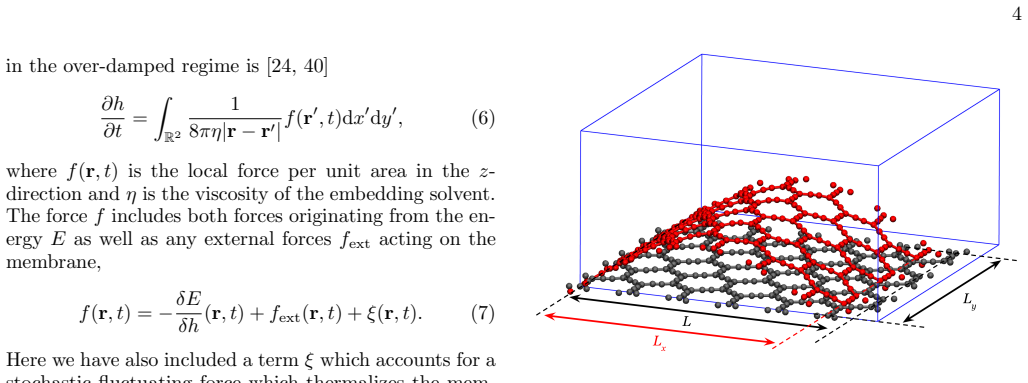
The load-bearing mechanism is the contrast between two measurement protocols for the same microscopic lattice. The buckling protocol compresses a flat sheet and fits force versus strain to a power series whose prefactor is the flexural rigidity κ_l,flex. The spherical-cap protocol adheres a partial coat to a membrane, measures its equilibrium curvature as membrane rigidity is varied, and fits κ_l,eff through the equilibrium-curvature relation Keq = κl/(κm + κl) K0. The hybrid dynamics themselves couple a particle-based lattice with harmonic bond-length, angle, and torsion springs to a Fourier-space continuum membrane updated in the small-gradient approximation of the bending energy; protein-
What would settle it
Simulate the same 18-mer cap adhered to a fully nonlinear membrane (for example, using a finite-element or discrete-geometry membrane solver) and re-extract κ_l,eff from the equilibrium curvature. If the order-of-magnitude gap over buckling κ_l,flex disappears, the reported size-dependent stiffening is an artifact of the small-gradient approximation.
Extended reading notes
Core claim
The central claim is that the flexural rigidity κ_l,flex, measured by buckling a flat lattice, is set solely by the microscopic harmonic force constants, while the effective rigidity κ_l,eff that controls spherical bud formation depends also on lattice size and connectivity. For a weakly connected 12-mer open cap the two measures nearly agree; for an 18-mer closed cap built from the same bond springs, κ_l,eff exceeds κ_l,flex by more than an order of magnitude at every stiffness tested. The explanation is that spherical deformation of a solid-like bond network excites stretching and shear alongside bending, so a pure bending energy with a single modulus cannot capture the response—the effect
Load-bearing premise
The membrane is propagated in the small-gradient (nearly flat) approximation of the bending energy; all extracted rigidities and comparisons inherit a systematic bias if the height gradients near a cap's edge leave that linearized regime, a limitation the paper explicitly acknowledges.
Editorial extensions
If this is right
- Continuum treatments of clathrin coats must treat the effective bending modulus as a growing function of lattice size and connectivity, not a single constant.
- Buckling measurements and bud-formation measurements probe different elastic responses; the difference is not a calibration error but reflects shear and stretching contributions active in spherical deformation.
- For a closed 18-mer cap assembled from identical springs, the effective rigidity exceeds the flexural rigidity by more than an order of magnitude, so using a buckling-derived modulus in a continuum budding model would underestimate the coat's resistance to bending.
- The validated hybrid framework allows systematic mapping from microscopic force constants to emergent mesoscale mechanics for arbitrary pre-assembled lattices.
- Membrane tension suppresses coat curvature in accord with the analytic prediction, supporting the use of the effective-rigidity description in the tested regime.
Reading between the lines
- If the central claim holds, the flat-to-curved transition during clathrin coat growth needs no stiffening of the microscopic bonds—the apparent stiffening could emerge purely from increasing lattice connectivity and size.
- A testable extension: fix lattice size and vary only internal connectivity (for example, delete a few bonds), and κ_l,eff should move from near κ_l,flex toward the closed-cap value; if it does not, the effect is driven by size rather than topology.
- If the effect survives fully nonlinear membrane treatments, continuum models of budding may need an assembly-dependent stiffness schedule, and experimental rigidity measurements on different-sized coats should be compared only at matched geometry.
- The same hybrid protocol could be applied to assemblies with defects or partial rings, which are expected to behave more like weakly connected caps and therefore appear softer.
Signed reviews
Editorial analysis
A structured set of objections, weighed in public.
Referee Report
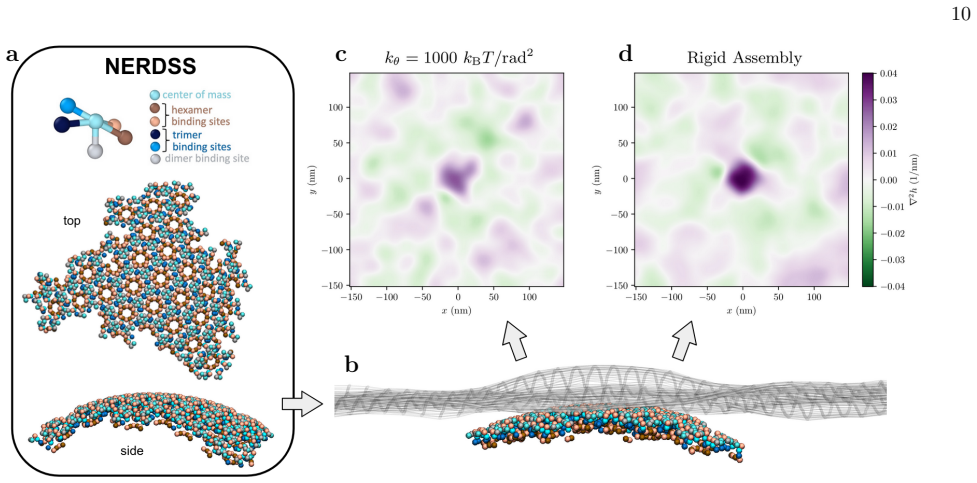
Summary. The manuscript presents a hybrid mesoscale framework that couples a Fourier-space Brownian dynamics (FSBD) continuum membrane model to flexible, particle-based coarse-grained protein lattices propagated with HOOMD-blue. The authors measure a flexural rigidity κ_l,flex from buckling simulations of flat clathrin sheets (Eq. 12) and an effective rigidity κ_l,eff by fitting the curvature of open and closed spherical clathrin caps adhered to membranes to Eq. (14). They validate the coupled membrane–lattice response against an analytic tension prediction (Eq. 16) and demonstrate the pipeline on a NERDSS-assembled HIV Gag lattice. The central claim is that κ_l,eff is geometry- and connectivity-dependent and can exceed κ_l,flex by more than an order of magnitude for a closed 18-mer cap, even though the microscopic bond springs are identical.
Significance. If the central claim holds, the paper provides a valuable, reusable simulation tool and a concrete caution against interpreting a single Helfrich-like bending modulus for protein lattices at different assembly stages. The free-angle buckling derivation in the SI is elegant, the code and data are publicly available, and the tension-dependent curvature prediction (Eq. 16) is an out-of-sample test that strengthens confidence in the coupled dynamics. The open-cap/closed-cap comparison is a clean demonstration that lattice connectivity can renormalize the apparent bending stiffness. However, the quantitative magnitude of the reported effect is currently tied to the small-gradient membrane approximation, and the 'size-dependent' wording rests on only two cap geometries; the conceptual conclusion is plausible but the headline numbers require further support.
major comments (3)
- [III.B, Eq. (14); Discussion (small-gradient limitation)] The headline quantitative claim—κ_l,eff exceeds κ_l,flex by more than an order of magnitude for the closed cap—is obtained by fitting Eq. (14) to curvatures produced by FSBD, whose energy is the small-gradient Helfrich functional (Eq. 5), valid only for |∇h| ≪ 1. The simulated caps are not clearly in that regime: Fig. 6c–d show height changes of tens of nm over lateral distances comparable to the cap radius, implying rim slopes of order 0.5–1, where the omitted O((∇h)^4) terms are not negligible. Because Eq. (14) is a one-parameter fit, any systematic bias in the simulated curvature propagates directly into κ_l,eff. The Discussion acknowledges this limitation but does not quantify its impact on the ratio. I request a quantitative test—e.g., recomputing κ_l,eff for representative k_θ values with a fully nonlinear membrane solver, or an explicit estimate of the truncation error from the si
- [Abstract; III.B, Fig. 5] The conclusion that the effective rigidity 'increases as the lattice grows' is based on only two caps—a 12-mer open cap and an 18-mer closed cap—which differ simultaneously in size, connectivity, and edge structure. No systematic variation of size at fixed connectivity, or of connectivity at fixed size, is presented. The attribution of the effect specifically to 'lattice size and connectivity' is therefore not uniquely identified by the data. Please provide additional intermediate structures or soften the claim to 'can be substantially larger for more closed or connected caps.'
- [Fig. 5c; III.B] The paper reports κ_l,eff values without confidence intervals or error bars in Fig. 5c. Since the central claim is an order-of-magnitude ratio, the fits should include standard errors, bootstrap estimates, or at least a sensitivity analysis. This is especially important because the curvature measurements at low κ_m appear noisy (Fig. 6a), and the small number of independent realizations is not stated. The absence of uncertainty quantification makes it difficult to assess whether the open-cap/closed-cap separation is statistically robust.
minor comments (5)
- [III.B] Typo: 'has been used used' should be 'has been used.'
- [III.D] The text cites 'Figs. 7c and 7c'; the second citation should be '7d.'
- [SI Sec. 1; Fig. S1] The SI text uses 'free-angle' (FA) for the boundary condition, but Fig. S1 labels it 'free slope' (FS). Please unify the notation.
- [II.D, Eq. (16)] The statement that the tension energy scales 'approximately as' Σa² is a limiting result; the SI expression contains a logarithmic factor and validity conditions. A brief sentence stating the range of validity would prevent overinterpretation of Eq. (16).
- [II.E] The choice k_mem = 1000 kBT/nm² is justified only in the SI. A one-sentence justification in Methods would help readers assess the coupling stiffness without reading the SI.
Circularity Check
No significant circularity: κ_l,flex and κ_l,eff are independently fitted, and the tension validation is an out-of-sample prediction.
full rationale
The paper's central claim—that effective spherical rigidity exceeds flexural rigidity for more connected lattices—rests on two independent calibration protocols. κ_l,flex is extracted from a buckling force-strain fit (Eq. 12) on flat 72-triskelion sheets; κ_l,eff is extracted from the dependence of coat curvature on membrane modulus (Eq. 14) using α=107.5° caps. The two protocols share the microscopic bond parameters but use disjoint deformation modes and independent fits, so the discrepancy is an emergent result, not a construction. The tension test (Eq. 16) uses the zero-tension-fitted κ_l,eff plus the measured coat area to predict curvature at finite Σ; the finite-Σ simulation data are not used in any fit, making it a genuine out-of-sample check. The analytic shape profile (Eq. 17) is likewise compared, not fitted. Self-citations (NERDSS, prior clathrin/Gag CG models) supply input structures and simulation tools; they are not invoked as evidence for the stiffening result. The manuscript's own stated limitation—the small-gradient Monge approximation in Eq. (5)—is a correctness/validity concern about the magnitude of the measured ratio, but it is not a circular reduction of the claim to its inputs. No step in the derivation chain equates a fitted parameter to the predicted quantity by construction.
Assumptions & free parameters
free parameters (7)
- k_θ (bond-angle spring) =
swept 100–5000 k_BT/rad²; 1080–5000 used in cap runs
- k_σ (bond-length spring) =
500 k_BT/nm² in cap runs (100–5000 swept in buckling)
- k_ω (torsion spring) =
500 k_BT/rad² in cap runs (100–5000 swept)
- κ_l,flex =
≈0–200 k_BT across the sweep (Fig. 4)
- κ_l,eff =
9–313 k_BT (open cap, k_θ=100–5000); >10³ k_BT for closed cap (Fig. 5c)
- k_mem (protein–membrane spring) =
1000 k_BT/nm²
- α (pucker angle) =
107.5° for caps; 90° for buckling sheets
assumptions (6)
- domain assumption Small-gradient (Monge) approximation to the Helfrich functional, Eq. (5)
- standard math Over-damped membrane hydrodynamics with the 1/(8πη|r−r′|) Oseen kernel, Eq. (6)
- domain assumption Clathrin lattice describable as a continuum thin sheet with Helfrich-like bending energy, Eq. (11), on the length scales studied
- domain assumption Protein subunits remain bound; the harmonic bonds never break during deformation
- standard math Gaussian curvature term in the Helfrich energy is constant and discarded
- domain assumption NERDSS coarse-grained geometries faithfully represent clathrin and HIV-1 Gag structures
Cite this review
Pith. "Pith review of Hybrid Dynamical Simulation Reveals Apparent Stiffening of Flexible Protein Lattices Driving Membrane Bending." pith.science (2026). https://pith.science/paper/BSLZV4AM
@misc{pith2026260706378,
  author       = {Pith},
  title        = {Pith review of: Hybrid Dynamical Simulation Reveals Apparent Stiffening of Flexible Protein Lattices Driving Membrane Bending},
  year         = {2026},
  howpublished = {\url{https://pith.science/paper/BSLZV4AM}},
  note         = {Machine review of arXiv:2607.06378}
}
read the original abstract
Membrane-deforming protein lattices play a central role in essential and pathogenic remodeling processes, including clathrin-mediated endocytosis and viral budding. Simulating these systems at biologically relevant length and time scales requires mesoscale approaches that preserve structural detail while avoiding the computational cost of atomistic resolution. Here, we present a hybrid simulation framework that couples a particle-based flexible protein lattice to a continuum membrane model, enabling systematic investigation of how lattice geometry and rigidity influence dynamic membrane remodeling. We validate the coupled model by comparing simulation results with theoretical predictions for membranes under increasing tension. Using buckling-based deformations of pre-assembled clathrin lattices, we quantify the lattice flexural rigidity and establish a direct relationship between the force constants in the coarse-grained energy and the emergent mechanical properties of the lattice. We then compare this flexural rigidity to an effective rigidity commonly used in continuum descriptions of sphere-forming protein assemblies. Although the flexural rigidity is set solely by the energy function, the effective rigidity depends on lattice size and connectivity, with the two measures converging only for weakly connected lattices. As a result, the effective rigidity relevant for spherical bud formation increases as the lattice grows. This size-dependent stiffening highlights the importance of structural details in interpreting lattice mechanics and cautions against assuming a single constant stiffness throughout assembly. We demonstrate the generality of the method by applying it to pre-assembled viral lattices generated with NERDSS. This work provides a validated framework for simulating how deformable, stable protein assemblies of diverse geometry couple to membrane dynamics and remodeling.
Figures


Figures from the paper (6 more)



Reference graph
Works this paper leans on
-
[1]
Physical Review E , volume=
Elastic deformation of a fluid membrane upon colloid binding , author=. Physical Review E , volume=. 2004 , publisher=
2004
-
[2]
The Journal of chemical physics , volume=
Determining the bending modulus of a lipid membrane by simulating buckling , author=. The Journal of chemical physics , volume=. 2013 , publisher=
2013
-
[3]
NIST Digital Library of Mathematical Functions
-
[4]
2026 , publisher=
Foley, Samuel L , title=. 2026 , publisher=
2026
-
[5]
2017 , publisher=
Computer simulation of liquids , author=. 2017 , publisher=
2017
-
[6]
Computational Materials Science , volume=
HOOMD-blue: A Python package for high-performance molecular dynamics and hard particle Monte Carlo simulations , author=. Computational Materials Science , volume=. 2020 , publisher=
2020
-
[7]
Physical Review E , volume=
Physical limits to membrane curvature sensing by a single protein , author=. Physical Review E , volume=. 2023 , publisher=
2023
-
[8]
Journal of physics D: Applied physics , volume=
The 2018 biomembrane curvature and remodeling roadmap , author=. Journal of physics D: Applied physics , volume=. 2018 , publisher=
2018
Show all 81 references
-
[9]
Current opinion in structural biology , volume=
Making the cut: Multiscale simulation of membrane remodeling , author=. Current opinion in structural biology , volume=. 2024 , publisher=
2024
-
[10]
Biophysical journal , year=
Subdomains of endophilin can drive membrane remodeling and facilitate controlled membrane scission , author=. Biophysical journal , year=
-
[11]
Journal of molecular biology , volume=
Three-dimensional structure of HIV-1 virus-like particles by electron cryotomography , author=. Journal of molecular biology , volume=. 2005 , publisher=
2005
-
[12]
New journal of physics , volume=
Multiscale approaches to protein-mediated interactions between membranes—relating microscopic and macroscopic dynamics in radially growing adhesions , author=. New journal of physics , volume=. 2015 , publisher=
2015
-
[13]
Experimental mathematics , volume=
The surface evolver , author=. Experimental mathematics , volume=. 1992 , publisher=
1992
-
[14]
Cell , volume=
The first five seconds in the life of a clathrin-coated pit , author=. Cell , volume=. 2012 , publisher=
2012
-
[15]
Journal of molecular biology , volume=
Interactions between HIV-1 Gag molecules in solution: an inositol phosphate-mediated switch , author=. Journal of molecular biology , volume=. 2007 , publisher=
2007
-
[16]
The Journal of Chemical Physics , volume=
The mesoscopic membrane with proteins (MesM-P) model , author=. The Journal of Chemical Physics , volume=. 2017 , publisher=
2017
-
[17]
Macromolecular rapid communications , volume=
Mesoscopic membrane physics: concepts, simulations, and selected applications , author=. Macromolecular rapid communications , volume=. 2009 , publisher=
2009
-
[18]
Chemistry and physics of lipids , volume=
Fluid lipid membranes: From differential geometry to curvature stresses , author=. Chemistry and physics of lipids , volume=. 2015 , publisher=
2015
-
[19]
Journal of the American Chemical Society , volume=
Curvature softening and negative compressibility of gel-phase lipid membranes , author=. Journal of the American Chemical Society , volume=. 2015 , publisher=
2015
-
[20]
arXiv preprint arXiv:1912.08172 , year=
Shapes of fluid membranes with chiral edges , author=. arXiv preprint arXiv:1912.08172 , year=
1912 arXiv
-
[21]
1988 , publisher=
The Theory of Polymer Dynamics , author=. 1988 , publisher=
1988
-
[22]
Journal of Computational Physics , volume=
Finite element modeling of lipid bilayer membranes , author=. Journal of Computational Physics , volume=. 2006 , publisher=
2006
-
[23]
The Journal of Chemical Physics , volume=
Error estimates on averages of correlated data , author=. The Journal of Chemical Physics , volume=
-
[24]
Methods in Enzymology , volume=
Quantifying uncertainty in trans-membrane stresses and moments in simulation , author=. Methods in Enzymology , volume=. 2024 , publisher=
2024
-
[25]
2025 , publisher=
Understanding molecular simulation: from algorithms to applications , author=. 2025 , publisher=
2025
-
[26]
Physical Review E , volume=
Coat stiffening can explain invagination of clathrin-coated membranes , author=. Physical Review E , volume=. 2024 , publisher=
2024
-
[27]
Soft matter , volume=
A continuum membrane model can predict curvature sensing by helix insertion , author=. Soft matter , volume=. 2021 , publisher=
2021
-
[28]
Current opinion in structural biology , volume=
Modeling membrane reshaping driven by dynamic protein assemblies , author=. Current opinion in structural biology , volume=. 2023 , publisher=
2023
-
[29]
Biophysical Journal , year=
Predicting protein curvature sorting across membrane compositions , author=. Biophysical Journal , year=
-
[30]
The Journal of chemical physics , volume=
Early stages of clathrin aggregation at a membrane in coarse-grained simulations , author=. The Journal of chemical physics , volume=. 2017 , publisher=
2017
-
[31]
Journal of Physics: Condensed Matter , volume=
Network models of fluid, hexatic and polymerized membranes , author=. Journal of Physics: Condensed Matter , volume=
-
[32]
PLOS Computational Biology , publisher =
Large self-assembled clathrin lattices spontaneously disassemble without sufficient adaptor proteins , year =. PLOS Computational Biology , publisher =. doi:10.1371/journal.pcbi.1009969 , author =
-
[33]
elife , volume=
Structure of the HIV immature lattice allows for essential lattice remodeling within budded virions , author=. elife , volume=. 2023 , publisher=
2023
-
[34]
Proceedings of the National Academy of Sciences , volume=
Design principles for robust vesiculation in clathrin-mediated endocytosis , author=. Proceedings of the National Academy of Sciences , volume=. 2017 , publisher=
2017
-
[35]
Zeitschrift f
Elastic properties of lipid bilayers: theory and possible experiments , author=. Zeitschrift f. 1973 , publisher=
1973
-
[36]
Biophysical journal , volume=
Measuring the elasticity of clathrin-coated vesicles via atomic force microscopy , author=. Biophysical journal , volume=. 2006 , publisher=
2006
-
[37]
Nature communications , volume=
Physical principles of membrane remodelling during cell mechanoadaptation , author=. Nature communications , volume=. 2015 , publisher=
2015
-
[38]
Journal of Chemical Theory and Computation , volume=
Membrane remodeling due to a mixture of multiple types of curvature proteins , author=. Journal of Chemical Theory and Computation , volume=. 2022 , publisher=
2022
-
[39]
1991 , publisher=
Differential geometry , author=. 1991 , publisher=
1991
-
[40]
2012 , publisher=
Theory of elasticity: volume 7 , author=. 2012 , publisher=
2012
-
[41]
The Journal of Chemical Physics , volume=
Shaping membrane vesicles by adsorption of hinge-like nanoparticles , author=. The Journal of Chemical Physics , volume=. 2024 , publisher=
2024
-
[42]
Physical Review E , volume=
Virus shapes and buckling transitions in spherical shells , author=. Physical Review E , volume=. 2003 , publisher=
2003
-
[43]
bioRxiv , pages=
Membrane Remodeling by the Collective Action of Caveolin-1 , author=. bioRxiv , pages=. 2025 , publisher=
2025
-
[44]
Langmuir , volume=
Integrin clustering in two and three dimensions , author=. Langmuir , volume=. 2012 , publisher=
2012
-
[45]
Physical review letters , volume=
Brownian dynamics in Fourier space: membrane simulations over long length and time scales , author=. Physical review letters , volume=. 2004 , publisher=
2004
-
[46]
Physical Review E—Statistical, Nonlinear, and Soft Matter Physics , volume=
Dynamic simulations of membranes with cytoskeletal interactions , author=. Physical Review E—Statistical, Nonlinear, and Soft Matter Physics , volume=. 2005 , publisher=
2005
-
[47]
PLoS biology , volume=
Cargo and dynamin regulate clathrin-coated pit maturation , author=. PLoS biology , volume=. 2009 , publisher=
2009
-
[48]
The Journal of membrane biology , volume=
Cell surface area regulation and membrane tension , author=. The Journal of membrane biology , volume=. 2001 , publisher=
2001
-
[49]
Nature structural & molecular biology , volume=
Cryo-EM of multiple cage architectures reveals a universal mode of clathrin self-assembly , author=. Nature structural & molecular biology , volume=. 2019 , publisher=
2019
-
[50]
Soft Matter , volume=
A tutorial for mesoscale computer simulations of lipid membranes: tether pulling, tubulation and fluctuations , author=. Soft Matter , volume=. 2025 , publisher=
2025
-
[51]
Computer Physics Communications , volume=
Rigid body constraints realized in massively-parallel molecular dynamics on graphics processing units , author=. Computer Physics Communications , volume=. 2011 , publisher=
2011
-
[52]
Biochemical Society Transactions , volume=
Membrane re-modelling by BAR domain superfamily proteins via molecular and non-molecular factors , author=. Biochemical Society Transactions , volume=. 2018 , publisher=
2018
-
[53]
Physical Review E—Statistical, Nonlinear, and Soft Matter Physics , volume=
Anisotropic surface tension of buckled fluid membranes , author=. Physical Review E—Statistical, Nonlinear, and Soft Matter Physics , volume=. 2011 , publisher=
2011
-
[54]
Traffic , volume=
Energetics of clathrin basket assembly , author=. Traffic , volume=. 2001 , publisher=
2001
-
[55]
Science Advances , volume=
The structures of natively assembled clathrin-coated vesicles , author=. Science Advances , volume=. 2020 , publisher=
2020
-
[56]
Nature Communications , volume=
Mesoscale simulation of biomembranes with FreeDTS , author=. Nature Communications , volume=. 2024 , publisher=
2024
-
[57]
Trends in cell biology , volume=
Principles of membrane remodeling by dynamic ESCRT-III polymers , author=. Trends in cell biology , volume=. 2021 , publisher=
2021
-
[58]
Biophysical Journal , volume=
Temporal control by cofactors prevents kinetic trapping in retroviral Gag lattice assembly , author=. Biophysical Journal , volume=. 2023 , publisher=
2023
-
[59]
Nature , volume=
Aggregation and vesiculation of membrane proteins by curvature-mediated interactions , author=. Nature , volume=. 2007 , publisher=
2007
-
[60]
Nature physics , volume=
Physical virology , author=. Nature physics , volume=. 2010 , publisher=
2010
-
[61]
Biophysical journal , volume=
Simulations show that virus assembly and budding are facilitated by membrane microdomains , author=. Biophysical journal , volume=. 2015 , publisher=
2015
-
[62]
Advances in physics , volume=
Configurations of fluid membranes and vesicles , author=. Advances in physics , volume=. 1997 , publisher=
1997
-
[63]
The journal of chemical physics , volume=
TriMem: A parallelized hybrid Monte Carlo software for efficient simulations of lipid membranes , author=. The journal of chemical physics , volume=. 2022 , publisher=
2022
-
[64]
Developmental cell , volume=
The structure and spontaneous curvature of clathrin lattices at the plasma membrane , author=. Developmental cell , volume=. 2021 , publisher=
2021
-
[65]
arXiv preprint arXiv:2604.13827 , year=
Beads, springs and fields: particle-based vs continuum models in cell biophysics , author=. arXiv preprint arXiv:2604.13827 , year=
-
[66]
Science Advances , volume=
Nanodissected elastically loaded clathrin lattices relax to increased curvature , author=. Science Advances , volume=. 2021 , publisher=
2021
-
[67]
The Journal of cell biology , volume=
Sorting it out: AP-2 and alternate clathrin adaptors in endocytic cargo selection , author=. The Journal of cell biology , volume=. 2003 , publisher=
2003
-
[68]
Nature Physics , volume=
Self-organization of mortal filaments and its role in bacterial division ring formation , author=. Nature Physics , volume=. 2024 , publisher=
2024
-
[69]
Journal of cell science , volume=
Clathrin assemblies at a glance , author=. Journal of cell science , volume=. 2024 , publisher=
2024
-
[70]
Biophysical journal , volume=
NERDSS: a nonequilibrium simulator for multibody self-assembly at the cellular scale , author=. Biophysical journal , volume=. 2020 , publisher=
2020
-
[71]
Biophysical Journal , volume=
Long-wavelength lipid bilayer undulation spectrum by all-atom simulation , author=. Biophysical Journal , volume=. 2026 , publisher=
2026
-
[72]
Proceedings of the national academy of sciences , volume=
Endocytic proteins drive vesicle growth via instability in high membrane tension environment , author=. Proceedings of the national academy of sciences , volume=. 2015 , publisher=
2015
-
[73]
Nature , volume=
Ultrafast endocytosis at mouse hippocampal synapses , author=. Nature , volume=. 2013 , publisher=
2013
-
[74]
Current opinion in cell biology , volume=
Fast and ultrafast endocytosis , author=. Current opinion in cell biology , volume=. 2017 , publisher=
2017
-
[75]
The European Physical Journal Special Topics , volume=
ESPResSo 4.0--an extensible software package for simulating soft matter systems , author=. The European Physical Journal Special Topics , volume=. 2019 , publisher=
2019
-
[76]
Journal of virology , volume=
Organization of immature human immunodeficiency virus type 1 , author=. Journal of virology , volume=. 2001 , publisher=
2001
-
[77]
Developmental cell , volume=
De novo endocytic clathrin coats develop curvature at early stages of their formation , author=. Developmental cell , volume=. 2021 , publisher=
2021
-
[78]
bioRxiv , year=
Membrane bending energy selects for compact growth of protein assemblies , author=. bioRxiv , year=
-
[79]
bioRxiv , pages=
Transforming macromolecular structures into simulations of self-assembly , author=. bioRxiv , pages=. 2026 , publisher=
2026
-
[80]
Physical Review E—Statistical, Nonlinear, and Soft Matter Physics , volume=
One-particle-thick, solvent-free, coarse-grained model for biological and biomimetic fluid membranes , author=. Physical Review E—Statistical, Nonlinear, and Soft Matter Physics , volume=. 2010 , publisher=
2010
-
[81]
Biophysical reports , volume=
Mem3DG: modeling membrane mechanochemical dynamics in 3D using discrete differential geometry , author=. Biophysical reports , volume=. 2022 , publisher=
2022
Reviewed August 2, 2026 · model on record in the stance chip above.
Discussion (0). Continue with ORCID to comment.