REVIEW 2 major objections 5 minor 51 references
A small autoregressive adapter turns factorized draft marginals into proposal trees that raise acceptance length and speed language-model decoding by 4.37×.
Reviewed by Pith at T0; open to challenge. T0 means a machine referee read the full paper against a public rubric. the ladder, T0–T4 →
2026-07-14 15:56 UTC pith:ZAGE5H3V
load-bearing objection Solid hybrid drafting + first practical GDN tree kernel; 4.37× / 24.7% gains look real and well-ablated. the 2 major comments →
Trees from Marginals: Autoregressive drafting with factorized priors
The pith
A machine-rendered reading of the paper's core claim, the machinery that carries it, and where it could break.
Core claim
The acceptance ceiling of factorized drafters is caused by their independence assumption, not by model size; a 56.7 M-parameter autoregressive residual adapter that conditions only on the top-K=512 marginal tokens of a factorized prior restores enough conditional structure that the resulting proposal trees exceed the acceptance rates available to any pure marginal drafter at long depths, delivering a 4.37 imes end-to-end speedup and a 24.7 % gain over an optimized DFlash baseline.
What carries the argument
Weaver: a single-layer residual transformer that receives verifier and factorized-drafter hidden states, predicts residual logits only over the top-K candidate pool, and grows a best-first proposal tree that is verified with a masked triangular solve on gated-delta-net layers so that no recurrent state is ever rolled back.
Load-bearing premise
That the top-512 tokens taken from the factorized marginals almost always contain essentially all of the verifier’s probability mass, so restricting both training and inference to that pool does not discard meaningful acceptance.
What would settle it
Measure the fraction of verifier probability mass that falls outside the top-512 pool on a held-out workload; if that out-of-pool mass routinely exceeds a few percent and acceptance length of Weaver trees falls back to pure-marginal levels, the hybrid claim fails.
If this is right
- Longer speculative budgets become useful again because acceptance no longer collapses with depth.
- Any existing factorized or diffusion-style drafter can be upgraded by the same residual adapter without changing its training recipe.
- Targets that use gated delta networks or other non-diagonal linear attention can now run tree verification without sequential branch scans or state rollbacks.
- Interactivity gains of roughly 4 imes over plain autoregressive decoding become available on single-sequence local deployments where batching is not an option.
- Tree shape can be optimized directly against estimated acceptance probability rather than draft probability alone.
Where Pith is reading between the lines
- Jointly training the factorized prior and Weaver could reshape the candidate pool itself so that residual corrections become even cheaper.
- The same top-K residual idea could be applied to multi-token prediction heads or early-exit layers that currently still pay a full-vocabulary cost.
- Once the verification kernel is already batched, the method naturally extends from interactivity to throughput serving without redesigning the draft model.
- Annealing the factorized prior temperature by draft position may close part of the remaining gap between pure marginals and the hybrid trees.
Editorial analysis
A structured set of objections, weighed in public.
Referee Report
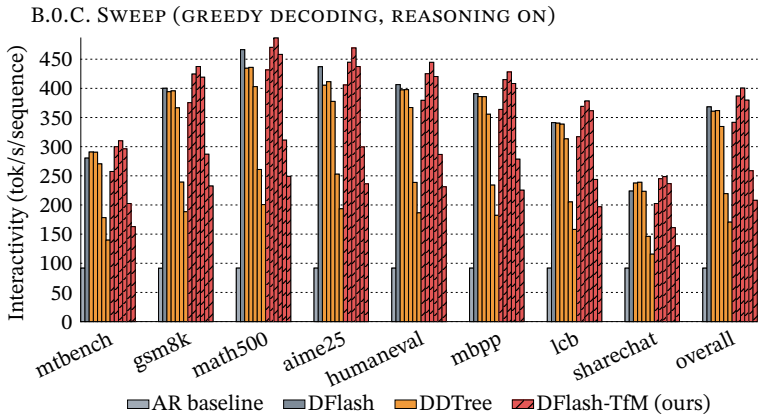
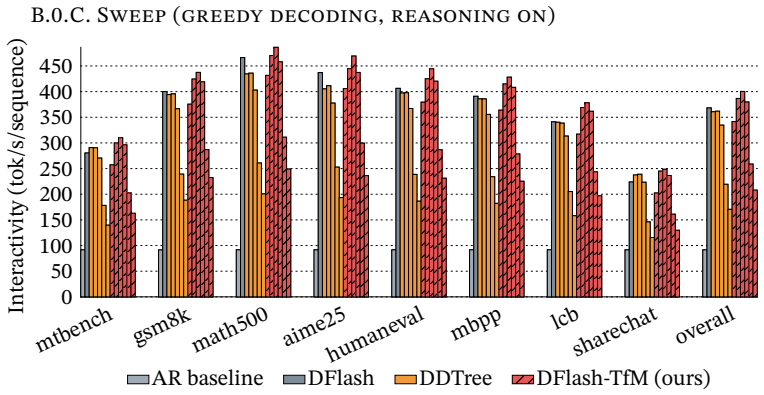
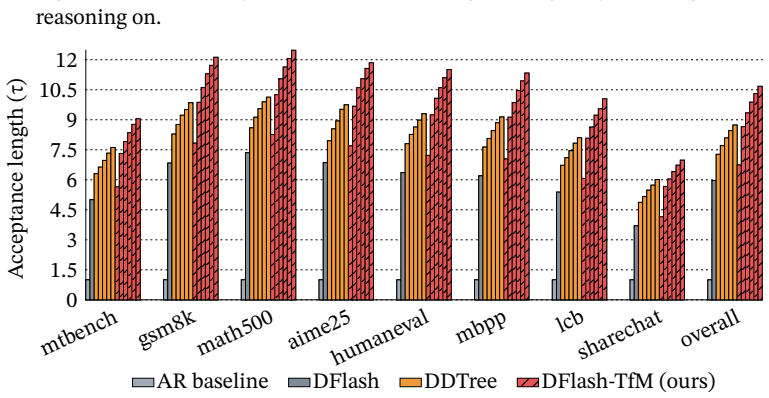
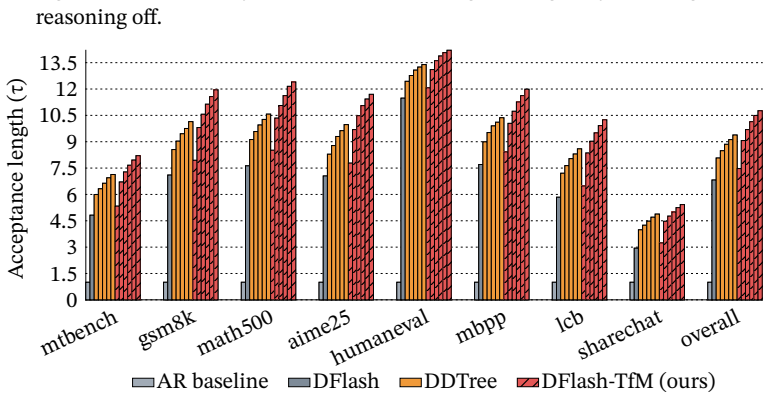
Summary. The paper addresses the acceptance-rate ceiling of factorized (parallel-marginal) draft models in speculative decoding. It introduces DFlash-TfM: a hybrid that takes top-K=512 marginals from a pretrained DFlash drafter and feeds them as a prior to Weaver, a 56.7 M-parameter single-layer autoregressive residual adapter that builds proposal trees over the restricted candidate set, avoiding a full-vocabulary projection. For targets with Gated Delta Net layers the authors derive a rollback-free tree-verification algebra (ancestor-masked chunk form of the delta rule) and a fused CUDA kernel in SGLang. On Qwen3.6-27B (bf16, B200, batch 1) the combination yields a 4.37 imes speedup over autoregressive decoding and a 24.7 % interactivity gain over an optimized DFlash baseline across eight chat/math/code workloads (Table 2, Fig. 1). Supporting evidence includes an empirical upper bound on pure-marginal acceptance (Fig. 4), verification ablations (Table 3, Fig. 6), budget sweeps (Appendix B), and kernel micro-benchmarks (Table 1, Fig. 5).
Significance. If the reported numbers hold under broader replication, the work is a clear advance for interactive and local LLM inference. Factorized drafters currently set records at small budgets but saturate; the hybrid restores conditional dependence at modest cost and demonstrably exceeds the pure-marginal acceptance bound at long depths. The GDN tree-verification kernel closes an open systems gap for non-diagonal linear-attention targets and is of independent interest. Strengths that raise confidence include multi-workload tables, isolation of residual vs. tree vs. kernel contributions, explicit comparison against a theoretical marginal oracle, and open weights/kernels. Free parameters (K, η, γ, w, c) are modest and the top-K mass retention is measured (97.8 %).
major comments (2)
- §4.3 and Table 2: the main speedup comparison selects the best verification scheme per method (naive verification for DFlash, Traversal/speculative sampling for DFlash-TfM). Table 3 and Fig. 6 show that the ranking of schemes is method-dependent, so the 24.7 % headline is not under a single fixed protocol. A uniform-protocol column (or an explicit statement that the reported numbers are “best-of-protocol”) is needed for the central claim to be fully transparent.
- §4.1.3 / footnote: the hybrid’s safety rests on the claim that DFlash’s top-K=512 pool retains 97.8 % of verifier mass on held-out data. The paper already measures this average, but does not report the tail (fraction of positions where mass falls below, e.g., 90 %) nor an ablation that forces a smaller K. A short sensitivity table would confirm that the residual advantage does not collapse when the pool is imperfect.
minor comments (5)
- Abstract and §1.2 claim a 77 % / 32 % MAL increase; these numbers appear only in prose. Adding them as explicit columns or footnotes in Table 2 would make the isolation of residual vs. tree contributions easier to verify.
- §3.4.1, Eqs. (9)–(12): the ancestor-masked chunk form is clear, but a one-line statement that the construction reduces to ordinary chunked GDN on a linear chain would help readers check the special case.
- Fig. 4 caption and §3.5: the “true marginal” estimator uses M random continuations; the value of M and the number of contexts are not stated. Adding them would strengthen the bound’s reproducibility.
- §4.2 notes that the public Qwen3.6-DFlash checkpoint is still under training; a short remark on expected sensitivity of the relative gains once the official checkpoint is frozen would be useful.
- Typos / notation: “DFlashTfM” hyphenation is inconsistent across abstract and body; “argmaxmarginal” line-break artifacts appear in §3.5; Algorithm 1 uses both “cands” and “candsnode”.
Circularity Check
No significant circularity: empirical systems paper whose speedups and acceptance gains are measured against external baselines, not forced by definition or self-citation.
full rationale
The central claims (4.37× over AR, 24.7% over optimized DFlash, higher long-depth acceptance than any pure-marginal oracle) rest on end-to-end wall-clock measurements and ablations (Table 2, Figs. 1/4/6) against public baselines (AR, DFlash, DDTree) on public workloads. Weaver is trained with an LK loss that includes a TV term equal to 1−p_accept; that is ordinary supervised training of a residual adapter, not a tautological redefinition of the reported metrics. The top-K=512 pool restriction is justified by a held-out mass measurement (97.8%), not by construction. The GDN tree-verification algebra (Eqs. 9–13) is a mathematical derivation of a masked triangular solve; the kernel timings are hardware measurements. No load-bearing uniqueness theorem or ansatz is imported from overlapping authors. No equation reduces the claimed speedup or acceptance length to a fitted constant by construction. Score 0 is therefore the correct outcome.
Axiom & Free-Parameter Ledger
free parameters (5)
- candidate pool size K =
512
- LK-loss mixing schedule eta =
2
- greedy-matching auxiliary weight gamma =
0.1
- tree expansion width w =
2-8
- per-node fan-out c =
8
axioms (3)
- domain assumption Speculative sampling acceptance probability equals 1 - TV(p_draft, p_verifier) for single-token proposals (Leviathan et al.).
- domain assumption Gated Delta Net state update S_t = α_t (I - β_t k_t k_t^ op) S_{t-1} + β_t k_t v_t^ op (Yang et al.).
- ad hoc to paper Top-K marginal tokens from a well-trained factorized drafter capture nearly all verifier mass.
invented entities (2)
-
Weaver residual adapter
independent evidence
-
Rollback-free GDN tree-verification algebra and fused kernel
independent evidence
Cite this review
Pith. "Pith review of Trees from Marginals: Autoregressive drafting with factorized priors." pith.science (2026). https://pith.science/paper/ZAGE5H3V
@misc{pith2026260706763,
  author       = {Pith},
  title        = {Pith review of: Trees from Marginals: Autoregressive drafting with factorized priors},
  year         = {2026},
  howpublished = {\url{https://pith.science/paper/ZAGE5H3V}},
  note         = {Machine review of arXiv:2607.06763}
}
read the original abstract
Speculative decoding greatly increases the interactivity of autoregressive language models by trading off computation for extra tokens generated in a single forward pass. Factorized draft models are especially efficient because they predict future-token marginals in parallel, but their independence assumption causes acceptance rates to degrade sharply as the speculative budget grows. We analyze this limitation and introduce Weaver, a lightweight autoregressive adapter that constructs proposal trees from the top-K marginals of a factorized drafter. Weaver restores conditional dependencies between proposed tokens while avoiding a full-vocabulary projection. To support fast verification for models with Gated Delta Net layers, we derive a rollback-free tree-verification algorithm and implement optimized CUDA kernels in SGLang. By combining these model and systems contributions we achieve a 4.37-fold speedup over autoregressive decoding, and outperform a highly optimized DFlash baseline by 24.7%.
Figures







Reference graph
Works this paper leans on
-
[1]
A. Vaswani et al., “Attention Is All You Need,” p. 1, Jun. 2017, [Online]. Available: https://arxiv.org/abs/1706.03762v7
Pith/arXiv arXiv 2017
-
[2]
ISSCC 2014 / SESSION 1 / PLENARY / 1.1 Computing's Energy Problem (and what we can do about it),
M. Horowitz, “ISSCC 2014 / SESSION 1 / PLENARY / 1.1 Computing's Energy Problem (and what we can do about it),” doi: 10.1109/ ISSCC.2014.6757323
arXiv 2014
-
[3]
Asynchronous RLHF: Faster and More Efficient OffPolicy RL for Language Models,
M. Noukhovitch, S. Huang, S. Xhonneux, A. Hosseini, R. Agarwal, and A. Courville, “Asynchronous RLHF: Faster and More Efficient OffPolicy RL for Language Models,” 13th International Conference on Learning Repre - sentations, ICLR 2025 , pp. 35297–35323, Oct. 2024, [Online]. Available: https://arxiv.org/abs/2410.18252v3
Pith/arXiv arXiv 2025
-
[4]
AReaL: A LargeScale Asynchronous Reinforcement Learn ing System for Language Reasoning,
W. Fu et al., “AReaL: A LargeScale Asynchronous Reinforcement Learn ing System for Language Reasoning,” May 2025, [Online]. Available: https://arxiv.org/abs/2505.24298v5
Pith/arXiv arXiv 2025
-
[5]
Fast Inference from Transform ers via Speculative Decoding,
Y. Leviathan, M. Kalman, and Y. Matias, “Fast Inference from Transform ers via Speculative Decoding,” Proceedings of Machine Learning Research, 24 vol. 202, pp. 19274–19286, Nov. 2022, [Online]. Available: https://arxiv. org/abs/2211.17192v2
Pith/arXiv arXiv 2022
-
[6]
PARD: Accelerating LLM Inference with Low Cost PARallel Draft Model Adaptation,
Z. An, H. Bai, Z. Liu, D. Li, and E. Barsoum, “PARD: Accelerating LLM Inference with Low Cost PARallel Draft Model Adaptation,” Apr. 2025, [Online]. Available: https://arxiv.org/abs/2504.18583v4
arXiv 2025
-
[7]
Introspective Diffusion Language Models,
Y. Yu et al., “Introspective Diffusion Language Models,” Apr. 2026, [On line]. Available: https://arxiv.org/abs/2604.11035v1
Pith/arXiv arXiv 2026
-
[8]
PARD 2: Target Aligned Parallel Draft Model for DualMode Speculative Decoding,
Z. An, T. Liu, Z. Liu, D. Li, R. Liu, and E. Barsoum, “PARD 2: Target Aligned Parallel Draft Model for DualMode Speculative Decoding,” May 2026, [Online]. Available: https://arxiv.org/abs/2605.08632v1
Pith/arXiv arXiv 2026
-
[9]
DFlash: Block Diffusion for Flash Specu lative Decoding,
J. Chen, Y. Liang, and Z. Liu, “DFlash: Block Diffusion for Flash Specu lative Decoding,” Feb. 2026, [Online]. Available: https://arxiv.org/abs/ 2602.06036v2
Pith/arXiv arXiv 2026
-
[10]
Traversal Verification for Speculative Tree Decoding,
Y. Weng et al., “Traversal Verification for Speculative Tree Decoding,” May 2025, [Online]. Available: https://arxiv.org/abs/2505.12398v2
arXiv 2025
-
[11]
Accelerating Speculative Decoding with Block Diffusion Draft Trees,
L. Ringel and Y. Romano, “Accelerating Speculative Decoding with Block Diffusion Draft Trees,” Apr. 2026, [Online]. Available: https://arxiv.org/ abs/2604.12989v1
Pith/arXiv arXiv 2026
-
[12]
SGLang: Efficient Execution of Structured Language Model Programs,
L. Zheng et al. , “SGLang: Efficient Execution of Structured Language Model Programs,” Advances in Neural Information Processing Systems, vol. 37, Dec. 2023, doi: 10.52202/079017-2000
-
[13]
Ac celerating Large Language Model Decoding with Speculative Sampling,
C. Chen, S. Borgeaud, G. Irving, J.B. Lespiau, L. Sifre, and J. Jumper, “Ac celerating Large Language Model Decoding with Speculative Sampling,” pp. 2023–2025, Feb. 2023, [Online]. Available: https://arxiv.org/abs/ 2302.01318v1
Pith/arXiv arXiv 2023
-
[14]
Medusa: Simple LLM Inference Acceleration Framework with Multiple Decoding Heads,
T. Cai et al., “Medusa: Simple LLM Inference Acceleration Framework with Multiple Decoding Heads,” Proceedings of Machine Learning Re - search, vol. 235, pp. 5209–5235, Jan. 2024, [Online]. Available: https:// arxiv.org/abs/2401.10774v3
Pith/arXiv arXiv 2024
-
[15]
EAGLE: Speculative Sampling Requires Rethinking Feature Uncertainty,
Y. Li, F. Wei, C. Zhang, and H. Zhang, “EAGLE: Speculative Sampling Requires Rethinking Feature Uncertainty,” Proceedings of Machine Learn- 25 ing Research, vol. 235, pp. 28935–28948, Jan. 2024, [Online]. Available: https://arxiv.org/pdf/2401.15077
Pith/arXiv arXiv 2024
-
[16]
PLD+: Accelerating LLM inference by leveraging Language Model Artifacts,
S. Somasundaram, A. Phukan, and A. Saxena, “PLD+: Accelerating LLM inference by leveraging Language Model Artifacts,” Dec. 2024, [Online]. Available: https://arxiv.org/abs/2412.01447v1
Pith/arXiv arXiv 2024
-
[17]
SAM Decoding: Speculative Decoding via Suffix Automaton,
Y. Hu et al., “SAM Decoding: Speculative Decoding via Suffix Automaton,” Nov. 2024, [Online]. Available: https://arxiv.org/abs/2411.10666v2
Pith/arXiv arXiv 2024
-
[18]
Turning Trash into Treasure: Accelerating Inference of Large Language Models with Token Recycling,
X. Luo et al. , “Turning Trash into Treasure: Accelerating Inference of Large Language Models with Token Recycling,” Proceedings of the Annual Meeting of the Association for Computational Linguistics , vol. 1, pp. 6816– 6831, Aug. 2024, doi: 10.18653/v1/2025.acl-long.338
-
[19]
Draft & Verify: Lossless Large Language Model Acceler ation via Self Speculative Decoding,
J. Zhang et al., “Draft & Verify: Lossless Large Language Model Acceler ation via Self Speculative Decoding,” Proceedings of the Annual Meeting of the Association for Computational Linguistics , vol. 1, pp. 11263–11282, May 2024, doi: 10.18653/v1/2024.acl-long.607
-
[20]
LayerSkip: Enabling Early Exit Inference and Self Speculative Decoding,
M. Elhoushi et al. , “LayerSkip: Enabling Early Exit Inference and Self Speculative Decoding,” Proceedings of the Annual Meeting of the Associa - tion for Computational Linguistics, vol. 1, pp. 12622–12642, Apr. 2024, doi: 10.18653/v1/2024.acl-long.681
-
[21]
Hydra: Sequentially Dependent Draft Heads for Medusa Decoding,
Z. Ankner, R. Parthasarathy, A. Nrusimha, C. Rinard, J. RaganKelley, and W. Brandon, “Hydra: Sequentially Dependent Draft Heads for Medusa Decoding,” Feb. 2024, [Online]. Available: https://arxiv.org/abs/2402. 05109v2
2024
-
[22]
EAGLE 2: Faster Inference of Language Models with Dynamic Draft Trees,
Y. Li, F. Wei, C. Zhang, and H. Zhang, “EAGLE 2: Faster Inference of Language Models with Dynamic Draft Trees,” EMNLP 2024 - 2024 Confer- ence on Empirical Methods in Natural Language Processing, Proceedings of the Conference, pp. 7421–7432, Jun. 2024, doi: 10.18653/v1/2024.emnlp- main.422
-
[23]
EAGLE 3: Scaling up Inference Acceleration of Large Language Models via Training Time Test,
Y. Li, F. Wei, C. Zhang, and H. Zhang, “EAGLE 3: Scaling up Inference Acceleration of Large Language Models via Training Time Test,” Mar. 2025, [Online]. Available: https://arxiv.org/abs/2503.01840v3 26
Pith/arXiv arXiv 2025
-
[24]
Multitokenprediction in Gemma 4
“Multitokenprediction in Gemma 4.” [Online]. Available: https://blog.google/innovation-and-ai/technology/developers- tools/multi-token-prediction-gemma-4/
-
[25]
Markov Chains and Mixing Times, second edition
D. A. Levin, Y. Peres, and E. L. Wilmer, “Markov Chains and Mixing Times, second edition.”
-
[26]
Block Verification Accelerates Speculative Decoding,
Z. Sun et al., “Block Verification Accelerates Speculative Decoding,” Apr. 2025, [Online]. Available: http://arxiv.org/abs/2403.10444
Pith/arXiv arXiv 2025
-
[27]
X. Miao et al., “SpecInfer: Accelerating Generative Large Language Model Serving with Treebased Speculative Inference and Verification,” Interna- tional Conference on Architectural Support for Programming Languages and Operating Systems - ASPLOS , vol. 3, pp. 932–949, Apr. 2024, doi: 10.1145/3620666.3651335
-
[28]
Sequoia: Scalable, Robust, and Hardware aware Specula tive Decoding,
Z. Chen et al., “Sequoia: Scalable, Robust, and Hardware aware Specula tive Decoding,” Feb. 2024, [Online]. Available: https://arxiv.org/abs/ 2402.12374v3
Pith/arXiv arXiv 2024
-
[29]
SpecTr: Fast Speculative Decoding via Optimal Transport,
Z. Sun, A. Beirami, A. T. Suresh, H. Jain, J. H. Ro, and F. Yu, “SpecTr: Fast Speculative Decoding via Optimal Transport,” Advances in Neural Information Processing Systems , vol. 36, Oct. 2023, [Online]. Available: https://arxiv.org/abs/2310.15141v2
Pith/arXiv arXiv 2023
-
[30]
MultiDraft Speculative Sampling: Canonical Decomposition and Theoretical Limits,
A. Khisti, M. R. Ebrahimi, H. Dbouk, A. Behboodi, † R. Memisevic, and C. Louizos, “MultiDraft Speculative Sampling: Canonical Decomposition and Theoretical Limits,” Oct. 2024, [Online]. Available: https://arxiv. org/abs/2410.18234v2
Pith/arXiv arXiv 2024
-
[31]
DySpec: Faster Speculative Decoding with Dynamic Token Tree Structure,
Y. Xiong, R. Zhang, Y. Li, T. Wu, and L. Zou, “DySpec: Faster Speculative Decoding with Dynamic Token Tree Structure,” Oct. 2024, [Online]. Available: https://arxiv.org/abs/2410.11744v1
Pith/arXiv arXiv 2024
-
[32]
The Mamba in the Llama: Distilling and Accelerating Hybrid Models,
J. Wang, D. Paliotta, A. May, A. M. Rush, and T. Dao, “The Mamba in the Llama: Distilling and Accelerating Hybrid Models,” Advances in Neural Information Processing Systems , vol. 37, Aug. 2024, doi: 10.52202/079017-1996. 27
-
[33]
Snakes and Ladders: Accelerating State Space Model Inference with Speculative Decoding
Y. Wu, Y. Dukler, † M. Trager, A. Achille, W. Xia, and S. Soatto, “Snakes and Ladders: Accelerating State Space Model Inference with Speculative Decoding.”
-
[34]
STree: Speculative Tree Decoding for Hybrid StateSpace Models,
Y. Wu, Z. Qin, A. Wong, and S. Soatto, “STree: Speculative Tree Decoding for Hybrid StateSpace Models,” May 2025, [Online]. Available: https:// arxiv.org/abs/2505.14969v2
arXiv 2025
-
[35]
Gated Delta Networks: Improving Mamba2 with Delta Rule,
S. Yang, J. Kautz, and A. Hatamizadeh, “Gated Delta Networks: Improving Mamba2 with Delta Rule,” 13th International Conference on Learning Rep- resentations, ICLR 2025, pp. 73311–73331, Dec. 2024, [Online]. Available: https://arxiv.org/abs/2412.06464v3
Pith/arXiv arXiv 2025
-
[36]
Parallelizing Linear Transformers with the Delta Rule over Sequence Length,
S. Yang, B. Wang, Y. Zhang, Y. Shen, and Y. Kim, “Parallelizing Linear Transformers with the Delta Rule over Sequence Length,” Advances in Neural Information Processing Systems , vol. 37, Jun. 2024, doi: 10.52202/079017-3668
-
[37]
G. Bai et al. , “MT Bench101: A Fine Grained Benchmark for Evalu ating Large Language Models in Multi Turn Dialogues,” Nov. 2024, doi: 10.18653/v1/2024.acl-long.401
-
[38]
LK Losses: Direct Acceptance Rate Optimization for Speculative Decod ing,
A. Samarin, S. Krutikov, A. Shevtsov, S. Skvortsov, F. Fisin, and A. Golubev, “LK Losses: Direct Acceptance Rate Optimization for Speculative Decod ing,” Feb. 2026, [Online]. Available: https://arxiv.org/abs/2602.23881 v2
Pith/arXiv arXiv 2026
-
[39]
Nemotron PostTrainingDatasetv2
D. Nathawani et al. , “Nemotron PostTrainingDatasetv2.” [Online]. Available: https://huggingface.co/datasets/nvidia/Nemotron-Post- Training-Dataset-v2
-
[40]
LMSYSChat1M: A Large Scale RealWorld LLM Con versation Dataset
L. Zheng et al., “LMSYSChat1M: A Large Scale RealWorld LLM Con versation Dataset.” 2023
2023
-
[41]
OpenHermes 2.5: An Open Dataset of Synthetic Data for Generalist LLM Assistants
Teknium, “OpenHermes 2.5: An Open Dataset of Synthetic Data for Generalist LLM Assistants.” [Online]. Available: https://huggingface. co/datasets/teknium/OpenHermes-2.5
-
[42]
Code Alpaca: An Instructionfollowing LLaMA model for code generation
S. Chaudhary, “Code Alpaca: An Instructionfollowing LLaMA model for code generation.” GitHub, 2023. 28
2023
-
[43]
Muon is Scalable for LLM Training,
J. Liu et al. , “Muon is Scalable for LLM Training,” Feb. 2025, [Online]. Available: https://arxiv.org/pdf/2502.16982
Pith/arXiv arXiv 2025
-
[44]
Decoupled Weight Decay Regularization,
I. Loshchilov and F. Hutter, “Decoupled Weight Decay Regularization,” 7th International Conference on Learning Representations, ICLR 2019, Nov. 2017, [Online]. Available: https://arxiv.org/pdf/1711.05101
Pith/arXiv arXiv 2019
-
[45]
ShareChat: A Dataset of Chatbot Conversations in the Wild
Y. Yan, T. Nguyen, B. Su, M. Lieffers, and T. Le, “ShareChat: A Dataset of Chatbot Conversations in the Wild.” [Online]. Available: https://arxiv. org/abs/2512.17843
-
[46]
Training Verifiers to Solve Math Word Problems,
K. Cobbe et al., “Training Verifiers to Solve Math Word Problems,” arXiv preprint arXiv:2110.14168, 2021
Pith/arXiv arXiv 2021
-
[47]
H. Lightman et al. , “Let's Verify Step by Step,” arXiv preprint arXiv:2305.20050, 2023
Pith/arXiv arXiv 2023
-
[48]
American Invitational Mathematics Examina tion (AIME) 2025
Y. Zhang and T. MathAI, “American Invitational Mathematics Examina tion (AIME) 2025.” 2025
2025
-
[49]
Evaluating Large Language Models Trained on Code,
M. Chen et al., “Evaluating Large Language Models Trained on Code,” 2021
2021
-
[50]
Program Synthesis with Large Language Models,
J. Austin et al., “Program Synthesis with Large Language Models,” arXiv preprint arXiv:2108.07732, 2021
Pith/arXiv arXiv 2021
-
[51]
LiveCodeBench: Holistic and Contamination Free Evalu ation of Large Language Models for Code,
N. Jain et al., “LiveCodeBench: Holistic and Contamination Free Evalu ation of Large Language Models for Code,” 13th International Conference on Learning Representations, ICLR 2025 , pp. 25479–25519, Mar. 2024, [Online]. Available: https://arxiv.org/pdf/2403.07974 29 Appendix A. Pseudocode for tree construction Algorithm 1: Adaptive tree construction. T...
Pith/arXiv arXiv 2025
This paper was first reviewed by grok-4.5 on July 14, 2026.
discussion (0)
Sign in with ORCID, Apple, or X to comment. Anyone can read and Pith papers without signing in.