REVIEW 2 major objections 5 minor 71 references
Radio data show AT 2022wtn launched a delayed, unusually fast and energetic non-relativistic outflow that only matches an accretion-disk state transition.
Reviewed by Pith at T0; open to challenge. T0 means a machine referee read the full paper against a public rubric. the ladder, T0–T4 →
T0 review · grok-4.5
2026-07-10 21:31 UTC pith:YHR7TNNP
load-bearing objection Solid multi-year radio campaign on an unusually energetic thermal TDE; the state-transition conclusion is plausible but rests on a free-expansion launch-date choice that the paper itself flags as uncertain. the 2 major comments →
Radio Observations of the Unusual Tidal Disruption Event AT 2022wtn: a Fast and Highly Energetic Outflow
The pith
A machine-rendered reading of the paper's core claim, the machinery that carries it, and where it could break.
Core claim
Only an accretion-disk state-transition outflow is consistent with the equipartition energy (~3.8 imes10^49 erg spherical; ~1.8 imes10^50 erg conical) and velocity (v≈0.21c spherical; ≈0.41c conical) derived for AT 2022wtn; relativistic jets, unbound debris, collisionally-induced outflows, and ordinary accretion winds are ruled out.
What carries the argument
Updated equipartition analysis of the radio spectral peak (radius and energy from peak frequency and flux under assumed spherical or conical filling factors), which converts the observed SEDs into physical velocity, kinetic energy, magnetic field, and ambient density.
Load-bearing premise
The outflow was launched near day 138 after optical discovery and stayed in free expansion long enough that a linear radius-versus-time fit correctly recovers that launch date and the resulting velocity.
What would settle it
A denser early radio light curve or independent multiwavelength timing that forces the launch date to be much earlier or much later than day 138, or a clear free-free absorption signature that removes the need for a delayed launch, would change the derived velocity and energy enough to reopen the excluded outflow models.
If this is right
- Non-relativistic radio TDEs can reach kinetic energies and speeds previously associated only with the most powerful thermal events, expanding the known range of outflow properties.
- Delayed radio brightening can be a direct signature of a later accretion-disk state transition rather than of unbound debris or prompt winds.
- Both spherical and mildly collimated geometries remain viable; distinguishing them requires better constraints on opening angle or ambient density.
- Long-term multi-frequency radio monitoring is essential for catching state-transition outflows that appear months after the optical peak.
Where Pith is reading between the lines
- If state-transition outflows are common, a substantial fraction of the late-time radio TDE population may be powered by the same delayed-accretion mechanism rather than by prompt debris or winds.
- The high ambient densities inferred near the black hole imply that circumnuclear gas in merging hosts can remain dense enough to produce luminous radio emission even at large radii.
- A single multi-epoch radio campaign that samples both the free-expansion and decelerating phases can already discriminate among the main competing outflow models without requiring X-ray or gamma-ray detections.
Editorial analysis
A structured set of objections, weighed in public.
Referee Report
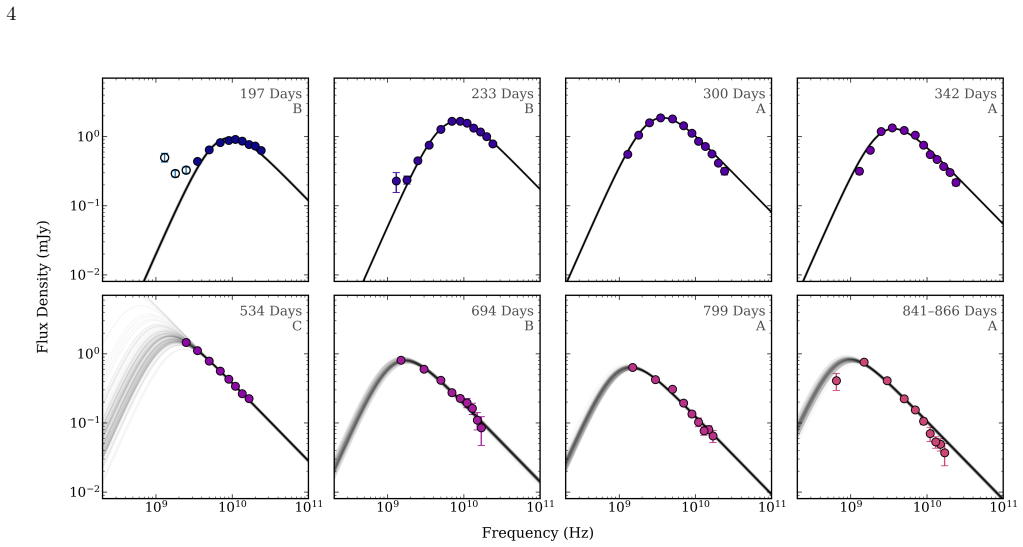
Summary. The manuscript presents multi-epoch VLA and GMRT radio observations of the TDE AT 2022wtn spanning 97–866 days after optical discovery. The authors fit self-absorbed synchrotron SEDs (Granot & Sari 2002 form, νm < νa < νc), fix p to its mean value 3.26, and apply an updated equipartition formalism (Rohde et al., in prep., building on Barniol Duran et al. 2013 and Matsumoto & Piran 2023) for both spherical (fA = 1) and conical (fA = 0.1) geometries. They report β ≈ 0.21c and Eeq ∼ 3.8 × 10^49 erg (spherical) or β ≈ 0.41c and Eeq ∼ 1.8 × 10^50 erg (conical), with a circumnuclear density profile next ∝ R^−2.08. After excluding free-free absorption, a cooling break, and a relativistic jet, they compare the derived energy and velocity against unbound debris, collisionally-induced outflows, accretion-driven winds, and an accretion-disk state-transition outflow, concluding that only the last is consistent. The central claim is that AT 2022wtn is a uniquely powerful non-relativistic radio TDE whose outflow is best explained by a delayed state-transition launch at δt ≈ 138 days.
Significance. If the high β and Eeq and the state-transition interpretation hold, the paper adds a well-sampled, multi-frequency radio data set and a carefully documented equipartition analysis to the growing sample of non-relativistic radio TDEs, and it strengthens the case that delayed disk-state transitions can power luminous, fast outflows. Strengths include quantitative rejection of free-free absorption (Appendix B) and cooling-break alternatives (Section 3.3), systematic comparison to other TDEs with a consistent equipartition pipeline (Figure 5), public modeling code, and an explicit multiwavelength consistency check against Onori et al. (2025). The result is of clear interest to the TDE and radio-transient communities even if the launch-date assumption is later refined.
major comments (2)
- Section 4.2 and Eq. (7): the reported β ≈ 0.21c (spherical) / 0.41c (conical) that exclude unbound debris, CIO, and accretion winds rest on a free-expansion launch date of δt ≈ 138 days obtained by linear extrapolation of the first five Req points. The paper itself notes that a pure power-law fit yields R ∝ t^0.53 and a launch near 179 days, and that a broken power-law (free expansion then Sedov-like) is allowed but unconstrained. A later launch by only ∼40 days lowers β into the ∼0.1c range already accommodated by the competing models. The exclusion of those models is therefore only as secure as the free-expansion assumption over the first five epochs. The authors should either (i) present a quantitative sensitivity study of β and Eeq versus launch date (including the power-law and broken-power-law cases) and restate the model comparison with the resulting range, or (ii) provide indepen
- Section 5.3.5 and the abstract: the claim that “only” an accretion-disk state-transition outflow is consistent is stronger than the evidence once launch-date uncertainty is acknowledged. Even under the preferred launch date, the spherical β ≈ 0.21c sits at the upper edge of the 0.05–0.3c range quoted from Wu et al. (2025), and the conical β ≈ 0.41c exceeds it. The paper should soften the language to “favored” or “most consistent among the models considered,” and should explicitly note which of the two geometries remains inside the state-transition velocity window after the launch-date sensitivity is folded in.
minor comments (5)
- Section 3.2 / Appendix D: fixing p to the mean 3.26 after free fits show large epoch-to-epoch variation is reasonable, but the text should state the quantitative impact on Eeq and Req of using the free-p posteriors (or of fixing s = 1) so readers can judge the systematic floor.
- Section 4.1 / footnote 17: the choice of fΩ = 4 (spherical) versus 0.1 (conical) produces a factor-of-40 difference in next relative to some earlier TDE analyses; a short sentence clarifying why this geometric convention is preferred would help cross-paper comparisons.
- Appendix C: for the conical geometry the calculated γm ∼ 4 (rather than the assumed γm = 2) reduces Eeq by ∼40 %. This should be flagged in the main text when conical energies are quoted, or the conical comparison sample should be recomputed with consistent γm.
- Figure 3 and Table 2: the final epoch shows an upturn in Fp; a brief remark on whether this is physical or an artifact of the GMRT/VLA joint fit would be useful.
- Typographical: “F arley”, “W alter”, “calu-lation”, and a few missing spaces after periods appear in the draft; a careful proofread is needed.
Circularity Check
No significant circularity: equipartition parameters are derived from observed SED peaks via standard formulae; model exclusion follows from comparison to external expectations under an explicit free-expansion assumption, not by construction.
specific steps
-
self citation load bearing
[Section 4.1, Eqs. (3)–(4) and surrounding text]
"We employ the equations derived in Rohde et al. (in prep.), a simultaneous application of additional p-dependent adjustments (R.-F. Shen & B. Zhang 2009) to the equipartition formalism presented in R. Barniol Duran et al. (2013) and T. Matsumoto & T. Piran (2023)..."
The updated equipartition expressions that supply every Req and Eeq value are taken from a contemporaneous work by an overlapping author set (C. Rohde is a co-author). The citation is not machine-checked or externally falsified beyond the paper’s own recomputation of a few literature TDEs; however, the formulae recover the standard Newtonian limits and the paper’s central claim does not rest solely on the update, so the circularity is minor and non-load-bearing.
full rationale
The paper's chain is observational: multi-epoch SEDs are fit for νp and Fp (p fixed to the data-driven mean 3.26 after free-p variation is judged unphysical), then Req and Eeq are obtained from the Newtonian equipartition expressions of Barniol Duran et al. (2013) / Matsumoto & Piran (2023) with p-dependent corrections (Rohde et al. in prep.). Velocity follows from the kinematic definition β = [ct/Req(1+z)+1]^{-1} once a launch epoch is chosen. The launch date δt≈138 d is obtained by linear extrapolation of the first five Req points under free expansion; the paper itself reports the alternative power-law fit (R∝t^{0.53}, launch ~179 d) and notes that a broken power-law is unconstrained. The high-β / high-E values are then compared to literature ranges for unbound debris, CIO, accretion winds and state-transition outflows. None of these steps reduces a claimed prediction to a fitted input by definition, nor does a self-citation uniqueness theorem force the geometry or the final model choice. The single minor self-citation (Rohde et al. in prep. for the updated formulae) is validated by recomputing literature TDEs and is not load-bearing for the exclusion argument. The free-expansion assumption is a genuine modeling choice that affects absolute β, but that is an assumption risk, not circularity. Score 1 reflects only that minor self-citation; the derivation remains self-contained against external benchmarks.
Axiom & Free-Parameter Ledger
free parameters (5)
- electron power-law index p =
3.26 (mean)
- electron energy fraction εe =
0.1
- area filling factor fA =
1 or 0.1
- outflow launch date =
138 ± 5 days
- volume filling factor / shell thickness =
0.36
axioms (4)
- domain assumption Electron and magnetic energy densities are near equipartition (ε=1), giving a lower limit on total energy.
- domain assumption Radio SEDs are single-zone synchrotron with break ordering νm < νa < νc and νp = νa.
- domain assumption Outflow is non-relativistic (Γ=1).
- ad hoc to paper Ambient density is obtained by dividing Ne by the geometric volume swept by the shock (no extra compression factor of 1/4).
read the original abstract
We present multi-epoch, multi-frequency radio observations of the tidal disruption event (TDE) AT 2022wtn, obtained with the Karl G. Jansky Very Large Array (VLA) and Giant Metrewave Radio Telescope (GMRT), spanning 97-866 days after optical detection. The peak radio flux density increases until 300 days post optical discovery, flattens out for several hundred days, then begins to decrease at 534 days. Utilizing an updated equipartition analysis framework, we estimate several physical parameters of the event and the surrounding medium. We model AT 2022wtn with two different geometries: a spherical and a conical emitting region. The spherical outflow model gives an expansion velocity of $v\approx0.21c$ and a kinetic energy of $\sim3.8\times10^{49}$ erg, and the conical outflow model yields a higher energy ($\sim1.8\times10^{50}$) and velocity ($v\approx0.41c$) than the spherical case. After ruling out the possibility of a relativistic jet, we consider several potential origins for sub-relativistic outflow regions in TDEs including unbound debris streams, collisionally-induced outflows, an accretion-driven wind, and an outflow from an accretion disk state transition, and find only an accretion disk state transition outflow to be consistent with the high energy and velocity found in our equipartition results. AT 2022wtn is a uniquely powerful non-relativistic radio-emitting TDE, and joins a growing population that display a diverse range of outflow properties.
Figures



Reference graph
Works this paper leans on
-
[1]
doi:10.1051/0004-6361/201833910 , abstract =
Aghanim, N., Akrami, Y., Ashdown, M., et al. 2020, Astronomy & Astrophysics, 641, A6, doi: 10.1051/0004-6361/201833910
-
[2]
D., Berger, E., Guillochon, J., Zauderer, B
Alexander, K. D., Berger, E., Guillochon, J., Zauderer, B. A., & Williams, P. K. G. 2016, The Astrophysical Journal Letters, 819, L25, doi: 10.3847/2041-8205/819/2/L25 18 Figure 9.The temporal evolution of the best fit parameters resulting from a fit of the MQ24 model to our data. Points are the median value of the chain and errorbars represent the 68% un...
-
[3]
Alexander, K. D., Velzen, S. v., Horesh, A., & Zauderer, B. A. 2020, Space Science Reviews, 216, 81, doi: 10.1007/s11214-020-00702-w
-
[4]
D., Margutti, R., Gomez, S., et al
Alexander, K. D., Margutti, R., Gomez, S., et al. 2025, arXiv e-prints, arXiv:2506.12729, doi: 10.48550/arXiv.2506.12729
-
[5]
Anderson, M. M., Mooley, K. P., Hallinan, G., et al. 2020, The Astrophysical Journal, 903, 116, doi: 10.3847/1538-4357/abb94b Astropy Collaboration, Robitaille, T. P., Tollerud, E. J., et al. 2013, A&A, 558, A33, doi: 10.1051/0004-6361/201322068 Astropy Collaboration, Price-Whelan, A. M., Sip˝ ocz, B. M., et al. 2018, AJ, 156, 123, doi: 10.3847/1538-3881/...
-
[6]
Bellm, E. C., Kulkarni, S. R., Graham, M. J., et al. 2018, Publications of the Astronomical Society of the Pacific, 131, 018002, doi: 10.1088/1538-3873/aaecbe Ben Bekhti, N., Fl¨ oer, L., Keller, R., et al. 2016, Astronomy & Astrophysics, 594, A116, doi: 10.1051/0004-6361/201629178
-
[7]
Berger, E., Zauderer, A., Pooley, G. G., et al. 2012, The Astrophysical Journal, 748, 36, doi: 10.1088/0004-637X/748/1/36
-
[8]
1952, MNRAS, 112, 195, doi: 10.1093/mnras/112.2.195
Bondi, H. 1952, MNRAS, 112, 195, doi: 10.1093/mnras/112.2.195
-
[9]
doi:10.1093/mnras/staa1246 , journal=
Bonnerot, C., & Lu, W. 2020, Monthly Notices of the Royal Astronomical Society, 495, 1374–1391, doi: 10.1093/mnras/staa1246 Bradley Cenko, S., Krimm, H. A., Horesh, A., et al. 2012, The Astrophysical Journal, 753, 77, doi: 10.1088/0004-637X/753/1/77 CASA Team, Bean, B., Bhatnagar, S., et al. 2022, PASP, 134, 114501, doi: 10.1088/1538-3873/ac9642 19
-
[10]
Cendes, Y., Alexander, K. D., Berger, E., et al. 2021, The Astrophysical Journal, 919, 127, doi: 10.3847/1538-4357/ac110a
-
[11]
Cendes, Y., Berger, E., Alexander, K. D., et al. 2022, The Astrophysical Journal, 938, 28, doi: 10.3847/1538-4357/ac88d0
-
[12]
Cendes, Y., Berger, E., Alexander, K. D., et al. 2024, The Astrophysical Journal, 971, 185, doi: 10.3847/1538-4357/ad5541
-
[13]
Continued Rapid Radio Brightening of the Tidal Disruption Event AT2018hyz
Cendes, Y., Berger, E., Beniamini, P., et al. 2025, Continued Rapid Radio Brightening of the Tidal Disruption Event AT2018hyz, arXiv, doi: 10.48550/arXiv.2507.08998
work page internal anchor Pith review Pith/arXiv arXiv doi:10.48550/arxiv.2507.08998 2025
-
[14]
Chevalier, R. A. 1998, The Astrophysical Journal, 499, 810, doi: 10.1086/305676
-
[15]
Christy, C. T., Alexander, K. D., Laskar, T., et al. 2023, The Astronomer’s Telegram, 15972, 1
work page 2023
-
[16]
Christy, C. T., Alexander, K. D., Margutti, R., et al. 2024, The Astrophysical Journal, 974, 18, doi: 10.3847/1538-4357/ad675b
-
[17]
Christy, C. T., Alexander, K. D., Laskar, T., et al. 2025, Dichotomy in Long-Lived Radio Emission from Tidal Disruption Events AT 2020zso and AT 2021sdu: Multi-Component Outflows vs. Host Contamination, arXiv, doi: 10.48550/arXiv.2509.14317
-
[18]
Miller, M. C. 2018, The Astrophysical Journal Letters, 859, L20, doi: 10.3847/2041-8213/aab429 De Colle, F., Guillochon, J., Naiman, J., & Ramirez-Ruiz, E. 2012, The Astrophysical Journal, 760, 103, doi: 10.1088/0004-637x/760/2/103
-
[19]
Alexander, K. D. 2018, The Astrophysical Journal, 854, 86, doi: 10.3847/1538-4357/aaa8e0
-
[20]
Evans, C. R., & Kochanek, C. S. 1989, ApJL, 346, L13, doi: 10.1086/185567
-
[21]
and Lang, Dustin and Goodman, Jonathan , date =
Foreman-Mackey, D., Hogg, D. W., Lang, D., & Goodman, J. 2013a, PASP, 125, 306, doi: 10.1086/670067
-
[22]
Frail, D. A., Kulkarni, S. R., Sari, R., et al. 2001, The Astrophysical Journal, 562, L55, doi: 10.1086/338119
-
[23]
2026a, The Journal of Open Source Software, 11, 9516, doi: 10.21105/joss.09516
Franz, N., Alexander, K., & Gomez, S. 2026a, The Journal of Open Source Software, 11, 9516, doi: 10.21105/joss.09516
-
[24]
Franz, N., Alexander, K. D., Gomez, S., et al. 2026b, ApJ, 999, 243, doi: 10.3847/1538-4357/ae346e
- [25]
-
[26]
2025, scipy/scipy: SciPy 1.17.0rc1, v1.17.0rc1 Zenodo, doi: 10.5281/zenodo.17873309
Gommers, R., Virtanen, P., Haberland, M., et al. 2025, scipy/scipy: SciPy 1.17.0rc1, v1.17.0rc1 Zenodo, doi: 10.5281/zenodo.17873309
-
[27]
J., van Velzen, S., Miller-Jones, J
Goodwin, A. J., van Velzen, S., Miller-Jones, J. C. A., et al. 2022, Monthly Notices of the Royal Astronomical Society, 511, 5328, doi: 10.1093/mnras/stac333
-
[28]
Goodwin, A. J., Miller-Jones, J. C. A., van Velzen, S., et al. 2023, MNRAS, 518, 847, doi: 10.1093/mnras/stac3127
-
[29]
J., Mummery, A., Laskar, T., et al
Goodwin, A. J., Mummery, A., Laskar, T., et al. 2025, The Astrophysical Journal, 981, 122, doi: 10.3847/1538-4357/adb0b1
-
[30]
2018, Monthly Notices of the Royal Astronomical Society, 481, 2711, doi: 10.1093/mnras/sty2454
Granot, J., De Colle, F., & Ramirez-Ruiz, E. 2018, Monthly Notices of the Royal Astronomical Society, 481, 2711, doi: 10.1093/mnras/sty2454
-
[31]
2002, The Astrophysical Journal, 568, 820, doi: 10.1086/338966
Granot, J., & Sari, R. 2002, The Astrophysical Journal, 568, 820, doi: 10.1086/338966
-
[32]
Guillochon, J., & Ramirez-Ruiz, E. 2013, The Astrophysical Journal, 767, 25, doi: 10.1088/0004-637X/767/1/25
-
[33]
Hajela, A., Alexander, K. D., Margutti, R., et al. 2025, The Astrophysical Journal, 983, 29, doi: 10.3847/1538-4357/adb620
-
[34]
Harris, C. R., Millman, K. J., van der Walt, S. J., et al. 2020, Nature, 585, 357, doi: 10.1038/s41586-020-2649-2
-
[35]
Hills, J. G. 1975, Nature, 254, 295, doi: 10.1038/254295a0
-
[36]
Horesh, A., Cenko, S. B., & Arcavi, I. 2021, Nature Astronomy, 5, 491, doi: 10.1038/s41550-021-01300-8
-
[37]
Hunter, J. D. 2007, Computing in Science & Engineering, 9, 90, doi: 10.1109/MCSE.2007.55
-
[38]
Jin, C. C., Li, D. Y., Jiang, N., et al. 2025, arXiv e-prints, arXiv:2501.09580, doi: 10.48550/arXiv.2501.09580
-
[39]
2016, in Positioning and Power in Academic Publishing: Players, Agents and Agendas, ed
Kluyver, T., Ragan-Kelley, B., P´ erez, F., et al. 2016, in Positioning and Power in Academic Publishing: Players, Agents and Agendas, ed. F. Loizides & B. Schmidt, IOS Press, 87 – 90
work page 2016
-
[40]
Krolik, J., Piran, T., Svirski, G., & Cheng, R. M. 2016, The Astrophysical Journal, 827, 127, doi: 10.3847/0004-637X/827/2/127
-
[41]
2025, arXiv e-prints, arXiv:2512.02147, doi: 10.48550/arXiv.2512.02147
Li, W., Jiang, N., Wang, T., et al. 2025, arXiv e-prints, arXiv:2512.02147, doi: 10.48550/arXiv.2512.02147
-
[42]
Lin, D., Strader, J., Carrasco, E. R., et al. 2018, Nature Astronomy, 2, 656, doi: 10.1038/s41550-018-0493-1
-
[43]
2020, Monthly Notices of the Royal Astronomical Society, 492, 686, doi: 10.1093/mnras/stz3405
Lu, W., & Bonnerot, C. 2020, Monthly Notices of the Royal Astronomical Society, 492, 686, doi: 10.1093/mnras/stz3405
-
[44]
2021, The Astrophysical Journal Letters, 923, L14, doi: 10.3847/2041-8213/ac3d97
Margalit, B., & Quataert, E. 2021, The Astrophysical Journal Letters, 923, L14, doi: 10.3847/2041-8213/ac3d97 20
-
[45]
Margalit, B., & Quataert, E. 2024, The Peak Frequency and Luminosity of Synchrotron Emitting Shocks: from Non-Relativistic to Ultra-Relativistic Explosions, arXiv, doi: 10.48550/arXiv.2403.07048
work page internal anchor Pith review Pith/arXiv arXiv doi:10.48550/arxiv.2403.07048 2024
-
[46]
2023, Monthly Notices of the Royal Astronomical Society, 522, 4565–4576, doi: 10.1093/mnras/stad1269
Matsumoto, T., & Piran, T. 2023, Monthly Notices of the Royal Astronomical Society, 522, 4565, doi: 10.1093/mnras/stad1269
-
[47]
2007, in Astronomical Society of the Pacific Conference Series, Vol
Golap, K. 2007, in Astronomical Society of the Pacific Conference Series, Vol. 376, Astronomical Data Analysis Software and Systems XVI, ed. R. A. Shaw, F. Hill, & D. J. Bell, 127
work page 2007
-
[48]
Metzger, B. D. 2022, The Astrophysical Journal Letters, 937, L12, doi: 10.3847/2041-8213/ac90ba
-
[49]
Metzger, B. D., Giannios, D., & Mimica, P. 2012, Monthly Notices of the Royal Astronomical Society, no, doi: 10.1111/j.1365-2966.2011.20273.x
-
[50]
2021, The Astrophysical Journal, 906, 101, doi: 10.3847/1538-4357/abc955
Mockler, B., & Ramirez-Ruiz, E. 2021, The Astrophysical Journal, 906, 101, doi: 10.3847/1538-4357/abc955
-
[51]
J., Margutti, R., Wiston, E., et al
Nayana, A. J., Margutti, R., Wiston, E., et al. 2025, ApJL, 993, L6, doi: 10.3847/2041-8213/ae0b4d
-
[52]
2022, Monthly Notices of the Royal Astronomical Society, 515, 5604, doi: 10.1093/mnras/stac2206
Nicholl, M., Lanning, D., Ramsden, P., et al. 2022, Monthly Notices of the Royal Astronomical Society, 515, 5604, doi: 10.1093/mnras/stac2206
-
[53]
The case of AT2022wtn: a Tidal Disruption Event in an interacting galaxy
Onori, F., Nicholl, M., Ramsden, P., et al. 2025, The case of AT2022wtn: a Tidal Disruption Event in an interacting galaxy, arXiv, doi: 10.48550/arXiv.2504.21686 pandas development team, T. 2025, pandas-dev/pandas: Pandas, v3.0.0rc0 Zenodo, doi: 10.5281/zenodo.17806077
work page internal anchor Pith review Pith/arXiv arXiv doi:10.48550/arxiv.2504.21686 2025
-
[54]
Perez, F., & Granger, B. E. 2007, Computing in Science and Engineering, 9, 21, doi: 10.1109/MCSE.2007.53
-
[55]
Perley, R. A., & Butler, B. J. 2017, ApJS, 230, 7, doi: 10.3847/1538-4365/aa6df9
-
[56]
Rees, M. J. 1988, Nature, 333, 523, doi: 10.1038/333523a0
-
[57]
Rhodes, L., Bright, J. S., Fender, R., et al. 2023, MNRAS, 521, 389, doi: 10.1093/mnras/stad344
-
[58]
2026, equipartition, Zenodo, doi: 10.5281/zenodo.19223150
Rohde, C., Franz, N., Laskar, T., & Christy, C. 2026, equipartition, Zenodo, doi: 10.5281/zenodo.19223150
-
[59]
Rybicki, G. B., & Lightman, A. P. 1986, Radiative Processes in Astrophysics
work page 1986
-
[60]
Sfaradi, I., Margutti, R., Chornock, R., et al. 2025, The First Radio-Bright Off-Nuclear TDE 2024tvd Reveals the Fastest-Evolving Double-Peaked Radio Emission, arXiv, doi: 10.48550/arXiv.2508.03807
work page internal anchor Pith review Pith/arXiv arXiv doi:10.48550/arxiv.2508.03807 2025
-
[61]
2009, title Clustering of luminous red galaxies - III
Shen, R.-F., & Zhang, B. 2009, Monthly Notices of the Royal Astronomical Society, 398, 1936–1950, doi: 10.1111/j.1365-2966.2009.15212.x
-
[62]
2009, title Clustering of luminous red galaxies - III
Strubbe, L. E., & Quataert, E. 2009, MNRAS, 400, 2070, doi: 10.1111/j.1365-2966.2009.15599.x Van Rossum, G., & Drake, F. L. 2009, Python 3 Reference Manual (Scotts Valley, CA: CreateSpace) van Velzen, S., Holoien, T. W.-S., Onori, F., Hung, T., &
-
[63]
2020, Space Science Reviews, 216, doi: 10.1007/s11214-020-00753-z
Arcavi, I. 2020, Space Science Reviews, 216, doi: 10.1007/s11214-020-00753-z
-
[64]
SciPy 1.0: Fundamental Algorithms for Scientific Computing in Python
Virtanen, P., Gommers, R., Oliphant, T. E., et al. 2020, Nature Methods, 17, 261, doi: 10.1038/s41592-019-0686-2
-
[65]
2025, TomWagg/software-citation-station: v1.4, v1.4 Zenodo, doi: 10.5281/zenodo.17654855
Wagg, T., Broekgaarden, F., Van-Lane, P., Wu, K., & G¨ ultekin, K. 2025, TomWagg/software-citation-station: v1.4, v1.4 Zenodo, doi: 10.5281/zenodo.17654855
-
[66]
Wagg, T., & Broekgaarden, F. S. 2024, arXiv e-prints, arXiv:2406.04405. https://arxiv.org/abs/2406.04405 Wes McKinney. 2010, in Proceedings of the 9th Python in Science Conference, ed. St´ efan van der Walt & Jarrod Millman, 56 – 61, doi: 10.25080/Majora-92bf1922-00a
-
[67]
C., Tsuna, D., Mockler, B., & Piro, A
Wu, S. C., Tsuna, D., Mockler, B., & Piro, A. L. 2025, Delayed radio emission in tidal disruption events from collisions of outflows driven by disk instabilities, https://arxiv.org/abs/2511.14008
-
[68]
Yalinewich, A., Steinberg, E., Piran, T., & Krolik, J. H. 2019, Monthly Notices of the Royal Astronomical Society, 487, 4083, doi: 10.1093/mnras/stz1567
-
[69]
Yao, Y., Chornock, R., Ward, C., et al. 2025, A Massive Black Hole 0.8 kpc from the Host Nucleus Revealed by the Offset Tidal Disruption Event AT2024tvd, https://arxiv.org/abs/2502.17661
work page internal anchor Pith review Pith/arXiv arXiv 2025
-
[70]
Zauderer, B. A., Berger, E., Soderberg, A. M., et al. 2011, Nature, 476, 425, doi: 10.1038/nature10366
-
[71]
2025, Nature Astronomy, 9, 702, doi: 10.1038/s41550-025-02502-0
Zhang, W., Shu, X., Sun, L., et al. 2025, Nature Astronomy, 9, 702, doi: 10.1038/s41550-025-02502-0
discussion (0)
Sign in with ORCID, Apple, or X to comment. Anyone can read and Pith papers without signing in.