REVIEW 3 major objections 6 minor 98 references
Embedding physics in neural networks yields models that generalize across photonic devices
Reviewed by Pith at T0; open to challenge. T0 means a machine referee read the full paper against a public rubric. the ladder, T0–T4 →
T0 review · glm-5.2
2026-07-09 15:22 UTC pith:ALOTT5VT
load-bearing objection Grey-box modeling review with useful cross-case comparison; DML case incomplete, modularity claim rests on unverified linearity assumption. the 3 major comments →
Beyond white- and black-box modeling tools in optical communications and optical computing: physics-informed data-driven modeling
The pith
A machine-rendered reading of the paper's core claim, the machinery that carries it, and where it could break.
Core claim
The paper's central claim is that a weighted combination of data-driven and physics-driven loss terms, even when the physics is only partially known, produces models that generalize across physical devices better than either pure physics or pure data-driven approaches, while requiring less training data than the latter and remaining differentiable for gradient-based optimization. The evidence is strongest for the interferometer mesh case, where the grey-box model's advantage in cross-device generalization is demonstrated quantitatively, and where the modular structure of the mesh allows a single-cell model to be translated and linearly combined to predict crosstalk across the full chip.
What carries the argument
The composite loss function L_total = (1-k)·L_data + k·L_physics, where L_data is a standard mean-squared-error term on input-output data and L_physics penalizes predictions that violate a known physical relationship (e.g., exponential thermal decay). The parameter k balances the two terms; the authors find k=0.5 optimal for cross-device generalization in the interferometer mesh case. A secondary mechanism is transfer learning: a simple physics model is trained on few samples, used to generate large synthetic datasets, which pre-train a more complex neural network that is then fine-tuned on the original few real samples.
Load-bearing premise
The claim that grey-box models generalize better rests on the assumption that the physics embedded in the loss term captures functional dependencies that are genuinely common across devices. For the interferometer mesh, this means the exponential thermal decay model accurately represents the dominant crosstalk mechanism in every cell. If unmodeled effects — such as optical crosstalk from waveguide crossings or fabrication-induced variations — dominate in certain cells, the物理学
What would settle it
If a grey-box model trained on one cell of an interferometer mesh, using a thermal-decay physics loss, were tested on a cell where the dominant crosstalk mechanism is optical (not thermal) and showed no generalization advantage over a pure data-driven model, the core claim would be weakened.
If this is right
- Digital twins of programmable photonic chips could be constructed by characterizing a single unit cell and translating its model across the chip by symmetry, rather than measuring every component individually.
- The physics-informed loss approach could extend to other photonic components where partial physical models exist but full multiphysics models are intractable, such as silicon photonics with combined thermal-optical-electrical crosstalk.
- Gradient-based end-to-end optimization of full optical communication links becomes feasible when differentiable grey-box models of amplifiers, lasers, and fibers are cascaded modularly.
- The transfer-learning workflow (train simple physics model, generate synthetic data, pre-train neural network, fine-tune on real data) offers a practical recipe for data-constrained photonic manufacturing environments.
Where Pith is reading between the lines
- The choice of which physical relationship to embed in the loss function becomes a design decision that trades generality for specificity: a more general physics term (e.g., energy conservation) would constrain less but apply more broadly, while a device-specific term (e.g., a particular thermal decay model) constrains more but may fail if the dominant physics differs across devices.
- If fabrication variability introduces effects not captured by the embedded physics (e.g., waveguide roughness causing optical crosstalk that does not follow the thermal decay model), the grey-box advantage would diminish, and the optimal k would shift toward the data-driven regime — suggesting that k itself could serve as a diagnostic for how well the chosen physics describes the system.
- The modular linear-combination framework for multi-cell crosstalk compensation (Eqs. 6-12) implicitly assumes crosstalk contributions are linearly superposable; if nonlinear crosstalk interactions become significant at higher device densities, this framework would need extension.
Editorial analysis
A structured set of objections, weighed in public.
Referee Report
Summary. This paper presents a comparative analysis of three modeling paradigms—white-box (WB, physics-based), black-box (BB, data-driven), and grey-box (GB, physics-informed data-driven)—applied to three photonic use cases: Raman amplifiers, directly modulated lasers (DMLs), and interferometer meshes. The central claim is that GB models offer significant advantages in generalizability and modularity while preserving data efficiency and limiting model complexity. The paper reviews and contextualizes the authors' prior work, extending a conference submission with new quantitative results for interferometer meshes, particularly on inter-cell generalization and modular crosstalk compensation.
Significance. The topic is timely and relevant to the optical communications and optical computing communities. The systematic cross-case comparison of modeling paradigms, with quantitative metrics (RMSE, inference time, parameter count), is a useful contribution. The modular crosstalk compensation framework for interferometer meshes (Section III-D) and the transfer-learning workflow for data-constrained settings (Section III-B) are concrete, falsifiable contributions. The paper provides actionable guidance for practitioners building digital twins of photonic systems.
major comments (3)
- The paper's central claim of GB advantages 'across three benchmark use cases' is structurally incomplete for the DML case. Section II-B.2 and Fig. 3 present only WB and BB models for DMLs; no GB model is discussed or evaluated. Section III-D acknowledges that 'No modular DML model has yet been reported.' The abstract and conclusion should be revised to accurately reflect that the three-way WB/BB/GB comparison is carried out for two use cases (amplifiers, meshes), while the DML case is a two-way WB/BB comparison. As written, the framing overstates the breadth of the GB evidence.
- Section III-D, Eqs. (7)-(12): The modular crosstalk compensation framework rests on the assumption that thermal crosstalk contributions sum linearly (Eq. 7: Δλ_i = Σ_{j≠i} Δλ_{i,j}). This linearity is asserted ('thermal XT effects are expected to sum up linearly') but not experimentally verified. The model's RMSE is approximately 0.6 pm (Table I); if nonlinear effects (thermal saturation, optical crosstalk, fabrication-dependent coupling) cause deviations exceeding this threshold, the framework's compensation accuracy degrades. Since modularity is a central claimed advantage of GB models, the authors should either provide experimental validation of the linearity assumption for multi-MRR configurations or explicitly state this as a limitation and qualify the modularity claim accordingly.
- Section III-C, Fig. 11a: The hyperparameter k (Eq. 5) is selected as k=0.5 based on the best global test RMSE across all six cells. Selecting a hyperparameter on the test set risks optimistic bias in the reported generalization performance. The authors should either use a validation set for k selection or report sensitivity of the global RMSE to k across a range of values, and discuss whether the k=0.5 optimum is robust or an artifact of the specific test data. This is load-bearing because the generalization advantage of GB over WB (0.61 vs. 0.72 pm, Table I) is modest and could be within the uncertainty introduced by hyperparameter selection.
minor comments (6)
- The paper is heavily self-referential, with the majority of cited results for each use case authored by the present authors ([23], [32], [48], [80], [89], [90]). While this is understandable for a review of the authors' own work, broader context from independent groups would strengthen the comparative claims. Consider adding a brief discussion of how the authors' GB approach relates to other physics-informed ML efforts in photonics beyond the cited works.
- Section II-C, Eq. (5): The loss function L_total = (1-k)·L_data + k·L_physics is introduced, but the specific form of L_physics for each use case is not consistently defined. For the interferometer mesh, L_physics is based on the thermal decay model (Eq. 4), but for Raman amplifiers and DMLs, the physics loss is not explicitly stated. Adding a brief description of L_physics for each case would improve self-containedness.
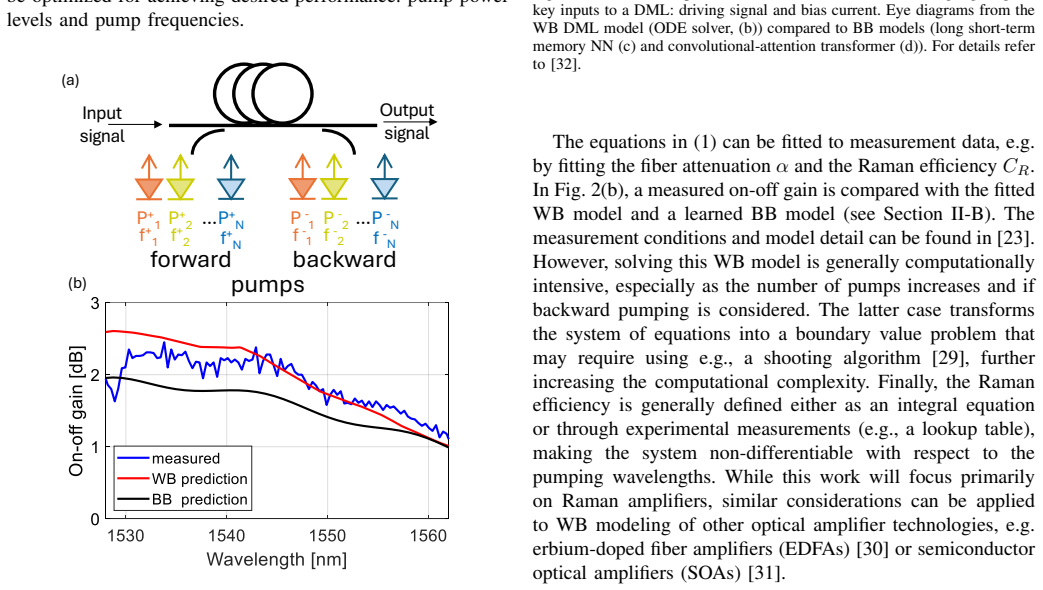
- Fig. 2(b): The caption references 'fitted WB model and learned BB model' but does not specify the training dataset size or model architecture for the BB model shown. Adding these details would make the comparison more interpretable.
- Section III-A, Fig. 7(b): The x-axis is labeled 'number of parameters' but the WB model (ThDM) and GB model (PILR) have very different parameter counts (81 vs. 13500+ for BB). The log scale or explicit parameter counts for each model would improve the clarity of the complexity comparison.
- The manuscript header reads 'JOURNAL OF LATEX CLASS FILES, VOL. 14, NO. 8, AUGUST 2015' and the manuscript received date is 'April 19, 2005; revised August 26, 2015.' These appear to be template artifacts and should be corrected before publication.
- Section II-A.3, Eq. (3): The MZI transfer function is written with j (imaginary unit) but the phase shifters use e^{jθ_1} and e^{jθ_2}. The notation is standard but the switch between j and e^{jθ} could be made consistent. Also, the transition from Eq. (3) to the discussion of crosstalk models could more explicitly state how the GB construction modifies Eq. (3).
Circularity Check
No genuine circularity found; heavy self-citation provides experimental data and implementations, not tautological theoretical claims.
full rationale
The paper is a comparative review of three modeling paradigms across three use cases. I examined each load-bearing derivation chain for circularity: (1) The GB model's physics loss (Eq. 5) uses the thermal decay model (Eq. 4) whose parameters are fitted during training. This is standard grey-box modeling — the physics constraint imposes a functional *form* (exponential decay with distance), while the predictions (wavelength shifts for unseen cells) are not the quantities being fitted. The generalization claim (Table I, Fig. 11) is that this form transfers across cells, which is an empirically testable hypothesis, not a tautology. (2) The modular crosstalk framework (Eqs. 6–12) is a mathematical derivation conditional on the linearity assumption (Eq. 7). The paper explicitly flags this as an assumption ('thermal XT effects are expected to sum up linearly'), not a derived result. An unverified assumption is a correctness risk, not circularity. (3) The transfer learning workflow (Fig. 8b) uses a WB model to generate synthetic data for pre-training a BB model — this is a methodology, not a circular derivation. (4) The heavy self-citation ([23], [32], [48], [80], [89], [90]) references the authors' own experimental measurements and model implementations. These provide independently reproducible data and code, not theoretical claims that would make the present argument tautological. The cited works are externally falsifiable (measurements on physical devices, published code/architectures). No step in the derivation chain reduces to its own inputs by construction. Score 2 reflects the heavy self-citation pattern, which is not load-bearing for circularity but is worth noting for independence of evidence.
Axiom & Free-Parameter Ledger
free parameters (4)
- k (loss weight) =
0.5
- p1, p2, p3 (thermal decay)
- Raman efficiency CR
- Laser rate equation parameters (g0, alpha, tau_n, etc.)
axioms (3)
- domain assumption Thermal crosstalk effects sum linearly across multiple MRRs on the same mesh
- domain assumption Thermal diffusion follows exponential decay with distance from heating element
- ad hoc to paper Physics-informed loss terms improve generalization by encoding functional dependencies common across devices
read the original abstract
Efficient optimization and control of photonic computing and communication systems increasingly rely on accurate surrogate models/digital twins. While data-driven models may achieve faster inference than traditional physics-based methods, they typically suffer from poor training data efficiency and limited generalizability. To address this trade-off, physics-informed data-driven modeling has emerged as a powerful hybrid paradigm. This paper presents a comparative analysis of these three modeling paradigms across three benchmark use cases: optical amplifiers, directly modulated lasers, and interferometer meshes. By evaluating model complexity, data efficiency, generalizability, and modularity, this work provides a detailed analysis of the respective trade-offs and highlights the advantages of combining physical insight with data-driven learning.
Figures




Reference graph
Works this paper leans on
-
[1]
Roadmapping the next generation of silicon photonics,
S. Shekhar, W. Bogaerts, L. Chrostowski, J. E. Bowers, M. Hochberg, R. Soref, and B. J. Shastri, “Roadmapping the next generation of silicon photonics,”Nature Communications, vol. 15, p. 751, 2024
work page 2024
-
[2]
Roadmap on optical communications,
E. Agrell, M. Karlsson, F. Poletti, S. Namiki, X. Chen, L. A. Rusch, B. Puttnam, P. Bayvel, L. Schmalen, Z. Taoet al., “Roadmap on optical communications,”Journal of Optics, vol. 26, no. 9, p. 093001, 2024
work page 2024
-
[3]
Space-division mul- tiplexing for optical fiber communications,
B. J. Puttnam, G. Rademacher, and R. S. Lu ´ıs, “Space-division mul- tiplexing for optical fiber communications,”Optica, vol. 8, no. 9, pp. 1186–1203, 2021
work page 2021
-
[4]
Local and global optimization methods for optical line control based on quality of transmission,
G. Borraccini, S. Straullu, A. D’Amico, F. Aquilino, S. Piciaccia, A. Tanzi, G. Galimberti, and V . Curri, “Local and global optimization methods for optical line control based on quality of transmission,” Journal of Optical Communications and Networking, vol. 16, no. 5, pp. B60–B70, 2024
work page 2024
-
[5]
Digital twin of optical networks: a review of recent advances and future trends,
D. Wang, Y . Song, Y . Zhang, X. Jiang, J. Dong, F. N. Khan, T. Sasai, S. Huang, A. P. T. Lau, M. Tornatoreet al., “Digital twin of optical networks: a review of recent advances and future trends,”Journal of Lightwave Technology, vol. 42, no. 12, pp. 4233–4259, 2024
work page 2024
-
[6]
Measurement informed models and digital twins for optical fiber communication systems,
M. S. Faruk and S. J. Savory, “Measurement informed models and digital twins for optical fiber communication systems,”Journal of Lightwave Technology, vol. 42, no. 3, pp. 1016–1030, 2023
work page 2023
-
[7]
Q. Fan, G. Zhou, T. Gui, C. Lu, and A. P. T. Lau, “Advancing theoretical understanding and practical performance of signal processing for nonlinear optical communications through machine learning,”Nature Communications, vol. 11, no. 1, p. 3694, 2020
work page 2020
-
[8]
Neuromorphic silicon photonics and hardware-aware deep learning for high-speed inference,
M. Moralis-Pegios, G. Mourgias-Alexandris, A. Tsakyridis, G. Gi- amougiannis, A. R. Totovic, G. Dabos, N. Passalis, M. Kirtas, T. Ru- tirawut, F. Gardes, A. Tefas, and N. Pleros, “Neuromorphic silicon photonics and hardware-aware deep learning for high-speed inference,” IEEE Journal of Lightwave Technology, vol. 40, no. 10, pp. 3243–3254, 2022
work page 2022
-
[9]
Y .-J. Lee, M. B. On, L. El Srouji, L. Zhang, M. Abdelghany, and S. J. B. Yoo, “Demonstration of programmable brain-inspired optoelectronic neuron in photonic spiking neural network with neural heterogeneity,” IEEE Journal of Lightwave Technology, vol. 42, pp. 1–12, 2024
work page 2024
-
[10]
Hardware error correction for programmable photonics,
S. Bandyopadhyay, R. Hamerly, and D. Englund, “Hardware error correction for programmable photonics,”Optica, vol. 8, no. 10, pp. 1247–1255, 2021
work page 2021
-
[11]
Q. Qiu, X. Liu, Y . Zhang, L. Yi, W. Hu, and Q. Zhuge, “Trustopt: a trusted online optimization strategy for reliable autonomous optical networks with field-trial demonstration,”Journal of Optical Communi- cations and Networking, vol. 18, no. 1, pp. A44–A53, 2025
work page 2025
-
[12]
Control and calibration recipes for photonic integrated circuits,
M. Milanizadeh, D. Aguiar, A. Melloni, and F. Morichetti, “Control and calibration recipes for photonic integrated circuits,”IEEE Journal of Selected Topics in Quantum Electronics, vol. 26, no. 5, pp. 1–10, 2020. JOURNAL OF LATEX CLASS FILES, VOL. 14, NO. 8, AUGUST 2015 12
work page 2020
-
[13]
Online versus offline optimization methods for Raman amplifier optimization,
U. C. de Moura, T. Pinto, A. R. Brusin, A. Carena, A. Napoli, D. Zibar, and F. Da Ros, “Online versus offline optimization methods for Raman amplifier optimization,” inOptoElectronics and Communications Conference (OECC), 2022
work page 2022
-
[14]
A. Fyrillas, O. Faure, N. Maring, J. Senellart, and N. Belabas, “Scal- able machine learning-assisted clear-box characterization for optimally controlled photonic circuits,”Optica, vol. 11, no. 3, pp. 427–436, 2024
work page 2024
-
[15]
Gradient-free training of autoencoders for non-differentiable communication chan- nels,
O. Jovanovic, M. P. Yankov, F. Da Ros, and D. Zibar, “Gradient-free training of autoencoders for non-differentiable communication chan- nels,”Journal of Lightwave Technology, vol. 39, no. 20, pp. 6381–6391, 2021
work page 2021
-
[16]
M. Soltani, F. Da Ros, A. Carena, and D. Zibar, “Inverse design of a Raman amplifier in frequency and distance domains using convolutional neural networks,”Optics Letters, vol. 46, no. 11, pp. 2650–2653, 2021
work page 2021
-
[17]
M. P. Yankov, M. Soltani, A. Carena, D. Zibar, and F. Da Ros, “A comparison between black-, gray-and white-box modeling for the bidirectional Raman amplifier optimization,”Optical Fiber Technology, vol. 89, p. 104060, 2025
work page 2025
-
[18]
Neural network modeling of bismuth-doped fiber amplifier,
A. Donodin, U. C. De Moura, A. M. R. Brusin, E. Manuylovich, V . Dvoyrin, F. Da Ros, A. Carena, W. Forysiak, D. Zibar, and S. K. Turitsyn, “Neural network modeling of bismuth-doped fiber amplifier,” Journal of the European Optical Society-Rapid Publications, vol. 19, no. 1, p. 4, 2023
work page 2023
-
[19]
Inverse system design using machine learning: The Raman amplifier case,
D. Zibar, A. M. Rosa Brusin, U. C. de Moura, F. Da Ros, V . Curri, and A. Carena, “Inverse system design using machine learning: The Raman amplifier case,”Journal of Lightwave Technology, vol. 38, no. 4, pp. 736–753, 2020
work page 2020
-
[20]
Diode lasers and photonic integrated circuits,
L. A. Coldren, “Diode lasers and photonic integrated circuits,”Optical Engineering, vol. 36, no. 2, p. 616, 1997
work page 1997
-
[21]
M. Raissi, P. Perdikaris, and G. E. Karniadakis, “Physics-informed neural networks: A deep learning framework for solving forward and inverse problems involving nonlinear partial differential equations,” Journal of Computational Physics, vol. 378, pp. 686–707, 2019
work page 2019
-
[22]
F. Da Ros, I. Teofilovic, S. H. Fernandez, M. P. Yankov, C. Peucheret, and D. Zibar, “Machine learning tools for modeling and optimization in optical communications and optical computing,” inOptical Fiber Communication Conference, 2026, pp. M3K–3
work page 2026
-
[23]
Fiber-agnostic machine learning based Raman amplifier models,
U. C. de Moura, F. Da Ros, M. P. Yankov, D. Zibar, and A. Carena, “Fiber-agnostic machine learning based Raman amplifier models,”Jour- nal of Lightwave Technology, vol. 41, no. 1, pp. 83–95, 2023
work page 2023
-
[24]
Comprehensive model of MZI-based circuits for photonic computing applications,
A. Marchisio, F. Da Ros, V . Curri, A. Carena, and P. Bardella, “Comprehensive model of MZI-based circuits for photonic computing applications,”Communications Physics, vol. 8, no. 1, p. 277, 2025
work page 2025
-
[25]
PyTorch: An Imperative Style, High- Performance Deep Learning Library,
A. Paszke, S. Gross, F. Massa, A. Lerer, J. Bradbury, G. Chananet al., “PyTorch: An Imperative Style, High- Performance Deep Learning Library,” inAdvances in Neural Information Processing Systems 32, 2019, pp. 8024–8035. [Online]. Available: http://papers.neurips.cc/paper/9015-pytorch-an- imperative-style-high-performance-deep-learning-library.pdf
work page 2019
-
[26]
JAX: composable transformations of Python+NumPy programs,
J. Bradbury, R. Frostig, P. Hawkins, M. J. Johnson, Y . Katariya, C. Learyet al., “JAX: composable transformations of Python+NumPy programs,” 2018. [Online]. Available: http://github.com/jax-ml/jax
work page 2018
-
[27]
M. Zirngibl, “Analytical model of Raman gain effects in massive wave- length division multiplexed transmission systems,”Electronics letters, vol. 34, no. 8, pp. 789–790, 1998
work page 1998
-
[28]
Raman amplification for fiber communications systems,
J. Bromage, “Raman amplification for fiber communications systems,” journal of lightwave technology, vol. 22, no. 1, pp. 79–93, 2004
work page 2004
-
[29]
Effective shooting algorithm and its application to fiber amplifiers,
X. Liu and B. Lee, “Effective shooting algorithm and its application to fiber amplifiers,”Optics Express, vol. 11, no. 12, pp. 1452–1461, 2003
work page 2003
-
[30]
Modeling of gain in erbium-doped fiber amplifiers,
A. Saleh, R. Jopson, J. Evankow, and J. Aspell, “Modeling of gain in erbium-doped fiber amplifiers,”IEEE Photonics Technology Letters, vol. 2, no. 10, pp. 714–717, 1990
work page 1990
-
[31]
A time-domain computer simulator of the nonlinear response of semiconductor optical amplifiers,
D. Cassioli, S. Scotti, and A. Mecozzi, “A time-domain computer simulator of the nonlinear response of semiconductor optical amplifiers,” IEEE Journal of Quantum Electronics, vol. 36, no. 9, pp. 1072–1080, 2000
work page 2000
-
[32]
Differentiable machine learning-based modeling for directly-modulated lasers,
S. H. Fernandez, O. Jovanovic, C. Peucheret, F. Da Ros, and D. Zibar, “Differentiable machine learning-based modeling for directly-modulated lasers,”IEEE Photonics Technology Letters, vol. 36, no. 4, pp. 266–269, 2024
work page 2024
-
[33]
Petermann,Laser Diode Modulation and Noise, ser
K. Petermann,Laser Diode Modulation and Noise, ser. Advances in Optoelectronics. Dordrecht, The Netherlands: Kluwer Academic Publishers, 1988, vol. 3
work page 1988
-
[34]
Effects of carrier transport on high-speed quantum well lasers,
R. Nagarajan, T. Fukushima, S. W. Corzine, and J. E. Bowers, “Effects of carrier transport on high-speed quantum well lasers,”Applied Physics Letters, vol. 59, no. 15, pp. 1835–1837, Oct. 1991
work page 1991
-
[35]
Extraction of DFB laser rate equa- tion parameters for system simulation purposes,
J. C. Cartledge and R. Srinivasan, “Extraction of DFB laser rate equa- tion parameters for system simulation purposes,”Journal of lightwave technology, vol. 15, no. 5, pp. 852–860, 1997
work page 1997
-
[36]
Particle swarm optimization-assisted approach for the extraction of VCSEL model parameters,
A. Marchisio, E. Ghillino, V . Curri, A. Carena, and P. Bardella, “Particle swarm optimization-assisted approach for the extraction of VCSEL model parameters,”Optics Letters, vol. 49, no. 1, pp. 125–128, 2023
work page 2023
-
[37]
Roadmap on Neuromorphic Photonics
D. Brunner, B. J. Shastri, M. A. A. Qadasi, H. Ballani, S. Barbay, S. Bi- asi, P. Bienstman, S. Bilodeau, W. Bogaerts, F. B ¨ohmet al., “Roadmap on neuromorphic photonics,”arXiv preprint arXiv:2501.07917, 2025
work page internal anchor Pith review Pith/arXiv arXiv 2025
-
[38]
Optimal design for universal multiport interferometers,
W. R. Clements, P. C. Humphreys, B. J. Metcalf, W. S. Kolthammer, and I. A. Walmsley, “Optimal design for universal multiport interferometers,” Optica, vol. 3, no. 12, pp. 1460–1465, Dec. 2016
work page 2016
-
[39]
F. Shokraneh, S. Geoffroy-gagnon, and O. Liboiron-Ladouceur, “The di- amond mesh, a phase-error- and loss-tolerant field-programmable MZI- based optical processor for optical neural networks,”Optics Express, vol. 28, no. 16, pp. 23 495–23 508, Aug. 2020
work page 2020
-
[40]
C. Feng, J. Gu, H. Zhu, Z. Ying, Z. Zhao, D. Z. Pan, and R. T. Chen, “A compact butterfly-style silicon photonic–electronic neural chip for hardware-efficient deep learning,”ACS Photonics, vol. 9, no. 12, pp. 3906–3916, Dec. 2022
work page 2022
-
[41]
Addressing the programming challenges of practical in- terferometric mesh based optical processors,
K. H. R. Mojaver, B. Zhao, E. Leung, S. M. R. Safaee, and O. Liboiron- Ladouceur, “Addressing the programming challenges of practical in- terferometric mesh based optical processors,”Optics Express, vol. 31, no. 15, pp. 23 851–23 866, Jul. 2023
work page 2023
-
[42]
Real-valued optical matrix computing with simplified MZI mesh,
B. Wu, S. Liu, J. Cheng, W. Dong, H. Zhou, J. Dong, M. Li, and X. Zhang, “Real-valued optical matrix computing with simplified MZI mesh,”Intelligent Computing, vol. 2, p. 0047, 2023
work page 2023
-
[43]
S. A. Fldzhyan, M. Y . Saygin, and S. S. Straupe, “Low-depth, compact, and error-tolerant photonic matrix-vector multiplication beyond the unitary group,”Optics Express, vol. 32, no. 26, pp. 46 239–46 250, Dec. 2024
work page 2024
-
[44]
F. Marchesin, M. Hejda, T. M. Carmona, S. D. Carlo, A. Savino, F. Pa- vanello, T. V . Vaerenbergh, and P. Bienstman, “Braided interferometer mesh for robust photonic matrix-vector multiplications with non-ideal components,”Optics Express, vol. 33, no. 2, pp. 2227–2246, Jan. 2025
work page 2025
-
[45]
Mitigating linear optics imperfections via port allocation and compilation
S. P. Kumar, L. Neuhaus, L. G. Helt, H. Qi, B. Morrison, D. H. Mahler, and I. Dhand, “Mitigating linear optics imperfections via port allocation and compilation,”arXiv preprint arXiv:2103.03183, 2021
work page internal anchor Pith review Pith/arXiv arXiv 2021
-
[46]
Unscrambling light—automatically undoing strong mixing between modes,
A. Annoni, E. Guglielmi, M. Carminati, G. Ferrari, M. Sampi- etro, D. A. Miller, A. Melloni, and F. Morichetti, “Unscrambling light—automatically undoing strong mixing between modes,”Light: Science & Applications, vol. 6, no. 12, pp. e17 110–e17 110, 2017
work page 2017
-
[47]
Multipurpose silicon photonics signal processor core,
D. P ´erez, I. Gasulla, L. Crudgington, D. J. Thomson, A. Z. Khokhar, K. Li, W. Cao, G. Z. Mashanovich, and J. Capmany, “Multipurpose silicon photonics signal processor core,”Nature Communications, vol. 8, no. 1, p. 636, 2017
work page 2017
-
[48]
Data-driven mod- eling of Mach-Zehnder interferometer-based optical matrix multipliers,
A. Cem, S. Yan, Y . Ding, D. Zibar, and F. Da Ros, “Data-driven mod- eling of Mach-Zehnder interferometer-based optical matrix multipliers,” Journal of Lightwave Technology, vol. 41, no. 16, pp. 5425–5436, 2023
work page 2023
-
[49]
Thermal crosstalk modelling and compensation methods for programmable photonic integrated circuits,
I. Teofilovic, A. Cem, D. Sanchez-Jacome, D. P ´erez-L´opez, and F. Da Ros, “Thermal crosstalk modelling and compensation methods for programmable photonic integrated circuits,”Journal of Lightwave Technology, vol. 42, no. 22, pp. 7816–7824, 2024
work page 2024
-
[50]
Robust, compact, and flexible neural model for a fiber Raman amplifier,
J. Zhou, J. Chen, X. Li, G. Wu, Y . Wang, and W. Jiang, “Robust, compact, and flexible neural model for a fiber Raman amplifier,”Journal of Lightwave Technology, vol. 24, no. 6, pp. 2362–2367, 2006
work page 2006
-
[51]
Simple model for quantum-dot semiconductor optical amplifiers using artificial neural networks,
J. I. Ababneh and O. Qasaimeh, “Simple model for quantum-dot semiconductor optical amplifiers using artificial neural networks,”IEEE Transactions on Electron Devices, vol. 53, no. 7, pp. 1543–1550, 2006
work page 2006
-
[52]
J. Chen and H. Jiang, “Optimal design of gain-flattened Raman fiber amplifiers using a hybrid approach combining randomized neural net- works and differential evolution algorithm,”IEEE Photonics Journal, vol. 10, no. 2, pp. 1–15, 2018
work page 2018
-
[53]
Introducing load aware neural networks for accurate predictions of Raman amplifiers,
U. C. de Moura, A. M. Rosa Brusin, V . Curri, D. Zibar, and A. Carena, “Introducing load aware neural networks for accurate predictions of Raman amplifiers,”Journal of Lightwave Technology, vol. 38, no. 23, pp. 6481–6491, 2020
work page 2020
-
[54]
U. C. de Moura, A. M. Rosa Brusin, A. Carena, D. Zibar, and F. Da Ros, “Simultaneous gain profile design and noise figure prediction for Raman amplifiers using machine learning,”Optics Letters, vol. 46, no. 5, pp. 1157–1160, 2021
work page 2021
-
[55]
Z. Wu, R. Gao, F. Wang, H. Chang, Z. Li, D. Guo, L. Zhu, Q. Zhang, G. Wang, S. Shenet al., “Inverse design of discrete Raman amplifiers using an invertible neural network for ultra-wideband optical transmis- sion based on hollow core fibers,”Optics Express, vol. 33, no. 4, pp. 8686–8700, 2025. JOURNAL OF LATEX CLASS FILES, VOL. 14, NO. 8, AUGUST 2015 13
work page 2025
-
[56]
T. Zhao, W. Ji, P. Liu, F. Gao, C. Li, Y . Wang, and W. Huang, “Highly efficient inverse design of semiconductor optical amplifiers based on neural network improved particle swarm optimization algorithm,”IEEE Photonics Journal, vol. 15, no. 2, pp. 1–9, 2023
work page 2023
-
[57]
Artificial neural networks- driven modeling of semiconductor optical amplifiers,
Y . Saghiran, A. Ghazisaeidi, and C. Lasagni, “Artificial neural networks- driven modeling of semiconductor optical amplifiers,”Optics Express, vol. 33, no. 12, pp. 25 607–25 619, 2025
work page 2025
-
[58]
R. Katsura and D. Hisano, “Modeling of gain and Q-factor character- istics in semiconductor optical amplifier based on convolutional neural network,” inConference on Lasers and Electro-Optics/Pacific Rim, 2024, p. P2 086
work page 2024
-
[59]
Machine learning-based EDFA gain model,
Y . You, Z. Jiang, and C. Janz, “Machine learning-based EDFA gain model,” in2018 European Conference on Optical Communication (ECOC), 2018, pp. 1–3
work page 2018
-
[60]
Design optimisation of power-efficient submarine line through machine learning,
M. Ionescu, A. Ghazisaeidi, J. Renaudier, P. Pecci, and O. Courtois, “Design optimisation of power-efficient submarine line through machine learning,” inCLEO: Science and Innovations, 2020, pp. STh4M–5
work page 2020
-
[61]
Machine learning-based EDFA gain model generalizable to multiple physical devices,
F. Da Ros, M. P. Yankov, M. L. Hansen, and D. Zibar, “Machine learning-based EDFA gain model generalizable to multiple physical devices,” inEuropean Conference on Optical Communication (ECOC), 2020
work page 2020
-
[62]
Hybrid machine learning EDFA model,
S. Zhu, C. Gutterman, A. D. Montiel, J. Yu, M. Ruffini, G. Zussman, and D. Kilper, “Hybrid machine learning EDFA model,” inOptical Fiber Communication Conference, 2020, pp. T4B–4
work page 2020
-
[63]
Power evolution modeling and optimization of fiber optic communication systems with EDFA repeaters,
M. P. Yankov, U. C. de Moura, and F. Da Ros, “Power evolution modeling and optimization of fiber optic communication systems with EDFA repeaters,”Journal of Lightwave Technology, vol. 39, no. 10, pp. 3154–3161, 2021
work page 2021
-
[64]
Machine-learning-based EDFA gain estimation,
J. Yu, S. Zhu, C. L. Gutterman, G. Zussman, and D. C. Kilper, “Machine-learning-based EDFA gain estimation,”Journal of Optical Communications and Networking, vol. 13, no. 4, pp. B83–B91, 2021
work page 2021
-
[65]
H. Rabbani, S. Larochelle, and L. A. Rusch, “Modeling the second stage of extended L-band fiber amplifiers using neural networks trained on experimental data,”Optics Express, vol. 33, no. 5, pp. 9973–9986, 2025
work page 2025
-
[66]
Artificial intelligence or real engineer, which is better?
M. Ionescu, “Artificial intelligence or real engineer, which is better?” in SubOptic, 2019
work page 2019
-
[67]
Optimization of a hybrid EDFA-Raman C+L band amplifier through neural-network models,
F. Da Ros, U. C. de Moura, R. S. Luis, G. Rademacher, B. J. Puttnam, A. R. Brusin, A. Carena, Y . Awaji, H. Furukawa, and D. Zibar, “Optimization of a hybrid EDFA-Raman C+L band amplifier through neural-network models,” inOptical Fiber Communication Conference, 2021, pp. Tu1E–5
work page 2021
-
[68]
A. Minakhmetov, B. Prieur, M. Le Monnier, D. Rouvillain, and B. Lav- igne, “Digital twin of unrepeatered line based on Raman and remote optically pumped amplifier machine learning models,” in2023 Optical Fiber Communications Conference and Exhibition (OFC), 2023, pp. 1– 3
work page 2023
-
[69]
K. Sarma and M. M. Khan, “Design and evaluation of an intelligent flat-gain O+ E band hybrid optical fiber amplifier: a machine learning approach,”Applied Optics, vol. 64, no. 14, pp. 4004–4013, 2025
work page 2025
-
[70]
Neural network-based control of TDFA,
M. Radovic, A. Sgambelluri, N. Sambo, and P. Castoldi, “Neural network-based control of TDFA,” in2024 International Conference on Optical Network Design and Modeling (ONDM), 2024, pp. 1–3
work page 2024
-
[71]
Gain prediction of dual-pump fiber optic parametric amplifier based on artificial neural network,
K. G. Tay, H. Pakarzadeh, A. Huong, N. Othman, and N. A. Cholan, “Gain prediction of dual-pump fiber optic parametric amplifier based on artificial neural network,”Optik, vol. 253, p. 168556, 2022
work page 2022
-
[72]
H. Sui, H. Zhu, J. Wu, B. Luo, S. Taccheo, and X. Zou, “Modeling pulse propagation in fiber optical parametric amplifier by a long short- term memory network,”Optik, vol. 260, p. 169125, 2022
work page 2022
-
[73]
Numerical modelling of bismuth-doped fiber amplifiers for wideband optical communications,
M. Federico and F. Poli, “Numerical modelling of bismuth-doped fiber amplifiers for wideband optical communications,”Journal of Lightwave Technology, 2026
work page 2026
-
[74]
Machine learning algorithms for predicting the amplitude of chaotic laser pulses,
P. Amil, M. C. Soriano, and C. Masoller, “Machine learning algorithms for predicting the amplitude of chaotic laser pulses,”Chaos: An Inter- disciplinary Journal of Nonlinear Science, vol. 29, no. 11, p. 113111, 2019
work page 2019
-
[75]
High precision recon- struction of silicon photonics chaos with stacked CNN-LSTM neural networks,
W. Cheng, J. Feng, Y . Wang, Z. Peng, H. Cheng, X. Ren, Y . Shuai, S. Zang, H. Liu, X. Pu, J. Yang, and J. Wu, “High precision recon- struction of silicon photonics chaos with stacked CNN-LSTM neural networks,”Chaos: An Interdisciplinary Journal of Nonlinear Science, vol. 32, no. 5, p. 053112, 2022
work page 2022
-
[76]
Modeling of high-dimensional time-delay chaotic system based on Fourier neural operator,
J. Feng, L. Jiang, L. Yan, X. He, A. Yi, W. Pan, and B. Luo, “Modeling of high-dimensional time-delay chaotic system based on Fourier neural operator,”Chaos, Solitons & Fractals, vol. 188, p. 115523, 2024
work page 2024
-
[77]
WTF-former: A model for predicting optical chaos in laser system,
J. Zou, T. Wang, D. Li, and Q. Wang, “WTF-former: A model for predicting optical chaos in laser system,”Optics Communications, vol. 587, p. 131946, 2025
work page 2025
-
[78]
Accurate deep learning based method for real-time directly modulated laser modeling,
Q. Zhang, S. Jia, T. Zhang, and J. Yu, “Accurate deep learning based method for real-time directly modulated laser modeling,”Optics Express, vol. 33, no. 2, pp. 2360–2375, 2025
work page 2025
-
[79]
VCSEL-based PAM-4 transmission sys- tem emulator: a data-driven deep-learning perspective,
S. Deligiannidis, N. Argyris, S. Dris, D. Kalavrouziotis, P. Bakopoulos, C. Mesaritakis, and A. Bogris, “VCSEL-based PAM-4 transmission sys- tem emulator: a data-driven deep-learning perspective,”Applied Optics, vol. 65, no. 16, pp. 5369–5375, 2026
work page 2026
-
[80]
M. P. Yankov, F. Da Ros, U. C. de Moura, A. Carena, and D. Zibar, “Flexible Raman amplifier optimization based on machine learning- aided physical stimulated Raman scattering model,”Journal of Light- wave Technology, vol. 41, no. 2, pp. 508–514, 2023
work page 2023
discussion (0)
Sign in with ORCID, Apple, or X to comment. Anyone can read and Pith papers without signing in.