REVIEW 4 major objections 5 minor 112 references
A data-driven quantum Koopman method embeds moderately nonlinear dynamics into learned linear observables and runs them as shallow parallel circuits on a superconducting processor, capturing multiscale patterns while mapping a noise-to-theo
Reviewed by Pith at T0; open to challenge. T0 means a machine referee read the full paper against a public rubric. the ladder, T0–T4 →
T0 review · grok-4.5
2026-07-10 19:16 UTC pith:4UR5NLJK
load-bearing objection Solid hardware-validated hybrid pipeline for moderately nonlinear continuum dynamics; the amenability boundary is empirical, not theorem-controlled, but the experiments and error bookkeeping are real. the 4 major comments →
Quantum simulation of real-world nonlinear dynamics via Koopman method
The pith
A machine-rendered reading of the paper's core claim, the machinery that carries it, and where it could break.
Core claim
The quantum Koopman method, by jointly learning finite observables and compiling the non-unitary propagator via a diagonalized linear-combination-of-Hamiltonian-simulation decomposition into parallel shallow circuits, can simulate moderately nonlinear dynamics on present superconducting hardware (up to 32×10-qubit circuits) while capturing dominant multiscale patterns; as nonlinearity increases, the dominant error source transitions from hardware noise to the finite-dimensional Koopman representation itself, thereby delineating a practical quantum-amenable regime.
What carries the argument
The quantum Koopman method (QKM): learn Koopman observables that embed the nonlinear flow into a finite linear system, then realize the non-unitary propagator as a weighted sum of diagonal unitaries (Theorems 1–3), each executed by a topology-native circuit whose only time-evolution gates are a single layer of Rz rotations.
Load-bearing premise
That a finite set of learned observables plus a single layer of phase-rotation gates can capture enough of the spectral weight of a moderately nonlinear system that the theoretical error stays scientifically useful without needing exponentially many higher-order multi-qubit interactions.
What would settle it
Increase the retained interaction order in the time-evolution block (or enlarge the observable dimension) on a system already in the intermediate regime; if the measured training loss and long-horizon relative L2 error do not drop below the stated 10^{-3} threshold while the circuit remains shallow enough for the claimed speedup, the amenability boundary claim fails.
Editorial analysis
A structured set of objections, weighed in public.
Referee Report
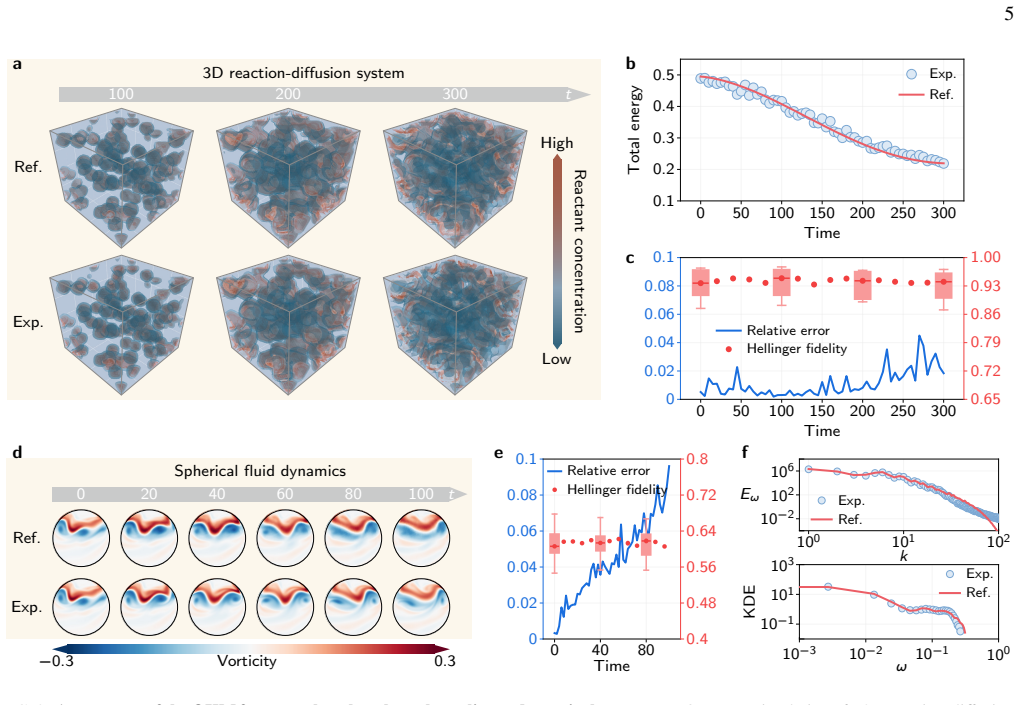
Summary. The manuscript introduces the quantum Koopman method (QKM): nonlinear dynamics are lifted via learned Koopman observables into a finite N=2^n linear system, the non-unitary propagator e^{At} is rewritten by a diagonalized LCHS (Theorems 1–2) and approximated by parallel shallow circuits whose time-evolution block is a single-layer R_z sandwich (Theorem 3), and physical fields are prepared/decoded by a classical NN autoencoder. The pipeline is executed on the superconducting processor “Yudu” for three systems—3D Gray–Scott reaction–diffusion (6 qubits × 8 circuits), spherical shallow-water flow (10 × 32), and satellite Gulf Stream velocities (10 × 8)—reporting energy, enstrophy spectra, L2 error, and Hellinger fidelity, and arguing a transition from hardware-noise-limited to finite-Koopman/ansatz-limited accuracy that defines QKM-amenable / intermediate / prohibitive regimes with theoretical evolution speedup S ∼ O(2^n/n^3) versus classical Koopman propagation.
Significance. If the claims hold, the work is a meaningful hardware-validated step for moderately nonlinear dynamics on NISQ devices: it unifies data-driven Koopman lifting with LCHS-derived, topology-native parallel circuits rather than heuristic VQAs; Theorems 1–3 are stated with SI proofs that match the circuit design; experiments expand prior nonlinear/fluid demos to up to 32 parallel 10-qubit circuits and include real observational data; SI provides noiseless baselines, ablation on h and R_zz, and an explicit error budget. Code is deposited. These strengths make the paper of interest even if the “practical boundary” interpretation must be qualified.
major comments (4)
- Abstract, Discussion, and Fig. 5: the central claim that the experiments “identify a practical boundary for quantum-amenable nonlinear dynamics” (noise-limited → representation-limited) and partition systems into QKM-amenable/intermediate/prohibitive regimes rests on ε_th ≲ ε^*=10^{-3}, operationalized by training loss ℓ_train (Tab. I; SI §8C). Theorems 1–3 rigorously bound only spectral sampling (ε_spec) and single-layer R_z residual (ε_ansatz via high-order Pauli-Z coefficients). Projection error ε_proj from truncating the infinite-dimensional Koopman generator to the learned N-dimensional observables is uncontrolled; the Discussion and SI §8 explicitly leave rigorous bounds on ε_proj open. Without a controlled separation of ε_proj from autoencoder capacity, the regime partition and the claim of reach beyond analytical linearizations remain empirical. Please either (i) provide a quanti
- Methods “Complexity analysis” and Tab. I: the advertised speedup S ∼ O(2^n/n^3) (and S_evo = 2^n/(h n)) is relative to classical dense/sparse propagation of the same finite-N Koopman system, not to classical simulation of the original nonlinear PDE/DNS. Experimental S in Tab. I is 0.14, 0.22, and 0.88—all below unity—so no end-to-end wall-clock advantage is demonstrated. The manuscript should state the baseline explicitly in the abstract/results, report classical Koopman wall-clock cost for the same N,h, and avoid language that could be read as advantage over classical nonlinear solvers. Clarify also that S_total includes M shots and that practical advantage requires N ≳ O(1/ε_meas^2).
- Results (spherical fluid, Gulf Stream) and SI §9: for the two more nonlinear cases, noiseless emulation L2 errors are already comparable to hardware (sphere ≲0.06 vs hardware ~0.1; ocean ~0.21 matching hardware), so the “transition to theory-limited” is largely the autoencoder+ansatz residual. A load-bearing comparison is missing: classical NN/Koopman (or the same encoder–decoder with classical matrix exp(At)) at identical N and training budget. Without it, one cannot attribute multiscale fidelity to the quantum LCHS circuits rather than to the learned reduced model. Please add this classical baseline for at least one intermediate case and discuss what the quantum step uniquely contributes at current n.
- Theorem 1 and SI §1A: the LCHS form requires L ⪯ 0, obtained by a global shift u(t)=e^{bt}c(t). For chaotic/unstable geophysical flows this rescaling changes the observable magnitudes and the Cauchy–Lorentz weights; the manuscript does not report the chosen b, the resulting ||L||_2 used in the Theorem 2 bound, or sensitivity of ε_spec and training loss to b. Please document the shift for each benchmark and verify that the reported spectral-sampling bound remains meaningful after rescaling.
minor comments (5)
- Fig. 1 and Fig. 2 captions/labels contain garbled text (“Λinear”, “efiolution”, “hared operator”, “Yudu” layout labels). Clean for production.
- Tab. I: define Sevo vs S consistently in the caption; “theoretical evolution speedup” vs “quantum speedup” is easy to conflate with end-to-end runtime.
- SI §3 Table S1: “Moderate (physical space)” for QKM vs Carleman/KvN is qualitative; a one-sentence quantitative criterion (e.g., spectral radius or Reynolds/reaction number range) would help.
- Hellinger fidelity is reported as a hardware-vs-ideal quantum distribution metric; briefly note in Methods that it does not measure physical-field accuracy (that is ε_L2), to avoid conflation.
- References: several arXiv preprints of related quantum-fluid work are cited; ensure final versions are updated where available and that the authors’ prior data-driven Koopman preprint is clearly distinguished from the present hardware contribution.
Circularity Check
No load-bearing circular reduction in the theorems or hardware claims; mild fitted-proxy use of training loss for the amenability partition plus non-load-bearing self-citation of the authors’ prior data-driven Koopman preprint.
specific steps
-
fitted input called prediction
[SI §8C (Eqs. S49–S50) + Results ‘Pathway to quantum utility’ + Tab. I + Fig. 5]
"we estimate the relative theoretical and optimization error as ε_th :=relative L2-ε_th ≈ L_train ≈ ℓ_train ... With measured training losses ℓ_train ranging from 10^{-3} to 2×10^{-2} (see Tab. I), the 3D reaction-diffusion benchmark falls within the QKM-amenable regime, whereas the spherical shallow-water and Gulf Stream benchmarks lie in the QKM-intermediate regime."
The operational criterion ε_th ≲ 10^{-3} that partitions systems into QKM-amenable/intermediate/prohibitive (and thereby ‘identifies a practical boundary’) is defined to be the training loss of the model fitted to trajectories of those same systems. The regime labels are therefore the fit quality by construction, not an independent prediction or theorem-derived quantity (Theorems 1–3 bound only ε_spec and ε_ansatz; ε_proj remains open).
-
self citation load bearing
[Introduction (paragraph on existing approaches) + Ref. [41]]
"Although a recent Koopman-inspired approach [41] has explored embedding physical priors into variational circuits, a unified framework that can simultaneously access moderately nonlinear regimes and compile into hardware-feasible circuits remains absent. ... [41] B. Zhang, Z. Lu, Y. Zhao, and Y. Yang, Data-driven quantum Koopman method for simulating nonlinear dynamics, preprint arXiv:2507.21890 (2025)."
The data-driven quantum Koopman premise is introduced via citation to the authors’ own prior preprint; however the citation is not load-bearing for Theorems 1–3, the LCHS circuit construction, the hardware experiments, or the regime analysis, which go beyond the prior work. Mild only.
full rationale
Theorems 1–3 (diagonalized LCHS, spectral sampling bound, single-layer Rz residual via Walsh/Pauli-Z coefficients) are self-contained mathematical derivations with explicit proofs in SI §1 and do not reduce to fitted constants or self-citations. The end-to-end pipeline is explicitly data-driven (joint training of encoder/decoder/circuit parameters on trajectories, Alg. 1), with train/val/test splits and a 2024 held-out Gulf Stream window providing external checks; hardware L2/Hellinger metrics and noiseless-vs-hardware comparisons are independent of the training objective. The only mild circularity is operationalizing the QKM-amenable/intermediate partition (ε_th ≲ 10^{-3}) directly by the fitted training loss ℓ_train (Tab. I, Fig. 5, SI §8C), so the regime labels are by construction the fit quality rather than an independent first-principles prediction. Self-citation of the authors’ prior arXiv:2507.21890 is present but not load-bearing for the new theorems, hardware results, or regime analysis. Projection-error openness is an acknowledged assumption, not a circular step. Overall the derivation chain is not forced by definition or self-citation.
Axiom & Free-Parameter Ledger
free parameters (6)
- Observable dimension N = 2^n and qubit count n
- Number of spectral channels h
- State-prep depth factors R, r
- Shot count M
- Operational accuracy threshold ε* = 10^{-3}
- NN encoder/decoder and circuit rotation parameters
axioms (5)
- domain assumption Koopman generator admits a useful finite-N projection learned from data that preserves dominant dynamics.
- standard math Hermitian part L of A can be made ⪯ 0 by rescaling so diagonalized LCHS (Theorem 1) applies.
- domain assumption Physical initial fields are structured (smooth/symmetric) so poly(n)-depth PQCs plus NN encoder suffice for state preparation.
- ad hoc to paper Target diagonal Hamiltonians concentrate spectral weight in low-order Pauli-Z strings so single-layer Rz error is small (Theorem 3).
- standard math Uniform h-point Cauchy–Lorentz quadrature of the LCHS integral converges as in Theorem 2 bound.
invented entities (2)
-
Quantum Koopman method (QKM) pipeline
independent evidence
-
QKM-amenable / intermediate / prohibitive regimes
no independent evidence
read the original abstract
Nonlinear dynamics is ubiquitous in nature, ranging from chemical pattern formation to ocean circulation, yet its simulation on quantum computers is fundamentally limited by the unitary nature of quantum evolution. We propose the quantum Koopman method, a data-driven framework that embeds nonlinear dynamics into a learned linear representation and implements the resulting evolution using shallow quantum circuits. This method learns Koopman observables from trajectory data, projects the lifted dynamics onto a finite-dimensional subspace, and decomposes the corresponding non-unitary propagator into parallel spectral channels. We utilize the Koopman method on a superconducting processor to simulate three distinct nonlinear systems, comprising reaction-diffusion dynamics, fluid motion on a sphere, and satellite-derived observations of Gulf Stream currents, employing up to 32 parallel circuits of 10 qubits. These quantum simulations capture the dominant multiscale patterns and statistical signatures of the underlying dynamics, and reveal a transition from performance limited by hardware noise in weakly nonlinear systems to performance limited by finite-dimensional Koopman representations as nonlinear scale interactions increase. This transition identifies a practical boundary for quantum-amenable nonlinear dynamics, establishing a hardware-validated route for simulating moderately nonlinear dynamics on near-term quantum hardware.
Figures



Reference graph
Works this paper leans on
-
[1]
author author D. An , author J.-P. \ Liu ,\ and\ author L. Lin ,\ title title black Linear combination of Hamiltonian Simulation for Nonunitary Dynamics with Optimal State Preparation Cost ,\ @noop journal journal Phys. Rev. Lett. \ volume 131 ,\ pages 150603 ( year 2023 ) NoStop
work page 2023
-
[2]
author author R. M. \ Wilcox ,\ title title black Exponential operators and parameter differentiation in quantum physics ,\ @noop journal journal J. Math. Phys. \ volume 8 ,\ pages 962 ( year 1967 ) NoStop
work page 1967
-
[3]
author author R. O'Donnell ,\ @noop title Analysis of boolean functions \ ( publisher Cambridge University Press ,\ year 2014 ) NoStop
work page 2014
-
[4]
Data-driven quantum Koopman method for simulating nonlinear dynamics
author author B. Zhang , author Z. Lu , author Y. Zhao ,\ and\ author Y. Yang ,\ title title black Data-driven quantum Koopman method for simulating nonlinear dynamics ,\ @noop journal journal preprint arXiv:2507.21890 \ ( year 2025 ) NoStop
work page internal anchor Pith review Pith/arXiv arXiv 2025
-
[5]
author author O. Ronneberger , author P. Fischer ,\ and\ author T. Brox ,\ title title black U-net: convolutional networks for biomedical image segmentation ,\ in\ @noop booktitle Med. Image Comput. Comput.-Assist. Interv. (MICCAI) \ ( organization Springer ,\ year 2015 )\ pp.\ pages 234--241 NoStop
work page 2015
-
[6]
author author H. Li , author J. Xie , author C. Zhang , author Y. Zhang ,\ and\ author Y. Zhao ,\ title title black A transformer-based convolutional method to model inverse cascade in forced two-dimensional turbulence ,\ @noop journal journal J. Comput. Phys. \ volume 520 ,\ pages 113475 ( year 2025 ) NoStop
work page 2025
-
[7]
author author E. Xie , author W. Wang , author Z. Yu , author A. Anandkumar , author J. M. \ Alvarez ,\ and\ author P. Luo ,\ title title black SegFormer : simple and efficient design for semantic segmentation with transformers ,\ @noop journal journal Adv. Neural Inf. Process. Syst. \ volume 34 ,\ pages 12077 ( year 2021 ) NoStop
work page 2021
-
[8]
author author BAQIS ,\ @noop title black Quafu superconducting quantum computing ,\ howpublished https://quafu-sqc.baqis.ac.cn https://quafu-sqc.baqis.ac.cn/home ( year 2024 ) NoStop
work page 2024
-
[9]
author author J.-P. \ Liu , author H. . \ Kolden , author H. K. \ Krovi , author N. F. \ Loureiro , author K. Trivisa ,\ and\ author A. M. \ Childs ,\ title title black Efficient quantum algorithm for dissipative nonlinear differential equations ,\ @noop journal journal Proc. Natl. Acad. Sci. U. S. A. \ volume 118 ,\ pages e2026805118 ( year 2021 ) NoStop
work page 2021
-
[10]
Quantum algorithms for general nonlinear dynamics based on the Carleman embedding
author author D. Jennings , author K. Korzekwa , author M. Lostaglio , author A. T. \ Sornborger , author Y. Subasi ,\ and\ author G. Wang ,\ title title black Quantum algorithms for general nonlinear dynamics based on the Carleman embedding ,\ @noop journal journal arXiv preprint arXiv:2509.07155 \ ( year 2025 ) NoStop
work page internal anchor Pith review Pith/arXiv arXiv 2025
-
[11]
author author I. Joseph ,\ title title black Koopman–von Neumann approach to quantum simulation of nonlinear classical dynamics ,\ @noop journal journal Phys. Rev. Res. \ volume 2 ,\ pages 043102 ( year 2020 ) NoStop
work page 2020
-
[12]
author author I. Novikau \ and\ author I. Joseph ,\ title title black Quantum algorithm for the advection-diffusion equation and the Koopman-von Neumann approach to nonlinear dynamical systems ,\ @noop journal journal Comput. Phys. Commun. \ volume 309 ,\ pages 109498 ( year 2025 ) NoStop
work page 2025
-
[13]
author author P. Gray \ and\ author S. Scott ,\ title title black Autocatalytic reactions in the isothermal, continuous stirred tank reactor: isolas and other forms of multistability ,\ @noop journal journal Chem. Eng. Sci. \ volume 38 ,\ pages 29 ( year 1983 ) NoStop
work page 1983
-
[14]
@noop title black The code is available at https://github.com/YYgroup/QKM https://github.com/YYgroup/QKM. Stop
-
[15]
author author J. Galewsky , author R. K. \ Scott ,\ and\ author L. M. \ Polvani ,\ title title black An initial-value problem for testing numerical models of the global shallow-water equations ,\ @noop journal journal Tellus Ser. A-Dyn. Meteorol. Oceanogr. \ volume 56 ,\ pages 429 ( year 2004 ) NoStop
work page 2004
-
[16]
author author K. J. \ Burns , author G. M. \ Vasil , author J. S. \ Oishi , author D. Lecoanet ,\ and\ author B. P. \ Brown ,\ title title black Dedalus: a flexible framework for numerical simulations with spectral methods ,\ @noop journal journal Phys. Rev. Res. \ volume 2 ,\ pages 023068 ( year 2020 ) NoStop
work page 2020
-
[17]
author author E.U. Copernicus Marine Service (CMEMS) ,\ @noop title black Global ocean gridded L4 sea surface heights and derived variables reprocessed 1993 ongoing ,\ howpublished https://doi.org/10.48670/moi-00148 https://doi.org/10.48670/moi-00148 ( year 2024 ) NoStop
-
[18]
author author H. Hersbach , author B. Bell , author P. Berrisford , author S. Hirahara , author A. Hor \'a nyi , author J. Mu \ n oz-Sabater , author J. Nicolas , author C. Peubey , author R. Radu , author D. Schepers , et al. ,\ title title black The ERA5 global reanalysis ,\ @noop journal journal Q. J. R. Meteorol. Soc. \ volume 146 ,\ pages 1999 ( year...
work page 1999
-
[19]
author author X.-M. \ Zhang , author T. Li ,\ and\ author X. Yuan ,\ title title black Quantum state preparation with optimal circuit depth: implementations and applications ,\ @noop journal journal Phys. Rev. Lett. \ volume 129 ,\ pages 230504 ( year 2022 ) NoStop
work page 2022
-
[20]
author author X. Sun , author G. Tian , author S. Yang , author P. Yuan ,\ and\ author S. Zhang ,\ title title black Asymptotically optimal circuit depth for quantum state preparation and general unitary synthesis ,\ @noop journal journal IEEE Trans. Comput.-Aided Des. Integr. Circuits Syst. \ volume 42 ,\ pages 3301 ( year 2023 ) NoStop
work page 2023
-
[22]
author author Z. Meng , author L. Chen , author J.-P. \ Liu ,\ and\ author G. He ,\ title title black Toward end-to-end quantum simulation of rapidly distorted turbulence ,\ @noop journal journal J. Comput. Phys. \ volume 558 ,\ pages 114888 ( year 2026 ) NoStop
work page 2026
-
[23]
author author S. Sim , author P. D. \ Johnson ,\ and\ author A. Aspuru-Guzik ,\ title title black Expressibility and entangling capability of parameterized quantum circuits for hybrid quantum-classical algorithms ,\ @noop journal journal Adv. Quantum Technol. \ volume 2 ,\ pages 1900070 ( year 2019 ) NoStop
work page 2019
-
[24]
\.Z yczkowski \ and\ author H.-J
author author K. \.Z yczkowski \ and\ author H.-J. \ Sommers ,\ title title black Average fidelity between random quantum states ,\ @noop journal journal Phys. Rev. A \ volume 71 ,\ pages 032313 ( year 2005 ) NoStop
work page 2005
-
[25]
author author I. Goodfellow , author Y. Bengio , author A. Courville ,\ and\ author Y. Bengio ,\ @noop title Deep learning ,\ Vol. volume 1 \ ( publisher MIT press Cambridge ,\ year 2016 ) NoStop
work page 2016
- [26]
- [27]
-
[28]
Akiba, Takaki and Morii, Youhi and Maruta, Kaoru , year =. Sci. Rep. , volume =
-
[29]
Quantum dynamics simulation of the advection-diffusion equation , author=. Phys. Rev. Res. , volume=. 2025 , publisher=
work page 2025
-
[30]
An, Dong and Liu, Jin-Peng and Lin, Lin , year =. Linear combination of. Phys. Rev. Lett. , volume =
-
[31]
Quantum variational algorithms are swamped with traps , author=. Nat. Commun. , volume=. 2022 , publisher=
work page 2022
-
[32]
Improving vision transformers by revisiting high-frequency components , author =. Eur. Conf. Comput. Vis. (ECCV) , pages =. 2022 , organization =
work page 2022
-
[33]
Elementary gates for quantum computation , author=. Phys. Rev. A , volume=. 1995 , publisher=
work page 1995
-
[34]
Long-term evolution of ocean eddy activity in a warming world , author=. Nat. Clim. Chang. , volume=. 2022 , publisher=
work page 2022
-
[35]
Compact quantum algorithms for time-dependent differential equations , author=. Phys. Rev. Res. , volume=. 2025 , publisher=
work page 2025
-
[36]
Hybrid quantum algorithms for flow problems , author=. Proc. Natl. Acad. Sci. U. S. A. , volume=. 2023 , publisher=
work page 2023
-
[37]
Machine learning for the physics of climate , author=. Nat. Rev. Phys. , volume=. 2025 , publisher=
work page 2025
- [38]
-
[39]
Quantum algorithm for solving the advection equation using
Brearley, Peter and Laizet, Sylvain , year =. Quantum algorithm for solving the advection equation using. Phys. Rev. A , volume =
- [40]
-
[41]
Quantum algorithm for the advection--diffusion equation simulated with the lattice
Budinski, Ljubomir , journal=. Quantum algorithm for the advection--diffusion equation simulated with the lattice. 2021 , publisher=
work page 2021
- [42]
-
[43]
Challenges and opportunities in quantum machine learning , author=. Nat. Comput. Sci. , volume=
-
[44]
Chen, Shiyi and Doolen, Gary D , journal=. Lattice
-
[45]
Enabling large-scale and high-precision fluid simulations on near-term quantum computers , author=. Comput. Methods Appl. Mech. Eng. , volume=. 2024 , publisher=
work page 2024
-
[46]
Chen, Min and Cheng, Jinglei and Li, Pingzhi and Wang, Haoran and Chen, Tianlong and Liu, Junyu , journal=. Symbolic analysis of. 2026 , publisher=
work page 2026
-
[47]
Quantum algorithm for systems of linear equations with exponentially improved dependence on precision , author=. SIAM J. Comput. , volume=. 2017 , publisher=
work page 2017
-
[48]
Global ocean gridded
-
[49]
The code is available at
-
[50]
Approximation by superpositions of a sigmoidal function , author=. Math. Control Signals Syst. , volume=. 1989 , publisher=
work page 1989
-
[51]
Practical quantum advantage in quantum simulation , author =. 2022 , journal =
work page 2022
-
[52]
Quantum computing for high-energy physics: state of the art and challenges , author=. PRX Quantum , volume=
- [53]
-
[54]
Towards quantum computing of turbulence , author =. 2022 , journal =
work page 2022
-
[55]
On the approximate realization of continuous mappings by neural networks , author=. Neural Netw. , volume=. 1989 , publisher=
work page 1989
- [56]
-
[57]
An initial-value problem for testing numerical models of the global shallow-water equations , author=. Tellus Ser. A-Dyn. Meteorol. Oceanogr. , volume=. 2004 , publisher=
work page 2004
-
[58]
Quantum speedup for aeroscience and engineering , author =. 2020 , journal =
work page 2020
- [59]
-
[60]
A quantum-inspired approach to exploit turbulence structures , author=. Nat. Comput. Sci. , volume=. 2022 , publisher=
work page 2022
-
[61]
Autocatalytic reactions in the isothermal, continuous stirred tank reactor: isolas and other forms of multistability , author =. Chem. Eng. Sci. , volume =. 1983 , publisher =
work page 1983
-
[62]
Quantum algorithm for linear systems of equations , author=. Phys. Rev. Lett. , volume=. 2009 , publisher=
work page 2009
-
[63]
Disentangling hype from practicality: on realistically achieving quantum advantage , author =. 2023 , journal =
work page 2023
-
[64]
Multilayer feedforward networks are universal approximators , author=. Neural Netw. , volume=. 1989 , publisher=
work page 1989
-
[65]
Variational quantum algorithms for computational fluid dynamics , author=. AIAA J. , volume=. 2023 , publisher=
work page 2023
-
[66]
Jennings, David and Korzekwa, Kamil and Lostaglio, Matteo and Wang, Guoming , year =. Quantum
-
[67]
Time complexity analysis of quantum algorithms via linear representations for nonlinear ordinary and partial differential equations , author =. J. Comput. Phys. , volume =
-
[68]
Quantum simulation of partial differential equations via
Jin, Shi and Liu, Nana and Yu, Yue , journal=. Quantum simulation of partial differential equations via
-
[69]
Joseph, Ilon , journal =
-
[70]
Koopman, Bernard O , journal =
-
[71]
Barren plateaus in variational quantum computing , author=. Nat. Rev. Phys. , pages=. 2025 , publisher=
work page 2025
-
[72]
A multiple-circuit approach to quantum resource reduction with application to the quantum lattice
Lee, Melody and Song, Zhixin and Kocherla, Sriharsha and Adams, Austin and Alexeev, Alexander and Bryngelson, Spencer H , journal=. A multiple-circuit approach to quantum resource reduction with application to the quantum lattice. 2026 , publisher=
work page 2026
-
[73]
Learning spatiotemporal dynamics with a pretrained generative model , author=. Nat. Mach. Intell. , volume=. 2024 , publisher=
work page 2024
-
[74]
Fourier neural operator for parametric partial differential equations , author=. Int. Conf. Learn. Represent. (ICLR) , year=
-
[75]
On the homotopy analysis method for nonlinear problems , author =. 2004 , journal =
work page 2004
-
[76]
Lin, Yen Ting and Tian, Yifeng and Livescu, Daniel and Anghel, Marian , journal=. Data-driven learning for the. 2021 , publisher=
work page 2021
-
[77]
Efficient quantum algorithm for dissipative nonlinear differential equations , author =. Proc. Natl. Acad. Sci. U. S. A. , volume =. 2021 , publisher =
work page 2021
-
[78]
Analysis of operator splitting errors for near-limit flame simulations , author =. 2017 , journal =
work page 2017
-
[79]
Quantum computing of reacting flows via
Lu, Zhen and Yang, Yue , year =. Quantum computing of reacting flows via. Proc. Combust. Inst. , volume =
-
[80]
Variational quantum algorithms for nonlinear problems , author=. Phys. Rev. A , volume=. 2020 , publisher=
work page 2020
-
[81]
Deep learning for universal linear embeddings of nonlinear dynamics , author=. Nat. Commun. , volume=. 2018 , publisher=
work page 2018
discussion (0)
Sign in with ORCID, Apple, or X to comment. Anyone can read and Pith papers without signing in.