REVIEW 1 major objections 8 minor 43 references
Pipeline discovers unknown AI face generators from rejected images
Reviewed by Pith at T0; open to challenge. T0 means a machine referee read the full paper against a public rubric. the ladder, T0–T4 →
T0 review · glm-5.2
2026-07-09 07:18 UTC pith:FLKO4DWI
load-bearing objection Incremental unknown-generator discovery is a real contribution, but the headline clustering metrics are computed on a doubly-filtered subset and the discovery stage is carried entirely by FSD features, not I-JEPA. the 1 major comments →
Face-trace: Open-Set Attribution and Progressive Discovery of Synthetic Face Generators
The pith
A machine-rendered reading of the paper's core claim, the machinery that carries it, and where it could break.
Core claim
The paper's central claim is that unknown synthetic face generators can be discovered — not merely rejected — by clustering rejected samples in a fused representation space combining projected I-JEPA features with Forensic Self-Descriptors, and that this discovery can proceed incrementally as samples arrive over time without retraining. The ablation reveals that I-JEPA embeddings alone yield ARI=0.00 for clustering unknown generators; the discovery stage's success is carried by the FSD component, which provides the forensic microstructure information needed to separate generators. The fused representation outperforms either component alone, suggesting complementarity between high-level视觉特征和法
What carries the argument
Fused representation: 64-dim PCA-reduced projected I-JEPA embedding concatenated with 64-dim PCA-reduced Forensic Self-Descriptor, forming a 128-dim vector clustered by HDBSCAN after UMAP preprocessing. Energy score from classifier logits used for OOD rejection. Incremental discovery uses Mahalanobis distance matching to existing clusters with adaptive per-cluster radii, buffering unmatched samples, and promoting candidate clusters that meet minimum support and cohesion thresholds.
Load-bearing premise
The clustering quality depends on Forensic Self-Descriptors producing compact, generator-specific clusters for unseen generators. The ablation shows that without FSD, no clustering structure emerges from I-JEPA embeddings alone. If FSD features do not generalize to future generator architectures with different forensic microstructures, the discovery stage would fail.
What would settle it
If a new class of generators produces images whose forensic microstructures are not captured by FSD — for example, architectures that leave different or weaker traces — the fused representation would not produce separable clusters, and the discovery stage would produce noise or merged groups rather than meaningful unknown-generator categories.
If this is right
- A deployed forensic system could progressively build a catalog of unknown generators without retraining, assigning pseudo-labels to new sources as they appear in a stream.
- The incremental design means the system can operate in streaming conditions, processing rejected samples one at a time rather than requiring a batch of unknowns upfront.
- The modular separation of classification, rejection, and discovery allows each component to be upgraded independently — a better rejection module would directly improve discovery input quality.
- The cross-dataset experiment (two novel clusters promoted, ARI=0.33, purity=78.94%) suggests the discovered unknown space can transfer across data distributions, though with significant degradation.
Editorial analysis
A structured set of objections, weighed in public.
Referee Report
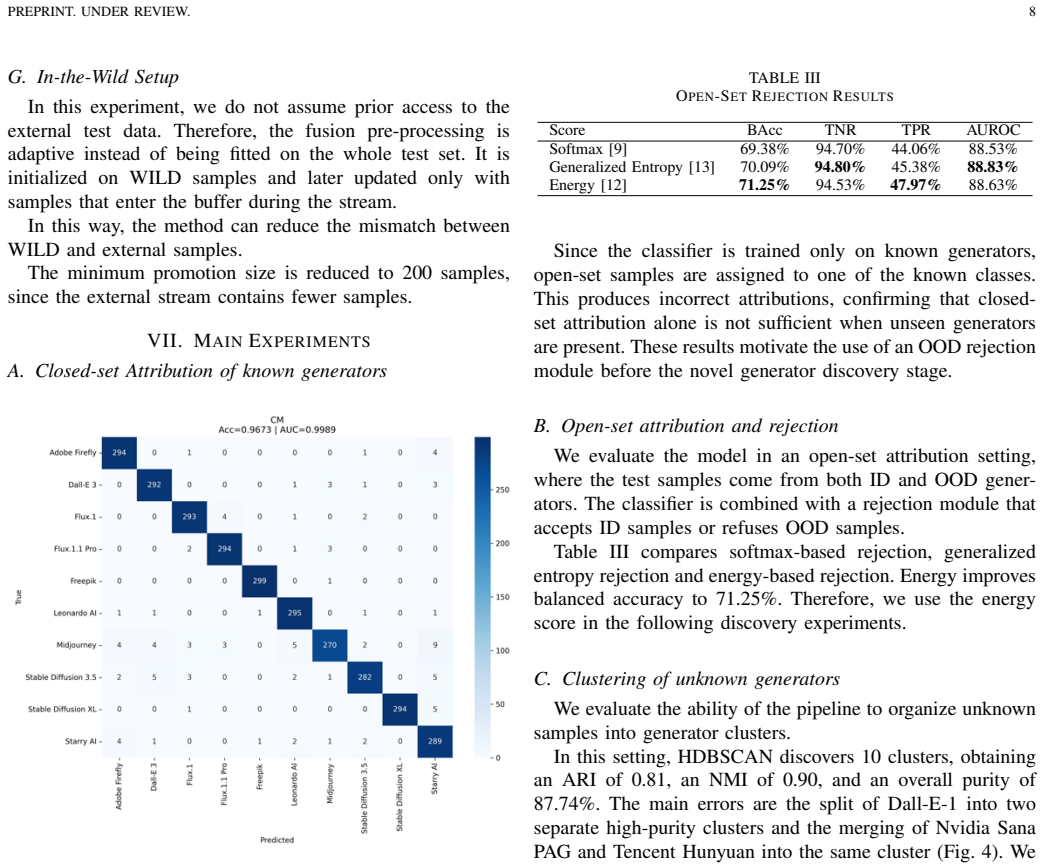
Summary. The paper proposes a pipeline for open-set synthetic face source attribution combining three stages: (1) closed-set classification using frozen I-JEPA embeddings, (2) energy-based OOD rejection, and (3) unknown generator discovery via HDBSCAN clustering of rejected samples using fused I-JEPA + Forensic Self-Descriptor (FSD) features. The pipeline is extended to an incremental setting where rejected samples arrive over time and are either matched to existing discovered clusters or buffered for new cluster promotion. Experiments on the WILD dataset (10 known, 10 unknown generators) report 96.73% closed-set accuracy, 71.25% balanced rejection accuracy, ARI=0.81/NMI=0.90/87.74% purity for offline clustering, and 99.23% final purity in the incremental setting. Cross-dataset and post-processing robustness experiments are also reported.
Significance. The paper addresses a practically important problem: organizing rejected unknown-generator samples into coherent groups rather than simply discarding them. The incremental, non-transductive formulation is a meaningful contribution to the forensic attribution literature. The ablation in Table VII is commendably honest in showing that I-JEPA embeddings alone yield ARI=0.00 and that the discovery stage's clustering quality is carried by FSD features. The cross-dataset experiment (Table X, Appendix C) and post-processing robustness analysis (Table VI) provide useful negative results. The pipeline is well-motivated and the experimental protocol is generally thorough.
major comments (1)
- §V-B and §VII-C: The headline clustering metrics (ARI=0.81, NMI=0.90, purity=87.74%) are computed only on non-noise samples, as stated in §V-B: 'all clustering metrics are computed only on non-noise samples.' The paper does not report what fraction of the 10,000 OOD samples are marked as noise by HDBSCAN. Additionally, the energy rejection stage (Table III) achieves TPR=47.97%, meaning approximately 52% of OOD samples are incorrectly accepted as known and never reach the discovery stage. The headline clustering metrics are therefore computed on a doubly-filtered subset of unknown samples. This is load-bearing for the central claim of 'discovering unknown generators.' The authors should report (a) the noise fraction, (b) the effective number of samples on which clustering metrics are computed, and (c) clustering metrics computed on the full OOD population (with noise samples counted as a
minor comments (8)
- Table III: The TPR of 47.97% means a majority of OOD samples bypass the discovery stage entirely. This should be stated explicitly in the main text as a known limitation of the pipeline, not only inferable from the table.
- §IV-D: The Mahalanobis distance is used for matching, but it is unclear whether the covariance matrix is estimated per-cluster or globally. Please clarify.
- §VI-F: The matching radius is defined using the 0.95 quantile of cluster distances and a margin equal to 0.95. It is unclear how these two values combine — is the radius the quantile value, the quantile plus the margin, or the quantile multiplied by the margin? Please clarify.
- Table VI vs. Table VII: The 'Plain' row in Table VI reports ARI=0.87, NMI=0.94, purity=89.19%, while Table VII's default row reports ARI=0.79, NMI=0.88, purity=0.86 for the same configuration (all open-set samples, no rejection, same HDBSCAN parameters). Please reconcile these differences.
- §VII-E: The in-the-wild experiment reports ARI=0.33, NMI=0.40, purity=78.94% for promoted novel clusters (Appendix XI), which is substantially lower than the WILD results. The main text should discuss this performance gap more explicitly.
- The paper uses both 'Forensic Self-Descriptors' and 'Forensic Self-Descriptions' (§II-E). Please use consistent terminology.
- Fig. 4 and Fig. 5: The UMAP visualizations would benefit from explicit legend labels for all generator classes.
- §III-C, Eq. (8): The per-cluster matching radius δ_q is mentioned but its computation is only described later in §VI-F. A forward reference would improve clarity.
Simulated Author's Rebuttal
The referee raises a valid and important point about the transparency of the headline clustering metrics. We agree that the noise fraction and effective sample counts must be reported, and that full-population clustering metrics should be included. We will revise the manuscript accordingly.
read point-by-point responses
-
Referee: §V-B and §VII-C: The headline clustering metrics (ARI=0.81, NMI=0.90, purity=87.74%) are computed only on non-noise samples, as stated in §V-B: 'all clustering metrics are computed only on non-noise samples.' The paper does not report what fraction of the 10,000 OOD samples are marked as noise by HDBSCAN. Additionally, the energy rejection stage (Table III) achieves TPR=47.97%, meaning approximately 52% of OOD samples are incorrectly accepted as known and never reach the discovery stage. The headline clustering metrics are therefore computed on a doubly-filtered subset of unknown samples. This is load-bearing for the central claim of 'discovering unknown generators.' The authors should report (a) the noise fraction, (b) the effective number of samples on which clustering metrics are computed, and (c) clustering metrics computed on the full OOD population (with noise samples counted as a
Authors: The referee is correct on all counts. The current presentation is incomplete in a way that could mislead readers about the effective coverage of the discovery stage. We will address this in the revision as follows: revision_made = 'yes'. revision_details = (1) We will report the noise fraction from HDBSCAN on the energy-rejected samples. (2) We will report the effective number of samples on which the headline clustering metrics (ARI, NMI, purity) are computed, making explicit the chain: 10,000 OOD samples → ~4,797 correctly rejected by energy (TPR=47.97%) → subset marked as non-noise by HDBSCAN → metrics computed on this subset. (3) We will add clustering metrics computed on the full OOD population of 10,000 samples, treating both (i) OOD samples incorrectly accepted as known by the energy stage and (ii) HDBSCAN noise samples as assignment failures (i.e., each counted as belonging to a single 'unassigned' group or as singleton clusters, following standard practice for evaluating clustering with noise). This will give readers a complete picture of end-to-end discovery performance, including the compounding effect of rejection errors. We agree that the abstract and main text should contextualize the headline numbers with these effective coverage figures so that the central claim of 'discovering unknown generators' is not overstated. We note that the incremental setting results (Table V) already report assignment rates (DMR, FAR, SBR) that partially address coverage, but the offline clustering section does not, and this gap will be closed. revision: no
Circularity Check
No significant circularity found; the derivation chain is self-contained against external benchmarks.
full rationale
The paper's pipeline combines four components: (1) a frozen I-JEPA encoder [30] for feature extraction, (2) an MLP classifier trained with cross-entropy on known generators, (3) energy-based OOD rejection [12] with a threshold calibrated on known-generator validation data at 5% FPR, and (4) HDBSCAN clustering [31] on fused FSD+I-JEPA features for unknown generator discovery. Each component is either a standard method from external work or a straightforward supervised training step. The key representation for discovery—Forensic Self-Descriptors [28]—is cited from Nguyen, Azizpour, and Stamm, who are not authors of the present paper (Infantino, Schiavella, Amerini). Similarly, the autonomous clustering system [29] is by the same external group. The ablation in Table VII transparently shows that I-JEPA features alone yield ARI=0.00 and that FSD carries the clustering performance, but this is a design-dependency and generalization concern, not circularity: the FSD features are externally developed and the clustering targets (unknown generators) are held out during training. The skeptic's concern about metrics being computed only on non-noise samples after OOD rejection is a valid evaluation-validity issue (potential overstatement of practical performance), but it does not constitute circular derivation—no step reduces to its own inputs by construction, no prediction is a fitted parameter renamed, and no load-bearing self-citation chain exists. The score of 1 reflects the minor observation that the central discovery result depends heavily on an externally cited feature extractor whose generalization is untested beyond the WILD dataset, but this is normal scientific dependency, not circularity.
Axiom & Free-Parameter Ledger
free parameters (15)
- Energy temperature T =
1
- Rejection threshold τ =
5% FPR on validation set
- UMAP n_neighbors =
15 (offline), 20 (init)
- UMAP min_dist =
0.3
- UMAP n_components =
32
- HDBSCAN min_cluster_size =
90 (offline), 40 (buffer)
- HDBSCAN min_samples =
15 (offline), 5 (buffer)
- HDBSCAN epsilon (cluster_selection_epsilon) =
0.5 (offline), 0.6 (init/buffer)
- Buffer size B =
700
- Minimum promotion size n_min =
300 (WILD), 200 (in-the-wild)
- Maximum promotion dispersion ρ_max =
26
- Matching radius quantile =
0.95
- Max buffer retention =
4 buffer clustering attempts
- PCA dimensions per branch =
64
- Label smoothing =
0.1
axioms (5)
- domain assumption Frozen I-JEPA embeddings preserve generator-specific information distinguishable by a lightweight classifier
- domain assumption Energy scores from a classifier trained on known generators separate ID from OOD samples
- domain assumption FSD features capture forensic microstructures that cluster by generator
- standard math HDBSCAN can discover generator-specific clusters without knowing the number of generators
- domain assumption Rejected samples from the same unknown generator form compact clusters in the fused embedding space
read the original abstract
Recent advances in generative Artificial Intelligence have made synthetic face images increasingly realistic, creating new challenges for multimedia forensics. Source attribution methods should not only identify the generator of an image when the source is known, but also handle samples produced by previously unseen models. However, most existing approaches address synthetic face attribution in a closed-set setting, where all possible generators are available during training. This assumption does not hold in real-world scenarios, where new generators continuously appear and rejected samples should be organized rather than simply discarded. In this work we propose a pipeline for open-set synthetic face source attribution that combines known generator classification, energy-based OOD rejection, and unknown generator discovery. A classifier is trained on known generators using frozen I-JEPA embeddings, while rejected samples are represented by combining projected I-JEPA features with Forensic Self-Descriptors and then clustered to discover groups of unknown generators. We also extend the discovery stage to an incremental scenario, where rejected samples arrive over time. Experiments on the WILD dataset show that the proposed method achieves 96.73% closed-set attribution accuracy. In the open-set setting, energy-based rejection reaches 71.25% balanced accuracy, while rejected samples are clustered into meaningful unknown-generator groups, obtaining an ARI of 0.81, an NMI of 0.90, and an overall clustering purity of 87.74%. In the incremental setting, the discovered generator space is progressively extended while maintaining a final purity of 99.23%. Cross-dataset experiments suggest that the pipeline can operate beyond the original dataset distribution, although post-processing remains challenging.
Figures




Reference graph
Works this paper leans on
-
[1]
AI-synthesized faces are indistin- guishable from real faces and more trustworthy,
S. J. Nightingale and H. Farid, “AI-synthesized faces are indistin- guishable from real faces and more trustworthy,”Proc. Natl. Acad. Sci. U.S.A., vol. 119, no. 8, Art. no. e2120481119, Feb. 2022, doi: 10.1073/pnas.2120481119
-
[2]
Face Deepfakes -- A Comprehensive Review
T. Fernando, D. Priyasad, S. Sridharan, A. Ross, and C. Fookes, “Face deepfakes: A comprehensive review,”arXiv preprint arXiv:2502.09812, 2025
work page internal anchor Pith review Pith/arXiv arXiv 2025
-
[3]
Deepfake Media Forensics: State of the Art and Challenges Ahead
I. Amerini, M. Barni, S. Battiato, P. Bestagini, G. Boato, T. S. Bonaven- tura, V . Bruni, R. Caldelli, F. De Natale, R. De Nicola, L. Guarnera, S. Mandelli, G. L. Marcialis, M. Micheletto, A. Montibeller, G. Orr `u, A. Ortis, P. Perazzo, G. Puglisi, D. Salvi, S. Tubaro, C. M. Tonti, M. Villari, and D. Vitulano, “Deepfake media forensics: State of the art...
work page internal anchor Pith review Pith/arXiv arXiv 2024
-
[4]
Deepfake attribution: On the source identification of artificially generated images,
B. Khoo, R. C.-W. Phan, and C.-H. Lim, “Deepfake attribution: On the source identification of artificially generated images,”WIREs Data Mining Knowl. Discov., 2021, doi: 10.1002/widm.1438
-
[5]
Deepfake detection, attribution, and authentication: Insights from the FF4ALL project,
I. Amerini, M. Barni, S. Battiato, P. Bestagini, G. Boato, P. Bongini, V . Bruni, R. Casula, L. Cirillo, R. Caldelli, G. Daidone, F. De Natale, R. De Nicola, L. Guarnera, S. M. La Cava, S. Mandelli, G. L. Marcialis, M. Micheletto, A. Montibeller, V . Negroni, G. Orr`u, P. Perazzo, G. Puglisi, D. Salvi, B. Tondi, S. Tubaro, M. Villari, and D. Vitulano, “De...
work page 2026
-
[6]
M. Salehi, H. Mirzaei, D. Hendrycks, Y . Li, M. H. Rohban, and M. Sabokrou, “A unified survey on anomaly, novelty, open-set, and out-of- distribution detection: Solutions and future challenges,”arXiv preprint arXiv:2110.14051, 2021
work page internal anchor Pith review Pith/arXiv arXiv 2021
-
[7]
UMAP: Uniform Manifold Approximation and Projection for Dimension Reduction
L. McInnes, J. Healy, and J. Melville, “UMAP: Uniform manifold approximation and projection for dimension reduction,”arXiv preprint arXiv:1802.03426, 2020
work page internal anchor Pith review Pith/arXiv arXiv 2020
-
[8]
Generalized out-of-distribution detection: A survey,
J. Yang, K. Zhou, Y . Li, and Z. Liu, “Generalized out-of-distribution detection: A survey,”Int. J. Comput. Vis., vol. 132, pp. 5635–5662, 2024, doi: 10.1007/s11263-024-02117-4
-
[9]
A baseline for detecting misclassified and out-of-distribution examples in neural networks,
D. Hendrycks and K. Gimpel, “A baseline for detecting misclassified and out-of-distribution examples in neural networks,” inProceedings of the 5th International Conference on Learning Representations (ICLR), 2017
work page 2017
-
[10]
Scaling Out-of-Distribution Detection for Real-World Settings
D. Hendrycks, S. Basart, M. Mazeika, M. Mostajabi, J. Steinhardt, and D. Song, “A benchmark for anomaly segmentation,”arXiv preprint arXiv:1911.11132, 2019
work page internal anchor Pith review Pith/arXiv arXiv 1911
-
[11]
On the Importance of Gradients for Detecting Distributional Shifts in the Wild
R. Huang, A. Geng, and Y . Li, “On the importance of gradi- ents for detecting distributional shifts in the wild,”arXiv preprint arXiv:2110.00218, 2021
work page internal anchor Pith review Pith/arXiv arXiv 2021
-
[12]
Energy-based out-of- distribution detection,
W. Liu, X. Wang, J. D. Owens, and Y . Li, “Energy-based out-of- distribution detection,” inAdvances in Neural Information Processing Systems, vol. 33, 2020, pp. 21464–21475
work page 2020
-
[13]
GEN: Pushing the limits of softmax- based out-of-distribution detection,
X. Liu, Y . Lochman, and C. Zach, “GEN: Pushing the limits of softmax- based out-of-distribution detection,” inProc. IEEE/CVF Conf. Comput. Vis. Pattern Recognit. (CVPR), pp. 23946–23955, 2023
work page 2023
-
[14]
Towards generalizable detector for generated image,
Q. Cai, C. Wu, Y . Zhang, J. Yu, and X. Tian, “Towards generalizable detector for generated image,”OpenReview, 2026. [Online]. Available: https://openreview.net/forum?id=MeawZGFIcT
work page 2026
-
[15]
Deepfake network architecture attribution,
T. Yang, Z. Huang, J. Cao, L. Li, and X. Li, “Deepfake network architecture attribution,” inProc. AAAI Conf. Artif. Intell., vol. 36, no. 4, pp. 4662–4670, 2022, doi: 10.1609/aaai.v36i4.20391
-
[16]
RepMix: Representation mixing for robust attribution of synthesized images,
T. Bui, N. Yu, and J. Collomosse, “RepMix: Representation mixing for robust attribution of synthesized images,” inProceedings of the European Conference on Computer Vision (ECCV), 2022, pp. 146–163
work page 2022
-
[17]
Progres- sive open space expansion for open-set model attribution,
T. Yang, D. Wang, F. Tang, X. Zhao, J. Cao, and S. Tang, “Progres- sive open space expansion for open-set model attribution,” inProc. IEEE/CVF Conf. Comput. Vis. Pattern Recognit. (CVPR), pp. 15856– 15865, 2023
work page 2023
-
[18]
Beyond deepfake vs real: Facial deepfake detection in the open-set paradigm,
T. T. N. Bahavan, S. Seneviratne, S. Saha, K. Chen, S. Rasnayaka, and S. Halgamuge, “Beyond deepfake vs real: Facial deepfake detection in the open-set paradigm,”arXiv preprint arXiv:2503.08055, 2026
-
[19]
Learning transferable visual models from natural language supervi- sion,
A. Radford, J. W. Kim, C. Hallacy, A. Ramesh, G. Goh, S. Agarwal, G. Sastry, A. Askell, P. Mishkin, J. Clark, G. Krueger, and I. Sutskever, “Learning transferable visual models from natural language supervi- sion,” inProceedings of the 38th International Conference on Machine Learning (ICML), 2021, vol. 139, pp. 8748–8763
work page 2021
-
[20]
O. Sim ´eoni, H. V . V o, M. Seitzer, F. Baldassarre, M. Oquab, C. Jose, V . Khalidov, M. Szafraniec, S. Yi, M. Ramamonjisoa, F. Massa, D. Haziza, L. Wehrstedt, J. Wang, T. Darcet, T. Moutakanni, L. Sentana, C. Roberts, A. Vedaldi, J. Tolan, J. Brandt, C. Couprie, J. Mairal, H. J ´egou, P. Labatut, and P. Bojanowski, “DINOv3,”arXiv preprint arXiv:2508.10104, 2025
work page internal anchor Pith review Pith/arXiv arXiv 2025
-
[21]
Supervised contrastive learning for few-shot AI-generated image detection and attribution,
J. A. Urue ˜na, D. Camacho, and J. Huertas Tato, “Supervised contrastive learning for few-shot AI-generated image detection and attribution,” arXiv preprint arXiv:2511.16541, 2025
-
[22]
Generalizable synthetic image detection via language-guided contrastive learning,
H. Wu, J. Zhou, and S. Zhang, “Generalizable synthetic image detection via language-guided contrastive learning,”IEEE Trans. Artif. Intell., vol. 7, no. 6, pp. 3485–3496, 2026, doi: 10.1109/TAI.2025.3641104
-
[23]
DE-FAKE: Detection and attribution of fake images generated by text-to-image generation models,
Z. Sha, Z. Li, N. Yu, and Y . Zhang, “DE-FAKE: Detection and attribution of fake images generated by text-to-image generation models,” inProc. ACM SIGSAC Conf. Comput. Commun. Secur. (CCS), pp. 3418–3432, 2023, doi: 10.1145/3576915.3616588
-
[24]
Are CLIP features all you need for universal synthetic image origin attribution?,
D. Cioni, C. Tzelepis, L. Seidenari, and I. Patras, “Are CLIP features all you need for universal synthetic image origin attribution?,” inCom- puter Vision–ECCV 2024 Workshops, pp. 363–382, Cham, Switzerland: Springer, 2025, doi: 10.1007/978-3-031-92648-8 22
-
[25]
Zero-shot clustering of embeddings with pretrained and self-supervised learning encoders,
S. C. Lowe, J. B. Haurum, S. Oore, T. B. Moeslund, and G. W. Taylor, “Zero-shot clustering of embeddings with pretrained and self-supervised learning encoders,”OpenReview, 2024
work page 2024
-
[26]
P. Sinhamahapatra, R. Koner, K. Roscher, and S. G ¨unnemann, “Is it all a cluster game? Exploring out-of-distribution detection based on clustering in the embedding space,”arXiv preprint arXiv:2203.08549, 2022
work page internal anchor Pith review Pith/arXiv arXiv 2022
-
[27]
Towards discovery and attribution of open-world GAN generated images,
S. Girish, S. Suri, S. S. Rambhatla, and A. Shrivastava, “Towards discovery and attribution of open-world GAN generated images,” in Proc. IEEE/CVF Int. Conf. Comput. Vis. (ICCV), pp. 14094–14103, 2021
work page 2021
-
[28]
T. D. Nguyen, A. Azizpour, and M. C. Stamm, “Forensic self- descriptions are all you need for zero-shot detection, open-set source attribution, and clustering of AI-generated images,”arXiv preprint arXiv:2503.21003, 2025
work page internal anchor Pith review Pith/arXiv arXiv 2025
-
[29]
Autonomous and Self-Adapting System for Synthetic Media Detection and Attribution
A. Azizpour, T. D. Nguyen, and M. C. Stamm, “Autonomous and self- adapting system for synthetic media detection and attribution,”arXiv preprint arXiv:2504.03615, 2025
work page internal anchor Pith review Pith/arXiv arXiv 2025
-
[30]
Self-supervised learning from images with a joint-embedding predictive architecture,
M. Assran, Q. Duval, I. Misra, P. Bojanowski, P. Vincent, M. Rab- bat, Y . LeCun, and N. Ballas, “Self-supervised learning from images with a joint-embedding predictive architecture,” inProceedings of the IEEE/CVF Conference on Computer Vision and Pattern Recognition (CVPR), 2023, pp. 15619–15629
work page 2023
-
[31]
Density-based clustering based on hierarchical density estimates,
R. J. G. B. Campello, D. Moulavi, and J. Sander, “Density-based clustering based on hierarchical density estimates,” inAdvances in Knowledge Discovery and Data Mining, J. Pei, V . S. Tseng, L. Cao, H. Motoda, and G. Xu, Eds. Berlin, Germany: Springer, 2013, vol. 7819, pp. 160–172, doi: 10.1007/978-3-642-37456-2 14
-
[32]
WILD: a new in-the-Wild Image Linkage Dataset for synthetic image attribution
P. Bonginiet al., “WILD: A new in-the-wild image linkage dataset for synthetic image attribution,”arXiv preprint arXiv:2504.19595, 2025
work page internal anchor Pith review Pith/arXiv arXiv 2025
-
[33]
SFHQ-T2I: Synthetic faces from text-to-image models,
D. Beniaguev, “SFHQ-T2I: Synthetic faces from text-to-image models,” Kaggle, 2024, doi: 10.34740/KAGGLE/DSV/9548853
-
[34]
So-Fake: Benchmarking and explaining social media image forgery detection,
Z. Huang, T. Li, X. Li, H. Wen, Y . He, J. Zhang, H. Fei, X. Yang, X. Huang, B. Peng, and G. Cheng, “So-Fake: Benchmarking and explaining social media image forgery detection,”arXiv preprint arXiv:2505.18660, 2025
-
[35]
AI-Face: A Million-Scale Demographically Annotated AI-Generated Face Dataset and Fairness Benchmark
L. Lin, Santosh, M. Wu, X. Wang, and S. Hu, “AI-Face: A million- scale demographically annotated AI-generated face dataset and fairness benchmark,”arXiv preprint arXiv:2406.00783, 2025
work page internal anchor Pith review Pith/arXiv arXiv 2025
-
[36]
Supervised contrastive learning,
P. Khosla, P. Teterwak, C. Wang, A. Sarna, Y . Tian, P. Isola, A. Maschinot, C. Liu, and D. Krishnan, “Supervised contrastive learning,” inAdvances in Neural Information Processing Systems, vol. 33, pp. 18661–18673, 2020
work page 2020
-
[37]
Learning to discover novel visual categories via deep transfer clustering,
K. Han, A. Vedaldi, and A. Zisserman, “Learning to discover novel visual categories via deep transfer clustering,” inProceedings of the IEEE/CVF International Conference on Computer Vision (ICCV), 2019, pp. 8400–8408
work page 2019
-
[38]
Generalized category discovery,
S. Vaze, K. Han, A. Vedaldi, and A. Zisserman, “Generalized category discovery,” inProceedings of the IEEE Conference on Computer Vision and Pattern Recognition (CVPR), 2022
work page 2022
-
[39]
Parametric classification for generalized category discovery: A baseline study,
X. Wen, B. Zhao, and X. Qi, “Parametric classification for generalized category discovery: A baseline study,” inProceedings of the IEEE/CVF International Conference on Computer Vision (ICCV), 2023, pp. 16544– 16554
work page 2023
-
[40]
ProtoGCD: Unified and unbiased prototype learning for generalized category discovery,
S. Ma, F. Zhu, X.-Y . Zhang, and C.-L. Liu, “ProtoGCD: Unified and unbiased prototype learning for generalized category discovery,”IEEE Trans. Pattern Anal. Mach. Intell., vol. 47, no. 7, pp. 6022–6038, 2025, doi: 10.1109/TPAMI.2025.3557502
-
[41]
Open-world deepfake attribution via confidence-aware asymmetric learning,
H. Zheng, N. Pu, W. Li, T. Long, N. Sebe, and Z. Zhong, “Open-world deepfake attribution via confidence-aware asymmetric learning,”arXiv preprint arXiv:2512.12667, 2025
-
[42]
VideoMAE V2: Scaling Video Masked Autoencoders with Dual Masking
R. Du, D. Chang, K. Liang, T. Hospedales, Y .-Z. Song, and Z. Ma, “On-the-fly category discovery,” inProc. IEEE/CVF Conf. Com- put. Vis. Pattern Recognit. (CVPR), pp. 11691–11700, 2023, doi: 10.1109/CVPR52729.2023.01125
-
[43]
Novel Class Discovery: an Introduction and Key Concepts
C. Troisemaine, V . Lemaire, S. Gosselin, A. Reiffers-Masson, J. Flocon- Cholet, and S. Vaton, “Novel class discovery: An introduction and key concepts,”arXiv preprint arXiv:2302.12028, 2023. PREPRINT. UNDER REVIEW. 13 APPENDIXA CLUSTERING OF UNKNOWN GENERATORS This appendix reports additional results supporting the clus- tering analysis discussed in the ...
work page internal anchor Pith review Pith/arXiv arXiv 2023
discussion (0)
Sign in with ORCID, Apple, or X to comment. Anyone can read and Pith papers without signing in.