REVIEW 3 major objections 4 minor 30 references
High-order complete flux schemes for convection-diffusion equations on arbitrary subdivisions
T0 review · 3 major / 4 minor · reviewed 2026-07-10 · grok-4.5
Pith's one-line read Exact Green’s-function flux turns convection–diffusion into high-order finite-volume schemes on any mesh or dual mesh.
desk verdict Clean Green’s-function complete-flux construction that removes the dual-mesh constraint for quadratic FV spaces; the abstract overclaims on L2 and 3-D evidence, but the 2-D numerics and derivation are solid enough for referees. read the letter →
The pith
A machine-rendered reading of the paper's core claim, the machinery that carries it, and where it could break.
The reading
What carries the argument
The exact normal-flux identity (homogeneous Scharfetter–Gummel term plus inhomogeneous Green’s-function integrals of source and tangential flux) that is substituted into the control-volume balance, producing the mesh-independent relation (3.16).
What would settle it
On a sequence of rectangular meshes with biquadratic C0 or C1 spaces and deliberately non-Gauss dual meshes (p* far from 1/2-√3/6, or Greville centers), measure the observed L2 convergence rate of the complete-flux scheme; if it falls below three while a classical finite-volume scheme on the same dual mesh also fails, the claimed dual-mesh independence is false.
Extended reading notes
Core claim
Inserting the exact Green’s-function representation of the normal flux into the control-volume balance yields a discrete scheme that is exactly equivalent to the continuous convection–diffusion equation; once the solution is restricted to a finite-dimensional polynomial space of any degree, the scheme automatically inherits optimal accuracy on completely arbitrary dual meshes, including those for which ordinary finite-volume methods lose an order.
Load-bearing premise
That the exact continuous flux relation stays accurate enough after the discrete substitutions needed on triangles (extending the local polynomial across neighboring elements) and after freezing the velocity as piecewise constant to obtain closed Bernoulli formulae.
Editorial extensions
If this is right
- Quadratic and higher-order finite-volume schemes can be built on arbitrary dual meshes without Gauss-point or Greville constraints.
- Positivity can be enforced on moderately coarse meshes simply by rescaling the free signed distances ξ K,ξ L edge-wise.
- The same Green’s-function construction extends verbatim to three-dimensional tetrahedral and hexahedral grids and to any polynomial degree.
- B-spline and other isogeometric spaces become usable for high-order convection–diffusion without dual-mesh redesign.
Reading between the lines
- The free geometric parameters ξ K,ξ L open a route to local, edge-wise positivity or layer-capturing strategies that do not alter the asymptotic order.
- Because the continuous relation is exact, a posteriori error indicators built from the residual of (3.16) should be asymptotically exact once the discrete space is rich enough.
- The same flux identity can be reused inside hybrid discontinuous Galerkin or mixed methods to remove the usual stabilization terms for convection-dominated regimes.
Editorial analysis
A structured set of objections, weighed in public.
Referee Report
Summary. The paper constructs complete-flux finite-volume schemes for steady convection-diffusion equations by deriving an exact normal-flux representation from the PDE via a local Green’s function. The flux splits into a homogeneous Scharfetter–Gummel part and an inhomogeneous part that incorporates the source and tangential flux divergence. Restricting the exact control-volume identity (3.16) to a chosen polynomial space yields discrete schemes of arbitrary order on arbitrary dual meshes. Concrete realizations include second-order schemes on triangles/quadrilaterals, third-order schemes on rectangles with biquadratic C0 Lagrange (parametrized duals) and C1 B-splines (Greville duals), and a formal three-dimensional extension. Numerical tests in two dimensions report optimal (or superconvergent) discrete max-norm rates and improved positivity for suitably scaled geometric parameters ξ Ke, ξ Le.
Significance. If the claimed mesh-independent optimal L2 accuracy for quadratic (and higher) spaces holds, the work removes a long-standing practical obstruction in high-order vertex-centered FVEM/CV-FEM and isogeometric B-spline schemes, where dual-mesh design (Gauss points, Greville placement) has been essential. The continuous exact-flux derivation is clean, recovers classical Bernoulli expressions under constant coefficients, and supplies a flexible geometric parameter that can be used for positivity. These features are of genuine interest for convection-dominated transport on complex meshes. The absence of analysis and of the L2/3-D evidence promised in the abstract, however, leaves the central practical claim only partially substantiated.
major comments (3)
- Abstract and §6 assert that “Numerical experiments in two and three dimensions confirm” optimal accuracy and that the scheme “always achieves optimal L2 convergence independently of the control volume mesh.” Section 5 contains only two two-dimensional examples; no three-dimensional computation appears despite the construction in §4.3. Moreover, all tabulated errors (Table 1, Fig. 6) are discrete ℓ∞ norms at nodes/Greville points, which exhibit superconvergence (order 4 for the quadratic schemes). Optimal L2 rates—the quantity known to degrade for standard FVEM/CV-FEM on non-Gauss duals—are never reported. The central claim therefore rests on evidence that is not present in the manuscript.
- No stability or convergence analysis is supplied for any of the schemes, including the third-order constructions of §4.2. While the continuous identity (3.16) is exact, the discrete schemes introduce several approximations (piecewise-constant velocity, extension of uh across triangles after (4.5), quadratic interpolation of tangential fluxes). The paper itself notes that the triangular extension can produce large layer errors on coarse meshes. Without even a consistency or discrete-maximum-principle argument, the assertion of mesh-independent optimal L2 accuracy remains a numerical observation rather than a demonstrated property.
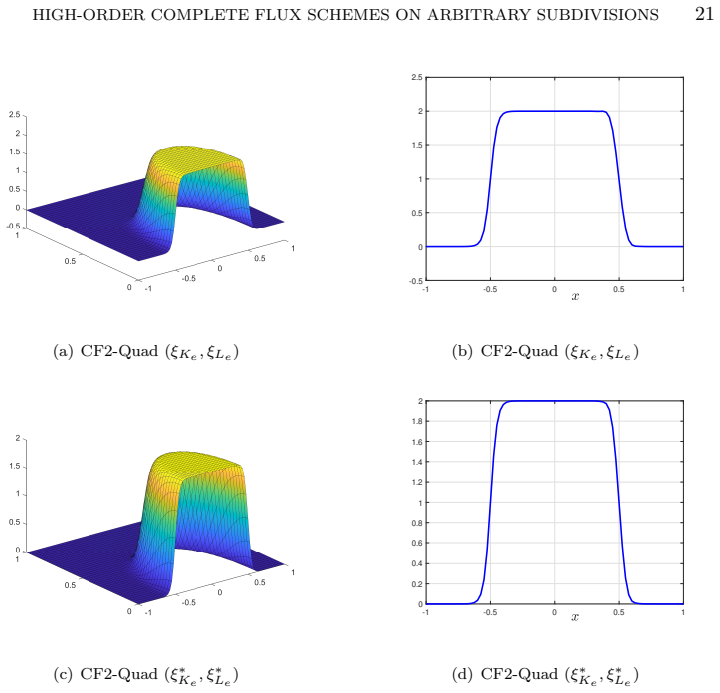
- The free geometric parameters ξ Ke, ξ Le (Remark 3.1) and the dual-mesh parameter p* are presented as advantages, yet no systematic selection principle is given. Subsection 5.2 shows that a particular scaling (0.3) improves positivity while a more aggressive scaling (0.2) does not; the text leaves the choice open. For the method to be usable on general meshes, either a theoretically justified rule or a clear computational strategy for choosing these parameters is needed.
minor comments (4)
- The abstract’s claim of “any polynomial degree” and “arbitrary subdivisions” is stronger than the concrete constructions actually developed (linear/bilinear, biquadratic C0/C1 on rectangles, second-order 3-D). Softening the abstract language would better match the body.
- Lemma 4.1 on stable evaluation of the Bernoulli-type functions is useful; a short remark on floating-point implementation (or a reference to existing libraries) would help practitioners.
- Figure 5(b) shows a locally refined triangular mesh, but the subsequent refinement study uses uniform refinement of that mesh; a brief statement of how hanging-node or adaptive dual meshes are handled would clarify applicability.
- Typographical inconsistencies appear in the arXiv header (“EQUA TIONS”, “an d”, “diffusion”) and in a few places in the text; a careful copy-edit is needed.
Circularity Check
Exact Green’s-function flux identity is derived from the PDE; discrete schemes are restrictions of that identity. No fitted parameters or self-citation force the claimed high-order rates.
full rationale
The paper’s central construction (Sections 3–4) begins from the continuous convection-diffusion equation, rewrites it in local normal-tangential coordinates, solves the resulting one-dimensional ODE with an explicit Green’s function, and obtains the exact control-volume balance (3.16). Discrete schemes are then obtained simply by restricting the same identity to a chosen polynomial space (piecewise linear/bilinear, biquadratic C0 Lagrange, or C1 B-spline) and evaluating the resulting integrals analytically or by quadrature. No free parameters are fitted to data; the Bernoulli-type expressions that appear for constant velocity are closed-form consequences of the Green’s function, not empirical fits. Self-citations are to the classical Scharfetter–Gummel and complete-flux literature (Thiart, ten Thije Boonkkamp et al.) and serve only as historical context; they do not supply uniqueness theorems or ansätze that force the new high-order statements. The numerical section reports discrete max-norm errors that exhibit the expected (super)convergence orders, but these are independent verifications, not inputs that close a circular loop. Consequently the derivation chain is self-contained and essentially free of circularity. (The separate correctness concerns—absence of tabulated L2 rates and of three-dimensional experiments—are outside the scope of a circularity analysis.)
Assumptions & free parameters
free parameters (2)
- dual-mesh parameter p* =
1/4 (used in experiments)
- signed distances ξKe, ξLe =
geometric distances or 0.3× geometric distances
assumptions (4)
- domain assumption The steady convection-diffusion equation −∇·(α∇u − βu) = f holds with α > 0 constant and β, f sufficiently regular.
- standard math For fixed tangential coordinate the local normal operator admits a Green’s function constructed from the two homogeneous solutions y1, y2.
- domain assumption Piecewise-constant approximation of the normal velocity βn on each control-volume edge is accurate enough for the second-order schemes.
- ad hoc to paper On triangular meshes, extending the discrete solution uh from the element containing the edge to neighboring elements introduces only higher-order consistency errors.
invented entities (1)
-
Complete-flux finite-volume schemes of arbitrary polynomial degree on arbitrary dual meshes
Cite this review
Pith. "Pith review of High-order complete flux schemes for convection-diffusion equations on arbitrary subdivisions." pith.science (2026). https://pith.science/paper/BA36FS7R
@misc{pith2026260708422,
  author       = {Pith},
  title        = {Pith review of: High-order complete flux schemes for convection-diffusion equations on arbitrary subdivisions},
  year         = {2026},
  howpublished = {\url{https://pith.science/paper/BA36FS7R}},
  note         = {Machine review of arXiv:2607.08422}
}
abstract
We develop a complete flux finite volume method for convection-diffusion equations that works on arbitrary meshes in two and three dimensions and for discrete spaces of any polynomial degree. Unlike standard finite volume discretizations, where the numerical flux is directly approximated from the flux definition, we derive the exact normal flux across each control volume edge/face from the underlying PDE. This exact flux splits naturally into a homogeneous part (the classical Scharfetter-Gummel flux) and an inhomogeneous part expressed via a Green's function that incorporates the tangential flux and the source term. The resulting formulation is exactly equivalent to the continuous equation and, once the discrete space is chosen, yields high-order schemes without any correction or stabilization. For piecewise linear spaces, the scheme achieves optimal second-order accuracy in convection-dominated regimes and can preserve positivity on moderately coarse meshes. For quadratic spaces, standard finite volume methods, based on the Lagrange elements or B-splines, fail to attain optimal $L^2$ convergence unless the control volume mesh is specially designed. The proposed complete flux scheme, however, always achieves optimal $L^2$ convergence independently of the control volume mesh. Numerical experiments in two and three dimensions confirm the robustness and optimal accuracy of the approach.
Figures


Figures from the paper (4 more)


Reference graph
Works this paper leans on
-
[1]
Aavatsmark , An introduction to multipoint flux approximations for quadr ilateral grids , Comput
I. Aavatsmark , An introduction to multipoint flux approximations for quadr ilateral grids , Comput. Geosci., 6 (2002), pp. 405–432
work page 2002
-
[2]
R. E. Bank and D. J. Rose , Some error estimates for the box method , SIAM J. Numer. Anal., 24 (1987), pp. 777–787
work page 1987
-
[3]
A. N. Brooks and T. J. R. Hughes , Streamline upwind/petrov-galerkin formulations for convection dominated flows with particular emphasis on the i ncompressible navier-stokes equations, Comput. Methods Appl. Mech. Engrg., 32 (1982), pp. 199–259
work page 1982
-
[4]
Cai , On the finite volume element method , Numer
Z. Cai , On the finite volume element method , Numer. Math., 58 (1991), pp. 713–735
work page 1991
-
[5]
Z. Chen, J. Wu, and Y. Xu , Higher-order finite volume methods for elliptic boundary va lue problems, Adv. Comput. Math., 37 (2012), pp. 191–253
work page 2012
-
[6]
H. M. Cheng and J. ten Thije Boonkkamp , A generalised complete flux scheme for aniso- tropic advection-diffusion equations , Adv. Comput. Math., 47 (2021), pp. Paper No. 19, 26
work page 2021
- [7]
-
[8]
P. F arrell and A. Linke , Uniform second order convergence of a complete flux scheme on unstructured 1D grids for a singularly perturbed advection -diffusion equation and some multidimensional extensions , J. Sci. Comput., 72 (2017), pp. 373–395
work page 2017
Show all 30 references
-
[9]
P. A. Forsyth , A control volume finite element approach to NAPL groundwater contamina- tion, SIAM J. Sci. Statist. Comput., 12 (1991), pp. 1029–1057
1991
-
[10]
Hermeline, A finite volume method for the approximation of diffusion oper ators on distorted meshes, J
F. Hermeline, A finite volume method for the approximation of diffusion oper ators on distorted meshes, J. Comput. Phys., 160 (2000), pp. 481–499
2000
-
[11]
T. J. R. Hughes, J. A. Cottrell, and Y. Bazilevs , Isogeometric analysis: CAD, finite elements, NURBS, exact geometry and mesh refinement , Comput. Methods Appl. Mech. Engrg., 194 (2005), pp. 4135–4195
2005
-
[12]
Kamber, H
G. Kamber, H. Gotovac, V. Kozuli ´c, and B. Gotovac , 2-D local hp adaptive isogeometric analysis based on hierarchical Fup basis functions , Comput. Methods Appl. Mech. Engrg., 398 (2022), pp. Paper No. 115272, 32
2022
-
[13]
Kamber, H
G. Kamber, H. Gotovac, V. Kozuli ´c, L. Malenica, and B. z. Gotovac , Adaptive numer- ical modeling using the hierarchical Fup basis functions an d control volume isogeometric analysis, Internat. J. Numer. Methods Fluids, 92 (2020), pp. 1437–14 61
2020
-
[14]
W. Lei, S. Piani, P. F arrell, N. Rotundo, and L. Heltai , A weighted hybridizable discon- tinuous Galerkin method for drift-diffusion problems , J. Sci. Comput., 99 (2024), pp. Paper No. 33, 26
2024
-
[15]
R. J. LeVeque , Finite Volume Methods for Hyperbolic Problems , Cambridge University Press, 2002
2002
-
[16]
R. Li, Z. Chen, and W. Wu , Generalized difference methods for differential equations , vol. 226, Marcel Dekker, Inc., New York, 2000
2000
-
[17]
Y. Li, P. Yang, and Z. Zhang , Polynomial preserving recovery for the finite volume elemen t This manuscript is for review purposes only. HIGH-ORDER COMPLETE FLUX SCHEMES ON ARBITRARY SUBDIVISION S 23 methods under simplex meshes , Math. Comp., 94 (2025), pp. 611–645
2025
-
[18]
Y. Lin, M. Yang, and Q. Zou , L2 error estimates for a class of any order finite volume schemes over quadrilateral meshes , SIAM J. Numer. Anal., 53 (2015), pp. 2009–2029
2015
-
[19]
L. Liu, J. van Dijk, J. H. M. ten Thije Boonkkamp, D. B. Mihailov a, and J. J. A. M. van der Mullen , The complete flux scheme—error analysis and application to p lasma simulation, J. Comput. Appl. Math., 250 (2013), pp. 229–243
2013
-
[20]
Patankar, Numerical Heat Transfer and Fluid Flow , CRC press, 2018
S. Patankar, Numerical Heat Transfer and Fluid Flow , CRC press, 2018
2018
-
[21]
H. G. Roos, M. Stynes, and L. Tobiska , Robust numerical methods for singularly perturbed differential equations: convection-diffusion-reaction an d flow problems , Springer, 2nd ed., 2008
2008
-
[22]
Scharfetter and H
D. Scharfetter and H. Gummel , Large-signal analysis of a silicon read diode oscillator , IEEE Transactions on Electron Devices, 16 (1969), pp. 64–77
1969
-
[23]
J. H. Seinfeld and S. N. Pandis , Atmospheric Chemistry and Physics: From Air Pollution to Climate Change , Wiley, 3rd ed., 2016
2016
-
[24]
Selberherr , Analysis and Simulation of Semiconductor Devices , Springer-Verlag, 1984
S. Selberherr , Analysis and Simulation of Semiconductor Devices , Springer-Verlag, 1984
1984
-
[25]
J. H. M. ten Thije Boonkkamp , A complete flux scheme for one-dimensional combustion simulation, in Finite volumes for complex applications IV, 2005, pp. 57 3–583
2005
-
[26]
J. H. M. ten Thije Boonkkamp and M. J. H. Anthonissen , The finite volume-complete flux scheme for advection-diffusion-reaction equations , J. Sci. Comput., 46 (2011), pp. 47–70
2011
-
[27]
Thiart, Improved finite-difference scheme for the solution of convec tion-diffusion problems with the simplen algorithm , Numer
G. Thiart, Improved finite-difference scheme for the solution of convec tion-diffusion problems with the simplen algorithm , Numer. Heat Transf. Part B, 18 (1990), pp. 81–95
1990
-
[28]
Xu and Q
J. Xu and Q. Zou , Analysis of linear and quadratic simplicial finite volume me thods for elliptic equations, Numer. Math., 111 (2009), pp. 469–492
2009
-
[29]
Zhang and Q
Z. Zhang and Q. Zou , Vertex-centered finite volume schemes of any order over quad rilateral meshes for elliptic boundary value problems , Numer. Math., 130 (2015), pp. 363–393
2015
-
[30]
Zheng and G
C. Zheng and G. D. Bennett , Applied Contaminant Transport Modeling , Wiley, 2nd ed., 2002. This manuscript is for review purposes only
2002
Reviewed July 10, 2026 · model on record in the stance chip above.
Discussion (0). Sign in to comment.