REVIEW 3 major objections 5 minor 75 references
Vortex Dynamics in Magic-Angle Twisted Graphene
T0 review · 3 major / 5 minor · reviewed 2026-07-10 · grok-4.5
Pith's one-line read A Josephson junction in twisted graphene tracks single vortices switching from thermal creep to quantum tunneling below ~80 mK.
desk verdict Solid multi-vortex rate analysis on a real device; the thermal-to-MQT claim is carefully hedged and rests on a model-dependent voltage-to-state map that is the main soft spot, not a collapse. read the letter →
The pith
A machine-rendered reading of the paper's core claim, the machinery that carries it, and where it could break.
The reading
What carries the argument
The gate-defined Josephson junction as single-vortex sensor: a vortex in a lead alters the phase difference across the junction, shifting the Fraunhofer pattern of Ic(B) and thereby switching the junction between superconducting and dissipative voltage levels at fixed bias, which appears as telegraph noise whose waiting times yield the dynamical rates.
What would settle it
If the low-temperature saturation of rates disappeared when the same device is remeasured with a different fixed field B* or with an independent vortex-imaging technique that confirms the absence of distant trapped vortices, the multi-vortex interpretation and the quantum-tunneling claim would both be undermined.
Extended reading notes
Core claim
Measurements of Ic(B) and V(t) in a weak-leads Josephson device reveal multi-vortex processes in which fast nearby fluctuations are modulated by quasi-stationary distant vortices; the temperature dependence of the extracted rates shows thermal activation above ~100 mK and saturation below ~80 mK that the authors attribute to macroscopic quantum tunneling of Pearl vortices.
Load-bearing premise
The mapping of distinct voltage levels and waiting-time clusters onto specific multi-vortex configurations (pristine lead versus distant trapped vortex) depends on the relative position of the measurement field to the first Fraunhofer zero and on calculated phase shifts.
Editorial extensions
If this is right
- Single-vortex entry and exit rates can be tracked versus carrier density, magnetic field and temperature in the same device.
- Edge barriers of a few kelvin and tunneling actions S/ℏ ≈ 24–27 are now measured quantities for Pearl vortices in twisted graphene.
- The same sensor architecture can be integrated into superconducting circuits that use or control individual vortices.
- The observed crossover temperature (~80–100 mK) sets a practical bound between classical creep and quantum motion in this material.
Reading between the lines
- The ability to gate-tune the superfluid density continuously suggests a route to map how the thermal-to-quantum crossover temperature scales with barrier height in a single sample.
- Because the sensor is purely transport-based, the same protocol could be applied to other two-dimensional superconductors where scanning probes are harder to implement.
- If the distant quasi-stationary vortices can themselves be manipulated by local gates, the device becomes a controllable multi-vortex register rather than a passive detector.
Signed reviews
Editorial analysis
A structured set of objections, weighed in public.
Referee Report
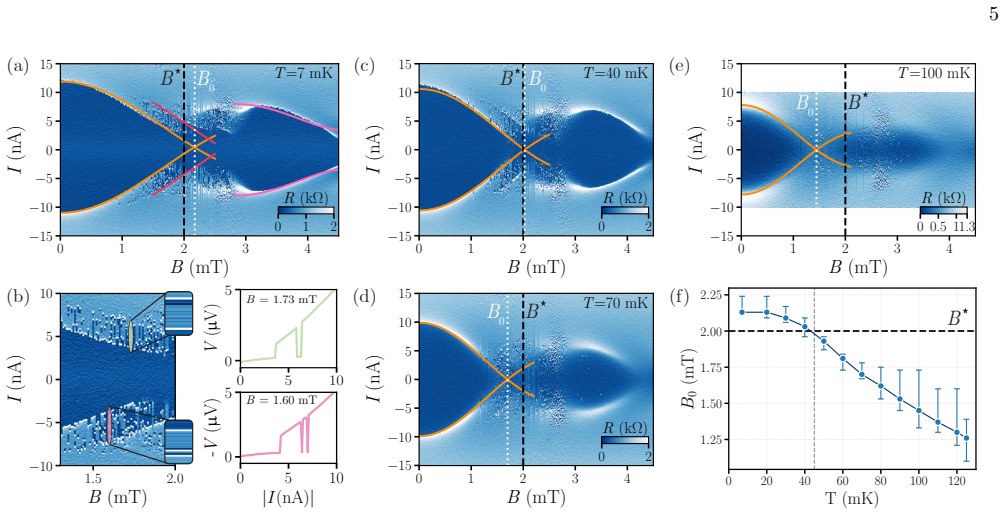
Summary. The manuscript reports a gate-defined Josephson junction fabricated in magic-angle twisted four-layer graphene that functions as a single-vortex sensor. Shifts in the Fraunhofer pattern of Ic(B) and telegraph noise in voltage time traces Vd(t) are interpreted as multi-vortex processes in which fast fluctuations of nearby Pearl vortices are modulated by quasi-stationary distant vortices. Waiting-time analysis of the two distinct clusters in the τnv–τv correlation plots yields four rates (Γfast_nv, Γslow_v, Γslow_nv, Γfast_v). Their temperature dependence between 7 mK and 120 mK is fitted to Arrhenius activation above ≈100 mK and saturates below ≈80 mK; the saturation is presented as evidence for a crossover to macroscopic quantum tunneling of vortices. Barriers U/kB of a few kelvin and actions S/ℏ ≈ 24–27 are extracted and shown to be consistent with the free-energy landscape of a Pearl vortex in a weakly screening strip.
Significance. If the multi-vortex assignment and the thermal-to-quantum interpretation hold, the work supplies a rare transport-based probe of individual Pearl-vortex entry/exit events and their rates in a tunable 2D superconductor. The careful post-processing pipeline (Yuzhelevski digitization, Freedman–Diaconis binning, bi-exponential fits, finite-bandwidth correction) and the public data release strengthen reproducibility. Consistency of the extracted U and S with the theoretical edge-barrier landscape of Ref. [63] and with independent estimates of ρs and λL constitutes a non-trivial check. Observation of macroscopic quantum tunneling of vortices would be of broad interest for quantum creep and for vortex-based superconducting electronics.
major comments (3)
- Sec. IV A–B and Figs. 3(c), 5(c): the four rates that underwrite the thermal/MQT claim are obtained only after the two clusters in the τnv–τv plots are assigned to “pristine lead + nearby fluctuating vortex” versus “distant quasi-stationary vortex + nearby fluctuating vortex.” That assignment rests on (i) the relative position of the fixed measurement field B* = 2 mT with respect to the fitted first zero B0(T) (Fig. 2f) and (ii) the sign of the slope of V(B) at B* (Fig. 4b). Both ingredients are model-dependent: B0 is extracted by fitting Eq. (2) with a temperature-dependent effective width Weff(T) that itself increases from 1.16 µm to 1.5 µm, and the voltage-level ordering is inferred from a calculated vortex-induced phase shift of ~0.4 mT. The paper notes that the signal becomes unusable near T ≈ 45 mK where B* ≈ B0, underscoring the sensitivity of the mapping. Alternative assignments
- Sec. V and Eqs. (3)–(4): the claim of a “sharp transition” to macroscopic quantum tunneling is based on the saturation of the four rates below ≈80 mK. While the data are consistent with a crossover from thermal activation to quantum tunneling, the temperature window is narrow, the attempt frequency ν0 is taken from the literature range rather than measured, and no independent signature (e.g., magnetic-field dependence of the action or a clear T0 matching condition) is provided. A more cautious phrasing—“suggestive of a crossover”—together with an explicit discussion of alternative saturation mechanisms (e.g., residual heating, detector bandwidth, or multi-vortex pinning) would better match the strength of the evidence.
- Sec. III and Fig. 2(f): the observed decrease of B0 with temperature is outside the generic weakly-screening model of Ref. [49] and is attributed to a speculative temperature-dependent suppression of superfluid density near the junction. Because B0(T) directly controls the voltage-to-state mapping used for all rate extractions, a more quantitative model (or at least a systematic uncertainty band on Weff(T)) is needed; otherwise the temperature evolution of the rates inherits an uncontrolled systematic.
minor comments (5)
- Fig. 1(c) and throughout: the top axis is labeled ΦW/Φ0 while the text uses ΦW = B W^{2}; a consistent definition and a brief reminder of the weakly-screening flux-to-field conversion would help readers unfamiliar with Ref. [49].
- Appendix C: the finite-bandwidth correction formulae (C2)–(C3) are taken from Ref. [70]; stating the measured Γdet = 1098(93) Hz already in the main text (rather than only in the appendix) would make the rate values easier to assess.
- Sec. II A: the argument that the junction is short (W ≲ 2ξJ) is clear, yet a short numerical table of the estimated lengths (ξ, λL, Λ, ξJ, W) would make the conclusion more immediately verifiable.
- Several figure panels contain residual OCR artifacts (m¯ for mT, Cou¯ts, etc.); these should be cleaned before final production.
- The relation of the present multi-vortex analysis to the earlier single-vortex reports [46,47] could be stated more explicitly in the introduction so that the incremental contribution is transparent.
Circularity Check
No significant circularity: rates and their T-dependence are extracted from data; Arrhenius/MQT interpretation and consistency checks with free-energy landscape are not forced by construction.
-
fitted input called prediction
[Sec. V, Eqs. (3)–(4) and Figs. 6(c)–(d)]
"Fitting the high-temperature part of the rates with such an Arrhenius law, we can extract u0 in the range o10^11 Hz o and barriers U/kB of a few Kelvin; e.g., o Uslow_v/kB o2.6 K and u0 o2.0 imes10^11 Hz. o Figures 6(c) and (d) show the rates plotted in terms of Snv,v/ u=ln( u'0/ u nv,v) with u'0= u0."
The attempt frequency u0 is obtained by fitting the high-T thermal rates; the identical numerical value is then inserted into the definition of the quantum action S/ u at low T. The plotted saturation values of S/ u therefore inherit the fitted u0 by construction. The raw rate saturation itself remains independent of this conversion, so the circularity is only partial and non-load-bearing for the thermal-to-MQT claim.
full rationale
The central claim rests on measured voltage time traces Vd(t) digitized into waiting times au nv, au v, binned into histograms, and fit to (bi-)exponentials to obtain four rates \Gamma (Sec. IV, Figs. 3 and 5). The observed saturation of those rates below ~80 mK and rapid rise above ~100 mK are direct experimental facts independent of any model input. Assignment of the two clusters to pristine vs. distant-vortex-modulated configurations uses the measured B0(T) trajectory (fit of main lobe to the weakly-screening Fraunhofer formula Eq. 2) and the sign of the measured V(B) slope at B* (Fig. 4); this is model-dependent interpretation, not a tautology that forces the rates themselves. High-T Arrhenius fits supply U and u0; the same u0 is then used to convert low-T rates into S/ u (Figs. 6c,d). That conversion is conventional and does not manufacture the saturation. Subsequent comparison of U ~ ho s and of S with the external free-energy landscape of Ref. [63] is a consistency check, not a prediction derived from the fit. Self-citations to the authors’ prior sensor papers [46,47] supply context and earlier single-vortex observations but are not load-bearing for the new multi-vortex rate extraction or the T-dependence reported here. No equation reduces to its own input by construction, no uniqueness theorem is imported to forbid alternatives, and no ansatz is smuggled via citation. Score 1 reflects only the mild, non-central reuse of the thermally fitted u0 when quoting numerical values of S/ u.
Assumptions & free parameters
free parameters (4)
- attempt frequency ν0 =
~2×10^11 Hz (pristine exit); ~7×10^11 Hz (penetrated exit)
- vortex positions (xv, yv) =
0.67 W / 0 and 0.055 W / 0.12 W
- effective junction width Weff(T) =
1.16 µm (7 mK) to 1.5 µm (120 mK)
- edge barriers U/kB =
≈2.6 K (slow exit), ≈2.0 K (fast exit)
assumptions (4)
- domain assumption The device is in the short-junction limit (W ≤ 2 ξJ), so observed jumps arise from Pearl vortices in the leads rather than metastable Josephson-vortex states.
- domain assumption Free-energy landscape G(y) of a Pearl vortex crossing a thin strip is given by the Bean–Livingston surface barrier plus magnetic and transport-current terms (Ref. [63]).
- ad hoc to paper Voltage levels in the telegraph noise map uniquely onto presence/absence of nearby versus distant vortices according to the sign of (B* – B0).
- standard math Standard Arrhenius and Caldeira–Leggett/Larkin–Ovchinnikov forms for thermally activated and dissipative quantum tunneling rates.
Cite this review
Pith. "Pith review of Vortex Dynamics in Magic-Angle Twisted Graphene." pith.science (2026). https://pith.science/paper/AM6U2JNN
@misc{pith2026260708585,
  author       = {Pith},
  title        = {Pith review of: Vortex Dynamics in Magic-Angle Twisted Graphene},
  year         = {2026},
  howpublished = {\url{https://pith.science/paper/AM6U2JNN}},
  note         = {Machine review of arXiv:2607.08585}
}
abstract
We use a gate-defined Josephson junction (JJ) device made from twisted-layer graphene for studying vortex dynamics in two dimensions. The JJ sensor signals the presence of individual vortices in the superconducting leads nearby the junction through shifts in the Fraunhofer interference pattern of the magnetic-field-dependent critical current $I_c(B)$ across the junction. Rapid vortex fluctuations manifest as telegraph-type noise in time traces of the junction voltage $V(t)$. Measurements of $I_c(B)$ and $V(t)$ are interpreted in terms of multi-vortex processes where fast vortex fluctuations in the leads are modulated by quasi-stationary vortices trapped in the leads. The different timescales associated with these processes allow for their disentangling and quantitative analysis. Tracking the temperature dependence of the vortex-dynamical rates between $T = 7$ mK and $T = 120$ mK, we find that the creep type vortex motion is thermally activated above $T \approx 100$ mK, while the saturation of rates below $T \approx 80$ mK is suggestive of a sharp transition to macroscopic quantum tunneling of vortices.
Figures


Figures from the paper (3 more)


Reference graph
Works this paper leans on
-
[63]
D. Freedman and P. Diaconis, Zeitschrift f¨ ur Wahrschein- lichkeitstheorie und Verwandte Gebiete57, 453 (1981)
work page 1981
-
[49]
Pearl, Applied Physics Letters5, 65 (1964)
J. Pearl, Applied Physics Letters5, 65 (1964)
work page 1964
-
[1]
enabling detection of individual Pearl-vortices [44] penetrating or leaving the superconducting leads. Our study adds a new transport-based probe for observing in- dividual vortex penetration and dynamics, yielding rates of vortex motion as a function of experimental param- eters such as carrier density, temperature, or magnetic field. Our findings show a...
work page Pith review arXiv 2026
-
[2]
Thus we have to check whether we deal with a ‘short’ or a ‘long’ Josephson junction
that could produce jumps in the Fraunhofer pattern. Thus we have to check whether we deal with a ‘short’ or a ‘long’ Josephson junction. Our junction device involves thin, weakly-screening leads and a rather strong-coupling junction. This com- bination renders the structure of (dynamical) Josephson vortices non-trivial. The situation is similar to the one...
-
[3]
Post-processing Voltage tracesV d(t) are first filtered using a notch filter atf cable = 661(20) Hz to remove cabling noise. Since the relevant signal information is confined below 100 Hz, we apply a second-order digital low-pass filter with a cut- off off LP = 200 Hz. The data are then resampled at fresample = 3 kHz to optimize computational efficiency; ...
-
[4]
Fitting procedure Waiting time statistics are analysed by binning the data according to the Freedman-Diaconis rule [58], with manual adjustments made for cases of severe under- or over-binning. As shown in Fig. 3(d), the distributions exhibit a bi-exponential dependence rather than a single decay, characterized by a fast timescale in the initial bins and ...
-
[5]
Finite-bandwidth correction Extracted rates are bandwidth-corrected to account for the systematic underestimation caused by finite detector response times [70]. In a two-level system, the detector may miss rapid sequential transitions between the two true states,AandB. If a fluctuation (e.g.,A→B→A) occurs faster than the detection rate Γdet, the system fa...
-
[6]
Y. Cao, V. Fatemi, A. Demir, S. Fang, S. L. Tomarken, J. Y. Luo, J. D. Sanchez-Yamagishi, K. Watanabe, T. Taniguchi, E. Kaxiras,et al., Nature556, 80 (2018)
work page 2018
Show all 75 references
-
[7]
Yankowitz, S
M. Yankowitz, S. Chen, H. Polshyn, Y. Zhang, K. Watan- abe, T. Taniguchi, D. Graf, A. F. Young, and C. R. Dean, Science363, 1059 (2019)
2019
-
[8]
X. Lu, P. Stepanov, W. Yang, M. Xie, M. A. Aamir, I. Das, C. Urgell, K. Watanabe, T. Taniguchi, G. Zhang, 12 cryogenic temperatures TG FG hBN MAT4G Graphite Al2O3 Vbias R1 + – Filter fBW = 1.1 kHz Ibias NI BNC-2110 Data Acquisition (DAQ) card V DC amp x 1000 gain amp x 30k Com...
2019
-
[9]
Y. Cao, V. Fatemi, S. Fang, K. Watanabe, T. Taniguchi, E. Kaxiras, and P. Jarillo-Herrero, Nature556, 43 (2018)
2018
-
[10]
J. M. Parket al., Nature590, 249 (2021)
2021
-
[11]
Z. Hao, A. Zimmerman, P. Ledwith, E. Khalaf, D. H. Najafabadi, K. Watanabe, T. Taniguchi, A. Vishwanath, and P. Kim, Science371, 1133 (2021)
2021
-
[12]
S. Carr, D. Massatt, S. Fang, P. Cazeaux, M. Luskin, and E. Kaxiras, Physical Review B95, 075420 (2017)
2017
-
[13]
J. M. Parket al., Nature Materials21, 877 (2022)
2022
-
[14]
H. Kim, Y. Choi, C. Lewandowski, A. Thomson, Y. Zhang, R. Polski, K. Watanabe, T. Taniguchi, J. Al- icea, and S. Nadj-Perge, Nature606, 494 (2022)
2022
-
[15]
Zhang, R
Y. Zhang, R. Polski, C. Lewandowski, A. Thomson, Y. Peng, Y. Choi, H. Kim, K. Watanabe, T. Taniguchi, J. Alicea,et al., Science377, 1538 (2022)
2022
-
[16]
G. W. Burg, E. Khalaf, Y. Wang, K. Watanabe, T. Taniguchi, and E. Tutuc, Nature Materials21, 884 (2022)
2022
-
[17]
Mukherjee, S
A. Mukherjee, S. Layek, S. Sinha, R. Kundu, A. H. Mar- chawala, M. Hingankar, J. Sarkar, L. Sangani, H. Agar- wal, S. Ghosh,et al., Nature Materials , 1 (2025)
2025
-
[18]
Rodan-Legrain, Y
D. Rodan-Legrain, Y. Cao, J. M. Park, S. C. de la Barrera, M. T. Randeria, K. Watanabe, T. Taniguchi, and P. Jarillo-Herrero, Nature Nanotechnology16, 769 (2021)
2021
-
[19]
F. K. de Vries, E. Portol´ es, G. Zheng, T. Taniguchi, K. Watanabe, T. Ihn, K. Ensslin, and P. Rickhaus, Na- ture Nanotechnology16, 760 (2021)
2021
-
[20]
D´ ıez-M´ erida, A
J. D´ ıez-M´ erida, A. D´ ıez-Carl´ on, S. Yang, Y.-M. Xie, X.- J. Gao, J. Senior, K. Watanabe, T. Taniguchi, X. Lu, A. P. Higginbotham,et al., Nature Communications14, 2396 (2023)
2023
-
[21]
Portol´ es, S
E. Portol´ es, S. Iwakiri, G. Zheng, P. Rickhaus, T. Taniguchi, K. Watanabe, T. Ihn, K. Ensslin, and F. K. de Vries, Nature Nanotechnology17, 1159 (2022)
2022
-
[22]
D´ ıez-Carl´ on, J
A. D´ ıez-Carl´ on, J. D´ ıez-M´ erida, P. Rout, D. Sedov, P. Virtanen, S. Banerjee, R. P. S. Penttil¨ a, P. Altpeter, K. Watanabe, T. Taniguchi, S.-Y. Yang, K. T. Law, T. T. Heikkil¨ a, P. T¨ orm¨ a, M. S. Scheurer, and D. K. Efetov, Phys. Rev. X15, 041033 (2025)
2025
-
[23]
Ronen, V
Y. Ronen, V. Bhardwaj, L. Rajagopal, L. Arici, M. Bo- carsly, A. Ilin, G. Shavit, K. Watanabe, T. Taniguchi, Y. Oreg, and T. Holder, unpublished (2025), 10.21203/rs.3.rs-5756127/v1
2025 doi
-
[24]
Iwakiri, A
S. Iwakiri, A. Mestre-Tor` a, E. Portol´ es, M. Visscher, M. Perego, G. Zheng, T. Taniguchi, K. Watanabe, M. Sigrist, T. Ihn,et al., Nature Communications15, 390 (2024)
2024
-
[25]
Zheng, E
G. Zheng, E. Portol´ es, A. Mestre-Tor` a, M. Perego, T. Taniguchi, K. Watanabe, P. Rickhaus, F. K. de Vries, T. Ihn, K. Ensslin,et al., Physical Review Research6, L012051 (2024)
2024
-
[26]
Rothstein, A
A. Rothstein, A. Fischer, A. Achtermann, E. Icking, K. Hecker, L. Banszerus, M. Otto, S. Trellenkamp, F. Lentz, K. Watanabe,et al., Nano Letters25, 6429 (2025)
2025
-
[27]
R. Jha, M. Endres, K. Watanabe, T. Taniguchi, M. Banerjee, C. Sch¨ onenberger, and P. Karnatak, Phys- ical Review Letters134, 216001 (2025)
2025
-
[28]
Blatter, M
G. Blatter, M. V. Feigel’man, V. B. Geshkenbein, A. I. Larkin, and V. M. Vinokur, Rev. Mod. Phys.66, 1125 (1994)
1994
-
[29]
A. A. Abrikosov, [Zh. Eksp. Teor. Fiz.32, 1442 (1957)] JETP5, 1174 (1957)
1957
-
[30]
Tinkham,Introduction to Superconductivity(Dover Publications, Mineola, NY, 2004)
M. Tinkham,Introduction to Superconductivity(Dover Publications, Mineola, NY, 2004)
2004
-
[31]
S. J. Bending, Advances in Physics48, 449 (1999)
1999
-
[32]
H. F. Hess, R. B. Robinson, and J. V. Waszczak, Phys. Rev. Lett.64, 2711 (1990)
1990
-
[33]
Tonomura, H
A. Tonomura, H. Kasai, O. Kamimura, T. Matsuda, K. Harada, Y. Nakayama, J. Shimoyama, K. Kishio, T. Hanaguri, K. Kitazawa, M. Sasase, and S. Okayasu, Nature412, 620 (2001)
2001
-
[34]
Embon, Y
L. Embon, Y. Anahory, A. Suhov, D. Halbertal, J. Cup- pens, A. Yakovenko, A. Uri, Y. Myasoedov, M. L. Rappa- port, M. E. Huber, A. Gurevich, and E. Zeldov, Scientific Reports5, 7598 (2015)
2015
-
[35]
P. W. Anderson, Phys. Rev. Lett.9, 309 (1962)
1962
-
[36]
P. W. ANDERSON and Y. B. KIM, Rev. Mod. Phys.36, 39 (1964)
1964
-
[37]
M. R. Beasley, R. Labusch, and W. W. Webb, Phys. Rev.181, 682 (1969)
1969
-
[38]
Yeshurun and A
Y. Yeshurun and A. P. Malozemoff, Phys. Rev. Lett.60, 2202 (1988)
1988
-
[39]
I. A. Campbell, L. Fruchter, and R. Cabanel, Phys. Rev. Lett.64, 1561 (1990)
1990
-
[40]
M. P. Maley, J. O. Willis, H. Lessure, and M. E. McHenry, Phys. Rev. B42, 2639 (1990). 13
1990
-
[41]
Yeshurun, A
Y. Yeshurun, A. P. Malozemoff, and A. Shaulov, Rev. Mod. Phys.68, 911 (1996)
1996
-
[42]
A. Mota, G. Juri, A. Pollini, K. Aupke, T. Teruzzi, P. Visani, and B. Hilti, Physica Scripta1992, 69 (1992)
1992
-
[43]
Mota, inThe Vortex State(Springer, 1994) pp
A. Mota, inThe Vortex State(Springer, 1994) pp. 265– 280
1994
-
[44]
Fruchter, A
L. Fruchter, A. Malozemoff, I. Campbell, J. Sanchez, M. Konczykowski, R. Griessen, and F. Holtzberg, Phys- ical Review B43, 8709 (1991)
1991
-
[45]
A. T. Hoekstra, A. Testa, G. Doornbos, J. Martinez, B. Dam, R. Griessen, B. Ivlev, M. Brinkmann, K. Wester- holt, W. Kwok,et al., Physical Review B59, 7222 (1999)
1999
-
[46]
Glazman and N
L. Glazman and N. Y. Fogel’, Soviet Journal of Low Tem- perature Physics10, 51 (1984)
1984
-
[47]
Blatter, V
G. Blatter, V. B. Geshkenbein, and V. M. Vinokur, Phys. Rev. Lett.66, 3297 (1991)
1991
-
[48]
Buchacek, Z
M. Buchacek, Z. L. Xiao, S. Dutta, E. Y. Andrei, P. Ray- chaudhuri, V. B. Geshkenbein, and G. Blatter, Phys. Rev. B100, 224502 (2019)
2019
-
[50]
Tafuri, J
F. Tafuri, J. Kirtley, D. Born, D. Stornaiuolo, P. Medaglia, P. Orgiani, G. Balestrino, and V. Kogan, Europhysics letters73, 948 (2006)
2006
-
[51]
Perego, C
M. Perego, C. Galante Agero, A. Mestre Tor´ a, E. Por- tol´ es, A. O. Denisov, T. Taniguchi, K. Watanabe, F. Gag- gioli, V. Geshkenbein, G. Blatter, T. Ihn, and K. Ensslin, Nature Communications16, 10259 (2025)
2025
-
[52]
Pearl-vortex tunneling in magic-angle twisted graphene,
M. Perego, P. Koopmann, C. G. Agero, A. M. Tora’, A. O. Denisov, T. Taniguchi, K. Watanabe, V. Geshken- bein, G. Blatter, T. Ihn, and K. Ensslin, “Pearl-vortex tunneling in magic-angle twisted graphene,” (2026), arXiv:2601.21735 [cond-mat.supr-con]
2026
-
[53]
Golod, A
T. Golod, A. Rydh, and V. M. Krasnov, Phys. Rev. Lett. 104, 227003 (2010)
2010
-
[54]
J. R. Clem, Physical Review B81, 144515 (2010)
2010
-
[55]
J. R. Clem, Phys. Rev. B84, 134502 (2011)
2011
-
[56]
Kogan and R
V. Kogan and R. Mints, Physical Review B89, 014516 (2014)
2014
-
[57]
Kogan and R
V. Kogan and R. Mints, Physica C502, 58 (2014)
2014
-
[58]
C. S. Owen and D. J. Scalapino, Phys. Rev.164, 538 (1967)
1967
-
[59]
Gurevich, Phys
A. Gurevich, Phys. Rev. B46, 3187 (1992)
1992
-
[60]
V. G. Kogan, V. V. Dobrovitski, J. R. Clem, Y. Mawatari, and R. G. Mints, Phys. Rev. B63, 144501 (2001)
2001
-
[61]
S. Hart, H. Ren, T. Wagner, P. Leubner, M. M¨ uhlbauer, C. Br¨ une, H. Buhmann, L. W. Molenkamp, and A. Ya- coby, Nature Physics10, 638 (2014)
2014
-
[62]
Yuzhelevski, M
Y. Yuzhelevski, M. Yuzhelevski, and G. Jung, Review of Scientific Instruments71, 1681 (2000), https://pubs.aip.org/aip/rsi/article- pdf/71/4/1681/19183923/1681 1 online.pdf
2000
-
[64]
A. P. Malozemoff and M. P. A. Fisher, Phys. Rev. B42, 6784 (1990)
1990
-
[65]
Kopylovet al., Physica C170, 291 (1990)
V. Kopylovet al., Physica C170, 291 (1990)
1990
-
[66]
A. O. Caldeira and A. J. Leggett, Annals of physics149, 374 (1983)
1983
-
[67]
Larkin and Y
A. Larkin and Y. N. Ovchinnikov, Zh. Eksp. Teor. Fiz 86, 726 (1984)
1984
-
[68]
Stejic, A
G. Stejic, A. Gurevich, E. Kadyrov, D. Christen, R. Joynt, and D. C. Larbalestier, Phys. Rev. B49, 1274 (1994)
1994
-
[69]
C. P. Bean and J. D. Livingston, Physical Review Letters 12, 14 (1964)
1964
-
[70]
Banerjee, Z
A. Banerjee, Z. Hao, M. Kreidel, P. Ledwith, I. Phinney, J. M. Park, A. Zimmerman, M. E. Wesson, K. Watanabe, T. Taniguchi,et al., Nature638, 93 (2025)
2025
-
[71]
Tanaka, J
M. Tanaka, J. ˆI.-j. Wang, T. H. Dinh, D. Rodan-Legrain, S. Zaman, M. Hays, A. Almanakly, B. Kannan, D. K. Kim, B. M. Niedzielski,et al., Nature638, 99 (2025)
2025
-
[72]
Golod and V
T. Golod and V. M. Krasnov, Nature Communications 13, 3658 (2022)
2022
-
[73]
M¨ arki, B
P. M¨ arki, B. A. Braem, and T. Ihn, Review of Scientific Instruments88(2017), 10.1063/1.4997963
2017 doi
-
[74]
Gustavsson,Time-resolved single-electron detection in semiconductor nanostructures, Ph.D
S. Gustavsson,Time-resolved single-electron detection in semiconductor nanostructures, Ph.D. thesis, Eid- gen¨ ossische Technische Hochschule Z¨ urich (2008)
2008
-
[75]
Naaman and J
O. Naaman and J. Aumentado, Phys. Rev. Lett.96 (2006), 10.1103/PhysRevLett.96.100201
2006 doi
Reviewed July 10, 2026 · model on record in the stance chip above.
Discussion (0). Continue with ORCID to comment.