REVIEW 3 major objections 10 minor 274 references
First public archive opens ALMA's black hole polarization data to all
Reviewed by Pith at T0; open to challenge. T0 means a machine referee read the full paper against a public rubric. the ladder, T0–T4 →
T0 review · glm-5.2
2026-07-10 03:27 UTC pith:MRXKUNIH
load-bearing objection VAPOLA delivers a genuinely useful public data repository for ALMA VLBI-mode polarization products; the main gap is catalog-level polarimetric validation, not the point-source assumption. the 3 major comments →
VAPOLA -- A multi-year, multi-band polarization survey of AGN and Sgr A* at mm wavelengths with ALMA I. Survey Overview and Science-Ready Archival Products
The pith
A machine-rendered reading of the paper's core claim, the machinery that carries it, and where it could break.
Core claim
VAPOLA demonstrates that the full-polarization interferometric data ALMA collects as a byproduct of VLBI campaigns can be systematically processed into science-ready products through a largely automated pipeline, making these data accessible to researchers who lack specialized knowledge of phased-array calibration. The paper also reports new detections of molecular absorption lines, including CN absorption toward Centaurus A observed for the first time in these data, alongside previously reported absorption features toward Sgr A* and NGC 1052.
What carries the argument
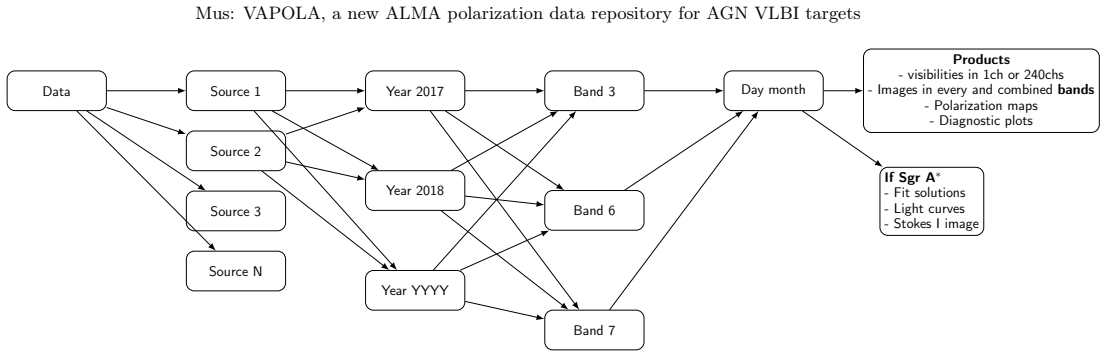
The central machinery is the automated processing pipeline that takes QA2-calibrated ALMA Measurement Sets and produces, with minimal user intervention, seven full-Stokes images per source per epoch (four individual spectral windows, two sidebands, one combined multi-frequency synthesis image), from which spectropolarimetric maps of spectral index, linear and circular polarization fraction, depolarization, rotation measure, and electric vector position angle are derived. For compact sources, the pipeline fits a point-source model directly in the visibility domain using UVMULTIFIT to extract Stokes I, Q, U, V and derived polarimetric quantities. For Sgr A*, a specialized minispiral-calibrated
Load-bearing premise
The pipeline assumes that modeling compact AGN sources as simple point sources in the visibility domain is sufficient for extracting accurate polarization parameters. The authors cite evidence that this holds within uncertainties for M87 and Sgr A*, but the assumption has not been systematically validated across the full source catalog, and sources with moderate extended structure could yield biased Stokes Q, U, V values that propagate into derived quantities like rotation.
What would settle it
If the point-source assumption introduces biases beyond the quoted 1-sigma uncertainties for sources with moderate extended structure, then the tabulated polarimetric parameters in the repository would be unreliable for a subset of the catalog, undermining the repository's value as a ready-to-use resource for non-experts who would have no easy way to identify which sources are affected.
If this is right
- Non-expert researchers can now perform polarimetric analyses of AGN and Sgr A* at millimeter wavelengths without needing to navigate the complex calibration pipeline for phased-array ALMA data, potentially broadening the community studying magnetic fields near supermassive black holes.
- The multi-epoch, multi-band structure of the repository enables systematic variability studies of AGN polarization across timescales from days to years and frequencies from 86 to 343 GHz, which can constrain jet launching mechanisms and magnetic field geometry at jet bases.
- The detection of molecular absorption lines toward multiple AGN targets in these data opens a path to using VLBI-mode ALMA observations for studies of molecular torus structure and interstellar medium chemistry along lines of sight to the Galactic Center.
- The standardized, version-controlled processing ensures that as calibration methods improve, all datasets can be reprocessed consistently, making cross-epoch and cross-band comparisons reliable over the long term.
Where Pith is reading between the lines
- If the point-source assumption used for visibility-domain polarimetric fitting breaks down for sources with significant extended structure on arcsecond scales, the tabulated Stokes parameters and derived quantities like rotation measure and depolarization for those sources could carry systematic biases. A systematic validation across the full source catalog, beyond the M87 and Sgr A* cases already
- The repository's growth rate will accelerate as more VLBI campaigns accumulate, particularly with the recent addition of Band 7 at 345 GHz. If the pipeline remains automated and the infrastructure scales, VAPOLA could become a standard reference dataset for millimeter-wavelength polarimetry analogous to long-term monitoring programs at centimeter wavelengths.
- The minispiral calibration technique developed for Sgr A* could potentially be adapted for other variable compact sources observed in future high-cadence campaigns, extending time-domain polarimetric analysis beyond the Galactic Center.
Editorial analysis
A structured set of objections, weighed in public.
Referee Report
Summary. This paper presents VAPOLA, a public repository of science-ready, full-polarization ALMA data products derived from VLBI campaigns (GMVA, EHT) from 2017 onward, covering Bands 3, 6, and 7. The repository is built on an automated pipeline that takes QA2-calibrated ALMA data and produces calibrated visibilities, full-Stokes images (per-SPW and combined), spectropolarimetric maps (spectral index, LP, CP, EVPA, RM, depolarization), tabulated polarimetric parameters from uv-domain fitting, and—for Sgr A*—time-domain light curves from minispiral calibration. The paper describes the calibration refinements beyond standard QA2 (Tsys corrections, cross-hand delay correction, APS bandpass phase treatment, reference-antenna change corrections, absorption-line flagging), the pipeline architecture, the repository structure, and science cases spanning AGN polarization, molecular tori, Galactic Center ISM, Sgr A* variability, and transient searches. The central claim—that VAPOLA is a functioning, publicly accessible repository delivering these products—is verifiable and well-supported.
Significance. The paper delivers a genuine community resource: the first public, multi-epoch, multi-band repository of full-polarization ALMA products from VLBI campaigns. The automated pipeline with documented calibration refinements (Sect. 3.1.1–3.1.5) and the dual-track approach of providing both uv-domain tabulated polarimetry and full-Stokes image products are concrete strengths. The repository is live and versioned (Appendix D), with a documented web interface (Appendix C). The Sgr A* minispiral calibration pipeline (Sect. 3.2.6) and the Isolation Forest flagging approach (Sect. 3.2.2, Appendix B) are methodologically sound. The paper is honest about limitations (e.g., Sect. 3.1.6 noting that RM and depolarization values can shift by >1σ upon reprocessing). This is a valuable data-release paper that lowers barriers to ALMA polarimetric science.
major comments (3)
- Sect. 3.2.3: The point-source (delta-function) assumption for uv-domain polarimetric extraction is the weakest link in the tabulated products. The authors cite Goddi et al. (2021) Appendix C, which validates this for M87 and Sgr A* specifically, but the VAPOLA catalog spans many more sources. For a repository marketed as 'science-ready,' a brief statement of what fraction of sources in the current catalog are expected to be affected by extended structure (or a flag in the polarization tables indicating sources where the point-source assumption may be unreliable) would strengthen the product. This is not a request for new analysis but for an explicit caveat or metadata column in the released tables.
- Sect. 3.1.1 and Sect. 3.2.3: The absolute flux scale is validated against ACA Grid Survey measurements (Sect. 3.1.1), but no equivalent systematic cross-check is described for polarimetric quantities (LP, CP, EVPA, RM) against independent measurements. Given that Sect. 3.1.6 acknowledges RM and depolarization values can shift by >1σ upon reprocessing, a brief discussion of whether any external polarimetric cross-validation exists or is planned would help users assess catalog-level reliability. If none exists, stating this explicitly is sufficient.
- Table A.1 and Sect. 2: The paper states that 2, 20, 40, and 5 PI-led projects have been supported in Bands 1, 3, 6, and 7 respectively, but Table A.1 shows only a sample of tracks. The total number of tracks currently processed and available in VAPOLA, and the total number of unique sources, should be stated explicitly (e.g., in Sect. 2 or Sect. 4) so users understand the current scope of the repository at the time of this publication.
minor comments (10)
- Abstract: 'analzing' is misspelled as 'analzing' (should be 'analyzing' or 'analysing' depending on convention).
- Abstract: The sentence 'Built on an automated pipeline that processes fully calibrated ALMA (QA2) data, generates science-ready products with minimal user intervention' is grammatically incomplete—it lacks a main verb for the subject 'VAPOLA.' Consider revising to 'VAPOLA is built on an automated pipeline that processes... and generates...'
- Sect. 3.1.3: The phrase 'eight-hump' structures (referring to the amplitude bandpass) is introduced without prior context for the reader unfamiliar with the eight channel groups in the APS phasing solution. A brief parenthetical clarifying that the APS phasing solution divides the 2 GHz band into eight frequency chunks would help.
- Sect. 3.2.2: The CUTOFF method is described but it is unclear whether it is ever used in practice or only the Isolation Forest method is the default. If CUTOFF is available but not used by default, this should be stated explicitly.
- Sect. 3.2.5: The RM is reported in units of 10^5 rad/m^2. This is an unusual unit choice; standard convention is rad/m^2. If the scaling is for display purposes in the pre-plotted maps, this should be clarified, and the tabulated values should use standard units.
- Fig. 3: The RM color bar for 3C 279 spans a very large range and the core RM is reported as (1.9 ± 4.9) × 10^3 rad/m^2, which appears inconsistent with the 10^5 rad/m^2 unit stated in Sect. 3.2.5. Please verify the units and scaling are consistent between the text, figure caption, and color bar labels.
- Sect. 4.2.4: The signal-to-noise thresholds for polarization maps are listed (I > 4σ, Ip > 3σ, V > 5σ), but it would help to state the typical RMS noise levels achieved in the images (at least representative values per band) so users can gauge sensitivity.
- Appendix C: The web portal URL (http://vapola.ia2.inaf.it) appears in the text but the HTTPS protocol is mentioned in the acknowledgements. The download page URL uses HTTPS. Please ensure the main site URL also uses HTTPS consistently.
- Sect. 5.2, Fig. 4: The figure caption states the spectra correspond to SPW 0 (left) and SPW 3 (right), but the x-axis label of the right panel shows frequencies around 228.5–230.0 GHz, which corresponds to SPW 2 (227.1 GHz) rather than SPW 3 (229.1 GHz) based on Table 1. Please verify.
- Sect. 3.1.6: The statement that 'results for some sources may differ by more than 1σ' for RM and depolarization is important but buried. Consider adding a brief note in Sect. 4 (repository description) directing users to Sect. 3.1.6 for caveats on derived polarimetric quantities.
Circularity Check
No circularity: VAPOLA is a data repository paper whose central claim is verifiable externally, and derived polarimetric quantities follow from standard definitions applied to calibrated visibilities.
full rationale
The paper presents a data repository and processing pipeline, not a theoretical derivation. The central claim—that VAPOLA is a publicly accessible repository of science-ready ALMA polarization products—is verifiable by accessing the web portal (http://vapola.ia2.inaf.it), making it externally falsifiable rather than circular. The polarimetric quantities (LP, CP, EVPA, RM) are computed from standard Stokes-parameter definitions (Sect. 3.2.3, 3.2.5) applied to calibrated visibilities; they are not fitted to reproduce prior results and then presented as predictions. The opacity correction (Eq. 1) is a standard scaling formula, not a self-referential definition. While there is self-citation to Goddi et al. (2019b, 2021) for the QA2 calibration procedures and the point-source assumption validation, these citations provide methodological groundwork rather than load-bearing circular logic: the calibration procedures are standard ALMA QA2 workflows, and the point-source assumption is validated against image-based methods (Goddi et al. 2021, Appendix C) rather than assumed by definition. The minispiral calibration for Sgr A* (Sect. 3.2.6) uses a physical decomposition into compact and extended components, with the time-dependent gain solved by chi-squared minimization (Eq. 3)—this is a modeling choice, not a circular definition. The flux scale is cross-checked against independent ACA Grid Survey measurements (Sect. 3.1.1). No step in the pipeline reduces to its own inputs by construction. The paper is self-contained against external benchmarks and scores 0 on circularity.
Axiom & Free-Parameter Ledger
free parameters (4)
- Isolation Forest contamination factor =
0.05
- CLEAN robust parameter =
0.5
- CLEAN gain =
0.1
- CUTOFF flagging threshold k =
3 or 4
axioms (4)
- domain assumption Point-source (delta function) model is sufficient for uv-domain polarimetric extraction of compact AGN cores
- domain assumption ALMA standard flux calibration uncertainties (~5% Band 3, ~10% Bands 6/7) apply to APS-mode observations
- domain assumption Tsys corrections should not be applied during phased-array calibration to avoid biasing the phased sum
- domain assumption The minispiral emission is quasi-stationary on the timescale of a single observation track
read the original abstract
The Atacama Large Millimeter/submillimeter Array (ALMA) is the most sensitive interferometric array at millimeter and submillimeter wavelengths. Through the ALMA Phasing System (APS), it can participate in global Very Long Baseline Interferometry (VLBI) arrays, enhancing their sensitivity and resolution. However, processing and analzing the ALMA data obtained in APS mode during VLBI observations remains a complex task, requiring specialized expertise and time-consuming calibration and imaging procedures. In this paper, we present VAPOLA-the first online, multi-epoch, multi-band repository of high-level data products from ALMA observations of active galactic nuclei (AGN) and Sgr A* during global VLBI campaigns. Built on an automated pipeline that processes fully calibrated ALMA (QA2) data, generates science-ready products with minimal user intervention. The repository includes fully calibrated interferometric visibilities, full-Stokes images across individual and combined spectral windows, polarimetric and spectral index maps, as well as tabulated polarimetric parameters from visibility-domain polarization fitting. By offering ready-to-use data through a user-friendly web portal, VAPOLA enables non-expert users to perform advanced science analyses without needing in-depth knowledge of ALMA procedures. This resource will facilitate a broad range of scientific investigations, including the characterization of magnetic field properties in accretion flows and relativistic jets, the structure and kinematics of dusty and molecular tori in AGN, and absorption studies of the interstellar medium toward the Galactic Center. In addition, the dataset provides source-integrated parameters and calibration metadata essential for refining VLBI calibration and imaging workflows as well as for placing robust observational constraints on theoretical models of supermassive black holes and their environments.
Figures



Reference graph
Works this paper leans on
-
[1]
Characterizing the accuracy of ALMA linear-polarization mosaics
Characterizing the Accuracy of ALMA Linear-polarization Mosaics. , keywords =. doi:10.1088/1538-3873/ab99cd , archivePrefix =. 2006.03671 , primaryClass =
work page internal anchor Pith review Pith/arXiv arXiv doi:10.1088/1538-3873/ab99cd 2006
-
[2]
doi:10.5281/zenodo.18793803 , url =
ALMA Cycle 13 Technical Handbook , author =. doi:10.5281/zenodo.18793803 , url =
-
[3]
Comparative chemistry of diffuse clouds. II. CN, HCN, HNC, CH _ 3 CN & N _ 2 H ^ +. , keywords =. doi:10.1051/0004-6361:20010260 , archivePrefix =. astro-ph/0103247 , primaryClass =
work page internal anchor Pith review Pith/arXiv arXiv doi:10.1051/0004-6361:20010260
-
[4]
ALMA Technical Handbook,ALMA Doc. 7.3, ver. 1.1. doi:10.5281/zenodo.4511522 , adsurl =
-
[5]
ALMA at 10 years: Past, Present, and Future , year = 2023, month = dec, eid =
AMAPOLA: ALMA Polarization Monitoring for Calibrator Sources. ALMA at 10 years: Past, Present, and Future , year = 2023, month = dec, eid =. doi:10.5281/zenodo.10231063 , adsurl =
-
[6]
The Disk Substructures at High Angular Resolution Project (DSHARP). I. Motivation, Sample, Calibration, and Overview. , keywords =. doi:10.3847/2041-8213/aaf741 , archivePrefix =. 1812.04040 , primaryClass =
work page internal anchor Pith review Pith/arXiv arXiv doi:10.3847/2041-8213/aaf741 2041
-
[7]
Trigonometric Parallaxes Of High-Mass Star Forming Regions: Our View Of The Milky Way
Trigonometric Parallaxes of High-mass Star-forming Regions: Our View of the Milky Way. , keywords =. doi:10.3847/1538-4357/ab4a11 , archivePrefix =. 1910.03357 , primaryClass =
work page internal anchor Pith review Pith/arXiv arXiv doi:10.3847/1538-4357/ab4a11 1910
-
[8]
The Cosmic Dawn and Epoch of Reionization with the Square Kilometre Array
The Cosmic Dawn and Epoch of Reionisation with SKA. Advancing Astrophysics with the Square Kilometre Array (AASKA14) , year = 2015, month = apr, eid =. doi:10.22323/1.215.0001 , archivePrefix =. 1505.07568 , primaryClass =
work page internal anchor Pith review Pith/arXiv arXiv doi:10.22323/1.215.0001 2015
-
[9]
Astrochemistry During the Formation of Stars
Astrochemistry During the Formation of Stars. , keywords =. doi:10.1146/annurev-astro-032620-021927 , archivePrefix =. 2006.07071 , primaryClass =
work page internal anchor Pith review Pith/arXiv arXiv doi:10.1146/annurev-astro-032620-021927 2006
-
[10]
THINGS: The HI Nearby Galaxy Survey
THINGS: The H I Nearby Galaxy Survey. , keywords =. doi:10.1088/0004-6256/136/6/2563 , archivePrefix =. 0810.2125 , primaryClass =
work page internal anchor Pith review Pith/arXiv arXiv doi:10.1088/0004-6256/136/6/2563
-
[11]
First Very Long Baseline Interferometry Detections at 870 m. , keywords =. doi:10.3847/1538-3881/ad5bdb , adsurl =
-
[12]
Disentangling the Circumnuclear Environs of Centaurus A. III. An Inner Molecular Ring, Nuclear Shocks, and the CO to Warm H _ 2 Interface. , keywords =. doi:10.3847/1538-4357/aa78a9 , archivePrefix =. 1706.05762 , primaryClass =
work page internal anchor Pith review Pith/arXiv arXiv doi:10.3847/1538-4357/aa78a9
-
[14]
The diffuse molecular component in the nuclear bulge of the Milky Way
The diffuse molecular component in the nuclear bulge of the Milky Way. , keywords =. doi:10.1051/0004-6361/201730602 , archivePrefix =. 1709.02464 , primaryClass =
work page internal anchor Pith review Pith/arXiv arXiv doi:10.1051/0004-6361/201730602
-
[15]
Imaging the Schwarzschild-radius-scale Structure of M87 with the Event Horizon Telescope Using Sparse Modeling. , keywords =. doi:10.3847/1538-4357/aa6305 , archivePrefix =. 1702.07361 , primaryClass =
work page internal anchor Pith review Pith/arXiv arXiv doi:10.3847/1538-4357/aa6305
-
[16]
Super-resolution Full Polarimetric Imaging for Radio Interferometry with Sparse Modeling
Superresolution Full-polarimetric Imaging for Radio Interferometry with Sparse Modeling. , keywords =. doi:10.3847/1538-3881/aa6302 , archivePrefix =. 1702.00424 , primaryClass =
work page internal anchor Pith review Pith/arXiv arXiv doi:10.3847/1538-3881/aa6302
-
[17]
Unified Radio Interferometric Calibration and Imaging with Joint Uncertainty Quantification
Unified radio interferometric calibration and imaging with joint uncertainty quantification. , keywords =. doi:10.1051/0004-6361/201935555 , archivePrefix =. 1903.11169 , primaryClass =
work page internal anchor Pith review Pith/arXiv arXiv doi:10.1051/0004-6361/201935555 1903
-
[18]
Cygnus A with CLEAN and resolve
Comparison of classical and Bayesian imaging in radio interferometry. Cygnus A with CLEAN and resolve. , keywords =. doi:10.1051/0004-6361/202039258 , adsurl =
-
[19]
Variable structures in M87* from space, time and frequency resolved interferometry
Variable structures in M87* from space, time and frequency resolved interferometry. Nature Astronomy , keywords =. doi:10.1038/s41550-021-01548-0 , archivePrefix =. 2002.05218 , primaryClass =
work page internal anchor Pith review Pith/arXiv arXiv doi:10.1038/s41550-021-01548-0 2002
-
[20]
doi:10.1088/1742-6596/490/1/012020 , url =
Performing edge detection by Difference of Gaussians using q-Gaussian kernels , journal =. doi:10.1088/1742-6596/490/1/012020 , url =
-
[21]
Attouch, Hedy and Bolte, Jérôme and Svaiter, Benar , year =. Convergence of descent methods for semi-algebraic and tame problems: Proximal algorithms, forward-backward splitting, and regularized Gauss-Seidel methods , volume =. Mathematical Programming , doi =
-
[22]
doi:10.1088/0266-5611/32/11/115004 , url =
Chenglong Bao and Bin Dong and Likun Hou and Zuowei Shen and Xiaoqun Zhang and Xue Zhang , title =. doi:10.1088/0266-5611/32/11/115004 , url =
-
[23]
Rotating Black Holes: Locally Nonrotating Frames, Energy Extraction, and Scalar Synchrotron Radiation. , year = 1972, month = dec, volume =. doi:10.1086/151796 , adsurl =
-
[24]
A Fast Iterative Shrinkage-Thresholding Algorithm for Linear Inverse Problems , volume =
Beck, Amir and Teboulle, Marc , year =. A Fast Iterative Shrinkage-Thresholding Algorithm for Linear Inverse Problems , volume =. SIAM J. Imaging Sciences , doi =
-
[25]
SIAM Journal on Scientific and Statistical Computing , year = 1995, volume = 16, pages =
A Limited Memory Algorithm for Bound Constrained Optimization. SIAM Journal on Scientific and Statistical Computing , year = 1995, volume = 16, pages =
work page 1995
-
[26]
Scale sensitive deconvolution of interferometric images. I. Adaptive Scale Pixel (Asp) decomposition. , keywords =. doi:10.1051/0004-6361:20040354 , archivePrefix =. astro-ph/0407225 , primaryClass =
work page internal anchor Pith review Pith/arXiv arXiv doi:10.1051/0004-6361:20040354
-
[27]
Francesco Biscani and Dario Izzo , title =. 2020 , publisher =. doi:10.21105/joss.02338 , url =
-
[28]
Closure statistics in interferometric data
Closure Statistics in Interferometric Data. , keywords =. doi:10.3847/1538-4357/ab8469 , archivePrefix =. 1910.02062 , primaryClass =
work page internal anchor Pith review Pith/arXiv arXiv doi:10.3847/1538-4357/ab8469 1910
-
[29]
Electromagnetic extraction of energy from Kerr black holes. , keywords =. doi:10.1093/mnras/179.3.433 , adsurl =
-
[30]
Boţ, R. and Csetnek, E. and Szilard Csaba, L. , year =. An inertial forward-backward algorithm for the minimization of the sum of two nonconvex functions , volume =. EURO Journal on Computational Optimization , doi =
-
[31]
Reconstructing Video from Interferometric Measurements of Time-Varying Sources. arXiv e-prints , keywords =
- [32]
-
[33]
Modeling Seven Years of Event Horizon Telescope Observations with Radiatively Inefficient Accretion Flow Models. , keywords =. doi:10.3847/0004-637X/820/2/137 , archivePrefix =. 1602.07701 , primaryClass =
work page internal anchor Pith review Pith/arXiv arXiv doi:10.3847/0004-637x/820/2/137
-
[34]
Hybrid Very Long Baseline Interferometry Imaging and Modeling with THEMIS. , keywords =. doi:10.3847/1538-4357/ab9c1f , adsurl =
-
[35]
THEMIS: A Parameter Estimation Framework for the Event Horizon Telescope. , keywords =. doi:10.3847/1538-4357/ab91a4 , adsurl =
-
[36]
Characterizing and Mitigating Intraday Variability: Reconstructing Source Structure in Accreting Black Holes with mm-VLBI , journal =. 2022 , pages =
work page 2022
-
[37]
Uncertainty quantification for radio interferometric imaging: I. proximal MCMC methods
Uncertainty quantification for radio interferometric imaging - I. Proximal MCMC methods. , keywords =. doi:10.1093/mnras/sty2004 , archivePrefix =. 1711.04818 , primaryClass =
work page internal anchor Pith review Pith/arXiv arXiv doi:10.1093/mnras/sty2004
-
[38]
Uncertainty quantification for radio interferometric imaging: II. MAP estimation
Uncertainty quantification for radio interferometric imaging: II. MAP estimation. , keywords =. doi:10.1093/mnras/sty2015 , archivePrefix =. 1711.04819 , primaryClass =
work page internal anchor Pith review Pith/arXiv arXiv doi:10.1093/mnras/sty2015
-
[39]
Information Theory , year = 2006, volume =
IEEE Trans. Information Theory , year = 2006, volume =
work page 2006
-
[40]
Enhancing Sparsity by Reweighted L1 Minimization , volume =
Candès, Emmanuel and Wakin, Michael and Boyd, Stephen , year =. Enhancing Sparsity by Reweighted L1 Minimization , volume =. Journal of Fourier Analysis and Applications , doi =
-
[41]
Sparsity Averaging Reweighted Analysis (SARA): a novel algorithm for radio-interferometric imaging. , keywords =. doi:10.1111/j.1365-2966.2012.21605.x , archivePrefix =. 1205.3123 , primaryClass =
-
[42]
PURIFY: a new approach to radio-interferometric imaging
PURIFY: a new approach to radio-interferometric imaging. , keywords =. doi:10.1093/mnras/stu202 , archivePrefix =. 1307.4370 , primaryClass =
work page internal anchor Pith review Pith/arXiv arXiv doi:10.1093/mnras/stu202
-
[43]
High Resolution Linear Polarimetric Imaging for the Event Horizon Telescope
High-resolution Linear Polarimetric Imaging for the Event Horizon Telescope. , keywords =. doi:10.3847/0004-637X/829/1/11 , archivePrefix =. 1605.06156 , primaryClass =
work page internal anchor Pith review Pith/arXiv arXiv doi:10.3847/0004-637x/829/1/11
-
[44]
Interferometric Imaging Directly with Closure Phases and Closure Amplitudes
Interferometric Imaging Directly with Closure Phases and Closure Amplitudes. , keywords =. doi:10.3847/1538-4357/aab6a8 , archivePrefix =. 1803.07088 , primaryClass =
work page internal anchor Pith review Pith/arXiv arXiv doi:10.3847/1538-4357/aab6a8
-
[45]
Accretion Flow Morphology in Numerical Simulations of Black Holes from the ngEHT Model Library: The Impact of Radiation Physics. Galaxies , keywords =. doi:10.3390/galaxies11020038 , archivePrefix =. 2212.01804 , primaryClass =
work page internal anchor Pith review Pith/arXiv arXiv doi:10.3390/galaxies11020038
- [46]
-
[47]
Fixed-Point Algorithms for Inverse Problems in Science and Engineering , doi =
Proximal Splitting Methods in Signal Processing , volume =. Fixed-Point Algorithms for Inverse Problems in Science and Engineering , doi =. 2009 , month =
work page 2009
- [48]
-
[49]
IEEE Journal of Selected Topics in Signal Processing , year = 2008, month = nov, volume =
Multiscale CLEAN Deconvolution of Radio Synthesis Images. IEEE Journal of Selected Topics in Signal Processing , year = 2008, month = nov, volume =. doi:10.1109/JSTSP.2008.2006388 , adsurl =
-
[50]
Photometric analysis of astronomical images by the wavelet transform. , keywords =
-
[51]
Du, Ke-Lin and Swamy, M. N. S. , title =. 2016 , isbn =
work page 2016
-
[52]
First M87 Event Horizon Telescope Results. I. The Shadow of the Supermassive Black Hole. , keywords =. doi:10.3847/2041-8213/ab0ec7 , archivePrefix =. 1906.11238 , primaryClass =
work page internal anchor Pith review Pith/arXiv arXiv doi:10.3847/2041-8213/ab0ec7 2041
-
[53]
First M87 Event Horizon Telescope Results. II. Array and Instrumentation. , keywords =. doi:10.3847/2041-8213/ab0c96 , archivePrefix =. 1906.11239 , primaryClass =
work page internal anchor Pith review Pith/arXiv arXiv doi:10.3847/2041-8213/ab0c96 2041
-
[54]
First M87 Event Horizon Telescope Results. III. Data Processing and Calibration. , keywords =. doi:10.3847/2041-8213/ab0c57 , archivePrefix =. 1906.11240 , primaryClass =
work page internal anchor Pith review Pith/arXiv arXiv doi:10.3847/2041-8213/ab0c57 2041
-
[55]
First M87 Event Horizon Telescope Results. IV. Imaging the Central Supermassive Black Hole. , keywords =. doi:10.3847/2041-8213/ab0e85 , archivePrefix =. 1906.11241 , primaryClass =
work page internal anchor Pith review Pith/arXiv arXiv doi:10.3847/2041-8213/ab0e85 2041
-
[56]
First M87 Event Horizon Telescope Results. V. Physical Origin of the Asymmetric Ring. , keywords =. doi:10.3847/2041-8213/ab0f43 , archivePrefix =. 1906.11242 , primaryClass =
work page internal anchor Pith review Pith/arXiv arXiv doi:10.3847/2041-8213/ab0f43 2041
-
[57]
First M87 Event Horizon Telescope Results. VI. The Shadow and Mass of the Central Black Hole. , keywords =. doi:10.3847/2041-8213/ab1141 , archivePrefix =. 1906.11243 , primaryClass =
work page internal anchor Pith review Pith/arXiv arXiv doi:10.3847/2041-8213/ab1141 2041
-
[58]
High-Frequency Polarization Variability from Active Galactic Nuclei. Galaxies , keywords =. doi:10.3390/galaxies9030051 , adsurl =
-
[59]
Polarimetric Observations of 15 Active Galactic Nuclei at High Frequencies: Jet Kinematics from Bimonthly Monitoring with the Very Long Baseline Array. , keywords =. doi:10.1086/444593 , archivePrefix =. astro-ph/0502501 , primaryClass =
work page internal anchor Pith review Pith/arXiv arXiv doi:10.1086/444593
-
[60]
Complex Faraday depth structure of active galactic nuclei as revealed by broad-band radio polarimetry. , keywords =. doi:10.1111/j.1365-2966.2012.20554.x , archivePrefix =. 1201.3161 , primaryClass =
-
[61]
First M87 Event Horizon Telescope Results. VII. Polarization of the Ring , journal =. 2021 , pages =
work page 2021
-
[62]
First M87 Event Horizon Telescope Results. VIII. Magnetic Field Structure near The Event Horizon , journal =. 2021 , pages =
work page 2021
-
[63]
First Sagittarius A* Event Horizon Telescope Results. I. The Shadow of the Supermassive Black Hole in the Center of the Milky Way. , keywords =. doi:10.3847/2041-8213/ac6674 , adsurl =
-
[64]
First Sagittarius A* Event Horizon Telescope Results. II. EHT and Multiwavelength Observations, Data Processing, and Calibration. , keywords =. doi:10.3847/2041-8213/ac6675 , adsurl =
-
[65]
First Sagittarius A* Event Horizon Telescope Results. III. Imaging of the Galactic Center Supermassive Black Hole. , keywords =. doi:10.3847/2041-8213/ac6429 , adsurl =
-
[66]
First Sagittarius A* Event Horizon Telescope Results. IV. Variability, Morphology, and Black Hole Mass. , keywords =. doi:10.3847/2041-8213/ac6736 , adsurl =
-
[67]
First Sagittarius A* Event Horizon Telescope Results. V. Testing Astrophysical Models of the Galactic Center Black Hole. , keywords =. doi:10.3847/2041-8213/ac6672 , adsurl =
-
[68]
First Sagittarius A* Event Horizon Telescope Results. VI. Testing the Black Hole Metric. , keywords =. doi:10.3847/2041-8213/ac6756 , adsurl =
-
[69]
First M87 Event Horizon Telescope Results. IX. Detection of Near-horizon Circular Polarization. , keywords =. doi:10.3847/2041-8213/acff70 , archivePrefix =. 2311.10976 , primaryClass =
work page internal anchor Pith review Pith/arXiv arXiv doi:10.3847/2041-8213/acff70 2041
-
[70]
The persistent shadow of the supermassive black hole of M 87. I. Observations, calibration, imaging, and analysis. , keywords =. doi:10.1051/0004-6361/202347932 , adsurl =
-
[71]
First Sagittarius A* Event Horizon Telescope Results. VII. Polarization of the Ring. , keywords =. doi:10.3847/2041-8213/ad2df0 , adsurl =
-
[72]
First Sagittarius A* Event Horizon Telescope Results. VIII. Physical Interpretation of the Polarized Ring. , keywords =. doi:10.3847/2041-8213/ad2df1 , adsurl =
-
[73]
doi:10.5281/zenodo.6519440 , version =
achael/eht-imaging: v1.2.4. doi:10.5281/zenodo.6519440 , version =
-
[74]
Farah, Joseph and Peter Galison and Akiyama, Kazunori and Bouman, Katherine L. and Bower, Geoffrey C. and Chael, Andrew and Fuentes, Antonio and G. Selective Dynamical Imaging of Interferometric Data , journal =. 2022 , pages =
work page 2022
-
[75]
Journal of the Optical Society of America (1917-1983) , keywords =
Restoring with Maximum Likelihood and Maximum Entropy. Journal of the Optical Society of America (1917-1983) , keywords =
work page 1917
-
[76]
The filamentary internal structure of the 3C279 blazar jet , doi =
Fuentes, Antonio and Gómez, Jose and Martí, José and Perucho, Manel and Zhao, Guang-Yao and Lico, Rocco and Lobanov, Andrei and Bruni, Gabriele and Kovalev, Yuri and Chael, Andrew and Akiyama, Kazunori and Bouman, Katherine and Sun, He and Cho, Ilje and Traianou, Efthalia and Toscano, Teresa and Dahale, Rohan and Gurvits, Leonid and Jorstad, Svetlana and ...
-
[77]
LOFAR Sparse Image Reconstruction
LOFAR sparse image reconstruction. , keywords =. doi:10.1051/0004-6361/201424504 , archivePrefix =. 1406.7242 , primaryClass =
work page internal anchor Pith review Pith/arXiv arXiv doi:10.1051/0004-6361/201424504
-
[78]
Sparse representations and convex optimization as tools for LOFAR radio interferometric imaging
Sparse representations and convex optimization as tools for LOFAR radio interferometric imaging. Journal of Instrumentation , keywords =. doi:10.1088/1748-0221/10/08/C08013 , archivePrefix =. 1504.03896 , primaryClass =
work page internal anchor Pith review Pith/arXiv arXiv doi:10.1088/1748-0221/10/08/c08013
-
[79]
On the source of Faraday rotation in the jet of the radio galaxy 3C120
On the Source of Faraday Rotation in the Jet of the Radio Galaxy 3C 120. , keywords =. doi:10.1088/0004-637X/733/1/11 , archivePrefix =. 1102.1943 , primaryClass =
work page internal anchor Pith review Pith/arXiv arXiv doi:10.1088/0004-637x/733/1/11 1943
-
[80]
Probing the Innermost Regions of AGN Jets and Their Magnetic Fields with RadioAstron. I. Imaging BL Lacertae at 21 Microarcsecond Resolution. , keywords =. doi:10.3847/0004-637X/817/2/96 , archivePrefix =. 1512.04690 , primaryClass =
work page internal anchor Pith review Pith/arXiv arXiv doi:10.3847/0004-637x/817/2/96
- [81]
discussion (0)
Sign in with ORCID, Apple, or X to comment. Anyone can read and Pith papers without signing in.