REVIEW 3 major objections 5 minor 37 references
Quarkyonic matter doubles hyperon-onset leverage on in-medium potentials, bans Σ− from 2-solar-mass cores, and caps residual mass softening at 0.025 solar masses.
Reviewed by Pith at T0; open to challenge. T0 means a machine referee read the full paper against a public rubric. the ladder, T0–T4 →
T0 review · grok-4.5
2026-07-13 04:10 UTC pith:D7DXKMIC
load-bearing objection Solid structural extension of FKM: weight-2 onset and lepton-sector Σ⁻ ban are clean; the flat dM_max/dU_Y claim is softer than the abstract sells because it sits on the pinned branch the paper itself flags. the 3 major comments →
In-medium hyperon potentials and the quarkyonic hyperon onset: charged Sigma's in β-equilibrium and the neutrino connection
The pith
A machine-rendered reading of the paper's core claim, the machinery that carries it, and where it could break.
Core claim
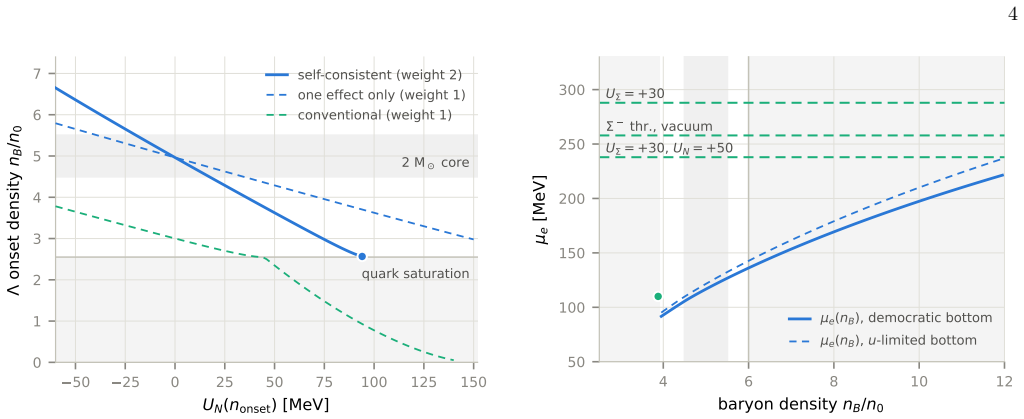
Dressing FKM's IdylliQ quarkyonic model with zero-momentum in-medium potentials produces the onset μ_B^onset = (2M_Y − M_N) + 2U_Y − U_N; self-consistency compounds the neutron potential to weight −2 on the onset density. In β-equilibrium the Σ− threshold collapses to the pure lepton condition μ_e ≥ 258 MeV + U_Σ − U_N, never reached inside a 2 M_☉ core, so Σ− flips from first hyperon to forbidden. Residual maximum-mass softening stays ≲0.025 M_☉ on the interacting star calibrated to 2.12 M_☉, and dM_max/dU_Y is roughly sixteen times smaller than in anchored mean-field models.
What carries the argument
The dressed quarkyonic onset condition μ_B^onset = (2M_Y − M_N) + 2U_Y − U_N (and its self-consistent form with weight −2 on U_N). Arising from d-quark phase-space counting, it doubles the leverage of measured potentials and forces the structural inversion of the charged-Σ sector once leptons are restored.
Load-bearing premise
The density dependence of the hyperon potential above nuclear saturation is taken from a simple quark-counting form plus a single adjustable turn-over parameter rather than derived from a full hyperonic energy functional.
What would settle it
A measured correlation between low-density hyperon potential and neutron-star maximum mass that recovers a large mean-field-sized slope dM_max/dU_Y, or direct evidence of Σ− inside cores of stars near two solar masses, would contradict the claimed statistical protection and lepton-sector ban.
If this is right
- Onset density moves by roughly 0.3 n0 per 10 MeV of U_Y—twice conventional leverage—so modest potential shifts can carry the onset across a 2 M☉ core density.
- Σ− is excluded from 2 M☉ cores under the stated conditions, inverting the usual Σ multiplet so that Σ+ becomes the cheapest member.
- Maximum-mass loss from hyperons remains ≲0.025 M☉ on the realistic interacting star, a factor of four to eight below typical hadronic models.
- At the hypernuclear anchor U_Λ(n0) = −28 MeV a few-MeV supra-saturation YNN turn-over already renders the maximum-mass star hyperon-free.
- The differential observable dM_max/dU_Y is an order of magnitude smaller than in mean-field models, supplying a concrete discriminant between the two resolutions of the hyperon puzzle.
Where Pith is reading between the lines
- Because of the weight-2 leverage, even a several-MeV neutrino constraint on low-density U_Λ maps more powerfully onto core density than hadronic models predict, while absolute composition stays prior-dominated by the high-density turn-over.
- Any future observation of early Σ− appearance in dense matter would falsify not only the potential values but the underlying quarkyonic blocking for charged species.
- The same counting logic applied to multi-strange baryons would systematically delay the entire strange sector, sharpening expected cooling and transport signatures of hybrid stars.
- A flat measured dM_max/dU_Y slope, once terrestrial potentials and precise masses are correlated, would favour the statistical resolution over mean-field or three-body resolutions even before core composition is settled.
Editorial analysis
A structured set of objections, weighed in public.
Referee Report
Summary. The paper dresses the Fujimoto–Kojo–McLerran IdylliQ quarkyonic model with zero-momentum in-medium hyperon and nucleon potentials and derives five results: (i) the dressed onset μ_B^onset = (2M_Y − M_N) + 2U_Y − U_N carries weight 2 on U_Y (dn_onset/dU_Y ≃ 0.3 n_0 per 10 MeV); (ii) a self-consistent U_N enters the onset density at weight −2, with a protection cliff U_N(n_onset) ≲ +96 MeV; (iii) in β-equilibrium the Σ− threshold collapses to the pure lepton-sector condition μ_e ≥ 258 MeV + U_Σ − U_N and is never reached inside a 2 M_⊙ core, inverting the Σ ordering; (iv) on the k_Y = k_bu pinned continuation, TOV softening stays ≲ 0.05 M_⊙ (FKM family) and ≲ 0.025 M_⊙ (interacting star); (v) with an interacting nucleonic sector calibrated to M_max = 2.12 M_⊙, core strangeness is controlled by (U_Λ(n_0), c_Λ), the projected SBND+DUNE FSI precision pins only U_Λ(n_0), and P(hyperon-free core) = 0.90 is prior-dominated, while dM_max/dU_Y is an order of magnitude smaller than in anchored mean-field models.
Significance. If the structural thresholds hold, the paper supplies a clean, quark-counting origin for a weight-2 (weight −2) onset and a lepton-sector Σ− ban that qualitatively restructures the charged multiplet — results that are independent of the supra-saturation ansatz and of the neutrino likelihood. The explicit validation of the undressed IdylliQ implementation against FKM Appendix B to <1.2%, the careful thermodynamic continuity argument on the pinned branch, and the unusually frank ranking of the error budget (blocking prescription, U_Y(ρ) extrapolation, U_N convention, then neutrino precision) are genuine strengths. The proposed differential discriminant dM_max/dU_Y is, in principle, a falsifiable cross-scenario observable linking terrestrial FSI to neutron-star masses. The work therefore converts a statistical resolution of the hyperon puzzle into a concrete terrestrial–astrophysical programme, provided the post-onset mass phenomenology is placed on firmer footing.
major comments (3)
- Sec. VI and the abstract state that the ≲ 0.025 M_⊙ softening (and by extension the flat dM_max/dU_Y of Sec. VIII) is computed on the boundary-pinned branch k_Y(k_sh) = k_bu, which the paper itself flags as omitting hyperons above k_bu that are energetically favoured by 27, 89 and 138 MeV at 7, 9 and 11 n_0 after the d-blocking swap cost. Within the FKM ansatz family this is a ceiling; for quarkyonic matter at large it is only a floor. The interacting star (n_c = 4.7 n_0) is only mildly exposed, but the order-of-magnitude discrimination against mean-field models (factor ~16 in Sec. VIII) is presented as the sharpest observable. Because opening those channels can both raise absolute softening and allow the post-onset occupation to grow beyond the pure counting value 1/(d_Y B_Y^d N_c^3), the flatness of dM_max/dU_Y is not guaranteed once the ansatz is left. A quantitative estimate of the m
- Eq. (9) and Secs. VII–VIII: the supra-saturation continuation U_Λ(n) = (2/3)U_iso(n) + δ u + c_Λ(u² − u) is an ansatz, not the derivative of a hyperonic energy functional. Sec. IV correctly notes that the missing cross term n_n ∂U_N/∂n_Y vanishes at onset but is O(n_Y ∂U_N/∂n_B) above it, so the post-onset composition and the ≲ 0.05 M_⊙ cap inherit a systematic of that order. The flip threshold c*_Λ = 2.9 MeV and P(hyperon-free) = 0.90 move with c_Λ, which the paper ranks as the largest genuinely dense-matter unknown after the blocking prescription. The structural onset relations (4)–(5) and (7) are unaffected, but the quantitative core-composition and mass-softening statements are not. Either a genuine YN functional that derives rather than imposes c_Λ, or a systematic variation that bounds the rearrangement and turn-over uncertainties on ΔM_max and on the flip bracket, is required for
- Sec. V and Fig. 3: the Σ− ban rests on μ_e(n_B) remaining below the dressed lepton-sector threshold. The paper shows that the ban’s comfort margin spans an order of magnitude across anchoring conventions for δ (constant offset vs δu), and that a nucleon potential outrunning U_Σ by ≳ 35 MeV would reopen the channel. The interacting charge sector is also ansatz-limited (k_p > k_bu). While the vacuum floor μ_e ≥ 258 MeV is robust across the free and interacting paths explored, the dressed exclusion at core densities is not fully independent of the same supra-saturation continuation that controls the Λ sector. A short sensitivity scan over the δ continuation and over a larger x_p range would make the “never reached inside a 2 M_⊙ core” statement quantitative rather than conditional.
minor comments (5)
- Table II is a useful summary of the threshold relations; adding a column for the conventional weight-1 Σ− threshold (μ_n + μ_e) would make the inversion fully self-contained for readers who skip Sec. V.
- Fig. 1 and Fig. 5: the 2 M_⊙ core band is helpful; stating the exact central density used for the band (or that it is the interacting-star n_c = 4.74 n_0) in the caption would remove ambiguity between the free and interacting stars.
- Sec. IV, rearrangement paragraph: the honest caveat is welcome, but a one-sentence estimate of the O(n_Y) shift in ΔM_max under the occupancy cap n_Y/n_B ~ few percent would help the reader judge whether the systematic is negligible for the 0.025 M_⊙ scale.
- The companion papers [15, 16] are cited as “submitted”; if they are not yet public, a brief self-contained statement of the projected δU_Λ = 5.6 MeV (slope-marginalised) in Sec. VIII would make the Bayesian propagation reproducible from this manuscript alone.
- Notation: U_L in the abstract appears to mean U_Λ; consistent use of U_Λ throughout would avoid a momentary misreading.
Circularity Check
No load-bearing circularity: weight-2 onset, lepton-sector Σ⁻ ban and 1/Nc^{3} softening follow by direct dressing of external FKM relations; Bayesian P=0.90 is explicitly prior-dominated (+0.01 from u data).
specific steps
-
self citation load bearing
[Sec. VIII, Bayesian propagation paragraph and Table III]
"Propagating the projected SBND+DUNE FSI precision through a joint Bayesian fit pins the low-density anchor UΛ(n0) but leaves cΛ — on which the neutrino data are silent — as the decisive quantity: with the heavy-ion prior, P(hyperon-free core)=0.90, against 0.89 from the priors alone — a prior-dominated statement rather than a measurement of the core composition."
The numerical precision δ UΛ=5.6 MeV that enters the likelihood is taken from the author’s own companion papers [15,16]. Because the likelihood is blind to cΛ, the posterior probability moves by only +0.01 relative to the priors; the self-citation therefore supplies a non-decisive input rather than forcing the central claim. Flagged only as mild self-citation, not as a circular reduction of the structural results.
full rationale
The derivation chain begins from the external FKM IdylliQ equilibrium condition (their B13 / Eq. (3) here) and the dual occupation rules; dressing with zero-momentum potentials immediately yields the weight-2 onset (Eq. (4)) and, after self-consistent rearrangement bookkeeping, the weight-−2 density condition (Eq. (5)). The Σ⁻ threshold collapses by exact cancellation of μ B once r=1 is inserted into the general displacement formula (Eq. (6) o(7)); none of these steps is defined in terms of the later numerical outputs. Softening bounds are obtained by integrating the TOV equations on the boundary-pinned continuation that the paper itself flags as a family ceiling / general floor. The interacting nucleonic functional is calibrated to a nucleonic Mmax=2.12 M☉ (standard practice) and then hyperons are added; the resulting ΔM≲0.025 M☉ is a consequence of the 1/Nc^{3} occupation cap, not a re-fit. The Bayesian P(hyperon-free core)=0.90 is obtained by swapping the companion mean-field table for the quarkyonic grid and is stated to be prior-dominated (0.89 from priors alone), with the neutrino likelihood blind to the decisive cΛ; the companions supply only the low-density δ UΛ width. The single mild self-citation is therefore non-load-bearing. No uniqueness theorem is imported, no fitted parameter is re-labelled a prediction, and the supra-saturation ansatz for UY is openly an input whose uncertainty is ranked first in the error budget. Score 2 reflects only the ordinary companion-paper citation for the FSI precision figure.
Axiom & Free-Parameter Ledger
free parameters (5)
- c_Λ (YNN-like supra-saturation turn-over) =
c*_Λ ≈ 2.9 MeV at U_Λ(n0)=−28 MeV (isoscalar); prior mean 15 MeV
- Quark smearing scale Λ =
0.4 GeV
- Nucleonic functional knobs (σ, u_c, a, b) =
σ=2, u_c=4; M_max=2.12 M_⊙
- δ (U_Y(n0) anchoring offset) =
δ chosen for U_Λ(n0)=−28 MeV; δ≈+50 MeV for U_Σ(n0)=+15 MeV
- Heavy-ion c_Λ prior =
15±15 MeV
axioms (5)
- domain assumption FKM IdylliQ dual model: baryon distributions generate quark occupations with Pauli blocking f_d≤1, neutron bulk occupation 1/18, hyperon per-species cap 1/18 (d_Y=2), and vacuum onset μ_B=2M_Y−M_N.
- domain assumption Zero-momentum single-particle potentials dress the onset dispersions: E_Y(0)→M_Y+U_Y, E_N(0)→M_N+U_N, yielding weight-2/weight−2 thresholds.
- ad hoc to paper U_Λ(n) follows light-quark counting off the isoscalar nucleon field plus linear anchor and quadratic turn-over [Eq. (9)].
- domain assumption Boundary-pinned branch k_Y=k_bu is the stiffest allowed continuation within the FKM family; hyperons above k_bu are omitted.
- domain assumption Projected SBND+DUNE FSI precision δU_Λ≈5.6 MeV (slope-marginalised) from companion papers.
read the original abstract
Quarkyonic matter resolves the neutron-star hyperon puzzle statistically: neutrons fill low-momentum $d$-quark phase space, shifting the $S=-1$ threshold from $\muB=M_Y$ to $2M_Y-M_N$ and suppressing residual softening by $1/\Nc^3$ in the Fujimoto--Kojo--McLerran (FKM) mechanism. We dress FKM's IdylliQ model with in-medium potentials, constrained by hypernuclear data and neutrino-induced hyperon FSI, and find: (i) the dressed onset, $\muB^{\rm onset}=(2M_Y{-}M_N)+2U_Y-\UN$, carries $U_Y$ at weight 2, with $dn_{\rm onset}/dU_Y\simeq0.3\,\nz$ per $10\MeV$, twice the leverage. (ii) A self-consistent neutron potential enters at weight $-2$, so protection needs $\UN(n_{\rm onset})\lesssim+96\MeV$. (iii) With leptons in $\beta$ equilibrium, the $\Sigma^-$ ($dds$) onset becomes $\mue\ge258\MeV+\US-\UN$, never reached inside a $2\,\Msun$ core: $\Sigma^-$ switches from first hyperon to forbidden and the $\Sigma$ ordering inverts. (iv) The $\kY\ge\kbu$ continuation gives TOV softening below $0.05\,\Msun$ in the FKM ansatz family and below $0.025\,\Msun$ for the realistic interacting star, $4$--$8$ below hadronic models. In the family this is a ceiling; generally it is a floor, since hyperons above $\kbu$ are omitted. (v) In an interacting low-density sector calibrated to $\Mmax=2.12\,\Msun$, core strangeness is controlled by $(\UL(\nz),c_\Lambda)$: at $\UL(\nz)=-28\MeV$, the maximum-mass star is hyperon-free once the supra-saturation $YNN$ turn-over exceeds a few-MeV threshold $c^*_\Lambda$. Projected SBND+DUNE FSI precision pins $\UL(\nz)$ but leaves $c_\Lambda$ -- to which neutrino data are blind -- decisive: with the heavy-ion prior, $P({\rm hyperon\mbox{-}free\ core})=0.90$, versus $0.89$ from priors alone, prior-dominated rather than measured. The sharpest observable is differential: $d\Mmax/dU_Y$ is an order of magnitude smaller than in mean-field models, discriminating the two resolutions.
Figures



Reference graph
Works this paper leans on
-
[1]
P. B. Demorest, T. Pennucci, S. M. Ransom, M. S. E. Roberts, and J. W. T. Hessels, Nature467, 1081 (2010), arXiv:1010.5788
Pith/arXiv arXiv 2010
-
[2]
Antoniadiset al., Science340, 1233232 (2013), arXiv:1304.6875
J. Antoniadiset al., Science340, 1233232 (2013), arXiv:1304.6875
Pith/arXiv arXiv 2013
-
[3]
E. Fonsecaet al., Astrophys. J. Lett.915, L12 (2021), arXiv:2104.00880
Pith/arXiv arXiv 2021
-
[4]
M. C. Milleret al., Astrophys. J. Lett.918, L28 (2021), arXiv:2105.06979
Pith/arXiv arXiv 2021
-
[5]
LIGO Scientific Collaboration and Virgo Collaboration, Phys. Rev. Lett.119, 161101 (2017), arXiv:1710.05832
Pith/arXiv arXiv 2017
-
[6]
D. Chatterjee and I. Vida˜ na, Eur. Phys. J. A52, 29 (2016), arXiv:1510.06306
Pith/arXiv arXiv 2016
-
[7]
L. Tolos and L. Fabbietti, Prog. Part. Nucl. Phys.112, 103770 (2020), arXiv:2002.09223
Pith/arXiv arXiv 2020
-
[8]
A. Gal, E. V. Hungerford, and D. J. Millener, Rev. Mod. Phys.88, 035004 (2016), arXiv:1605.00557
Pith/arXiv arXiv 2016
-
[9]
G. F. Burgio, H.-J. Schulze, I. Vida˜ na, and J.-B. Wei, Prog. Part. Nucl. Phys.120, 103879 (2021), arXiv:2105.03747
Pith/arXiv arXiv 2021
-
[10]
I. Bednarek, P. Haensel, J. L. Zdunik, M. Bejger, and R. Ma´ nka, Astron. Astrophys.543, A157 (2012), arXiv:1111.6942
Pith/arXiv arXiv 2012
-
[11]
L. McLerran and S. Reddy, Phys. Rev. Lett.122, 122701 (2019), arXiv:1811.12503 [nucl-th]
Pith/arXiv arXiv 2019
-
[12]
Y. Fujimoto, T. Kojo, and L. D. McLerran, Phys. Rev. Lett.132, 112701 (2024), arXiv:2306.04304 [nucl-th]
Pith/arXiv arXiv 2024
-
[13]
Y. Fujimoto, T. Kojo, and L. McLerran, Phys. Rev. C 113, 035206 (2026), arXiv:2410.22758 [nucl-th]
arXiv 2026
-
[14]
P. K. Sahaet al., Phys. Rev. C70, 044613 (2004), arXiv:nucl-ex/0405031
Pith/arXiv arXiv 2004
-
[15]
J. A. Nowak (2026), companion Letter, submitted to Phys. Rev. Lett
2026
-
[16]
J. A. Nowak (2026), companion paper, submitted to Phys. Rev. D
2026
-
[17]
S. K. Singh and M. J. Vicente Vacas, Phys. Rev. D74, 053009 (2006), arXiv:hep-ph/0606235
Pith/arXiv arXiv 2006
-
[18]
M. Rafi Alam, I. Ruiz Simo, M. Sajjad Athar, and M. J. Vicente Vacas, Phys. Rev. D82, 033001 (2010), arXiv:1004.5484
Pith/arXiv arXiv 2010
-
[19]
C. Thorpe, J. Nowak, K. Niewczas, J. T. Sobczyk, and C. Juszczak, Phys. Rev. C104, 035502 (2021), arXiv:2010.12361
Pith/arXiv arXiv 2021
-
[20]
A. Benitez Galan, L. Alvarez-Ruso, M. Rafi Alam, I. Ruiz Simo, and M. J. Vicente Vacas, Phys. Rev. D 109, 033001 (2024), arXiv:2305.17004
Pith/arXiv arXiv 2024
-
[21]
MicroBooNE Collaboration, Phys. Rev. Lett.135, 251804 (2025), arXiv:2503.00291 [hep-ex]
arXiv 2025
-
[22]
R. Acciarriet al.(MicroBooNE, LAr1-ND, ICARUS- WA104), A Proposal for a Three Detector Short-Baseline Neutrino Oscillation Program in the Fermilab Booster Neutrino Beam (2015), arXiv:1503.01520 [physics.ins- det]
arXiv 2015
-
[23]
Y. Zeng, A. Bastianello, S. Dhar, Z. Wang, X. Yu, M. Horvath, G. E. Astrakharchik, Y. Guo, H.-C. N¨ agerl, and M. Landini, Realization of fractional Fermi seas (2026), arXiv:2602.17657 [cond-mat.quant-gas]
Pith/arXiv arXiv 2026
-
[24]
A. Bastianello, Y. Zeng, S. Dhar, Z. Wang, X. Yu, M. Horvath, G. E. Astrakharchik, Y. Guo, H.-C. N¨ agerl, and M. Landini, Phys. Rev. Lett.136, 230402 (2026), arXiv:2602.17656 [cond-mat.quant-gas]
Pith/arXiv arXiv 2026
-
[25]
H. Tajima, K. Iida, T. Kojo, and H. Liang, Class. Quant. Grav.43, 105004 (2026), arXiv:2602.14113 [nucl-th]
Pith/arXiv arXiv 2026
-
[26]
D. Gerstung, N. Kaiser, and W. Weise, Eur. Phys. J. A 56, 175 (2020), arXiv:2001.10563 [nucl-th]
Pith/arXiv arXiv 2020
-
[27]
Y. Nara, S. Jinno, Y. Murase, and A. Ohnishi, Phys. Rev. C (2022), arXiv:2208.01297
Pith/arXiv arXiv 2022
-
[28]
A. Ohnishi, S. Jinno, Y. Murase, and Y. Nara, EPJ Web Conf. (2022), arXiv:2210.17202
Pith/arXiv arXiv 2022
-
[29]
P. J. Kalita, T. Malik, T. Zhao, B. Kumar, and J. M. Lattimer, Observable Signatures of a Quarkyonic Phase in Neutron Stars (2025), arXiv:2510.23405 [nucl-th]
arXiv 2025
-
[30]
J. Margueron, H. Hansen, P. Proust, and G. Chan- fray, Phys. Rev. C104, 055803 (2021), arXiv:2103.10209 [nucl-th]
Pith/arXiv arXiv 2021
-
[31]
Kojo, A quarkyonic matter model (2026), arXiv:2606.00943 [hep-ph]
T. Kojo, A quarkyonic matter model (2026), arXiv:2606.00943 [hep-ph]
Pith/arXiv arXiv 2026
- [32]
- [33]
-
[34]
K. Folias and C. C. Moustakidis, Nucl. Phys. A1054, 122982 (2025), arXiv:2408.13107 [nucl-th]
Pith/arXiv arXiv 2025
-
[35]
K. Folias and C. C. Moustakidis, Thermal Quarkyonic Matter and Its Implications for Neutron Star Structure (2025), arXiv:2511.12669 [nucl-th]. 10
arXiv 2025
-
[36]
M. Nagatsuka and T. Kojo, Phys. Rev. D113, 054030 (2026), arXiv:2512.15434 [hep-ph]
arXiv 2026
- [37]
discussion (0)
Sign in with ORCID, Apple, or X to comment. Anyone can read and Pith papers without signing in.