REVIEW 2 major objections 6 minor 175 references
Choices under uncertainty match risk in consistency with utility and expected utility, yet leave more room for ambiguity models that risk does not.
Reviewed by Pith at T0; open to challenge. T0 means a machine referee read the full paper against a public rubric. the ladder, T0–T4 →
T0 review · grok-4.5
2026-07-13 03:38 UTC pith:Q74NM5KK
load-bearing objection Clean nonparametric risk-vs-uncertainty comparison of the full axiom hierarchy; the multiple-prior FOSD layer is the real addition and the evidence for greater non-EUT scope under uncertainty holds up. the 2 major comments →
Ever since Ellsberg
The pith
A machine-rendered reading of the paper's core claim, the machinery that carries it, and where it could break.
Core claim
Individual choices under uncertainty are as consistent with utility maximization and with expected-utility maximization as the same subjects’ choices under risk. The decisive difference is that FOSD-rationalizability under multiple priors substantially outperforms FOSD-rationalizability under the uniform prior under uncertainty, opening first-order empirical scope for non-EUT ambiguity models that have little scope under risk; absolute and relative consistency of EUT versus non-EUT models vary widely across subjects.
What carries the argument
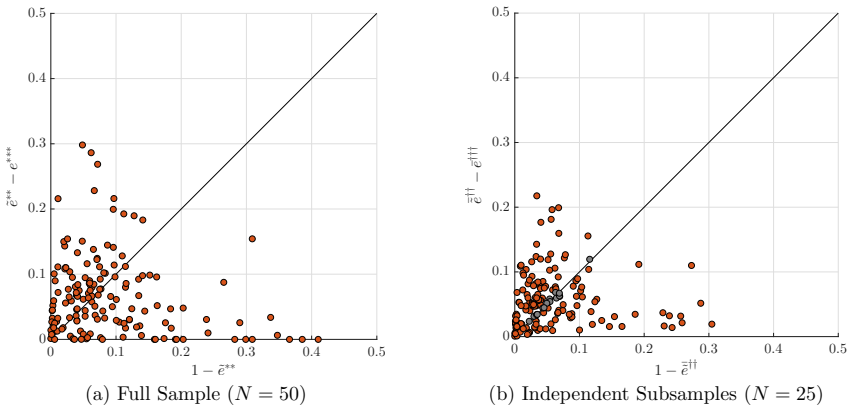
A nested chain of critical cost-efficiency (CCEI-type) scores: e* (basic rationalizability via GARP), ãe** (FOSD-rationalizability under multiple priors, accommodating ambiguity), e** (FOSD under the uniform prior), and e*** (subjective EUT). Consecutive gaps locate, for each subject, whether departures from EUT stem from ordering failures, FOSD failures even multiple priors cannot absorb, or genuine ambiguity-sensitive behavior.
Load-bearing premise
That paying only one randomly selected round does not let subjects hedge ambiguity across the fifty sequential, heterogeneous budgets in a way that would artificially shrink measured ambiguity aversion.
What would settle it
An otherwise identical experiment that pays every round (or uses a non-random incentive that blocks hedging) and checks whether the multiple-prior versus uniform-prior wedge shrinks or disappears; if the wedge vanishes under full payment, the ambiguity reading is compromised by the incentive protocol.
Editorial analysis
A structured set of objections, weighed in public.
Referee Report
Summary. The paper provides a comprehensive, nonparametric revealed-preference test of the full axiom hierarchy for subjective expected utility (EUT) under uncertainty, using the Ahn et al. (2014) three-state portfolio-choice data (N=154), and compares it to an otherwise identical risk experiment (Dembo et al. 2026, N=168). Nested CCEI-type scores—e* (GARP/rationalizability), ˜e** (FOSD under multiple priors), e** (FOSD under the uniform prior), and e*** (EUT under the uniform prior)—decompose departures from subjective EUT. The main claims are that the distributions of e* and e*** under uncertainty are statistically indistinguishable from those under risk, while the ˜e**–e** wedge under uncertainty creates greater empirical scope for multiple-prior non-EUT models (RDU/REU class) than exists under risk; absolute and relative consistency vary substantially across subjects. Supporting analyses include KS tests, subject-level difference-in-differences on half-sample draws, a check that the uniform prior approximately maximizes single-prior rationalizability, and a Bronars-style power simulation against unstructured error.
Significance. If the results hold, the paper supplies the first individual-level, nonparametric, full-axiom test of subjective EUT versus multiple-prior alternatives in a rich portfolio environment, and a clean risk–uncertainty comparison under matched designs. The nested CCEI hierarchy, the individual DiD procedure (1,000 half-samples of 25 observations), and the power simulation against simulated subjects with controlled e†† are genuine methodological strengths: they separate failures of ordering/monotonicity from residual room for ambiguity-sensitive models without fitting free parameters. The finding that basic rationalizability and EUT-rationalizability do not deteriorate under uncertainty, while multiple-prior FOSD opens a measurable wedge that risk does not, is of direct interest to theorists of ambiguity and to experimentalists designing tests of such models. The work is a natural companion to Dembo et al. (2026) and is well positioned for a top field or general-interest journal.
major comments (2)
- [Section 7.1, Table 1, Figure 3] The central claim that choices under uncertainty are “as consistent” with utility maximization and EUT as choices under risk rests on a between-subject comparison of two independent pools (Ahn et al. 2014 vs. Dembo et al. 2026). Section 7.1 reports KS non-rejection for e*, e**, and e*** (p ≈ 0.43/0.64/0.23) and nearly identical WARP/GARP patterns in Table 1, which is reassuring. However, the manuscript does not report or discuss demographic or recruitment comparability of the two pools (labs, years, subject composition). Because the “as consistent as” claim is load-bearing for the paper’s contribution relative to the risk companion, a short subsection or appendix table documenting pool similarity (or acknowledging residual confounds) would strengthen the inference. Without that, a skeptical reader can still attribute distributional equality partly to sample composition rather than to the
- [Abstract; Section 5.1.4; Section 8] Section 5.1.4 correctly notes that REU (and RDU) are nested between EUT-rationalizability and FOSD-rationalizability under multiple priors, and that REU is not nonparametrically characterizable given cardinal indeterminacy of the ambiguity–scale product. The abstract and conclusion nonetheless speak of “greater empirical scope for non-EUT models” under uncertainty. That claim is accurate at the class level (˜e** bounds the entire multiple-prior class), but the paper should state more sharply in the abstract/introduction that the wedge does not identify which multiple-prior specification (kinked RDU vs. smooth REU, or generalized kinked) is responsible, and that separating them is left for future work. As written, a casual reader may over-read the result as validating specific ambiguity models rather than the multiple-prior FOSD layer.
minor comments (6)
- [Figure 1; Figures 3–4] Figure 1 and Figures 3–4 use survival functions with 95% CI braces; the braces are helpful but visually dense near the upper tail. Consider a companion table of selected percentiles (e.g., 25/50/75/90) for e*, ˜e**, e**, e*** under uncertainty and risk to make the layered gaps easier to cite.
- [Section 3, footnote 6] Footnote 6 on random incentives and hedging is careful and cites Baillon, Halevy, and Li (2022a,b). Given how central this design premise is to measured ambiguity aversion, a one-paragraph discussion in the main text of Section 3 (rather than only a long footnote) would improve accessibility for experimental readers.
- [Section 7.2, Figure 5] In Section 7.2, Figure 5 shows mean e***(π1) with CIs; the text states the same holds for e** and at the individual level but omits those figures “to economize on space.” A short online appendix figure for e**(π1) would make the “uniform prior is approximately optimal” claim fully transparent.
- [Throughout] Typographical/consistency: “Ahnet al.” appears without a space or non-breaking space before “et al.” in several places (e.g., early Introduction); standardize to “Ahn et al.” throughout. Also “Demboet al.” same issue.
- [Section 6] Section 6 illustrative subjects: the table of scores for IDs 703, 629, 921, 340, 407, 612 reports e** = e*** for all six; a brief sentence explaining why that equality holds for these particular patterns (near-equalization or corner behavior) would help readers who are new to the nested scores.
- [Front matter] JEL codes and keywords are fine; consider adding “revealed preference” more prominently if the journal’s keyword list allows, since that is the paper’s methodological core.
Circularity Check
No significant circularity: nested CCEI scores are definitional by preference-class inclusion, but empirical gaps, KS tests, DiD, and power simulations are data-driven from independent observations.
full rationale
The paper applies standard Afriat/GARP/CCEI and GRID revealed-preference tests (extended from Polisson-Quah-Renou 2020 and the authors' companion risk paper) to the Ahn et al. (2014) portfolio data under uncertainty, and compares score distributions to an independent subject pool under risk. Nesting 1 ≥ e* ≥ ˜e** ≥ e** ≥ e*** follows immediately from the nested families of utility functions (well-behaved o FOSD-multiple-priors o FOSD-uniform o EUT-uniform); this is definitional bookkeeping, not a circular derivation of the central claim. The claim itself—comparable e*/e*** distributions across domains plus a larger ˜e**–e** wedge under uncertainty—is measured from the observed choices via nonparametric inequalities, Kolmogorov–Smirnov tests, subject-level difference-in-differences on subsamples, and a Bronars-style simulation of unstructured FOSD violations. No free parameters are fitted and then re-labeled as predictions; no uniqueness theorem is imported to forbid alternatives; self-citations supply the risk-experiment data and the computational method but do not force the comparative magnitudes. Residual design premises (random incentives, inability to separate RDU from REU) are acknowledged limitations, not circular reductions. Honest non-finding of circularity is therefore warranted.
Axiom & Free-Parameter Ledger
axioms (5)
- standard math Afriat's theorem: a finite dataset is rationalizable by a continuous increasing utility iff it satisfies GARP
- domain assumption FOSD monotonicity under the objectively known probability structure (state 2 has probability 1/3, states 1 and 3 share 2/3)
- domain assumption Symmetry of the rationalizing utility across the two uncertain states
- domain assumption Uniform prior is the natural single-prior benchmark under the experimental design
- standard math Nishimura-Ok-Quah (2017) strengthening of GARP for FOSD-rationalizability and Polisson-Quah-Renou (2020) GRID method for EUT-rationalizability
invented entities (1)
-
FOSD-rationalizability under multiple priors (~e**)
independent evidence
read the original abstract
Ellsberg's famous paradox challenged Savage's subjective expected utility theory (EUT) -- which reduces uncertainty to risk -- by suggesting an aversion toward ambiguity. We provide a revealed preference test of the full set of axioms underpinning subjective EUT under uncertainty and compare it to an analogous test of objective EUT under risk. We find that individual choices are as consistent with utility maximization and expected utility maximization under uncertainty as they are under risk. Nevertheless, there is greater empirical scope for non-EUT models under uncertainty than under risk, and the absolute and relative consistency of EUT and non-EUT models vary considerably across subjects.
Figures



Reference graph
Works this paper leans on
-
[1]
Ok , date-added =
Hiroki Nishimura and Efe A. Ok , date-added =. Utility Representation of an Incomplete and Nontransitive Preference Relation , volume =. Journal of Economic Theory , pages =
-
[2]
Incomplete Preferences and Rational Intransitivity of Choice , volume =
Michael Mandler , date-added =. Incomplete Preferences and Rational Intransitivity of Choice , volume =. Games and Economic Behavior , number =
-
[3]
Comparative Incompleteness: Measurement, Behavioral Manifestations and Elicitation , volume =
Edi Karni and Marie-Louise Vier. Comparative Incompleteness: Measurement, Behavioral Manifestations and Elicitation , volume =. Journal of Economic Behavior and Organization , pages =
-
[4]
Ok , date-added =
Kfir Eliaz and Efe A. Ok , date-added =. Indifference or Indecisiveness? Choice-Theoretic Foundations of Incomplete Preferences , volume =. Games and Economic Behavior , number =
-
[5]
Incomplete Preferences: Modeling, Representations, and Behavioral Implications , year =
Edi Karni , date-added =. Incomplete Preferences: Modeling, Representations, and Behavioral Implications , year =
-
[6]
On the Representation of Incomplete Preferences under Uncertainty with Indecisiveness in Tastes and Beliefs , volume =
Gil Riella , date-added =. On the Representation of Incomplete Preferences under Uncertainty with Indecisiveness in Tastes and Beliefs , volume =. Economic Theory , pages =
-
[7]
Subjective Expected Utility with Incomplete Preferences , volume =
Tsogbadral Galaabaatar and Edi Karni , date-added =. Subjective Expected Utility with Incomplete Preferences , volume =. Econometrica , number =
-
[8]
Ok and Pietro Ortoleva and Gil Riella , date-added =
Efe A. Ok and Pietro Ortoleva and Gil Riella , date-added =. Incomplete Preferences under Uncertainty: Indecisiveness in Beliefs versus Tastes , volume =. Econometrica , number =
-
[9]
Ok , date-added =
Juan Dubra and Fabio Maccheroni and Efe A. Ok , date-added =. Expected Utility Theory without the Completeness Axiom , volume =. Journal of Economic Theory , number =
-
[10]
Regret Theory: A New Foundation , volume =
Enrico Diecidue and Jeeva Somasundaram , date-added =. Regret Theory: A New Foundation , volume =. Journal of Economic Theory , number =
-
[11]
Skew-Symmetric Additive Representations of Preferences , volume =
Yutaka Nakamura , date-added =. Skew-Symmetric Additive Representations of Preferences , volume =. Journal of Mathematical Economics , number =
-
[12]
Regret Theory with General Choice Sets , volume =
John Quiggin , date-added =. Regret Theory with General Choice Sets , volume =. Journal of Risk and Uncertainty , number =
-
[13]
An Axiomatic Foundation for Regret Theory , volume =
Robert Sugden , date-added =. An Axiomatic Foundation for Regret Theory , volume =. Journal of Economic Theory , number =
-
[14]
Fishburn , date-added =
Peter C. Fishburn , date-added =. Non-transitive Measurable Utility for Decision under Uncertainty , volume =. Journal of Mathematical Economics , number =
-
[15]
Fishburn , date-added =
Peter C. Fishburn , date-added =. SSB Utility Theory and Decision-Making under Uncertainty , volume =. Mathematical Social Sciences , number =
-
[16]
Randomize at Your Own Risk: On the Observability of Ambiguity Aversion , volume =
Aur. Randomize at Your Own Risk: On the Observability of Ambiguity Aversion , volume =. Econometrica , number =
-
[17]
Experimental Elicitation of Ambiguity Attitude Using the Random Incentive System , volume =
Aur\'elien Baillon and Yoram Halevy and Chen Li , date-added =. Experimental Elicitation of Ambiguity Attitude Using the Random Incentive System , volume =. Experimental Economics , pages =
-
[18]
Randomization and Ambiguity Aversion , volume =
Shaowei Ke and Qi Zhang , date-added =. Randomization and Ambiguity Aversion , volume =. Econometrica , number =
-
[19]
Preferences for Flexibility and Randomization under Uncertainty , volume =
Kota Saito , date-added =. Preferences for Flexibility and Randomization under Uncertainty , volume =. American Economic Review , number =
-
[20]
Chambers and Paul J
Yaron Azrieli and Christopher P. Chambers and Paul J. Healy , date-added =. Incentives in Experiments: A Theoretical Analysis , volume =. Journal of Political Economy , number =
-
[21]
Abraham Wald's complete class theorem and Knightian uncertainty , volume =
Christoph Kuzmics , date-added =. Abraham Wald's complete class theorem and Knightian uncertainty , volume =. Games and Economic Behavior , pages =
-
[22]
Unintended Hedging in Ambiguity Experiments , volume =
J\"org Oechssler and Alex Roomets , date-added =. Unintended Hedging in Ambiguity Experiments , volume =. Economics Letters , number =
-
[23]
Randomization Devices and the Elicitation of Ambiguity-Averse Preferences , volume =
Sophie Bade , date-added =. Randomization Devices and the Elicitation of Ambiguity-Averse Preferences , volume =. Journal of Economic Theory , number =
-
[24]
Wakker , date-added =
Aur\'elien Baillon and Zhenxing Huang and Asli Selim and Peter P. Wakker , date-added =. Measuring Ambiguity Attitudes for All (Natural) Events , volume =. Econometrica , number =
-
[25]
Dimmock and Roy Kouwenberg and Peter P
Stephen G. Dimmock and Roy Kouwenberg and Peter P. Wakker , date-added =. Ambiguity Attitudes in a Large Representative Sample , volume =. Management Science , number =
-
[26]
Hey , date-added =
Anna Conte and John D. Hey , date-added =. Assessing Multiple Prior Models of Behaviour under Ambiguity , volume =. Journal of Risk and Uncertainty , number =
-
[27]
Hey and Gianna Lotito and Anna Maffioletti , date-added =
John D. Hey and Gianna Lotito and Anna Maffioletti , date-added =. The Descriptive and Predictive Adequacy of Theories of Decision Making under Uncertainty/Ambiguity , volume =. Journal of Risk and Uncertainty , pages =
-
[28]
Trautmann and Gijs van de Kuilen , booktitle =
Stefan T. Trautmann and Gijs van de Kuilen , booktitle =. Ambiguity Attitudes , year =
-
[29]
The Ellsberg Paradox and Risk Aversion: An Anticipated Utility Approach , volume =
Uzi Segal , date-added =. The Ellsberg Paradox and Risk Aversion: An Anticipated Utility Approach , volume =. International Economic Review , number =
-
[30]
Objective Imprecise Probabilistic Information, Second Order Beliefs and Ambiguity Aversion: An Axiomatization , year =
Rapha\"el Giraud , booktitle =. Objective Imprecise Probabilistic Information, Second Order Beliefs and Ambiguity Aversion: An Axiomatization , year =
-
[31]
Ahn , date-added =
David S. Ahn , date-added =. Ambiguity Without a State Space , volume =. Review of Economic Studies , number =
-
[32]
A Bayesian Approach to Uncertainty Aversion , volume =
Yoram Halevy and Vincent Feltkamp , date-added =. A Bayesian Approach to Uncertainty Aversion , volume =. Review of Economic Studies , number =
-
[33]
Testing Ambiguity Models through the Measurement of Probabilities for Gains and Losses , volume =
Aur\'elien Baillon and Han Bleichrodt , date-added =. Testing Ambiguity Models through the Measurement of Probabilities for Gains and Losses , volume =. American Economic Journal: Microeconomics , number =
-
[34]
Wakker , date-added =
Mohammed Abdellaoui and Aur\'elien Baillon and Laetitia Placido and Peter P. Wakker , date-added =. The Rich Domain of Uncertainty: Source Functions and Their Experimental Implementation , volume =. American Economic Review , number =
-
[35]
Zame , date-added =
Peter Bossaerts and Paolo Ghirardato and Serena Guarnaschelli and William R. Zame , date-added =. Ambiguity in Asset Markets: Theory and Experiment , volume =. Review of Financial Studies , number =
-
[36]
Ellsberg Revisited: An Experimental Study , volume =
Yoram Halevy , date-added =. Ellsberg Revisited: An Experimental Study , volume =. Econometrica , number =
-
[37]
Machina and Marciano Siniscalchi , booktitle =
Mark J. Machina and Marciano Siniscalchi , booktitle =. Ambiguity and Ambiguity Aversion , year =
-
[38]
Decision Theory unver Ambiguity , volume =
Johanna Etner and Meglena Jeleva and Jean-Marc Tallon , date-added =. Decision Theory unver Ambiguity , volume =. Journal of Economic Surveys , number =
-
[39]
Wakker , date-added =
Peter P. Wakker , date-added =. Prospect Theory: For Risk and Ambiguity , year =
-
[40]
Ambiguity and Second-Order Belief , volume =
Kyoungwon Seo , date-added =. Ambiguity and Second-Order Belief , volume =. Econometrica , number =
-
[41]
Nau , date-added =
Robert F. Nau , date-added =. Uncertainty Aversion with Second-Order Utilities and Probabilities , volume =. Management Science , number =
-
[42]
A Theory of Subjective Compound Lotteries , volume =
Haluk Ergin and Faruk Gul , date-added =. A Theory of Subjective Compound Lotteries , volume =. Journal of Economic Theory , number =
-
[43]
Attitude Toward Imprecise Information , volume =
Thibault Gajdos and Takashi Hayashi and Jean-Marc Tallon and Jean-Christophe Vergnaud , date-added =. Attitude Toward Imprecise Information , volume =. Journal of Economic Theory , number =
-
[44]
Preferences Over Sets of Lotteries , volume =
Wojciech Olszewski , date-added =. Preferences Over Sets of Lotteries , volume =. Review of Economic Studies , number =
-
[45]
Differentiating Ambiguity and Ambiguity Attitude , volume =
Paolo Ghirardato and Fabio Maccheroni and Massimo Marinacci , date-added =. Differentiating Ambiguity and Ambiguity Attitude , volume =. Journal of Economic Theory , number =
-
[46]
Subjective Probability and Expected Utility Without Additivity , volume =
David Schmeidler , date-added =. Subjective Probability and Expected Utility Without Additivity , volume =. Econometrica , number =
-
[47]
Knight , date-added =
Frank H. Knight , date-added =. Risk, Uncertainty, and Profit , year =
-
[48]
Quah , date-added =
Aluma Dembo and Shachar Kariv and Matthew Polisson and John K.-H. Quah , date-added =. Ever since Allais , volume =. Journal of Political Economy , number =
-
[49]
Epstein , date-added =
Larry G. Epstein , date-added =. Are Probabilities Used in Markets? , volume =. Journal of Economic Theory , number =
-
[50]
Machina and D
Mark J. Machina and D. Schmeidler , date-added =. A More Robust Definition of Subjective Probability , volume =. Econometrica , number =
-
[51]
A Smooth Model of Decision Making under Ambiguity , volume =
Peter Klibanoff and Massimo Marinacci and Sujoy Mukerji , date-added =. A Smooth Model of Decision Making under Ambiguity , volume =. Econometrica , number =
-
[52]
Maxmin Expected Utility with Non-Unique Prior , volume =
Itzhak Gilboa and David Schmeidler , date-added =. Maxmin Expected Utility with Non-Unique Prior , volume =. Journal of Mathematical Economics , number =
-
[53]
Risk, Ambiguity, and the Savage Axioms , volume =
Daniel Ellsberg , date-added =. Risk, Ambiguity, and the Savage Axioms , volume =. Quarterly Journal of Economics , number =
-
[54]
Savage , date-added =
Leonard J. Savage , date-added =. The Foundations of Statistics , year =
-
[55]
Bewley , date-added =
Truman F. Bewley , date-added =. Knightian Decision Theory. Part I , volume =. Decisions in Economics and Finance , pages =
-
[56]
Anderson , date-added =
Robert M. Anderson , date-added =. Core Theory with Strongly Convex Preferences , volume =. Econometrica , number =
-
[57]
Charness and U
G. Charness and U. Gneezy and A. Imas , date-added =. Experimental Methods: Eliciting Risk Preferences , volume =. Journal of Economic Behavior and Organization , pages =
-
[58]
C. A. Holt and S. K. Laury , date-added =. Risk Aversion and Incentive Effects , volume =. American Economic Review , number =
-
[59]
Starmer and R
C. Starmer and R. Sugden , date-added =. Testing Alternative Explanations of Cyclical Choices , volume =. Economica , number =
-
[60]
Loomes and C
G. Loomes and C. Starmer and R. Sugden , date-added =. Observing Violations of Transitivity by Experimental Methods , volume =. Econometrica , number =
-
[61]
Loomes and C
G. Loomes and C. Starmer and R. Sugden , date-added =. Preference Reversal: Information-Processing Effect or Rational Non-Transitive Choice? , volume =. Economic Journal , number =
-
[62]
Tversky , date-added =
A. Tversky , date-added =. Intransitivity of Preferences , volume =. Psychological Review , number =
-
[63]
Fudenberg and W
D. Fudenberg and W. Gao and A. Liang , date-added =. How Flexible Is That Functional Form? Quantifying the Restrictiveness of Theories , year =. Review of Economics and Statistics , number =
-
[64]
Fudenberg and J
D. Fudenberg and J. Kleinberg and A. Liang and S. Mullainathan , date-added =. Measuring the Completeness of Economic Models , volume =. Journal of Political Economy , number =
-
[65]
Ellis and S
K. Ellis and S. Kariv and E. Ozbay , date-added =. The Predictivity of Theories of Choice Under Uncertainty , year =
-
[66]
Ellis and S
K. Ellis and S. Kariv and E. Ozbay , date-added =. Predicting and Understanding Individual-Level Choice under Risk , year =
-
[67]
H. R. Varian , date-added =. Non-Parametric Analysis of Optimizing Behavior with Measurement Error , volume =. Journal of Econometrics , number =
-
[68]
Approximate Expected Utility Rationalization , volume =
Federico Echenique and Taisuke Imai and Kota Saito , date-added =. Approximate Expected Utility Rationalization , volume =. Journal of the European Economic Association , number =
-
[69]
Andreoni and L
J. Andreoni and L. Vesterlund , date-added =. Which is the Fair Sex? Gender Differences in Altruism , volume =. Quarterly Journal of Economics , number =
-
[70]
The Distributional Preferences of Americans, 2013--2016 , volume =
Raymond Fisman and Pamela Jakiela and Shachar Kariv and Silvia Vannutelli , date-added =. The Distributional Preferences of Americans, 2013--2016 , volume =. Experimental Economics , pages =
2013
-
[71]
Casalino and Raymond Fisman and Shachar Kariv and Daniel Markovits , date-added =
Jing Li and Lawrence P. Casalino and Raymond Fisman and Shachar Kariv and Daniel Markovits , date-added =. Experimental Evidence of Physician Social Preferences , volume =. Proceedings of the National Academy of Sciences , number =
-
[72]
Hu and J
G. Hu and J. Li and J. K.-H. Quah and R. Tang , date-added =. A Theory of Revealed Indirect Preference , year =
-
[73]
Lanier and B
J. Lanier and B. Miao and J. K.-H. Quah and S. Zhong , date-added =. Intertemporal Consumption with Risk: A Revealed Preference Analysis , year =. Review of Economics and Statistics , pages =
-
[74]
Andreoni and C
J. Andreoni and C. Sprenger , date-added =. Estimating Time Preferences from Convex Budgets , volume =. American Economic Review , number =
-
[75]
Barseghyan and F
L. Barseghyan and F. Molinari and M. Thirkettle , date-added =. Discrete Choice under Risk with Limited Consideration , volume =. American Economic Review , number =
-
[76]
Breig and P
Z. Breig and P. Feldman , date-added =. Revealing Risky Mistakes Through Revisions , volume =. Journal of Risk and Uncertainty , pages =
-
[77]
Nielsen and J
K. Nielsen and J. Rehbeck , date-added =. When Choices Are Mistakes , volume =. American Economic Review , number =
-
[78]
Dietrich and A
F. Dietrich and A. Staras and R. Sugden , date-added =. Savage's Response to Allais as Broomean Reasoning , volume =. Journal of Economic Methodology , number =
-
[79]
Murphy , date-added =
Samiran Banerjee and James H. Murphy , date-added =. A Simplified Test for Preference Rationality of Two-Commodity Choice , volume =. Experimental Economics , pages =
-
[80]
Quah , date-added =
Matthew Polisson and John K.-H. Quah , date-added =. Rationalizability, Cost-Rationalizability, and Afriat's Efficiency Index , year =
discussion (0)
Sign in with ORCID, Apple, or X to comment. Anyone can read and Pith papers without signing in.