pith. machine review for the scientific record. sign in

econ.GN

General Economics

General methodological, applied, and empirical contributions to economics.

0
econ.GN 2026-05-12 2 theorems

AI boosts solo entries but teams top the charts

Generative AI Fuels Solo Entrepreneurship, but Teams Still Lead at the Top

Post-ChatGPT Product Hunt data shows more individuals launching products, yet teams hold the highest quality rankings.

Figure from the paper full image
abstract click to expand
Recent advances in generative artificial intelligence (AI) are reshaping who enters entrepreneurship, but not who reaches the top of the quality distribution. Using data on over 160,000 product launches on Product Hunt, we find that entrepreneurial entry increased sharply following the public release of ChatGPT-3.5, driven disproportionately by solo entrepreneurs. This shift toward solo entry is particularly pronounced in categories that historically favored team-based ventures. However, much of this growth reflects low-commitment, experimental entry and does not translate into greater representation among the highest-quality outcomes. Team-based ventures are increasingly dominant in the top tiers of platform rankings. These findings suggest that generative AI lowers barriers to solo entrepreneurship while reinforcing team-based advantages.

0
0
econ.GN 2026-05-12 Recognition

Skill premium rise causes one gender to fully invest and the other less

Skill Premia and Pre-Marital Investments in Marriage Markets

In symmetric marriage markets with search frictions, higher wages for skilled workers create unique equilibria with divergent gender skill,

abstract click to expand
I study a decentralized marriage market with search frictions, costly pre-marital skill investments, and non-transferable utility. Despite a symmetric environment, the market can exhibit asymmetric equilibria, with one gender investing more in skills than the other; in some environments, the asymmetric equilibrium is unique. A microfounded model of household utility maximization shows that this transition from a unique symmetric equilibrium to a unique asymmetric equilibrium can be driven by rising labor-market wages for high-skilled workers: as the skill premium rises, one gender ends up fully investing while the other invests substantially less.
0
0
econ.GN 2026-05-11 2 theorems

Off-grid solar spreads via contagion that expands then consolidates

From Expansion to Consolidation: Socio-Spatial Contagion Dynamics in Off-Grid PV Adoption

Satellite analysis across 507 communities links clustering intensity to faster adoption and shows a shift from range growth to filling in as

Figure from the paper full image
abstract click to expand
In traditional rural societies, where social ties are embedded in physical space, the diffusion of emerging technologies may be amplified through socio-spatial contagion (SSC). Such processes may play a key role in accelerating residential PV adoption in off-grid regions. Yet empirical evidence on SSC in PV adoption remains largely limited to affluent, grid-connected settings, while off-grid regions often lack systematic installation records. To address these gaps, we use a deep learning segmentation model to extract PV installations from a decade-long series of remote sensing imagery across 507 off-grid settlement clusters (hereafter, communities). This enables data-driven spatio-temporal point pattern inference of SSC in data-scarce contexts. SSC is quantified through the range and intensity of clustering of new installations around prior adopters, and the dynamics of these dimensions are linked to adoption outcomes. We found that SSC is nearly ubiquitous, often spanning most of the community's spatial extent, while exhibiting substantial heterogeneity in intensity. Although SSC intensifies over time, its effects remain temporally concentrated, peaking within 1 to 2 years of nearby installations and weakening thereafter. SSC intensity is positively associated with adoption rates in both cross-sectional and temporal analyses. However, the relationship between SSC range and adoption changes over time - in early diffusion phases, adoption growth is associated with range expansion, whereas in later phases it is associated with range contraction. This shift reflects a transition from clustering to consolidation of installations. These findings highlight the potential of seeding interventions to accelerate PV diffusion in off-grid regions.
0
0
econ.GN 2026-05-11 2 theorems

Contagion drives off-grid solar from spread to fill-in

From Expansion to Consolidation: Socio-Spatial Contagion Dynamics in Off-Grid PV Adoption

Early clustering expands range while later growth contracts it, marking the shift from new sites to denser coverage.

Figure from the paper full image
abstract click to expand
In traditional rural societies, where social ties are embedded in physical space, the diffusion of emerging technologies may be amplified through socio-spatial contagion (SSC). Such processes may play a key role in accelerating residential PV adoption in off-grid regions. Yet empirical evidence on SSC in PV adoption remains largely limited to affluent, grid-connected settings, while off-grid regions often lack systematic installation records. To address these gaps, we use a deep learning segmentation model to extract PV installations from a decade-long series of remote sensing imagery across 507 off-grid settlement clusters (hereafter, communities). This enables data-driven spatio-temporal point pattern inference of SSC in data-scarce contexts. SSC is quantified through the range and intensity of clustering of new installations around prior adopters, and the dynamics of these dimensions are linked to adoption outcomes. We found that SSC is nearly ubiquitous, often spanning most of the community's spatial extent, while exhibiting substantial heterogeneity in intensity. Although SSC intensifies over time, its effects remain temporally concentrated, peaking within 1 to 2 years of nearby installations and weakening thereafter. SSC intensity is positively associated with adoption rates in both cross-sectional and temporal analyses. However, the relationship between SSC range and adoption changes over time - in early diffusion phases, adoption growth is associated with range expansion, whereas in later phases it is associated with range contraction. This shift reflects a transition from clustering to consolidation of installations. These findings highlight the potential of seeding interventions to accelerate PV diffusion in off-grid regions.
0
0
econ.GN 2026-05-11 Recognition

Historical GWP data forecasts economic explosion by 2047

On the probability distribution of long-term changes in the growth rate of the global economy: An outside view

A diffusion model fitted to millennia of observations places most data in the middle of predicted ranges and implies median explosion in 204

abstract click to expand
Daniel Kahneman and Amos Tversky argued for challenging inside views (informed by contextual specifics) with outside views (based on historical "base rates" for certain event types). A reasonable inside view of the prospects for the global economy in this century is that growth will converge to 2.5%/year or less: population growth is expected to slow or halt by 2100; and as more countries approach the technological frontier, economic growth should slow as well. To test that view, this paper models gross world product (GWP) observed since 10,000 BCE or earlier, in order to estimate a base distribution for changes in the growth rate as a function of the GWP level. For econometric rigor, it casts a GWP series as a sample path in a stochastic diffusion whose specification is novel yet rooted in neoclassical growth theory. After estimation, most observations fall between the 40th and 60th percentiles of predicted distributions. The fit implies that GWP explosion is all but inevitable, in a median year of 2047. The friction between inside and outside views highlights two insights. First, accelerating growth is more easily explained by theory than is constant growth. Second, the world system may be less stable than traditional growth theory and the growth record of the last two centuries suggest.
0
0
econ.GN 2026-05-11 Recognition

ChatGPT availability leaves high school test scores unchanged

Little Impact of ChatGPT Availability on High School Student Test Score Performance

Summer usage drops identify heavy educational adopters with no performance difference

abstract click to expand
In educational settings, AI can be used as a learning aid, but can also be used to avoid schoolwork, thereby passing classes while learning little. Many existing studies on the impact of AI on education focus on AI use in controlled settings or with specialized tools. In this paper, the dropoff in ChatGPT activity during non-school summer months in 2023 and 2024 is used to identify areas with heavy educational AI use and thus estimate the educational impact of AI as it is actually used. I find no meaningful impact of AI usage on high school test score averages in either direction. These results imply that, to the extent that high school students use AI to avoid learning, it either does not matter much for their test performance or is cancelled out by positive uses of AI in the aggregate.
0
0
econ.GN 2026-05-11 Recognition

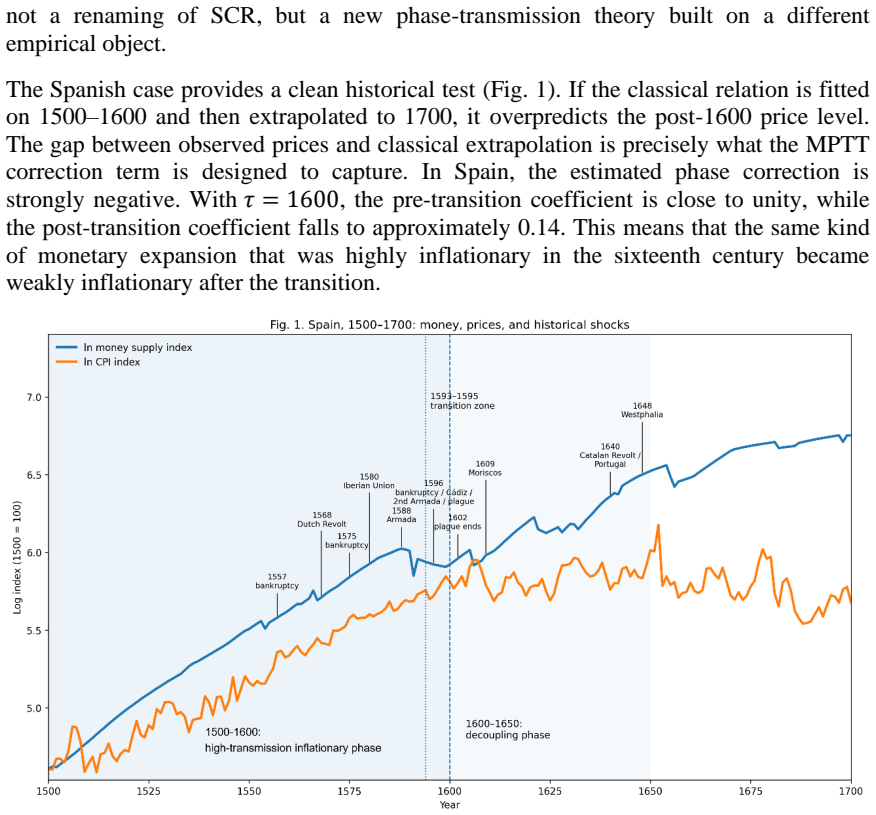
Spanish inflation decoupled from money supply growth after 1600

The Phase Structure of Metallic Money: An MPTT Framework for the Spanish Price Revolution

Pre-1600 prices rose nearly in step with bullion inflows, but later money growth had far smaller price effects.

Figure from the paper full image
abstract click to expand
The Spanish Price Revolution is usually treated as a classic case in which American bullion inflows expanded the money supply and generated inflation. This view captures the first phase of the episode but fails to explain why the same monetary expansion did not continue to produce proportional price growth after 1600. We develop a two-phase Money Phase Transition Theory (MPTT) model in which the classical monetary relation is recovered before a transition point, while a second-phase correction term modifies the money-price transmission coefficient after the transition. Using annual Spanish CPI and reconstructed money-supply data, we show that 1500-1600 was a high-transmission metallic inflationary phase: CPI increased approximately 3.35-fold while money supply increased approximately 3.73-fold. After 1600, money supply continued to rise, increasing approximately 1.82-fold during 1600-1650, while CPI rose only approximately 1.22-fold. A classical one-phase model fitted on 1500-1600, therefore, overpredicts post-1600 prices when extrapolated forward. The MPTT two-phase model with transition point tau=1600 estimates beta_1=0.949, gamma=-0.812, and beta_2=beta_1+gamma=0.137, indicating a sharp post-transition weakening of monetary transmission. An unrestricted break scan identifies a deeper BIC-minimizing break around 1636. These results suggest that the Spanish Price Revolution was not a single monotonic bullion-inflation process but the rise and exhaustion of high-transmission metallic money inflation.
0
0
econ.GN 2026-05-08 Recognition

Feedback models bring dynamic causality into economics teaching

Introducing Feedback Thinking and System Dynamics Modeling in Economics Education

A pricing example and four-level hierarchy show how system dynamics captures loops that standard classes often miss.

abstract click to expand
System dynamics is a methodology that is widely used in many academic fields. It explains the behavior of social and economic systems with models that capture complex causality and feedback effects. This 'practice paper' discusses the opportunities and barriers for introducing feedback thinking and system dynamics models in the economics curriculum. We start by providing a pricing feedback model that illustrates some of the benefits that system dynamics can provide in enhancing economics education. Then we summarize the experiences of each of the authors in teaching system dynamics on economics educational programs. This includes different approaches to teaching economics with system dynamics that depend on the learning objectives, the preparation of students, and the background of the instructor. We also develop a four-level course hierarchy for using system dynamics in economics teaching. We then point out the tradeoffs that instructors must consider as they introduce new pedagogies for delivering economics material. Finally, we provide some concluding comments with some suggestions for future work. The expected audiences for this paper are instructors as well as graduate students who are considering academia as a profession.
0
0
econ.GN 2026-05-08

Migration reduces elderly share in Swiss municipalities

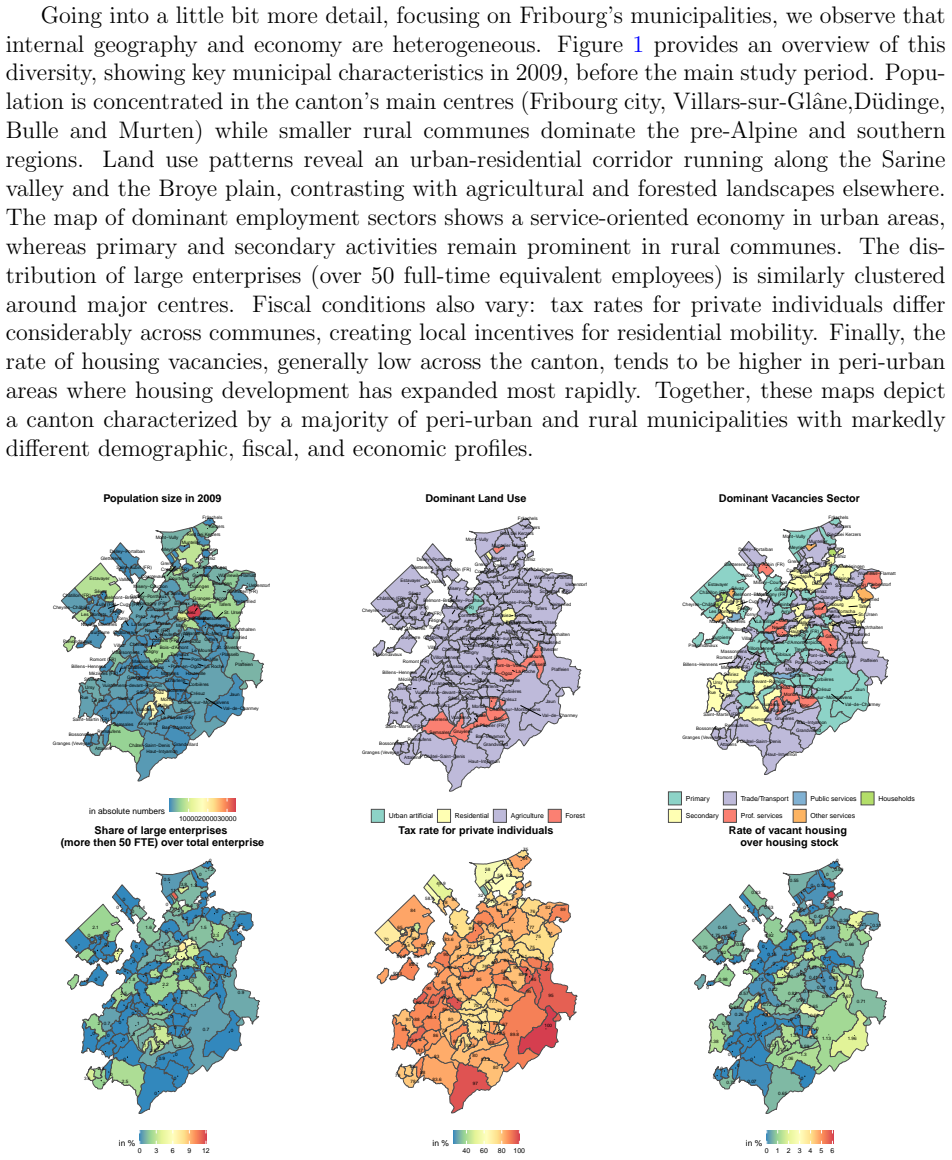
Migration-Driven Demographic Changes: effects on local communities in the canton of Fribourg

Fribourg study finds modest persistent shifts in age structure, school cohorts, and housing from both internal and international inflows.

Figure from the paper full image
abstract click to expand
Migration is reshaping demographic landscapes across Europe, raising urgent questions about adapting to rapid population changes. This study examines the canton of Fribourg, Switzerland, which experienced a 30% population increase over the past 15 years, driven by international and internal migration. As local governments face mounting pressures from demographic shifts in housing, education, and social services, understanding the causal effects of migration is essential for evidence-based policymaking. We study how migration reshapes local demographic, educational, and housing outcomes across 112 Fribourg municipalities (2010-2021). Using the intertemporal difference-in-differences estimator of De Chaisemartin and D'Haultfoeuille (2024), which accommodates staggered timing and cumulative, non-binary treatment, we identify the effect of a one-percentage-point increase in cumulative migration balance (relative to baseline population). Migration exposure generates modest but persistent adjustments across demographic, educational, and housing dimensions. Both migration types reduce the share of elderly residents, and international inflows are associated with higher birth counts. Internal migration increases resident students and alters compulsory and secondary-school cohorts, while international migration slightly reduces the tertiary-education share. Housing adjustments are gradual and concentrated in household composition and selected dwelling types, with international migration increasing mid-sized households and internal migration reducing mixed-use dwellings. Though yearly effects are small, their persistence yields meaningful cumulative changes. Overall, migration acts as a counterweight to population aging and generates incremental adjustments in service demand, underscoring the need to incorporate migration exposure into cantonal and municipal planning.
0
0
econ.GN 2026-05-08

Aesthetic quality adds no premium to AI text bids

Artificial Aesthetics: The Implicit Economics of Valuing AI-Generated Text

Participants notice stylistic differences but do not pay more, because aesthetics and function load as one quality factor.

abstract click to expand
Aesthetic qualities command measurable premiums in traditional goods markets. However, it remains unclear whether users are willing to pay for such qualities in AI-generated text. This paper estimates the willingness to pay for aesthetic attributes in large language model outputs using an online experiment with N = 117 participants. Participants evaluated responses from four anonymized models across academic, professional, and personal contexts, rated outputs along multiple dimensions, and submitted bids for access using a Becker-DeGroot-Marschak (BDM) mechanism. We find no statistically significant relationship between perceived aesthetic quality and willingness to pay. While participants systematically distinguish between outputs and exhibit consistent preferences over stylistic features, these differences do not translate into higher monetary valuation. Further analysis shows that aesthetic and functional attributes load onto a single latent factor, suggesting that users perceive quality as a unified construct rather than a separable aesthetic dimension. These results imply that, in current large language model (LLM) markets, aesthetic improvements function as baseline expectations rather than sources of price differentiation.
0
0
econ.GN 2026-05-07

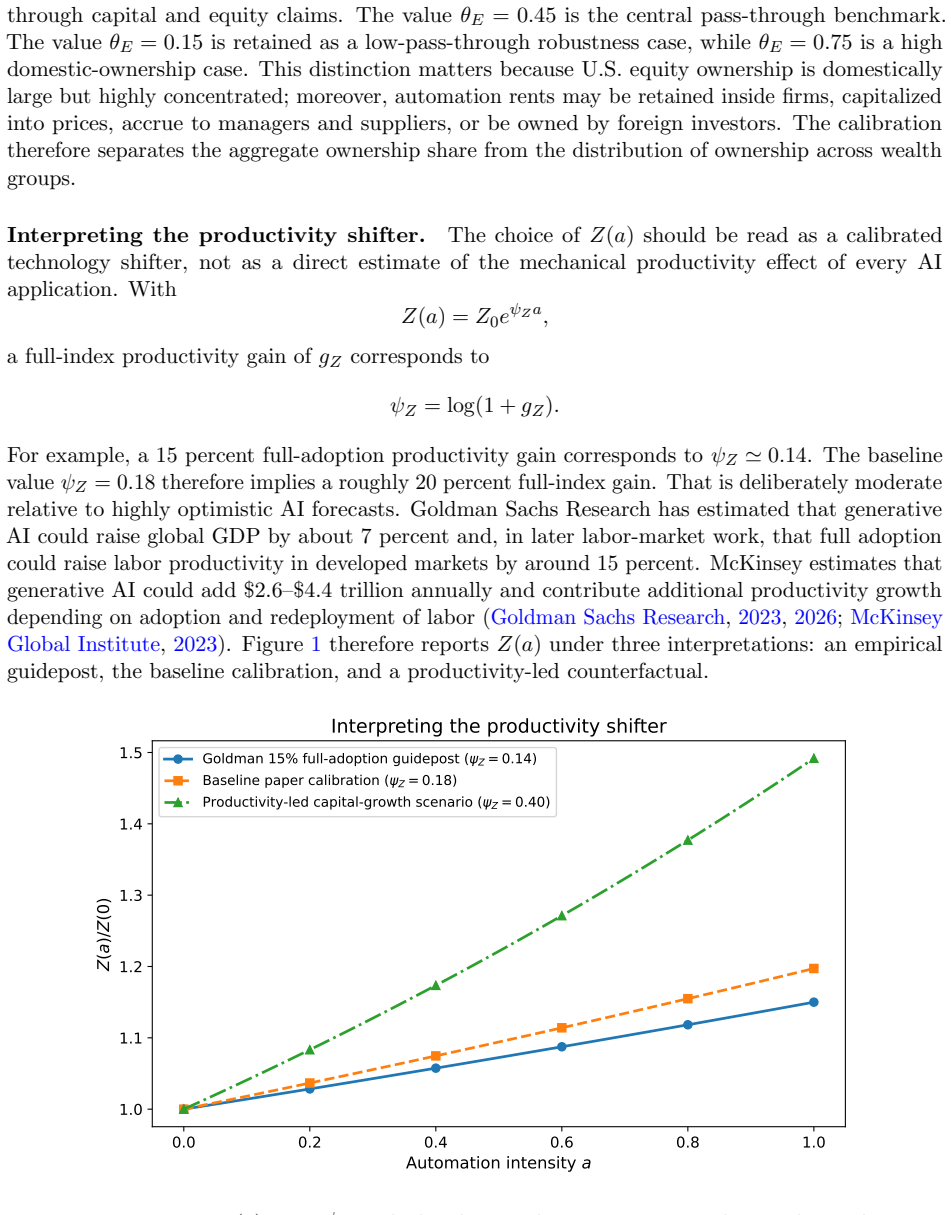
Automation can exceed the social optimum when low-wealth households drive demand

The Demand Externality of Automation

Firms overlook how automation shifts income away from high-MPC consumers toward concentrated capital owners in this equilibrium model.

Figure from the paper full image
abstract click to expand
Automation raises productivity and reduces paid human labor, but it also reallocates income and ownership claims. This paper studies that tradeoff in a static benchmark and in a stationary heterogeneous-agent general equilibrium. Firms choose automation from a profit function. Households differ by skill and wealth, save in a capital/equity claim, and face incomplete insurance. Wages and returns are determined by market clearing from a Cobb--Douglas final-good firm, while the wealth distribution is pinned down by a Hamilton--Jacobi--Bellman (HJB) equation and a Kolmogorov forward equation (KFE). The paper is deliberately two-sided. With strong productivity growth, high-skill complementarity, low obsolescence, and broad ownership, automation raises output, capital, and consumption. With strong exposure of low-wealth, high-marginal-propensity-to-consume (high-MPC) households and concentrated ownership, privately chosen automation can be excessive even though it raises high-skilled labor income. The central object is the derivative of household consumption demand and collective wage bill with respect to automation. Fiscal policy is modeled as a government problem rather than as an abstract planner: a tax changes the firm's automation first-order condition, raises revenue only on the remaining automation base, and must specify rebates and administrative losses.
0
0
econ.GN 2026-05-06 3 theorems

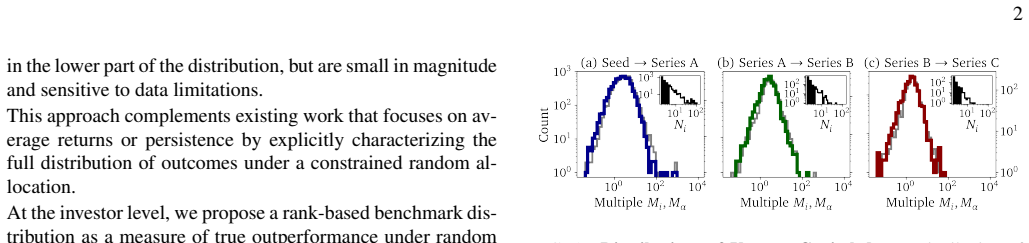
VC portfolios no better than random on big successes

Do Venture Capitalists Beat Random Allocation?

High-return tails match constrained random benchmarks, showing limited evidence of selection skill.

Figure from the paper full image
abstract click to expand
Venture capital outcomes are dominated by a small number of extreme successes, making it difficult to distinguish investor skill from favorable realizations in a highly skewed return distribution. We study this question by comparing empirical VC portfolios to a constrained random benchmark that preserves key portfolio characteristics, including timing, geography, sector composition, and portfolio size, while randomizing individual company selection. Across funding stages, empirical portfolio distributions appear remarkably close to their random benchmarks. We find no evidence that portfolio construction increases the probability of high-multiple outcomes: the right tail remains statistically indistinguishable from random allocation. Deviations in the lower part of the distribution are small and sensitive to the interpretation of zero outcomes, suggesting at most weak evidence of downside improvement. We further introduce a rank-based benchmark distribution to evaluate outperformance at each position in the cross-section. This analysis shows that even the best-performing portfolios do not exceed the outcomes expected for their rank under random sampling. Our results suggest that VC portfolio outcomes are largely consistent with constrained random allocation, highlighting the difficulty of identifying aggregate skill in heavy-tailed investment environments. A similar conclusion holds for the performance of financial analysts in predicting future earnings.
0
0
econ.GN 2026-05-06

Interest rate determinants in open economies align with Ramsey model

The Real Interest Rate as a Control Variable in the Open Economy

With interest rate as control, open economy rates depend on discount rates and productivity expectations that raise wages.

abstract click to expand
This paper addresses the structure and dynamics of an open market economy and its relations with the real interest rate. In this respect, the paper is situated within a broad conventional literature. However, it departs from the standard approach to the interest rate by treating it as a control variable. Even so, the analysis concludes that the two main determinants of the interest rate are the future utility discount rate and expectations regarding future multifactor productivity (labor efficiency). Furthermore, increases in such expectations lead to increases in both the interest rate and wages. These results are consistent with to those obtained with the Cass, Koopmans, Ramsey model.
0
0
econ.GN 2026-05-06

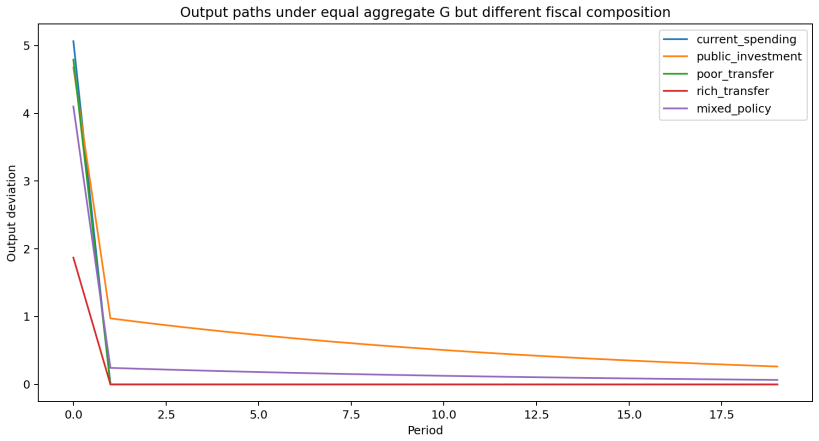
Fiscal G works only when every spending tool has the same output effect

Fiscal Aggregation and the Limits of IS--LM--BP: Derivations, Aggregation Bias and Reproducible Adversarial Simulations

Heterogeneous instruments require composition-weighted multipliers once the IS-LM-BP model adds debt dynamics and risk premia

Figure from the paper full image
abstract click to expand
This paper develops a formal critique of scalar fiscal aggregation in the IS LM BP/Mundell Fleming framework. It shows that when fiscal policy is composed of heterogeneous instruments current purchases, public investment and transfers to different households the aggregate variable G is sufficient for output analysis only under a restrictive gradient condition: all instruments must have identical marginal effects on output. The paper proves this condition, derives composition weighted multipliers, identifies aggregation bias and extends the open economy IS LM BP model to incorporate fiscal composition, public capital, debt dynamics and risk-premium effects. A reproducible computational exercise with symbolic checks, derivative tests, accounting identities, adversarial counterexamples, sensitivity sweeps, Monte Carlo simulations and stress tests confirms the internal consistency of the argument. The contribution is methodological: IS LM BP remains useful as a compact equilibrium framework, but fiscal policy analysis requires vector-valued instruments and state-contingent multipliers rather than a single homogeneous spending variable.
0
0
econ.GN 2026-05-06

This paper examines over 23 million US worker retraining records from 2017-2023 to testโ€ฆ

Did US Worker Retraining Reduce Participant Automation Exposure?

WIOA retraining rarely moves participants into less automation-exposed occupations, with wage gains driven mainly by mean reversion insteadโ€ฆ

abstract click to expand
This paper evaluates whether the U.S. Workforce Innovation and Opportunity Act (WIOA) supported American worker resilience to technological automation. Analyzing over 23 million WIOA participation records (2017-2023), we introduce the "Retrainability Index," which measures program outcomes through post-intervention wage recovery and shifts in Routine Task Intensity (RTI). We show WIOA rarely shifts workers into less automation-exposed work, with a significant portion of participants simply returning to their prior field. Successful outcomes driven mostly by wage gains, possibly due to "catch-up" mean reversion, rather than changes in occupation. Outcomes are moderated by a person's prior occupational skill set and area of work, as well as their local economy. We find evidence that employer led programs--notably apprenticeships--are associated with the highest incidence of success. This suggests the United States' existing public active labor market programming can support baseline wage recovery for vulnerable populations, but is not well-equipped to support the large-scale, cross-industry labor transitions.
0
0
econ.GN 2026-05-05

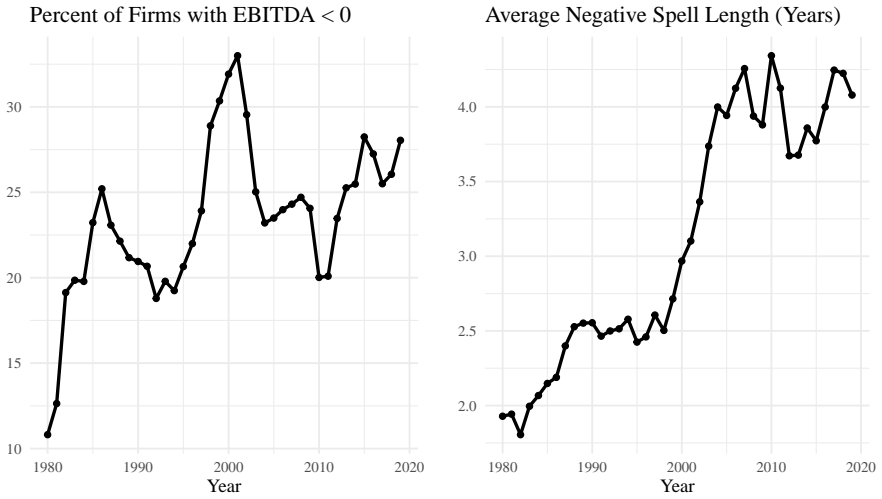
One demand parameter explains rising firm losses and cuts GDP 9%

The Rise of Negative Earnings and Demand Shifting Investment

Model shows a single rise in scale elasticity matches loss trends since 1980 and reallocates resources to lower output.

Figure from the paper full image
abstract click to expand
We document the rise of negative earnings between 1980 and 2019: a secular increase in the percent of firms reporting losses, both among public firms and in the broader universe of US corporations, and a secular increase in the persistence of losses year-to-year among public firms. This rise has occurred alongside a spreading of the sales and earnings distribution and a recomposition of firm spending away from production costs and traditional investment and towards sales general and administrative expenses. We rationalize these phenomena with a model of heterogenous firms engaging in supply and demand shifting investment. Our model includes a scale elasticity of demand determining the relationship between the intensive margin of demand (demand per customer) and the extensive margin of demand (number of customers). We are able to quantitatively match the rise in reported losses and qualitatively match (1) the increased persistence of losses, (2) the spreading of the sales and earning distribution and (3) the recomposition of firm spending with this parameter as the single driver of changes across steady state equilibria. The rise in the scale elasticity associated with the increase in reported losses has non-trivial aggregate implications: in our model it lowers GDP by -9.1% by reallocating labor away from goods and capital production and reallocating demand away from productive firms.
0
0
econ.GN 2026-05-05

Demand shifting raises firm losses and lowers GDP by 9.1 percent

The Rise of Negative Earnings and Demand Shifting Investment

A single increase in demand scale elasticity matches the post-1980 rise in negative earnings, their persistence, earnings dispersion, and SG

Figure from the paper full image
abstract click to expand
We document the rise of negative earnings between 1980 and 2019: a secular increase in the percent of firms reporting losses, both among public firms and in the broader universe of US corporations, and a secular increase in the persistence of losses year-to-year among public firms. This rise has occurred alongside a spreading of the sales and earnings distribution and a recomposition of firm spending away from production costs and traditional investment and towards sales general and administrative expenses. We rationalize these phenomena with a model of heterogenous firms engaging in supply and demand shifting investment. Our model includes a scale elasticity of demand determining the relationship between the intensive margin of demand (demand per customer) and the extensive margin of demand (number of customers). We are able to quantitatively match the rise in reported losses and qualitatively match (1) the increased persistence of losses, (2) the spreading of the sales and earning distribution and (3) the recomposition of firm spending with this parameter as the single driver of changes across steady state equilibria. The rise in the scale elasticity associated with the increase in reported losses has non-trivial aggregate implications: in our model it lowers GDP by -9.1% by reallocating labor away from goods and capital production and reallocating demand away from productive firms.

0
0
econ.GN 2026-05-05

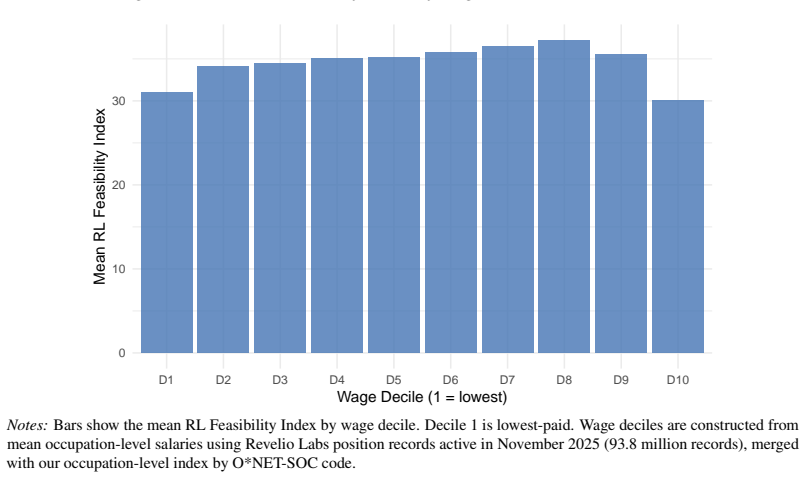
New RL index re-ranks which jobs AI can learn to do

What Jobs Can AI Learn? Measuring Exposure by Reinforcement Learning

Power-plant operators and conductors score high for reinforcement-learning feasibility while musicians and physicians score low, reversing a

Figure from the paper full image
abstract click to expand
Which jobs can AI learn to do? We examine this for every occupation in the US economy. Existing indices measure the overlap between AI capabilities and occupational tasks rather than which tasks AI systems can learn to perform, and as a result misclassify occupations where the gap between present capability and learnability is large. Reinforcement learning in post-training, now the dominant paradigm at the frontier, is structured around task completion and maps more directly onto the task-based architecture of occupational classifications than prior approaches. Using LLM annotators guided by a rubric developed with RL experts and validated against confirmed deployment cases, we score all 17,951 ONET tasks for training feasibility and aggregate to the occupation level, producing an RL Feasibility Index. The index diverges sharply from existing AI exposure measures for specific occupation groups: power plant operators, railroad conductors, and aircraft cargo handling supervisors score high on RL feasibility but low on general AI exposure, while creative and interpersonal roles (musicians, physicians, natural sciences managers) show the reverse. These divergences carry direct implications for policy interventions.
0
0
econ.GN 2026-05-05

Coalition external fights intensify their internal conflicts

Compound Attrition Games: A Unified Model for Inter- and Intra-Coalition Rivalry

New attrition model proves unique mixed equilibrium and shows internal discord weakens external endurance.

abstract click to expand
Strategic competitions in the real world, from wars to geopolitical rivalries, often involve coalitions competing against rival groups. These contests are not simple interactions between unified entities, but multilayered processes in which coalitions face external competition while dealing with internal conflicts over resources and strategy. Existing game-theoretic models typically treat inter-coalition rivalry and intra-coalition competition separately. This paper introduces the Compound Coalition-Attrition Game (CCAG), a unified framework that integrates a war of attrition between coalitions with a simultaneous war of attrition within each coalition. In this model, the endurance of a coalition in external competition is determined by the strategic choices of its members, who compete internally for shares of the outcome. We prove the nonexistence of pure-strategy equilibria and characterize the unique mixed-strategy Nash equilibrium. The analysis reveals feedback effects: external competition intensifies internal conflict, while internal discord weakens external performance. A case study compares traditional commodity markets, including gold, copper, and silver, with cryptocurrency markets, including Bitcoin, Ethereum, and Solana, using data from 2018 to 2023 in a simulation framework. The results demonstrate applicability in industrial strategy, corporate decision-making, and geopolitical competition. The CCAG framework provides a tool for analysing complex strategic environments.
0
0
econ.GN 2026-05-04

Remote jobs deliver larger wage gains and promotions than office roles

Remote work expands pathways to upward career mobility

48 million transitions show the biggest boosts for lower-income workers from places with fewer high-skill opportunities by loosening where a

abstract click to expand
Geographic constraints have long structured access to high-growth career opportunities, concentrating upward mobility within a limited set of cities and organizations. The expansion of remote work potentially alters this opportunity structure by decoupling job matching from physical proximity, yet its implications for career mobility remain unclear. Using 48 million U.S. job transitions between 2020 and 2024 linked to employer-level measures of remote eligibility, we estimate how entering remote-eligible jobs shapes career outcomes at job transitions. Workers entering remote-eligible jobs experience significantly higher wage growth and higher rates of upward seniority mobility than comparable workers entering fully on-site roles. These transitions are also associated with greater cross-metropolitan job mobility and moves toward smaller, less prestigious employers. Importantly, effects are largest among lower-income workers and those originating from regions with limited high-skill opportunity density. Together, the findings indicate that remote work relaxes geographic constraints in job matching, reshaping the distribution of upward mobility across places and workers.
0
0
econ.GN 2026-05-04

Self-devaluing certificates create honest money for AI agents

RSDM: The Consensus Honest Money in the AI Era

RSDM records gradual metal-weight decay on deposit receipts to replace storage fees and resist fiat depreciation in global AI transactions.

abstract click to expand
The medium of exchange of the traditional economy is mainly the fiat currency of each country or region, and when cross-border transactions occur, they need to be settled according to the exchange rate. In the AI world, however, the medium of exchange tends to be a globally recognized currency. Especially when AI acts as an agent for cross-border capital pool and cross cyclical asset allocation, it needs a sound money that can resist the depreciation of fiat currency and store long-term value. Therefore, we propose a globally consensus and universally accepted monetary rule framework for the AI era. The devaluation of money runs through almost the whole process of history, from the weight reduction and purity decrease of metallic coin to the unanchored over-issuance of paper currency. Whether it is the periodic compulsory recoinage in medieval Europe or Gesell's stamp scrip, both are essentially mechanisms for taxing money holdings. Unlike Gesell's stamp scrip, Redeemable Self-Decaying/Devaluing Money (RSDM) is a tokenized commodity money. Its essential innovation is to fill the hole in the storage fee of metal coins through the self-devaluing of metal weight recorded on the deposit certificate (warehouse receipt) of metal coins. In a sense, RSDM is an innovative version of Jiaozi (a deposit receipt for base metal coin that emerged in Sichuan, China, about a thousand years ago). In this paper, we propose five forms of online and offline issuance of RSDM, providing a prototype for creating a globally recognized modern honest money.
0
0
econ.GN 2026-05-01

Wealth sets energy-efficiency adoption threshold

Optimal Consumption and Investment with Energy-Efficiency Adoption

New model shows households adopt when wealth crosses a price- and uncertainty-dependent level, and subsidies steer total energy use.

abstract click to expand
Despite many decades of research, economically grounded models that analyse energy consumption and energy-efficiency adoption within a unified framework remain underdeveloped. This article addresses this gap by proposing a model of consumption, investment, and energy-efficiency adoption under uncertainty. It develops new definitions of the rebound and backfire effects, and integrates their welfare implications into a model of optimal subsidy design. Macro-level technology diffusion and energy consumption across heterogeneous agents are also formalised. Explicit results for core objects are derived, including the adoption threshold and post-adoption strategies, and these are shown to depend on agent wealth, introducing a novel channel through which financial conditions influence technology-adoption decisions. An approximation scheme is proposed to estimate welfare implications explicitly. Adoption of energy efficiency is shown to be welfare improving in the main. A detailed case study of a representative German single-family home illustrates the theoretical results. Numerical analysis indicates that the subsidy policy effectively steers aggregate energy consumption.
0
0
econ.GN 2026-04-30

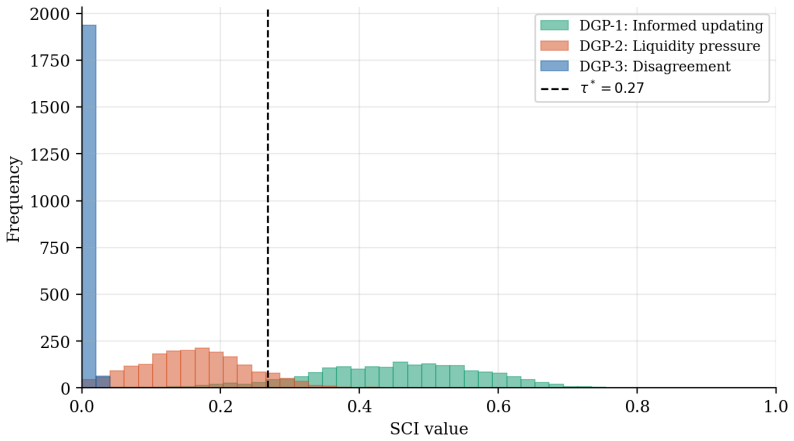
Index scores prediction market moves by credibility

The Signal Credibility Index for Prediction Markets: A Microstructure-Grounded Diagnostic with Weighted and Time-Varying Extensions

Persistence on logit prices plus flow concentration separates durable Bayesian updates from liquidity and strategic noise.

Figure from the paper full image
abstract click to expand
Prediction-market price moves are widely treated as informationally equivalent: a price jump is read the same way regardless of whether it reflects durable Bayesian updating, transient liquidity pressure, strategic position adjustment, or genuine disagreement. This paper formalizes the Signal Credibility Index (SCI) introduced in Nechepurenko (2026) as a stand-alone diagnostic. We make four contributions: (i) a revised persistence component using the persistence ratio PR(t,w) on logit prices, well-defined on short rolling windows; (ii) a weighted Cobb-Douglas form SCI({\alpha}\alpha {\alpha}) with flow-based concentration HHI_flow; (iii) a time-varying specification SCI(t; w) for real-time monitoring; and (iv) Monte Carlo validation including an out-of-distribution stress test, coordinated multi-wallet manipulation, and a logistic-regression benchmark. The validation establishes discrimination among designed microstructure regimes, not external evidence of downstream coordination effects. We document two failure modes consistent with the index targeting coordination credibility rather than pure information content: a Type II error on informed-but-concentrated whale repricing, and a Type I error on coordinated multi-wallet manipulation.
4 0
0
econ.GN 2026-04-30

Framework attributes G20 contagion to trade and financial channels

What Drives Contagion? Identifying and Attributing Cross-Border Transmission Mechanisms

Two-stage wavelet and IV method isolates channel shares across eight crisis sub-periods with explicit identification checks.

Figure from the paper full image
abstract click to expand
We address the joint detection-and-attribution problem in cross-border financial contagion through a two-stage framework. The first stage applies wavelet-quantile transfer entropy across time-scales and lower, median, and upper-tail quantiles. The second stage attributes each significant link to one of five channels comprising of i) Trade, ii) Financial, iii) Geopolitical, iv) Behavioural, and v) Monetary Policy, via instrumental-variables two-stage least squares with channel-specific external instruments, LASSO-based instrument selection (Belloni, Chernozhukov and Hansen, 2014), local projections at one-, five-, and twenty-two-day horizons (Jorda, 2005), heteroskedasticity-based identification (Rigobon, 2003) for episodes in which over-identification is rejected, and Cinelli-Hazlett (2020) sensitivity bounds. The framework is applied to 18 G20 equity markets across eight crisis sub-periods spanning January 2006 to March 2026. Network density varies meaningfully across sub-periods (range 14% to 32%). Dominant-channel identification is robust across methods in the Pre-Crisis baseline and the European Sovereign Debt Crisis, both dominated by financial frictions; for the remaining six episodes identification is method-sensitive, and we report the share posterior alongside an explicit identification-status classification. Trade is empirically prominent across all post-2007 episodes, ranging from 9% during Pre-Crisis to 28% during the Global Financial Crisis. The behavioural channel is bounded above by 22% across all eight episodes under the de-confounded composite. The framework provides a methodologically disciplined account of cross-border contagion mechanisms and offers identification-status disclosure not systematically present in the existing literature.
0
0
econ.GN 2026-04-30

Top inventor arrivals raise local patent rates beyond teams

Marshall meets Bartik: Revisiting the mysteries of the trade

Tax and commuting variations identify spillovers that cross organizations and shift where innovation concentrates.

Figure from the paper full image
abstract click to expand
We identify a causal effect of top inventor inflows on the patent productivity of local inventors by combining the idea-generating process described by Marshall (1890) with the Bartik (1991) instruments involving the state taxes and commuting zone characteristics of the United States. We find that local productivity gains go beyond organizational boundaries and co-inventor relationships, which implies the partially nonexcludable good nature of knowledge in a spatial economy and pertains to the mysteries of the trade in the air. Our counterfactual experiment suggests that the spatial distribution of inventive activity is substantially distorted by the presence of state tax differences.
0
0
econ.GN 2026-04-30

Gold standard deflation raised real value of fixed claims 22-44%

The Reservation Inflation of Hard Money: Gold-Standard Deflation and the Real Expansion of Nominal Claims, 1873-1896

Price declines 1873-1896 expanded the purchasing power of debts and reserves, showing hard money redirects rather than removes inflationary,

Figure from the paper full image
abstract click to expand
The original SCR theory proposed that inflation has two distinct expressions: circulation inflation, measured by rising transaction prices, and reservation inflation, measured by the rising real weight of monetary symbols, debt contracts, reserve claims, and other nominal stores of value relative to physical goods. A companion Japan paper tested one side of this theory by showing that, after money entered a reserve-dominant phase, monetary-base expansion no longer translated strongly into consumer-price inflation. This paper tests the other side of SCR: whether reservation inflation can arise when monetary issuance is constrained and circulation inflation is absent. The classical gold-standard deflation of 1873-1896 provides a clean historical setting. Using long-run British retail price data and the Minneapolis Fed historical U.S. CPI series, I show that the price level declined in both economies. Between 1873 and 1896, Britain's price index fell from 18.0 to 14.7, while the U.S. historical CPI fell from 36.0 to 25.0. Yet this deflation mechanically increased the real value of fixed nominal claims. A fixed-claim reservation index rose by 22.4% in Britain and 44.0% in the United States. Thus, the episode combines negative circulation inflation with positive reservation inflation. The result suggests that hard money does not abolish inflationary pressure in the SCR sense; it changes its domain of expression. Together with the Japan case, this paper supports a phase-dependent view of inflation in which CPI is only one observable expression of the monetary-material asymmetry.
0
0
econ.GN 2026-04-29

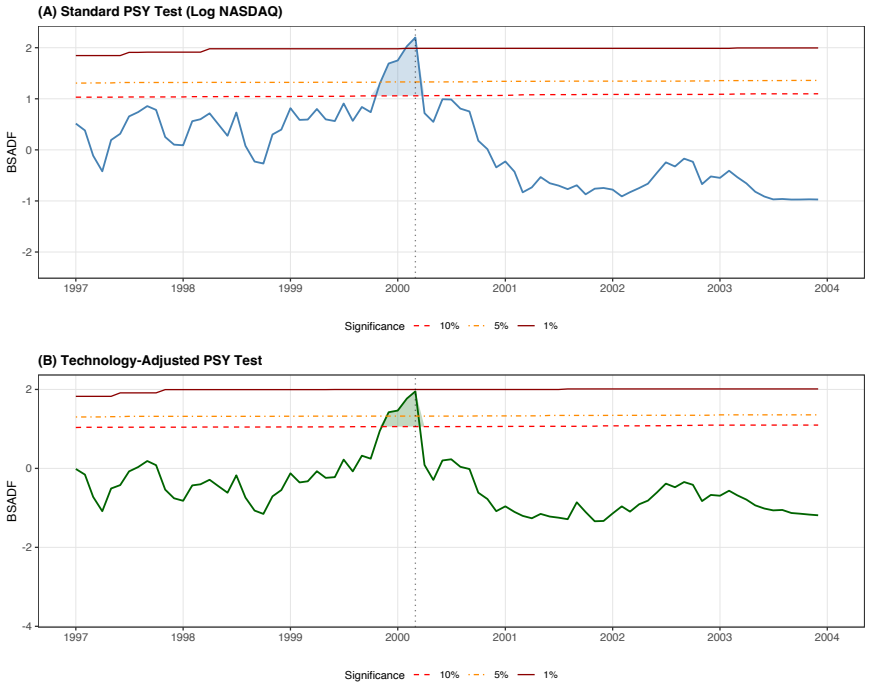
Technology adoption distorts bubble tests with local explosiveness

General-Purpose Technology and Speculative Bubble Detection

Decomposition using proxies finds no speculation in AI stocks but confirms it in the dot-com episode.

Figure from the paper full image
abstract click to expand
We show that the leading bubble test suffers severe size distortion when fundamentals incorporate general-purpose technology adoption. Embedding a hump-shaped technology shock in the Campbell-Shiller present-value model, we prove that the fundamental price becomes locally explosive during adoption, contaminating the test's limit distribution with a non-centrality parameter proportional to the shock's peak. We propose a fundamental-versus-speculative decomposition that projects prices onto observable technology proxies and applies the test to the residual. Empirically, the decomposition eliminates evidence of speculation in the 2020-2025 AI rally while confirming a speculative peak confined to December 1999-March 2000 in the dot-com episode.
0
0
econ.GN 2026-04-29 Recognition

Decomposition removes tech shocks from bubble tests

General-Purpose Technology and Speculative Bubble Detection

Projecting prices onto technology proxies eliminates apparent speculation in the AI rally while preserving it for the narrow 1999-2000 dot-

Figure from the paper full image
abstract click to expand
We show that the leading bubble test suffers severe size distortion when fundamentals incorporate general-purpose technology adoption. Embedding a hump-shaped technology shock in the Campbell-Shiller present-value model, we prove that the fundamental price becomes locally explosive during adoption, contaminating the test's limit distribution with a non-centrality parameter proportional to the shock's peak. We propose a fundamental-versus-speculative decomposition that projects prices onto observable technology proxies and applies the test to the residual. Empirically, the decomposition eliminates evidence of speculation in the 2020-2025 AI rally while confirming a speculative peak confined to December 1999-March 2000 in the dot-com episode.
0
0
econ.GN 2026-04-29

Disabled education mandates paid for themselves via higher revenues

The Short- and Long-Term Impacts of Expanding Public Education for Disabled Students

Affected students gained schooling and jobs, with spillovers to non-disabled peers and long-run tax benefits exceeding costs.

Figure from the paper full image
abstract click to expand
Between 1949 and 1980, every U.S. state mandated public schools to provide educational services for disabled students. This is one of the largest education reforms in U.S. history, but little is known about its impacts. Given scarce data in this period, I compile survey and administrative datasets and set up a difference-in-difference design using variation in the mandates' timing. I show that the mandates increased both services for disabled students and preschool enrollments. In adulthood, disabled individuals below school age at a mandate's implementation became about 20% less likely to have no education, attained up to 0.23 more years of education, and were more likely to have worked. Although this policy could have taken away resources from non-disabled students, in fact, education and employment also increased for non-disabled individuals. These effects align with evidence that the mandates increased spending per student by up to 15%. Families were also impacted: the mandates increased employment among mothers of disabled children and the probability that disabled individuals became household heads. Over the long term, the mandates paid for themselves by generating government revenues in excess of their cost. These results provide new evidence on the large, broad impacts of expanding access to education for disabled students.
0
0
econ.GN 2026-04-29

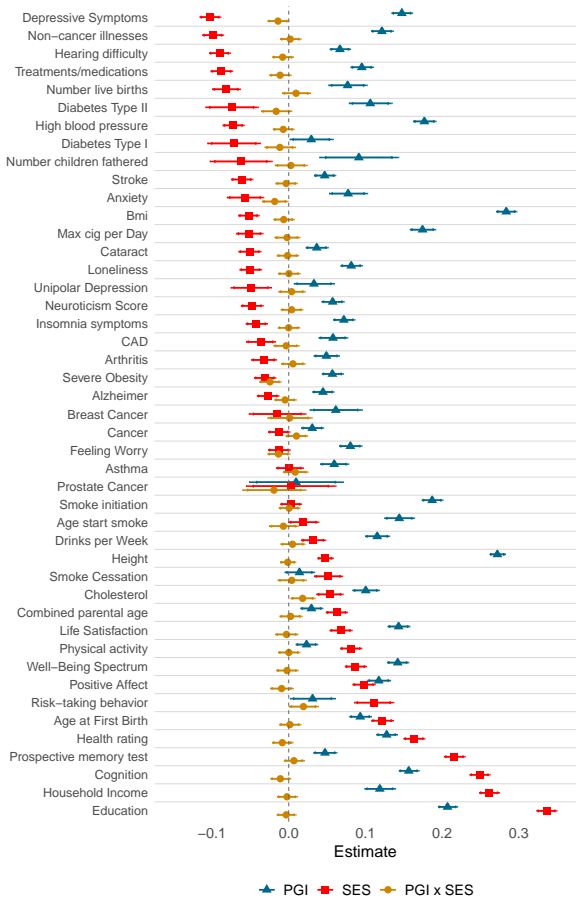
Genes and family status shape adult traits additively

Sources of Inequality at Birth: The Interplay Between Genes and Parental Socioeconomic Status

Polygenic indexes and parental SES each predict 45 traits strongly but show little sign of moderating each other in three longitudinal data

Figure from the paper full image
abstract click to expand
The start of a human's life can be characterized by two lotteries: that of your genes (nature) and the family you were born into (nurture). These set in motion a trajectory, from birth onward, in health and human capital. Leveraging three longitudinal social-science data sets, we systematically analyze the relationship between an individual's genotype, the socioeconomic status (SES) of the families they grew up in, and their realized traits in adulthood. We proxy an individual's genetic predisposition by polygenic indexes (PGIs) and family SES by a latent factor of parental education and father's (former) occupational status. We then investigate how PGIs, parental SES, and their interaction contribute to later-life outcomes across a range of forty-five socioeconomic, anthropometric, health, behavioral, and personality traits. We find strong genetic and socioeconomic associations with these phenotypes, but no evidence of sizable gene-environment interactions.
0
0
econ.GN 2026-04-28

Property premium absorbed into standard interest rate formula

Property, Interest, and Money: Is Heinsohn and Steiger's Property Premium a Determinant of Interest?

Time preference holds, so the premium matches risk in normal credit and stands apart only for banks with redeemable money.

abstract click to expand
Heinsohn and Steiger's "Eigentum, Zins und Geld" (1996) proposes the property premium as the foundational determinant of interest, replacing time preference. This paper examines whether the replacement succeeds. It does not. The two arguments against time preference, the savings-inelasticity claim after Hahn and the portfolio-shift claim after Keynes, both fail on standard microeconomic grounds. With time preference intact, the property premium sits within the standard decomposition of the interest rate. In ordinary collateralized credit it coincides with the risk premium. Only when the lender is a money-issuing bank with a real redemption obligation does a third term enter the decomposition that standard asset-pricing theory does not articulate. That third term is Heinsohn and Steiger's genuine contribution. The paper discusses its apparent disappearance or disguised operation after 2008, and the circularity of a property anchor measured in money.
0
0
econ.GN 2026-04-28

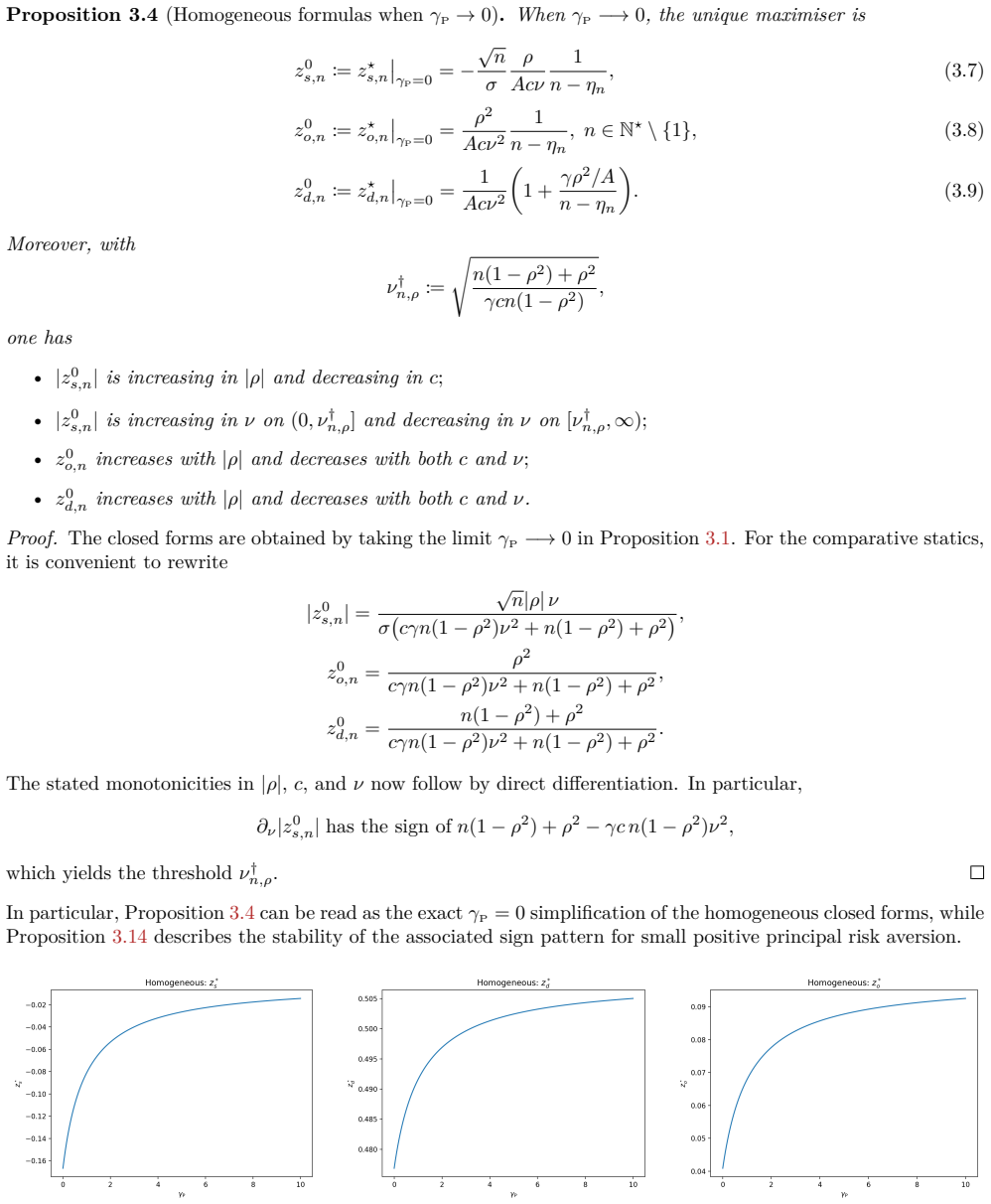
Heterogeneity forces ESG contracts to use sign-changing cross tilts

Optimal incentive scheme for ESG disclosure

High principal risk aversion eliminates aggregate exposure and tightens loadings to identity pooling in a linear-quadratic-Gaussian model.

Figure from the paper full image
abstract click to expand
This paper characterises optimal incentive schemes for ESG disclosure in a continuous-time principal-agent setting. We model a risk-averse principal (e.g., a platform or standard-setter) contracting with a team of heterogeneous agents whose disclosure signals are each correlated with a traded climate risk factor. The optimal contract balances incentive provision against the variance of aggregate payouts by leveraging three instruments: own-signal loading, cross-signal loadings across agents, and hedging tilts on the traded asset. We derive closed-form linear optimal controls in a tractable linear-quadratic-Gaussian framework. When the principal is nearly risk-neutral, the contract uses the traded asset purely to hedge the specific `enforcement risk' generated by high-powered incentives. As the principal's risk aversion increases, the optimal scheme converges to a `market-neutral' regime where aggregate asset exposure is eliminated and the cross-signal structure tightens to an `identity pooling' constraint. We characterise this limit analytically as a constrained quadratic program governed by an M-matrix. In the high-risk-aversion regime, heterogeneity creates genuinely new effects absent under symmetry: the cross-section of S-tilts must change sign (unless degenerate), and an agent's own-signal diagonal can turn negative when that row is too strongly exposed to the common traded factor relative to the rest of the group. The results provide a theoretical foundation for `mixed' compensation structures in Regenerative Finance (ReFi), rationalising the use of both stable payments and volatile governance tokens to optimise risk-sharing.
0
0
econ.GN 2026-04-28

Genetic education score raises lifetime pay 13% only for college grads

Effects of Genetic Propensity for Education on Labor Market and Health Trajectories across the Working Life

Finnish data show the boost comes from faster moves to better employers and shrinks sharply once fathers' genetics are controlled.

Figure from the paper full image
abstract click to expand
Education is a major source of inequality in income and health. Polygenic indices for educational attainment (EA-PGI) capture both direct and indirect genetic influences on education, but their effects on income and health remain unclear. Using Finnish registry data on 51,056 graduates followed annually since graduation for up to 25 years, we report three findings. First, higher EA-PGI strongly predicts income growth, but only among higher educated people: tertiary-educated graduates at the 90th percentile earn EUR 45,392 (13.1 percent) higher discounted lifetime income than those at the 10th percentile. This effect is not mediated by overall health and is entirely absent for the secondary (high school)-educated workers, who do not benefit from higher EA-PGI levels. Second, EA-PGI does not predict income differences at labor market entry or the quality of the first employer, but rather higher job-to-job mobility toward higher-quality firms that drives the long-run income divergence. Third, controlling for parental EA-PGI in 12,871 parent-offspring trios reduces the discounted lifetime income gap by 71 percent, and the effect of paternal (but not maternal) EA-PGI on offspring income exceeds that of the offspring's own EA-PGI. These findings suggest that genetic factors associated with educational attainment predict income trajectories primarily through faster and more frequent changes to higher-paying employers. However, much of this association reflects indirect paternal genetic effects, consistent with enduring paternal patterns of intergenerational job and income transmission.
0
0
econ.GN 2026-04-28

Prediction market prices coordinate political behavior when credible

Price as Focal Point: Prediction Markets,Conditional Reflexivity, and the Politics of Common Knowledge

Public signals organize voters and elites through persistence and cross-platform agreement rather than forecast accuracy alone.

Figure from the paper full image
abstract click to expand
Prediction markets are widely treated as forecasting devices that reveal collective expectations about uncertain futures. This article argues that under specifiable conditions they also function as coordination mechanisms: public probabilities that organize the behavior of voters, donors, journalists, traders, and institutions in ways that can be self-fulfilling or self-defeating. Most existing work asks whether prediction markets forecast accurately; this paper asks whether accurate forecasting is even the right criterion for a market that has become a public coordination device. Drawing on transaction-level evidence from the 2024 U.S. presidential election, we show that the social force of a market signal depends less on its size than on its persistence, the breadth of responding trader types, and cross-platform consensus. We introduce a Signal Credibility Index (SCI) -- combining the variance ratio VR(6), a two-sidedness diagnostic, and a trader-concentration adjustment -- as a microstructure-grounded criterion for predicting when price moves acquire behavioral traction. Applied to three major 2024 political shocks, the framework reveals that superficially similar events generated qualitatively distinct signal types with different implications for elite coordination. A cross-platform comparison establishes a systematic decoupling of social authority from epistemic robustness: the most visible market produced the least accurate forecasts. The framework carries direct implications for regulating prediction markets as democratic information infrastructure.
4 0
0
econ.GN 2026-04-28

Reserve absorption mutes Japan's base expansions

A phase transition in monetary function explains expansion without inflation

After the 2013 phase shift, incremental base money raises reserves rather than consumer prices.

Figure from the paper full image
abstract click to expand
Large monetary expansions do not necessarily generate consumer-price inflation, challenging scalar views of "money supply." Here we propose that monetary function is phase-dependent: newly issued base money can occupy distinct functional compartments with different coupling to prices. Starting from an accounting framework that separates reproduction, consumption, and reservation, we operationalize a measurable order parameter, phi=RB/MB, the reserve-share fraction of the monetary base. Using Japan's monthly record (1971-2026), we identify a compositional phase transition after 2013 from a cash-dominated to a reserve-dominated regime, quantitatively captured by a Landau-type order-parameter transition. Phase-conditional local projections using unexpected (residual) base-growth shocks show that, in Japan, unexpected base expansions are absorbed primarily as reserve balances-phi rises significantly-rather than entering the consumption-goods transaction sector; consequently, the core CPI inflation response is strongly attenuated and can even reverse sign. This demonstrates that increases in monetary supply do not necessarily cause inflation: the key is the "phase" in which incremental money accumulates (reservoir versus circulation). We further define function-specific efficiencies for reservation absorption and CPI transmission and provide an operational distinction between circulation-driven and reservation-dominant inflation regimes.
1 0
0
econ.GN 2026-04-27

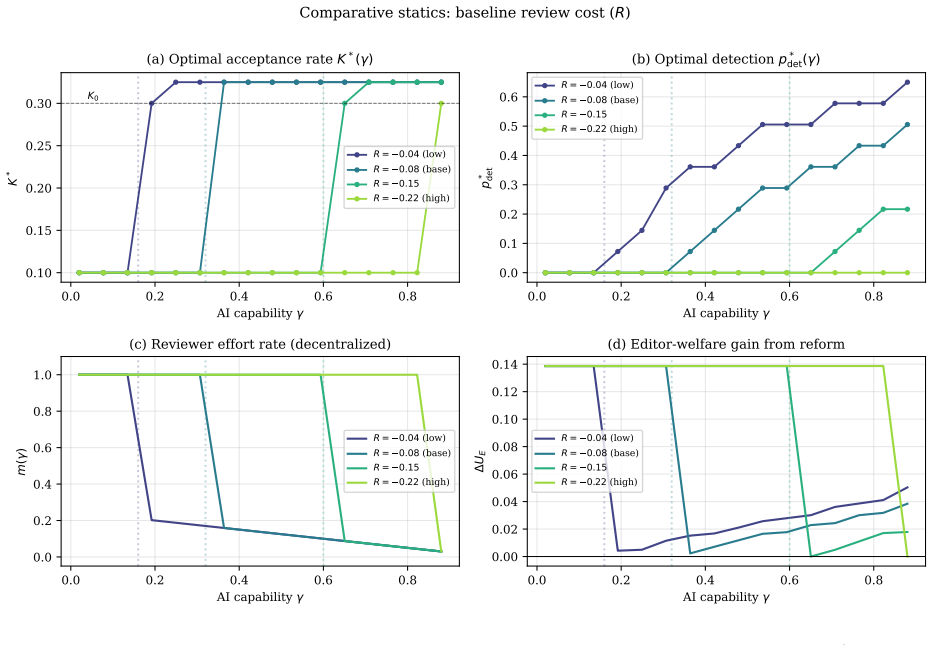
AI threshold flips journal policy from tightening to loosening standards

Buying the Right to Monitor:Editorial Design in AI-Assisted Peer Review

Model shows editors should tighten before the collapse but loosen afterward while investing in detection to preserve selection quality.

Figure from the paper full image
abstract click to expand
Generative AI acts as a disruptive technological shock to evaluative organizations. In academic peer review, it enters both sides of the market: authors use AI to polish submissions, and reviewers use it to generate plausible reports without exerting evaluative effort. We develop a three-sided equilibrium model to analyze this dual adoption and derive a counterintuitive managerial implication for journal policy. We show that when AI capability crosses a critical threshold, reviewer effort collapses discontinuously. This transition creates a welfare misalignment: authors benefit from a weakened ``rat race,'' while editors suffer from degraded signal informativeness. Characterizing the editor's optimal constrained response, we identify a strict policy reversal. Before the AI transition, editors should tighten acceptance standards to curb rent-dissipating author polishing. After the transition, conventional intuition fails: editors must loosen acceptance standards while investing in AI detection, because further tightening only amplifies dissipative polishing without improving sorting. We prove analytically that this sign reversal is a structural consequence of the reviewer effort collapse under log-concave quality distributions. Ultimately, addressing AI in evaluative systems requires treating monitoring and loosened selectivity as complementary design instruments.
0
0
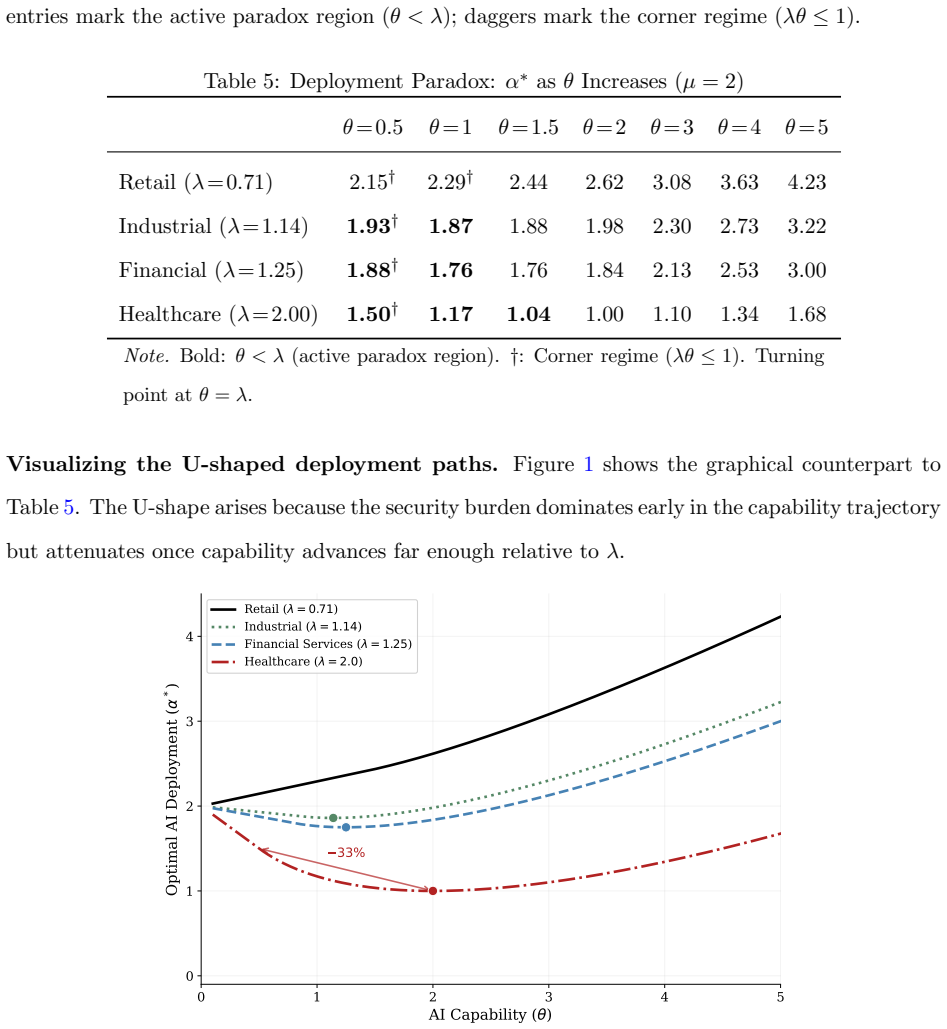
econ.GN 2026-04-27

Better AI Can Reduce Optimal Deployment in High-Loss Settings

The Security Cost of Intelligence: AI Capability, Cyber Risk, and Deployment Paradox

When capability requires wider authority exposure, deployment falls below no-risk levels and the gap widens with breach magnitude.

Figure from the paper full image
abstract click to expand
Firms are deploying more capable AI systems, but organizational controls often have not kept pace. These systems can generate greater productivity gains, but high-value uses require broader authority exposure -- data access, workflow integration, and delegated authority -- when governance controls have not yet decoupled capability from authority exposure. We develop an analytical model in which a firm jointly chooses AI deployment and cybersecurity investment under this governance-capability gap. The central result shows a deployment paradox: in high-loss environments, better AI can lead a firm to deploy less when capability is deployed through broader authority exposure under weak governance. Optimal deployment also falls below the no-risk benchmark, and this shortfall widens with breach-loss magnitude and with the authority exposure attached to more capable systems. Governance investment that reduces breach-loss magnitude shrinks the paradox region itself, while breach externalities expand the range of environments in which deployment is socially constrained. Governance maturity is therefore not merely a constraint on AI adoption. It is a condition that shapes whether capability improvements translate into productive deployment.
0
0
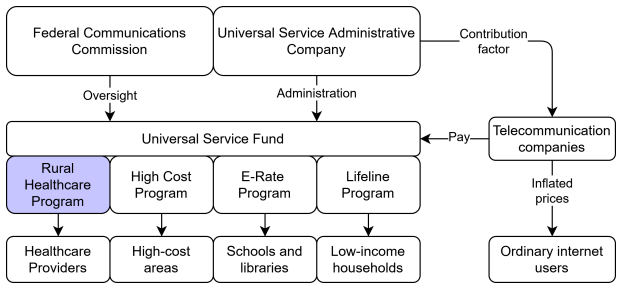
econ.GN 2026-04-27

Ad valorem mechanism cuts health subsidy spending

Price Cap vs. Per-Unit Subsidies: Selection, Pricing, and Cross Subsidization

Providers bearing 35% of costs lowers FCC program outlays while group bids allow ineligible members to draw funds indirectly.

Figure from the paper full image
abstract click to expand
We evaluate subsidy mechanisms in the FCC's Rural Health Care program using administrative data covering the full population of participants. The original price-cap mechanism removes cost-containment incentives for health care providers. An ad valorem mechanism introduced in 2014 addresses this flaw by making providers bear 35% of costs. However, allowing consortium applications creates a new distortion: cross-subsidization from eligible to ineligible members. We develop theoretical models predicting these effects and estimate treatment effects using an extension of the two-way fixed effects framework with continuous treatments. We find that the ad valorem mechanism substantially reduces program spending relative to the price cap, while the consortium option significantly inflates it. Enforcement records and an inverted U-shaped relationship between cross-subsidization intensity and ineligible member share corroborate the findings.
0
0
econ.GN 2026-04-27

Low types hack benchmarks in ML contests

On Benchmark Hacking in ML Contests: Modeling, Insights and Design

Game theory model identifies a skill threshold for benchmark hacking and finds that skewed rewards improve contest results.

Figure from the paper full image
abstract click to expand
Benchmark hacking refers to tuning a machine learning model to score highly on certain evaluation criteria without improving true generalization or faithfully solving the intended problem. We study this phenomenon in a generic machine learning contest, where each contestant chooses two types of effort: creative effort that improves model capability as desired by the contest host, and mechanistic effort that only improves the model's fitness to the particular task in contest without contributing to true generalization. We establish the existence of a symmetric monotone pure strategy equilibrium in this competition game. It also provides a natural definition of benchmark hacking in this strategic context by comparing a player's equilibrium effort allocation to that of a single-agent baseline scenario. Under our definition, contestants with types below certain threshold (low types) always engage in benchmark hacking, whereas those above the threshold do not. Furthermore, we show that more skewed reward structures (favoring top-ranked contestants) can elicit more desirable contest outcomes. We also provide empirical evidence to support our theoretical predictions.
0
0
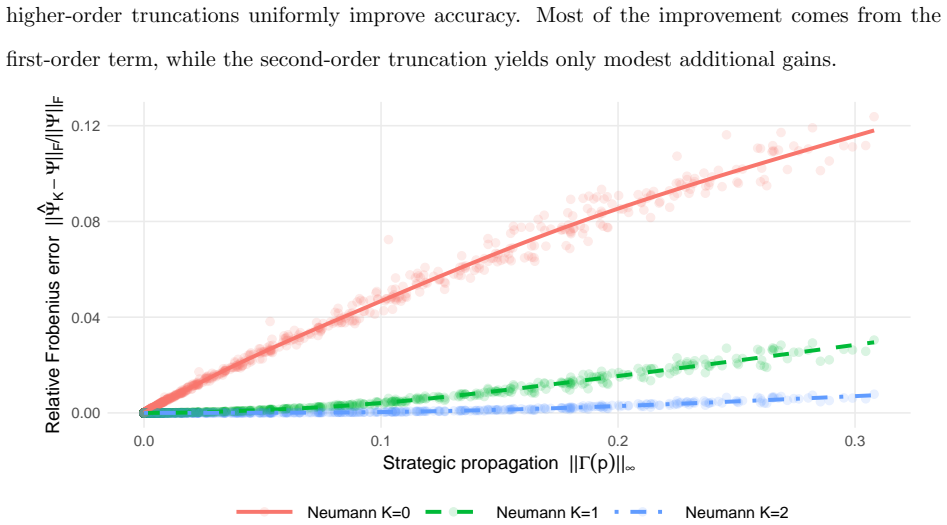
econ.GN 2026-04-24

Pass-through matrix splits into curvature

Demand Curvature and Pass-Through in Differentiated Oligopoly

In differentiated oligopoly, price responses to costs depend on demand curvature, consumer diversion, and which firm owns which products.

Figure from the paper full image
abstract click to expand
This paper studies cost pass-through in differentiated-product oligopoly. I derive a general representation of the pass-through matrix that decomposes equilibrium price responses into the roles of demand curvature, substitution, and multiproduct ownership. This extends the classic insight in single-product monopoly to multiproduct settings in which diversion and ownership also matter. I then develop a tractable first-order approximation that yields a sufficient-statistics characterization for empirically relevant demand systems. Finally, I characterize the small-share limit and show how common demand specifications impose tail restrictions that shape pass-through. The results provide a practical framework for applied work on tax incidence, merger analysis, and related questions in imperfect competition.
0
0
econ.GN 2026-04-22

AI agents aggregate info well only in simple prediction markets

Information Aggregation with AI Agents

Experiments find sharp performance drop as signals require reasoning about others' knowledge, yet markets stay robust to communication, time

Figure from the paper full image
abstract click to expand
Can Large Language Models (AI agents) aggregate dispersed private information through trading and reason about the knowledge of others by observing price movements? We conduct a controlled experiment where AI agents trade in a prediction market after receiving private signals, measuring information aggregation by the log error of the last price. We find that although the median market is effective at aggregating information in the easy information structures, increasing the complexity has a significant and negative impact, suggesting that AI agents may suffer from similar limitations as humans when reasoning about others. Consistent with our theoretical predictions, information aggregation remains unaffected by allowing cheap talk communication, changing the duration of the market or initial price, and strategic prompting, thus demonstrating that prediction markets are robust. We establish that "smarter" AI agents perform better at aggregation and they are more profitable. Surprisingly, giving them feedback about past performance has no impact on aggregation.
0
0
econ.GN 2026-04-22

Routine jobs boost business applications by 28 per 100k residents

Routine Work, Firm Boundaries, and the Rise of Local Supplier Entry

Outsourcing place-bound cognitive tasks creates demand for local micro-suppliers across U.S. commuting zones.

abstract click to expand
Between 2005 and 2019, U.S. business applications rose 40 percent while conversion to employer firms fell by nearly half. We study whether boundary redrawing helps explain this pattern. Structured routine-cognitive work can be governed through deliverables and thinner buyer and supplier interfaces. When such work remains place-bound, outsourcing creates demand for domestic specialist suppliers. Across 722 commuting zones, a one percentage-point higher baseline routine employment share raises applications by 27.8 per 100,000 residents. Realized entry concentrates in micro-establishments, with no startup quality gains. Contract and industry evidence point to local supplier entry, not routine-manual displacement.
0
0
econ.GN 2026-04-22

Indonesia shows more educational mobility over three generations than expected

Educational Mobility Across Multiple Generations in Indonesia

Parent-child links overstate long-run persistence when financial constraints and marriage customs are accounted for.

abstract click to expand
Standard intergenerational measures have been shown to understate the long-run persistence of socioeconomic advantages in developed countries. We study theoretically and empirically whether this pattern extends to less developed settings, using Indonesia as a case study. Using the Indonesian Family Life Survey (IFLS) and Census data, we study multigenerational correlations in education across three generations. Contrary to previous findings, we observe greater multigenerational mobility than parent-child correlations alone would suggest. We develop a theoretical framework to highlight two key factors influencing multigenerational dynamics in developing countries: (1) financial and credit constraints, and (2) cultural norms related to marital sorting. To confirm their relevance, we exploit regional variations in exposure to the 1997-98 Asian financial crisis and in marital customs.
0
0
econ.GN 2026-04-22

AI agents mirror owners' behavior across platforms

Behavioral Transfer in AI Agents: Evidence and Privacy Implications

Matched pairs show transfer in topics, values and style even without setup, plus higher personal disclosures.

abstract click to expand
AI agents powered by large language models are increasingly acting on behalf of humans in social and economic environments. Prior research has focused on their task performance and effects on human outcomes, but less is known about the relationship between agents and the specific individuals who deploy them. We ask whether agents systematically reflect the behavioral characteristics of their human owners, functioning as behavioral extensions rather than producing generic outputs. We study this question using 10,659 matched human-agent pairs from Moltbook, a social media platform where each autonomous agent is publicly linked to its owner's Twitter/X account. By comparing agents' posts on Moltbook with their owners' Twitter/X activity across features spanning topics, values, affect, and linguistic style, we find systematic transfer between agents and their specific owners. This transfer persists among agents without explicit configuration, and pairs that align on one behavioral dimension tend to align on others. These patterns are consistent with transfer emerging through accumulated interaction between owners (or owners' computer environments) and their agents in everyday use. We further show that agents with stronger behavioral transfer are more likely to disclose owner-related personal information in public discourse, suggesting that the same owner-specific context that drives behavioral transfer may also create privacy risk during ordinary use. Taken together, our results indicate that AI agents do not simply generate content, but reflect owner-related context in ways that can propagate human behavioral heterogeneity into digital environments, with implications for privacy, platform design, and the governance of agentic systems.
0
0
econ.GN 2026-04-22

US embargo explains most of Cuba's post-1959 income gap

Comment on "The Forsaken Road: Reassessing Living Standards Following the Cuban Revolution and the American Embargo"

Standard trade elasticities and shared interaction terms raise the embargo's role from under 10 percent to a large share or all of the gap.

abstract click to expand
Bastos, Geloso, and Bologna Pavlik (2026) argue that the US embargo explains less than one tenth of the difference in per capita income between Cuba and a counterfactual scenario in which the country did not follow socialist economic policies. We show that their results are driven by the use of an elasticity of income to trade openness that is neither representative nor a reasonable upper bound of the values found in the literature and by their choice to attribute the effect of the interaction between the embargo and other determinants of growth solely to those other determinants. We show that, once these problems are corrected, the embargo can account for a substantial fraction, and in some cases all, of Cuba's post 1959 economic underperformance.
0
0
econ.GN 2026-04-22

Sparse features encode LLM altruism and steer giving in games

Understanding the Mechanism of Altruism in Large Language Models

Causal interventions on these SAE directions shift Dictator Game allocations and generalize to other social-preference tasks.

Figure from the paper full image
abstract click to expand
Altruism is fundamental to human societies, fostering cooperation and social cohesion. Recent studies suggest that large language models (LLMs) can display human-like prosocial behavior, but the internal computations that produce such behavior remain poorly understood. We investigate the mechanisms underlying LLM altruism using sparse autoencoders (SAEs). In a standard Dictator Game, minimal-pair prompts that differ only in social stance (generous versus selfish) induce large, economically meaningful shifts in allocations. Leveraging this contrast, we identify a set of SAE features (0.024% of all features across the model's layers) whose activations are strongly associated with the behavioral shift. To interpret these features, we use benchmark tasks motivated by dual-process theories to classify a subset as primarily heuristic (System 1) or primarily deliberative (System 2). Causal interventions validate their functional role: activation patching and continuous steering of this feature direction reliably shift allocation distributions, with System 2 features exerting a more proximal influence on the model's final output than System 1 features. The same steering direction generalizes across multiple social-preference games. Together, these results enhance our understanding of artificial cognition by translating altruistic behaviors into identifiable network states and provide a framework for aligning LLM behavior with human values, thereby informing more transparent and value-aligned deployment.
0
0
econ.GN 2026-04-22

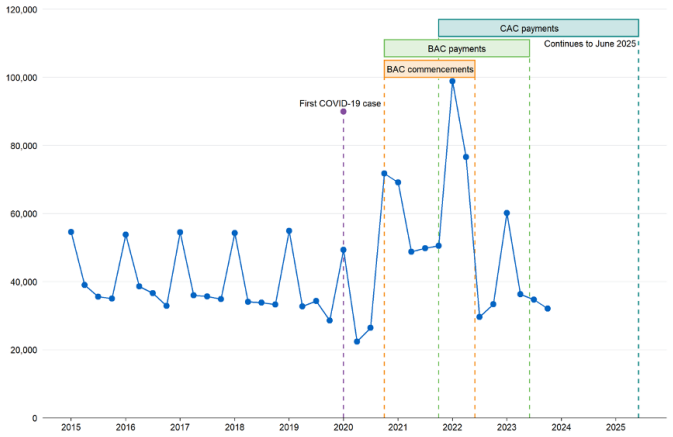
Subsidies lifted apprentice starts 70% but not completions

A rapid evaluation of Australia's COVID-era apprentice wage subsidy programs

Wage supports scaled new apprenticeships quickly yet produced higher cancellation rates from employer conversions of existing staff.

Figure from the paper full image
abstract click to expand
In the midst of the COVID-19 pandemic in 2020, the Australian Government launched two programs to incentivise new apprentices to start and complete apprenticeships -- the Boosting Apprenticeship Commencements (BAC) and Completing Apprenticeship Commencements (CAC) programs. These programs were wage subsidies to encourage employers to take on or retain apprentices. This paper evaluates the impact of these programs on apprenticeship commencements and completions taking a mixed-methods approach combining econometric modelling and interviews with stakeholders including employers and peak bodies. The programs led to a 70\% increase in commencement of apprenticeships but do not seem to have boosted retention rates. There appears to be a small increase in cancellation rates suggesting lower eventual completion rates compared to previous cohorts. Cancellation rates were higher for non-trade commencements (7\% increase) during BAC, but slightly lower for trade commencements (0.7\% decrease). We find this effect in non-trade apprenticeships was likely driven by `sharp practice' where some employers took advantage of the BAC by converting existing employees over to apprenticeships to attract the wage subsidy with no intention of having these employees stay as apprentices beyond the period of the BAC's generous subsidy. While the BAC / CAC were successful in many of their goals, there are several lessons that can be learnt from its design. In particular, the need to implement the program quickly meant early design choices inadvertently encouraged `sharp practice' and a rush for places that placed strain on the training sector. However, employers appreciated the front-loading of payments which provided the most financial support when apprentices were new and at their least productive.
0
0
econ.GN 2026-04-21

Generative AI spreads with exposure across Europe but leaves tasks unchanged

From Exposure to Adoption: Generative AI in European Workplaces

Adoption rises where skills and digital infrastructure align with exposure, yet shift-share analysis detects no early restructuring of jobๅ†…ๅฎน

Figure from the paper full image
abstract click to expand
This study examines who adopts generative AI and whether early adoption has begun to reshape the task content of jobs across 35 European countries. Adoption ranges from under 3% to 25%. Occupational exposure strongly predicts uptake, but AI does not diffuse passively along exposure lines. At the worker level, skills, abstract task content, and employee organisational influence steepen the exposure-adoption gradient; at the country level, so do digitalisation and workplace training. A gender gap persists, concentrated in the most exposed occupations. A shift-share design finds no detectable effect of adoption on worker-reported task restructuring, consistent with an initial integration phase.
0
0
econ.GN 2026-04-21

Prompt edits change bubble size in AI markets

Dissecting AI Trading: Behavioral Finance and Market Bubbles

Targeted changes to behavioral mechanisms in LLM agents raise or lower bubble magnitude in simulated trading experiments.

Figure from the paper full image
abstract click to expand
We study how AI agents form expectations and trade in experimental asset markets. Using a simulated open-call auction populated by autonomous Large Language Model (LLM) agents, we document three main findings. First, AI agents exhibit classic behavioral patterns: a pronounced disposition effect and recency-weighted extrapolative beliefs. Second, these individual-level patterns aggregate into equilibrium dynamics that replicate classic experimental findings (Smith et al., 1988), including the predictive power of excess demand for future prices and the positive relationship between disagreement and trading volume. Third, by analyzing the agents' reasoning text through a twenty-mechanism scoring framework, we show that targeted prompt interventions causally amplify or suppress specific behavioral mechanisms, significantly altering the magnitude of market bubbles.
0
0
econ.GN 2026-04-21

Balkan exchange merger would double equities' response to rate hikes

Can Institutional Integration of Western Balkans Stock Exchanges Strengthen Monetary Transmission?

Synthetic control analysis shows equity valuations drop twice as much after 100 basis point tightening in integrated versus fragmented stock

Figure from the paper full image
abstract click to expand
This paper asks how institutional stock-market integration reshapes the transmission of monetary policy through asset prices in small open economies. Motivated by the persistent segmentation of Western Balkan capital markets, we develop a two-stage counterfactual transmission framework to identify how stock-exchange consolidation would alter the elasticity of market valuations to monetary shocks. First, a synthetic-control simulation constructs a counterfactual integrated Western Balkan stock exchange comprising Bosnia and Herzegovina, North Macedonia, and Serbia, benchmarked to the Baltic OMX merger, thereby quantifying the structural valuation gains of institutional integration. Second, we identify exogenous monetary-policy innovations using a Taylor-rule framework augmented with inflation and output forecasts and reserve adjustments. These shocks are then embedded within a Local-Projections estimator \`a la Jord\`a (2005) to trace the dynamic responses of market capitalisation under fragmented and integrated market regimes. The results point to a systematic amplification of monetary-policy transmission through the asset-price channel once markets are unified. Following a policy tightening of about 100 basis points, equity valuations fall roughly twice as strongly under integration than under fragmented markets. Additionally, we find that integration alters the sensitivity of monetary transmission itself: the initial pass-through intensifies, but its marginal responsiveness to further integration declines over time, signalling the consolidation of a new steady-state regime.
0
0
econ.GN 2026-04-21

Economics core tightens after 2008 while edges loosen

Self-referentiality and asymmetric knowledge flows between journals. The case of economics

Citation asymmetries place the CORE cluster at the top of a one-way knowledge hierarchy that grew stronger after the crisis.

Figure from the paper full image
abstract click to expand
This paper investigates the evolution of self-referentiality and knowledge flows in economics journals before and after the 2008 financial crisis. Using a multi-level approach, we analyze patterns at the discipline, cluster, and journal levels, combining citational measures with a classification of journals based on intellectual similarity and social proximity. At the aggregate level, results suggest a general decline in self-referentiality, indicating increased openness across the discipline. However, this trend conceals substantial heterogeneity. At finer levels of analysis, two clusters - CORE and Finance - emerge as persistent outliers, exhibiting very high levels of self-referentiality. While Finance experienced a gradual reduction over time, the CORE shows increasing closure. By examining reference asymmetries, we uncover a hierarchical structure of knowledge flows. The CORE operates as a central hub and net exporter of knowledge to all other clusters, particularly to the traditional core fields of economics, whereas Finance acts as a net exporter only within its own domain and remains dependent on the CORE. These asymmetries are reinforced at the level of individual journals, where a small set of top journals occupies the apex of a hierarchically ordered system of knowledge transmission. We argue that these patterns reflect the interplay between intellectual dynamics and organizational structures, particularly the role of editorial networks in shaping access to publication and visibility. The findings suggest that, following the financial crisis, economics has experienced a process of increasing epistemic and organizational closure at its core, alongside greater openness in peripheral areas. This dual dynamic raises questions about the representativeness of top journals and the evolving structure of the discipline.
0
0
econ.GN 2026-04-21

Nazi membership growth preceded Jewish deportations

Hysteresis and Selection in the Rise of Fascism: The `Ordinary Men' of the Nazi Party

Early joiners created hysteresis within communities and families, drawing later members from the same groups.

abstract click to expand
We digitize and analyze the near-universe of National Socialist German Workers' Party (NSDAP) membership records and link them to newly digitized population and industrial censuses. Four findings emerge. First, as the party expanded, its membership came to resemble the broader population more closely in occupational, demographic, and religious terms. Second, SS members remained distinctly different: younger, more educated, and more fanatical, as proxied by membership portraits. Third, within communities, coworkers, and families, early membership generated hysteresis, with subsequent entrants drawn from the same groups. Finally, local increases in party membership are associated with subsequent deportations of Germany's Jews.
0
0
econ.GN 2026-04-20

Closed-form extensions preserve JFR-rg regime logic

JFR-rg Part II: Dynamic Extensions, Time Constraints, and Investment Design in High-Debt, Low-Growth Economies

The framework endogenizes risk premiums to explain sustained low rates or their loss in high-debt economies.

Figure from the paper full image
abstract click to expand
This paper develops the logical extension of the JFR-rg framework introduced in Part I within the same observables-centered and regime-conditional architecture. Six extensions are formalized: the Virtuous Ratchet (E1), the corrected Repression Dividend Multiplier (E2), the Debt Reduction Paradox (E3), the Multi-Country Repression Equilibrium (E4), the Demographic-$\phi$ Clock (E5), and the Institutional Control Rights Index (E6). Together, these clarify the dynamic implications of a JFR-rg regime for path dependence, institutional erosion, growth-enhancing investment, and regime transition in high-debt, low-growth economies. The paper's claim of logical completion is architectural rather than universal. It does not claim a full welfare-theoretic or political-economy microfoundation. Rather, it shows that the principal dynamic implications internal to Part I can be stated in closed form, and that two natural excluded generalizations -- bounded stochastic perturbations and endogenous fiscal responses -- preserve the regime logic. A Minimal Equilibrium Closure is then introduced to endogenize the sovereign risk premium through a two-layer domestic demand structure and a complementarity condition. The paper also formulates the statistical problem of inferring a latent regime boundary under one-sided regime dominance. The inferential contribution is conservative by design: it constructs outer statistical summaries of the relevant boundary objects rather than forcing point classification when the observables remain compatible with multiple nearby regime readings. Comparison with Blanchard (2019), Hoshi-Ito (2014), and Mehrotra-Sergeyev (2021) shows where JFR-rg adds explanatory value in the Japanese case: not by replacing standard debt-sustainability analysis, but by endogenizing the institutional conditions under which low sovereign rates are sustained, weakened, or lost.
0
0
econ.GN 2026-04-20

Stablecoin pegs hinge on Treasury markets and blockchain rails

The Hidden Plumbing of Stablecoins: Financial and Technological Risks in the GENIUS Act Era

Even well-backed coins can face de-pegging pressure from redemption surges or tech disruptions under the GENIUS Act

abstract click to expand
U.S. dollar stablecoins are increasingly used as payment and settlement instruments beyond cryptocurrency markets. With the enactment of the GENIUS Act in 2025, the United States established the first comprehensive federal framework governing their issuance, backing, and supervision. This paper evaluates the financial, technological, and regulatory risks that may arise as GENIUS-compliant stablecoins scale into mainstream use. We show that maintaining par-value redemption may depend not only on backing-asset quality, but also on the functioning of Treasury and repo markets, the balance-sheet capacity of broker-dealers, and the operational reliability of blockchain-based transaction rails. Even conservatively backed stablecoins can face stress from redemption surges, market-intermediation bottlenecks, or technological disruptions. We argue that durable stability will likely require an integrated approach spanning financial-market infrastructure, prudential regulation, and software governance. While grounded in U.S.\ law, the analysis identifies principles that are relevant for regulators in other jurisdictions developing stablecoin regimes.
0
0
econ.GN 2026-04-20

Reinforcement learning agents collude in pricing within observed times

Convergence to collusion in algorithmic pricing

In repeated oligopoly with continuous prices, a deep RL model learns to coordinate and punish deviations, matching real-world collusion data

Figure from the paper full image
abstract click to expand
Artificial intelligence algorithms are increasingly used by firms to set prices. Previous research shows that they can exhibit collusive behaviour, but how quickly they can do so has so far remained an open question. I show that a modern deep reinforcement learning model deployed to price goods in a repeated oligopolistic competition game with continuous prices converges to a collusive outcome in an amount of time that matches empirical observations, under reasonable assumptions on the length of a time step. This model shows cooperative behaviour supported by reward-punishment schemes that discourage deviations.
0
0
econ.GN 2026-04-20

Indonesian government skills declined as top workers chose private jobs

Estimating Government Worker Skills

Machine learning on private wages shows a continuous drop from 1988-2014 and a 43 percent public pay premium for given skills.

Figure from the paper full image
abstract click to expand
We propose a new approach to estimate government worker skills, a setting where output is hard to observe and wages may be uninformative about skills. The approach uses wages in comparable jobs in the private sector and machine learning tools to link skills to skill-related observables. We apply the approach to rich Indonesian household-level panel data from 1988-2014, showing two main applications. First, government skills have continuously declined relative to the private sector, driven by the most skilled workers ending up in the private sector. Second, the Indonesian government pays a wage premium of 43% conditional on skills.
0
0
econ.GN 2026-04-20

Covenant adjustments fix false alarms but only small optimism errors

A Theory of Covenant Accounting Adjustment

A theory shows that managers correct GAAP errors in debt contracts selectively and may waste effort to spot them.

abstract click to expand
We develop an incomplete-contracting model with accounting-based covenants to study how covenant accounting adjustments are made and what properties they exhibit. Standard accounting rules (e.g., GAAP) can generate false-alarm errors or undue-optimism errors. The manager can exert costly effort to privately identify these errors and propose adjustments. If errors are not corrected, control rights may be inefficiently allocated, leading to costly renegotiation. We show that (1) adjustments always correct false-alarm errors, but correct undue-optimism errors only when their magnitude is small; and (2) the manager may expend socially wasteful effort to identify these errors. The model yields testable empirical predictions and policy implications.
0
0
econ.GN 2026-04-17

The paper develops a machine learning model using synthetic aperture radar satelliteโ€ฆ

Watching Trade from Space: Nowcasting and Spatial Extrapolation of Port-Level Maritime Trade Using Satellite Imagery

Satellite imagery and port data enable nowcasting of port-level maritime trade with reliable recovery of percentage changes, applied toโ€ฆ

Figure from the paper full image
abstract click to expand
Satellite data are increasingly used to measure economic activity, yet port-level trade remains largely unmeasured from space. This paper combines synthetic aperture radar imagery, nighttime lights, and port characteristics to measure monthly port-level maritime trade using only publicly available data. The model achieves strong out-of-sample accuracy for U.S. ports, with satellite signals and port attributes playing complementary roles. While absolute levels are difficult to extrapolate beyond the training domain, percentage changes are reliably recovered, as we confirm through a leave-one-region-out exercise and Monte Carlo simulation. Applying the framework to Russian ports after the 2022 sanctions, we detect shifts consistent with trade reorientation toward the Far East. The approach complements AIS-based methods by remaining robust to strategic signal manipulation.
0
0
econ.GN 2026-04-17

Divestitures cut employment 31% at grocery stores over five years

Antitrust on Aisle Five: How Well Do Divestiture Remedies Work?

Census data shows weaker assets and lower-capability buyers drive sales drops and higher exits under merger remedies.

Figure from the paper full image
abstract click to expand
Antitrust authorities frequently rely on structural divestitures to address competitive concerns raised by mergers. Using census-level establishment data and proprietary transaction records from the U.S. grocery sector, we provide systematic evidence on the long-run effects of such remedies. Divested stores experience an average 31 percent decline in employment over five years, driven by elevated exit rates and persistent contraction among surviving establishments. Sales similarly decline. Transaction-level evidence indicates that divested assets are systematically weaker and are often transferred to lower-capability buyers. These findings suggest that structural remedies may be less effective when the implementation of divestitures allows merging parties substantial discretion over the assets and buyers involved.
0
0
econ.GN 2026-04-17

Free buses boost women's paid work participation

Ticket to ride: Impact of free public transport on women's workforce participation in India

Policy eases mobility barriers and raises employment duration, with larger gains where patriarchal restrictions are strong.

abstract click to expand
We leverage a quasi natural experiment from India on introduction of free bus schemes for women across five states to study it's impact on women's workforce participation. We use two rounds of the representative Time Use Survey and a triple difference estimation strategy, complemented by an event study framework to identify the causal relationship of interest. Findings reveal that the bus scheme was successful in improving women's paid work participation and duration of employment. We confirm that these results are not merely a continuation of prior trends. The scheme's effects are concentrated among early adopters like Punjab and Tamil Nadu, two states with historically different levels of women's workforce participation. We also find disproportionately higher effects for women residing in more patriarchal districts with higher mobility restrictions. We argue that the scheme works through easing of non-financial binding constraints, which lowers the barriers to women's mobility and workforce participation.
0
0
econ.GN 2026-04-16

DP handles multi-product constraints while RL shows different scaling in pricing tests

A Comparative Study of Dynamic Programming and Reinforcement Learning in Finite Horizon Dynamic Pricing

Comparison across single to multi-typology environments measures revenue, stability, and computation for finite-horizon dynamic pricing.

Figure from the paper full image
abstract click to expand
This paper provides a systematic comparison between Fitted Dynamic Programming (DP), where demand is estimated from data, and Reinforcement Learning (RL) methods in finite-horizon dynamic pricing problems. We analyze their performance across environments of increasing structural complexity, ranging from a single typology benchmark to multi-typology settings with heterogeneous demand and inter-temporal revenue constraints. Unlike simplified comparisons that restrict DP to low-dimensional settings, we apply dynamic programming in richer, multi-dimensional environments with multiple product types and constraints. We evaluate revenue performance, stability, constraint satisfaction behavior, and computational scaling, highlighting the trade-offs between explicit expectation-based optimization and trajectory-based learning.
0
0
econ.GN 2026-04-16

Demand timing errors cut event-ticket revenue by 0.42% on average

The Revenue Effect of Demand Misspecification in Event Ticket Pricing

Simulations find late-demand omissions hurt most, especially when inventory is tight and willingness to pay rises near the deadline.

Figure from the paper full image
abstract click to expand
We study a finite-horizon dynamic pricing problem for event tickets with limited inventory and time-varying demand. The central practical difficulty is that the total demand function $L(t)$ is not observed directly and must be estimated from data, while pricing decisions are sensitive to its temporal shape. The paper examines how the accuracy of this estimate affects revenue. We consider a model in which sales intensity is driven by the total demand $L(t)$, a price-response function $v(p)$, and a time-dependent willingness-to-pay factor $\varphi(t)$. The factor $\varphi(t)$ plays a central role: it captures the increase in customers' willingness to pay as the event date approaches and makes the temporal profile of demand economically important for pricing. Within this framework, the updated numerical study evaluates a benchmark dynamic-programming policy across nine deterministic true-demand scenarios, a collection of feature-aware misspecifications of $L(t)$, and multiple environment regimes induced by $v(p)=e^{-\eta p}$, the deadline factor $\varphi(t)$, and inventory level $Q$. The reported summaries are based on stochastic simulation and a ratio-of-means relative-loss metric. The results show that a more accurate representation of the temporal demand profile leads to more effective pricing decisions and higher revenue. Over the full misspecification collection the aggregate relative revenue loss is $0.42\%$, the upper decile exceeds $1\%$, and the most expensive errors are omissions of late-demand components. The average effect is therefore modest but non-negligible, and it becomes stronger when deadline effects are pronounced and inventory is tight.
0
0
econ.GN 2026-04-16

Wind overtakes gas as main driver of Texas electricity prices

Mapping the causal structure of price formation in Texas's transitioning electricity market

Causal analysis finds wind generation effects on day-ahead prices now more than three times larger than natural gas, upending traditionalๅธ‚ๅ ดs

abstract click to expand
Electricity markets are changing, driven by large-scale renewable integration and rising demand from electrification and digitalisation. This raises fundamental questions about how electricity prices form as the relationships among key price determinants evolve. Here we apply causal discovery to characterise these dynamics across major supply- and demand-side drivers of wholesale electricity prices in Texas, where rapid renewable growth intersects with surging demand. We show that wind generation has become the dominant causal driver of day-ahead electricity prices with effects more than 3 times larger than those of natural gas prices, overturning the view of the Texas market as gas-price-driven. Wind reduces prices locally but redistributes congestion costs across regions in seasonally varying patterns. Natural gas prices remain causally relevant, though their influence is modest and the dominant gas benchmark changes over time. Electricity demand also shows region- and period-specific causal effects. These findings highlight the need for causal models that capture time-varying relationships across both supply and demand to guide system planners and market participants navigating the ongoing transition.
0
0
econ.GN 2026-04-16

Gender gaps in unpaid work persist for Italian dual full-time couples

Gender, Unpaid Work, and Social Norms in Young Italian Families: Evidence from Couples Time Diaries

Matched time diaries show women do more domestic tasks and less leisure even when both partners work full time, tied to traditional male-att

abstract click to expand
Why do large gender inequalities in everyday life persist even as women strengthen their attachment to paid work? Existing evidence shows that women continue to do more unpaid work than men, but much of that evidence is based on individual diaries, says little about how inequality is jointly organized within couples, and rarely links daily time allocation to directly measured gender attitudes. This paper addresses that gap using the TIMES Observatory, an original survey of 1,928 co-resident couples with at least one child younger than 11 in Emilia-Romagna or Campania. The data combine matched partner diaries for one weekday and one weekend day with rich socio-economic information and direct measures of gender norms. We document three main findings. First, women do substantially more unpaid work and spend more time with children, while men do more paid work and enjoy more leisure without children. Second, these asymmetries remain sizeable even among dual full-time couples, implying that stronger female labor-market attachment does not by itself equalize daily life. Third, more traditional gender attitudes - especially among men - are descriptively associated with lower male participation in childcare and domestic work and with wider gaps in discretionary leisure. The analysis is descriptive rather than causal, but it shows that gender inequality within couples is visible not only in the amount of work performed, but also in the distribution of time that is genuinely discretionary.
0
0
econ.GN 2026-04-16

Electricity auctions should condition contracts on world states

On the Design of Stochastic Electricity Auctions

Optimal partitioning defines states that let renewables communicate production uncertainty for efficient market outcomes.

Figure from the paper full image
abstract click to expand
Electricity is typically traded in day-ahead auctions because many power system decisions, such as unit commitment, must be made in advance. However, when wind and solar generators sell power one day ahead, they face uncertainty about their actual production. In current day-ahead auctions, this uncertainty cannot be directly communicated, leading to inefficient use of renewable energy and suboptimal system decisions. We show how this problem can be addressed using the concept of equilibrium under uncertainty from microeconomic theory. In particular, we demonstrate that electricity contracts should be conditioned not only on the time and location of delivery, but also on the state of the world (e.g., whether it will be windy or calm). This requires a precise definition of the state of the world. Since there are infinitely many possible definitions, criteria are needed to select among them. We develop such criteria and show that the resulting states correspond to solutions of an optimal partitioning problem. Finally, we illustrate how these states can be computed and interpreted using a case study of offshore wind farms in the European North Sea.
0
0
econ.GN 2026-04-16

Sibling priority in daycare lifts welfare 6.4%

Daycare Matching with Siblings: Social Implementation and Welfare Evaluation

Families strongly dislike splitting siblings; the 2024 rule also shrinks gaps between households with and without siblings.

Figure from the paper full image
abstract click to expand
In centralized assignment problems, agents may have preferences over joint rather than individual assignments, such as couples in residency matching or siblings in school choice and daycare. Standard preference estimation methods typically ignore such complementarities. This paper develops an empirical framework that explicitly incorporates them. Using data from daycare assignment in a municipality in Japan, we estimate a model in which families incur both additional commuting distance and a fixed non-distance disutility when siblings are assigned to different facilities. We find that split assignment generates a large disutility, equivalent to more than twice the average commuting distance. We then simulate counterfactual assignment policies that vary the strength of sibling priority and evaluate welfare. The sibling priority reform that we designed and that was implemented in 2024 increases welfare by 6.4% while reducing inequality in assignment rates across sibling groups; models that ignore sibling complementarities substantially understate these gains. At the same time, we uncover a clear efficiency-equity tradeoff: along the frontier, increasing mean welfare by 100 meters is associated with an increase in inequality of about 1.7 percentage points, and the welfare-maximizing policy reverses much of the reform's reduction in inequality, largely through the displacement of households without siblings.
0
0
econ.GN 2026-04-16

Immediate mental health support yields lasting gains

Waiting for Help: Timely Access to Psychological Support for Young Adults Exposed to Parental Substance Misuse

Trial shows early access to psychological help improves outcomes for years, even after others receive delayed treatment.

Figure from the paper full image
abstract click to expand
Access to mental health care is often rationed through waiting lists, yet there is limited causal evidence on the consequences of delayed access. We study whether eliminating waiting time for psychological support improves outcomes for young adults who grew up with parental substance misuse. Using a randomized waitlist-controlled trial in Denmark combined with survey and administrative data, we find that immediate access leads to sizable short-run improvements in psychological health. These gains persist three to four years after randomization, even after both groups have received the intervention. By contrast, we find limited evidence of large average effects on broader health or labor market outcomes. Our results highligth the importance of treatment timing in capacity-constrained settings.
0
0
econ.GN 2026-04-15

Implementation choices explain conflicting markup trend estimates

Micro and Macro Perspectives on Production-Based Markups

Treating the production markup as a residual makes results sensitive to data cleaning and model choices.

abstract click to expand
We review the "production approach" to estimating markups, the ratio of price to marginal cost. The approach is uniquely scalable: it requires no model of consumer demand or market structure and applies broadly across firms, industries, and time. Our organizing insight is that the production-based markup is a residual. Like the Solow residual, it is clean in theory but potentially contaminated by misspecification and mismeasurement. This framing helps explain why small differences in implementation can produce starkly different results from the same data. In some cases, markups have risen sharply. In others, they have not. Despite the disagreements in the literature, the importance of understanding and measuring market power cannot be overstated. We provide conceptual rationales for this disagreement, offer practical guidance on data and estimation, and call for greater transparency about how much of the variation attributed to markups may instead reflect technology.
0
0
econ.GN 2026-04-15

Complexity boosts environmental performance in BRICS-T nations

Unveiling the Nexus Between Economic Complexity and Environmental Sustainability: Evidence from BRICS-T Countries

1999-2021 data shows 1% complexity gain improves scores 0.02-1.24%; growth and energy intensity reduce them.

Figure from the paper full image
abstract click to expand
This study analyses the impacts of economic complexity on environmental performance in BRICS-T countries. Annual data for the period 1999-2021, Durbin-Hausman cointegration test and Augmented Mean Group (AMG) estimator are used in the analysis. The robustness of the Panel AMG results is tested with CCEMG and CS-ARDL methods. The results indicate that economic complexity has a positive impact on environmental performance. An increase of 1% in the economic complexity index increases environmental performance in BRICS-T countries between 0.020% and 1.243%. However, economic growth, energy intensity and population density were found to have a negative impact on environmental performance. Renewable energy use, in contrast, contributes positively to environmental performance.
0
0
econ.GN 2026-04-15

Lira appreciation and inflation cut Turkish exports

Investigating the Impacts of Exchange Rate and Inflation on Exports: A Double Threat or Opportunity for Turkiye?

1995-2023 analysis finds long-run negative effects of -0.185 and -0.125, offset by positive roles for FDI and imports.

Figure from the paper full image
abstract click to expand
This study analyzes the impacts of exchange rate and inflation on exports in Turkiye. Annual data for the period 1995-2023 were used in the analysis. The Johansen cointegration analysis and Dynamic Least Squares (DOLS) method were employed in the study. Identifying the cointegration relationship enabled the estimation of the long-run coefficients. The results show that an increase in the real effective exchange rate (appreciation of the Turkish lira) and inflation reduce exports with coefficients of -0.185 and -0.125, respectively. Foreign direct investment and imports, added to the study as control variables, have a positive impact on exports with coefficients of 0.117 and 0.849, respectively. These findings indicate that exchange rate stability and inflation control are priorities for improving foreign trade performance. Furthermore, policies that increase foreign direct investment and strategically manage imports complement this process.
0
0
econ.GN 2026-04-14 1 theorem

Prices and policies explain most U.S

What Drives Energy Use? Prices, Efficiency Policies, and the Demand Frontier

Frontier analysis attributes 26 percent of variation to prices and 19 percent to efficiency policies, dwarfing GDP and climate roles.

Figure from the paper full image
abstract click to expand
What drives cross-state differences in U.S. energy consumption? We combine LMDI decomposition, stochastic frontier analysis, and variable-importance methods on a panel of 50 states plus DC over the 2006--2022 period. The observed 12.8% decline in per capita energy use is driven almost entirely by intensity improvements. A variance decomposition attributes 63% of cross-state variation in log energy use to the demand frontier, 34\% to inefficiency above it, and 3% to noise. Within the frontier, energy prices account for roughly 26% of cross-state variation and state efficiency policies for about 13%, while GDP and climate together explain only around 10\%. Efficiency policies also operate through a second channel by reducing inefficiency, adding a further 6 percentage points to their total contribution. The results suggest that pricing and regulation are the primary drivers of cross-state energy use differences.
0
0
econ.GN 2026-04-14 Recognition

Interviewers expecting answers obtain more income data

Effects of interviewers on response to income and wealth items

SHARE analysis links higher interviewer expectations to fewer missing financial responses across most models and countries.

Figure from the paper full image
abstract click to expand
Item nonresponse to financial questions is a persistent source of survey error, especially in interviewer-administered surveys. We examine whether interviewers' expectations about respondents' willingness to report income are associated with actual item responses to income and asset questions in Wave 6 of the Survey of Health, Ageing and Retirement in Europe (SHARE). Using data from 41,934 respondents in 12 countries, linked to interviewer survey and roster information, we analyze responses to four financial items with substantial nonresponse. We compare three approaches to handling missing covariates: complete-case analysis, multiple imputation (fill-in methods), and a generalized missing-indicator framework with information-criterion-based model averaging. Across most specifications, respondents interviewed by interviewers with higher expected income response rates are more likely to provide financial information. However, model averaging does not yield clear gains over simpler approaches. The results suggest that interviewer expectations contain useful information for understanding and modeling item nonresponse to sensitive financial items, with potential implications for interviewer training and survey fieldwork design.
0
0
econ.GN 2026-04-14

Recognition can lock polities into weak state capacity

Statehood Without Capacity

Symbolic legitimacy and external acknowledgment accumulate while the institutions needed for effective governance stay underdeveloped.

abstract click to expand
This paper develops a political-economy theory of statehood without capacity. I argue that under specific institutional and geopolitical conditions, a polity can become trapped in an equilibrium of nominal statehood: a state in which claims to sovereignty, external recognition, and symbolic legitimacy persist or even strengthen while the coercive, fiscal, administrative, and legal capacities required for effective statehood remain weak. The mechanism is driven by three forces. First, fragmented elites may privately benefit from preserving autonomous control, patronage, and localized rent extraction rather than consolidating authority into a unified state. Second, externally mediated transfers can reduce the immediate costs of institutional non-consolidation and thereby stabilize a low-capacity equilibrium. Third, international recognition and symbolic endorsement may be only weakly conditioned on domestic administrative performance, allowing recognition capital to accumulate more rapidly than capacity capital. The theory generates a dynamic divergence between juridical or symbolic statehood and effective statehood, with implications for investment, fiscal fragility, corruption, and vulnerability to conflict shocks. The paper derives testable predictions and then interprets Palestine as a flagship application of the broader mechanism. The central implication is that statehood is not only a question of recognition or territorial claim but an equilibrium outcome of institutional consolidation. Where the incentives to consolidate remain weak, sovereignty may be asserted without becoming viable.
0
0
econ.GN 2026-04-13

Adaptation policies cut U.S

Unveiling contrasting impacts of heat mitigation and adaptation policies on U.S. internal migration

Machine learning analysis of over 4,700 heat policies across 11,000 county flows shows opposing effects moderated by local demographics.

abstract click to expand
While climate-induced population migration has received rising attention, the role played by human climate endeavors remains underexplored. Here, we combine machine learning with attribution mapping to analyze the impacts of 4,713 heat-related policies (HPs) on 11,177 migration flows between U.S. counties. We find that heat adaptation policies (APs) and heat mitigation policies (MPs) have significant and opposing impacts on internal migration: APs reduce out-migration, while MPs increase it. These policies have heterogeneous effects on migration among policy types. Behavioral and cultural MPs at origins lead to a 0.24%-0.68% (95% confidence interval) increase in annual outflows per policy, whereas behavioral and cultural APs at destinations elevate outflows of origins by 0.11%-1.55% (95% confidence interval). Migration patterns are nonlinearly moderated by income, ageing, education, and racial diversity of both origin and destination counties. Ageing rates have the most noticeable U-shaped relationship in shaping migration responses to behavioral and cultural MPs at origins, and inverted U-shapes for institutional MPs at origins and nature-based MPs at destinations. These findings offer critical insights for policymakers on how HPs influence migration as global warming and policy interventions persist.
0
0
econ.GN 2026-04-13

Classifier reveals AI patent convergence in US and China

AI Patents in the United States and China: Measurement, Organization, and Knowledge Flows

Better detection method shows shared growth and interdependence despite different innovation structures.

Figure from the paper full image
abstract click to expand
We develop a high-precision classifier to measure artificial intelligence (AI) patents by fine-tuning PatentSBERTa on manually labeled data from the USPTO's AI Patent Dataset. Our classifier substantially improves the existing USPTO approach, achieving 97.0% precision, 91.3% recall, and a 94.0% F1 score, and it generalizes well to Chinese patents based on citation and lexical validation. Applying it to granted U.S. patents (1976-2023) and Chinese patents (2010-2023), we document rapid growth in AI patenting in both countries and broad convergence in AI patenting intensity and subfield composition, even as China surpasses the United States in recent annual patent counts. The organization of AI innovation nevertheless differs sharply: U.S. AI patenting is concentrated among large private incumbents and established hubs, whereas Chinese AI patenting is more geographically diffuse and institutionally diverse, with larger roles for universities and state-owned enterprises. For listed firms, AI patents command a robust market-value premium in both countries. Cross-border citations show continued technological interdependence rather than decoupling, with Chinese AI inventors relying more heavily on U.S. frontier knowledge than vice versa.
0
0
econ.GN 2026-04-13 2 theorems

Specialization tilts policy toward integrators

The Division of Understanding: Specialization and Democratic Accountability

Model shows narrow expertise leaves most citizens with less influence on cross-domain issues and lowers the value of public spending.

abstract click to expand
This paper studies how the organization of production shapes democratic accountability. I propose a model in which learning economies make specialization productively efficient: most workers perform one-domain tasks, while a small set of integrators with cross-domain knowledge keep the system coherent. When policy consequences run across domains, integrators understand them better than specialists. Electoral competition then tilts government policies toward integrators' interests, while low aggregate system knowledge weakens governance and reduces the fraction of public resources converted into citizen-valued services. Labor markets leave these civic margins unpriced, failing to internalize the political returns to system knowledge. Broadening specialists can therefore raise welfare relative to the market allocation. The model speaks to debates on liberal arts education and the effects of AI.
0
0
econ.GN 2026-04-13

Specialization tilts public services to integrators

The Division of Understanding: Specialization and Democratic Accountability

Electoral competition directs resources to those who grasp policy spillovers, lowering overall governance returns and leaving civic

abstract click to expand
This paper studies how the organization of production shapes democratic accountability. I propose a model in which learning economies make specialization productively efficient: most workers perform one-domain tasks, while a small set of integrators with cross-domain knowledge keep the system coherent. When policy consequences run across domains, integrators understand them better than specialists. Electoral competition then tilts government policies toward integrators' interests, while low aggregate system knowledge weakens governance and reduces the fraction of public resources converted into citizen-valued services. Labor markets leave these civic margins unpriced, failing to internalize the political returns to system knowledge. Broadening specialists can therefore raise welfare relative to the market allocation. The model speaks to debates on liberal arts education and the effects of AI.
0
0
econ.GN 2026-04-13

US and Israel lead VC-based ranking of tech sovereignty

The Geoeconomics of Venture Capital An Economic Complexity Approach to Emerging Technological Sovereignty

Complexity measures applied to venture portfolios place the United States and Israel at the top, highlight key domains, and suggest easiest

Figure from the paper full image
abstract click to expand
We explore a quantitative approach to emerging technological sovereignty and geoeconomic power by assessing the relative positioning of countries with economic complexity methods applied to the structure of national venture-capital (VC) portfolios and their associated Revealed Venture Advantage (RVA) metrics. Using Crunchbase firm- and deal-level data, we map venture-backed startups to 18 emerging technology domains via a probabilistic multi-label large-language-model classifier, and construct an RVA-based country-technology specialization matrix for the 17 countries with the highest aggregate VC funding. From this matrix, we derive two eigenvector-based measures: a Geoeconomic Complexity Index (GCI) that ranks countries by the composition of their venture specializations, and an Emerging Technology Geoeconomic Complexity Index (ETGCI) that ranks domains by the extent to which specialization is concentrated among high-GCI countries. Empirically, Cloud Computing, Cybersecurity Tools, and Medtech exhibit the highest ETGCI values, reflecting concentration of specialization in a small set of leading countries. The United States and Israel consistently occupy a marked "high-diversity/low-ubiquity" position and lead the GCI ranking, followed by China, France, Japan, and Germany; both country and domain rankings are stable from 2021-2024. Finally, relatedness-based simulations identify, when it exists, for each country the Simplest Single Sovereignty Enhancing Technology (SSSET), i.e., the most feasible single new technological direction associated with the largest expected improvement in relative geoeconomic positioning.
0
0
econ.GN 2026-04-10

Bitcoin falls on hawkish policy talk without rate changes

Is Bitcoin A Hedge Against Central Banking? Evidence from AI-Driven Monetary Policy Expectations

AI scan of 118,000 messages shows Bitcoin tracks central bank narratives and is predicted by them at short horizons.

Figure from the paper full image
abstract click to expand
This study investigates the transmission of monetary policy narratives to Bitcoin prices, distinguishing the impact of ex-ante expectations from ex-post interest rate implementation. We introduce a high-frequency Monetary Policy Expectations (MPE) index, using a Large Language Model (LLM)-based classification of 118,000+ market messages to achieve a precise hawkish/dovish decomposition. Results from a framework combining Long Short-Term Memory (LSTM) networks with SHapley Additive exPlanations (SHAP) indicate that Bitcoin functions as a sensitive barometer of central bank signaling; specifically, hawkish narratives consistently trigger negative price responses independently of actual Federal Funds Rate adjustments. We demonstrate that the MPE index Granger-causes Bitcoin returns at short-to-medium horizons, establishing linear predictive causality, while the LSTM-SHAP framework reveals pronounced non-linear, macroeconomic regime-dependent interactions. These findings highlight Bitcoin's structural sensitivity to global monetary discourse, establishing LLM-derived sentiment as a potent leading macroeconomic indicator for the digital asset landscape.
0
0
econ.GN 2026-04-10 1 theorem

Reframing AI as thought partner lifts top document quality

Scaffolding Human-AI Collaboration: A Field Experiment on Behavioral Protocols and Cognitive Reframing

Field trial at a retailer finds cognitive training outperforms pair protocols, with gains at the high end of output.

Figure from the paper full image
abstract click to expand
Organizations have widely deployed generative AI tools, yet productivity gains remain uneven, suggesting that how people use AI matters as much as whether they have access. We conducted a field experiment with 388 employees at a Fortune 500 retailer to test two scaffolding interventions for human-AI collaboration. All participants had access to the same AI tool; we varied only the structure surrounding its use. A behavioral scaffolding intervention (a structured protocol requiring joint AI use within pairs) was associated with lower document quality relative to unstructured use and substantially lower document production. A cognitive scaffolding intervention (partnership training that reframed AI as a thought partner) was associated with higher individual document quality at the top of the distribution. Treatment participants also showed greater positive belief change across the session, though sensitivity analyses suggest this likely reflects recovery from carry-over effects rather than genuine training-induced shifts. Both findings are subject to design limitations including an AM/PM session confound, differential attrition, and LLM grading sensitivity to document length.
0

browse all of econ.GN โ†’ full archive ยท search ยท sub-categories