REVIEW 3 major objections 5 minor 76 references
Strongly correlated quantum matter: t--J model, real-space pairing, spin-dependent masses, and atomicity in chemical bond and nanosystems
T0 review · 3 major / 5 minor · reviewed 2026-07-13 · grok-4.5
Pith's one-line read Five decades of work on strongly correlated fermions is framed as three core pieces: the t–J model with real-space pairing, spin-dependent quasiparticle masses, and a thermodynamic treatment of the Mott–Hubbard transition.
desk verdict Personal five-decade overview that cleanly restates Spałek’s priority claims for t–J + real-space pairing and spin-dependent masses; archival value only, no new results. read the letter →
The pith
A machine-rendered reading of the paper's core claim, the machinery that carries it, and where it could break.
The reading
What carries the argument
Canonical perturbation expansion of the Hubbard model in the strong-correlation limit |tij| ≪ (U−K): the Hamiltonian is projected into low- and high-energy Fock subspaces, the mixing terms are eliminated, and the second-order effective Hamiltonian is rewritten with projected spin-singlet pairing operators bij that encode both antiferromagnetic exchange and real-space pair binding.
What would settle it
A controlled measurement (or higher-order calculation) showing that the superconducting dome, the paramagnon spectrum, or the spin-split mass ratio in a cuprate or heavy-fermion compound cannot be reproduced by the projected t–J or t–J–U Hamiltonian and instead requires terms outside that expansion.
Extended reading notes
Core claim
The author claims that three results he obtained form fundamental components of the modern theory of strongly correlated fermions: the first derivation of the t–J model (Anderson kinetic exchange plus projected real-space pairing operators), the concept of spin-dependent heavy quasiparticle masses, and the first nontrivial thermodynamic model of the Mott–Hubbard transition, all grounded in the strong-correlation paradigm of the 1960s and later applied to high-Tc cuprates, heavy-fermion systems, and simple molecules.
Load-bearing premise
That the second-order projected Hamiltonian obtained by canonical expansion is already a closed, sufficient description of high-temperature superconductivity and does not require additional channels or higher-order processes that would change the phase diagram.
Editorial analysis
A structured set of objections, weighed in public.
Referee Report
Summary. This manuscript is a personal critical overview of the author’s nearly five-decade research program on strongly correlated fermions. It centers on three claimed foundational contributions: (i) the derivation of the t–J model via canonical perturbation expansion of the Hubbard model (Sec. 2, Eqs. 2.5–2.9), incorporating Anderson kinetic exchange and real-space spin-singlet pairing operators (Eqs. 2.12–2.13) later applied to high-Tc cuprates via the t–J–U–(V) model and DE-GWF/SGA methods; (ii) the concept of spin-dependent quasiparticle masses in polarized heavy-fermion systems (Sec. 3.4, Eq. 3.10); and (iii) early statistical-thermodynamic modeling of the Mott–Hubbard transition. Related extensions include the EDABI method for nanosystems and the introduction of “atomicity” as a bonding factor complementary to covalency and ionicity in the H2 molecule (Sec. 4.4). The author positions these, together with quantum-critical phenomena, as core elements of the strong-correlation paradigm established in the 1960s.
Significance. As a first-person historical synthesis by a long-term contributor, the paper usefully consolidates the logical thread from kinetic exchange through projected pairing operators to semi-quantitative cuprate phase diagrams (Figs. 3–6) and spin-split masses. The explicit rewriting of the second-order effective Hamiltonian in terms of real-space pairing operators (Eq. 2.13) and the later DE-GWF results that recover d-wave domes, paramagnon spectra, and both hole- and electron-doped regimes constitute a coherent, falsifiable research line. The EDABI optimization of single-particle orbitals in the correlated state and the atomicity concept for H2 supply concrete, testable extensions beyond standard model Hamiltonians. If the priority and fundamentality claims are accepted within the genre of an author-centered overview, the manuscript serves as a compact archival reference for these ideas and their interconnections.
major comments (3)
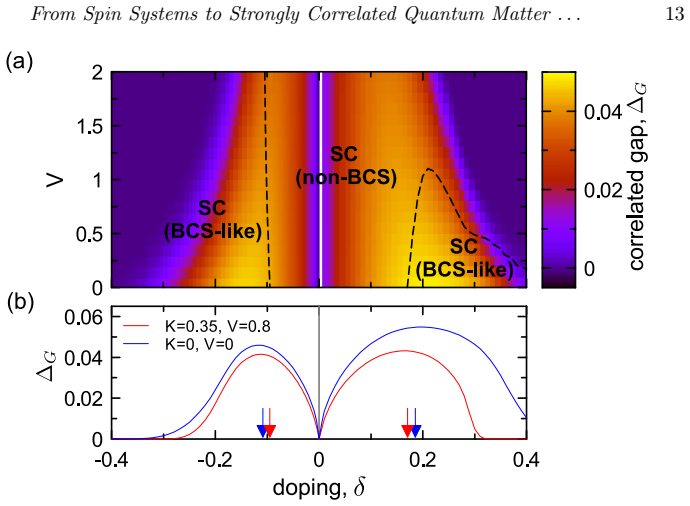
- [Sec. 2.4–2.6, Eqs. 2.12–2.13, Figs. 3–4] Abstract and Sec. 2.4–2.6: The central claim that the projected real-space pairing operators (Eqs. 2.12–2.13) obtained from the second-order canonical expansion constitute the microscopic origin of high-Tc superconductivity is load-bearing, yet the DE-GWF phase diagrams (Figs. 3–4) still omit the pseudogap and overestimate the upper critical doping, as the text itself notes in Sec. 2.6.2. A clearer statement is needed of which experimental features are regarded as decisive tests of this origin versus which remain outside the present controlled approximation.
- [Sec. 2.1–2.3, Eqs. 2.5–2.9] Sec. 2.1–2.3 and priority statements: The assertion of the “first derivation” of the t–J model (including real-space pairing) rests on the author’s 1977–1988 papers. While the second-order expansion (Eqs. 2.5–2.9) is standard and correctly recovers Anderson kinetic exchange at half-filling, contemporaneous and subsequent independent constructions should be briefly situated so that the distinctive contribution (the closed pairing-operator form) is cleanly separated from the shared kinetic-exchange framework.
- [Sec. 3.4, Eq. 3.10; Sec. 4.1] Sec. 3.4 and 4.1, Eq. 3.10: The spin-dependent mass formula follows directly from the projected hopping probability in the U o∞ limit and is consistent with the Gutzwiller renormalization. The subsequent claim that partial polarization renders the two spin species “distinguishable” (Sec. 4.1) is conceptually interesting but remains programmatic (“deferred to a separate paper”). Either a concrete statistical-mechanical consequence or a clear demarcation that this is an open conjecture should be supplied if the concept is listed among the fundamental components.
minor comments (5)
- [Fig. 3] Fig. 3 caption and surrounding text: The theoretical critical doping is visibly higher than experiment; a quantitative statement of the discrepancy (or of the parameter set used) would help the reader assess the “semi-quantitative” claim.
- [Sec. 2.5, Eq. 2.15] Sec. 2.5: The simultaneous presence of finite U and Jij in the t–J–U model is justified by appeal to oxygen-mediated superexchange, but a short estimate of the relative d–d versus d–p–d contributions would make the construction more transparent.
- [Sec. 4.4, Fig. 18] Sec. 4.4 and Fig. 18: The atomicity concept is introduced to cure the unphysical growth of covalency at large R. An explicit operational definition (e.g., a formula in terms of the two-particle density matrix or occupation numbers) would allow independent verification.
- Throughout: Occasional missing spaces and hyphenation artifacts appear in the arXiv text (e.g., “foralmostfivedecades”); a final proofreading pass is recommended.
- [References / Sec. 2.4] References: Several key contemporaneous works on kinetic exchange and RVB are cited, but a short paragraph situating the 1988 pairing-operator paper relative to the contemporaneous literature would strengthen the historical narrative without altering the personal focus.
Circularity Check
Personal historical overview with expected self-citations for priority; algebraic rewritings of t–J and spin-dependent masses are self-contained and not circular by construction.
-
self citation load bearing
[Abstract; Sec. 2.1–2.4 (Eqs. 2.9–2.13 and surrounding text)]
"the first derivation of what is now called the t–J model, comprising both the limit of Anderson kinetic exchange of spin–spin interaction in the Mott–Hubbard insulator and taking into account real-space pairing... our construction [21] to the t–J model... It was surprising to the author to discover that a relatively complex expression of the effective Hamiltonian (2.9) can be brought to the simpler and formally closed form by introducing also the projected spin-singlet pairing operators in the real-space [26]"
Priority for the t–J model plus real-space pairing is asserted via the author’s own prior publications; the present text re-derives the second-order expansion and rewrites it algebraically into pairing form, but the claim of originality and foundational status rests on those self-citations rather than an independent external source.
-
self citation load bearing
[Sec. 3.4 (Eq. 3.10 and preceding paragraph)]
"One of the most interesting concepts invoked in my group was the introduction of spin-dependent effective masses [53–56]. This concept is specific for strongly correlated fermions and is due to the spin-dependent renormalization of the hopping part... m* → m*_σ = (1−n_σ)/(1−n) m* ≡ q_σ^{-1} m*."
The concept of spin-dependent masses and its foundational status are attributed to the author’s group via self-citations; while a short derivation from projected hopping is given here, the claim that this is a fundamental component of the theory rests on the self-referential chain.
full rationale
This is an author-centered critical overview of five decades of work, not a primary derivation paper. The load-bearing mathematical steps—the second-order canonical perturbation expansion of the Hubbard model yielding the effective Hamiltonian (Eqs. 2.5–2.9), its algebraic rewriting via projected real-space singlet pairing operators (Eqs. 2.12–2.13), and the spin-dependent mass renormalization m*_σ = [(1−n_σ)/(1−n)] m* from projected hopping probabilities (Eq. 3.10)—are presented explicitly and do not reduce any claimed prediction or first-principles result to its own inputs by construction. Phase diagrams, paramagnon spectra, and ARPES comparisons arise from the group’s prior SGA/DE-GWF variational framework and are checked against external experimental data; parameters (e.g., J/|t| ≃ 0.3) are chosen but there is no fit-then-predict of a statistically forced near-relative quantity. Self-citations establish archival priority for the t–J construction, real-space pairing, spin-dependent masses, and early Mott thermodynamics; per the rules this is normal for the genre and does not constitute circularity unless the physics argument itself collapses to an unverified self-citation, which it does not. Pseudogap and disorder limitations are already conceded in the text. No self-definitional loops, uniqueness theorems imported from the authors, or ansatz smuggling appear. Score 2 reflects only the minor, non-load-bearing self-citation burden inherent to a personal review.
Assumptions & free parameters
free parameters (3)
- J/|t| ratio =
0.3
- U (Hubbard repulsion) =
8–10 eV
- hybridization V/W
assumptions (3)
- domain assumption Strong-correlation limit |tij| ≪ (U−K) permits a canonical perturbation expansion that eliminates double occupancy and yields the effective t–J Hamiltonian to second order.
- domain assumption Projected real-space singlet operators b†ij correctly capture the pairing channel responsible for high-Tc superconductivity.
- ad hoc to paper Statistically consistent Gutzwiller approximation (SGA) plus diagrammatic expansion (DE-GWF) is a controlled variational method for the t–J–U model.
invented entities (1)
-
atomicity (as a bonding factor complementary to covalency and ionicity)
Cite this review
Pith. "Pith review of Strongly correlated quantum matter: t--J model, real-space pairing, spin-dependent masses, and atomicity in chemical bond and nanosystems." pith.science (2026). https://pith.science/paper/HOPGQRJ2
@misc{pith2026260709465,
  author       = {Pith},
  title        = {Pith review of: Strongly correlated quantum matter: t--J model, real-space pairing, spin-dependent masses, and atomicity in chemical bond and nanosystems},
  year         = {2026},
  howpublished = {\url{https://pith.science/paper/HOPGQRJ2}},
  note         = {Machine review of arXiv:2607.09465}
}
read the original abstract
I critically overview my research on strongly correlated fermion systems for almost five decades. It concentrated on: (i) the first derivation of what is now called the t--J model, comprising both the limit of Anderson kinetic exchange of spin--spin interaction in the Mott--Hubbard insulator and taking into account real-space pairing, subsequently applied to high-temperature superconductivity; (ii) the concept of spin-dependent heavy mass of quasiparticles in heavy-fermion systems, and (iii) the first nontrivial model of statistical thermodynamics of the Mott--Hubbard transition. Those three features, together with the specific quantum critical phenomena provide, in my view, fundamental components of the theory of strongly correlated fermions established in the 1960s. Some related questions such as introduction of atomicity in the chemical bonding (iv), and specific properties of correlated nanosystems within the rigorous EDABI (v) approach are also briefly elaborated at the end.
Figures


Figures from the paper (15 more)


Reference graph
Works this paper leans on
-
[1]
For a review see, e.g., N. F. Mott,Metal-Insulator Transitions, 2 ed., Taylor & Francis (London, 1991)
1991
-
[2]
New approach to the theory of superexchange inter- actions
P. W. Anderson, “New approach to the theory of superexchange inter- actions”, Phys. Rev.115, 2–13 (1959)
1959
-
[3]
Theory of magnetic exchange interactions: exchange ininsulatorsandsemiconductors
P. W. Anderson, “Theory of magnetic exchange interactions: exchange ininsulatorsandsemiconductors”,inSolid state physics,Vol.14,edited by F. Seitz and S. Turnbull (Elsevier, 1963), pp. 99–214
1963
-
[4]
Electron correlations in narrow energy bands iii. an im- proved solution
J. Hubbard, “Electron correlations in narrow energy bands iii. an im- proved solution”, Proc. Roy. Soc. (London) S.281, 401–419 (1964)
1964
-
[5]
Electron correlation and ferromagnetism of transition metals
J. Kanamori, “Electron correlation and ferromagnetism of transition metals”, Progress of Theoretical Physics30, 275–289 (1963)
1963
-
[6]
Correlation of electrons in a narrow band
M. C. Gutzwiller, “Correlation of electrons in a narrow band”, Phys. Rev.137, A1726–A1735 (1965)
1965
-
[7]
Application of gutzwiller’s varia- tional method to the metal-insulator transition
W. F. Brinkman and T. M. Rice, “Application of gutzwiller’s varia- tional method to the metal-insulator transition”, Phys. Rev. B2, 4302– 4304 (1970)
1970
-
[8]
Discontinuousmetal-insulatortran- sitions and fermi-liquid behavior of correlated electrons
J.Spałek,A.Datta,andJ.Honig,“Discontinuousmetal-insulatortran- sitions and fermi-liquid behavior of correlated electrons”, Phys. Rev. Lett.59, 728–731 (1987)
1987
Show all 76 references
-
[9]
Low-temperature proper- ties of an almost-localized fermi liquid
J. Spałek, M. Kokowski, and J. M. Honig, “Low-temperature proper- ties of an almost-localized fermi liquid”, Phys. Rev. B39, 4175–4185 (1989)
1989
-
[10]
Fermi liquid behavior and the metal-insulator transition of almost localized electrons: a brief theoretical review and an application toV 2O3 system
J. Spałek, “Fermi liquid behavior and the metal-insulator transition of almost localized electrons: a brief theoretical review and an application toV 2O3 system”, J. of Sol. St. Chem.88, 70–93 (1990)
1990
-
[11]
Properties of an almost localized fermi liquid in an applied magnetic field revisited: a statistically con- sistent gutzwiller approach
M. M. Wysokiński and J. Spałek, “Properties of an almost localized fermi liquid in an applied magnetic field revisited: a statistically con- sistent gutzwiller approach”, J. Phys.: Condens. Matter26, 055601 (2014)
2014
-
[12]
A mott in- sulator of fermionic atoms in an optical lattice
R. Jördens, N. Strohmaier, K. Günter, H. Moritz, et al., “A mott in- sulator of fermionic atoms in an optical lattice”, Nature455, 204–207 (2008)
2008
-
[13]
t-J model then and now: a personal perspective from the pioneering times
J. Spałek, “t-J model then and now: a personal perspective from the pioneering times”, Acta Phys. Polon. A111, 409–424 (2007). 36REFERENCES
2007
-
[14]
Theory of unconventional superconductivity in strongly correlatedsystems:realspacepairingandstatisticallyconsistentmean- fieldtheory-inperspective
J. Spałek, “Theory of unconventional superconductivity in strongly correlatedsystems:realspacepairingandstatisticallyconsistentmean- fieldtheory-inperspective”,ActaPhys.Polon.A121,764–784(2012)
2012
-
[15]
Brief perspective of high-temperature superconductivity in the cuprates: strong correlations combined with superexchange match experiment
J. Spałek, “Brief perspective of high-temperature superconductivity in the cuprates: strong correlations combined with superexchange match experiment”, Acta Phys. Polon. A143, 169–179 (2023)
2023
-
[16]
Density functional theory: Its origins, rise to prominence, and future
See, e.g., R.O. Jones, "Density functional theory: Its origins, rise to prominence, and future", Rev. Mod. Phys.87, 897 (2015)
2015
-
[17]
Avella and F
A. Avella and F. Mancini, eds.,Strongly correlated systems: numerical methods(Springer Berlin Heidelberg, 2013)
2013
-
[18]
Mottphysicsincorrelatednanosystems:localization-delocalization transition by the exact diagonalization ab initio method
J.Spałek,“Mottphysicsincorrelatednanosystems:localization-delocalization transition by the exact diagonalization ab initio method”, inTopol- ogy, entanglement, and strong correlations, edited by E. Pavarini and E. Koch (Forschungszentrum Jülich Zentralbibliothek, Verlag, Jülic...
2020
-
[19]
P. A. M. Dirac,The principles of quantum mechanics, 4. ed., Interna- tional series of monographs on physics 27 (Oxford University Press, Oxford, 2010), 314 pp
2010
-
[20]
Raboty po kvantovoi teorii polya
V. A. Fock, “Raboty po kvantovoi teorii polya”, , pp. 25–51 (in Rus- sian); (Izdatel’stvo Leningradskogo Universiteta, 1957); for didactical exposition see A. L. Fetter and J. D. Walecka,Quantum Theory of Many-Particle Systems(McGraw-Hill Book Co., 1971) pp.16-43
1957
-
[21]
Spałek, Acta Phys
For an early historical account see: J. Spałek, Acta Phys. Polon. A111, 409 (2007). For original detailed account see: J. Spałek, Habilitation Thesis, Jagiellonian University, Kraków (1981)
2007
-
[22]
Ferromagnetism in narrow s-band with inclu- sion of intersite correlations
J. Spałek and A. Oleś, “Ferromagnetism in narrow s-band with inclu- sion of intersite correlations”, Physica B+C86–88, 375–377 (1977)
1977
-
[23]
Kinetic exchange interaction in a narrow s-band
K. A. Chao, J. Spałek, and A. M. Oleś, “Kinetic exchange interaction in a narrow s-band”, J. of Phys. C: Solid State Physics10, L271–L276 (1977)
1977
-
[24]
Canonical perturbation ex- pansion of the hubbard model
K. A. Chao, J. Spałek, and A. M. Oleś, “Canonical perturbation ex- pansion of the hubbard model”, Phys. Rev. B18, 3453–3464 (1978)
1978
-
[25]
Kinetic exchange interaction in a dou- bly degenerate narrow band and its application toF e1−xCoxS2 and Co1−xN ixS2
J. Spałek and K. A. Chao, “Kinetic exchange interaction in a dou- bly degenerate narrow band and its application toF e1−xCoxS2 and Co1−xN ixS2”, Journal of Physics C: Solid State Physics13, 5241–5251 (1980)
1980
-
[26]
Effect of pair hopping and magnitude of intra-atomic in- teraction on exchange-mediated superconductivity
J. Spałek, “Effect of pair hopping and magnitude of intra-atomic in- teraction on exchange-mediated superconductivity”, Phys. Rev. B37, 533–536 (1988). REFERENCES37
1988
-
[27]
Conceptofoff-diagonallong-rangeorderandthequantum phases of liquid he and of superconductors
C.N.Yang,“Conceptofoff-diagonallong-rangeorderandthequantum phases of liquid he and of superconductors”, Rev. of Mod. Phys.34, 694–704 (1962)
1962
-
[28]
Universal properties of high-temperature superconductors from real-space pairing:t–J–U model and its quantitative comparison with experiment
J. Spałek, M. Zegrodnik, and J. Kaczmarczyk, “Universal properties of high-temperature superconductors from real-space pairing:t–J–U model and its quantitative comparison with experiment”, Phys. Rev. B95, 024506 (2017)
2017
-
[29]
Universal properties of high-temperature superconductorsfromreal-spacepairing:roleofcorrelatedhoppingand intersite coulomb interaction within thet–J–Umodel
M. Zegrodnik and J. Spałek, “Universal properties of high-temperature superconductorsfromreal-spacepairing:roleofcorrelatedhoppingand intersite coulomb interaction within thet–J–Umodel”, Phys. Rev. B 96, 054511 (2017)
2017
-
[30]
T. Dey, M. Fidrysiak, and J. Spałek, , unpublished (2026)
2026
-
[31]
Supercon- ductivity in high-Tc and related strongly correlated systems from vari- ational perspective: beyond mean field theory
J. Spałek, M. Fidrysiak, M. Zegrodnik, and A. Biborski, “Supercon- ductivity in high-Tc and related strongly correlated systems from vari- ational perspective: beyond mean field theory”, Phys. Rep.959, 1–117 (2022)
2022
- [32]
-
[33]
New functional integral approach to strongly correlated fermi systems: the gutzwiller approximation as a saddle point
G. Kotliar and A. E. Ruckenstein, “New functional integral approach to strongly correlated fermi systems: the gutzwiller approximation as a saddle point”, Phys. Rev. Lett.57, 1362–1365 (1986)
1986
-
[34]
Spałek and W
For a review see: J. Spałek and W. Wójcik,Almost Localized Fermions and Mott-Hubbard Transitions at Non-Zero Temperature,inSpectroscopy of Mott Insulators and Correlated Metals, Springer Series in Solid State Sciences, Vol. 19, pp. 41–65 (1995)
1995
-
[35]
Incorporationofcharge-andpair-density- wave states into the one–band model of d–wave superconductivity
M.ZegrodnikandJ.Spałek,“Incorporationofcharge-andpair-density- wave states into the one–band model of d–wave superconductivity”, Physical Review B98, 155144 (2018)
2018
-
[36]
Biało, Ph.D
I. Biało, Ph.D. Thesis, AGH University of Science and Technology and TU Wien, 2020 (unpublished)
2020
-
[37]
Fidrysiak, M
M. Fidrysiak, M. Zegrodnik, and J. Spałek, J. of Phys.: Condens. Mat- ter30, 475602 (2018) and Refs. therein
2018
-
[38]
Fordetailedexperimentalresultsreviewsee:Hashimoto,M.andVishik, I. M. and He, R.-H. and Devereaux, T. P. and Shen, Z.-X., Nature Physics,10, 483 (2014)
2014
-
[39]
Robustspinandchargeexcitationsthrough- out the high- tc cuprate phase diagram from incipient mottness
M.FidrysiakandJ.Spałek,“Robustspinandchargeexcitationsthrough- out the high- tc cuprate phase diagram from incipient mottness”, Phys. Rev. B102, 014505 (2020). 38REFERENCES
2020
-
[40]
Unified theory of spin and charge exci- tations in high–Tc cuprate superconductors: a quantitative compari- son with experiment and interpretation
M. Fidrysiak and J. Spałek, “Unified theory of spin and charge exci- tations in high–Tc cuprate superconductors: a quantitative compari- son with experiment and interpretation”, Phys. Rev. B104, l020510 (2021)
2021
-
[41]
Universal collective modes from strong electronic correlations: modified1/Nf theory with application to high– Tc cuprates
M. Fidrysiak and J. Spałek, “Universal collective modes from strong electronic correlations: modified1/Nf theory with application to high– Tc cuprates”, Phys. Rev. B103, 165111 (2021)
2021
-
[42]
Exchange-mediated pairing: gap anisotropy and a narrow-band limit for hybridized electrons
J. Spałek and P. Gopalan, “Exchange-mediated pairing: gap anisotropy and a narrow-band limit for hybridized electrons”, Journal de Physique 50, 2869–2893 (1989)
1989
-
[43]
Anderson-kondo lattice hamilto- nian from the anderson-lattice model: a modified schrieffer-wolff trans- formation and the effective exchange interactions
E. Kądzielawa-Major and J. Spałek, “Anderson-kondo lattice hamilto- nian from the anderson-lattice model: a modified schrieffer-wolff trans- formation and the effective exchange interactions”, Acta Phys. Polon. A126, A-100-A–104 (2014)
2014
-
[44]
Antiferromagnetic heavy-fermion and kondo-insulating states with compensated magnetic moments
R. Doradziński and J. Spałek, “Antiferromagnetic heavy-fermion and kondo-insulating states with compensated magnetic moments”, Phys. Rev. B56, R14239–R14242 (1997)
1997
-
[45]
Mean-field magnetic phase diagram of the periodic anderson model with the kondo-compensated phases
R. Doradziński and J. Spałek, “Mean-field magnetic phase diagram of the periodic anderson model with the kondo-compensated phases”, Phys. Rev. B58, 3293–3301 (1998)
1998
-
[46]
Spałek and R
J. Spałek and R. Doradziński, in Magnetism and electronic correlations in local-moment systems: rare-earth elements and compounds, edited by M. Donath, P. A. Dowben, and W. Nolting (1998), pp. 387–405
1998
-
[47]
Anderson lattice with explicit kondo cou- pling revisited: metamagnetism and the field-induced suppression of the heavy fermion state
O. Howczak and J. Spałek, “Anderson lattice with explicit kondo cou- pling revisited: metamagnetism and the field-induced suppression of the heavy fermion state”, J. Phys.: Condens. Matter24, 205602 (2012)
2012
-
[48]
Superconductivity in the presence of strong pauli paramagnetism:CeCu2Si2
F. Steglich, J. Aarts, C. D. Bredl, W. Lieke, et al., “Superconductivity in the presence of strong pauli paramagnetism:CeCu2Si2”, Physical Review Letters43, 1892–1896 (1979)
1979
-
[49]
4f-virtual-bound-state formation inCeAl 3 at low temperatures
K. Andres, J. E. Graebner, and H. R. Ott, “4f-virtual-bound-state formation inCeAl 3 at low temperatures”, Phys. Rev. Lett.35, 1779– 1782 (1975)
1975
-
[50]
Howczak, Ph.D
O. Howczak, Ph.D. Thesis, Jagiellonian University, Kraków, 2012
2012
-
[51]
Microscopic model of hybrid pairing: a common approach to heavy-fermion and high-Tc superconductivity
J. Spałek, “Microscopic model of hybrid pairing: a common approach to heavy-fermion and high-Tc superconductivity”, Phys. Rev. B38, 208–212 (1988). REFERENCES39
1988
-
[52]
Superconduc- tivity in the three-band model of cuprates: variational wave function study and relation to the single-band case
M.Zegrodnik,A.Biborski,M.Fidrysiak,andJ.Spałek,“Superconduc- tivity in the three-band model of cuprates: variational wave function study and relation to the single-band case”, Phys. Rev. B99, 104511 (2019)
2019
-
[53]
Almost-localized electrons in a magnetic field
J. Spałek and P. Gopalan, “Almost-localized electrons in a magnetic field”, Phys. Rev. Lett.64, 2823–2826 (1990)
1990
-
[54]
Spin-splitmasses and metamagnetic behavior of almost-localized fermions
P.Korbel,J.Spałek,W.Wójcik,andM.Acquarone,“Spin-splitmasses and metamagnetic behavior of almost-localized fermions”, Phys. Rev. B52, R2213–R2216 (1995)
1995
-
[55]
Magnetic properties of almost localized fermions revisited: spin dependent masses and quantum critical behavior
J. Spałek, “Magnetic properties of almost localized fermions revisited: spin dependent masses and quantum critical behavior”, Physica Status Solidi (b)243, 78–88 (2006)
2006
-
[56]
Spin-split masses and a critical behavior of almost local- ized narrow-band and heavy-fermion systems
J. Spałek, “Spin-split masses and a critical behavior of almost local- ized narrow-band and heavy-fermion systems”, Physica B: Condensed Matter378–380, 654–660 (2006)
2006
-
[57]
High magnetic field study ofCeP d2Si2
I. Sheikin, A. Gröger, S. Raymond, D. Jaccard, et al., “High magnetic field study ofCeP d2Si2”, Phys. Rev. B67, 094420 (2003)
2003
-
[58]
Anoma- lous de Haas–van Alphen oscillations inCeCoIn5
A. McCollam, S. R. Julian, P. M. C. Rourke, D. Aoki, et al., “Anoma- lous de Haas–van Alphen oscillations inCeCoIn5”, Phys. Rev. Lett. 94, 186401 (2005)
2005
-
[59]
Anomalous changeinthedeHaas—vanAlphenoscillationsofCeCoIn 5 atultralow temperatures
H. Shishido, S. Yamada, K. Sugii, M. Shimozawa, et al., “Anomalous changeinthedeHaas—vanAlphenoscillationsofCeCoIn 5 atultralow temperatures”, Phys. Rev. Lett.120, 177201 (2018)
2018
-
[60]
Truncated massdivergenceinamottmetal
K. Semeniuk, H. Chang, J. Baglo, S. Friedemann, et al., “Truncated massdivergenceinamottmetal”,ProceedingsoftheNationalAcademy of Sciences120,10.1073/pnas.2301456120(2023)
2023 doi
-
[61]
Kondo-lattice in an applied mag- netic field: spin-split masses and metamagnetism
R. Citro, A. Romano, and J. Spałek, “Kondo-lattice in an applied mag- netic field: spin-split masses and metamagnetism”, Physica B: Con- densed Matter259–261, 213–214 (1999)
1999
-
[62]
Photoemission signature of momentum-dependent hybridization inCeCoIn5
R. Kurleto, M. Fidrysiak, L. Nicolaï, J. Minár, et al., “Photoemission signature of momentum-dependent hybridization inCeCoIn5”, Phys. Rev. B104, 125104 (2021)
2021
-
[63]
Spałek, P
J. Spałek, P. Kuterba, M. Wójcik, et al., in preparation. (2026)
2026
-
[64]
Pavarini et al., Schriften des Forschungszentrums Jülich, Vol
See, e.g.,Dynamical Mean-Field Theory of Correlated Electrons, edited by E. Pavarini et al., Schriften des Forschungszentrums Jülich, Vol. 12 (2022). 40REFERENCES
2022
-
[65]
Hendzel, P
M. Hendzel, P. Kuterba, J. Spałek, Role of Kinetic Exchange and Coulomb Interaction in Bonding of Hydrogen Molecular Systems and Excited States, Acta Phys. Pol. B 57, 5-A18 (2026), this issue
2026
-
[66]
Lieb-Wu solution, gutzwiller- wave-function, and gutzwiller-ansatz approximations with adjustable single-particle wave function for the hubbard chain
J. Kurzyk, J. Spałek, and W. Wójcik, “Lieb-Wu solution, gutzwiller- wave-function, and gutzwiller-ansatz approximations with adjustable single-particle wave function for the hubbard chain”, Acta Phys. Polon. A111, 603–618 (2007)
2007
-
[67]
Extended hubbard model with renormalized wannier wave functions in the correlated state: beyond the parametrized models
J. Kurzyk, W. Wójcik, and J. Spałek, “Extended hubbard model with renormalized wannier wave functions in the correlated state: beyond the parametrized models”, Eur. Phys. J. B66, 385–398 (2008)
2008
-
[68]
Extended hub- bard model with the renormalized wannier wave functions in the cor- related state ii: quantum critical scaling of the wave function near the mott-hubbard transition
J. Spałek, J. Kurzyk, R. Podsiadły, and W. Wójcik, “Extended hub- bard model with the renormalized wannier wave functions in the cor- related state ii: quantum critical scaling of the wave function near the mott-hubbard transition”, Eur. Phys. J. B74, 63–74 (2010)
2010
-
[69]
Absence of mott transition in an exact solution of the short-range, one-band model in one dimension
E. H. Lieb and F. Y. Wu, “Absence of mott transition in an exact solution of the short-range, one-band model in one dimension”, Phys. Rev. Lett.20, 1445–1448 (1968)
1968
-
[70]
The one-dimensional hubbard model: a remi- niscence
E. H. Lieb and F. Wu, “The one-dimensional hubbard model: a remi- niscence”, Physica A: Statistical Mechanics and its Applications321, 1–27 (2003)
2003
-
[71]
Toward complementary characterizationofthechemicalbond
M. Hendzel, M. Fidrysiak, and J. Spałek, “Toward complementary characterizationofthechemicalbond”,J.Phys.Chem.Lett.13,10261– 10266 (2022)
2022
-
[72]
The com- bined exact diagonalization–ab initio approach and its application to correlatedelectronicstatesandMott–Hubbardlocalizationinnanoscopic systems
J. Spałek, E. M. Görlich, A. Rycerz, and R. Zahorbeński, “The com- bined exact diagonalization–ab initio approach and its application to correlatedelectronicstatesandMott–Hubbardlocalizationinnanoscopic systems”, J. Phys.: Condens. Matter19, 255212 (2007)
2007
-
[73]
Interparticle correlations and chemical bonding from physical side: covalency vs atomicity and ionicity
E. Brocławik, M. Fidrysiak, M. Hendzel, and J. Spałek, “Interparticle correlations and chemical bonding from physical side: covalency vs atomicity and ionicity”, inPolish quantum chemistry from kołos to now(Elsevier, 2023), pp. 351–373
2023
-
[74]
Fidrysiak, Fermiology, Charge Transfer Energy, and Robust Para- magnons in high-Tc Cuprate Superconductors, Acta Phys
M. Fidrysiak, Fermiology, Charge Transfer Energy, and Robust Para- magnons in high-Tc Cuprate Superconductors, Acta Phys. Pol. B 57, 5-A14 (2026), this issue
2026
-
[75]
Spałek et al., A Nonstandard Statistics for Strongly Correlated Sys- tems: Two Simple Examples, Acta Phys
J. Spałek et al., A Nonstandard Statistics for Strongly Correlated Sys- tems: Two Simple Examples, Acta Phys. Pol. B 57, 5-A16 (2026), this issue
2026
-
[76]
Spałek and M
J. Spałek and M. Hendzel, in preparation (2026)
2026
Reviewed July 13, 2026 · model on record in the stance chip above.
Discussion (0). Continue with ORCID to comment.