REVIEW 4 minor 42 references
Convergence analysis of a nonlinear eigensolver based on rational approximation of the resolvent
T0 review · 0 major / 4 minor · reviewed 2026-07-14 · grok-4.5
Pith's one-line read Block-sketched resolvent poles recover nonlinear eigenvalues, and zooming plus block probing make the accuracy predictable and high.
desk verdict Solid first quantitative theory for AAA-resolvent polefinding: block probing recovers multiplicities and zooming improves accuracy as predicted, with matching numerics and public code. read the letter →
The pith
A machine-rendered reading of the paper's core claim, the machinery that carries it, and where it could break.
The reading
What carries the argument
The sketched resolvent F(z) = Ω_L^* T(z)^{-1} Ω_R together with its barycentric rational approximant R; Keldysh's expansion supplies the Laurent coefficients whose singular-value asymptotics reveal partial multiplicities (Theorem 2.3), while Rouché and moment/Hankel arguments (Theorems 3.2, 3.4) control how poles of R track those of F.
What would settle it
On a fixed family of problems whose eigenvalues have known partial multiplicities, repeatedly zoom the domain diameter δ by factors of ten while keeping the rational residual at machine precision; if the observed pole error does not improve proportionally to δ (or to δ times u^{1/m}), the scaling claim fails.
Extended reading notes
Core claim
For a regular holomorphic matrix-valued T, the poles of a rational approximation R to the block-sketched resolvent F converge to the eigenvalues of T. With block size at least the geometric multiplicity, partial multiplicities are recovered from the singular-value growth of F; zooming and block probing improve pole accuracy linearly in domain diameter and by reducing the number of poles per subdomain; and barycentric polefinding via the companion pencil is backward and forward stable under mild support-point separation.
Load-bearing premise
When the computational domain is shrunk, the hidden constant in the pole-error bound is assumed to stay bounded; if that constant grows, the claimed linear accuracy gain with diameter can disappear.
Editorial analysis
A structured set of objections, weighed in public.
Referee Report
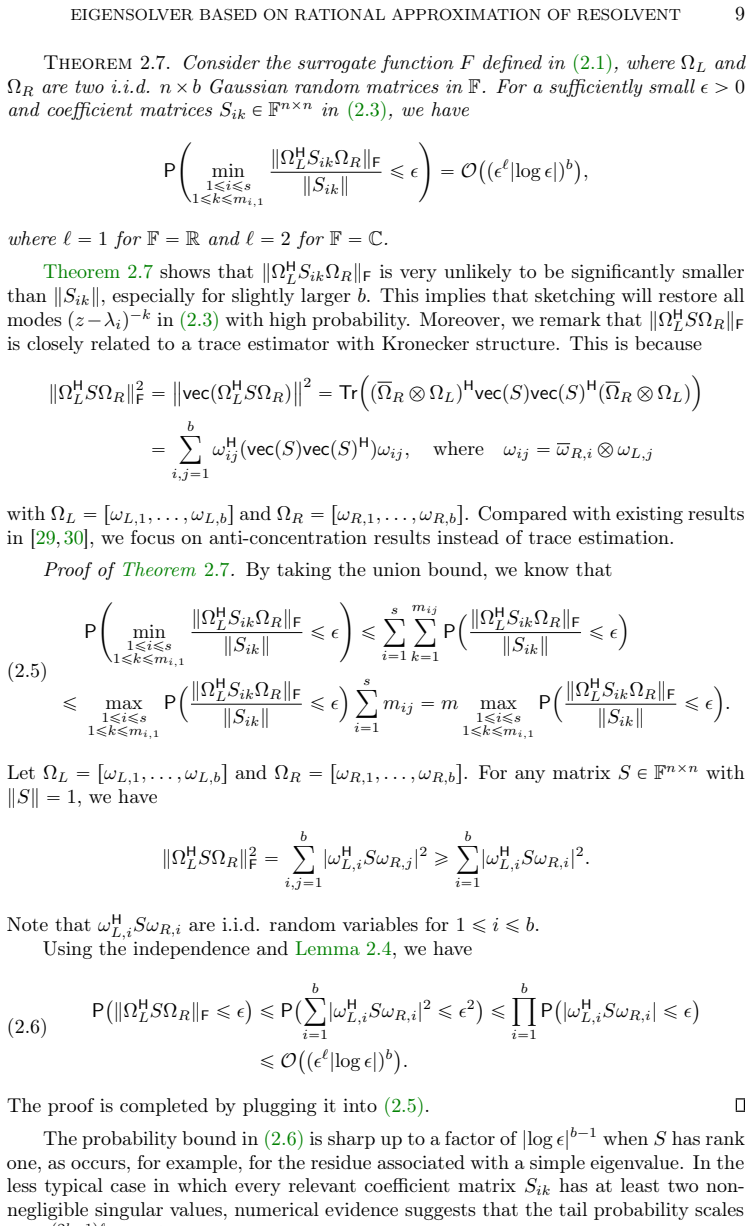
Summary. The paper analyzes a nonlinear eigensolver that recovers eigenvalues of a holomorphic matrix-valued function T as poles of a rational approximation R to the block-sketched resolvent F(z)=Ω_L^H T(z)^{-1} Ω_R. Using Keldysh’s theorem it shows that, for block size at least the geometric multiplicity, the singular-value growth of F near an eigenvalue encodes the partial multiplicities (Theorem 2.3) and that block probing sharply reduces the probability of missing modes (Theorem 2.7). Convergence of poles of R is quantified by a Rouché/Walsh argument on unit-diameter domains (Theorem 3.2); a scaling argument then yields linear improvement with domain diameter under a bounded-prefactor proviso, while a moment/Hankel analysis (Theorem 3.4) explains the further gain obtained by reducing the number of poles per subdomain. Backward and forward stability of barycentric polefinding via the companion pencil are established under mild support-point separation (Theorems 4.3–4.4). Numerical tables and the butterfly NLEVP experiment confirm the predicted exponents and the benefit of block probing plus zooming.
Significance. The work supplies the first rigorous accuracy theory for resolvent-based AAA-type nonlinear eigensolvers, justifying two practical enhancements (block probing and recursive zooming) that practitioners already employ. The proofs rest on classical complex analysis, random-matrix anti-concentration and standard matrix perturbation theory; the numerical experiments are designed to test sharpness of the 1/m and linear-in-δ rates and are reproducible via public code. The stability results for barycentric rootfinding are of independent interest beyond eigenvalue computation. If the stated hypotheses hold, the paper gives a clear theoretical foundation for a flexible class of linear and nonlinear eigensolvers.
minor comments (4)
- After the scaling argument in §3.1 the paper correctly flags that the prefactor C_δ is assumed bounded under zooming; a short remark on geometries where this may fail (or a pointer to the few-pole analysis of Theorem 3.4 as the main practical mechanism) would make the proviso even clearer to readers.
- Table 3.1 and Table 3.2 would benefit from an explicit statement of the AAA residual tolerance used, so that the comparison with u^{1/m} is fully self-contained.
- In the proof of Theorem 4.3 the condition |z_k|=O(1) is harmless by shifting/scaling, but a one-sentence reminder that the same shift must be applied to the computed eigenvalue would avoid any ambiguity for implementers.
- Figure 3.2 heat maps are informative; adding a color-bar scale (or a sentence in the caption) would make the logarithmic residual levels immediately readable.
Circularity Check
No significant circularity: pole-convergence and stability results are derived from classical complex analysis, random-matrix anti-concentration and matrix perturbation theory applied to the sketched resolvent and barycentric pencil.
full rationale
The paper’s central claims (Thm 2.3 on singular-value growth of the block-sketched resolvent, Thm 3.2 on pole location via Rouché + Cauchy estimates, Thm 3.4 on node-polynomial convergence from Hankel/Vandermonde moments, and Thms 4.3–4.4 on backward/forward stability of the barycentric companion pencil) are proved from first principles using Keldysh’s theorem, residue calculus, Wedin’s singular-vector perturbation and standard first-order defective-eigenvalue perturbation theory. No free parameters are fitted to data and then re-presented as predictions; the numerical tables and the butterfly experiment compare against independent references (exact poles of a diagonal matrix, polyeig). Self-citations appear only for algorithmic context (AAA, set-valued AAA, earlier resolvent-based eigensolvers) and are not load-bearing for the convergence or stability theorems. The sole explicit proviso (uniform boundedness of the zooming prefactor C_δ) is stated by the authors themselves and is not used to force the main unit-domain result. Consequently the derivation chain is self-contained and non-circular.
Assumptions & free parameters
assumptions (6)
- domain assumption T is holomorphic on a domain containing the closure of D and the NEP is regular (det T(z0)≠0 for some z0 in D).
- standard math Keldysh theorem: T(z)^{-1} = V_L (zI−J)^{-1} V_R^H + H(z) with H holomorphic in D.
- domain assumption For generic probing matrices with block size b ≥ geometric multiplicity d_i, sketching does not cancel the blow-up of the d_i singular values of F near λ_i.
- ad hoc to paper Under domain scaling, the constant C_δ in the pole-error bound remains bounded as diameter δ→0.
- domain assumption AAA (set-valued) produces a barycentric rational R with residual O(u) on the sample set / boundary when the target is meromorphic with few poles.
- domain assumption Support points satisfy |z_k|=O(1) and at most one support point is Θ(1)-close to a computed root (condition (4.3)).
Cite this review
Pith. "Pith review of Convergence analysis of a nonlinear eigensolver based on rational approximation of the resolvent." pith.science (2026). https://pith.science/paper/WIDJBADT
@misc{pith2026260710377,
  author       = {Pith},
  title        = {Pith review of: Convergence analysis of a nonlinear eigensolver based on rational approximation of the resolvent},
  year         = {2026},
  howpublished = {\url{https://pith.science/paper/WIDJBADT}},
  note         = {Machine review of arXiv:2607.10377}
}
read the original abstract
Given a holomorphic matrix-valued function, the poles of its sketched resolvent are generically its eigenvalues. Once a good rational approximation of the sketched resolvent is obtained, the poles of this rational approximation typically lie close to those eigenvalues, thus providing a flexible framework for solving both linear and nonlinear eigenvalue problems. However, the accuracy of the computed eigenvalues is limited and remains poorly understood. This paper analyzes the convergence of this approach and demonstrates the effectiveness of two techniques to improve accuracy: block probing and zooming in. We also establish the backward and forward stability of polefinding for a barycentric rational form via a generalized eigenproblem. Numerical experiments demonstrate the sharpness of our theoretical results.
Figures


Figures from the paper (5 more)


Reference graph
Works this paper leans on
-
[1]
A. P. Austin and L. N. Trefethen , Computing eigenvalues of real symmetric matrices with rational filters in real arithmetic, SIAM J. Sci. Comput., 37 (2015), pp. A1365–A1387, https://doi.org/10.1137/140984129
-
[2]
F. L. Bauer and C. T. Fike , Norms and exclusion theorems, Numer. Math., 2 (1960), pp. 137–141, https://doi.org/10.1007/BF01386217
-
[3]
Beckermann , The condition number of real Vandermonde, Krylov and positive defi- nite Hankel matrices, Numer
B. Beckermann , The condition number of real Vandermonde, Krylov and positive defi- nite Hankel matrices, Numer. Math., 85 (2000), pp. 553–577, https://doi.org/10.1007/ PL00005392
2000
-
[4]
T. Betcke, N. J. Higham, V. Mehrmann, C. Schröder, and F. Tisseur , NLEVP: a collection of nonlinear eigenvalue problems, ACM Trans. Math. Software, 39 (2013), pp. Art. 7, 28, https://doi.org/10.1145/2427023.2427024
-
[5]
W.-J. Beyn , An integral method for solving nonlinear eigenvalue problems, Linear Algebra Appl., 436 (2012), pp. 3839–3863, https://doi.org/10.1016/j.laa.2011.03.030
-
[6]
Blatt and R
H.-P. Blatt and R. K. Kov achev a , Growth behavior and zero distribution of ratio- nal approximants, Constr. Approx., 34 (2011), pp. 393–420, https://doi.org/10.1007/ s00365-010-9124-5
2011
-
[7]
O. P. Bruno, M. Santana, and L. N. Trefethen ,Evaluation of resonances: Adaptivity and AAA rational approximation of randomly scalarized boundary integral resolvents, SIAM J. Sci. Comput., 48 (2026), pp. A1260–A1283, https://doi.org/10.1137/24M1690680
-
[8]
Z. Bujanovic and D. Kressner , Norm and trace estimation with random rank-one vectors, SIAMJ.MatrixAnal.Appl., 42(2021), pp.202–223, https://doi.org/10.1137/20M1331718
Show all 42 references
-
[9]
T. Chen, E. N. Epperly, R. A. Meyer, C. Musco, and A. Rao , Does block size matter in randomized block Krylov low-rank approximation?, in Proceedings of the 2026 Annual ACM-SIAM Symposium on Discrete Algorithms (SODA), SIAM, Philadelphia, PA, 2026, pp. 1026–1046, https://doi.o...
2026 doi
-
[10]
De Terán, F
F. De Terán, F. M. Dopico, and J. Moro , First order spectral perturbation theory of square singular matrix pencils, Linear Algebra Appl., 429 (2008), pp. 548–576, https:// doi.org/10.1016/j.laa.2008.03.015
2008 doi
-
[11]
https://dlmf.nist.gov/, Release 1.2.4 of 2025- 03-15, https://dlmf.nist.gov/
NIST Digital Library of Mathematical Functions. https://dlmf.nist.gov/, Release 1.2.4 of 2025- 03-15, https://dlmf.nist.gov/. F. W. J. Olver, A. B. Olde Daalhuis, D. W. Lozier, B. I. Schneider, R. F. Boisvert, C. W. Clark, B. R. Miller, B. V. Saunders, H. S. Cohl, and M. A. Mc...
2025
-
[12]
Epstein, Some applications of the Mellin transform in statistics, Ann
B. Epstein, Some applications of the Mellin transform in statistics, Ann. Math. Statistics, 19 (1948), pp. 370–379, https://doi.org/10.1214/aoms/1177730201
1948 doi
-
[13]
Gautschi, On inverses of Vandermonde and confluent Vandermonde matrices, Numer
W. Gautschi, On inverses of Vandermonde and confluent Vandermonde matrices, Numer. Math., 4 (1962), pp. 117–123, https://doi.org/10.1007/BF01386302
1962 doi
-
[14]
Ga vin, A
B. Ga vin, A. Międlar, and E. Polizzi , FEAST eigensolver for nonlinear eigenvalue prob- lems, J. Comput. Sci., 27 (2018), pp. 107–117, https://doi.org/10.1016/j.jocs.2018.05.006
2018 doi
-
[15]
A. A. Gončar , On a theorem of Saff, Mat. Sb. (N.S.), 94(136) (1975), pp. 152–157, 160
1975
-
[16]
I. V. Gosea and S. Güttel , Algorithms for the rational approximation of matrix-valued functions, SIAM J. Sci. Comput., 43 (2021), pp. A3033–A3054, https://doi.org/10.1137/ 20M1324727
2021
-
[17]
Güttel, D
S. Güttel, D. Kressner, and B. V andereycken , Randomized sketching of nonlinear ei- genvalue problems, SIAM J. Sci. Comput., 46 (2024), pp. A3022–A3043, https://doi.org/ 10.1137/22M153656X
2024 doi
-
[18]
Güttel, G
S. Güttel, G. M. Negri Porzio, and F. Tisseur , Robust rational approximations of nonlinear eigenvalue problems, SIAM J. Sci. Comput., 44 (2022), pp. A2439–A2463, https: //doi.org/10.1137/20M1380533
2022 doi
-
[19]
Güttel and F
S. Güttel and F. Tisseur , The nonlinear eigenvalue problem, Acta Numer., 26 (2017), pp. 1–94, https://doi.org/10.1017/S0962492917000034
2017 doi
-
[20]
Güttel, R
S. Güttel, R. V an Beeumen, K. Meerbergen, and W. Michiels , NLEIGS: a class of fully rational Krylov methods for nonlinear eigenvalue problems, SIAM J. Sci. Comput., 36 (2014), pp. A2842–A2864, https://doi.org/10.1137/130935045
2014 doi
-
[21]
Ikegami, T
T. Ikegami, T. Sakurai, and U. Nagashima , A filter diagonalization for generalized eigen- value problems based on the Sakurai-Sugiura projection method, J. Comput. Appl. Math., 233 (2010), pp. 1927–1936, https://doi.org/10.1016/j.cam.2009.09.029
2010 doi
-
[22]
M. V. Keldysh , On the completeness of the eigenfunctions of some classes of non-selfadjoint linear operators, Russian Mathematical Surveys, 26 (1971), p. 15, https://doi.org/10.1070/ RM1971v026n04ABEH003985
1971
-
[23]
Klein, Applications of linear barycentric rational interpolation, PhD thesis, Université de 24 NIAN SHAO AND YUJI NAKATSUKASA Fribourg, 2012
G. Klein, Applications of linear barycentric rational interpolation, PhD thesis, Université de 24 NIAN SHAO AND YUJI NAKATSUKASA Fribourg, 2012
2012
- [24]
-
[25]
Kressner, M
D. Kressner, M. J. Peláez, and J. Moro ,Structured Hölder condition numbers for multiple eigenvalues, SIAM J. Matrix Anal. Appl., 31 (2009), pp. 175–201, https://doi.org/10.1137/ 060672893
2009
-
[26]
Kressner and N
D. Kressner and N. Shao , On a randomized small-block Lanczos method for large-scale null space computations, SIAM J. Sci. Comput., (2026), https://doi.org/10.1137/24M1674881
2026 doi
-
[27]
Lietaert, K
P. Lietaert, K. Meerbergen, J. Pérez, and B. V andereycken , Automatic rational ap- proximation and linearization of nonlinear eigenvalue problems, IMA J. Numer. Anal., 42 (2022), pp. 1087–1115, https://doi.org/10.1093/imanum/draa098
2022 doi
-
[28]
Mehrmann and H
V. Mehrmann and H. Voss , Nonlinear eigenvalue problems: a challenge for modern ei- genvalue methods, GAMM Mitt. Ges. Angew. Math. Mech., 27 (2004), pp. 121–152, https://doi.org/10.1002/gamm.201490007
2004 doi
-
[29]
R. A. Meyer and H. A vron , Hutchinson’s estimator is bad at Kronecker-trace-estimation, SIAMJ.MatrixAnal.Appl., 47(2026), pp.353–387, https://doi.org/10.1137/24M1720895
2026 doi
-
[30]
R. A. Meyer, W. J. Sw artworth, and D. Woodruff , Understanding the Kronecker matrix-vector complexity of linear algebra, in Forty-second International Conference on Machine Learning, 2025, https://openreview.net/forum?id=2qTwKMDAsD
2025
-
[31]
C. B. Moler and G. W. Stew art , An algorithm for generalized matrix eigenvalue problems, SIAM J. Numer. Anal., 10 (1973), pp. 241–256, https://doi.org/10.1137/0710024
1973 doi
-
[32]
Nakatsukasa, O
Y. Nakatsukasa, O. Sète, and L. N. Trefethen , The AAA algorithm for rational ap- proximation, SIAMJ.Sci.Comput., 40(2018), pp.A1494–A1522, https://doi.org/10.1137/ 16M1106122
2018
-
[33]
Nakatsukasa and L
Y. Nakatsukasa and L. N. Trefethen , Applications of AAA rational approximation, Acta Numer., 35 (2026), pp. 459–601, https://doi.org/10.1017/S0962492925100263
2026 doi
-
[34]
Neumaier, Residual inverse iteration for the nonlinear eigenvalue problem, SIAM J
A. Neumaier, Residual inverse iteration for the nonlinear eigenvalue problem, SIAM J. Nu- mer. Anal., 22 (1985), pp. 914–923, https://doi.org/10.1137/0722055
1985 doi
-
[35]
Polizzi, Density-matrix-based algorithm for solving eigenvalue problems, Phys
E. Polizzi, Density-matrix-based algorithm for solving eigenvalue problems, Phys. Rev. B, 79 (2009), p. 115112, https://doi.org/10.1103/PhysRevB.79.115112
2009 doi
-
[36]
Rudelson and R
M. Rudelson and R. Vershynin , Non-asymptotic theory of random matrices: extreme sin- gular values, in Proceedings of the International Congress of Mathematicians. Volume III, Hindustan Book Agency, New Delhi, 2010, pp. 1576–1602
2010
-
[37]
Y. Saad, M. El-Guide, and A. Międlar ,A rational approximation method for the nonlinear eigenvalue problem, arXiv preprint arXiv:1901.01188, (2019), https://doi.org/10.48550/ arXiv.1901.01188
1901 arXiv
-
[38]
Sakurai and H
T. Sakurai and H. Sugiura , A projection method for generalized eigenvalue problems using numerical integration, in Proceedings of the 6th Japan-China Joint Seminar on Numeri- cal Mathematics (Tsukuba, 2002), vol. 159, 2003, pp. 119–128, https://doi.org/10.1016/ S0377-0427(03)00565-X
2002
-
[39]
Shao, A structural bound for cluster robustness of randomized small-block Lanczos, arXiv preprint arXiv:2507.10144, (2025), https://doi.org/10.48550/arXiv.2507.10144
N. Shao, A structural bound for cluster robustness of randomized small-block Lanczos, arXiv preprint arXiv:2507.10144, (2025), https://doi.org/10.48550/arXiv.2507.10144
-
[40]
J. L. W alsh, The convergence of sequences of rational functions of best approximation, Math. Ann., 155 (1964), pp. 252–264, https://doi.org/10.1007/BF01344163
1964 doi
-
[41]
Wedin, Perturbation bounds in connection with singular value decomposition, Nordisk Tidskr
P.-A. Wedin, Perturbation bounds in connection with singular value decomposition, Nordisk Tidskr. Informationsbehandling (BIT), 12 (1972), pp. 99–111, https://doi.org/10.1007/ bf01932678
1972
-
[42]
W. T. Wells, R. L. Anderson, and J. W. Cell , The distribution of the product of two central or noncentral chi-square variates, Ann. Math. Statist., 33 (1962), pp. 1016–1020, https://doi.org/10.1214/aoms/1177704469
1962 doi
Reviewed July 14, 2026 · model on record in the stance chip above.
Discussion (0). Continue with ORCID to comment.