REVIEW 2 major objections 4 minor 63 references
Local reduced density matrices of one to four sites suffice to classify topological phases, including SPT phases, via a quantum kernel fed to a classical SVM.
Reviewed by Pith at T0; open to challenge. T0 means a machine referee read the full paper against a public rubric. the ladder, T0–T4 →
T0 review · grok-4.5
2026-07-14 10:10 UTC pith:E5OZXBKK
load-bearing objection Solid numerical demo that local RDM kernels (NA=1–4) recover full SPT phase diagrams of two standard 1D models, with clean size generalization; incremental but useful for experiment. the 2 major comments →
Learning Topological Quantum Phases from Limited Subsystems
The pith
A machine-rendered reading of the paper's core claim, the machinery that carries it, and where it could break.
Core claim
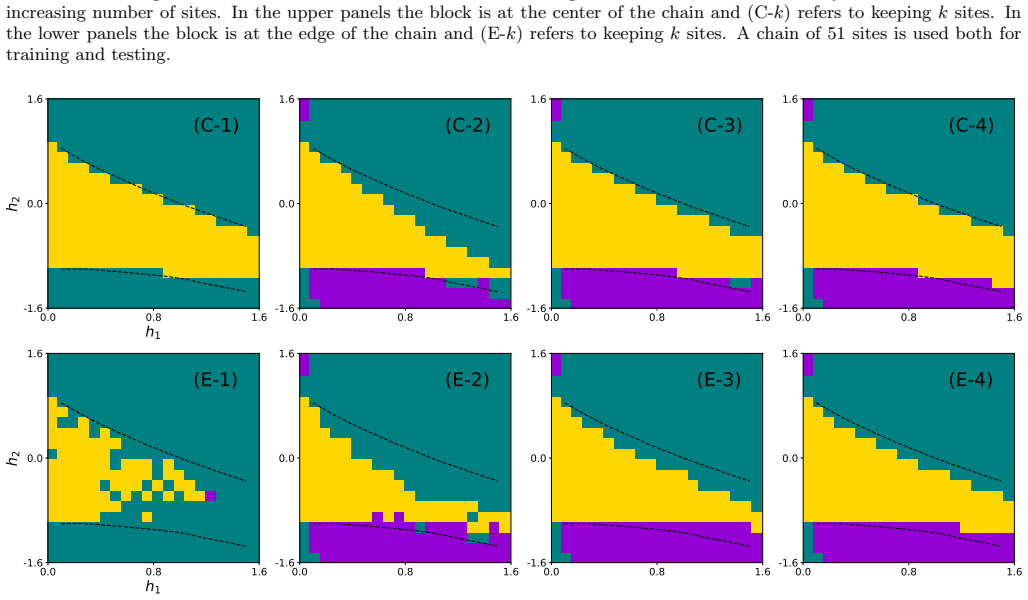
Reduced density matrices of as few as one to four sites retain the signatures needed to classify all phases—including the symmetry-protected topological phases—of the generalized cluster-Ising spin-1/2 chain and the anisotropic Haldane spin-1 chain when those matrices are used as a quantum kernel for a classical support-vector machine. The classifier trained on chains of length 31 generalizes without retraining to chains of length 51.
What carries the argument
The quantum kernel K(x_n, x_m) = Tr[ρ_A(x_n) ρ_A(x_m)], built from the reduced density matrices of a small contiguous block A; this kernel is the sole input to a classical multi-class SVM that learns the decision boundaries separating the phases.
Load-bearing premise
The phase labels used for supervised training must already be correct, because they are taken from earlier infinite-size calculations rather than being discovered by the method itself.
What would settle it
Recompute the same local kernels on the same two models but deliberately mis-label a subset of the training points that lie deep inside each phase; if test accuracy remains high against the published diagrams, the method is merely reproducing the geometry of the training labels rather than recognizing phases.
If this is right
- Phase identification of SPT and other topological phases becomes possible with only local experimental access to a few contiguous sites.
- The same trained classifier can be reused on longer chains without recomputing global ground states or string order parameters.
- Kernel entries can be estimated by swap tests, single-triplet measurements, classical shadows or small-scale tomography, all of which are within reach of present-day hardware.
- Once the SVM coefficients are known, the decision observable itself can be rewritten as a short Pauli string that is measured directly on the subsystem.
Where Pith is reading between the lines
- If the local-kernel method continues to work for two-dimensional or higher-order topological phases, full-system string-order measurements may become unnecessary for routine phase classification.
- The rapid size-convergence of the reduced density matrix suggests that training data can be generated cheaply on small systems and then deployed on experimentally relevant lengths.
- The success with a single central site for the Haldane phase implies that the space of one-site density matrices already separates the topological region from its neighbors by exclusion.
Editorial analysis
A structured set of objections, weighed in public.
Referee Report
Summary. The paper proposes a supervised SVM classifier that uses a quantum kernel K(x_n, x_m) = Tr[ρ_A(x_n) ρ_A(x_m)] built from reduced density matrices of small contiguous blocks A (N_A = 1–4 sites) extracted from MPS ground states. It is applied to reconstruct the known phase diagrams of the generalized cluster-Ising spin-1/2 chain and the anisotropic Haldane spin-1 chain, both of which contain SPT phases. High classification accuracy is reported when A is placed at the center (and, with larger N_A, at the edge), and the classifier trained on L = 31 chains generalizes to L = 51 chains. The authors conclude that local RDMs already encode enough information to identify global topological phases once phase labels are supplied.
Significance. If the numerical evidence holds, the result is practically useful: it shows that experimentally accessible local tomography or swap-test kernels can replace non-local string-order measurements for phase identification in 1-D SPT systems. The size-generalization property (training on moderate L, testing on longer L) further lowers the computational and experimental overhead. Strengths include the transparent kernel construction (Eq. 2), the use of standard MPS libraries with stated bond dimensions, and the clear visual and quantitative benchmarks (Figs. 3–7) on two well-studied models. The work does not claim unsupervised discovery; its contribution is the demonstration that local kernels suffice for supervised classification of topological diagrams.
major comments (2)
- [Section II, Figs. 2–6] Section II and Figs. 2–6: the training labels are taken from previously published infinite-size DMRG/MPS phase boundaries (Refs. [23, 38, 58]). While this is not circular for a supervised method, the manuscript never quantifies how sensitive the reported accuracies (Fig. 7) are to small shifts or uncertainties in those external boundaries. A short robustness check—e.g., randomly flipping a few percent of training labels near the critical lines—would strengthen the claim that the local kernel truly separates the phases rather than merely interpolating the supplied geometry.
- [Section III.C, Fig. 7] Section III.C and Fig. 7: accuracy is reported as a single number per N_A without error bars, cross-validation folds, or variation over different random draws of the training set. Because the number and precise locations of the colored training points in Fig. 2 are not specified beyond “randomly chosen,” it is impossible to assess statistical reliability or reproducibility of the high-accuracy claims (especially the single-site SPT recognition).
minor comments (4)
- [Throughout] Several typos appear in the text: “dge of che chain” (p. 7), “N´ eel” accents, “T=0 properties” (p. 3), and “support vector machines with quantum kernels” header capitalization. A careful proof-reading pass is needed.
- [Section II, Fig. 1] Fig. 1 caption and surrounding text: the mixed-canonical MPS construction is standard, yet the precise truncation of the bond index γ to χ is mentioned only in passing; a one-sentence statement of the discarded weight would help readers judge the quality of the ρ_A used for the kernels.
- [Section II] The experimental estimation routes (swap test, shadows, tomography) are listed but never quantified; even a rough shot-count estimate for N_A = 4 would make the “efficiently estimated experimentally” claim more concrete.
- [Figs. 5–6] In the Haldane-model panels the color scale for the three Néel phases is hard to distinguish in grayscale printouts; a different marker style or hatching would improve accessibility.
Circularity Check
No definitional or fitted circularity; supervised local-kernel SVM reproduces externally labeled phase diagrams without reducing claims to inputs by construction.
full rationale
The paper's central derivation is a standard supervised pipeline: MPS ground states of the GCI and anisotropic Haldane Hamiltonians yield reduced density matrices ho_A of 1–4 sites; the quantum kernel K(x_n,x_m)=Tr[ ho_A(x_n) ho_A(x_m)] is fed to a classical SVM (C=1 default) whose training labels are taken from previously published infinite-size DMRG/MPS phase diagrams (Refs. [23,38,58] and Fig. 2). Test accuracy is then measured against a regular grid of the same external labels (Figs. 3–7). Nothing in Eqs. (2)–(6) or the optimization (4) forces the decision boundaries by definition or by a fit that is later re-labeled a prediction; the kernel is an independent similarity measure on local RDMs, and size generalization (L=31 train o L=51 test) follows from rapid convergence of ho_A, which is an empirical observation rather than a tautology. Self-citations to the authors’ prior ML works ([34,47]) appear only as additional confirmations of the known diagrams and are not load-bearing for the local-kernel claim. The supervised character is openly stated in the conclusions and does not constitute circularity under the stated criteria. Score 1 reflects only the mild, non-load-bearing use of the authors’ own earlier classifications as supporting literature.
Axiom & Free-Parameter Ledger
free parameters (3)
- SVM regularization C =
1
- MPS bond dimension χ =
150 / 50
- Number and placement of training points
axioms (4)
- domain assumption Ground states of the two Hamiltonians are accurately represented by finite-bond MPS in the mixed-canonical form.
- domain assumption The phase diagrams of the GCI and anisotropic Haldane models are those previously obtained by infinite-size DMRG/MPS (Figs. 2a,b).
- standard math The representer theorem allows the SVM weight operator W to be expanded solely in the training RDMs, yielding a convex dual problem whose solution depends only on the kernel matrix.
- domain assumption Reduced density matrices of fixed block size NA converge rapidly with total chain length L, so that a classifier trained at L=31 remains valid at L=51.
read the original abstract
Characterizing quantum topological phases requires measuring non-local string order parameters, demanding access to the full system, which is often experimentally unfeasible. In this work, we introduce a data-efficient supervised learning framework that circumvents this limitation by recognizing quantum phases from small subsystems. Our protocol utilizes a quantum kernel constructed from the reduced density matrices of these subsystems, which can be efficiently estimated experimentally. We benchmark our framework with the classification of the phase diagrams of two spin models on one-dimensional lattices, namely the generalized cluster-Ising spin-1/2 chain and the anisotropic Haldane spin-1 chain. Remarkably, our approach achieves high accuracy in phase classification when operations are limited to as few as one to four sites, and it also generalizes to longer chains even when trained on moderate system sizes. These findings demonstrate that local reduced density matrices preserve vital signatures of global topological phases, offering a practical route to characterize rich phase diagrams of quantum many-body systems.
Figures




Reference graph
Works this paper leans on
-
[1]
Sachdev, Quantum phase transitions, Physics world12, 33 (1999)
S. Sachdev, Quantum phase transitions, Physics world12, 33 (1999)
1999
-
[2]
Vojta, Quantum phase transitions, Reports on Progress in Physics66, 2069 (2003)
M. Vojta, Quantum phase transitions, Reports on Progress in Physics66, 2069 (2003)
2069
-
[3]
Mendes-Santos, G
T. Mendes-Santos, G. Giudici, M. Dalmonte, and M. Rajabpour, Entanglement hamiltonian of quantum critical chains and conformal field theories, Physical Review B100, 155122 (2019)
2019
-
[4]
Calabrese and A
P. Calabrese and A. Lefevre, Entanglement spectrum in one-dimensional systems, Physical Review A—Atomic, Molecular, and Optical Physics78, 032329 (2008)
2008
-
[5]
Calabrese and J
P. Calabrese and J. Cardy, Entanglement entropy and quantum field theory, Journal of statistical mechanics: theory and experiment2004, P06002 (2004)
2004
-
[6]
Calabrese, J
P. Calabrese, J. Cardy, and B. Doyon, Entanglement entropy in extended quantum systems, J. Phys. A42, 500301 (2009)
2009
-
[7]
Bayat, P
A. Bayat, P. Sodano, and S. Bose, Negativity as the entanglement measure to probe the kondo regime in the spin-chain kondo model, Physical Review B—Condensed Matter and Materials Physics81, 064429 (2010)
2010
-
[8]
R. A. Santos, V. Korepin, and S. Bose, Negativity for two blocks in the one-dimensional spin-1 affleck-kennedy-lieb-tasaki model, Physical Review A—Atomic, Molecular, and Optical Physics84, 062307 (2011)
2011
-
[9]
Calabrese, J
P. Calabrese, J. Cardy, and E. Tonni, Entanglement negativity in quantum field theory, Physical review letters109, 130502 (2012)
2012
-
[10]
Ruggiero, V
P. Ruggiero, V. Alba, and P. Calabrese, Negativity spectrum of one-dimensional conformal field theories, Physical Review B94, 195121 (2016)
2016
-
[11]
W. Chen, K. Hida, and B. Sanctuary, Ground-state phase diagram of s= 1 xxz chains with uniaxial single-ion-type anisotropy, Physical Review B67, 104401 (2003)
2003
-
[12]
Langari, F
A. Langari, F. Pollmann, and M. Siahatgar, Ground-state fidelity of the spin-1 heisenberg chain with single ion anisotropy: quantum renormalization group and exact diagonalization approaches, Journal of Physics: Condensed Matter25, 406002 (2013)
2013
-
[13]
Ejima and H
S. Ejima and H. Fehske, Comparative density-matrix renormalization group study of symmetry-protected topological phases in spin-1 chain and bose-hubbard models, Physical Review B91, 045121 (2015)
2015
-
[14]
X.-J. Yu and W.-L. Li, Quantum phase transition between topologically distinct quantum critical points, arXiv preprint arXiv:2403.03716 (2024)
Pith/arXiv arXiv 2024
-
[15]
N. U. K¨ oyl¨ uo˘ glu, S. Majumder, M. Amico, S. Mostame, E. van den Berg, M. Rajabpour, Z. Minev, and K. Najafi, Measuring central charge on a universal quantum processor, Nature Communications (2026)
2026
-
[16]
A. F. Albuquerque, C. J. Hamer, and J. Oitmaa, Quantum phase diagram and excitations for the one-dimensional s= 1 heisenberg antiferromagnet with single-ion anisotropy, Physical Review B—Condensed Matter and Materials Physics79, 054412 (2009)
2009
-
[17]
Smacchia, L
P. Smacchia, L. Amico, P. Facchi, R. Fazio, G. Florio, S. Pascazio, and V. Vedral, Statistical mechanics of the cluster ising model, Physical Review A—Atomic, Molecular, and Optical Physics84, 022304 (2011)
2011
-
[18]
W. Son, L. Amico, R. Fazio, A. Hamma, S. Pascazio, and V. Vedral, Quantum phase transition between cluster and antiferromagnetic states, Europhysics Letters95, 50001 (2011)
2011
-
[19]
P´ erez-Garc´ ıa, M
D. P´ erez-Garc´ ıa, M. M. Wolf, M. Sanz, F. Verstraete, and J. I. Cirac, String order and symmetries in quantum spin lattices, Physical review letters100, 167202 (2008)
2008
-
[20]
Pollmann, A
F. Pollmann, A. M. Turner, E. Berg, and M. Oshikawa, Entanglement spectrum of a topological phase in one dimension, Physical Review B—Condensed Matter and Materials Physics81, 064439 (2010)
2010
-
[21]
T. Ohta, S. Tanaka, I. Danshita, and K. Totsuka, Topological and dynamical properties of a generalized cluster model in one dimension, Physical Review B93, 165423 (2016)
2016
-
[22]
T. Ohta, S. Tanaka, I. Danshita, and K. Totsuka, Phase diagram and sweep dynamics of a one-dimensional generalized cluster model, Journal of the Physical Society of Japan84, 063001 (2015)
2015
-
[23]
Tzeng, H
Y.-C. Tzeng, H. Onishi, T. Okubo, and Y.-J. Kao, Quantum phase transitions driven by rhombic-type single-ion anisotropy in thes= 1 haldane chain, Phys. Rev. B96, 060404 (2017)
2017
-
[24]
Tzeng and M.-F
Y.-C. Tzeng and M.-F. Yang, Scaling properties of fidelity in the spin-1 anisotropic model, Physical Review A—Atomic, Molecular, and Optical Physics77, 012311 (2008). 10
2008
-
[25]
D.-L. Deng, X. Li, and S. Das Sarma, Machine learning topological states, Phys. Rev. B96, 195145 (2017)
2017
-
[26]
Lian, S.-T
W. Lian, S.-T. Wang, S. Lu, Y. Huang, F. Wang, X. Yuan, W. Zhang, X. Ouyang, X. Wang, X. Huang, L. He, X. Chang, D.-L. Deng, and L. Duan, Machine learning topological phases with a solid-state quantum simulator, Phys. Rev. Lett.122, 210503 (2019)
2019
-
[27]
Zhang, S
H. Zhang, S. Jiang, X. Wang, W. Zhang, X. Huang, X. Ouyang, Y. Yu, Y. Liu, D.-L. Deng, and L.-M. Duan, Experimental demonstration of adversarial examples in learning topological phases, Nature communications13, 4993 (2022)
2022
-
[28]
Zhang, W
X. Zhang, W. Jiang, J. Deng, K. Wang, J. Chen, P. Zhang, W. Ren, H. Dong, S. Xu, Y. Gao,et al., Digital quantum simulation of floquet symmetry-protected topological phases, Nature607, 468 (2022)
2022
-
[29]
Xiang, W
L. Xiang, W. Jiang, Z. Bao, Z. Song, S. Xu, K. Wang, J. Chen, F. Jin, X. Zhu, Z. Zhu,et al., Long-lived topological time-crystalline order on a quantum processor, Nature Communications15, 8963 (2024)
2024
-
[30]
Carrasquilla and R
J. Carrasquilla and R. G. Melko, Machine learning phases of matter, Nature Physics13, 431 (2017)
2017
-
[31]
Cristianini and J
N. Cristianini and J. Shawe-Taylor,An Introduction to Support Vector Machines and Other Kernel-based Learning Methods (Cambridge University Press, 2000)
2000
-
[32]
M. Schuld, Supervised quantum machine learning models are kernel methods, arXiv preprint arXiv:2101.11020 (2021)
Pith/arXiv arXiv 2021
-
[33]
Huang, R
H.-Y. Huang, R. Kueng, G. Torlai, V. V. Albert, and J. Preskill, Provably efficient machine learning for quantum many- body problems, Science377, eabk3333 (2022)
2022
-
[34]
M. Khosrojerdi, A. Cuccoli, P. Verrucchi, and L. Banchi, Unsupervised learning to recognize quantum phases of matter, arXiv preprint arXiv:2510.14742 (2025)
arXiv 2025
-
[35]
Y.-D. Wu, Y. Zhu, Y. Wang, and G. Chiribella, Learning quantum properties from short-range correlations using multi-task networks, Nature Communications15, 8796 (2024)
2024
-
[36]
Y. Du, Y. Zhu, Y.-H. Zhang, M.-H. Hsieh, P. Rebentrost, W. Gao, Y.-D. Wu, J. Eisert, G. Chiribella, D. Tao,et al., Artificial intelligence for representing and characterizing quantum systems, arXiv preprint arXiv:2509.04923 (2025)
Pith/arXiv arXiv 2025
-
[37]
Y.-D. Wu, Y. Zhu, G. Chiribella, and N. Liu, Efficient learning of continuous-variable quantum states, Phys. Rev. Res.6, 033280 (2024)
2024
-
[38]
I. Cong, S. Choi, and M. D. Lukin, Quantum convolutional neural networks, Nature Physics15, 1273 (2019)
2019
-
[39]
Q. Li, Y. Huang, X. Hou, Y. Li, X. Wang, and A. Bayat, Ensemble-learning error mitigation for variational quantum shallow-circuit classifiers, Physical Review Research6, 013027 (2024)
2024
-
[40]
Lazzarin, D
M. Lazzarin, D. E. Galli, and E. Prati, Multi-class quantum classifiers with tensor network circuits for quantum phase recognition, Physics Letters A434, 128056 (2022)
2022
-
[41]
Gong, H.-L
M. Gong, H.-L. Huang, S. Wang, C. Guo, S. Li, Y. Wu, Q. Zhu, Y. Zhao, S. Guo, H. Qian,et al., Quantum neuronal sensing of quantum many-body states on a 61-qubit programmable superconducting processor, Science Bulletin68, 906 (2023)
2023
-
[42]
Mansuroglu, T
R. Mansuroglu, T. Eckstein, L. N¨ utzel, S. A. Wilkinson, and M. J. Hartmann, Variational hamiltonian simulation for translational invariant systems via classical pre-processing, Quantum Science and Technology8, 025006 (2023)
2023
-
[43]
M. S. Tepaske, D. Hahn, and D. J. Luitz, Optimal compression of quantum many-body time evolution operators into brickwall circuits, SciPost Physics14, 073 (2023)
2023
-
[44]
Mc Keever and M
C. Mc Keever and M. Lubasch, Classically optimized hamiltonian simulation, Physical review research5, 023146 (2023)
2023
-
[45]
Lloyd, M
S. Lloyd, M. Mohseni, and P. Rebentrost, Quantum principal component analysis, Nature physics10, 631 (2014)
2014
-
[46]
Banchi, J
L. Banchi, J. L. Pereira, S. T. Jose, and O. Simeone, Statistical complexity of quantum learning, Advanced Quantum Technologies8, 2300311 (2025)
2025
-
[47]
Khosrojerdi, J
M. Khosrojerdi, J. L. Pereira, A. Cuccoli, and L. Banchi, Learning to classify quantum phases of matter with a few measurements, Quantum Science and Technology10, 025006 (2025)
2025
-
[48]
Parigi, M
M. Parigi, M. Khosrojerdi, F. Caruso, and L. Banchi, Analysis of quantum image representations for supervised classifica- tion, AVS Quantum Science8(2026)
2026
-
[49]
Sancho-Lorente, J
T. Sancho-Lorente, J. Rom´ an-Roche, and D. Zueco, Quantum kernels to learn the phases of quantum matter, Physical Review A105, 042432 (2022)
2022
-
[50]
Y. Wu, B. Wu, J. Wang, and X. Yuan, Quantum phase recognition via quantum kernel methods, Quantum7, 981 (2023)
2023
-
[51]
J. R. McClean, S. Boixo, V. N. Smelyanskiy, R. Babbush, and H. Neven, Barren plateaus in quantum neural network training landscapes, Nature communications9, 4812 (2018)
2018
-
[52]
Banchi, A
L. Banchi, A. Bayat, and S. Bose, Entanglement entropy scaling in solid-state spin arrays via capacitance measurements, Physical Review B94, 241117 (2016)
2016
-
[53]
Huang, R
H.-Y. Huang, R. Kueng, and J. Preskill, Predicting many properties of a quantum system from very few measurements, Nature Physics16, 1050 (2020)
2020
-
[54]
J. Haah, A. W. Harrow, Z. Ji, X. Wu, and N. Yu, Sample-optimal tomography of quantum states, IEEE Transactions on Information Theory63, 5628 (2017)
2017
-
[55]
Schollw¨ ock, The density-matrix renormalization group in the age of matrix product states, Annals of physics326, 96 (2011)
U. Schollw¨ ock, The density-matrix renormalization group in the age of matrix product states, Annals of physics326, 96 (2011)
2011
-
[56]
Gray, quimb: A python package for quantum information and many-body calculations, Journal of Open Source Software 3, 819 (2018)
J. Gray, quimb: A python package for quantum information and many-body calculations, Journal of Open Source Software 3, 819 (2018)
2018
-
[57]
Pollmann and A
F. Pollmann and A. M. Turner, Detection of symmetry-protected topological phases in one dimension, Physical Review B—Condensed Matter and Materials Physics86, 125441 (2012)
2012
-
[58]
A. Sone, A. Tanji, and N. Yamamoto, Quantum inception score, Physical Review Research6, 033198 (2024)
2024
-
[59]
J. Ren, Y. Wang, and W.-L. You, Quantum phase transitions in spin-1 xxz chains with rhombic single-ion anisotropy, Physical Review A97, 042318 (2018). 11
2018
-
[60]
Nico-Katz and S
A. Nico-Katz and S. Bose, Entanglement-complexity geometric measure, Physical Review Research5, 013041 (2023)
2023
-
[61]
Den Nijs and K
M. Den Nijs and K. Rommelse, Preroughening transitions in crystal surfaces and valence-bond phases in quantum spin chains, Physical Review B40, 4709 (1989)
1989
-
[62]
Zauner, D
V. Zauner, D. Draxler, L. Vanderstraeten, J. Haegeman, and F. Verstraete, Symmetry breaking and the geometry of reduced density matrices, New Journal of Physics18, 113033 (2016)
2016
-
[63]
C. L. Henley and H. J. Changlani, Density-matrix based numerical methods for discovering order and correlations in interacting systems, Journal of Statistical Mechanics: Theory and Experiment2014, P11002 (2014)
2014
discussion (0)
Sign in with ORCID, Apple, or X to comment. Anyone can read and Pith papers without signing in.