REVIEW 2 major objections 4 minor 64 references
Pinwheel-shaped bound triplet pairs in the magnetization plateaus of SrCu$_2$(BO$_3$)$_2$
T0 review · 2 major / 4 minor · reviewed 2026-07-14 · grok-4.5
Pith's one-line read NMR spectra of SrCu2(BO3)2 show that its low-field magnetization plateaus are Wigner crystals of pinwheel-shaped spin-2 bound triplet pairs, not ordinary triplets.
desk verdict Solid experimental discrimination: Cu NMR calibrated on the 1/3 plateau selects pinwheel spin-2 crystals over extended triplets for the 1/8 and 2/15 plateaus. read the letter →
The pith
A machine-rendered reading of the paper's core claim, the machinery that carries it, and where it could break.
The reading
What carries the argument
Pinwheel-shaped spin-2 bound triplet pairs: composite objects delocalized over eight dimers whose Wigner-crystal arrangements produce the distinctive intermediate positive and weakly negative spin polarizations seen in the NMR histograms.
What would settle it
A copper NMR spectrum in the 1/8 or 2/15 plateau that recovers the full intensity of the near-zero and weakly positive local-field lines and shows the isolated most-positive field expected for extended triplets, or a re-fit that forces non-physical transferred couplings larger than the on-site term.
Extended reading notes
Core claim
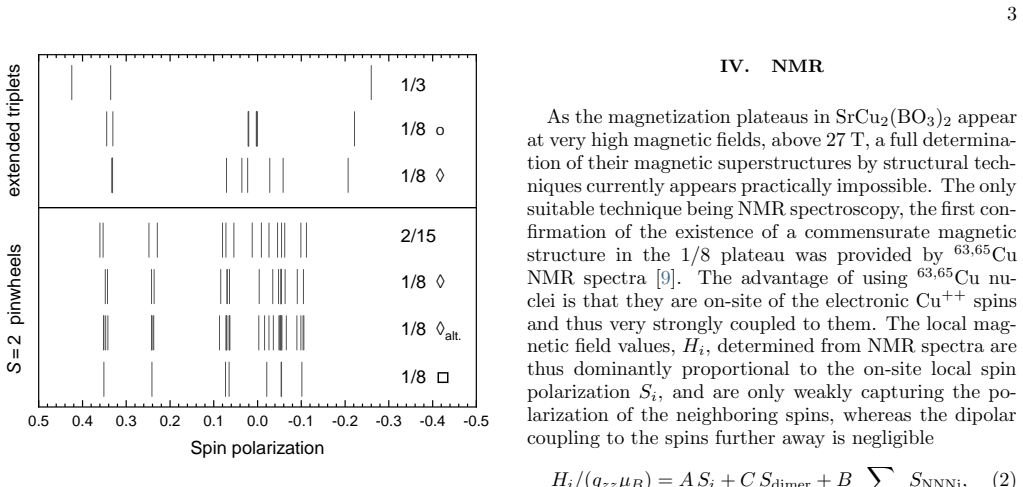
Using 63,65Cu NMR spectra up to 41.9 T and hyperfine couplings constrained by the non-controversial 1/3 plateau, the local-field distributions of the 1/8 and 2/15 plateaus match iPEPS spin polarizations of pinwheel-shaped spin-2 bound states and are incompatible with crystals of extended triplets.
Load-bearing premise
The on-site hyperfine constant fixed in the dense 1/3 plateau at 41.9 T, together with only two adjustable transferred couplings, still correctly maps local fields to spins in the dilute 1/8 and 2/15 plateaus at lower field, and the missing near-zero lines are only a relaxation effect.
Editorial analysis
A structured set of objections, weighed in public.
Referee Report
Summary. The manuscript reports 63,65Cu NMR spectra of SrCu2(BO3)2 up to 41.9 T in the 1/8, 2/15 and 1/3 magnetization plateaus, combined with high-accuracy iPEPS spin structures. From the uncontroversial three-site stripe structure of the 1/3 plateau the authors extract the on-site hyperfine constant A ≈ −20.64 T/μB (and small transferred C, B) via Eq. (2). Transferring this A and fitting only B and C, they show that the measured local-field distributions in the 1/8 and 2/15 plateaus match the histograms of pinwheel-shaped spin-2 bound states and are incompatible with crystals of extended triplets (which force non-physical |B| ≫ |C| and predict an isolated most-positive Hi that is absent experimentally). The work thereby supplies the first real-space experimental confirmation that the low-magnetization plateaus are Wigner crystals of bound triplet pairs rather than ordinary triplon crystals.
Significance. If the interpretation holds, the paper establishes a new fundamental paradigm for magnetization plateaus: crystallization of composite spin-2 bound states rather than elementary triplons or semiclassical collinear configurations. The experimental discrimination rests on a clean calibration of the dominant hyperfine coupling from an uncontroversial plateau and on a direct, falsifiable comparison of local-field histograms; residual free parameters (B, C) cannot invert the class-level distinction. The result is of immediate interest to the frustrated-magnetism and flat-band communities and is supported by state-of-the-art iPEPS data that improve on earlier variational energies.
major comments (2)
- Sec. IV and Fig. 4: the decisive discrimination between pinwheels and extended triplets relies on the assumption that the on-site A fixed at 41.9 T remains field-independent down to 27–29 T, while only the transferred B and C are allowed to vary. The authors themselves note a 12 % discrepancy between Acc(q=0) at 41.9 T and the low-field value, which they attribute to magnetostriction of the transferred terms. A short quantitative estimate of how large a field-induced change in A would have to be to make an extended-triplet structure produce physical B, C (or to spoil the pinwheel fit) would strengthen the claim that the class-level conclusion is robust.
- Sec. IV, Fig. 4(b,c) and SM Table I: several predicted lines near Hi ≈ 0 (and one weakly positive line) are missing and are ascribed to short-T2 wipe-out. While this is plausible for nearly unpolarized spins, the argument is currently qualitative. A brief estimate of the expected T2 contrast, or a statement that the missing intensity cannot be reassigned to a different spin structure without destroying the fit of the observed Hi < 0 lines, would close this residual loophole.
minor comments (4)
- Fig. 2 and SM Fig. S2: the numerical spin-polarization values are given, but a compact table of the grouped/averaged polarizations actually used in the least-squares fits of Fig. 4 would make the comparison fully reproducible without re-digitizing the histograms.
- Eq. (2) and the subsequent fit: the relative signs and magnitudes of B and C obtained for the optimal rhomboid structure (B = −5.07 T/μB, C = 0.21 T/μB) differ markedly from the 1/3-plateau values; a one-sentence physical comment on why the transferred couplings can change so strongly between dense and dilute plateaus would help the reader.
- SM Sec. VI (3D stacking): the ABAB stacking argument for the 1/3 plateau is convincing; a short remark on why analogous inter-plane splittings are not resolved in the dilute 1/8 and 2/15 spectra would complete the discussion.
- Typographical: “MA TERIAL”, “RESUL TS”, “POLARIZA TION” etc. contain spurious spaces; “sextuplets” is used consistently but “sextuplet” would be more standard.
Circularity Check
No significant circularity: iPEPS candidates are independent variational hypotheses; NMR selects among them after hyperfine calibration on the uncontroversial 1/3 structure.
full rationale
The load-bearing chain is: (i) iPEPS variational energies and spin-polarization histograms for competing unit cells (pinwheel S=2 bound states vs extended-triplet crystals) are obtained from the Shastry-Sutherland Hamiltonian (Eq. 1) with J'/J=0.63; (ii) the 1/3-plateau structure is uncontroversial (three distinct polarizations, all methods agree) and supplies experimental Hi values that fix Acc(q=0) and then A,C,B via Eq. 2; (iii) the same A is transferred to the dilute plateaus while B,C are re-optimized; pinwheel histograms reproduce the observed Hi<0 lines with physical |B|,|C|<<|A|, while triplet candidates force non-physical |B|>|C| and predict an isolated most-positive Hi absent from the data. None of these steps is definitional or forced by construction: the spin structures are not fitted to the NMR spectra, the hyperfine constants are not taken from the low-plateau data being tested, and the decisive discrimination is the qualitative failure of one class of candidates. Self-citations (Corboz-Mila 2014 for the bound-state idea; present iPEPS refinements) supply the candidate list but do not close the loop; experiment independently falsifies the triplet class. Residual approximations (field-dependent transferred terms, T2 wipe-out, neglected DM/3D) affect quantitative B,C values but do not invert the class-level selection. Score 1 only for the ordinary presence of author-overlapping citations that are not load-bearing for the confirmation claim.
Assumptions & free parameters
free parameters (4)
- Hyperfine A (on-site) =
−20.64 T/μB
- Transferred hyperfine B and C =
e.g. B ≈ −3.8 to −5.1 T/μB, C ≈ 0.2 to 1.5 T/μB depending on structure
- J′/J =
0.63
- Voigt Lorentzian/Gaussian width ratio =
2.0
assumptions (5)
- domain assumption The material is described by the 2D Shastry-Sutherland Heisenberg model (Eq. 1) with small DM and interlayer terms that can be neglected for the spin textures of interest.
- domain assumption iPEPS with the reported unit cells and bond dimensions yields sufficiently accurate local spin polarizations to discriminate pinwheel vs extended-triplet classes.
- domain assumption Local field Hi is linear in on-site and near-neighbor spins via Eq. (2) with |A| ≫ |C| > |B|.
- domain assumption The 1/3 plateau is a crystal of extended triplets with three distinct spin values (stripe structure).
- ad hoc to paper Missing intensity near Hi ≈ 0 (and one positive line) is caused by short T2 wipe-out, not by absence of those spin values.
invented entities (1)
-
Pinwheel-shaped spin-2 bound triplet pairs (as crystallizing objects)
independent evidence
Cite this review
Pith. "Pith review of Pinwheel-shaped bound triplet pairs in the magnetization plateaus of SrCu$_2$(BO$_3$)$_2$." pith.science (2026). https://pith.science/paper/ZXQ5EHCY
@misc{pith2026260710877,
  author       = {Pith},
  title        = {Pith review of: Pinwheel-shaped bound triplet pairs in the magnetization plateaus of SrCu$_2$(BO$_3$)$_2$},
  year         = {2026},
  howpublished = {\url{https://pith.science/paper/ZXQ5EHCY}},
  note         = {Machine review of arXiv:2607.10877}
}
abstract
The sequence of magnetization plateaus at 1/8, 2/15, 1/6, 1/4, 1/3, 2/5, and 1/2 of the saturation observed in SrCu$_2$(BO$_3$)$_2$ remained a puzzle until tensor-networks-based numerical simulations suggested that the low-magnetization plateaus are stabilized as Wigner crystals of spin-2 bound states, and not as one of the standard configurations (semiclassical up-down, or crystals of triplets). We report on $^{63,65}$Cu nuclear magnetic resonance spectra up to 41.9 T: Based on constraints deduced from the 1/3 plateau, we show that the spectra in the 1/8 and 2/15 plateaus indeed agree with the prediction for the spin-2 bound states, while being incompatible with a crystal of triplets. This adds the formation of Wigner crystals of bound states as an alternative fundamental paradigm in the theory of magnetization plateaus.
Figures


Figures from the paper (1 more)

Reference graph
Works this paper leans on
-
[1]
Takigawa and F
M. Takigawa and F. Mila, Magnetization Plateaus, in Introduction to Frustrated Magnetism, Springer Series in Solid-State Sciences, Vol. 164, Eds.: C. Lacroix, P. Mendels, F. Mila, (Springer-Verlag Berlin Heidelberg, 2011), p. 241
2011
-
[2]
Nishimori and S
H. Nishimori and S. Miyashita, Magnetization Process of the Spin-1/2 Antiferromagnetic Ising-Like Heisenberg Model on the Triangular Lattice, J. Phys. Soc. Jpn.55, 7 4448 (1986)
1986
-
[3]
A. V. Chubukov and D. I. Golosov, Quantum theory of an antiferromagnet on a triangular lattice in a magnetic field, J. Phys.: Condens. Matter3, 69 (1991)
1991
-
[4]
Mila, Ladders in a magnetic field: a strong coupling approach, Eur
F. Mila, Ladders in a magnetic field: a strong coupling approach, Eur. Phys. J. B6, 201 (1998)
1998
-
[5]
Okazaki, J
N. Okazaki, J. Miyoshi, and T. Sakai, Magnetization Plateau in the Frustrated Spin Ladder, J. Phys. Soc. Jpn. 69, 37 (2000)
2000
-
[6]
Sriram Shastry and Bill Sutherland, Exact ground state of a quantum mechanical antiferromagnet, Physica B+C108, 1069 (1981)
B. Sriram Shastry and Bill Sutherland, Exact ground state of a quantum mechanical antiferromagnet, Physica B+C108, 1069 (1981)
1981
-
[7]
Kageyama, K
H. Kageyama, K. Yoshimura, R. Stern, N. V. Mushnikov, K. Onizuka, M. Kato, K. Kosuge, C. P. Slichter, T. Goto, and Y. Ueda, Exact Dimer Ground State and Quan- tized Magnetization Plateaus in the Two-Dimensional Spin System SrCu 2(BO3)2, Phys. Rev. Lett.82, 3168 (1999)
1999
-
[8]
Onizuka, H
K. Onizuka, H. Kageyama, Y. Narumi, K. Kindo, Y. Ueda, and T. Goto, 1/3 magnetization plateau in SrCu2(BO3)2 - stripe order of excited triplets, J. Phys. Soc. Jpn.69, 1016 (2000)
2000
Show all 64 references
-
[9]
Kodama, M
K. Kodama, M. Takigawa, M. Horvati´ c, C. Berthier, H. Kageyama, Y. Ueda, S. Miyahara, F. Becca, F. Mila, Magnetic Superstructure in the Two-Dimensional Quan- tum Antiferromagnet SrCu 2(BO3)2, Science298, 395 (2002)
2002
-
[10]
Schulenburg, A
J. Schulenburg, A. Honecker, J. Schnack, J. Richter, and H.-J. Schmidt, Macroscopic Magnetization Jumps due to Independent Magnons in Frustrated Quantum Spin Lat- tices, Phys. Rev. Lett.88, 167207 (2002)
2002
-
[11]
Capponi, O
S. Capponi, O. Derzhko, A. Honecker, A. M. L¨ auchli, and J. Richter, Numerical study of magnetization plateaus in the spin- 1 2 kagome Heisenberg antiferromagnet, Phys. Rev. B88, 144416 (2013)
2013
-
[12]
Nishimoto, N
S. Nishimoto, N. Shibata, and C. Hotta, Controlling frustrated liquids and solids with an applied field in a kagome Heisenberg antiferromagnet, Nat. Commun.4, 2287 (2013)
2013
-
[13]
He, S.-L
L.-W. He, S.-L. Yu, and J.-X. Li, Variational Monte Carlo Study of the 1/9-Magnetization Plateau in Kagome An- tiferromagnets, Phys. Rev. Lett.133, 096501 (2024)
2024
-
[14]
Takigawa, M
M. Takigawa, M. Horvati´ c, T. Waki, S. Kr¨ amer, C. Berthier, F. L´ evy-Bertrand, I. Sheikin, H. Kageyama, Y. Ueda, F. Mila, Incomplete devil’s staircase in the mag- netization curve of SrCu 2(BO3)2, Phys. Rev. Lett.110, 067210 (2013)
2013
-
[16]
Jordan, R
J. Jordan, R. Or´ us, G. Vidal, F. Verstraete, and J. I. Cirac, Classical Simulation of Infinite-Size Quantum Lat- tice Systems in Two Spatial Dimensions, Phys. Rev. Lett. 101, 250602 (2008)
2008
-
[17]
Jaime, R
M. Jaime, R. Daou, S. A. Crooker, F. Weickert, A. Uchida, A. E. Feiguin, C. D. Batista, H. A. Dabkowska, and B. D. Gaulin, Magnetostriction and magnetic texture to 100.75 Tesla in frustrated SrCu 2(BO3)2, Natl. Acad. Sci. U.S.A.109, 12404 (2012)
2012
-
[18]
Y. H. Matsuda, N. Abe, S. Takeyama, H. Kageyama, P. Corboz, A. Honecker, S. R. Manmana, G. R. Foltin, K. P. Schmidt, and F. Mila, Magnetization of SrCu 2(BO3)2 in Ultrahigh Magnetic Fields up to 118 T, Phys. Rev. Lett.111, 137204 (2013)
2013
-
[19]
Z. Shi, S. Dissanayake, P. Corboz, W. Steinhardt, D. Graf, D. M. Silevitch, H. A. Dabkowska, T. F. Rosenbaum, F. Mila, and S. Haravifard, Discovery of quantum phases in the Shastry-Sutherland compound SrCu2(BO3)2 under extreme conditions of field and pres- sure, Nat Commun13, 1 (2022)
2022
-
[20]
Momoi and K
T. Momoi and K. Totsuka, Magnetization plateaus of the Shastry-Sutherland model for SrCu 2(BO3)2: Spin- density wave, supersolid, and bound states, Phys. Rev. B62, 15067 (2000)
2000
-
[21]
Philippe Corboz and Fr´ ed´ eric Mila, Crystals of Bound States in the Magnetization Plateaus of the Shastry- Sutherland Model, Phys. Rev. Lett.112, 147203 (2014)
2014
-
[22]
Smith and Douglas A
Robert W. Smith and Douglas A. Keszler, Syn- thesis, structure, and properties of the orthoborate SrCu2(BO3)2, J. Solid State Chem.93, 430 (1991)
1991
-
[23]
Miyahara and K
S. Miyahara and K. Ueda, Theory of the orthogonal dimer Heisenberg spin model for SrCu 2(BO3)2, J. Phys.: Condens. Matter15, R327 (2003)
2003
-
[24]
Nomura, P
T. Nomura, P. Corboz, A. Miyata, S. Zherlitsyn, Y. Ishii, Y. Kohama, Y. H. Matsuda, A. Ikeda, C. Zhong, H. Kageyama, and F. Mila, Unveiling new quantum phases in the Shastry-Sutherland compound SrCu2(BO3)2 up to the saturation magnetic field, Nat. Commun.14, 3769 (2023)
2023
-
[25]
Kodama, S
K. Kodama, S. Miyahara, M. Takigawa, M. Horvati´ c, C. Berthier, F. Mila, H. Kageyama, and Y. Ueda, Field- Induced Effects of Anisotropic Magnetic Interactions in SrCu2(BO3)2, J. Phys.: Condens. Matter17, L61 (2005)
2005
-
[26]
Miyahara and K
S. Miyahara and K. Ueda, Exact Dimer Ground State of the Two Dimensional Heisenberg Spin System SrCu2(BO3)2, Phys. Rev. Lett.82, 3701 (1999)
1999
-
[27]
Kageyama, M
H. Kageyama, M. Nishi, N. Aso, K. Onizuka, T. Yosi- hama, K. Nukui, K. Kodama, K. Kakurai, and Y. Ueda, Direct Evidence for the Localized Single-Triplet Exci- tations and the Dispersive Multitriplet Excitations in SrCu2(BO3)2, Phys. Rev. Lett.84, 5876 (2000)
2000
-
[28]
Koga and N
A. Koga and N. Kawakami, Quantum Phase Transitions in the Shastry-Sutherland Model for SrCu2(BO3)2, Phys. Rev. Lett.84, 4461 (2000)
2000
-
[29]
Corboz and F
P. Corboz and F. Mila, Tensor network study of the Shastry-Sutherland model in zero magnetic field, Phys. Rev. B87, 115144 (2013)
2013
-
[30]
T. Waki, K. Arai, M. Takigawa, Y. Saiga, Y. Uwatoko, H. Kageyama, and Y. Ueda, A Novel Ordered Phase in SrCu2(BO3)2 under High Pressure, J. Phys. Soc. Jpn. 76, 073710 (2007)
2007
-
[31]
Haravifard, A
S. Haravifard, A. Banerjee, J. van Wezel, D. M. Silevitch, A. M. dos Santos, J. C. Lang, E. Kermarrec, G. Srajer, B. D. Gaulin, J. J. Molaison, H. A. Dabkowska, and T. F. Rosenbaum, Emergence of long-range order in sheets of magnetic dimers, PNAS111, 14372 (2014)
2014
-
[32]
M. E. Zayed, Ch. R¨ uegg, J. Larrea J., A. M. L¨ auchli, C. Panagopoulos, S. S. Saxena, M. Ellerby, D. F. McMor- row, Th. Str¨ assle, S. Klotz, G. Hamel, R. A. Sadykov, V. Pomjakushin, M. Boehm, M. Jim´ enez–Ruiz, A. Schnei- dewind, E. Pomjakushina, M. Stingaciu, K. Conder, an...
2017
-
[33]
Sakurai, Y
T. Sakurai, Y. Hirao, K. Hijii, S. Okubo, H. Ohta, Y. Uwatoko, K. Kudo, and Y. Koike, Direct Observation of the Quantum Phase Transition of SrCu 2(BO3)2 by High-Pressure and Terahertz Electron Spin Resonance, 8 J. Phys. Soc. Jpn.87, 033701 (2018)
2018
-
[34]
J. Guo, G. Sun, B. Zhao, L. Wang, W. Hong, V. A. Sidorov, N. Ma, Q. Wu, S. Li, Z. Y. Meng, A. W. Sand- vik, and L. Sun, Quantum Phases of SrCu 2(BO3)2 from High-Pressure Thermodynamics, Phys. Rev. Lett.124, 206602 (2020)
2020
-
[35]
Larrea Jim´ enez, S
J. Larrea Jim´ enez, S. P. G. Crone, E. Fogh, M. E. Zayed, R. Lortz, E. Pomjakushina, K. Conder, A. M. L¨ auchli, L. Weber, S. Wessel, A. Honecker, B. Normand, Ch. R¨ uegg, P. Corboz, H. M. Rønnow, and F. Mila , A quantum magnetic analogue to the critical point of water, Natur...
2021
-
[36]
Supplementary Materials
-
[37]
Hai-Jun Liao, Jin-Guo Liu, Lei Wang, and Tao Xi- ang, Differentiable Programming Tensor Networks. Phys. Rev. X9, 031041 (2019)
2019
-
[38]
Philippe Corboz, Variational optimization with infinite projected entangled-pair states, Phys. Rev. B94, 035133 (2016)
2016
-
[39]
Nojiri, H
H. Nojiri, H. Kageyama, K. Onizuka, Y. Ueda, M. Motokawa, Direct Observation of the Multiple Spin Gap Excitations in Two-Dimensional Dimer System SrCu2(BO3)2, J. Phys. Soc. Jpn.68, 2906 (1999)
1999
-
[40]
Takigawa, S
M. Takigawa, S. Matsubara, M. Horvati´ c, C. Berthier, H. Kageyama, and Y. Ueda, NMR Evidence for the Per- sistence of a Spin Superlattice Beyond the 1/8 Magne- tization Plateau in SrCu 2(BO3)2, Phys. Rev. Lett.101, 037202 (2008)
2008
-
[41]
Takigawa, T
M. Takigawa, T. Waki, M. Horvati´ c, C. Berthier, Novel Ordered Phases in the Orthogonal Dimer Spin System SrCu2(BO3)2, J. Phys. Soc. Jpn.79, 011005 (2010)
2010
-
[42]
Pugnat, R
P. Pugnat, R. Barbier, F. Debray, C. Grandcl´ ement, S. Kr¨ amer, F. Molini´ e, R. Pfister, L. Ronayette, B. Vincent, Ch. Simon, The Grenoble Hybrid Magnet: From Com- missioning to First Operation up to 42 T, IEEE Trans. Appl. Supercond.36, 4300407 (2026)
2026
-
[43]
Yanan Li, Hadrien Mayaffre, Florian B¨ artl, Steffen Kr¨ amer, Mladen Horvati´ c, Automated frequency tuning for broadband NMR spectroscopy: A LabVIEW-based solution, J. Mag. Reson.384, 108020 (2026)
2026
-
[44]
Abragam,Principles of Nuclear Magnetism(Claren- don Press, Oxford, UK, 1961)
A. Abragam,Principles of Nuclear Magnetism(Claren- don Press, Oxford, UK, 1961)
1961
-
[45]
Kodama, J
K. Kodama, J. Yamazaki, M. Takigawa, H. Kageyama, K. Onizuka and Y. Ueda, Cu nuclear spin-spin coupling in the dimer singlet state in SrCu2(BO3)2, J. Phys.: Con- dens. Matter14, L319 (2002)
2002
-
[46]
Fagot-Revurat, M
Y. Fagot-Revurat, M. Horvati´ c, C. Berthier, P. S´ egransan, G. Dhalenne and A. Revcolevschi, 63,65Cu NMR investigation of CuGeO 3 single crystals: The uni- form and the dimerized spin-Peierls phase, Phys. Rev. B 55, 2964 (1997)
1997
-
[47]
Corboz, Y
P. Corboz, Y. Zhang, B. Ponsioen, and F. Mila, Quan- tum Spin Liquid Phase in the Shastry-Sutherland Model Revealed by High-Precision Infinite Projected Entangled- Pair States, Phys. Rev. Lett.136, 186701 (2026)
2026
-
[48]
Ghosh, T
P. Ghosh, T. M¨ uller, and R. Thomale, Another exact ground state of a two-dimensional quantum antiferro- magnet, Phys. Rev. B105, L180412 (2022)
2022
-
[49]
Ghosh, J
P. Ghosh, J. Seufert, T. M¨ uller, F. Mila, and R. Thomale, Maple leaf antiferromagnet in a magnetic field, Phys. Rev. B108, L060406 (2023)
2023
-
[50]
wiped-out
E. Fogh, M. Nayak, O. Prokhnenko, M. Bartkowiak, K. Munakata, J.-R. Soh, A. A. Turrini, M. E. Zayed, E. Pomjakushina, H. Kageyama, H. Nojiri, K. Kakurai, B. Normand, F. Mila and H. M. Rønnow, A Field-induced bound-state condensation and spin-nematic phase in SrCu2(BO3)2 reveal...
2024
-
[51]
Verstraete and J
F. Verstraete and J. I Cirac, Renormalization algorithms for Quantum-Many Body Systems in two and higher dimensions, arXiv:cond-mat/0407066 (2004)
2004 arXiv
-
[52]
Jordan, R
J. Jordan, R. Or´ us, G. Vidal, F. Verstraete, and J. I. Cirac, Classical Simulation of Infinite-Size Quantum Lattice Systems in Two Spatial Dimensions, Phys. Rev. Lett.101, 250602 (2008)
2008
-
[53]
Corboz, S
P. Corboz, S. R. White, G. Vidal, and M. Troyer, Stripes in the two-dimensionalt-Jmodel with infinite projected entangled-pair states, Phys. Rev. B84, 041108(R) (2011)
2011
-
[54]
Corboz, T
P. Corboz, T. M. Rice, and M. Troyer, Competing States in thet-JModel: Uniform d-Wave State versus Stripe State, Phys. Rev. Lett.113, 046402 (2014)
2014
-
[55]
Nishino and K
T. Nishino and K. Okunishi, Corner Transfer Matrix Renormalization Group Method, J. Phys. Soc. Jpn.65, 891 (1996)
1996
-
[56]
Or´ us and G
R. Or´ us and G. Vidal, Simulation of two-dimensional quantum systems on an infinite lattice revisited: Corner transfer matrix for tensor contraction, Phys. Rev. B80, 094403 (2009)
2009
-
[57]
Singh, R
S. Singh, R. N. C. Pfeifer, and G. Vidal, Tensor network states and algorithms in the presence of a global U(1) symmetry, Phys. Rev. B83, 115125 (2011)
2011
-
[58]
Bauer, P
B. Bauer, P. Corboz, R. Or´ us, and M. Troyer, Implementing global abelian symmetries in projected entangled-pair state 8 algorithms, Phys. Rev. B83, 125106 (2011)
2011
-
[59]
H. C. Jiang, Z. Y. Weng, and T. Xiang, Accurate De- termination of Tensor Network State of Quantum Lattice Models in Two Dimensions, Phys. Rev. Lett.101, 090603 (2008)
2008
-
[60]
H. N. Phien, J. A. Bengua, H. D. Tuan, P. Corboz, and R. Orus, Infinite projected entangled pair states algorithm improved: Fast full update and gauge fixing, Phys. Rev. B92, 035142 (2015)
2015
-
[61]
Hai-Jun Liao, Jin-Guo Liu, Lei Wang, and Tao Xiang, Differentiable Programming Tensor Networks. Phys. Rev. X9, 031041 (2019)
2019
-
[62]
Corboz, Y
P. Corboz, Y. Zhang, B. Ponsioen, and F. Mila, Quantum Spin Liquid Phase in the Shastry-Sutherland Model Revealed by High-Precision Infinite Projected Entangled-Pair States, Phys. Rev. Lett.136, 186701 (2026)
2026
-
[63]
Y. H. Matsuda, N. Abe, S. Takeyama, H. Kageyama, P. Corboz, A. Honecker, S. R. Manmana, G. R. Foltin, K. P. Schmidt, and F. Mila, Magnetization of SrCu2(BO3)2 in ultrahigh magnetic fields up to 118 T, Phys. Rev. Lett.111, 137204 (2013)
2013
-
[64]
Kohlrautz, J
J. Kohlrautz, J. Haase, E. L. Green, Z. T. Zhang, J. Wosnitza, T. Herrmannsd¨ orfer, H. A. Dabkowska, B. D. and Gaulin, R. Stern and H. K¨ uhne, Field-stepped broadband NMR in pulsed magnets and application to SrCu2(BO3)2 at 54 T, Journal of Magnetic Resonance271, 52 (2016)
2016
-
[65]
Takigawa, M
M. Takigawa, M. Horvati´ c, T. Waki, S. Kr¨ amer, C. Berthier, F. L´ evy-Bertrand, I. Sheikin, H. Kageyama, Y. Ueda, F. Mila, Incomplete devil’s staircase in the magnetization curve of SrCu 2(BO3)2, Phys. Rev. Lett.110, 067210 (2013)
2013
Reviewed July 14, 2026 · model on record in the stance chip above.
Discussion (0). Continue with ORCID to comment.