REVIEW 2 major objections 5 minor 44 references
Pure Nash equilibria in multi-strategy network games with conformists, rebels and stubborn agents exist only when conformists have enough local support and vanish almost surely on large random graphs.
Reviewed by Pith at T0; open to challenge. T0 means a machine referee read the full paper against a public rubric. the ladder, T0–T4 →
T0 review · grok-4.5
2026-07-14 07:45 UTC pith:3FPVXT2P
load-bearing objection Solid multi-strategy extension of CRS network games: clean existence/non-existence theorems, elementary local obstruction, and almost-sure failure on random graphs under transparent hypotheses. the 2 major comments →
Network games with three types of players
The pith
A machine-rendered reading of the paper's core claim, the machinery that carries it, and where it could break.
Core claim
In an m-strategy CRS network game a pure Nash equilibrium exists whenever there are no conformist–rebel edges or every conformist has at least half its neighbors in the set of conformists and stubborn agents of one common strategy; yet on large random networks satisfying mild degree and type conditions such an equilibrium fails to exist almost surely, because a simple local obstruction appears with probability one.
What carries the argument
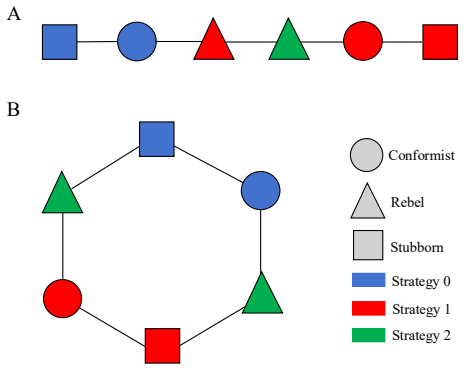
The local structure M*: a conformist–rebel edge whose remaining neighbors are stubborn agents perfectly balanced across all m strategies. Its presence forces an immediate best-response cycle and therefore precludes any pure Nash equilibrium; second-moment arguments show it occurs almost surely in large random graphs.
Load-bearing premise
The almost-sure non-existence proof assumes that vertices whose degrees are one more than a multiple of the number of strategies still induce a linear number of edges; if that residue class is too sparse the second-moment argument no longer applies.
What would settle it
Generate large Erdős–Rényi graphs with the paper’s type probabilities and check whether the fraction of instances that still possess a pure Nash equilibrium (found by best-response dynamics) stays bounded away from zero as n grows; if it does, Theorem 2 fails.
Editorial analysis
A structured set of objections, weighed in public.
Referee Report
Summary. The paper studies pure-strategy Nash equilibria (PNE) in an m-strategy network game with three player types: conformists (who match the modal neighbor strategy), rebels (who match the least common), and stubborn agents (who fix a strategy). On arbitrary networks it gives two sufficient conditions for existence (no CR edges, or every conformist has at least half its neighbors in C ∪ S_a) and proves, via a local obstruction M* and a second-moment argument, that PNE almost surely fails to exist in large random graphs under mild degree and type conditions. For complete graphs, lines, rings, trees (m > Δ), and stars it supplies necessary and sufficient conditions and characterizes equilibrium strategy frequencies. The unifying message is that PNE is supported when every conformist has enough C/S neighbors and is blocked by abundant CR edges.
Significance. The work cleanly unifies coordination, anti-coordination and fixed-behavior motives in a multi-strategy setting that previous literature treated only pairwise or for binary actions. The potential-game reductions (Results 1–2), the elementary local obstruction (Lemma 1), the second-moment non-existence theorem (Theorem 2), and the complete characterizations on classical architectures (Theorems 3–5, Corollaries 1–2) are all self-contained and machine-checkable from the payoff definitions. The random-graph claim is falsifiable and is already supported by the ER simulations of Figure 1. These contributions supply a systematic existence theory for heterogeneous multi-strategy network games that was previously missing.
major comments (2)
- Theorem 2 rests on the technical hypothesis that the induced subgraph on V_n* = {i : d_i ≡ 1 (mod m), d_i ≤ K} still contains at least αn edges. While the authors correctly note that this holds for Poisson, normal, scale-free and exponential families (and for the ER simulations of Figure 1), the hypothesis is not automatic for every degree sequence with bounded second moment. A short remark clarifying the precise range of degree distributions for which the linear-edge condition is known to hold, or an alternative argument that avoids the residue-class restriction, would make the almost-sure claim fully robust.
- For trees with m ≤ Δ the paper leaves open the existence question (explicitly flagged after Theorem 5 and illustrated by Figure 3B). Because trees are a core architecture and the m > Δ case is already settled, even a partial characterization (e.g., for stars or for bounded-degree trees) would substantially strengthen the special-structure section; otherwise the limitation should be stated more prominently in the abstract and introduction.
minor comments (5)
- Result 2 is labelled “RS game” but the surrounding sentence twice writes “CS game”; the typo should be corrected.
- In the model section the payoff collection is introduced as U but then written as V; notation should be made consistent.
- Figure 1 caption: “exsitence” → “existence”.
- The discussion of weighted payoffs (Section 5) is useful but could briefly note whether the local obstruction M* survives under strategy-specific weights.
- A few references (e.g., Cao et al. 2026) are cited as arXiv preprints; final versions or DOIs should be supplied if available.
Circularity Check
No significant circularity: central existence/non-existence claims are proved directly from the payoff definition and elementary potential-game or second-moment arguments; self-citations supply only standard two-type building blocks.
specific steps
-
self citation load bearing
[Section 3.1, Result 1 and its use in Theorem 1(i)]
"Result 1. For any network, the m-strategy game with conformists and stubborn agents (CS game) has at least one PNE. This result was introduced in Cao et al. (2024), showing that the m-strategy CS game is an exact potential game … For condition (i), a CRS game without CR edges can be decomposed into a CS game and an RS game. Result 1 and Result 2 show that both … possess a PNE."
Existence of PNE for the pure CS subgame is asserted solely by citation to a prior paper by overlapping authors (Cao, Zhang) rather than re-derived; that fact is then invoked as one of the two sufficient conditions of Theorem 1. The dependence is real but minor: the multi-strategy CRS claims do not reduce to it by construction, the potential-game argument is elementary and standard, and the complementary RS case is proved in full inside the present manuscript.
full rationale
The paper’s load-bearing results (Theorem 1 sufficient conditions, Lemma 1 local obstruction M*, Theorem 2 almost-sure non-existence via second-moment method on V_n*, and the complete/line/ring/tree/star characterizations) are derived self-containedly from the CRS payoff functions (Eq. 1) and Definition 1 of PNE. Result 2 (RS potential) is proved in full; Result 3 (bipartite CR) is proved in full; the random-graph argument never invokes external data fits or uniqueness theorems. The sole self-citation of substance is Result 1 (CS potential game), taken from Cao et al. (2024) by overlapping authors and used to obtain the “no CR edges” half of Theorem 1. That citation is ordinary reuse of a prior special case, not a circular reduction of the multi-strategy claims, and the potential-game method itself is standard and independently verifiable. No fitted parameters are renamed as predictions, no ansatz is smuggled, and no uniqueness result is imported to force the present conclusions. Hence circularity is negligible.
Axiom & Free-Parameter Ledger
axioms (4)
- domain assumption Payoffs of conformists equal the number of neighbors sharing their strategy; payoffs of rebels equal the number of neighbors with a different strategy; stubborn agents have constant payoff 0.
- standard math A finite undirected simple graph with no self-loops; pure strategies only.
- domain assumption In the random-graph model, degrees satisfy a uniform second-moment bound, the induced subgraph on V_n* retains linearly many edges, and types are drawn i.i.d. with full support.
- standard math Exact potential games admit pure Nash equilibria (Monderer–Shapley).
invented entities (2)
-
Local structure M*
no independent evidence
-
CRS game
no independent evidence
read the original abstract
In this paper, we analyze a multi-strategy network game with three types of players, conformists, rebels, and stubborn agents. Conformists adopt the strategy that is most common among their neighbors, rebels adopt the least common, and stubborn agents adhere to a fixed strategy. We study the existence and structure of pure strategy Nash equilibrium (PNE). On arbitrary networks, we establish sufficient conditions for PNE existence, and we prove that in large random networks PNE almost surely fails to exist. For several specific network architectures, such as complete network, lines, rings, trees, and stars, we derive necessary and sufficient conditions for PNE existence and fully characterize the equilibrium strategy frequencies. Collectively, these results offer a unified perspective that PNE is likely to exist when every conformist has more conformist and stubborn neighbors, and fails when the network game has numerous conformist-rebel edges.
Figures



Reference graph
Works this paper leans on
-
[1]
Cuesta, and Angel Sánchez, Triadic influence as a proxy for compatibility in social relationships, Proceedings of the National Academy of Sciences, vol
Miguel Ruiz-García, Juan Ozaita, María Pereda, Antonio Alfonso, Pablo Brañas-Garza, José A. Cuesta, and Angel Sánchez, Triadic influence as a proxy for compatibility in social relationships, Proceedings of the National Academy of Sciences, vol. 120, no. 13, pp. e2215041120, 2023
2023
-
[2]
Pei, Dynamic games on arbitrary networks with two types of players, Journal of Mathematical Economics, vol. 113, pp. 102990, 2024
2024
-
[3]
Boyu Zhang, Zhigang Cao, Cheng-Zhong Qin, and Xiaoguang Yang, Fashion and homophily, Operations Research, vol. 66, no. 6, pp. 1486--1497, 2018
2018
-
[4]
Wenjie Cao, Hegui Zhang, Gang Kou, and Boyu Zhang, Discrete opinion dynamics in social networks with stubborn agents and limited information, Information Fusion, vol. 109, pp. 102410, 2024
2024
-
[5]
Shapley, Potential games, Games and Economic Behavior, vol
Dov Monderer and Lloyd S. Shapley, Potential games, Games and Economic Behavior, vol. 14, no. 1, pp. 124--143, 1996
1996
-
[6]
Information Fusion , volume=
Discrete opinion dynamics in social networks with stubborn agents and limited information , author=. Information Fusion , volume=. 2024 , publisher=
2024
-
[7]
Games and economic behavior , volume=
Potential games , author=. Games and economic behavior , volume=. 1996 , publisher=
1996
-
[8]
Operations Research , volume=
Fashion and homophily , author=. Operations Research , volume=. 2018 , publisher=
2018
-
[9]
Proceedings of the National Academy of Sciences , volume =
Triadic influence as a proxy for compatibility in social relationships , author =. Proceedings of the National Academy of Sciences , volume =
-
[10]
Dynamic games on arbitrary networks with two types of players , journal =
-
[11]
Opinion fluctuations and disagreement in social networks
Acemo g lu, D., Como, G., Fagnani, F., Ozdaglar, A., 2013. Opinion fluctuations and disagreement in social networks. Math. Oper. Res. 38, 1--27
2013
-
[12]
Evolutionary dynamics on any population structure
Allen, B., Lippner, G., Chen, Y.T., Fotouhi, B., Momeni, N., Yau, S.T., Nowak, M.A., 2017. Evolutionary dynamics on any population structure. Nature 544, 227--230
2017
-
[13]
Evolutionary dynamics of higher-order interactions in social networks
Alvarez-Rodriguez, U., Battiston, F., de Arruda, G.F., Moreno, Y., Perc, M., Latora, V., 2021. Evolutionary dynamics of higher-order interactions in social networks. Nat. Hum. Behav. 5, 586--595
2021
-
[14]
Cournot competition in networked markets
Bimpikis, K., Ehsani, S., Ilkilic, R., 2019. Cournot competition in networked markets. Manage. Sci. 65, 2467--2481
2019
-
[15]
Identification of peer effects through social networks
Bramoull\'e, Y., Djebbari, H., Fortin, B., 2009. Identification of peer effects through social networks. J. Econom. 150(1), 41--55
2009
-
[16]
Games played on networks, in: The Oxford Handbook of the Economics of Networks
Bramoull\'e, Y., Kranton, R., 2016. Games played on networks, in: The Oxford Handbook of the Economics of Networks. Oxford University Press
2016
-
[17]
Strategic interaction and networks
Bramoull\'e, Y., Kranton, R., D'amours, M., 2014. Strategic interaction and networks. Am. Econ. Rev. 104, 898--930
2014
-
[18]
An experimental study of network effects on coordination in asymmetric games
Broere, J., Buskens, V., Stoof, H., S\'anchez, A., 2019. An experimental study of network effects on coordination in asymmetric games. Sci. Rep. 9, 6842
2019
-
[19]
Peer effects and social networks in education
Calv\'o-Armengol, A., Patacchini, E., Zenou, Y., 2009. Peer effects and social networks in education. Rev. Econ. Stud. 76, 1239--1267
2009
-
[20]
Dynamic matching pennies on networks
Cao, Z., Qin, C.Z., Yang, X., Zhang, B., 2019. Dynamic matching pennies on networks. Int. J. Game Theory 48, 887--920
2019
-
[21]
Network games with heterogeneous players
Cao, W., S\'anchez, A., Zhang, B., 2026. Network games with heterogeneous players. https://arxiv.org/html/2607.05932v1
Pith/arXiv arXiv 2026
-
[22]
Discrete opinion dynamics in social networks with stubborn agents and limited information
Cao, W., Zhang, H., Kou, G., Zhang, B., 2024. Discrete opinion dynamics in social networks with stubborn agents and limited information. Inf. Fusion 109, 102410
2024
-
[23]
Divide and conquer in two-sided markets: A potential-game approach
Chan, L.T., 2021. Divide and conquer in two-sided markets: A potential-game approach. RAND J. Econ. 52, 839--858
2021
-
[24]
Learning, local interaction, and coordination
Ellison, G., 1993. Learning, local interaction, and coordination. Econometrica, 1047--1071
1993
-
[25]
Network games
Galeotti, A., Goyal, S., Jackson, M.O., Vega-Redondo, F., Yariv, L., 2010. Network games. Rev. Econ. Stud. 77, 218--244
2010
-
[26]
Heterogeneous network games: Conflicting preferences
Hern\'andez, P., Mu\ noz-Herrera, M., S\'anchez, A., 2013. Heterogeneous network games: Conflicting preferences. Games Econ. Behav. 79, 56--66
2013
-
[27]
Social and economic networks
Jackson, M.O., 2008. Social and economic networks. Princeton University Press, Princeton
2008
-
[28]
O., Watts, A., 2002
Jackson, M. O., Watts, A., 2002. On the formation of interaction networks in social coordination games. Games Econ. Behav. 41, 265--291
2002
-
[29]
Diffusion of behavior and equilibrium properties in network games
Jackson, M.O., Yariv, L., 2007. Diffusion of behavior and equilibrium properties in network games. Amer. Econ. Rev. 97, 92--98
2007
-
[30]
O., Zenou, Y., 2015
Jackson, M. O., Zenou, Y., 2015. Games on networks. In Handbook of game theory with economic applications. Elsevier. 4, 95--163
2015
-
[31]
S., 1996
Monderer, D., Shapley, L. S., 1996. Potential games, Games Econ. Behav. 14, 124--143
1996
-
[32]
Evolutionary games and spatial chaos
Nowak, M.A., May, R.M., 1992. Evolutionary games and spatial chaos. Nature 359, 826--829
1992
-
[33]
A simple rule for the evolution of cooperation on graphs and social networks
Ohtsuki, H., Hauert, C., Lieberman, E., Nowak, M.A., 2006. A simple rule for the evolution of cooperation on graphs and social networks. Nature 441, 502--505
2006
-
[34]
Dynamic games on arbitrary networks with two types of players
Pei, S., Cressman, R., Zhang, B., 2024. Dynamic games on arbitrary networks with two types of players. J. Math. Econ. 113, 102990
2024
-
[35]
H., 2023
Ramazi, P., Roohi, M. H., 2023. Characterizing oscillations in heterogeneous populations of coordinators and anticoordinators. Automatica 154, 111068
2023
-
[36]
Networks of conforming or nonconforming individuals tend to reach satisfactory decisions
Ramazi, P., Riehl, J., Cao, M., 2016. Networks of conforming or nonconforming individuals tend to reach satisfactory decisions. Proc. Natl. Acad. Sci. U.S.A. 113, 12985--12990
2016
-
[37]
A., Sánchez, A., 2023
Ruiz-Garcia, M., Ozaita, J., Pereda, M., Alfonso, A., Brañas-Garza, P., Cuesta, J. A., Sánchez, A., 2023. Triadic influence as a proxy for compatibility in social relationships. Proc. Natl. Acad. Sci. U.S.A. 120, e2215041120
2023
-
[38]
Social diversity promotes the emergence of cooperation in public goods games
Santos, F.C., Santos, M.D., Pacheco, J.M., 2008. Social diversity promotes the emergence of cooperation in public goods games. Nature 454, 213--216
2008
-
[39]
Information gerrymandering and undemocratic decisions
Stewart, A.J., Mosleh, M., Diakonova, M., Arechar, A.A., Rand, D.G., Plotkin, J.B., 2019. Information gerrymandering and undemocratic decisions. Nature 573, 117--121
2019
-
[40]
Binary opinion dynamics with stubborn agents
Yildiz, E., Ozdaglar, A., Acemoglu, D., Saberi, A., Scaglione, A., 2013. Binary opinion dynamics with stubborn agents. ACM Trans. Econ. Comput. 1, 1--30
2013
-
[41]
The dynamics of social innovation
Young, H.P., 2011. The dynamics of social innovation. Proc. Natl. Acad. Sci. U.S.A. 108, 21285--21291
2011
-
[42]
Z., Yang, X., 2018
Zhang, B., Cao, Z., Qin, C. Z., Yang, X., 2018. Fashion and homophily. Oper. Res. 66, 1486--1497
2018
-
[43]
Leslie Lamport, : a document preparation system, Addison Wesley, Massachusetts, 2nd edition, 1994
1994
-
[44]
In connection with cross-referencing and possible future hyperlinking it is not a good idea to collect more that one literature item in one + +
+ is cited as + ESG96 +. In connection with cross-referencing and possible future hyperlinking it is not a good idea to collect more that one literature item in one + +. The so-called Harvard or author-year style of referencing is enabled by the package natbib . With this package the literature can be cited as follows: enumerate [ ] Parenthetical: + WB96 ...
1996
discussion (0)
Sign in with ORCID, Apple, or X to comment. Anyone can read and Pith papers without signing in.