REVIEW 3 major objections 6 minor 56 references
Code representation is a first-class design choice in agentic bug localization: role-aware summaries beat file-path baselines by up to 40% Hit@5 while using far fewer tokens than raw source.
Reviewed by Pith at T0; open to challenge. T0 means a machine referee read the full paper against a public rubric. the ladder, T0–T4 →
T0 review · grok-4.5
2026-07-14 07:25 UTC pith:LW3JLS4G
load-bearing objection Solid empirical bake-off showing representation choice actually moves file-level localization Hit rates and cost; role-aware summaries win the trade-off under their generator, with one clear unablated soft spot. the 3 major comments →
Retrieval-Oriented Code Representations in Agentic Bug Localization
The pith
A machine-rendered reading of the paper's core claim, the machinery that carries it, and where it could break.
Core claim
File-level bug localization is representation-driven: which textual view of repository files is indexed and shown to retrievers and rankers changes both effectiveness and cost. Role-aware summaries outperform file-path baselines by up to 40% Hit@5 at a footprint 10.4–20.9× smaller than raw source; combining complementary representations and LLM post-retrieval ranking yield further gains of up to 31.9% and 42.0% Hit@5 in the reported settings; and integrating role-aware summaries plus ranking into a known pipeline reaches 94% Hit@6 (+4.7% over that baseline).
What carries the argument
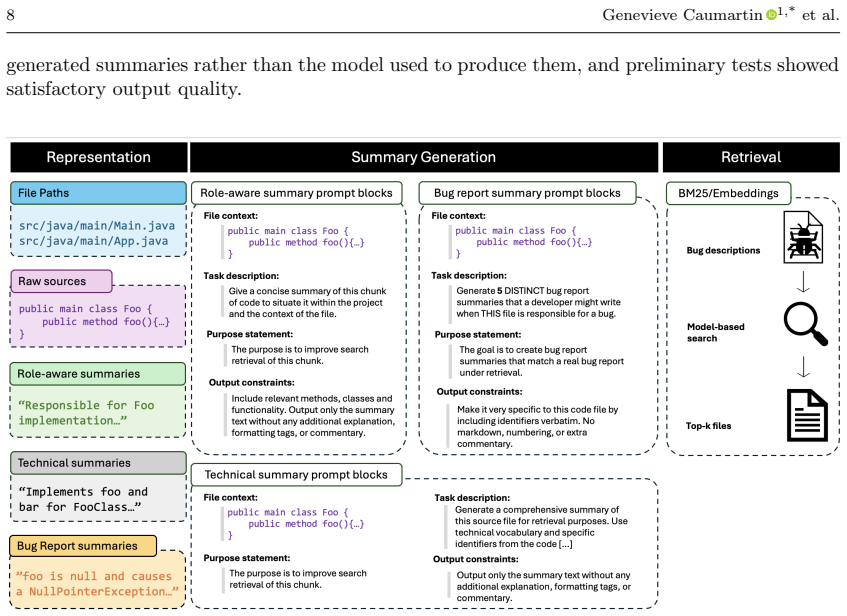
Representation footprint—the token volume of the searchable index or LLM input for a given textual view of the repository—together with the five compared views (paths, raw source, role-aware summaries, detailed technical summaries, synthetic bug-report summaries). Footprint makes the accuracy–cost trade-off explicit and shows why compact role-aware summaries are the practical sweet spot for many stages.
Load-bearing premise
That role-aware summaries generated once by a single mid-size model with fixed prompts stay faithful, stable stand-ins for file meaning across repositories, languages, and later code changes.
What would settle it
Regenerate the role-aware summaries with a different model family or prompt set, re-run the same BM25, embedding, and LLM retrieval protocols on LCA and SWE-Verified, and check whether the reported Hit@5 gains over paths and the footprint advantage over raw source reverse or vanish.
If this is right
- Agentic localization pipelines should choose representation by stage: inexpensive paths or raw source for first-stage retrieval, compact role-aware summaries when an LLM must compare many candidates under a token budget.
- Rank fusion over complementary views can raise top-k coverage beyond any single representation.
- Summary generation is a one-time or incremental preprocessing cost that can be amortized across many queries on the same repository.
- Raw source remains strong for some lexical and embedding setups but is a poor default for single-prompt LLM ranking because it starves the model of candidates.
- Representation belongs in the design space of retrieval architectures alongside the choice of sparse, dense, or LLM retriever.
Where Pith is reading between the lines
- If representation quality dominates, production systems will need continuous representation maintenance that regenerates summaries only for changed files, analogous to incremental indexing.
- The same stage-wise representation trade-off likely extends to other repository-scale agent tasks—feature location, review, dependency analysis—where wrong-file retrieval is the bottleneck.
- Synthetic bug-report expansions underperformed here; better conditioned, project-tuned expansion might still recover classic document-expansion gains for code.
- Smaller open models may need hybrid lexical or structural cues even when larger models thrive on dense summaries, so representation should be co-tuned with model scale.
Editorial analysis
A structured set of objections, weighed in public.
Referee Report
Summary. The paper frames file-level bug localization for agentic repair as a representation-driven retrieval problem. On Long Code Arena (150 tasks) and SWE-bench Verified (500 tasks) it compares five textual representations—file paths (STRUCT), raw source (RAW), role-aware summaries (ROLESUM), detailed technical summaries (TECSUM), and synthetic bug-report summaries (BUGSUM)—under BM25, four dense embedders, three Qwen2.5-Coder sizes (7B/14B/32B), reciprocal-rank fusion, and LLM post-retrieval ranking (k=20 candidates). Cost is quantified primarily via representation footprint (token volume). Headline results: ROLESUM improves Hit@5 over STRUCT by up to ~40% while using a footprint 10.4–20.9× smaller than RAW; fusion of complementary representations and LLM ranking add further gains (up to ~31.9% and ~42.0% Hit@5 in reported cells); an Agentless case study reaches 94% Hit@6 (+4.7%). The authors conclude that code representation should be treated as a first-class design choice guided by pipeline stage and cost–accuracy trade-offs.
Significance. If the reported trade-offs hold under broader conditions, the work supplies concrete, stage-aware guidance for agentic localization pipelines that currently default to paths or raw source. Strengths include breadth (lexical, dense, and LLM retrievers; two public long-context benchmarks; fusion and ranking stages), explicit footprint accounting, a practical Agentless transfer, and a full replication package (code, prompts, databases, results). These make the empirical bake-off reusable and falsifiable within the studied generator/prompt/setup. The main contribution is not a new retriever but evidence that representation choice materially changes both Hit@k/MAP@k and context cost—an under-studied lever in repository-scale agent design.
major comments (3)
- Section 3.2 and Threats to Validity: the central design recommendation—that ROLESUM is the best cost-effectiveness trade-off and therefore that representation should be a first-class choice—rests on summaries produced once by a single mid-size model (GPT-OSS 20B) under author-chosen block-structured prompts, with only “preliminary experimentation” used to retain three variants. Tables 2 and 5 (and the Agentless transfer) report the headline Hit@5/footprint lifts only for those particular summaries. There is no ablation of generator family (general vs code-specialized), temperature, or prompt wording, nor any inter-generator agreement or summary-quality metric. Because the paper itself states that “File summaries’ quality highly affects retrieval quality,” the relative ranking of ROLESUM vs STRUCT/RAW (and fusion/ranking gains built on ROLESUM) may reverse under a different generator. Thi
- Results tables (Tables 2–7) and metrics section: all Hit@5/MAP@5 comparisons are point estimates with no statistical significance tests, confidence intervals, or bootstrap/error bars, despite modest task counts (n=150 LCA, n=500 SWE) and known non-determinism of LLM retrieval/ranking even at temperature 0. Several “best” cells differ by only a few percentage points; without uncertainty quantification it is hard to judge whether the claimed superiority of ROLESUM (or of particular fusions) is stable. Adding at least paired tests or bootstrap CIs on the primary Hit@5 contrasts would strengthen the cost-effectiveness ranking.
- Section 5.3 / Table 5 and Section 6: LLM-based retrieval frequently returns very small candidate sets (e.g., a single file in 48/150 LCA and 309/500 SWE instances for the 32B model). The authors correctly avoid feeding these sets into the ranking study, but the same conservatism affects interpretation of Hit@5 for LLM retrievers and of fusion gains that mix LLM and traditional lists. The paper should quantify how often top-k is truncated and discuss whether Hit@k remains comparable across retriever families when effective k differs systematically.
minor comments (6)
- Abstract and takeaways repeatedly cite “up to 40% Hit@5” and “10.4 to 20.9× smaller”; these maxima are correct for selected cells but can be read as typical. A short qualifier (“in the best retriever–dataset cells”) would avoid over-generalization.
- Table 9 (indexing time) flags a CodeXEmbed outlier on TECSUM due to memory offloading; the main text should either exclude that cell from qualitative claims or re-run with adjusted batch/token limits so the table is not misleading.
- Section 3.5: MAP@5 and Hit@5 are standard, but the choice of k=5 (and Agentless Hit@6) is justified only briefly as a “developer inspection budget.” A one-sentence sensitivity note (e.g., Hit@10 trends) would help readers who use different cutoffs.
- Figure 6 caption and surrounding text: “Path / Sum / Raw / Bug” abbreviations are clear in context but should be expanded once in the caption for standalone readability.
- Related Work §2.2–2.3: the positioning against hierarchical pipelines (e.g., Agentless skeletons) and doc2query-style expansion is good; a short explicit contrast with cross-encoder summary localization (Han et al.) would further clarify novelty of the multi-retriever, multi-stage bake-off.
- Threats: dataset contamination is acknowledged as an upper bound; stating whether any decontamination or post-cutoff filtering was attempted (even if none) would complete the discussion.
Circularity Check
No circularity: empirical bake-off of representations on external ground-truth labels and standard IR metrics.
full rationale
The paper is a self-contained comparative evaluation of five textual code representations (STRUCT, RAW, ROLESUM, TECSUM, BUGSUM) for file-level bug localization. It measures MAP@5 and Hit@k against independently labeled buggy files from public benchmarks (LCA Bug Localization and SWE-bench Verified). Representation footprint is a descriptive token-volume statistic, not a fitted or predicted quantity. Fusion via reciprocal rank fusion and LLM post-retrieval ranking are applied after retrieval and scored on the same external labels. No equation or claim reduces a “prediction” to a fitted input by construction; no uniqueness theorem or load-bearing self-citation forces the ranking of representations. Self-references are confined to the replication package. The central design recommendation follows directly from observed effectiveness–cost trade-offs on held-out tasks, not from definitional circularity.
Axiom & Free-Parameter Ledger
free parameters (5)
- Hit@k reporting cutoff (k=5; ranking over k=20; Agentless Hit@6)
- LLM context length fixed at 16k tokens
- Number of synthetic bug reports per file (=5)
- Summary-generation model and prompts (GPT-OSS 20B; three retained task blocks)
- BM25 hyperparameters (k1=0.9, b=0.4 defaults)
axioms (4)
- domain assumption File-level localization against patch-derived ground-truth files is a valid primary success criterion for agentic bug localization.
- ad hoc to paper Token volume (representation footprint) is a sufficient primary cost proxy for comparing representations across retrievers.
- domain assumption Standard IR metrics MAP@k and Hit@k adequately measure localization utility for developers/agents.
- domain assumption Reciprocal rank fusion is an appropriate way to combine complementary representation rankings.
invented entities (2)
-
Role-aware summary (ROLESUM) representation
no independent evidence
-
Representation footprint
no independent evidence
read the original abstract
LLM-based agents are increasingly being used to support software development, yet their performance in repository-level tasks depends on retrieving the right code context. Existing studies have explored file-level localization using traditional information retrieval over file paths and raw source code. However, the role of textual code representations in retrieval and localization remains underexplored. We study file-level bug localization as a representation-driven retrieval problem. Across the Long Code Arena (LCA) and SWE-bench Verified (SWE) datasets, we compare five code representations: file paths, raw source code, and three LLM-generated textual representations. Our experiments include lexical, semantic, and LLM-based retrieval, followed by LLM-based post-retrieval ranking. We quantify the cost incurred by a representation through the representation footprint. We find that the choice of code representation affects both localization effectiveness and cost. Role-aware summaries outperform file-path representations by up to 40% Hit@5 while requiring a representation footprint 10.4 to 20.9x smaller than raw source code. Combining complementary representation results and ranking retrieved candidates with an LLM provides further gains of up to 31.9% and 42.0%, respectively. Overall, role-aware summaries provide the best cost-effectiveness trade-off, while raw source code offers effectiveness in some settings at a significantly higher cost. A case study with Agentless reveals the utility of our techniques within a well-known pipeline, reaching 94% Hit@6 on file localization (+4.7% against the baseline). Our findings suggest that code representation should be treated as a first-class design choice in agentic localization pipelines, guided by pipeline stage and cost-accuracy requirements.
Figures




Reference graph
Works this paper leans on
-
[1]
ACM Trans Inf Syst 20(4):357--389, doi:10.1145/582415.582416, ://doi.org/10.1145/582415.582416
Amati G, Van Rijsbergen CJ (2002) Probabilistic models of information retrieval based on measuring the divergence from randomness. ACM Trans Inf Syst 20(4):357--389, doi:10.1145/582415.582416, ://doi.org/10.1145/582415.582416
-
[2]
://www.anthropic.com/news/contextual-retrieval, accessed July 12, 2025
Anthropic (2024) Introducting contextual retrieval. ://www.anthropic.com/news/contextual-retrieval, accessed July 12, 2025
2024
-
[3]
://arxiv.org/abs/2406.11612, arXiv:2406.11612 [cs]
Bogomolov E, Eliseeva A, Galimzyanov T, Glukhov E, Shapkin A, Tigina M, Golubev Y, Kovrigin A, van Deursen A, Izadi M, Bryksin T (2024) Long code arena: a set of benchmarks for long-context code models. ://arxiv.org/abs/2406.11612, arXiv:2406.11612 [cs]
Pith/arXiv arXiv 2024
-
[4]
://huggingface.co/buckets/gencau/code-representations
Caumartin G (2026 a ) Generated databases, datasets and results. ://huggingface.co/buckets/gencau/code-representations
2026
-
[5]
://github.com/gencau/code-representations
Caumartin G (2026 b ) Replication package. ://github.com/gencau/code-representations
2026
-
[6]
://arxiv.org/abs/2502.15292, 2502.15292
Chang J, Zhou X, Wang L, Lo D, Li B (2025) Bridging bug localization and issue fixing: A hierarchical localization framework leveraging large language models. ://arxiv.org/abs/2502.15292, 2502.15292
Pith/arXiv arXiv 2025
-
[7]
Chen Z, Tang R, Deng G, Wu F, Wu J, Jiang Z, Prasanna V, Cohan A, Wang X (2025) L oc A gent: Graph-guided LLM agents for code localization. In: Che W, Nabende J, Shutova E, Pilehvar MT (eds) Proceedings of the 63rd Annual Meeting of the Association for Computational Linguistics (Volume 1: Long Papers), Association for Computational Linguistics, Vienna, Au...
-
[8]
Cormack GV, Clarke CLA, Buettcher S (2009) Reciprocal rank fusion outperforms condorcet and individual rank learning methods. In: Proceedings of the 32nd International ACM SIGIR Conference on Research and Development in Information Retrieval, Association for Computing Machinery, New York, NY, USA, SIGIR '09, pp 758--759, doi:10.1145/1571941.1572114, ://do...
-
[9]
doi:10.1007/978-0-387-39940-9\_488, ://doi.org/10.1007/978-0-387-39940-9\_488
Craswell N (2009) Mean Reciprocal Rank, Springer US, Boston, MA, pp 1703--1703. doi:10.1007/978-0-387-39940-9\_488, ://doi.org/10.1007/978-0-387-39940-9\_488
-
[10]
://arxiv.org/abs/1810.04805, 1810.04805
Devlin J, Chang MW, Lee K, Toutanova K (2019) Bert: Pre-training of deep bidirectional transformers for language understanding. ://arxiv.org/abs/1810.04805, 1810.04805
Pith/arXiv arXiv 2019
-
[11]
In: TREC, Citeseer, vol 2, pp 243--252
Fox EA, Shaw JA (1994) Combination of multiple searches. In: TREC, Citeseer, vol 2, pp 243--252
1994
-
[12]
In: Hiemstra D, Moens MF, Mothe J, Perego R, Potthast M, Sebastiani F (eds) Advances in Information Retrieval, Springer International Publishing, pp 146--160
Gao L, Dai Z, Chen T, Fan Z, Van Durme B, Callan J (2021) Complement lexical retrieval model with semantic residual embeddings. In: Hiemstra D, Moens MF, Mothe J, Perego R, Potthast M, Sebastiani F (eds) Advances in Information Retrieval, Springer International Publishing, pp 146--160
2021
-
[13]
Han J, Huang C, Liu J (2024) bjenet: a fast and accurate software bug localization method in natural language semantic space. Software Quality Journal 32(4):1515--1538, doi:10.1007/s11219-024-09693-1, ://doi.org/10.1007/s11219-024-09693-1
-
[14]
He P, Wang S, Chowdhury S, Chen TH (2025) Evaluating the effectiveness and efficiency of demonstration retrievers in rag for coding tasks. In: 2025 IEEE International Conference on Software Analysis, Evolution and Reengineering (SANER), pp 500--510, doi:10.1109/SANER64311.2025.00053
-
[15]
Hirsch T, Hofer B (2025) Best practices for evaluating irfl approaches. Journal of Systems and Software 222:112342, doi:10.1016/j.jss.2025.112342, ://www.sciencedirect.com/science/article/pii/S016412122500010X
-
[16]
doi:10.48550/arXiv.2409.12186, ://arxiv.org/abs/2409.12186, arXiv:2409.12186 [cs]
Hui B, Yang J, Cui Z, Yang J, Liu D, Zhang L, Liu T, Zhang J, Yu B, Lu K, Dang K, Fan Y, Zhang Y, Yang A, Men R, Huang F, Zheng B, Miao Y, Quan S, Feng Y, Ren X, Ren X, Zhou J, Lin J (2024) Qwen2.5-coder technical report. doi:10.48550/arXiv.2409.12186, ://arxiv.org/abs/2409.12186, arXiv:2409.12186 [cs]
-
[17]
Huyen C (2024 a ) Evaluate AI Systems, O’Reilly, chap 4, pp 159--209
2024
-
[18]
Huyen C (2024 b ) RAG and Agents, O’Reilly, chap 6, pp 253--306
2024
-
[19]
://arxiv.org/abs/2305.03653, 2305.03653
Jagerman R, Zhuang H, Qin Z, Wang X, Bendersky M (2023) Query expansion by prompting large language models. ://arxiv.org/abs/2305.03653, 2305.03653
Pith/arXiv arXiv 2023
-
[20]
doi:10.48550/arXiv.2408.11058, ://arxiv.org/abs/2408.11058, arXiv:2408.11058 [cs]
Jain S, Dora A, Sam KS, Singh P (2024) Llm agents improve semantic code search. doi:10.48550/arXiv.2408.11058, ://arxiv.org/abs/2408.11058, arXiv:2408.11058 [cs]
-
[21]
Jimenez CE, Yang J, Wettig A, Yao S, Pei K, Press O, Narasimhan KR (2024) SWE -bench: Can language models resolve real-world github issues? In: The Twelfth International Conference on Learning Representations, ://openreview.net/forum?id=VTF8yNQM66
2024
-
[22]
Lam AN, Nguyen AT, Nguyen HA, Nguyen TN (2017) Bug localization with combination of deep learning and information retrieval. In: 2017 IEEE/ACM 25th International Conference on Program Comprehension (ICPC), pp 218--229, doi:10.1109/ICPC.2017.24
-
[23]
://arxiv.org/abs/2507.15003, 2507.15003
Li H, Zhang H, Hassan AE (2025) The rise of ai teammates in software engineering (se) 3.0: How autonomous coding agents are reshaping software engineering. ://arxiv.org/abs/2507.15003, 2507.15003
Pith/arXiv arXiv 2025
-
[24]
arXiv preprint ://arxiv.org/abs/2308.13775
Li J, Li Y, Li G, Hu X, Xia X, Jin Z (2023 a ) Editsum: A retrieve-and-edit framework for source code summarization. arXiv preprint ://arxiv.org/abs/2308.13775
Pith/arXiv arXiv 2023
-
[25]
doi:10.48550/arXiv.2308.03281, ://arxiv.org/abs/2308.03281, arXiv:2308.03281 [cs]
Li Z, Zhang X, Zhang Y, Long D, Xie P, Zhang M (2023 b ) Towards general text embeddings with multi-stage contrastive learning. doi:10.48550/arXiv.2308.03281, ://arxiv.org/abs/2308.03281, arXiv:2308.03281 [cs]
-
[26]
In: Proceedings of the 44th Annual International ACM SIGIR Conference on Research and Development in Information Retrieval (SIGIR 2021), pp 2356--2362
Lin J, Ma X, Lin SC, Yang JH, Pradeep R, Nogueira R (2021) Pyserini : A Python toolkit for reproducible information retrieval research with sparse and dense representations. In: Proceedings of the 44th Annual International ACM SIGIR Conference on Research and Development in Information Retrieval (SIGIR 2021), pp 2356--2362
2021
-
[27]
In: Second Conference on Language Modeling, ://openreview.net/forum?id=z3lG70Azbg
Liu Y, Meng R, Joty S, silvio savarese, Xiong C, Zhou Y, Yavuz S (2025) Code XE mbed: A generalist embedding model family for multilingual and multi-task code retrieval. In: Second Conference on Language Modeling, ://openreview.net/forum?id=z3lG70Azbg
2025
-
[28]
In: Proceedings of the 60th Annual Meeting of the Association for Computational Linguistics (Volume 1: Long Papers), pp 6227--6240
Lu S, Duan N, Han H, Guo D, Hwang Sw, Svyatkovskiy A (2022) Reacc: A retrieval-augmented code completion framework. In: Proceedings of the 60th Annual Meeting of the Association for Computational Linguistics (Volume 1: Long Papers), pp 6227--6240
2022
-
[29]
Lukins SK, Kraft NA, Etzkorn LH (2010) Bug localization using latent dirichlet allocation. Inf Softw Technol 52(9):972--990, doi:10.1016/j.infsof.2010.04.002, ://doi.org/10.1016/j.infsof.2010.04.002
-
[30]
://arxiv.org/abs/2406.01422, 2406.01422
Ma Y, Yang Q, Cao R, Li B, Huang F, Li Y (2025) Alibaba lingmaagent: Improving automated issue resolution via comprehensive repository exploration. ://arxiv.org/abs/2406.01422, 2406.01422
Pith/arXiv arXiv 2025
-
[31]
://arxiv.org/abs/2502.16704, 2502.16704
Makharev V, Ivanov V (2025) Code summarization beyond function level. ://arxiv.org/abs/2502.16704, 2502.16704
Pith/arXiv arXiv 2025
-
[32]
://doi.org/10.1145/3696630.3728533
Mao Y, He J, Chen C (2025) From Prompts to Templates: A Systematic Prompt Template Analysis for Real-world LLMapps, Association for Computing Machinery, New York, NY, USA, pp 75--86. ://doi.org/10.1145/3696630.3728533
-
[33]
://arxiv.org/abs/2510.21413, 2510.21413
Mohsenimofidi S, Galster M, Treude C, Baltes S (2026) Context engineering for ai agents in open-source software. ://arxiv.org/abs/2510.21413, 2510.21413
arXiv 2026
-
[34]
://arxiv.org/abs/2410.12972, 2410.12972
Murthy R, Venkateswaran P, Kumar P, Contractor D (2025) Kcif: Knowledge-conditioned instruction following. ://arxiv.org/abs/2410.12972, 2410.12972
Pith/arXiv arXiv 2025
-
[35]
://arxiv.org/abs/1904.08375, 1904.08375
Nogueira R, Yang W, Lin J, Cho K (2019) Document expansion by query prediction. ://arxiv.org/abs/1904.08375, 1904.08375
Pith/arXiv arXiv 2019
-
[36]
://arxiv.org/abs/2508.10925, 2508.10925
OpenAI (2025) gpt-oss-120b & gpt-oss-20b model card. ://arxiv.org/abs/2508.10925, 2508.10925
Pith/arXiv arXiv 2025
-
[37]
doi:10.48550/arXiv.2409.13642, ://arxiv.org/abs/2409.13642, arXiv:2409.13642 [cs]
Rafi MN, Kim DJ, Chen TH, Wang S (2024) Enhancing fault localization through ordered code analysis with llm agents and self-reflection. doi:10.48550/arXiv.2409.13642, ://arxiv.org/abs/2409.13642, arXiv:2409.13642 [cs]
-
[38]
Rao S, Kak A (2011) Retrieval from software libraries for bug localization: a comparative study of generic and composite text models. In: Proceedings of the 8th Working Conference on Mining Software Repositories, Association for Computing Machinery, New York, NY, USA, MSR '11, pp 43--52, doi:10.1145/1985441.1985451, ://doi.org/10.1145/1985441.1985451
-
[39]
In: Proceedings of the 14th Information Retrieval Workshop, ://ceur-ws.org/Vol-3802/paper22.pdf
Rizzo D, Raganato A, Viviani M (2024) Comparatively assessing large language models for query expansion in information retrieval via zero-shot and chain-of-thought prompting. In: Proceedings of the 14th Information Retrieval Workshop, ://ceur-ws.org/Vol-3802/paper22.pdf
2024
-
[40]
Found Trends Inf Retr 3(4):333--389, doi:10.1561/1500000019, ://doi.org/10.1561/1500000019
Robertson S, Zaragoza H (2009) The probabilistic relevance framework: Bm25 and beyond. Found Trends Inf Retr 3(4):333--389, doi:10.1561/1500000019, ://doi.org/10.1561/1500000019
-
[42]
Saha RK, Lease M, Khurshid S, Perry DE (2013 b ) Improving bug localization using structured information retrieval. In: 2013 28th IEEE/ACM International Conference on Automated Software Engineering (ASE), pp 345--355, doi:10.1109/ASE.2013.6693093
-
[43]
Wang L, Yang N, Wei F (2023) Query2doc: Query expansion with large language models. In: Bouamor H, Pino J, Bali K (eds) Proceedings of the 2023 Conference on Empirical Methods in Natural Language Processing, Association for Computational Linguistics, Singapore, pp 9414--9423, doi:10.18653/v1/2023.emnlp-main.585, ://aclanthology.org/2023.emnlp-main.585/
-
[44]
Wang S, Lo D (2014) Version history, similar report, and structure: putting them together for improved bug localization. In: Proceedings of the 22nd International Conference on Program Comprehension, Association for Computing Machinery, New York, NY, USA, ICPC 2014, pp 53--63, doi:10.1145/2597008.2597148, ://doi.org/10.1145/2597008.2597148
-
[45]
IEEE Transactions on Software Engineering 50(7):1852--1866, doi:10.1109/TSE.2024.3403042
Wang S, Geng M, Lin B, Sun Z, Wen M, Liu Y, Li L, Bissyandé TF, Mao X (2024) Fusing code searchers. IEEE Transactions on Software Engineering 50(7):1852--1866, doi:10.1109/TSE.2024.3403042
-
[46]
://arxiv.org/abs/2407.01489, 2407.01489
Xia CS, Deng Y, Dunn S, Zhang L (2024) Agentless: Demystifying llm-based software engineering agents. ://arxiv.org/abs/2407.01489, 2407.01489
Pith/arXiv arXiv 2024
-
[47]
Xiao S, Liu Z, Zhang P, Muennighoff N (2023) C-pack: Packaged resources to advance general chinese embedding. 2309.07597
Pith/arXiv arXiv 2023
-
[48]
://arxiv.org/abs/2501.05040, 2501.05040
Xie C, Li B, Gao C, Du H, Lam W, Zou D, Chen K (2025) Swe-fixer: Training open-source llms for effective and efficient github issue resolution. ://arxiv.org/abs/2501.05040, 2501.05040
Pith/arXiv arXiv 2025
-
[49]
Xu C, Liu Z, Ren X, Zhang G, Liang M, Lo D (2025) Flexfl: Flexible and effective fault localization with open-source large language models. IEEE Trans Softw Eng 51(5):1455–1471, doi:10.1109/TSE.2025.3553363, ://doi.org/10.1109/TSE.2025.3553363
-
[50]
In: The Twelfth International Conference on Learning Representations, ://openreview.net/forum?id=mlJLVigNHp
Xu F, Shi W, Choi E (2024) RECOMP : Improving retrieval-augmented LM s with context compression and selective augmentation. In: The Twelfth International Conference on Learning Representations, ://openreview.net/forum?id=mlJLVigNHp
2024
-
[51]
Advances in Neural Information Processing Systems 37:50528--50652
Yang J, Jimenez CE, Wettig A, Lieret K, Yao S, Narasimhan K, Press O (2024) Swe-agent: Agent-computer interfaces enable automated software engineering. Advances in Neural Information Processing Systems 37:50528--50652
2024
-
[52]
ACM Trans Softw Eng Methodol doi:10.1145/3799693, ://doi.org/10.1145/3799693, just Accepted
Zhang Q, Fang C, Xie Y, Ma Y, Sun W, Yang Y, Chen Z (2026) A systematic literature review on large language models for automated program repair. ACM Trans Softw Eng Methodol doi:10.1145/3799693, ://doi.org/10.1145/3799693, just Accepted
doi:10.1145/3799693 2026
-
[53]
Zhang Y, Ruan H, Fan Z, Roychoudhury A (2024) Autocoderover: Autonomous program improvement. In: Proceedings of the 33rd ACM SIGSOFT International Symposium on Software Testing and Analysis, Association for Computing Machinery, New York, NY, USA, ISSTA 2024, pp 1592--1604, doi:10.1145/3650212.3680384, ://doi.org/10.1145/3650212.3680384
-
[54]
arXiv preprint arXiv:250605176
Zhang Y, Li M, Long D, Zhang X, Lin H, Yang B, Xie P, Yang A, Liu D, Lin J, Huang F, Zhou J (2025) Qwen3 embedding: Advancing text embedding and reranking through foundation models. arXiv preprint arXiv:250605176
2025
-
[55]
Zheng Z, Hui K, He B, Han X, Sun L, Yates A (2020) BERT-QE : C ontextualized Q uery E xpansion for D ocument R e-ranking. In: Cohn T, He Y, Liu Y (eds) Findings of the Association for Computational Linguistics: EMNLP 2020, Association for Computational Linguistics, Online, pp 4718--4728, doi:10.18653/v1/2020.findings-emnlp.424, ://aclanthology.org/2020.fi...
-
[56]
Zhou J, Zhang H, Lo D (2012) Where should the bugs be fixed? more accurate information retrieval-based bug localization based on bug reports. In: 2012 34th International Conference on Software Engineering (ICSE), pp 14--24, doi:10.1109/ICSE.2012.6227210
-
[57]
Know-Based Syst 248(C), doi:10.1016/j.knosys.2022.108741, ://doi.org/10.1016/j.knosys.2022.108741
Zhu Z, Tong H, Wang Y, Li Y (2022) Enhancing bug localization with bug report decomposition and code hierarchical network. Know-Based Syst 248(C), doi:10.1016/j.knosys.2022.108741, ://doi.org/10.1016/j.knosys.2022.108741
discussion (0)
Sign in with ORCID, Apple, or X to comment. Anyone can read and Pith papers without signing in.