REVIEW 2 major objections 5 minor 33 references
Score-Only Distillation for Compact Dense Retrieval
T0 review · 2 major / 5 minor · reviewed 2026-07-14 · grok-4.5
Pith's one-line read A compact retriever can learn a large teacher's ranking behavior from score vectors alone, recovering up to half the quality gap while running several times faster.
desk verdict Solid, carefully scoped score-only distillation for bi-encoders: real controls, real speedups, modest novelty, and one reporting gap that still needs a split table. read the letter →
The pith
A machine-rendered reading of the paper's core claim, the machinery that carries it, and where it could break.
The reading
What carries the argument
The row-centered score-vector objective: the squared L2 norm of the residual between student and teacher scores after subtracting the row mean. It is a memory-linear reformulation of uniform all-pairs PairMSE, matching all pairwise teacher preferences without building explicit pair tensors.
What would settle it
Train the same student on the same score rows and then measure full-corpus NDCG@10 on held-out tasks whose corpus, query type, or relevance convention differ from the row sources; if the distilled student falls to or below the frozen base while the teacher remains stronger, the claimed compression does not transfer.
Extended reading notes
Core claim
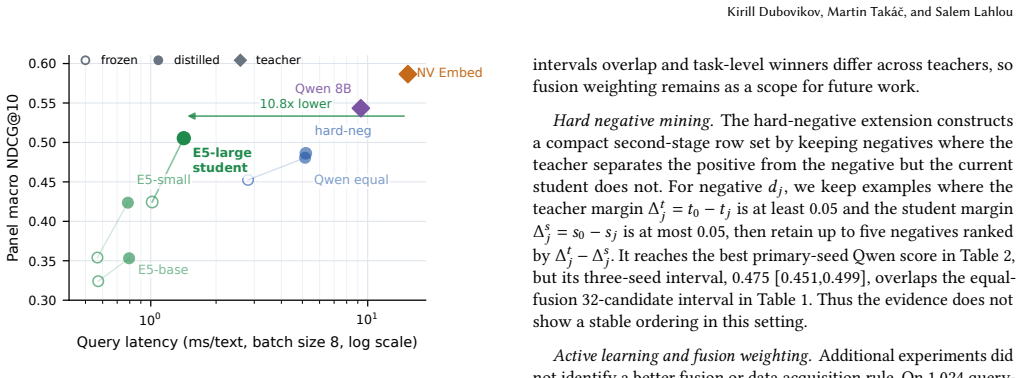
Black-box teacher score vectors alone carry enough ranking signal to improve compact bi-encoders under matched retrieval protocols: on a fixed eight-task panel, score-vector distillation recovers up to 50% of the base-to-teacher gap for both Qwen 0.6B and E5-large students, outperforming label-only contrastive training and positive-negative MarginMSE on the same rows, while the distilled 0.6B student is 4.7× faster for queries and 9.7× faster for documents than sequential online teacher fusion.
Load-bearing premise
That candidate rows built from ground-truth positives and pipeline negatives on a few source datasets, scored by black-box embedding teachers, supply ranking supervision that still improves full-corpus retrieval under the same protocol.
Editorial analysis
A structured set of objections, weighed in public.
Referee Report
Summary. The paper studies black-box score-only distillation for compact dense bi-encoders: a student is trained from teacher query–document score vectors over candidate rows (one ground-truth positive plus pipeline negatives), without teacher embeddings, hidden states, or shared embedding space. The main technical device is a row-centered residual MSE (Eq. 1), shown via a variance identity to be equivalent (up to a constant factor) to uniform all-pairs PairMSE (Eq. 2). On a fixed eight-task BEIR-style panel with full-corpus macro NDCG@10, Qwen3-0.6B and E5-large students improve over their frozen bases when distilled from Qwen3-8B, NV-Embed, or equal fusion targets; label-only CE on the same rows collapses below the base, and positive-negative MarginMSE trails the centered objective. The authors report recovery of roughly 25–50% of the base-to-teacher gap, encoder-side speedups (4.7× query / 9.7× document vs sequential teacher fusion), and mixed external transfer, scoping the claim to compression under matched retrieval protocols.
Significance. If the result holds under the authors’ matched-protocol scope, the work is a useful, carefully scoped contribution to retrieval serving: it shows that black-box embedding teachers can supervise compact bi-encoders via score vectors alone, without representation alignment, and that a memory-linear reformulation of all-pairs PairMSE is sufficient for that signal. Strengths include matched controls (label-only CE and MarginMSE on identical rows), two student families, explicit separation of hard-negative mining and fusion as extensions rather than the main protocol, and honest reporting of mixed external transfer and overlapping multi-seed intervals. The paper does not claim a new loss family or universal adaptation; it claims serving-cost compression of teacher rankings under matched protocols, which is a practically relevant and falsifiable claim for IR systems that already pay for large embedding teachers offline.
major comments (2)
- Tables 1–2 and Figure 2 report only All-8 full-corpus macro NDCG@10. The manuscript states that SciFact/NFCorpus/FiQA supply training rows while ArguAna/SciDocs/TREC-COVID/Webis-Touche2020/Quora are held out from row construction, and it mentions paired-bootstrap machinery over 1,271 row-source vs 12,505 eval-only queries, yet no row-source vs eval-only (or per-task) split of the panel is shown. Given modest Qwen deltas (+0.019–0.022; fusion CI lower bound +0.002) and Section 4.3’s documented regressions on other BEIR-style tasks, the central “up to 50% gap recovery on the fixed eight-task panel” claim needs that split to establish that gains are not concentrated on the three row-source datasets. Without it, the matched-protocol generalization claim is under-supported even inside the authors’ own design.
- Section 4.1 and Table 1: for the primary Qwen student, multi-seed evidence is reported only for equal fusion (CI [0.454, 0.490]), which overlaps both single-teacher point estimates and leaves the lower bound near the frozen base (+0.002). Most loss controls in Table 2 are single-seed (seed=42). The headline recovery range in Figure 2 and the abstract therefore rests on limited seed coverage for the main student family. Either multi-seed CIs for the single-teacher and centered-MSE main rows, or a clear statement that Qwen gains are seed-sensitive and secondary to the stronger E5-large result, is needed for the load-bearing claim.
minor comments (5)
- Figure 2’s y-axis (“Recovered teacher gap %”) and the abstract’s “up to 50%” should state explicitly which teacher and which base define the gap for each plotted point; the E5-large vs Qwen points appear to use different teachers.
- Section 3: briefly note that L_center is invariant to additive row offsets but not to multiplicative rescaling of scores; the unit-centered ablation in Table 2 partially addresses this but is not discussed in the text.
- Section 4.4 / Figure 3: clarify that latency is encoder-only microbenchmarks at batch size 8 on MI210, not end-to-end retrieval with ANN/index load, so the 4.7×/9.7× and 10.8× figures are upper bounds on serving benefit.
- Data-generation pipeline for negatives is referenced but not specified (how candidates are sampled, from which index, hardness). A short appendix paragraph would aid reproducibility.
- Typos / polish: “check-ing” line break in §4; “Qwen equal” labels in figures could be expanded once for readers skimming.
Circularity Check
No significant circularity: empirical score-vector distillation with a standard variance-identity reformulation of PairMSE; NDCG@10 evaluator is independent of the training targets.
full rationale
This is a self-contained empirical IR paper. The only algebraic step is the identity L_allpairs(s,t)=2 L_center(s,t) obtained from the elementary variance relation sum_{i,j}(r_i-r_j)^2=2k sum_i(r_i-mean(r))^2 (Eqs. 1-2); the paper presents it explicitly as a memory-efficient rewrite of the already-known uniform all-pairs PairMSE of RD-Suite, not as a novel first-principles derivation or a prediction. Teacher scores are external black-box supervision; the student is trained by ordinary gradient descent on those fixed targets; final claims are measured by full-corpus macro NDCG@10 on a held-out panel that is never used to construct the loss. No parameter is fitted to a subset and then re-reported as a prediction of a closely related quantity, no uniqueness theorem is imported from the authors' prior work, and no ansatz is smuggled via self-citation. The mixed external-transfer results and the row-source vs. eval-only design questions raised by a skeptic are evaluation-scope issues, not circular reductions of the claimed derivation chain. Score 0 is therefore the correct, proportionate finding.
Assumptions & free parameters
free parameters (5)
- candidate row width k =
32 (primary); 6 (hard-neg extension)
- LoRA rank and alpha (Qwen student) =
r=256, alpha=512
- learning rate and effective batch size =
Qwen 1e-5 / 16; E5 2e-5 / 8
- CE temperature tau =
0.05
- hard-negative margin thresholds =
0.05 / 0.05
assumptions (4)
- domain assumption Normalized cosine similarity of independently encoded query and document vectors is a valid teacher ranking score for distillation targets.
- domain assumption Full-corpus macro NDCG@10 on the fixed eight BEIR tasks is an adequate measure of retrieval quality for the claim about ranking compression.
- standard math Uniform all-pairs PairMSE over ordered document pairs is equivalent (up to factor 2) to squared norm of the row-centered residual vector.
- ad hoc to paper Ground-truth positives plus pipeline-generated negatives form candidate rows that are informative for full-corpus ranking.
invented entities (1)
-
row-centered score-vector distillation objective (L_center)
independent evidence
Cite this review
Pith. "Pith review of Score-Only Distillation for Compact Dense Retrieval." pith.science (2026). https://pith.science/paper/WXESVP7R
@misc{pith2026260711465,
  author       = {Pith},
  title        = {Pith review of: Score-Only Distillation for Compact Dense Retrieval},
  year         = {2026},
  howpublished = {\url{https://pith.science/paper/WXESVP7R}},
  note         = {Machine review of arXiv:2607.11465}
}
abstract
Large embedding models improve retrieval quality, but serving large encoders online is expensive. We study whether a compact retriever can learn teacher ranking behavior from score vectors without access to teacher hidden states. The student trains on rows built from ground-truth positives and negative candidates produced by our data generation pipeline; we evaluate student-teacher hard-negative mining separately as an extension. We use a row-centered score-vector objective, a memory-efficient implementation of uniform all-pairs PairMSE loss. On a fixed eight-task evaluation panel, our distillation protocol recovers up to 50\% of the base-to-teacher gap. The distilled 0.6B student is 4.7$\times$ faster for query encoding and 9.7$\times$ faster for document encoding than sequential online teacher fusion. External-transfer performance after distillation remains mixed, so our evidence supports compression of teacher rankings under matched retrieval protocols.
Figures


Reference graph
Works this paper leans on
-
[1]
Javed A. Aslam and Mark H. Montague. 2001. Models for Metasearch. InPro- ceedings of the 24th Annual International ACM SIGIR Conference on Research and Development in Information Retrieval. Association for Computing Machinery, New York, NY, USA, 275–284. doi:10.1145/383952.384007
-
[2]
Alexander Bondarenko, Maik Fröbe, Meriem Beloucif, Lukas Gienapp, Yamen Ajjour, Alexander Panchenko, Chris Biemann, Benno Stein, Henning Wachsmuth, Martin Potthast, and Matthias Hagen. 2020. Overview of Touché 2020: Argument Retrieval. InExperimental IR Meets Multilinguality, Multimodality, and Interaction (Lecture Notes in Computer Science, Vol. 12260). ...
2020
-
[3]
Vera Boteva, Demian Gholipour Ghalandari, Artem Sokolov, and Stefan Riezler
-
[4]
In Advances in Information Retrieval
A Full-Text Learning to Rank Dataset for Medical Information Retrieval. In Advances in Information Retrieval. Springer, Padua, Italy, 716–722. doi:10.1007/ 978-3-319-30671-1_58
-
[5]
Arman Cohan, Sergey Feldman, Iz Beltagy, Doug Downey, and Daniel S. Weld
-
[6]
InProceedings of the 58th Annual Meeting of the Associa- tion for Computational Linguistics
SPECTER: Document-level Representation Learning using Citation- informed Transformers. InProceedings of the 58th Annual Meeting of the Associa- tion for Computational Linguistics. Association for Computational Linguistics, Online, 2270–2282. doi:10.18653/v1/2020.acl-main.207
-
[7]
Thomas Diggelmann, Jordan Boyd-Graber, Jannis Bulian, Massimiliano Cia- ramita, and Markus Leippold. 2020. CLIMATE-FEVER: A Dataset for Verification of Real-World Climate Claims.arXiv preprint arXiv:2012.00614(2020)
arXiv 2020
-
[8]
Pinar Donmez and Jaime G. Carbonell. 2008. Optimizing Estimated Loss Reduc- tion for Active Sampling in Rank Learning. InProceedings of the 25th International Conference on Machine Learning. Association for Computing Machinery, New York, NY, USA, 248–255. doi:10.1145/1390156.1390188
Show all 33 references
-
[9]
Sivakumar
Cynthia Dwork, Ravi Kumar, Moni Naor, and D. Sivakumar. 2001. Rank Aggre- gation Methods for the Web. InProceedings of the 10th International Conference on World Wide Web. Association for Computing Machinery, New York, NY, USA, 613–622. doi:10.1145/371920.372165
2001 doi
-
[10]
Faegheh Hasibi, Krisztian Balog, and Svein Erik Bratsberg. 2017. DBpedia-Entity v2: A Test Collection for Entity Search. InProceedings of the 40th International ACM SIGIR Conference on Research and Development in Information Retrieval. Association for Computing Machinery, New ...
2017
-
[11]
Geoffrey Hinton, Oriol Vinyals, and Jeff Dean. 2015. Distilling the Knowledge in a Neural Network.arXiv preprint arXiv:1503.02531(2015). arXiv:1503.02531
2015 arXiv
-
[12]
Sebastian Hofstätter, Sophia Althammer, Michael Schröder, Mete Sertkan, and Allan Hanbury. 2020. Improving Efficient Neural Ranking Models with Cross- Architecture Knowledge Distillation.arXiv preprint arXiv:2010.02666(2020). arXiv:2010.02666
2020 arXiv
-
[13]
Kalervo Järvelin and Jaana Kekäläinen. 2002. Cumulated Gain-based Evaluation of IR Techniques.ACM Transactions on Information Systems20, 4 (2002), 422–446. doi:10.1145/582415.582418
2002 doi
- [14]
-
[15]
Seungyeon Kim, Ankit Singh Rawat, Manzil Zaheer, Sadeep Jayasumana, Veer- anjaneyulu Sadhanala, Wittawat Jitkrittum, Aditya Krishna Menon, Rob Fergus, and Sanjiv Kumar. 2023. EmbedDistill: A Geometric Knowledge Distillation for Information Retrieval.arXiv preprint arXiv:2301.1...
2023 arXiv
-
[16]
Chankyu Lee, Rajarshi Roy, Mengyao Xu, Jonathan Raiman, Mohammad Shoeybi, Bryan Catanzaro, and Wei Ping. 2024. NV-Embed: Improved Techniques for Training LLMs as Generalist Embedding Models.arXiv preprint arXiv:2405.17428 (2024)
2024 arXiv
-
[17]
Sheng-Chieh Lin, Jheng-Hong Yang, and Jimmy Lin. 2020. Distilling Dense Representations for Ranking using Tightly-Coupled Teachers.arXiv preprint arXiv:2010.11386(2020)
2020 arXiv
-
[18]
Bo Long, Olivier Chapelle, Ya Zhang, Yi Chang, Zhaohui Zheng, and Belle L. Tseng. 2010. Active Learning for Ranking through Expected Loss Optimization. InProceedings of the 33rd International ACM SIGIR Conference on Research and Development in Information Retrieval. Associatio...
2010 doi
-
[19]
Macedo Maia, Siegfried Handschuh, Andre Freitas, Brian Davis, Ross McDer- mott, Manel Zarrouk, and Alexandra Balahur. 2018. WWW’18 Open Challenge: Financial Opinion Mining and Question Answering. InCompanion Proceedings of the The Web Conference 2018. International World Wide ...
2018 doi
-
[20]
Montague and Javed A
Mark H. Montague and Javed A. Aslam. 2001. Relevance Score Normalization for Metasearch. InProceedings of the 10th International Conference on Information and Knowledge Management. Association for Computing Machinery, New York, NY, USA, 427–433. doi:10.1145/502585.502657
2001 doi
-
[21]
Zhen Qin, Rolf Jagerman, Rama Kumar Pasumarthi, Honglei Zhuang, He Zhang, Aijun Bai, Kai Hui, Le Yan, and Xuanhui Wang. 2023. RD-Suite: A Benchmark for Ranking Distillation. InAdvances in Neural Information Processing Systems, Vol. 36. arXiv:2306.04455
2023 arXiv
-
[22]
Qwen Team. 2025. Qwen3 Embedding: Advancing Text Embedding and Rerank- ing Through Foundation Models.arXiv preprint arXiv:2506.05176(2025)
2025 arXiv
-
[23]
Manveer Singh Tamber, Suleman Kazi, Vivek Sourabh, and Jimmy Lin. 2025. Teaching Dense Retrieval Models to Specialize with Listwise Distillation and LLM Data Augmentation.arXiv preprint arXiv:2502.19712(2025)
2025 arXiv
-
[24]
Nandan Thakur, Nils Reimers, Andreas Rücklé, Abhishek Srivastava, and Iryna Gurevych. 2021. BEIR: A Heterogeneous Benchmark for Zero-shot Evaluation of Information Retrieval Models.arXiv preprint arXiv:2104.08663(2021)
2021 arXiv
-
[25]
James Thorne, Andreas Vlachos, Christos Christodoulopoulos, and Arpit Mittal
-
[26]
In Proceedings of the 2018 Conference of the North American Chapter of the Association for Computational Linguistics
FEVER: a Large-scale Dataset for Fact Extraction and VERification. In Proceedings of the 2018 Conference of the North American Chapter of the Association for Computational Linguistics. 809–819. arXiv:1803.05355 doi:10.18653/v1/N18- 1074
-
[27]
Voorhees, Tasmeer Alam, Steven Bedrick, Dina Demner-Fushman, William R
Ellen M. Voorhees, Tasmeer Alam, Steven Bedrick, Dina Demner-Fushman, William R. Hersh, Kyle Lo, Kirk Roberts, Ian Soboroff, and Lucy Lu Wang. 2020. TREC-COVID.ACM SIGIR Forum54, 1 (2020), 1–12. arXiv:2005.04474 doi:10. 1145/3451964.3451965
2020
-
[28]
Hai An Vu, Minh-Phuc Truong, Tu Vu, and Linh Ngo Van. 2026. MoL: Mixture of Layers in Cross-Tokenizer Embedding Model Distillation.Knowledge-Based Systems343 (2026), 116001. doi:10.1016/j.knosys.2026.116001
2026 doi
-
[29]
Robin Vujanic and Thomas Rueckstiess. 2025. LEAF: Knowledge Distillation of Text Embedding Models with Teacher-Aligned Representations.arXiv preprint arXiv:2509.12539(2025)
2025 arXiv
-
[30]
Henning Wachsmuth, Shahbaz Syed, and Benno Stein. 2018. Retrieval of the Best Counterargument without Prior Topic Knowledge. InProceedings of the 56th Annual Meeting of the Association for Computational Linguistics (Volume 1: Long Papers). Association for Computational Linguis...
2018 doi
-
[31]
David Wadden, Shanchuan Lin, Kyle Lo, Lucy Lu Wang, Madeleine van Zuylen, Arman Cohan, and Hannaneh Hajishirzi. 2020. Fact or Fiction: Verifying Scientific Claims. InProceedings of the 2020 Conference on Empirical Methods in Natural Language Processing (EMNLP). Association for...
2020 doi
-
[32]
Liang Wang, Nan Yang, Xiaolong Huang, Binxing Jiao, Linjun Yang, Daxin Jiang, Rangan Majumder, and Furu Wei. 2022. Text Embeddings by Weakly-Supervised Contrastive Pre-training.arXiv preprint arXiv:2212.03533(2022)
2022 arXiv
-
[33]
Cohen, Ruslan Salakhutdinov, and Christopher D
Zhilin Yang, Peng Qi, Saizheng Zhang, Yoshua Bengio, William W. Cohen, Ruslan Salakhutdinov, and Christopher D. Manning. 2018. HotpotQA: A Dataset for Diverse, Explainable Multi-hop Question Answering. InProceedings of the 2018 Conference on Empirical Methods in Natural Langua...
Reviewed July 14, 2026 · model on record in the stance chip above.
Discussion (0). Continue with ORCID to comment.