REVIEW 3 major objections 5 minor 119 references
Muon does not consistently outperform AdamW on low-rank matrix factorization; its reported gains are sensitive to learning-rate tuning and problem conditioning.
Reviewed by Pith at T0; open to challenge. T0 means a machine referee read the full paper against a public rubric. the ladder, T0–T4 →
T0 review · deepseek-v4-flash
2026-08-04 04:17 UTC pith:MRDNH4AO
load-bearing objection Useful, honest empirical check: Muon's edge on simple matrix factorization is problem-dependent and mostly an NMF story, but 'equal tuning' is really 'equal LR tuning' and the paper should say so. the 3 major comments →
Reassessing Muon for Matrix Factorization
The pith
A machine-rendered reading of the paper's core claim, the machinery that carries it, and where it could break.
Core claim
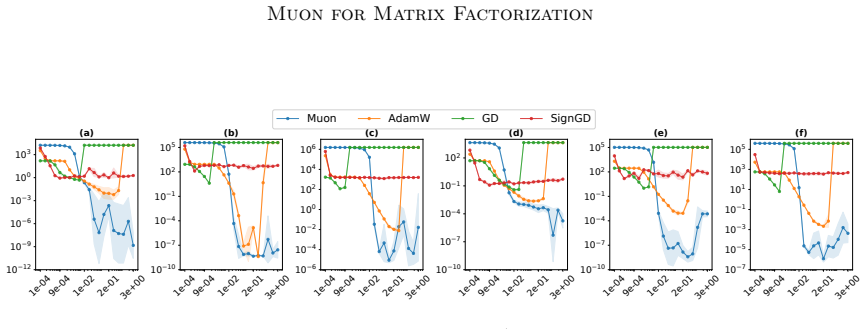
The paper's central claim is that Muon's strong large-scale results do not transfer to controlled low-rank factorization. Across five problem families—symmetric factorization, matrix completion, nonnegative factorization, Gaussian-kernel factorization, and tensor-train factorization—the authors sweep learning rate exhaustively while holding model capacity fixed. Under this tuning, AdamW and plain gradient descent match or beat Muon on symmetric factorization and completion, reaching losses as low as 1e-13 while Muon plateaus around 1e-8 to 1e-5; on NMF, Muon consistently wins, reaching 1e-9 to 1e-6 while AdamW stalls near 1e-3. Rankings at a fixed default learning rate often reverse after tu
What carries the argument
The load-bearing mechanism is Muon's update rule: maintain a momentum buffer, replace it by an approximate polar factor computed with Newton-Schulz iterations, then step in that direction. The polar factor sets every singular value of the update to 1 while preserving singular vectors, making Muon a spectral-norm steepest-descent method. The paper's experimental machinery is the comparison protocol: fixed small matrix problems, log-spaced learning-rate sweeps, and the stable learning-rate range as the meaningful performance metric. An auxiliary analytical result casts AdamW as solving a per-coordinate adaptive trust-region problem and Muon as solving the Orthogonal Procrustes problem, giving
Load-bearing premise
The paper defines 'well-tuned' as sweeping only the learning rate, while Muon's momentum, Newton-Schulz iteration count, and orthogonalization polynomial coefficients are held fixed at values inherited from large-model practice, so those fixed choices could be masking a better Muon configuration on small factorization problems.
What would settle it
Repeat the same factorization benchmark while sweeping Muon's Newton-Schulz iteration count (for example, J = 3, 5, 8, 12) and the orthogonalization polynomial coefficients alongside the learning rate; if some Muon configuration reaches AdamW's 1e-13 loss floor or beats AdamW at condition number 625, the paper's central claim would be falsified.
If this is right
- Muon's reported advantage over AdamW on large-scale models does not automatically transfer to simple, well-understood optimization problems.
- Well-tuned AdamW and plain gradient descent match or exceed Muon on symmetric low-rank factorization and matrix completion, so claims of Muon superiority need conditioning on problem structure.
- Muon retains a consistent advantage on nonnegative matrix factorization, suggesting its orthogonalized updates help when the target has nonnegativity constraints and redundant factor directions.
- Single-configuration optimizer rankings are unreliable: in nearly all tested settings, the ranking at a default learning rate differs from the ranking after per-optimizer tuning.
- Ill-conditioning and the shape of the eigenvalue distribution, not merely the condition number, determine which optimizer wins, so benchmark conclusions should report a range of conditioning regimes.
Where Pith is reading between the lines
- Editorial extension: if the same pattern holds in other structured problems, Muon's benefit may be tied to problems with symmetry or redundancy constraints rather than to spectral conditioning alone.
- Editorial extension: the paper's 'well-tuned' definition sweeps only the learning rate; jointly tuning Muon's Newton-Schulz iteration count and orthogonalization coefficients could shrink the gap on factorization and completion.
- Editorial extension: the spectral-subspace alignment dynamics suggest a testable prediction that Muon will excel exactly where per-coordinate adaptivity overspecializes to dominant directions, such as highly imbalanced or long-tailed spectra.
Editorial analysis
A structured set of objections, weighed in public.
Referee Report
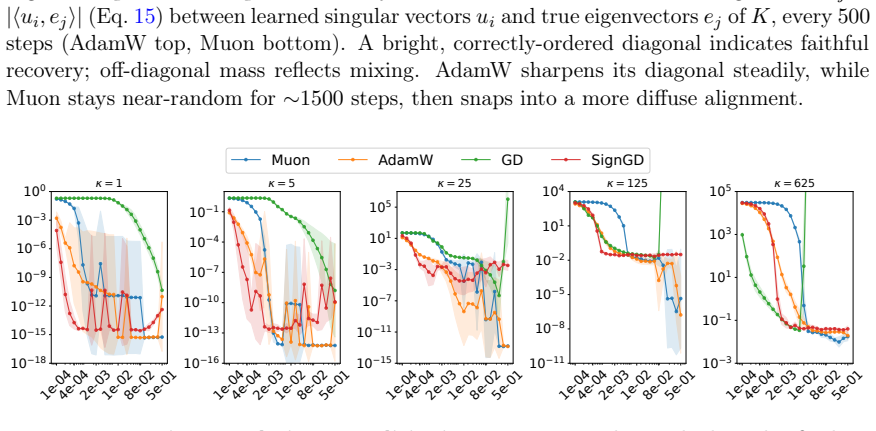
Summary. The paper studies the Muon optimizer on low-rank matrix factorization, matrix completion, nonnegative matrix factorization, Gaussian-kernel factorization, and tensor-train factorization. Its central claim is that Muon does not consistently outperform AdamW in these settings and that its previously reported advantages are problem-dependent: with per-optimizer learning-rate tuning, AdamW and GD match or beat Muon on plain factorization, AdamW and Muon are comparable on completion, and Muon wins on NMF. The authors also analyze sensitivity to spectral shape at fixed condition number and investigate spectral subspace recovery dynamics. They conclude that optimizer rankings should be reported across tuned hyperparameter ranges and conditioning regimes, not at single default configurations.
Significance. If fully established, the paper would be a useful counterweight to LLM-scale claims that Muon dominates AdamW, and it would support the methodological recommendation to compare optimizers over tuned hyperparameter ranges. The paper has genuine strengths: multiple controlled problem settings, explicit caveats about problem-dependence, a detailed spectrum-family analysis, an analytical derivation of the AdamW and Muon updates in Appendix K, and a mechanistic alignment study. However, the headline 'under equal tuning' is stronger than the protocol supports, because the paper tunes only the learning rate while holding Muon-specific hyperparameters at LLM-scale defaults. The central negative claim is therefore not yet fully established; the evidence is consistent with a more modest claim about LR-only tuning with standard Muon hyperparameters.
major comments (3)
- [§3.2 and Findings] The protocol tunes only the learning rate: 'holding all other hyperparameters (momentum, and for Muon the Newton–Schulz count J and the orthogonalization coefficients) at standard values.' The Muon-specific values (µ=0.95, J=5, and the quintic coefficients (3.4445,-4.7750,2.0315)) are inherited from LLM-scale practice. These are optimizer hyperparameters, so the conclusion that Muon's advantage disappears 'under equal tuning' is not established by this protocol. The paper should either add a sensitivity analysis for J, the orthogonalization polynomial, and momentum (at least on the factorization and completion settings where Muon loses), or revise the claim to 'when only the learning rate is tuned and Muon uses its standard defaults.' Appendix I already contains a similar acknowledgment for the depth experiment; a parallel caveat is needed for the main claim.
- [Appendix K, Eq. (36); §3.2] Appendix K derives that, for the same learning rate η, AdamW's update has Frobenius norm roughly √N times larger than Muon's (Eq. (36)); with N=100 this factor is about 10. Yet the learning-rate grid is identical for all optimizers (25 points in [1e-4, 5e-1] for factorization/completion, 20 points in [1e-4, 3.2] for NMF). If Muon's optimal learning rate lies above the grid, the reported 'tuned' Muon loss is not its true tuned loss. The paper does not report the location of each optimizer's best learning rate relative to the grid boundaries. Please add this information, and either extend the grid or rescale the Muon learning rate by roughly √N to rule out an asymmetric search artifact.
- [Table 1; §4] Several 'tuned winner' conclusions are based on 3-seed geometric means with differences of only a factor of 2–3 (e.g., completion κ=1: Muon 1.4×10^-16 vs AdamW 4.8×10^-16; completion κ=5: 5.7×10^-15 vs 5.5×10^-15). These are within the reported log-std bands and cannot support a ranking. The large gaps on factorization and NMF are robust, but for the near-tie rows the paper should report per-seed values or otherwise state a criterion for declaring a winner. This matters because the paper's 'tuned ranking varies across problems' narrative depends on many such comparisons.
minor comments (5)
- [§2] Typographical errors: 'We an analyze the exact softplus' and 'Moreover, We analyze' should be cleaned up.
- [Appendix K.2] The text cites 'Loshchilov & Hutter (2017)' but this reference is missing from the reference list. Please add it.
- [Figure 6 and Eq. (15)] The alignment matrix M_ij uses 'learned singular vectors u_i' and 'true eigenvectors e_j', but the relation between u_i and the factor matrices is not defined in the main text. Please clarify the notation and ordering used to compute M.
- [Table 1] The row labels for the completion and NMF blocks are visually confusing ('Completion (κ)', 'κ=14.6×10^-16', etc.). Align the condition number/rank values with the loss values, e.g., by using separate columns.
- [General] No code or data repository is linked. For an empirical benchmark paper, a reproducibility statement with code and seeds would substantially strengthen the contribution.
Circularity Check
No circular derivation; all central claims are empirical comparisons with acknowledged protocol limitations.
full rationale
The paper does not derive any prediction from a fitted parameter or from a self-citation chain. Its central claims (Muon does not consistently beat AdamW on factorization/completion, but wins on NMF) are empirical findings from learning-rate sweeps, summarized in Table 1 and Figures 1-2. Appendix K derives the AdamW and Muon updates from their defining proxy problems (Propositions 1 and 2, Eqs. 19-36); these derivations do not assume the comparative conclusion. The only possible concern is Section 3.2's protocol, which tunes only the learning rate while holding momentum and Muon's Newton-Schulz J/coefficients 'at standard values'; that is a fairness/coverage limitation that could affect the strength of the 'equal tuning' wording, but it is not a circular reduction: no fitted value is renamed as a prediction and no equation equals the target result by construction. Appendix I also transparently states two limitations of the TT-depth comparison. Self-citations (Parviz & Yoshida 2025; Jha et al. 2026; Sghaier et al. 2026) appear only in related-work passages and are not load-bearing for any central result. Score 0.
Axiom & Free-Parameter Ledger
free parameters (3)
- Muon orthogonalization coefficients (a,b,c) =
3.4445, -4.7750, 2.0315
- Newton-Schulz iteration count J =
5
- Muon momentum mu =
0.95
axioms (3)
- domain assumption Low-rank matrix factorization is a valid controlled testbed for spectral optimizers whose advantages were reported in deep learning.
- ad hoc to paper Sweeping only the learning rate, while holding all other hyperparameters fixed, constitutes fair per-optimizer tuning.
- domain assumption A fixed 3000-iteration budget with a patience-based decay schedule is sufficient for all optimizers to reach their attainable floors.
read the original abstract
Muon has recently emerged as a strong optimizer for large-scale deep learning, where it reshapes gradient updates through approximate orthogonalization and has been reported to outperform Adam and AdamW in large language model training. Its empirical success has motivated a growing body of theoretical work that interprets Muon as steepest descent under the spectral norm. Yet it remains unclear which of Muon's advantages stem from its update rule itself and which are artifacts of the scale, architecture, and data of modern deep networks. In this work, we isolate the optimizer from these confounding factors by studying Muon on a simple, well-understood, and spectrally structured problem: low-rank matrix factorization. Through a controlled comparison against carefully tuned adaptive baselines, we find that Muon does not consistently outperform AdamW in this setting and that several previously reported advantages are sensitive to hyperparameter choices. Our results provide a more nuanced picture of when spectrum-aware orthogonalization is beneficial and argue for evaluating modern optimizers on controlled problems in addition to end-to-end benchmarks.
Figures






Reference graph
Works this paper leans on
-
[1]
2024 , note =
Keller Jordan , title =. 2024 , note =
2024
-
[2]
Jingyuan Liu and Jianlin Su and Xingcheng Yao and Zhejun Jiang and Guokun Lai and Yulun Du and Yidao Qin and Weixin Xu and Enzhe Lu and Junjie Yan and Yanru Chen and Huabin Zheng and Yibo Liu and Shaowei Liu and Bohong Yin and Weiran He and Han Zhu and Yuzhi Wang and Jianzhou Wang and Mengnan Dong and Zheng Zhang and Yongsheng Kang and Hao Zhang and Xinra...
-
[3]
Shuntaro Nagashima and Hideaki Iiduka , year=. Improved Convergence Rates of. 2601.19400 , archivePrefix=
-
[4]
Training Deep Learning Models with Norm-Constrained LMOs , booktitle =
Thomas Pethick and Wanyun Xie and Kimon Antonakopoulos and Zhenyu Zhu and Antonio Silveti. Training Deep Learning Models with Norm-Constrained LMOs , booktitle =. 2025 , url =
2025
-
[5]
2022 , eprint=
Orthogonalising gradients to speed up neural network optimisation , author=. 2022 , eprint=
2022
-
[6]
Proceedings of the 35th International Conference on Machine Learning,
Jeremy Bernstein and Yu. Proceedings of the 35th International Conference on Machine Learning,. 2018 , url =
2018
-
[7]
Preconditioning Benefits of Spectral Orthogonalization in
Jianhao Ma and Yu Huang and Yuejie Chi and Yuxin Chen , year=. Preconditioning Benefits of Spectral Orthogonalization in. 2601.13474 , archivePrefix=
-
[8]
arXiv preprint arXiv:2604.04356 , year=
REAM: Merging improves pruning of experts in LLMs , author=. arXiv preprint arXiv:2604.04356 , year=
-
[9]
New Perspectives in Graph Machine Learning , year=
Nonlinear Laplacians Improve Signed-Directed Graph Learning , author=. New Perspectives in Graph Machine Learning , year=
-
[10]
International conference on machine learning , pages=
On the optimization of deep networks: Implicit acceleration by overparameterization , author=. International conference on machine learning , pages=. 2018 , organization=
2018
-
[11]
arXiv preprint arXiv:1711.00811 , year=
Expressive power of recurrent neural networks , author=. arXiv preprint arXiv:1711.00811 , year=
-
[12]
arXiv preprint arXiv:2605.19943 , year=
Probabilistic Tiny Recursive Model , author=. arXiv preprint arXiv:2605.19943 , year=
-
[13]
Conference on learning theory , pages=
On the expressive power of deep learning: A tensor analysis , author=. Conference on learning theory , pages=. 2016 , organization=
2016
-
[14]
Advances in neural information processing systems , volume=
Tensorizing neural networks , author=. Advances in neural information processing systems , volume=
-
[15]
Jiaxiang Li and Mingyi Hong , year=. A Note on the Convergence of. 2502.02900 , archivePrefix=
-
[16]
Artem Riabinin and Egor Shulgin and Kaja Gruntkowska and Peter Richt. Gluon: Making. CoRR , volume =. 2025 , url =. doi:10.48550/ARXIV.2505.13416 , eprinttype =. 2505.13416 , timestamp =
-
[17]
Wei Shen and Ruichuan Huang and Minhui Huang and Cong Shen and Jiawei Zhang , title =. CoRR , volume =. 2025 , url =. doi:10.48550/ARXIV.2505.23737 , eprinttype =. 2505.23737 , timestamp =
-
[18]
Lizhang Chen and Jonathan Li and Qiang Liu , title =. CoRR , volume =. 2025 , url =. doi:10.48550/ARXIV.2506.15054 , eprinttype =. 2506.15054 , timestamp =
-
[19]
Convergence Bound and Critical Batch Size of
Naoki Sato and Hiroki Naganuma and Hideaki Iiduka , year=. Convergence Bound and Critical Batch Size of. 2507.01598 , archivePrefix=
-
[20]
Journal of Machine Learning Research , year =
Vardan Papyan , title =. Journal of Machine Learning Research , year =
-
[21]
Proceedings of the 36th International Conference on Machine Learning , pages =
An Investigation into Neural Net Optimization via Hessian Eigenvalue Density , author =. Proceedings of the 36th International Conference on Machine Learning , pages =. 2019 , editor =
2019
-
[22]
Eigenvalues of the Hessian in Deep Learning: Singularity and Beyond , journal =
Levent Sagun and L. Eigenvalues of the Hessian in Deep Learning: Singularity and Beyond , journal =. 2017 , url=
2017
-
[23]
Levent Sagun and Utku Evci and V. Ugur G. Empirical Analysis of the Hessian of Over-Parametrized Neural Networks , booktitle =. 2018 , url =
2018
-
[24]
Investigating the Overlooked Hessian Structure: From
Qian-Yuan Tang and Yufei Gu and Yunfeng Cai and Mingming Sun and Ping Li and zhou Xun and Zeke Xie , booktitle=. Investigating the Overlooked Hessian Structure: From. 2025 , url=
2025
-
[25]
Measure Theory, Probability, and Stochastic Processes , series =. 2022 , isbn =. doi:10.1007/978-3-031-14205-5 , url =
-
[26]
Ishaan Shah and Anthony M. Polloreno and Karl Stratos and Philip Monk and Adarsh Chaluvaraju and Andrew Hojel and Andrew Ma and Anil Thomas and Ashish Tanwer and Darsh J. Shah and Khoi Nguyen and Kurt Smith and Michael Callahan and Michael Pust and Mohit Parmar and Peter Rushton and Platon Mazarakis and Ritvik Kapila and Saurabh Srivastava and Somanshu Si...
-
[27]
Proceedings of the 39th International Conference on Machine Learning , pages =
Only tails matter: Average-Case Universality and Robustness in the Convex Regime , author =. Proceedings of the 39th International Conference on Machine Learning , pages =. 2022 , volume =
2022
-
[28]
2019 , eprint=
Hessian based analysis of SGD for Deep Nets: Dynamics and Generalization , author=. 2019 , eprint=
2019
-
[29]
2019 , url=
Gradient Descent Happens in a Tiny Subspace , author=. 2019 , url=
2019
-
[30]
Minhak Song and Kwangjun Ahn and Chulhee Yun , booktitle=. Does. 2025 , url=
2025
-
[31]
Proceedings of the 37th International Conference on Machine Learning , pages =
Acceleration through spectral density estimation , author =. Proceedings of the 37th International Conference on Machine Learning , pages =. 2020 , volume =
2020
-
[32]
Dmitry Kovalev , title =. CoRR , volume =. 2025 , url =. doi:10.48550/ARXIV.2503.12645 , eprinttype =. 2503.12645 , timestamp =
-
[33]
Beyond the Ideal: Analyzing the Inexact
Egor Shulgin and Sultan AlRashed and Francesco Orabona and Peter Richt. Beyond the Ideal: Analyzing the Inexact. CoRR , volume =. 2025 , url =. doi:10.48550/ARXIV.2510.19933 , eprinttype =. 2510.19933 , timestamp =
-
[34]
Kaja Gruntkowska and Alexander Gaponov and Zhirayr Tovmasyan and Peter Richt. Error Feedback for. CoRR , volume =. 2025 , url =. doi:10.48550/ARXIV.2510.00643 , eprinttype =. 2510.00643 , timestamp =
-
[35]
Convergence of
Kim, Gyu Yeol and Oh,. Convergence of. The Fourteenth International Conference on Learning Representations , year=
-
[36]
Damek Davis and Dmitriy Drusvyatskiy , title =. CoRR , volume =. 2025 , url =. doi:10.48550/ARXIV.2512.04299 , eprinttype =. 2512.04299 , timestamp =
-
[37]
Weijie Su , title =. CoRR , volume =. 2025 , url =. doi:10.48550/ARXIV.2511.00674 , eprinttype =. 2511.00674 , timestamp =
-
[38]
Noah Amsel and David Persson and Christopher Musco and Robert Gower , title =. CoRR , volume =. 2025 , url =. doi:10.48550/ARXIV.2505.16932 , eprinttype =. 2505.16932 , timestamp =
-
[39]
2025 , eprint=
Factorization-free Orthogonal Projection onto the Positive Semidefinite Cone with Composite Polynomial Filtering , author=. 2025 , eprint=
2025
-
[40]
2024 , url =
Keller Jordan and Jeremy Bernstein and Brendan Rappazzo and @fernbear.bsky.social and Boza Vlado and You Jiacheng and Franz Cesista and Braden Koszarsky and @Grad62304977 , title =. 2024 , url =
2024
-
[41]
Ekaterina Grishina and Matvey Smirnov and Maxim V. Rakhuba , title =. CoRR , volume =. 2025 , url =. doi:10.48550/ARXIV.2506.10935 , eprinttype =. 2506.10935 , timestamp =
-
[42]
2025 , month =
Franz Louis Cesista and You Jiacheng and Keller Jordan , title =. 2025 , month =
2025
-
[43]
Tim Tsz. PolarGrad:. CoRR , volume =. 2025 , url =. doi:10.48550/ARXIV.2505.21799 , eprinttype =. 2505.21799 , timestamp =
-
[44]
2025 , url =
Boumal, Nicolas and Gonon, Antoine , title =. 2025 , url =
2025
-
[45]
Advances in neural information processing systems , volume=
Implicit regularization in deep matrix factorization , author=. Advances in neural information processing systems , volume=
-
[46]
Advances in neural information processing systems , volume=
Implicit regularization in matrix factorization , author=. Advances in neural information processing systems , volume=
-
[47]
2025 , eprint=
Dion: Distributed Orthonormalized Updates , author=. 2025 , eprint=
2025
-
[48]
Chuan He and Zhanwang Deng and Zhaosong Lu , title =. CoRR , volume =. 2025 , url =. doi:10.48550/ARXIV.2509.11983 , eprinttype =. 2509.11983 , timestamp =
-
[49]
Feihu Huang and Yuning Luo and Songcan Chen , title =. CoRR , volume =. 2025 , url =. doi:10.48550/ARXIV.2509.14562 , eprinttype =. 2509.14562 , timestamp =
-
[50]
Ahmed Khaled and Kaan Ozkara and Tao Yu and Mingyi Hong and Youngsuk Park , title =. CoRR , volume =. 2025 , url =. doi:10.48550/ARXIV.2510.16981 , eprinttype =. 2510.16981 , timestamp =
-
[51]
Rui Pan and Yang Luo and Yuxing Liu and Yang You and Tong Zhang , title =. CoRR , volume =. 2025 , url =. doi:10.48550/ARXIV.2510.17802 , eprinttype =. 2510.17802 , timestamp =
-
[52]
Why transformers need
Zhang, Yushun and Chen, Congliang and Ding, Tian and Li, Ziniu and Sun, Ruoyu and Luo, Zhiquan , journal=. Why transformers need
-
[53]
Provable acceleration of
Xu, Zhenghao and Wang, Yuqing and Zhao, Tuo and Ward, Rachel and Tao, Molei , booktitle=. Provable acceleration of
-
[54]
Conference On Learning Theory , pages=
Algorithmic regularization in over-parameterized matrix sensing and neural networks with quadratic activations , author=. Conference On Learning Theory , pages=. 2018 , organization=
2018
-
[55]
arXiv preprint arXiv:2409.20325 , year=
Old optimizer, new norm: An anthology , author=. arXiv preprint arXiv:2409.20325 , year=
-
[56]
Advances in neural information processing systems , volume=
Preconditioned spectral descent for deep learning , author=. Advances in neural information processing systems , volume=
-
[57]
Training deep learning models with norm-constrained
Pethick, Thomas and Xie, Wanyun and Antonakopoulos, Kimon and Zhu, Zhenyu and Silveti-Falls, Antonio and Cevher, Volkan , journal=. Training deep learning models with norm-constrained
-
[58]
BIT Numerical Mathematics , volume=
Perturbation bounds in connection with singular value decomposition , author=. BIT Numerical Mathematics , volume=. 1972 , publisher=
1972
-
[59]
Proceedings of the International Congress of Mathematicians 2010 , pages=
Non-asymptotic theory of random matrices: extreme singular values , author=. Proceedings of the International Congress of Mathematicians 2010 , pages=. 2010 , organization=
2010
-
[60]
Numerical Linear Algebra with Applications , volume=
Some remarks on the perturbation of polar decompositions for rectangular matrices , author=. Numerical Linear Algebra with Applications , volume=. 2006 , publisher=
2006
-
[61]
International Conference on Machine Learning , pages=
Shampoo: Preconditioned stochastic tensor optimization , author=. International Conference on Machine Learning , pages=. 2018 , organization=
2018
-
[62]
2018 , organization=
Bernstein, Jeremy and Wang, Yu-Xiang and Azizzadenesheli, Kamyar and Anandkumar, Animashree , booktitle=. 2018 , organization=
2018
-
[63]
Stat , volume=
On the non-asymptotic and sharp lower tail bounds of random variables , author=. Stat , volume=. 2020 , publisher=
2020
-
[64]
SIAM journal on Matrix Analysis and Applications , volume=
The geometry of algorithms with orthogonality constraints , author=. SIAM journal on Matrix Analysis and Applications , volume=. 1998 , publisher=
1998
-
[65]
2013 , publisher=
Matrix computations , author=. 2013 , publisher=
2013
-
[66]
SIAM Journal on Matrix Analysis and Applications , volume=
New perturbation bounds for the unitary polar factor , author=. SIAM Journal on Matrix Analysis and Applications , volume=. 1995 , publisher=
1995
-
[67]
SIAM journal on matrix analysis and applications , volume=
Perturbation bounds of unitary and subunitary polar factors , author=. SIAM journal on matrix analysis and applications , volume=. 2002 , publisher=
2002
-
[68]
arXiv preprint arXiv:2410.21265 , year=
Modular duality in deep learning , author=. arXiv preprint arXiv:2410.21265 , year=
-
[69]
IEEE Journal of Selected Topics in Signal Processing , volume=
Stochastic spectral descent for discrete graphical models , author=. IEEE Journal of Selected Topics in Signal Processing , volume=. 2015 , publisher=
2015
-
[70]
Transformers are
Katharopoulos, Angelos and Vyas, Apoorv and Pappas, Nikolaos and Fleuret, Fran. Transformers are. International conference on machine learning , pages=. 2020 , organization=
2020
-
[71]
2008 , publisher=
Functions of matrices: theory and computation , author=. 2008 , publisher=
2008
-
[72]
Stochastic spectral descent for restricted
Carlson, David and Cevher, Volkan and Carin, Lawrence , booktitle=. Stochastic spectral descent for restricted. 2015 , organization=
2015
-
[73]
arXiv preprint arXiv:2202.07052 , year=
Orthogonalising gradients to speed up neural network optimisation , author=. arXiv preprint arXiv:2202.07052 , year=
-
[74]
arXiv preprint arXiv:2504.16041 , year=
Muon Optimizer Accelerates Grokking , author=. arXiv preprint arXiv:2504.16041 , year=
-
[75]
arXiv preprint arXiv:2310.01769 , year=
How over-parameterization slows down gradient descent in matrix sensing: The curses of symmetry and initialization , author=. arXiv preprint arXiv:2310.01769 , year=
-
[76]
The Polar Express: Optimal Matrix Sign Methods and Their Application to the
Amsel, Noah and Persson, David and Musco, Christopher and Gower, Robert , journal=. The Polar Express: Optimal Matrix Sign Methods and Their Application to the
-
[77]
Practical efficiency of
Shah, Ishaan and Polloreno, Anthony M and Stratos, Karl and Monk, Philip and Chaluvaraju, Adarsh and Hojel, Andrew and Ma, Andrew and Thomas, Anil and Tanwer, Ashish and Shah, Darsh J , journal=. Practical efficiency of
-
[78]
Understanding
Maes, Lucas and Zhang, Tianyue H and Jolicoeur-Martineau, Alexia and Mitliagkas, Ioannis and Scieur, Damien and Lacoste-Julien, Simon and Guille-Escuret, Charles , journal=. Understanding
-
[79]
Towards quantifying the preconditioning effect of
Das, Rudrajit and Agarwal, Naman and Sanghavi, Sujay and Dhillon, Inderjit S , journal=. Towards quantifying the preconditioning effect of
-
[80]
arXiv preprint arXiv:2502.01763 , year=
On The Concurrence of Layer-wise Preconditioning Methods and Provable Feature Learning , author=. arXiv preprint arXiv:2502.01763 , year=
discussion (0)
Sign in with ORCID, Apple, or X to comment. Anyone can read and Pith papers without signing in.