REVIEW 4 major objections 6 minor 60 references
Step-by-step, vision-checked reasoning produces better 3D indoor layouts than one-shot planning.
Reviewed by Pith at T0; open to challenge. T0 means a machine referee read the full paper against a public rubric. the ladder, T0–T4 →
T0 review · deepseek-v4-flash
2026-08-02 04:53 UTC pith:MAUCUEY6
load-bearing objection A solid progressive-reasoning system for 3D layout with a useful dataset and sensible RL, but the semantic claim is only partly established because GPT-4o is both reward and judge. the 4 major comments →
ThinkBLOX: 3D Indoor Scene Generation with Progressive Reasoning
The pith
A machine-rendered reading of the paper's core claim, the machinery that carries it, and where it could break.
Core claim
At the paper's core is the claim that layout quality comes from decomposing synthesis into state-conditioned steps. At each step the model receives the user prompt, the current partial layout in JSON, a rendered view of the scene with coordinate grid marks, and the target object; it emits a <think> rationale and a structured <answer> from which the placement is parsed. This lets each decision be anchored to visual evidence and gives the model a way to recover from context, rather than committing to a full layout in one pass. On top of that, the paper introduces a tiered RL scheme that normalizes rewards separately for physical validity, semantic aesthetics, and reasoning-action grounding, ar
What carries the argument
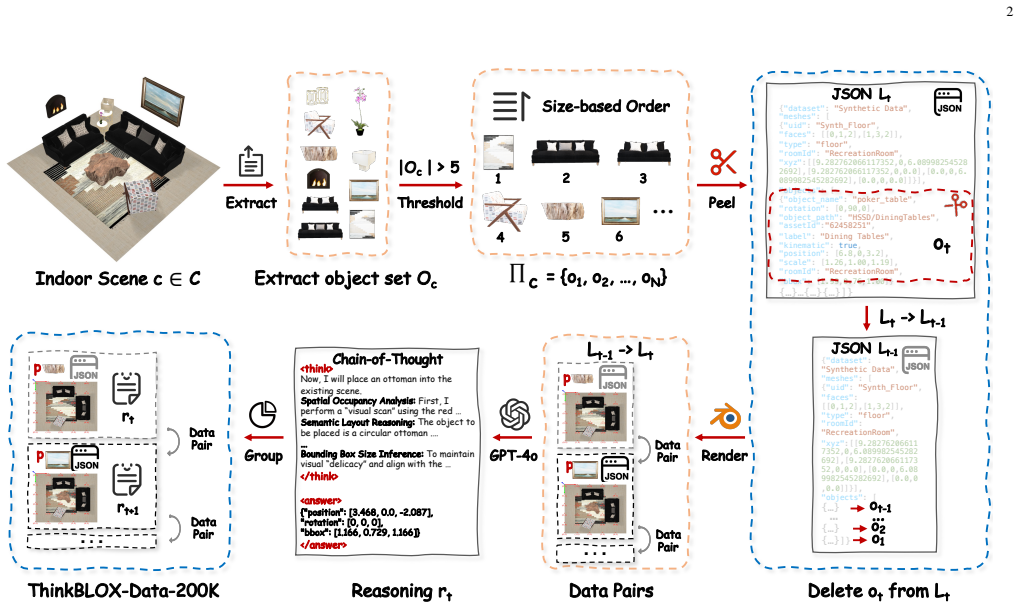
The carrying mechanism is the progressive reason-then-act loop. It is trained on ThinkBLOX-Data-200K, a set of 224,757 procedural placement pairs built by peeling objects out of complete scenes (large to small) and pairing each step with multi-view images, a chain-of-thought rationale, and a JSON layout. The second mechanism is Tier-Decoupled GDPO, a policy update that normalizes rewards tier by tier: hard constraints (format, collision, boundary), soft semantics (functional alignment and a vision-language “yes” confidence), and reasoning-action consistency are each normalized within their own group before the advantages are weighted and combined. The loop supplies the reasoning step, and th
Load-bearing premise
The load-bearing premise is that the vision-language judge used for the semantic reward and the final semantic score is a valid, neutral measure of layout quality; because the same judge helps write the training rationales and scores the output, the semantic advantage could partly measure stylistic self-consistency rather than true scene quality.
What would settle it
Have a vision-language model that played no role in data creation, reward design, or evaluation score the same set of outputs, and compare its ranking with the human study; if the ThinkBLOX lead shrinks or flips when the training judge is not involved, the semantic gain is driven by alignment with the evaluator, not by a general improvement in scene quality.
If this is right
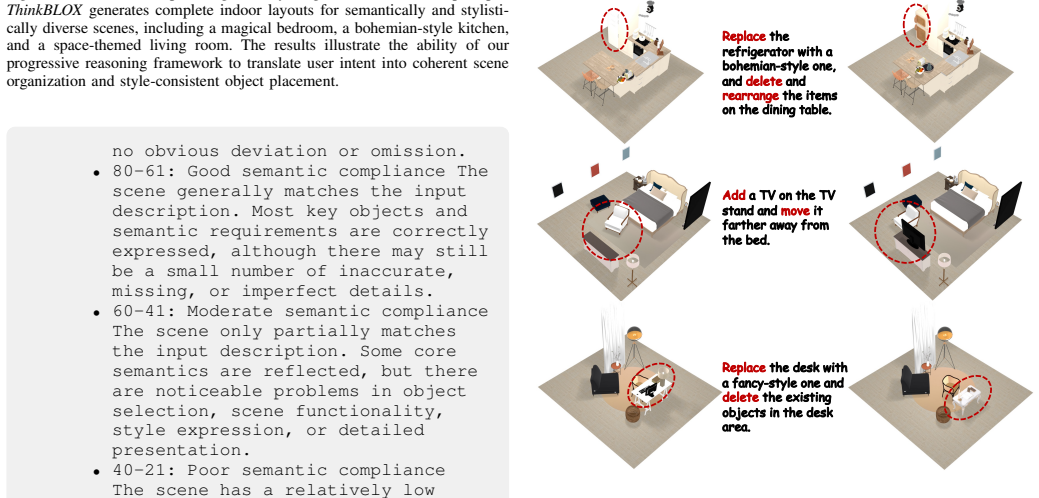
- If the claims hold, local edits (add, move, replace, delete) modify only the target object or region, so an interactive user no longer triggers a full re-layout.
- Physical plausibility and semantic coherence improve together rather than trading off, which one-shot planners typically force.
- Dense, object-heavy scenes become tractable, since each placement is conditioned on the actual partial scene instead of predicted all at once.
- The same inference loop covers global generation, global rearrangement, and local rearrangement, so one model serves several interactive tasks.
- Tier-separated reward normalization generalizes as a recipe for other multi-objective generation tasks with conflicting criteria.
Where Pith is reading between the lines
- Beyond the paper: the reported semantic metric may partly reflect consistency with the same judge used for training and evaluation; a judge that never created any rationale or reward signal would tell whether the gain is general scene quality.
- Beyond the paper: the order in which objects are placed is an implicit curriculum. Since the dataset peels scenes in size order, the model may inherit a large-anchor-first bias; training on multiple peel orders or searching over placement orders could improve robustness.
- Beyond the paper: the reasoning-action consistency reward resembles grounding an agent's verbal plan to actual world coordinates, so the framework may transfer to embodied rearrangement tasks where a robot must verify each step against a visual state.
- Beyond the paper: the measured improvements on collision-free and in-boundary scores suggest that explicit visual feedback (rendered current scene plus grid marks) could be a cheap add-on for existing one-shot systems, turning them into progressive refiners without full retraining.
Editorial analysis
A structured set of objections, weighed in public.
Referee Report
Summary. The paper proposes ThinkBLOX, a VLM-based framework for 3D indoor scene generation that replaces one-shot layout prediction with a progressive, state-conditioned reason-then-act process. The authors construct ThinkBLOX-Data-200K, a dataset of 224,757 placement pairs with GPT-4o-generated CoT rationales and structured JSON layouts, perform SFT from Qwen2.5-VL-7B, and then apply a proposed Tier-Decoupled GDPO scheme with three reward tiers: physical validity, semantic aesthetics, and reasoning-action consistency. At inference, the model plans a global placement order and then places objects one by one, supporting local editing without global re-layout. The experiments compare against LayoutGPT, Holodeck, I-Design, and MetaSpatial on the LayoutVLM benchmark, reporting gains in CF/IB, positional/rotational coherency, and the PSA score, with additional cross-model and human evaluation. The abstract claims significant improvements in physical plausibility, semantic alignment, and interactive editability.
Significance. If the results hold, the work is significant: it addresses a real limitation of one-shot layout generators by making layout synthesis interactive and incremental, and it provides a large training dataset plus a reward-grouping scheme for multi-objective RL in a multimodal setting. The physical-plausibility claims are supported by objective geometric scores (CF/IB), and the ablations are extensive enough to show that the proposed components contribute. The cross-model and human studies are constructive attempts at robustness. However, the semantic half of the headline claim is currently not established because the training and evaluation loop overlaps on GPT-4o, the semantic metrics are not defined precisely, and the main comparison table lacks error bars and significance testing. The paper is therefore promising but needs substantial evidence before the central claim can be accepted.
major comments (4)
- [§III.A.2.b, §IV.c, §V.A.1] The semantic evaluation is partially closed-loop. GPT-4o generates the CoT training data (Sec. IV.c), GPT-4o's “Yes” log-probability is used as the dense semantic reward R_render = exp(log p_yes) during RL (Sec. III.A.2.b), and the PSA score is computed using a GPT-4o-based semantic rating (Sec. V.A.1). The reported PSA advantage (ThinkBLOX 51.8 vs MetaSpatial 38.6) may therefore partly measure alignment with the training-time judge rather than intrinsic layout quality. Table II and the human study are genuine mitigations, but Gemini 3 and Qwen3-VL belong to the same VLM family and the human study has only 33 participants with no reported significance tests. The paper should report semantic accuracy using a judge or metric that was not used for reward optimization, provide per-item correlation of R_render with human judgments, and state whether the PSA judge is identical to the reward ju
- [Table I] Table I reports CF, IB, Pos., Rot., and PSA without error bars or significance tests. The percentages appear in increments of 11.1, which implies roughly 9 evaluated scenes per room category. For example, the Living Room row shows CF=22.2 and PSA=9.9 for ThinkBLOX, which is inconsistent with the overall average and suggests high per-category variance. Because the paper claims consistency across room categories and significant overall improvement, the authors should report the number of scenes per category, confidence intervals, and paired statistical tests against each baseline. The ablation table (Table III) includes ± intervals, so there is no methodological reason to omit them from the main comparison.
- [§V.A.1] The semantic metrics Pos. Coherency and Rot. Coherency are never defined. The manuscript only states that they measure whether the layout aligns with the textual prompt, but it does not specify the algorithm, the thresholding, the evaluator, or whether the scores are continuous or binary. Since these numbers appear in Table I and Table III and are used to support the semantic-alignment claim, the lack of a precise definition prevents independent reproduction. The authors should provide the exact computation procedure or release the evaluation script.
- [Eq. (1), §III.A.2.c] Equation (1) performs a group-relative normalization per tier by dividing by std{r_k^(i,1..G)} with no additive epsilon. If a tier's reward is constant across the G rollouts—which can easily occur for S_cons when the parser always matches or for S_hard when all rollouts are collision-free and in-bounds—the advantage is undefined or infinite. The epsilon is only added in the later batch-wise normalization (Eq. (3)), not at the tier level. This is a stability issue in the core algorithmic contribution. Please add a guarded denominator and report the frequency of zero-variance tiers during training.
minor comments (6)
- [Abstract / Table I] The abstract says “11 room types,” but Table I appears to list 12 categories (Bedroom through Game Room). Please correct the count.
- [Table III] The rows labeled “SFT (one-shot) w/or n” and “SFT w/or n” are presumably typos for “w/o r_n” and “w/o r_n” given the section title “Ablating Progressive Reasoning.” Please fix the notation.
- [§IV.d] The quality-filtering criterion uses “Levenshtein similarity between the original and re-predicted answers,” but it does not say which model performs the re-prediction. Please specify the model and inference setting used for the consistency check.
- [§III.A.2.b] Please clarify the exact computation of R_render = exp(log p_yes): whether log p_yes is the raw logit, the log-softmax value, whether it is normalized by sequence length, and how cases with p_yes=0 or log p_yes=0 are handled. This matters for interpreting the reward scale and for reproducibility.
- [§IV.b / §III.B] The training dataset uses a size-based placement order, while inference uses a plan-based order. Please discuss whether this train-inference order mismatch is intentional and whether the model is robust to order changes beyond the ordering ablation shown in Table III.
- [Fig. 8 and §V.E] The human study text says “12 representative scenes” and “60 evaluated images,” while the figure caption says “12 room categories.” Please clarify whether the evaluation covered 12 scenes or 12 room categories; if the former, the claim that the advantage is stable across all 12 room categories is not supported.
Circularity Check
Semantic PSA gains are partially closed-loop: GPT-4o acts as both the RL reward and the PSA judge; cross-model and human checks mitigate but do not fully break the loop.
specific steps
-
fitted input called prediction
[Sec. III.A.2.b (Semantic Consistency reward) and Sec. V.A.1 (Evaluation Metrics)]
"To obtain a dense semantic reward, we query GPT-4o on whether the generated layout conforms to the instruction and use the log-probability of the “Yes” token: R render = e logprobyes, where Rrender ∈ [0,1] reflects the evaluator’s confidence. ... The PSA score is computed by integrating the GPT-4o-based semantic rating, where GPT-4o serves as a human-aligned evaluator [37], with the physical plausibility metric."
R_render is directly optimized during Tier-Decoupled GDPO: the policy is rewarded for increasing GPT-4o's “Yes” log-probability on the rendered layout. The headline semantic metric, PSA, is computed from the same GPT-4o semantic rating. Thus the reported semantic advantage (e.g., ThinkBLOX 51.8 vs MetaSpatial 38.6 PSA) is partly a measure of how well the policy fits the GPT-4o judge used as its own training signal, not an independent property of layout quality. The paper's cross-model judges (Gemini 3, Qwen3-VL-30B) and 33-participant human study are genuine mitigations, but the cross-model judges are still VLM judges, and the human study is small and reports no significance tests. The physical CF/IB metrics are geometric and independent, so the circularity burden is confined to the semant
full rationale
The physical-plausibility part of the claim rests on self-contained geometric metrics: CF and IB are rule-based and do not depend on the model being evaluated. The central semantic claim, however, is partially closed-loop. In training, R_render = exp(log p_yes) rewards the policy for eliciting GPT-4o's “Yes” on the rendered layout (Sec. III.A.2.b). In evaluation, the PSA score integrates GPT-4o's semantic rating (Sec. V.A.1). Consequently, a portion of the PSA gain over baselines that were never trained against this GPT-4o reward is forced by construction: the policy is fitted to the same judge that later scores it. This is compounded by the dataset construction, where the CoT rationales used for SFT are also generated by GPT-4o, further aligning the model to GPT-4o's preferences. The paper's evaluator-robustness experiment with two other VLM judges and the human study provide partial independent evidence, preventing a fully circular verdict. Nevertheless, because the primary automatic semantic metric is the same function as the training reward, the semantic half of the headline claim is not fully independent; an intermediate circularity score is warranted.
Axiom & Free-Parameter Ledger
free parameters (6)
- λ (collision gain) =
5.0
- Tier weights w_k (Eq. 2) =
not reported
- KL coefficient β =
0.004
- Rollout group size G =
8
- Dataset curation thresholds =
≥5 objects; ≥3 reasoning steps; Levenshtein similarity > 0.8
- Training hyperparameters =
LoRA rank 16, alpha 32, LR 2e-5, SFT 10K steps, GDPO 2K steps
axioms (6)
- domain assumption GPT-4o judgments are a valid, human-aligned measure of layout semantic quality
- domain assumption Greedy sequential placement conditioned on rendered partial scenes suffices for globally coherent layouts
- domain assumption GDPO is a stable value-model-free RL base and tier decoupling repairs its reward conflict
- domain assumption Large-to-small object ordering captures functionally correct placement dependencies
- domain assumption Parse() via template-guided regex faithfully recovers placements from free-form CoT
- domain assumption GPT-4o rationales passing textual-similarity filtering are correct placement explanations
read the original abstract
While traditional graphics methods often synthesize 3D indoor scenes autoregressively or hierarchically, recent vision-language model (VLM)-based generators predominantly adopt a one-shot paradigm where the full layout is planned at once. This one-shot approach often requires global re-optimization or complete reconstruction during interactive editing (e.g., inserting or moving objects) and can lead to physically or semantically poorly organized arrangements. To address these challenges, we propose ThinkBLOX, a VLM-based progressive reasoning framework that iteratively designs and refines 3D scenes. ThinkBLOX treats layout generation as a state-conditioned, step-by-step reasoningand-action process. To power this, we construct the ThinkBLOX-Data-200K dataset, containing 224,757 procedural placement pairs annotated with multi-view scene context, explicit Chain-of-Thought (CoT) rationales, and structured JSON layouts. Through supervised fine-tuning (SFT) on this dataset, the VLM learns to bridge the reasoning-action gap under incremental updates. Furthermore, recognizing that scene synthesis is inherently a multisolution task where SFT suffers from reward conflict, we introduce Tier-Decoupled GDPO. This reinforcement learning scheme organizes heterogeneous rewards into distinct tiers, stabilizing policy optimization across physical validity, semantic plausibility, and reasoning-action consistency. Extensive experiments show that ThinkBLOX significantly outperforms recent one-shot and iterative baselines in physical plausibility, semantic alignment, and interactive editability. Additionally, we show that it supports diverse applications, including both global and local generation and rearrangement of 3D scenes.
Figures





Reference graph
Works this paper leans on
-
[1]
arXiv preprint arXiv:2510.12095 , year=
Il3d: A large-scale indoor layout dataset for llm-driven 3d scene generation , author=. arXiv preprint arXiv:2510.12095 , year=
-
[2]
Liu, Shih-Yang and Dong, Xin and Lu, Ximing and Diao, Shizhe and Belcak, Peter and Liu, Mingjie and Chen, Min-Hung and Yin, Hongxu and Wang, Yu-Chiang Frank and Cheng, Kwang-Ting and others , journal=
-
[3]
IEEE Transactions on Visualization and Computer Graphics , year=
Chat2Layout: Interactive 3D furniture layout with a multimodal LLM , author=. IEEE Transactions on Visualization and Computer Graphics , year=
-
[4]
arXiv preprint arXiv:2406.03866 , year=
Llplace: The 3d indoor scene layout generation and editing via large language model , author=. arXiv preprint arXiv:2406.03866 , year=
-
[5]
Advances in Neural Information Processing Systems , volume=
Layoutgpt: Compositional visual planning and generation with large language models , author=. Advances in Neural Information Processing Systems , volume=
-
[6]
Proceedings of the Computer Vision and Pattern Recognition Conference , pages=
Layoutvlm: Differentiable optimization of 3d layout via vision-language models , author=. Proceedings of the Computer Vision and Pattern Recognition Conference , pages=
-
[7]
MetaSpatial: Reinforcing 3D Spatial Reasoning in
Zhenyu Pan and Han Liu , booktitle=. MetaSpatial: Reinforcing 3D Spatial Reasoning in
-
[8]
European Conference on Computer Vision , pages=
Anyhome: Open-vocabulary generation of structured and textured 3d homes , author=. European Conference on Computer Vision , pages=. 2024 , organization=
2024
-
[9]
Advances in Neural Information Processing Systems , volume=
3d-llm: Injecting the 3d world into large language models , author=. Advances in Neural Information Processing Systems , volume=
-
[10]
Proceedings of the IEEE/CVF Conference on Computer Vision and Pattern Recognition , pages=
3d-grand: A million-scale dataset for 3d-llms with better grounding and less hallucination , author=. Proceedings of the IEEE/CVF Conference on Computer Vision and Pattern Recognition , pages=
-
[11]
Scene-LLM: Extending Language Model for 3D Visual Reasoning , year=
Fu, Rao and Liu, Jingyu and Chen, Xilun and Nie, Yixin and Xiong, Wenhan , booktitle=. Scene-LLM: Extending Language Model for 3D Visual Reasoning , year=
-
[12]
Proceedings of the IEEE/CVF Conference on Computer Vision and Pattern Recognition , pages=
Ll3da: Visual interactive instruction tuning for omni-3d understanding reasoning and planning , author=. Proceedings of the IEEE/CVF Conference on Computer Vision and Pattern Recognition , pages=
-
[13]
Proceedings of the IEEE/CVF Conference on Computer Vision and Pattern Recognition , pages=
Gpt4point: A unified framework for point-language understanding and generation , author=. Proceedings of the IEEE/CVF Conference on Computer Vision and Pattern Recognition , pages=
-
[14]
European Conference on Computer Vision , pages=
Pointllm: Empowering large language models to understand point clouds , author=. European Conference on Computer Vision , pages=. 2024 , organization=
2024
-
[15]
Advances in Neural Information Processing Systems , volume=
Chat-scene: Bridging 3d scene and large language models with object identifiers , author=. Advances in Neural Information Processing Systems , volume=
-
[16]
Proceedings of the IEEE/CVF Conference on Computer Vision and Pattern Recognition , pages=
Spatialvlm: Endowing vision-language models with spatial reasoning capabilities , author=. Proceedings of the IEEE/CVF Conference on Computer Vision and Pattern Recognition , pages=
-
[17]
Advances in Neural Information Processing Systems , volume=
Spatialrgpt: Grounded spatial reasoning in vision-language models , author=. Advances in Neural Information Processing Systems , volume=
-
[18]
European Conference on Computer Vision , pages=
Scenescript: Reconstructing scenes with an autoregressive structured language model , author=. European Conference on Computer Vision , pages=. 2024 , organization=
2024
-
[19]
European Conference on Computer Vision , pages=
Agent3d-zero: An agent for zero-shot 3d understanding , author=. European Conference on Computer Vision , pages=. 2024 , organization=
2024
-
[20]
arXiv preprint arXiv:2310.11441 , year=
Set-of-mark prompting unleashes extraordinary visual grounding in gpt-4v , author=. arXiv preprint arXiv:2310.11441 , year=
-
[21]
Proceedings of the IEEE/CVF Conference on Computer Vision and Pattern Recognition , pages=
Vip-llava: Making large multimodal models understand arbitrary visual prompts , author=. Proceedings of the IEEE/CVF Conference on Computer Vision and Pattern Recognition , pages=
-
[22]
Proceedings of the 31st International Conference on Computational Linguistics , pages=
Scaffolding coordinates to promote vision-language coordination in large multi-modal models , author=. Proceedings of the 31st International Conference on Computational Linguistics , pages=
-
[23]
2025 , doi =
Guo, Daya and others , journal =. 2025 , doi =
2025
-
[24]
DeepSeek-R1 , author=
Comparative evaluation of advanced AI reasoning models in pediatric clinical decision support: ChatGPT O1 vs. DeepSeek-R1 , author=. MedRxiv , pages=. 2025 , publisher=
2025
-
[25]
arXiv preprint arXiv:2204.05862 , year=
Training a helpful and harmless assistant with reinforcement learning from human feedback , author=. arXiv preprint arXiv:2204.05862 , year=
-
[26]
IEEE/CAA Journal of Automatica Sinica , volume=
A brief overview of ChatGPT: The history, status quo and potential future development , author=. IEEE/CAA Journal of Automatica Sinica , volume=. 2023 , publisher=
2023
-
[27]
arXiv preprint arXiv:2412.16720 , year=
Openai o1 system card , author=. arXiv preprint arXiv:2412.16720 , year=
-
[28]
Liu, Jiawei and Zhang, Lingming , howpublished =
-
[29]
arXiv preprint arXiv:2504.20073 , year=
Ragen: Understanding self-evolution in llm agents via multi-turn reinforcement learning , author=. arXiv preprint arXiv:2504.20073 , year=
-
[30]
ACM Transactions on Graphics (TOG) , volume=
Example-based synthesis of 3D object arrangements , author=. ACM Transactions on Graphics (TOG) , volume=. 2012 , publisher=
2012
-
[31]
2021 International conference on 3D vision (3DV) , pages=
Sceneformer: Indoor scene generation with transformers , author=. 2021 International conference on 3D vision (3DV) , pages=. 2021 , organization=
2021
-
[32]
Advances in neural information processing systems , volume=
Atiss: Autoregressive transformers for indoor scene synthesis , author=. Advances in neural information processing systems , volume=
-
[33]
2025 , url =
Qwen Team , journal =. 2025 , url =
2025
-
[34]
arXiv preprint arXiv:1505.06289 , year=
Text to 3d scene generation with rich lexical grounding , author=. arXiv preprint arXiv:1505.06289 , year=
-
[35]
Proceedings of the 2014 conference on empirical methods in natural language processing , pages=
Learning spatial knowledge for text to 3D scene generation , author=. Proceedings of the 2014 conference on empirical methods in natural language processing , pages=
2014
-
[36]
ACM Transactions on Graphics , volume=
Grains: Generative recursive autoencoders for indoor scenes , author=. ACM Transactions on Graphics , volume=
-
[37]
Proceedings of the IEEE/CVF International Conference on Computer Vision , pages=
Graph-to-3d: End-to-end generation and manipulation of 3d scenes using scene graphs , author=. Proceedings of the IEEE/CVF International Conference on Computer Vision , pages=
-
[38]
arXiv preprint arXiv:2508.17832 , year=
HLG: Comprehensive 3D Room Construction via Hierarchical Layout Generation , author=. arXiv preprint arXiv:2508.17832 , year=
-
[39]
2026 International Conference on 3D Vision (3DV) , pages=
Hsm: Hierarchical scene motifs for multi-scale indoor scene generation , author=. 2026 International Conference on 3D Vision (3DV) , pages=. 2026 , organization=
2026
-
[40]
ACM Transactions on Graphics (TOG) , volume=
Planit: Planning and instantiating indoor scenes with relation graph and spatial prior networks , author=. ACM Transactions on Graphics (TOG) , volume=. 2019 , publisher=
2019
-
[41]
and Ritchie, Daniel , title =
Wang, Kai and Savva, Manolis and Chang, Angel X. and Ritchie, Daniel , title =. ACM Trans. Graph. , month = jul, articleno =. 2018 , issue_date =
2018
-
[42]
Advances in Neural Information Processing Systems , volume=
Commonscenes: Generating commonsense 3d indoor scenes with scene graph diffusion , author=. Advances in Neural Information Processing Systems , volume=
-
[43]
International Journal of Computer Vision , volume=
3d-future: 3d furniture shape with texture , author=. International Journal of Computer Vision , volume=
-
[44]
European Conference on Computer Vision , pages=
Sceneteller: Language-to-3d scene generation , author=. European Conference on Computer Vision , pages=. 2024 , organization=
2024
-
[45]
Proceedings of the IEEE/CVF Conference on Computer Vision and Pattern Recognition , pages=
Holodeck: Language guided generation of 3d embodied ai environments , author=. Proceedings of the IEEE/CVF Conference on Computer Vision and Pattern Recognition , pages=
-
[46]
Proceedings of the AAAI Conference on Artificial Intelligence and Interactive Digital Entertainment , volume=
Scenecraft: Automating interactive narrative scene generation in digital games with large language models , author=. Proceedings of the AAAI Conference on Artificial Intelligence and Interactive Digital Entertainment , volume=
-
[47]
2024 , booktitle =
Zhou, Xiaoyu and Ran, Xingjian and Xiong, Yajiao and He, Jinlin and Lin, Zhiwei and Wang, Yongtao and Sun, Deqing and Yang, Ming-Hsuan , title =. 2024 , booktitle =
2024
-
[48]
2024 , booktitle =
Wang, Yufei and Xian, Zhou and Chen, Feng and Wang, Tsun-Hsuan and Wang, Yian and Fragkiadaki, Katerina and Erickson, Zackory and Held, David and Gan, Chuang , title =. 2024 , booktitle =
2024
-
[49]
Proceedings of the AAAI Conference on Artificial Intelligence , volume=
SceneX: Procedural Controllable Large-Scale Scene Generation , author=. Proceedings of the AAAI Conference on Artificial Intelligence , volume=
-
[50]
Proceedings of the IEEE/CVF Conference on Computer Vision and Pattern Recognition , pages=
Habitat synthetic scenes dataset (hssd-200): An analysis of 3d scene scale and realism tradeoffs for objectgoal navigation , author=. Proceedings of the IEEE/CVF Conference on Computer Vision and Pattern Recognition , pages=
-
[51]
Proceedings of the Twelfth International Conference on Learning Representations , year=
InstructScene: Instruction-Driven 3D Indoor Scene Synthesis with Semantic Graph Prior , author=. Proceedings of the Twelfth International Conference on Learning Representations , year=
-
[52]
Proceedings of the IEEE/CVF Conference on Computer Vision and Pattern Recognition , pages=
Gpt-4v (ision) is a human-aligned evaluator for text-to-3d generation , author=. Proceedings of the IEEE/CVF Conference on Computer Vision and Pattern Recognition , pages=
-
[53]
arXiv preprint arXiv:2410.21276 , year=
Gpt-4o system card , author=. arXiv preprint arXiv:2410.21276 , year=
-
[54]
The Thirty-ninth Annual Conference on Neural Information Processing Systems , year=
Direct Numerical Layout Generation for 3D Indoor Scene Synthesis via Spatial Reasoning , author=. The Thirty-ninth Annual Conference on Neural Information Processing Systems , year=
-
[55]
European Conference on Computer Vision , pages=
I-design: Personalized llm interior designer , author=. European Conference on Computer Vision , pages=. 2024 , organization=
2024
-
[56]
European Conference on Computer Vision , pages=
Forest2seq: Revitalizing order prior for sequential indoor scene synthesis , author=. European Conference on Computer Vision , pages=. 2024 , organization=
2024
-
[57]
Proceedings of the Computer Vision and Pattern Recognition Conference , pages=
CasaGPT: cuboid arrangement and scene assembly for interior design , author=. Proceedings of the Computer Vision and Pattern Recognition Conference , pages=
-
[58]
2025 , eprint=
Qwen2.5-VL Technical Report , author=. 2025 , eprint=
2025
-
[59]
arXiv preprint arXiv:2402.03300 , year=
Deepseekmath: Pushing the limits of mathematical reasoning in open language models , author=. arXiv preprint arXiv:2402.03300 , year=
-
[60]
2024 , eprint=
LLaVA-NeXT-Interleave: Tackling Multi-image, Video, and 3D in Large Multimodal Models , author=. 2024 , eprint=
2024
discussion (0)
Sign in with ORCID, Apple, or X to comment. Anyone can read and Pith papers without signing in.