REVIEW 3 major objections 6 minor 26 references
A wireless microwave link can excite a superconducting qubit-readout resonator at 20 mK without changing its intrinsic frequency or losses.
Reviewed by Pith at T0; open to challenge. T0 means a machine referee read the full paper against a public rubric. the ladder, T0–T4 →
T0 review · deepseek-v4-flash
2026-08-02 03:34 UTC pith:YUFWAV7U
load-bearing objection First wireless excitation of a superconducting readout resonator at mK, preserving intrinsic response; the stray-radiation explanation for the QL offset is plausible but under-supported by the switch-control tests. the 3 major comments →
Wireless millikelvin interconnects for superconducting quantum hardware
The pith
A machine-rendered reading of the paper's core claim, the machinery that carries it, and where it could break.
Core claim
The authors show that a ~10.6 GHz wireless link using patch antennas and polarization-selective double-split-ring-resonator metalenses can excite a λ/4 NbN notch resonator at 20 mK, and that the resonator's intrinsic response—resonant frequency, internal quality factor Q_i(T), and fractional frequency shift Δf/f_r(T) from 20 mK to 3 K—matches the wired baseline within the same cryostat. The loaded quality factor Q_L is systematically lower by about 650 in the wireless case, a constant offset the authors trace (via three cryogenic-switch configurations and an equivalent-circuit model) to a parallel parasitic impedance Z_p between the device and its copper enclosure, powered by stray radiation
What carries the argument
The central mechanism is the side-by-side wired/wireless excitation of one device with cryogenic switches that can sever the intended connection, letting the authors isolate the intended line-of-sight channel from stray paths. The supporting circuit model splits the coupling into the designed feedline–resonator capacitance (C_feed ≈ 15–25 fF) and a stray parasitic impedance Z_p, with an extracted enclosure–feedline capacitance of roughly 40 fF from electrostatic simulation—comparable in size to the intended coupling, which explains the Q_L penalty. The TX/RX modules use metasurface lenses (arrays of double split-ring resonators) that collimate and refocus the beam at ~10.6 GHz and convert po
Load-bearing premise
The load-bearing premise is that the two cryogenic switches keep their nominal ~-60 dB isolation at millikelvin temperatures, so the residual resonator excitation seen with both switches open is stray radiation rather than leakage through the open switch network.
What would settle it
Measure the in-situ isolation of the cryogenic switch chain at 20 mK, or rerun configuration C3 with the switches replaced by removable RF connectors so the line is physically broken. If the residual resonator feature at about 50 dB below baseline disappears or scales with the measured isolation, the stray-radiation interpretation fails; if it persists with physically disconnected lines, it is confirmed.
If this is right
- Wireless excitation can be used for readout without disturbing the physics of the resonator: the same two-level-system and quasiparticle loss signatures appear in both wired and wireless operation.
- Any deployed wireless interconnect must be co-designed with the enclosure and packaging, because stray radiation couples to the device as strongly as the intended feedline (C_p ≈ 40 fF ≈ C_feed).
- RF absorbers restore clean resonance lineshapes by suppressing multi-path reverberation, but they are not enough by themselves; residual stray coupling remains and must be addressed separately.
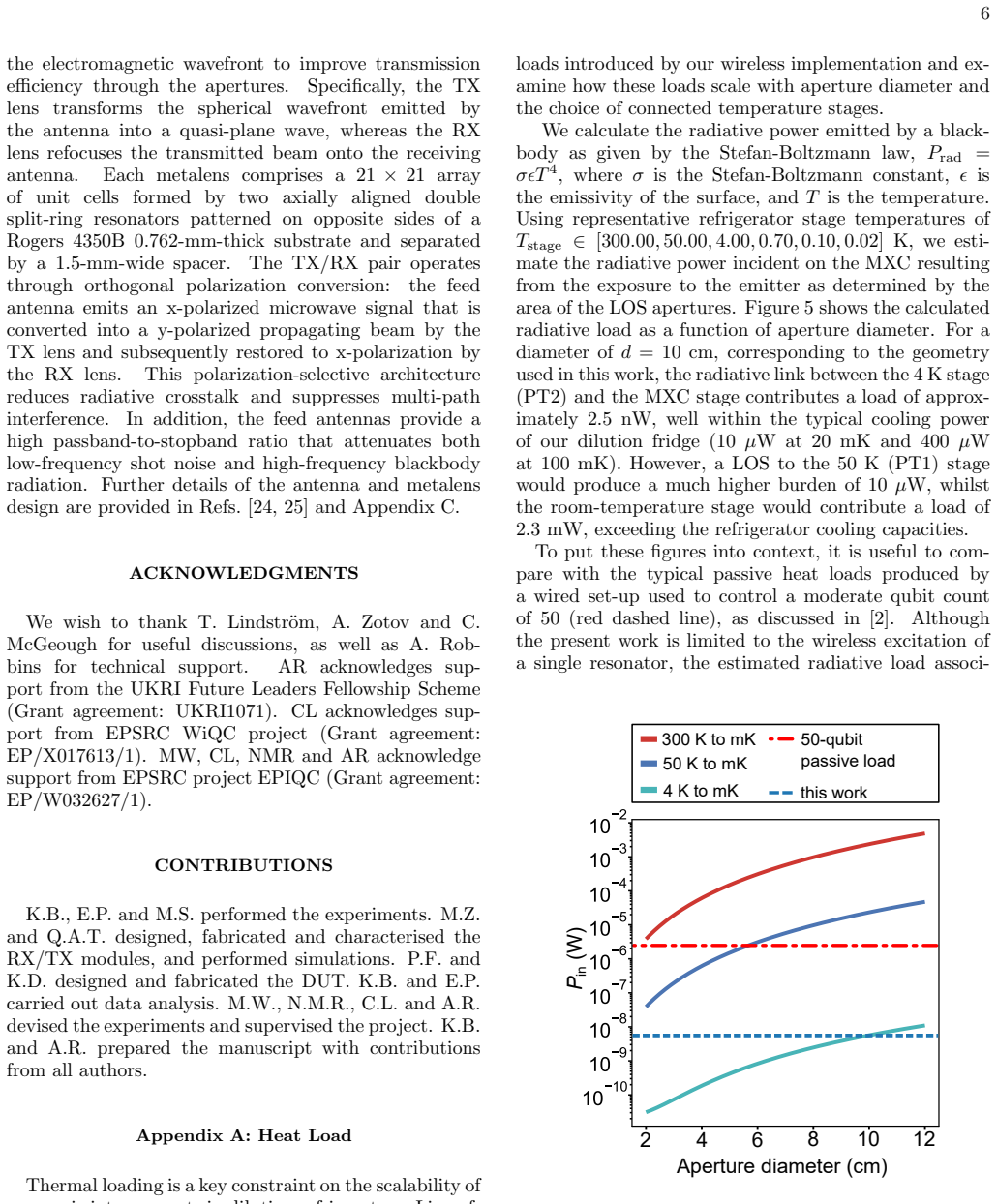
- A line-of-sight aperture from the 4 K stage to the mixing chamber contributes only ~2.5 nW of radiative heat at the tested aperture diameter, roughly three orders of magnitude below the passive load of a 50-qubit wired setup, supporting the thermal argument for intra-cryostat wireless links.
Where Pith is reading between the lines
- If the Z_p interpretation is right, the cryostat enclosure is not an inert shield but a circuit element: changing its geometry should measurably change the loaded-Q offset, giving a direct test of the parasitic-capacitance model before building a new fridge.
- Because the constant ΔQ_L is independent of temperature, it should also appear in qubit readout and could masquerade as degraded readout fidelity; quantifying it on a full qubit operation seems the next necessary experiment.
- The measured transmission fraction of only ~13.7% suggests that improving lens efficiency, not just suppressing stray paths, is an equally direct lever for practical wireless readout—the two are separable engineering targets.
- A clean falsifier for the stray-radiation story would be to repeat the open-switch test with the switches physically replaced by detachable connectors: if the residual resonator feature survives, the radiative path is confirmed; if it vanishes, switch isolation was the cause.
Editorial analysis
A structured set of objections, weighed in public.
Referee Report
Summary. The paper reports an experimental comparison of wired and wireless excitation of a superconducting NbN microwave resonator at millikelvin temperatures inside a dilution refrigerator. The authors show that for a readout-type resonator, wireless excitation reproduces the internal quality factor Q_i and the fractional frequency shift Δf/f_r as functions of temperature, but yields a systematically lower loaded quality factor Q_L by about 650. They attribute this offset to a parasitic electromagnetic pathway (modeled as impedance Z_p) arising from stray radiation coupling the cryostat enclosure to the device and readout line. The paper also demonstrates that RF absorbers suppress cavity reverberations and restore clean resonance lineshapes, but do not eliminate the residual coupling. A control experiment with cryogenic switches open in one or both MXC positions is used to argue that poor switch isolation cannot explain the residual excitation.
Significance. If the primary compatibility result is robust, this is a valuable experimental contribution to the emerging field of wireless/cryogenic interconnects for superconducting quantum hardware. The direct wired-vs-wireless comparison within the same cryostat, the use of cryogenic SOLR calibration, and the temperature-dependent measurements spanning TLS-dominated and quasiparticle-dominated regimes are commendable strengths. The finding that wireless excitation preserves f_r and Q_i(T) is a concrete, falsifiable result with practical implications. However, the more ambitious claim—that the Q_L offset arises specifically from stray radiation through a parasitic Z_p path—is not quantitatively established. The switch-control evidence is inconclusive because the in-situ isolation of the cryogenic switches is not verified, and the equivalent-circuit model is not fitted to the observed lineshapes. Thus the abstract's statement that the work 'reveals parasitic electromagnetic pathways' overstates the current evidence. The central compatibility result is likely sound, but a key explanatory component requires additional experimental or modeling support.
major comments (3)
- [Section IV, Fig. 3(c)] The switch-control experiment does not definitively rule out switch leakage as the source of the residual resonance. The argument assumes that each open switch retains its nominal ~-60 dB isolation at 20 mK and that the two open switches provide additive isolation. Neither assumption is verified in situ. With two open switches, a residual baseline ~50 dB below the C1 level is observed; if each switch's isolation degraded to ~-25 dB at mK temperatures, two open switches would produce a comparable baseline. Thus configuration C3 cannot distinguish stray-radiation coupling from leakage through the open switch network. The statement that 'the absence of signal degradation ... allows one to rule out poor isolation as the only source' is too strong without a direct measurement of the switch isolation under the same cryogenic conditions.
- [Section IV, Fig. 3(d) and Appendix E] The parasitic-impedance model is presented qualitatively and is not validated against the measured data. The claim that Z_p, with an extracted Cp ≈ 40 fF, is 'compatible with the observed reduction in Q_L' is not supported by any calculation or fit. To substantiate the attribution of the ΔQ_L ≈ 650 offset to stray radiation, the authors should show that a circuit model incorporating Z_p quantitatively reproduces the measured Q_L difference and, ideally, the C2/C3 lineshapes. As it stands, the model is an untested hypothesis, and the abstract's wording ('revealing parasitic electromagnetic pathways') exceeds the evidence.
- [Figures 2(b), 2(c), and 3(a)] No uncertainty estimates or error bars are shown for Q_i, Δf/f_r, or Q_L, despite these being extracted from fits to noisy S21 data using circle fitting. The claim of a 'constant' |ΔQ_L| ≈ 650 offset across the full temperature range, and the 'close agreement' in Q_i(T), require quantitative uncertainty information. Without error bars, it is difficult to assess whether the offset is truly temperature-independent or whether the apparent agreement is statistically meaningful. The authors should report fit uncertainties (e.g., from the covariance of the circle fit) and ideally repeat measurements.
minor comments (6)
- [Abstract and conclusion] The abstract and conclusion state that the work 'reveals parasitic electromagnetic pathways.' Given the inconclusive switch-control test and unvalidated Z_p model, the authors should hedge this claim (e.g., 'suggests' or 'indicates') unless the requested evidence is added.
- [Equation (D2)] The formula for Δf_qp appears mis-transcribed: the denominator should likely be k_B T · sinh(Δ/(k_B T)) rather than as currently typeset. Please check the expression and the surrounding text.
- [Figure 2(a) caption] The caption states that traces are shifted vertically by multiples of 20 dB, but it is unclear which trace corresponds to which temperature and whether the shift applies to both WLS and WRD traces. Adding labels or a legend would improve readability.
- [Section II] The phrase 'short coaxial lines running across the MXC stage' is vague; specify approximate length and attenuation if relevant to the Q_L comparison.
- [Appendix A, Fig. 5] The heat-load calculation uses a blackbody formula with emissivity ε, but ε is not stated. Please specify the assumed value (e.g., ε=1) and note that the result scales linearly with ε.
- [General notation] Temperature notation is inconsistent: 'Tmxc' appears in some places and 'T_mxc' in others. Please unify.
Circularity Check
No significant circularity: the central claim is a direct wired-vs-wireless measurement, not a derivation from fitted parameters.
full rationale
The paper's central result — that WLS and WRD excitation yield the same f_r, Q_i(T), and Δf/f_r(T) — is a direct comparison of measured transmission resonances, extracted by an independent circle-fitting method [16]. No quantity called a prediction is obtained by fitting a parameter to the same data and then re-reporting it. The Δf_qp reference line uses α_L,ki = 0.974 from the authors' prior device work [21,26], but it is a consistency benchmark, not an input that forces the WLS-vs-WRD agreement; the two datasets are independent measurements. The Q_L offset and stray-pathway interpretation are empirical inferences from switch configurations C1-C3. The paper explicitly notes the C2 result 'could be the result of poor switch isolation (nominally -60 dB)' and uses C3 to argue against it; the lack of in-situ switch-isolation verification is an evidentiary/rigor concern, not a circular reduction, since the argument is not an equation that is equal to its inputs by construction. The metalens design cites the authors' prior lens work [24,25], but the wireless compatibility claim is validated by measurement rather than by that citation. No self-definitional, fitted-input-called-prediction, or self-citation chain forces the conclusions. Score 0.
Axiom & Free-Parameter Ledger
free parameters (4)
- α_L,ki (kinetic inductance fraction) =
0.974
- Circle-fitting model parameters (a, α, τ, φ, Q_L, Q_c) =
extracted per trace
- Parasitic impedance Z_p =
not quantitatively specified
- Enclosure parasitic capacitance C_p =
≈40 fF
axioms (5)
- domain assumption Notch-resonator transmission model Eq. D1
- domain assumption Quasiparticle frequency-shift model Eq. D2
- domain assumption Cryogenic switches retain ~-60 dB isolation at mK
- domain assumption Operated in the few-photon regime at ~-116 dBm
- domain assumption Metasurface lens model and simulations accurately describe the wireless beam
invented entities (1)
-
Parasitic stray-radiation coupling path Z_p
no independent evidence
read the original abstract
Scalable quantum computing is limited by the dense network of electrical interconnects linking cryogenic quantum processors to room-temperature control electronics. To overcome this bottleneck, considerable effort has focused on cryogenic CMOS electronics and microwave-to-optical transduction, aiming to reduce wiring complexity and thermal loading. Wireless interconnects have recently emerged as a promising complementary approach, yet their compatibility with superconducting quantum hardware remains largely unexplored. Here, we demonstrate the wireless excitation of a superconducting microwave resonator of the type routinely employed for qubit readout, operating at millikelvin temperatures inside a dilution refrigerator. By directly comparing wired and wireless operation within the same cryogenic environment, we show that wireless coupling preserves the intrinsic resonator response while revealing parasitic electromagnetic pathways arising from stray radiation within the cryostat enclosure. These results establish a framework for the co-design of wireless interconnects, cryogenic packaging and superconducting quantum hardware.
Figures




Reference graph
Works this paper leans on
-
[1]
E. T. Campbell, B. M. Terhal, and C. Vuillot, Roads towards fault-tolerant universal quantum computation, Nature549, 172 (2017)
2017
-
[2]
Krinner, S
S. Krinner, S. Storz, P. Kurpiers, P. Magnard, J. Heinsoo, R. Keller, J. L¨ utolf, C. Eichler, and A. Wallraff, Engineer- ing cryogenic setups for 100-qubit scale superconducting circuit systems, EPJ Quantum Technology6, 1 (2019)
2019
-
[3]
Awschalom, K
D. Awschalom, K. K. Berggren, H. Bernien, S. Bhave, L. D. Carr, P. Davids, S. E. Economou, D. Englund, A. Faraon, M. Fejer, S. Guha, M. V. Gustafsson, E. Hu, L. Jiang, J. Kim, B. Korzh, P. Kumar, P. G. Kwiat, M. Lonˇ car, M. D. Lukin, D. A. Miller, C. Mon- roe, S. W. Nam, P. Narang, J. S. Orcutt, M. G. Raymer, A. H. Safavi-Naeini, M. Spiropulu, K. Srini- ...
2021
-
[4]
J. C. Brennan, J. Barbosa, C. Li, M. Ahmad, F. Imroze, C. Rose, W. Karar, M. Stanley, H. Heidari, N. M. Ridler, and M. Weides, Classical interfaces for controlling cryo- genic quantum computing technologies, APL Quantum 2, 041501 (2025)
2025
-
[5]
X. Xue, B. Patra, J. P. G. van Dijk, N. Samkharadze, S. Subramanian, A. Corna, B. Paquelet Wuetz, C. Jeon, F. Sheikh, E. Juarez-Hernandez, B. P. Esparza, H. Ram- purawala, B. Carlton, S. Ravikumar, C. Nieva, S. Kim, H.-J. Lee, A. Sammak, G. Scappucci, M. Veldhorst, F. Sebastiano, M. Babaie, S. Pellerano, E. Charbon, and L. M. K. Vandersypen, Cmos-based cr...
2021
-
[6]
Patra, R
B. Patra, R. M. Incandela, J. P. G. van Dijk, H. A. R. Ho- mulle, L. Song, M. Shahmohammadi, R. B. Staszewski, A. Vladimirescu, M. Babaie, F. Sebastiano, and E. Char- bon, Cryo-cmos circuits and systems for quantum com- puting applications, IEEE Journal of Solid-State Circuits 53, 309 (2018)
2018
-
[7]
Acharya, S
R. Acharya, S. Brebels, A. Grill, J. Verjauw, T. Ivanov, D. P. Lozano, D. Wan, J. Van Damme, A. M. Vadiraj, M. Mongillo, B. Govoreanu, J. Craninckx, I. P. Radu, K. De Greve, G. Gielen, F. Catthoor, and A. Potoˇ cnik, Multiplexed superconducting qubit control at millikelvin temperatures with a low-power cryo-CMOS multiplexer, Nature Electronics6, 900 (2023)
2023
-
[8]
Lecocq, F
F. Lecocq, F. Quinlan, K. Cicak, J. Aumentado, S. A. Diddams, and J. D. Teufel, Control and readout of a superconducting qubit using a photonic link, Nature591, 575 (2021)
2021
-
[9]
Arnold, T
G. Arnold, T. Werner, R. Sahu, L. N. Kapoor, L. Qiu, and J. M. Fink, All-optical superconducting qubit read- out, Nature Physics21, 393 (2025)
2025
-
[10]
Y. Zou, B. Keskin, G. G. Taylor, Z. Li, J. Wang, E. Alar- con, F. Sebastiano, M. Babaie, and E. Charbon, Power Delivery for Cryogenic Scalable Quantum Applications: Challenges and Opportunities (2025), arXiv:2511.13965 [eess]
Pith/arXiv arXiv 2025
-
[11]
N. J. Lambert, A. Rueda, F. Sedlmeir, and H. G. L. Schwefel, Coherent conversion between microwave and optical photons—an overview of physical implemen- tations, Advanced Quantum Technologies3, 1900077 (2020)
2020
-
[12]
Alarc´ on, S
E. Alarc´ on, S. Abadal, F. Sebastiano, M. Babaie, E. Charbon, P. H. Bol ´ ıvar, M. Palesi, E. Blokhina, D. Leipold, B. Staszewski, A. Garcia-S´ aez, and C. G. Almudever, Scalable multi-chip quantum architectures enabled by cryogenic hybrid wireless/quantum-coherent network-in-package, in2023 IEEE International Sympo- sium on Circuits and Systems (ISCAS)(...
2023
-
[13]
A. Bandara, V. C. Arrojo, H. Deng, M. Babaie, F. Se- bastiano, E. Charbon, E. Vinogradov, E. Alarcon, and S. Abadal, 28 GHz Wireless Channel Characterization for a Quantum Computer Cryostat at 4 Kelvin (2025), arXiv:2510.16962 [quant-ph]
arXiv 2025
-
[14]
J. Wang, I. Harris, M. Ibrahim, D. Englund, and R. Han, A wireless terahertz cryogenic interconnect that mini- mizes heat-to-information transfer, Nature Electronics8, 426 (2025)
2025
-
[15]
Rieger, S
D. Rieger, S. G¨ unzler, M. Spiecker, A. Nambisan, W. Wernsdorfer, and I. Pop, Fano Interference in Mi- crowave Resonator Measurements, Physical Review Ap- plied20, 014059 (2023)
2023
-
[16]
S. Probst, F. B. Song, P. A. Bushev, A. V. Usti- nov, and M. Weides, Efficient and robust analysis of complex scattering data under noise in microwave res- onators, Review of Scientific Instruments86, 024706 (2015), arXiv:1410.3365 [cond-mat]
Pith/arXiv arXiv 2015
-
[17]
C. R. H. McRae, H. Wang, J. Gao, M. R. Vissers, T. Brecht, A. Dunsworth, D. P. Pappas, and J. Mutus, Materials loss measurements using superconducting mi- crowave resonators, Review of Scientific Instruments91, 091101 (2020)
2020
-
[18]
Alexander, C
A. Alexander, C. G. Weddle, and C. J. K. Richard- son, Power and temperature dependent model for high Q superconductor resonators, APL Quantum2, 036102 (2025)
2025
-
[19]
E. M. Levenson-Falk and S. A. Shanto, A review of design concerns in superconducting quantum circuits, Materials for Quantum Technology5, 022003 (2025)
2025
-
[20]
Huang, B
S. Huang, B. Lienhard, G. Calusine, A. Veps¨ al¨ ainen, J. Braum¨ uller, D. K. Kim, A. J. Melville, B. M. Niedziel- ski, J. L. Yoder, B. Kannan, T. P. Orlando, S. Gustavs- son, and W. D. Oliver, Microwave Package Design for Superconducting Quantum Processors, PRX Quantum2, 020306 (2021)
2021
-
[21]
P. Foshat, S. Poorgholam-khanjari, V. Seferai, H. Feng, S. Johny, O. A. Mukhanov, M. Hutchings, R. H. Hadfield, M. Weides, and K. Delfanazari, Quasiparticle Dynamics in NbN Superconducting Microwave Resonators at Single Photon Regime (2025), arXiv:2506.17816 [quant-ph]
Pith/arXiv arXiv 2025
-
[22]
Stanley, M
M. Stanley, M. Salter, J. Urbonas, J. Skinner, S.-H. Shin, S. E. de Graaf, and N. M. Ridler, Characterizing S-Parameters of Microwave Coaxial Devices With up to Four Ports at Temperatures of 3 K and Above for Quan- tum Computing Applications, IEEE Transactions on In- strumentation and Measurement73, 1 (2024)
2024
-
[23]
L. Oberto, E. Shokrolahzade, E. Enrico, L. Fasolo, A. Celotto, B. Galvano, A. Alocco, P. Terzi, F. A. Mubarak, and M. Spirito, Full Two-Port S-Parameters at mK Temperatures: A Calibration Strategy and Un- certainty Budget (2026), arXiv:2505.19922 [physics]
Pith/arXiv arXiv 2026
-
[24]
Al-Moathin, M
A. Al-Moathin, M. Zhong, Q. Al-Taai, Y. Jiang, M. Farage, J. U. R. Kazim, M. Z. Ali, F. Nikbakht- 10 nasrabadi, M. Powell, P. Khatri, M. Stanley, A. Rossi, H. Heidari, M. A. Imran, Q. H. Abbasi, N. M. Ridler, M. Weides, and C. Li, Characterization of a Compact Wideband Microwave Metasurface Lens for Cryogenic Applications, in2023 101st ARFTG Microwave Mea...
2023
-
[25]
ur Rehman Kazim, M
J. ur Rehman Kazim, M. Z. Ali, A. Al-Moathin, F. Nikbakhtnasrabadi, P. Khatri, M. Powell, M. Stanley, N. M. Ridler, A. Rossi, M. Weides, H. Heidari, M. A. Im- ran, Q. H. Abbasi, and C. Li, Wireless Microwave Signal Transmission for Cryogenic Applications, in2023 IEEE International Symposium on Antennas and Propagation and USNC-URSI Radio Science Meeting (...
2023
-
[26]
P. Foshat, P. Baity, S. Danilin, V. Seferai, S. Poorgholam- Khanjari, H. Feng, O. A. Mukhanov, M. Hutchings, R. H. Hadfield, M. Imran, M. Weides, and K. Delfanazari, Characterizing Niobium Nitride Superconducting Mi- crowave Coplanar Waveguide Resonator Array for Cir- cuit Quantum Electrodynamics in Extreme Conditions (2023), arXiv:2306.02356 [cond-mat, p...
Pith/arXiv arXiv 2023
discussion (0)
Sign in with ORCID, Apple, or X to comment. Anyone can read and Pith papers without signing in.