REVIEW 4 major objections 5 minor 250 references
The globular cluster M 22 contains at least two stellar populations distinguished by a real iron abundance spread of ≥0.24 dex and an average s-process element spread of ~0.65 dex, and the spread persists within each population.
Reviewed by Pith at T0; open to challenge. T0 means a machine referee read the full paper against a public rubric. the ladder, T0–T4 →
T0 review · deepseek-v4-flash
2026-08-02 02:52 UTC pith:YN2W3XPL
load-bearing objection High-quality differential analysis that likely confirms M22's Fe and s-process spreads, though the six-star sample and unclosed 1D LTE systematics keep the result short of definitive. the 4 major comments →
The complex stellar system M 22: confirming abundance variations with high precision differential measurements
The pith
A machine-rendered reading of the paper's core claim, the machinery that carries it, and where it could break.
Core claim
Differential line-by-line analysis of very high quality (R = 110,000, signal-to-noise ≈ 300) spectra of six red giant branch stars in M 22 confirms that the cluster is chemically inhomogeneous. The data show a clear split into two populations: a metal-rich group enhanced in s-process elements and a metal-poor group that is not, with a minimum iron spread of 0.24 dex and an average s-process spread of 0.65 dex. Abundance variations are detected in 18 elements—Fe, Na, Si, Ca, Sc, Ti, Cr, Mn, Co, Ni, Zn, Y, Zr, La, Ce, Nd, Sm, and Eu. The variations persist, and are in some cases larger, within each individual population, especially among the metal-poor stars. The authors interpret this as evid
What carries the argument
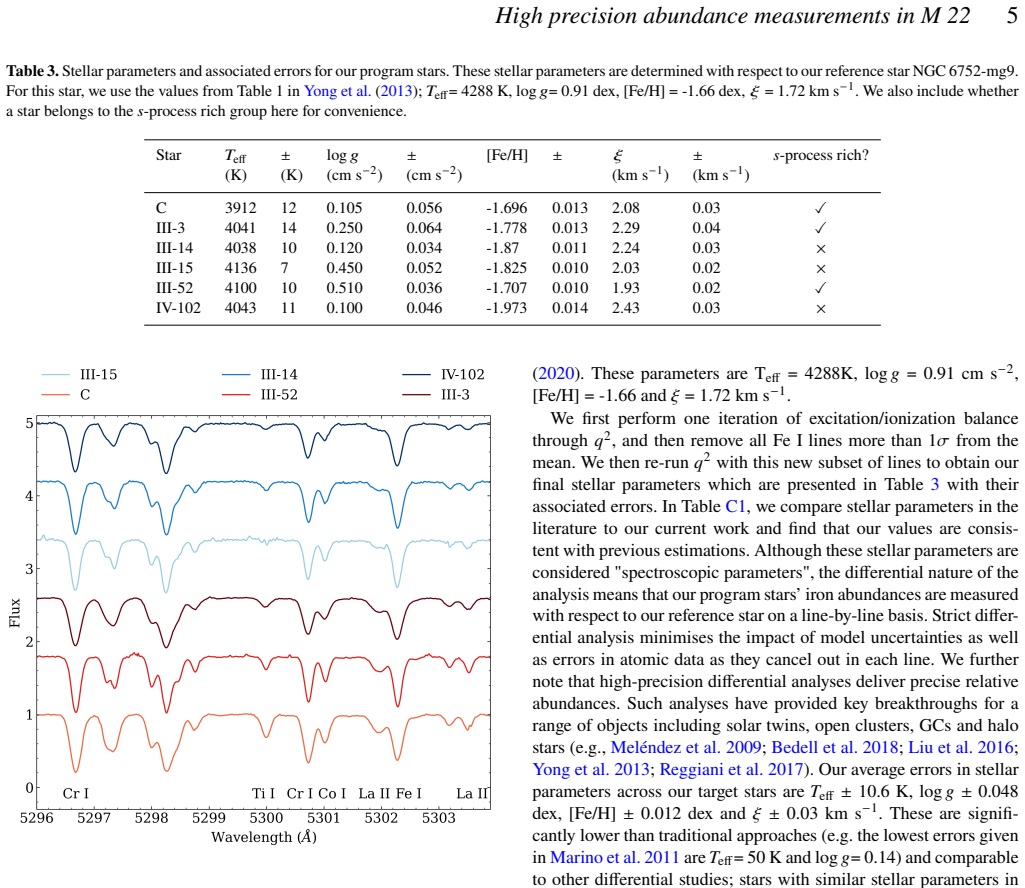
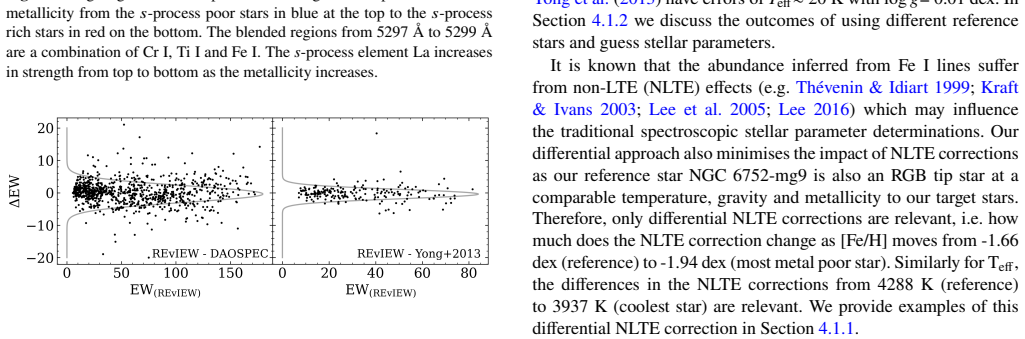
The key machinery is the strictly differential, line-by-line abundance analysis. Each program star's spectrum is measured against the same reference giant (NGC 6752-mg9) using the same line list and the same one-dimensional, local-thermodynamic-equilibrium model-atmosphere grid, so that errors in atomic data, model atmospheres, and continuum placement cancel to first order in every line. Equivalent widths are measured with a purpose-built fitting routine that combines Gaussian fits with a neural network trained on synthetic spectra, and strong or weak lines that would introduce systematic errors are removed. This reduces relative abundance uncertainties to roughly 0.01 dex and lets the autho
Load-bearing premise
All of the claimed spreads rest on the assumption that one-dimensional, local-thermodynamic-equilibrium model atmospheres and the differences between the reference star and the M 22 giants introduce systematic errors far smaller than the quoted 0.01–0.02 dex uncertainties; if population-dependent systematics, such as CNO-induced changes to the model structure, are larger than the estimated ~0.001 dex differential NLTE corrections, the reported iron and s-process spreads could
What would settle it
Re-derive iron and s-process abundances for the same six stars using a full 3D non-LTE pipeline with photometric effective temperatures and literature C+N+O abundances. If the differential NLTE correction between the most metal-poor star and the reference giant exceeds about 0.02 dex, the ≥0.24 dex iron spread is not yet established; if the correction stays at the ~0.001 dex level estimated in the paper, the spread is confirmed. A complementary larger-sample test: obtain the same quality spectra for 20+ additional RGB stars across the s-process divide; if the bimodal separation does not recur,
If this is right
- M 22 joins the small class of Type II globular clusters, like ω Centauri and Terzan 5, that show real metallicity and/or s-process variations, so any model of Galactic globular cluster formation must explain why a disc cluster has this property.
- The iron spread and its persistence when different reference stars and stellar parameter choices are used mean that earlier null detections most likely resulted from lower precision or from neglecting C+N+O abundance differences, not from the absence of a spread.
- The within-population spreads in heavy elements, which grow with atomic number, argue that the gas from which each population formed was itself not chemically uniform, favouring enrichment from multiple nucleosynthetic sources rather than a single pollution event.
- The strong correlation between Si and Y abundance differences and the overall chemical patterns provide direct constraints on merger, nuclear-star-cluster, and early-disc formation scenarios for M 22.
- A kinematic analysis combining M 22's disc-like orbit with these chemical data suggests that if M 22 is a stripped nucleus, the merger that brought it in must have been gentle and at low inclination; if it is a merged pair of clusters, the merger must have occurred early enough for the heavy-element pattern to be imprinted.
Where Pith is reading between the lines
- The paper's differential analysis hinges on the assumption that the reference giant and the M 22 stars have identical line-formation physics. If the C+N+O abundance difference between the two M 22 populations, estimated at about 0.13 dex, changes the model atmosphere temperature structure in a way the 1D grid does not capture, the quoted 0.24 dex iron spread could be inflated by a few hundredths o
- The increasing heavy-element spread with atomic number within the metal-poor population, if confirmed by a larger sample, would suggest that the s-process yield in the cluster's early gas depended on neutron exposure, i.e., on the mass of the polluting AGB stars. This could be tested by comparing the observed Y, Zr, La, Ce, Nd, and Sm patterns to nucleosynthesis yields from AGB models of 3–6 solar
- If M 22 really is a surviving building block of the Milky Way's disc, then other, fainter disc clusters or dissolved remnants with a similar bimodal s-process pattern should exist. Wide-field, high-resolution surveys of metal-poor disc stars could search for stars with high [La/Eu] at [Fe/H] ≈ -1.7 and disc-like orbits; finding such a population would strengthen the building-block scenario.
- Since the six stars were selected to have detectable MgH lines for future Mg isotope analysis, the same data could be used to measure Mg isotopic ratios. If the two s-process populations differ in 25Mg/24Mg and 26Mg/24Mg, that would favour AGB self-enrichment; if the ratios are identical, the two populations would more likely have formed from gas enriched by different external sources.
Editorial analysis
A structured set of objections, weighed in public.
Referee Report
Summary. The paper presents a strictly differential line-by-line abundance analysis of six red giant branch stars in M 22, using high-resolution (R = 110,000), high-S/N (≈300) VLT/UVES spectra and the q2/MOOG pipeline with NGC 6752-mg9 as the reference star. The authors report an iron abundance spread of at least 0.24 dex, a separation between two s-process populations with an average s-process spread of about 0.65 dex, and non-negligible abundance variations within each population. They argue that these results confirm M 22 as a Type II cluster and discuss three possible origins: a nuclear star cluster, a merger product, or a building block of the Milky Way.
Significance. If the central claim is robust, this is an important result: it would settle a long-standing debate about whether M 22 hosts intrinsic heavy-element abundance variations, strengthen the Type II cluster classification, and constrain scenarios for its formation. The paper has clear strengths: the spectra are of exceptional quality, the differential approach uses ~100 Fe I lines per star, internal errors reach ~0.01 dex, and the authors test the sensitivity of the Fe spread to different reference stars and initial parameters (Fig. 8). The public release of the REvIEW code is also a positive feature. The main weakness is that the systematic uncertainties from 1D LTE model atmospheres, CNO abundance variations, and 3D/NLTE effects are not quantified for the elements that drive the main claims.
major comments (4)
- [§2.3 and §4.1.1] The central Fe-spread and s-process-spread claims rest on differential 1D LTE ATLAS9 models with [α/Fe]=+0.4 and no CNO enhancement. M 22 populations are reported to differ by Δ[C+N+O]≈0.13 dex (§4.1.3), which can alter the T-τ structure and line formation for both Fe I/Fe II and s-process lines. The paper estimates differential NLTE corrections only for Fe (INSPECT, §4.1.1), not for La II, Ce II, Nd II, or Eu II, and does not test CNO-enhanced model atmospheres or 3D corrections. Given that the observed ΔFeI range is 0.235 dex and the within-population σ values are 0.04–0.06 dex, a population-dependent systematic of ~0.05 dex would be comparable to the signal. I request that the authors quantify such systematics or provide explicit model tests with CNO-enhanced and/or 3D atmospheres.
- [Abstract and §3.1] The abstract states an "average s-process abundance spread of 0.65 dex", but §3.1 reports an average separation of ≈0.5 dex between the two s-process groups and the largest element spread (Y) as "almost 0.6 dex". No table or figure in the paper supports 0.65 dex. This quantitative inconsistency needs to be reconciled or corrected before publication.
- [§3.2, Tables 4–5] Several of the elements used to support the claim of intra-population abundance variations are measured from one line per star (Eu, Zn, Zr, Sm, and Cr II in some cases). The authors themselves note that the low Eu abundance of IV-102, which drives the s-poor population Eu dispersion, "may be an artefact of our differential approach" (§3.2). Because the within-population dispersion is a distinct headline claim (larger heavy-element spreads in the metal-poor population), the paper should explicitly separate results based on multiple lines from those based on single lines and quantify how a single-line systematic would affect the conclusion.
- [§3.1] The sample is six stars selected from Marino et al. (2011) based on their s-process group and detectability of MgH lines, with only three stars per population. The authors note that "results are limited by our small sample size", but the abstract and conclusions present cluster-wide statements about the spread and its population dependence. The intrinsic-spread claim per se is supported by the differential precision, but the distribution-level statements (e.g., "the more metal-poor population hosting larger spreads") need to be framed with appropriate caveats about selection and sample size.
minor comments (5)
- [Table 4] Column header "⟨s−rich⟩−⟨s−rich⟩" appears to be a typo; it should read "⟨s−poor⟩−⟨s−rich⟩".
- [Appendix B] The text notes that the hyperparameter selection uses a labelled real data set, which "does cause data leakage". This is transparent, but the potential impact on the FFNN validation should be discussed more explicitly, since the code is a component of the analysis.
- [References] Yong et al. 2014a and 2014b are listed with identical journal, volume, and page numbers (MNRAS, 441, 3396). This is likely a bibliographic error and should be corrected.
- [Fig. 8] The caption states that abundances have been scaled by the reference metallicity but also says "[Fe/H] abundances should not be compared between methods". The scaling makes the figure difficult to interpret; a clearer explanation of what is plotted is needed.
- [Table C1] The "This work" [Fe/H] values are relative to NGC 6752-mg9, while the literature values are absolute. This should be labeled explicitly in the table to avoid confusion.
Circularity Check
Minor inherited grouping from Marino et al. (2011), but the differential abundance measurements and reference-star robustness tests make the central claim largely self-contained.
specific steps
-
self definitional
[Sections 2.1 and 3.1; Figs 1 and 4]
"We select our program stars from Marino et al. (2011). ... Three of which belong to the s-process poor group as identified by Marino et al. (2011), and the remaining three are from the s-process rich population. ... We reproduce the divide between the two s-process groups using ΔLa−Eu as a function of ΔFe... As in Marino et al. (2011), we see a clear separation in our program stars and find that there must be at least a 0.24 dex iron abundance spread in the cluster as well as a spread of at least 0.38 dex for ΔLa−Eu."
The two stellar populations are not inferred from the new sample: the targets were deliberately drawn from Marino et al.'s pre-existing s-rich and s-poor groups, which are defined by the same [La/Eu] ratio used to quantify the s-process spread. The reported 0.65 dex s-process spread and ΔLa−Eu separation in Fig. 4 are therefore statistics of a sample constructed to contain that separation; the new EW measurements can validate the prior values but cannot independently establish the bimodality. Because the central Fe-spread claim also comes from these pre-selected groups (C vs IV-102), the 'confirmation' is partly inherited from the input classification, though the differential measurements and robustness tests provide independent content.
full rationale
The paper's central result is a differential abundance measurement, not a first-principles derivation, so most circularity patterns do not apply. q2 uses Fe excitation/ionization balance to set stellar parameters and then reports Fe abundances; this is standard and the paper tests robustness by varying reference stars and initial parameters (Fig. 8), including the independent Gaia benchmark HD 122563. The NLTE check uses the external INSPECT database. The paper also openly notes its small sample size and the possible IV-102 Eu artefact. The only substantive caveat is the inherited s-rich/s-poor grouping from Marino et al. (2011), which makes the two-population claim a confirmation of a pre-selected split rather than an unbiased detection. This is a selection limitation, but the measured abundances and error budget are new, and the Fe spread persists across reference-star changes, so the central claim does not reduce by construction to a fit or to a self-citation chain.
Axiom & Free-Parameter Ledger
free parameters (8)
- Stellar parameters for star C (Teff, log g, [Fe/H], xi) =
3912 K, 0.105, -1.696, 2.08 km/s
- Stellar parameters for star III-3 (Teff, log g, [Fe/H], xi) =
4041 K, 0.250, -1.778, 2.29 km/s
- Stellar parameters for star III-14 (Teff, log g, [Fe/H], xi) =
4038 K, 0.120, -1.870, 2.24 km/s
- Stellar parameters for star III-15 (Teff, log g, [Fe/H], xi) =
4136 K, 0.450, -1.825, 2.03 km/s
- Stellar parameters for star III-52 (Teff, log g, [Fe/H], xi) =
4100 K, 0.510, -1.707, 1.93 km/s
- Stellar parameters for star IV-102 (Teff, log g, [Fe/H], xi) =
4043 K, 0.100, -1.973, 2.43 km/s
- Strong-line EW cutoff =
120 mÅ
- Weak-line EW cutoff =
5 mÅ
axioms (6)
- domain assumption 1D LTE plane-parallel ATLAS9 model atmospheres with [alpha/Fe]=+0.4 are adequate for the program stars, and differential analysis cancels residual model errors.
- domain assumption Reference star NGC 6752-mg9 has accurate photometric parameters (Teff=4288K, logg=0.91, [Fe/H]=-1.66, xi=1.72) and is a valid differential anchor for M22 RGB stars.
- domain assumption Excitation and ionization balance of Fe I and Fe II yields unbiased relative stellar parameters for metal-poor giants.
- domain assumption The [La/Eu] separation criterion from Marino et al. (2011) identifies two genuine stellar populations in M22.
- domain assumption Equivalent widths measured by REvIEW are accurate to ~1–2 mÅ; comparisons with DAOSPEC and IRAF show small offsets.
- domain assumption The stellar lines used are unblended (or properly deblended) and the continuum placement is correct.
read the original abstract
M 22 (NGC 6656) is a chemically complex globular cluster-like system reported to harbour heavy element abundance variations. However, the extent of these variations and the origin of this cluster is still debated. In this work, we investigate the chemical inhomogeneity of M 22 using differential line-by-line analysis of high-quality (R = 110,000, S/N = 300 per pixel at 514 nm) VLT/UVES spectra of six carefully chosen red giant branch stars. By achieving abundance uncertainties as low as ~0.01 dex (~2 per cent), this high-precision data validates the results of previous studies and reveals variations in Fe, Na, Si, Ca, Sc, Ti, Cr, Mn, Co, Ni, Zn, Y, Zr, La, Ce, Nd, Sm and Eu. Additionally, we can confirm that the cluster hosts two stellar populations with a spread of at least 0.24 dex in [Fe/H] and an average s-process abundance spread of 0.65 dex. In addition to global variations across the cluster, we also find non-negligible variations within each of the two populations, with the more metal-poor population hosting larger spreads in elements heavier than Fe than the metal-rich. We address previous works which do not identify anomalous abundances and relate our findings to our current dynamical understanding of the cluster. Given our results, we suggest that M 22 is either a nuclear star cluster, the product of two merged clusters, or an original building block of the Milky Way.
Figures



Reference graph
Works this paper leans on
-
[1]
Mg isotopic ratios in giant stars of the globular cluster NGC 6752. , keywords =. doi:10.1051/0004-6361:20030296 , archivePrefix =. astro-ph/0303057 , primaryClass =
-
[2]
Heavy Elements in Globular Clusters: The Role of Asymptotic Giant Branch Stars. , keywords =. doi:10.1088/0004-637X/785/1/77 , archivePrefix =. 1403.0819 , primaryClass =
-
[3]
The s-Process Enrichment of the Globular Clusters M4 and M22. , keywords =. doi:10.1088/0004-637X/795/1/34 , archivePrefix =. 1409.1227 , primaryClass =
-
[5]
High precision differential abundance measurements in globular clusters: chemical inhomogeneities in NGC 6752. , keywords =. doi:10.1093/mnras/stt1276 , archivePrefix =. 1307.4486 , primaryClass =
-
[6]
Two stellar groups with different iron and s-process element abundances
A double stellar generation in the globular cluster NGC 6656 (M 22). Two stellar groups with different iron and s-process element abundances. , keywords =. doi:10.1051/0004-6361/200911827 , archivePrefix =. 0905.4058 , primaryClass =
-
[7]
The two metallicity groups of the globular cluster M 22: a chemical perspective. , keywords =. doi:10.1051/0004-6361/201116546 , archivePrefix =. 1105.1523 , primaryClass =
-
[8]
arXiv e-prints , keywords =
How Many Elements Matter?. arXiv e-prints , keywords =
-
[9]
Metallicity fluctuation statistics in the interstellar medium and young stars - I. Variance and correlation. , keywords =. doi:10.1093/mnras/stx3286 , archivePrefix =. 1708.06853 , primaryClass =
-
[10]
SLUG IV: a novel forward-modelling method to derive the demographics of star clusters. , keywords =. doi:10.1093/mnras/sty2896 , archivePrefix =. 1810.10173 , primaryClass =
-
[11]
SLUG - stochastically lighting up galaxies - III. A suite of tools for simulated photometry, spectroscopy, and Bayesian inference with stochastic stellar populations. , keywords =. doi:10.1093/mnras/stv1374 , archivePrefix =. 1502.05408 , primaryClass =
-
[12]
Quantifying the effects of stochasticity on star formation rate indicators
SLUG - Stochastically Lighting Up Galaxies - II. Quantifying the effects of stochasticity on star formation rate indicators. , keywords =. doi:10.1093/mnras/stu1688 , archivePrefix =. 1403.4605 , primaryClass =
-
[13]
SLUG Stochastically Lighting Up Galaxies. I. Methods and Validating Tests. , keywords =. doi:10.1088/0004-637X/745/2/145 , archivePrefix =. 1106.3072 , primaryClass =
-
[14]
Characterizing the Heavy Elements in Globular Cluster M22 and an Empirical s-process Abundance Distribution Derived from the Two Stellar Groups. , keywords =. doi:10.1088/0004-637X/742/1/37 , archivePrefix =. 1108.3868 , primaryClass =
-
[15]
Proper Motions and Radial Velocities in the Globular Cluster M22 and the Cluster Distance. , keywords =. doi:10.1086/173590 , adsurl =
-
[16]
CNO and F abundances in the globular cluster M 22 (NGC 6656). , keywords =. doi:10.1051/0004-6361/201118623 , archivePrefix =. 1202.0797 , primaryClass =
-
[17]
Core-collapse Supernovae from 9 to 120 Solar Masses Based on Neutrino-powered Explosions. , keywords =. doi:10.3847/0004-637X/821/1/38 , archivePrefix =. 1510.04643 , primaryClass =
-
[18]
Nucleosynthesis and yields - Z = 0.02, 0.008 and 0.004
Super and massive AGB stars - II. Nucleosynthesis and yields - Z = 0.02, 0.008 and 0.004. , keywords =. doi:10.1093/mnras/stt1877 , archivePrefix =. 1310.2614 , primaryClass =
-
[19]
Stellar Yields from Metal-rich Asymptotic Giant Branch Models. , keywords =. doi:10.3847/0004-637X/825/1/26 , archivePrefix =. 1604.02178 , primaryClass =
-
[20]
The impact of starbursts on element abundance ratios. , keywords =. doi:10.1093/mnras/staa2431 , archivePrefix =. 1911.02598 , primaryClass =
Pith/arXiv arXiv 1911
-
[21]
arXiv e-prints , keywords =
Stellar Migration and Chemical Enrichment in the Milky Way Disc: A Hybrid Model. arXiv e-prints , keywords =
-
[22]
The Similarity of Abundance Ratio Trends and Nucleosynthetic Patterns in the Milky Way Disk and Bulge. , keywords =. doi:10.3847/1538-4357/abd6be , archivePrefix =. 2009.05063 , primaryClass =
Pith/arXiv arXiv 2009
-
[23]
Abundance Ratios in GALAH DR2 and Their Implications for Nucleosynthesis. , keywords =. doi:10.3847/1538-4357/ab4b5d , archivePrefix =. 1908.06113 , primaryClass =
Pith/arXiv arXiv 1908
-
[24]
The Origin of Elements from Carbon to Uranium. , keywords =. doi:10.3847/1538-4357/abae65 , archivePrefix =. 2008.04660 , primaryClass =
Pith/arXiv arXiv 2008
-
[25]
arXiv e-prints , keywords =
Origin of metals in old Milky Way halo stars based on GALAH and Gaia. arXiv e-prints , keywords =
-
[26]
Chemical Cartography with APOGEE: Multi-element Abundance Ratios. , keywords =. doi:10.3847/1538-4357/ab07c7 , archivePrefix =. 1810.12325 , primaryClass =
-
[27]
arXiv e-prints , keywords =
The GALAH Survey: Dependence of elemental abundances on age and metallicity for stars in the Galactic disc. arXiv e-prints , keywords =
-
[28]
Simulating Metal Mixing of Both Common and Rare Enrichment Sources in a Low-mass Dwarf Galaxy. , keywords =. doi:10.3847/1538-4357/ab6efc , archivePrefix =. 1909.04695 , primaryClass =
Pith/arXiv arXiv 1909
-
[29]
Mixing of metals during star cluster formation: statistics and implications for chemical tagging. , keywords =. doi:10.1093/mnras/sty2625 , archivePrefix =. 1807.01712 , primaryClass =
-
[30]
LYRA - I. Simulating the multiphase ISM of a dwarf galaxy with variable energy supernovae from individual stars. , keywords =. doi:10.1093/mnras/staa3875 , archivePrefix =. 2010.07311 , primaryClass =
Pith/arXiv arXiv 2010
-
[31]
Dust-regulated galaxy formation and evolution: a new chemodynamical model with live dust particles. , keywords =. doi:10.1093/mnras/stv165 , archivePrefix =. 1501.05459 , primaryClass =
-
[32]
The New Galaxy: Signatures of Its Formation. , keywords =. doi:10.1146/annurev.astro.40.060401.093840 , archivePrefix =. astro-ph/0208106 , primaryClass =
-
[33]
Detection of metallicity correlations in 100 nearby galaxies. , keywords =. doi:10.1093/mnras/stab1263 , archivePrefix =. 2104.14807 , primaryClass =
-
[34]
Measuring the mixing scale of the ISM within nearby spiral galaxies. , keywords =. doi:10.1093/mnras/staa2743 , archivePrefix =. 2009.02342 , primaryClass =
Pith/arXiv arXiv 2009
-
[35]
Mapping Metallicity Variations across Nearby Galaxy Disks. , keywords =. doi:10.3847/1538-4357/ab5115 , archivePrefix =. 1910.07190 , primaryClass =
Pith/arXiv arXiv 1910
-
[36]
3D gas-phase elemental abundances across the formation histories of Milky Way-mass galaxies in the FIRE simulations: initial conditions for chemical tagging. , keywords =. doi:10.1093/mnras/stab1606 , archivePrefix =. 2102.06220 , primaryClass =
-
[37]
Numerical convergence of hydrodynamical simulations of galaxy formation: the abundance and internal structure of galaxies and their cold dark matter haloes. , keywords =. doi:10.1093/mnras/staa316 , archivePrefix =. 1908.05019 , primaryClass =
Pith/arXiv arXiv 1908
-
[38]
The Solar Twin Planet Search. I. Fundamental parameters of the stellar sample. , keywords =. doi:10.1051/0004-6361/201424244 , archivePrefix =. 1408.4130 , primaryClass =
-
[39]
, year = 1973, month = sep, volume =
The nitrogen abundance of the very metal-poor star HD 122563. , year = 1973, month = sep, volume =. doi:10.1086/152374 , adsurl =
doi:10.1086/152374 1973
-
[40]
The chemical composition of red giants in 47 Tucanae. II. Magnesium isotopes and pollution scenarios. , keywords =. doi:10.1051/0004-6361/201526643 , archivePrefix =. 1602.00058 , primaryClass =
-
[41]
Magnesium Isotope Ratios in Centauri Red Giants. , keywords =. doi:10.1088/0004-637X/769/1/8 , archivePrefix =. 1304.0523 , primaryClass =
-
[42]
DAOSPEC: An Automatic Code for Measuring Equivalent Widths in High-Resolution Stellar Spectra. , keywords =. doi:10.1086/596126 , archivePrefix =. 0811.2932 , primaryClass =
-
[43]
Magnesium Isotope Ratios in Hyades Stars. , keywords =. doi:10.1086/381701 , archivePrefix =. astro-ph/0312054 , primaryClass =
-
[44]
Abundances in globular cluster red giants. IV. M 22 and omega Centauri. , keywords =. doi:10.1086/159097 , adsurl =
-
[45]
Gaia and Hubble Unveil the Kinematics of Stellar Populations in the Type II Globular Clusters Centauri and M22. , keywords =. doi:10.3847/1538-4357/aba04b , archivePrefix =. 2006.16355 , primaryClass =
Pith/arXiv arXiv 2006
-
[46]
M22: An [Fe/H] Abundance Range Revealed. , keywords =. doi:10.1088/0004-637X/705/2/1481 , archivePrefix =. 0909.5265 , primaryClass =
-
[47]
Star Clusters , year = 1980, editor =
Evidence for primordial inhomogeneities from abundance of giants in M 5, M 13, and M 22. Star Clusters , year = 1980, editor =
1980
-
[48]
Further spectroscopic evidence bearing on the M22-omega Centauri comparison. , keywords =. doi:10.1086/157524 , adsurl =
-
[49]
, year = 1977, month = apr, volume =
Cyanogen strengths and ultraviolet excesses of evolved stars in 17 globular clusters from DDO photometry. , year = 1977, month = apr, volume =. doi:10.1086/190438 , adsurl =
-
[50]
Cyanogen strengths of globular cluster post-main-sequence stars. , keywords =. doi:10.1086/182192 , adsurl =
-
[51]
, year = 1975, month = oct, volume =
The Chemical Inhomogeneity of Omega Centauri. , year = 1975, month = oct, volume =. doi:10.1086/181945 , adsurl =
doi:10.1086/181945 1975
-
[52]
, year = 1975, month = oct, volume =
Abundance variations on the lower giant branch of Omega Centauri. , year = 1975, month = oct, volume =. doi:10.1086/181946 , adsurl =
-
[53]
The anomalous giant branch of omega Centauri
Near infrared photometry of globular clusters - VIII. The anomalous giant branch of omega Centauri. , keywords =. doi:10.1093/mnras/181.3.591 , adsurl =
-
[54]
Membership and other problems of the globular cluster M22. , keywords =. doi:10.1093/mnras/182.2.293 , adsurl =
-
[55]
, year = 1976, month = oct, volume =
Barium stars in the globular cluster NGC 6656. , year = 1976, month = oct, volume =. doi:10.1093/mnras/177.1.73 , adsurl =
-
[56]
, year = 1976, month = apr, volume =
Evidence for Abundance Differences amongh Giant Branch Stars in the Globular Cluster Omega Centauri. , year = 1976, month = apr, volume =
1976
-
[57]
The Observatory , year = 1962, month = oct, volume =
A CH star in omega Centauri. The Observatory , year = 1962, month = oct, volume =
1962
-
[58]
A new CH star in the globular cluster Omega Centauri. , keywords =. doi:10.1086/181977 , adsurl =
-
[59]
Royal Observatory Annals , keywords =
Studies of the globular cluster [omega] Centauri I,. Royal Observatory Annals , keywords =
-
[60]
Photometry of Southern globular clusters. I. Bright stars in OME Cen. , year = 1973, month = jan, volume =. doi:10.1093/mnras/162.3.207 , adsurl =
-
[61]
The Giant Branch of Omega Centauri. I. Abundance Variations due to Mixing. , year = 1976, month = sep, volume =. doi:10.1086/154616 , adsurl =
-
[62]
Wide-field photometry of the Galactic globular cluster M22. , keywords =. doi:10.1111/j.1365-2966.2004.07599.x , archivePrefix =. astro-ph/0401392 , primaryClass =
arXiv 2004
-
[63]
, keywords =
Faint nebulosity near OME Cen. , keywords =
-
[64]
, keywords =
Str \"o mgren photometry in globular clusters: M55 & M22. , keywords =
-
[65]
The chemical inhomogeneity of M 22. , keywords =. doi:10.1086/160764 , adsurl =
-
[66]
Vistas in Astronomy , year = 1956, month = jan, volume =
The dimensions of omega centauri. Vistas in Astronomy , year = 1956, month = jan, volume =. doi:10.1016/0083-6656(56)90032-0 , adsurl =
-
[67]
, year = 1961, month = mar, volume =
The shape of a rotating star cluster. , year = 1961, month = mar, volume =. doi:10.1086/108376 , adsurl =
-
[68]
Rotating Globular Clusters. , keywords =. doi:10.1088/0004-637X/772/1/67 , archivePrefix =. 1305.6025 , primaryClass =
-
[69]
The internal rotation of globular clusters revealed by Gaia DR2. , keywords =. doi:10.1093/mnras/sty2365 , archivePrefix =. 1806.02580 , primaryClass =
-
[70]
A stellar census in globular clusters with MUSE: The contribution of rotation to cluster dynamics studied with 200 000 stars. , keywords =. doi:10.1093/mnras/stx2719 , archivePrefix =. 1710.07257 , primaryClass =
-
[71]
Three-component Kinematics of Multiple Stellar Populations in Globular Clusters with Gaia and VLT. , keywords =. doi:10.3847/1538-4357/ab5aee , archivePrefix =. 1905.09908 , primaryClass =
Pith/arXiv arXiv 1905
-
[72]
Iron and s-elements abundance variations in NGC 5286: comparison with `anomalous' globular clusters and Milky Way satellites. , keywords =. doi:10.1093/mnras/stv420 , archivePrefix =. 1502.07438 , primaryClass =
-
[73]
An Abundance Analysis of Bright Giants in the Globular Cluster NGC 1851. , keywords =. doi:10.1086/525850 , archivePrefix =. 0711.1394 , primaryClass =
-
[74]
Iron and neutron-capture element abundance variations in the globular cluster M2 (NGC 7089) ^ ★. , keywords =. doi:10.1093/mnras/stu806 , archivePrefix =. 1404.6873 , primaryClass =
-
[75]
Formation of Centauri from an ancient nucleated dwarf galaxy in the young Galactic disc. , keywords =. doi:10.1046/j.1365-2966.2003.07275.x , archivePrefix =. astro-ph/0310348 , primaryClass =
arXiv 2003
-
[76]
A catalogue of masses, structural parameters, and velocity dispersion profiles of 112 Milky Way globular clusters. , keywords =. doi:10.1093/mnras/sty1057 , archivePrefix =. 1804.08359 , primaryClass =
-
[77]
The Gaia-ESO Survey: Kinematics of seven Galactic globular clusters. , keywords =. doi:10.1051/0004-6361/201425036 , archivePrefix =. 1411.4886 , primaryClass =
-
[78]
Catalogue des N \'e buleuses et des Amas d' \'E toiles (Catalog of Nebulae and Star Clusters)
-
[79]
The Globular Cluster Messier 22 (N. G. C. 6656). Publications of the American Astronomical Society , year = 1922, series =
1922
-
[80]
, year = 1959, month = feb, volume =
Color-magnitude diagram for the globular cluster M 22. , year = 1959, month = feb, volume =. doi:10.1086/107848 , adsurl =
-
[81]
Harvard College Observatory Bulletin , year = 1930, month = mar, volume =
The Mass-Spectrum Relation for Giant Stars in the Globular Cluster Messier 22. Harvard College Observatory Bulletin , year = 1930, month = mar, volume =
1930
discussion (0)
Sign in with ORCID, Apple, or X to comment. Anyone can read and Pith papers without signing in.