REVIEW 1 major objections 6 minor 65 references
A structure-preserving Numerical Method for the Compressible Resistive-Hall-MHD System
T0 review · 1 major / 6 minor · reviewed 2026-08-02 · deepseek-v4-flash
Pith's one-line read A splitting scheme for compressible resistive Hall-MHD preserves total energy, positivity, entropy dissipation, and the magnetic divergence involution constraint exactly.
desk verdict A genuine first for compressible resistive Hall-MHD structure preservation, with solid derivations, but practical robustness rests on unquantified artificial-resistivity tuning. read the letter →
The pith
A machine-rendered reading of the paper's core claim, the machinery that carries it, and where it could break.
The reading
What carries the argument
The argument rests on an operator split: Operator #1 is the compressible Euler system advanced by an explicit SSP-RK method; Operator #2 is the magnetic source system (Lorentz force coupled to the induction equation with ideal, Hall, and resistive terms) advanced implicitly by Crank-Nicolson. The magnetic field is discretized in the curl-conforming BDM1 finite element space, so grad W_h0 subset of H_h holds, and the divergence involution is preserved by taking the curl of a gradient to be zero. The energy update adds the Joule heating term r |curl H|^2 through a lumped projection, converting resistive dissipation into internal energy exactly. Newton's method for the implicit step is stabiliz
What would settle it
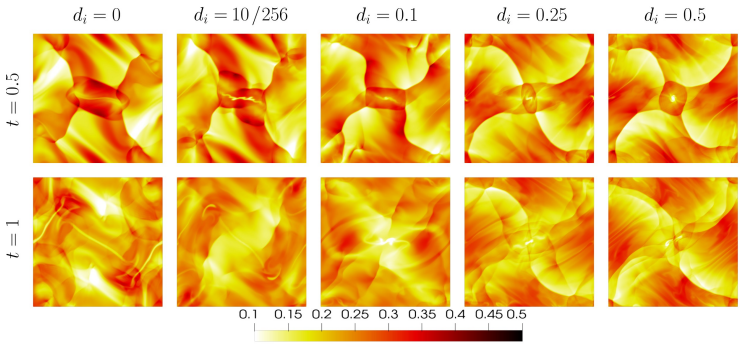
Run the Orszag-Tang vortex with d_i = 0.5 on the directionally-biased structured mesh using the stated CFL (0.05) and resistivity constants, and at every time step until t = 1 check (1) whether the total energy sum_i m_i E_i + mu/2 ||H||^2 changes beyond round-off, and (2) whether Newton's iteration reaches a residual below 1e-8 within 25 iterations. If either condition fails, the claims of exact energy conservation and mesh-robust operation are falsified.
Extended reading notes
Core claim
The paper's central claim is Proposition 3.2: the splitting update hall_mhd_update satisfies total conservation of energy (sum_i m_i E_i^{n+1} + mu/2 ||H^{n+1}||^2 = sum_i m_i E_i^n + mu/2 ||H^n||^2), admissibility (rho > 0 and E - 1/2 |m|^2/rho > 0), the entropy-dissipation inequality (sum_i m_i eta(u_i^{n+1}) <= sum_i m_i eta(u_i^n)), and the involution constraint (H^{n+1}, grad omega) = (H^n, grad omega) for all omega in W_h0, provided the underlying Euler solver preserves the corresponding properties. Numerical tests show near-second-order convergence (L2 rates 1.92-2.00) on a resistive whistler wave, GEM reconnection at up to 1024x1024 elements, and the first reported macroscopic simula
Load-bearing premise
The practical stability of the scheme rests on empirically tuned artificial resistivity constants (c_low = 0.25, c_res = 1.0) and per-regime CFL reductions; the proven coercivity bound in Appendix B requires a stronger resistivity than the scheme actually uses, so in untested Hall-dominated regimes Newton's iteration could fail even though the structure-preservation theorems remain true.
Editorial extensions
If this is right
- No divergence cleaning is needed: the involution constraint on the magnetic field is preserved by construction, on both structured and unstructured meshes.
- Resolutions up to 1024x1024 elements for GEM reconnection and 724x724 for the Orszag-Tang vortex provide reference-quality data for a model that has mostly been simulated on 128x128 cells.
- Because the induction equation receives no stabilization beyond the artificial resistivity, the scheme remains compatible with a vanishing-resistivity interpretation of MHD solutions.
- The coercivity estimates give explicit sufficient conditions (small time step, or r_min > 1/2 mu c_e) under which the Newton Jacobian is guaranteed invertible, providing a principled guide for time-step selection.
- Entropy dissipation is inherited from any Euler solver that satisfies a discrete entropy inequality, so the structure-preservation result transfers to a family of hyperbolic solvers.
Reading between the lines
- A natural extension not pursued in the paper would be adaptive mesh refinement driven by the Jacobian coercivity estimate, which could replace the ad hoc CFL reductions used for d_i = 0.25 and 0.5 in the Orszag-Tang runs.
- The proof of structure preservation is dimension-agnostic, so the framework should extend to fully three-dimensional Hall-MHD; the practical obstacle is the cost of Newton's method in 3D, not the discretization design.
- The artificial resistivity is a nonlinear diffusion based on the electron velocity, so similar stabilization could apply in other plasma models where the electron speed far exceeds the ion speed.
- If the Orszag-Tang results here are reproduced by independent codes, they could serve as a standard verification benchmark for the compressible resistive Hall-MHD equations.
Signed reviews
Editorial analysis
A structured set of objections, weighed in public.
Referee Report
Summary. The paper presents a second-order (in benchmarks) operator-splitting finite element scheme for the compressible resistive Hall-MHD system. The PDE is split into a compressible Euler operator and a magnetic source operator; the Euler part uses continuous P1 elements with SSP-RK, while the magnetic part uses curl-conforming BDM-like elements and Crank-Nicolson time stepping, with Newton iteration. The main theoretical results are Proposition 3.2: the complete split scheme conserves total energy, preserves admissible states, dissipates mathematical entropy, and preserves the divergence involution, under stated assumptions on the Euler solver. The paper also provides a coercivity analysis of the Newton Jacobian, introduces a blended low/high-order artificial resistivity, and validates the method with a resistive whistler wave convergence study, the GEM reconnection challenge at up to 1024x1024, a new compressible Hall-MHD Orszag-Tang study, and a mesh-topology sensitivity study. I verified the central algebraic identities in (37), the Hall-term cancellation, and the bookkeeping in Appendix B.
Significance. If the results hold, this is a useful contribution: it appears to be among the few structure-preserving schemes for compressible resistive Hall-MHD, with explicit preservation of involution without divergence cleaning, and it ships nontrivial high-resolution GEM and OT benchmarks. The whistler test is a genuine external validation because it uses an independently derived linear dispersion relation. The coercivity analysis is a strength, even though it is not fully exploited. The main uncertainty is the practical nonlinear-solver robustness, not the structural algebra.
major comments (1)
- [Sections 3.2, 3.4, 3.5 and Appendix B] Practical well-posedness of the Newton solver and existence of the discrete solution. Proposition 3.2 presupposes a solution (v_h^{n+1}, H_h^{n+1}) of the nonlinear system (32). The coercivity estimates (B.6)-(B.7) give sufficient conditions, but the actual resistivity in Section 3.5, r_low = c_low h_i |v_e|, is O(h) and cannot satisfy the mesh-independent threshold r_min >= (1/2) mu c_e of (B.7); Section 3.4 explicitly states that the chosen resistivity is deliberately not strong enough to guarantee invertibility. The manuscript reports no Newton iteration counts, residual histories, or conditioning estimates, in particular for the 724x724 d_i=0.5 Orszag-Tang run at CFL=0.05. As a result, existence of the discrete solution for the reported parameter regimes is an empirical fact rather than a consequence of the analysis, and the structure-preservation theorem has no computational referen
minor comments (6)
- [Proof 3.1, display after (37)] The kinetic-energy terms in the proof are missing the factor rho_i^n. As printed, the proof writes sum_i (1/2) m_i |v_i^{n+1}|^2, whereas the theorem (37) correctly has sum_i m_i (1/2) rho_i^n |v_i^{n+1}|^2. The stated result is correct, but the proof is inconsistent as written.
- [Equation (49), Section 3.5] The residual R_h^n contains r^n on the right-hand side even though r^n is the quantity being defined in this section. This makes the definition circular as written; presumably r_h^{n-1} or another explicit previous resistivity is intended.
- [Section 4.3, Orszag-Tang setup] The text says 'd_i = 256/10' where the Hall scale is resolved by approximately 10 grid points. This appears to be a typo for d_i = 10/256, consistent with the Figure 4 caption. Please correct.
- [Abstract and Appendix A] Minor name/typo issues: 'Crank-Nicholson' should be 'Crank-Nicolson', and 'Nobel-Abel-Stiffened-Gas' should be 'Noble-Abel-Stiffened-Gas'.
- [Section 4.2, GEM boundary conditions] The GEM setup uses 'natural boundary conditions' obtained by dropping boundary terms, which is not identical to the H x n = 0 condition used in the energy and involution proofs. State this explicitly so that the theorem/test boundary-condition mismatch is transparent.
- [Table 1 and Figure 1, Section 4.1] The convergence rates for momentum components are 1.92-1.94, slightly below the nominal second order achieved for H_x and H_y. The text says 'near-optimal' and this is fair, but the slight discrepancy deserves a one-sentence comment, e.g., a consequence of the split scheme or the quadrature/limiting in the Euler solver.
Circularity Check
No significant circularity: structure-preservation claims are proved in-paper from the discretization and explicit solver assumptions, and the whistler-wave benchmark uses an independently derived linear dispersion relation.
full rationale
Proposition 3.2 is a sequential composition of Proposition 3.1 with explicit hypotheses on euler_system_update; the energy, admissibility, entropy, and involution claims are proven directly from equations (32)-(35) and the stated assumptions, not imported from a fit. The whistler-wave test compares the method against the analytic linear dispersion relation (55) and solution (56), which is an external benchmark, so the observed convergence rates 1.92-2.00 are genuine verification rather than a fitted prediction. The artificial resistivity in Section 3.5 is empirically tuned, but it is not renamed as a prediction; the coercivity estimates (B.6)-(B.7) are correctly stated as sufficient conditions, and the paper explicitly disclaims unconditional invertibility: 'we will not use a viscosity strong enough to unconditionally guarantee invertibility' (Section 3.4). The main reliance on prior work [22] supplies the Euler solver and its assumptions; this is a published, separately argued result and does not reduce the Hall/resistive contributions to their own inputs. The absence of Newton-iteration statistics for the hardest runs is a robustness/reproducibility gap, not a circularity. Overall, the derivation chain is self-contained for the claims it makes, with the stated conditional structure made explicit.
Assumptions & free parameters
free parameters (4)
- c_low (low-order artificial resistivity coefficient) =
0.25
- c_res (residual-based resistivity coefficient) =
1.0
- CFL constant =
0.5 (0.1 and 0.05 in Section 4.3)
- Artificial resistivity blend rule =
r_i = max{r, min{r_low_i, r_res_i}}
assumptions (5)
- domain assumption Thermodynamic stability of the EOS: ∂s/∂e = 1/θ > 0 and concavity of s(v,e) with ∂²s/∂e² ≤ 0, giving ∂θ/∂e ≥ 0 (Appendix A, (A.3)–(A.5)).
- domain assumption The Euler solver euler_system_update satisfies conservation (43), admissibility (44), and the entropy inequality (45) (Section 3.3).
- domain assumption Boundedness hypotheses of Proposition B.1: ‖curlH‖_{L∞} ≤ c_h and ‖(d_i/ρ)curlH − v‖_{L∞} ≤ c_e.
- standard math The linearized whistler-wave dispersion relation (55) with O(r²) accuracy is the exact reference solution for the convergence test (Section 4.1).
- domain assumption Resistivity is fundamental to well-posedness of compressible Hall-MHD (Section 1).
Cite this review
Pith. "Pith review of A structure-preserving Numerical Method for the Compressible Resistive-Hall-MHD System." pith.science (2026). https://pith.science/paper/VGGDW3GB
@misc{pith2026260714286,
  author       = {Pith},
  title        = {Pith review of: A structure-preserving Numerical Method for the Compressible Resistive-Hall-MHD System},
  year         = {2026},
  howpublished = {\url{https://pith.science/paper/VGGDW3GB}},
  note         = {Machine review of arXiv:2607.14286}
}
read the original abstract
In this paper, we present a structure-preserving method for the compressible resistive Hall-magnetohydrodynamics (MHD) model. The differential operator is split into two parts: a hydrodynamic part consisting of the compressible Euler equations, and a magnetic part consisting of a system coupling the Lorentz force and the induction equation. The method uses continuous Lagrange elements for the Euler part and a curl-conforming finite element space for the magnetic part. The hydrodynamic part preserves the positivity of the density and internal energy, the conservation of total energy, and the minimum principle for the specific entropy. Owing to the choice of finite elements, the magnetic part preserves the divergence involution constraint. The fluid part is solved using explicit strong-stability-preserving Runge-Kutta (SSP-RK) methods, whereas the magnetic part is solved by Crank-Nicholson method, which requires using Newton's method. Coercivity estimates for the Jacobian of the corresponding Newton iteration are presented. We introduce a high-order artificial resistivity to improve the conditioning of the nonlinear residual and the invertibility of the Jacobian. Several challenging benchmarks, including a smooth whistler wave, the Orszag-Tang vortex for comparing resistive MHD with resistive Hall-MHD, and a magnetic reconnection problem, are solved to validate the robustness and accuracy of the method.
Figures


Figures from the paper (4 more)


Reference graph
Works this paper leans on
-
[20]
Lars K. S. Daldorff, Gábor Tóth, Tamas I. Gombosi, Giovanni Lapenta, Jorge Amaya, Stefano Markidis, and Jeremiah U. Brackbill. Two-way coupling of a global Hall magnetohydrodynamics model with a local implicit particle-in-cell model.J. Comput. Phys., 268:236–254, 2014
2014
-
[21]
Lars K. S. Daldorff, Gábor Tóth, Tamas I. Gombosi, Giovanni Lapenta, Jorge Amaya, Stefano Markidis, and Jeremiah U. Brackbill. Two-way coupling of a global Hall magnetohydrodynamics model with a local implicit particle-in-cell model.J. Comput. Phys., 268:236–254, 2014. 35
2014
-
[1]
Ki- netic formulation and global existence for the Hall-Magneto-hydrodynamics system
Marion Acheritogaray, Pierre Degond, Amic Frouvelle, and Jian-Guo Liu. Ki- netic formulation and global existence for the Hall-Magneto-hydrodynamics system. Kinet. Relat. Models, 4(4):901–918, 2011
2011
-
[2]
Bettina Albers and Krzysztof Wilmanski.Continuum thermodynamics. Part II. Applications and examples, volume 85 ofSeries on Advances in Mathematics for Applied Sciences. World Scientific Publishing Co. Pte. Ltd., Hackensack, NJ, 2015
2015
-
[3]
Periodic table of the finite elements.Siam News, 47(9):212, 2014
Douglas N Arnold and Anders Logg. Periodic table of the finite elements.Siam News, 47(9):212, 2014
2014
-
[4]
A semi-implicit Hall-MHD solver using whistler wave preconditioning.Comput
Lukas Arnold, Jürgen Dreher, and Rainer Grauer. A semi-implicit Hall-MHD solver using whistler wave preconditioning.Comput. Phys. Comm., 178(8):553–557, 2008
2008
-
[5]
Tinsley Oden
Ivo Babuska and J. Tinsley Oden. Verification and validation in computational engineering and science: basic concepts.Comput. Methods Appl. Mech. Engrg., 193(36-38):4057–4066, 2004
2004
-
[6]
Dinshaw S. Balsara. Self-adjusting, positivity preserving high order schemes for hydrodynamics and magnetohydrodynamics.J. Comput. Phys., 231(22):7504–7517, 2012
2012
Show all 65 references
-
[7]
Balsara, Tobias Rumpf, Michael Dumbser, and Claus-Dieter Munz
Dinshaw S. Balsara, Tobias Rumpf, Michael Dumbser, and Claus-Dieter Munz. Effi- cient, high accuracy ADER-WENO schemes for hydrodynamics and divergence-free magnetohydrodynamics.J. Comput. Phys., 228(7):2480–2516, 2009. 34
2009
-
[8]
Bard and J
C. Bard and J. Dorelli. High-performance computational magnetohydrodynamics with python.Computer Physics Communications, 322:110077, 2026
2026
-
[9]
Springer, Cham, 2015
Sören Bartels.Numerical methods for nonlinear partial differential equations, vol- ume 47 ofSpringer Series in Computational Mathematics. Springer, Cham, 2015
2015
-
[10]
Vanishing viscosity solutions of nonlinear hyperbolic systems.Ann
Stefano Bianchini and Alberto Bressan. Vanishing viscosity solutions of nonlinear hyperbolic systems.Ann. of Math. (2), 161(1):223–342, 2005
2005
-
[11]
Geospace environmental modeling (gem) magnetic reconnection challenge.Journal of Geophysical Research: Space Physics, 106(A3):3715–3719, 2001
J Birn, JF Drake, MA Shay, BN Rogers, RE Denton, M Hesse, M Kuznetsova, ZW Ma, A Bhattacharjee, A Otto, et al. Geospace environmental modeling (gem) magnetic reconnection challenge.Journal of Geophysical Research: Space Physics, 106(A3):3715–3719, 2001
2001
-
[12]
Finite element approximation of eigenvalue problems.Acta Numer., 19:1–120, 2010
Daniele Boffi. Finite element approximation of eigenvalue problems.Acta Numer., 19:1–120, 2010
2010
-
[13]
John wiley & sons, 1991
Herbert B Callen.Thermodynamics and an Introduction to Thermostatistics. John wiley & sons, 1991
1991
-
[14]
L. Chacón. A scalable multidimensional fully implicit solver for Hall magnetohydro- dynamics.J. Comput. Phys., 526:Paper No. 113789, 20, 2025
2025
-
[15]
Well-posedness for Hall- magnetohydrodynamics.Ann
Dongho Chae, Pierre Degond, and Jian-Guo Liu. Well-posedness for Hall- magnetohydrodynamics.Ann. Inst. H. Poincaré C Anal. Non Linéaire, 31(3):555– 565, 2014
2014
-
[16]
Singularity formation for the incompressible Hall-MHD equations without resistivity.Ann
Dongho Chae and Shangkun Weng. Singularity formation for the incompressible Hall-MHD equations without resistivity.Ann. Inst. H. Poincaré C Anal. Non Linéaire, 33(4):1009–1022, 2016
2016
-
[17]
Positivity-preserving DG and central DG methods for ideal MHD equations.J
Yue Cheng, Fengyan Li, Jianxian Qiu, and Liwei Xu. Positivity-preserving DG and central DG methods for ideal MHD equations.J. Comput. Phys., 238:255–280, 2013
2013
-
[18]
K. N. Chueh, C. C. Conley, and J. A. Smoller. Positively invariant regions for systems of nonlinear diffusion equations.Indiana Univ. Math. J., 26(2):373–392, 1977
1977
-
[19]
StudiesinMath- ematicsanditsApplications, Vol.4.North-HollandPublishingCo., Amsterdam-New York-Oxford, 1978
PhilippeG.Ciarlet.The finite element method for elliptic problems. StudiesinMath- ematicsanditsApplications, Vol.4.North-HollandPublishingCo., Amsterdam-New York-Oxford, 1978
1978
-
[22]
A structure preserving nu- merical method for the ideal compressible MHD system.J
Tuan Anh Dao, Murtazo Nazarov, and Ignacio Tomas. A structure preserving nu- merical method for the ideal compressible MHD system.J. Comput. Phys., 508:Pa- per No. 113009, 25, 2024
2024
-
[23]
Dedner, F
A. Dedner, F. Kemm, D. Kröner, C.-D. Munz, T. Schnitzer, and M. Wesenberg. Hy- perbolic divergence cleaning for the MHD equations.J. Comput. Phys., 175(2):645– 673, 2002
2002
-
[24]
Ideal GLM-MHD: about the entropy consistent nine-wave magnetic field divergence diminishing ideal magnetohydrodynamics equations.J
DominikDerigs, AndrewR.Winters, GregorJ.Gassner, StefanieWalch, andMarvin Bohm. Ideal GLM-MHD: about the entropy consistent nine-wave magnetic field divergence diminishing ideal magnetohydrodynamics equations.J. Comput. Phys., 364:420–467, 2018
2018
-
[25]
Springer, Cham, [2021] ©2021
Alexandre Ern and Jean-Luc Guermond.Finite elements I—Approximation and interpolation, volume 72 ofTexts in Applied Mathematics. Springer, Cham, [2021] ©2021
2021
-
[26]
On well-posedness and blow-up for the full compressible Hall-MHD system.Nonlinear Anal
Jishan Fan, Bashir Ahmad, Tasawar Hayat, and Yong Zhou. On well-posedness and blow-up for the full compressible Hall-MHD system.Nonlinear Anal. Real World Appl., 31:569–579, 2016
2016
-
[27]
On strong solutions to the compressible Hall-magnetohydrodynamic system.Nonlinear Anal
Jishan Fan, Ahmed Alsaedi, Tasawar Hayat, Gen Nakamura, and Yong Zhou. On strong solutions to the compressible Hall-magnetohydrodynamic system.Nonlinear Anal. Real World Appl., 22:423–434, 2015
2015
-
[28]
Efficient kinetic lattice boltzmann simulation of three-dimensional hall-mhd turbulence.Journal of Plasma Physics, 89(4):905890413, 2023
Raffaello Foldes, Emmanuel Lévêque, Raffaele Marino, Ermanno Pietropaolo, Alessandro De Rosis, Daniele Telloni, and Fabio Feraco. Efficient kinetic lattice boltzmann simulation of three-dimensional hall-mhd turbulence.Journal of Plasma Physics, 89(4):905890413, 2023
2023
-
[29]
J. P. Freidberg. Ideal magnetohydrodynamic theory of magnetic fusion systems. Rev. Mod. Phys., 54:801–902, Jul 1982
1982
-
[30]
Global existence and optimal decay rates of solutions for compressible Hall-MHD equations.Discrete Contin
Jincheng Gao and Zheng-An Yao. Global existence and optimal decay rates of solutions for compressible Hall-MHD equations.Discrete Contin. Dyn. Syst., 36(6):3077–3106, 2016
2016
-
[31]
Springer-Verlag, New York, 1996
Edwige Godlewski and Pierre-Arnaud Raviart.Numerical approximation of hyper- bolic systems of conservation laws, volume 118 ofApplied Mathematical Sciences. Springer-Verlag, New York, 1996
1996
-
[32]
Cambridge university press, 2004
JP Hans Goedbloed and Stefaan Poedts.Principles of magnetohydrodynamics: with applications to laboratory and astrophysical plasmas. Cambridge university press, 2004
2004
-
[33]
Viscous regularization of the Euler equations and entropy principles.SIAM J
Jean-Luc Guermond and Bojan Popov. Viscous regularization of the Euler equations and entropy principles.SIAM J. Appl. Math., 74(2):284–305, 2014
2014
-
[34]
Hoelzl, G.T.A
M. Hoelzl, G.T.A. Huijsmans, S.J.P. Pamela, M. Bécoulet, E. Nardon, F.J. Ar- tola, B. Nkonga, C.V. Atanasiu, V. Bandaru, A. Bhole, D. Bonfiglio, A. Cathey, 36 O. Czarny, A. Dvornova, T. Fehér, A. Fil, E. Franck, S. Futatani, M. Gruca, H. Guil- lard, J.W. Haverkort, I. Holod, D...
2021
-
[35]
Bifurcation analysis of magnetic reconnection in Hall-MHD-systems.Phys
Holger Homann and Rainer Grauer. Bifurcation analysis of magnetic reconnection in Hall-MHD-systems.Phys. D, 208(1-2):59–72, 2005
2005
-
[36]
Stephen C. Jardin. MHD simulations for fusion applications. InNumerical models for fusion, volume 39/40 ofPanor. Synthèses, pages 177–235. Soc. Math. France, Paris, 2013
2013
-
[37]
On the Cauchy problem for the Hall and electron magnetohydrodynamic equations without resistivity I: Illposedness near degenerate stationary solutions.Ann
In-Jee Jeong and Sung-Jin Oh. On the Cauchy problem for the Hall and electron magnetohydrodynamic equations without resistivity I: Illposedness near degenerate stationary solutions.Ann. PDE, 8(2):Paper No. 15, 106, 2022
2022
-
[38]
Principles of plasma physics
Nicholas A Krall, Alvin W Trivelpiece, and KR Symon. Principles of plasma physics. IEEE Transactions on Plasma Science, 2(3):196–196, 1974
1974
-
[39]
Structure-preserving and helicity-conserving finite element approximations and preconditioning for the hall mhd equations.Journal of Computational Physics, 492:112410, 2023
Fabian Laakmann, Kaibo Hu, and Patrick E Farrell. Structure-preserving and helicity-conserving finite element approximations and preconditioning for the hall mhd equations.Journal of Computational Physics, 492:112410, 2023
2023
-
[40]
On the Cauchy problem of compressible full Hall-MHD equations.Z
Suhua Lai, Xinying Xu, and Jianwen Zhang. On the Cauchy problem of compressible full Hall-MHD equations.Z. Angew. Math. Phys., 70(5):Paper No. 139, 22, 2019
2019
-
[41]
P. D. Lax. Hyperbolic systems of conservation laws. II.Comm. Pure Appl. Math., 10:537–566, 1957
1957
-
[42]
The noble-abel stiffened-gas equation of state.Physics of Fluids, 28(4):046102, 04 2016
Olivier Le Métayer and Richard Saurel. The noble-abel stiffened-gas equation of state.Physics of Fluids, 28(4):046102, 04 2016
2016
-
[43]
Lebon, D
G. Lebon, D. Jou, and J. Casas-Vázquez.Understanding non-equilibrium thermo- dynamics. Springer-Verlag, Berlin, 2008. Foundations, applications, frontiers
2008
-
[44]
Locally divergence-free discontinuous Galerkin methods for MHD equations.J
Fengyan Li and Chi-Wang Shu. Locally divergence-free discontinuous Galerkin methods for MHD equations.J. Sci. Comput., 22/23:413–442, 2005
2005
-
[45]
M. J. Lighthill. Studies on magneto-hydrodynamic waves and other anisotropic wave motions.Philos. Trans. Roy. Soc. London Ser. A, 252:397–430, 1960
1960
-
[46]
A unified gas kinetic scheme for continuum and rarefied flows v: Multiscale and multi-component plasma transport.Communications in Computational Physics, 22(5):1175–1223, 2017
Chang Liu and Kun Xu. A unified gas kinetic scheme for continuum and rarefied flows v: Multiscale and multi-component plasma transport.Communications in Computational Physics, 22(5):1175–1223, 2017. 37
2017
-
[47]
Londrillo and L
P. Londrillo and L. Del Zanna. On the divergence-free condition in Godunov- type schemes for ideal magnetohydrodynamics: the upwind constrained transport method.J. Comput. Phys., 195(1):17–48, 2004
2004
-
[48]
Empirical equations of state for solids
Ralph Menikoff. Empirical equations of state for solids. InShockWave Science and Technology Reference Library, pages 143–188. Springer, 2007
2007
-
[49]
Ralph Menikoff and Bradley J. Plohr. The riemann problem for fluid flow of real materials.Rev. Mod. Phys., 61:75–130, Jan 1989
1989
-
[50]
Two-and-a-half-dimensional magnetohydrody- namic turbulence.The Physics of Fluids, 25(2):345–349, 1982
David Montgomery and Leaf Turner. Two-and-a-half-dimensional magnetohydrody- namic turbulence.The Physics of Fluids, 25(2):345–349, 1982
1982
-
[51]
Orszag and Cha-Mei Tang
Steven A. Orszag and Cha-Mei Tang. Small-scale structure of two-dimensional magnetohydrodynamic turbulence.Journal of Fluid Mechanics, 90(1):129 – 143,
-
[52]
Kinetic dissipation and anisotropic heating in a turbulent collisionless plasma.Physics of Plasmas, 16(3), 2009
TN Parashar, MA Shay, PA Cassak, and WH Matthaeus. Kinetic dissipation and anisotropic heating in a turbulent collisionless plasma.Physics of Plasmas, 16(3), 2009
2009
-
[53]
PL Pritchett. Geospace environment modeling magnetic reconnection challenge: Simulations with a full particle electromagnetic code.Journal of Geophysical Re- search: Space Physics, 106(A3):3783–3798, 2001
2001
-
[54]
A numerical study of magnetic reconnection: a central scheme for Hall MHD
Xin Qian, Jorge Balbás, Amitava Bhattacharjee, and Hongang Yang. A numerical study of magnetic reconnection: a central scheme for Hall MHD. InHyperbolic problems: theory, numerics and applications, volume 67 ofProc. Sympos. Appl. Math., pages 879–888. Amer. Math. Soc., Provide...
2009
-
[55]
Rossmanith
James A. Rossmanith. An unstaggered, high-resolution constrained transport method for magnetohydrodynamic flows.SIAM J. Sci. Comput., 28(5):1766–1797, 2006
2006
-
[56]
Alfvénic collisionless magnetic reconnection and the hall term.Journal of Geophysical Research: Space Physics, 106(A3):3759–3772, 2001
MA Shay, JF Drake, BN Rogers, and RE Denton. Alfvénic collisionless magnetic reconnection and the hall term.Journal of Geophysical Research: Space Physics, 106(A3):3759–3772, 2001
2001
-
[57]
Sitenko and V
A. Sitenko and V. Malnev.Plasma physics theory, volume 10 ofApplied Mathematics and Mathematical Computation. Chapman & Hall, London, 1995
1995
-
[58]
Small-scale behavior of hall magnetohydro- dynamic turbulence.Physical Review E, 92(6):063102, 2015
Julia E Stawarz and Annick Pouquet. Small-scale behavior of hall magnetohydro- dynamic turbulence.Physical Review E, 92(6):063102, 2015
2015
-
[59]
Multidimensional Hall magnetohydrody- namics with isotropic or anisotropic thermal pressure: numerical scheme and its validation using solitary waves.J
Marek Strumik and Krzysztof Stasiewicz. Multidimensional Hall magnetohydrody- namics with isotropic or anisotropic thermal pressure: numerical scheme and its validation using solitary waves.J. Comput. Phys., 330:846–862, 2017
2017
-
[60]
A minimum entropy principle in the gas dynamics equations.Appl
Eitan Tadmor. A minimum entropy principle in the gas dynamics equations.Appl. Numer. Math., 2(3-5):211–219, 1986. 38
1986
-
[61]
Global existence and exponential sta- bility of solutions for planar compressible Hall-magnetohydrodynamic equations.J
Qiang Tao, Ying Yang, and Zheng-an Yao. Global existence and exponential sta- bility of solutions for planar compressible Hall-magnetohydrodynamic equations.J. Differential Equations, 263(7):3788–3831, 2017
2017
-
[62]
Torrilhon
M. Torrilhon. Non-uniform convergence of finite volume schemes for Riemann prob- lems of ideal magnetohydrodynamics.J. Comput. Phys., 192(1):73–94, 2003
2003
-
[63]
Gábor Tóth, Yingjuan Ma, and Tamas I. Gombosi. Hall magnetohydrodynamics on block-adaptive grids.J. Comput. Phys., 227(14):6967–6984, 2008
2008
-
[64]
Positivity-preserving analysis of numerical schemes for ideal magne- tohydrodynamics.SIAM J
Kailiang Wu. Positivity-preserving analysis of numerical schemes for ideal magne- tohydrodynamics.SIAM J. Numer. Anal., 56(4):2124–2147, 2018
2018
-
[65]
A provably positive discontinuous Galerkin method for multidimensional ideal magnetohydrodynamics.SIAM J
Kailiang Wu and Chi-Wang Shu. A provably positive discontinuous Galerkin method for multidimensional ideal magnetohydrodynamics.SIAM J. Sci. Comput., 40(5):B1302–B1329, 2018. 39
2018
Reviewed August 2, 2026 · model on record in the stance chip above.
Discussion (0). Continue with ORCID to comment.