REVIEW 3 major objections 5 minor 127 references
Early Near-Infrared Excess and Rapid Disk-Corona Evolution in the Tidal Disruption Event 2024aepd
T0 review · 3 major / 5 minor · reviewed 2026-08-02 · deepseek-v4-flash
Pith's one-line read A tidal disruption event reveals an early near-infrared excess best explained by free-free emission from a reprocessing envelope, plus a disk-to-corona X-ray transition near day 178.
desk verdict Solid TDE data paper with a likely real NIR excess and clean X-ray state transition, but the break-evolution claim is contradicted by the paper's own table. read the letter →
The pith
A machine-rendered reading of the paper's core claim, the machinery that carries it, and where it could break.
The reading
What carries the argument
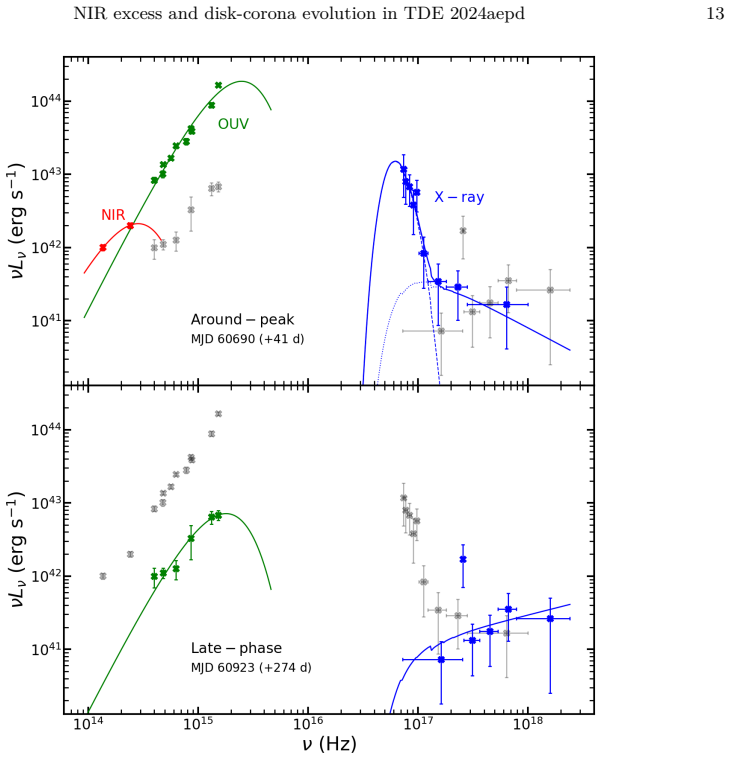
The central model is frequency-dependent free-free reprocessing in a homogeneous, spherical, electron-scattering-dominated envelope with a power-law density profile rho ∝ r^{-s}. Because free-free opacity rises toward low frequencies, NIR photons thermalize at larger radii than optical/UV photons, boosting the NIR flux and producing a power-law spectrum shallower than the Rayleigh-Jeans tail; the break frequency connects the blackbody and power-law branches and, with the fitted slope s, yields the thermalization radius, density normalization, and enclosed mass. The X-ray analysis uses a two-component spectral decomposition (thermal disk plus power law) to track the state transition.
What would settle it
A single NIR spectrum with emission or absorption features characteristic of free-free processes would discriminate directly; more practically, observing the NIR excess before day 40 and tracking its rise would test the claimed <17-day lag. A dust-echo model predicts a delayed, roughly 1100 K blackbody with a light-travel lag comparable to the sublimation radius, whereas free-free predicts an immediate, flat power law that tracks the UV-optical decline.
Extended reading notes
Core claim
For TDE 2024aepd, the near-infrared excess appears by day ~40 with a power-law slope consistent with zero, far flatter than the Rayleigh-Jeans tail of the UV-optical blackbody. Because the light-travel time to the inferred dust sublimation radius (~740 days) far exceeds the observed lag (<17 days), the authors argue a conventional dust echo is disfavoured and propose instead that the excess comes from free-free emission in a dense, extended reprocessing layer. In the same source, the X-ray spectrum, initially a thermal disk plus a hard excess, becomes purely power-law by ~178 days and hardens as the disk fades, which they interpret as the rapid emergence and strengthening of a corona. They a
Load-bearing premise
The free-free conclusion rests on assuming the reprocessing material is a homogeneous, spherical, electron-scattering-dominated layer with a power-law density profile; if the outflow is clumpy or anisotropic, the inferred masses and the claim of a stable density structure could fail, and the paper itself notes a dust echo cannot be fully excluded.
Editorial extensions
If this is right
- Early-time NIR coverage may reveal that a substantial fraction of TDEs show such excesses, and the flat NIR slope can be used as a diagnostic of the reprocessing layer's density structure.
- The measured break-frequency shift with roughly constant density slope implies the reprocessing envelope's structure persists while its density declines, constraining outflow and reprocessing models.
- The disk-to-corona transition at roughly 0.5% Eddington supports using TDEs as fast laboratories for accretion-state transitions, analogous to X-ray binaries.
- The positive photon-index versus X-ray-luminosity correlation in the TDE sample, without the low-luminosity anti-correlation branch, points to a lack of very low-Eddington observations rather than a fundamentally different accretion flow.
Reading between the lines
- If the free-free interpretation is right, the NIR excess directly probes gas mass and density profile; targeted NIR spectroscopy might look for the expected frequency dependence or polarization to confirm the mechanism.
- The dust-echo alternative could be tested by measuring the NIR rise before day 40 and by searching for a late-rising echo; a detection of a delayed, ~1100 K component would overturn the free-free conclusion.
- The same chromatic-reprocessing framework may apply to fast blue optical transients and to the V-shaped SEDs of Little Red Dots, making early-time NIR monitoring a useful discriminant in those populations.
Editorial analysis
A structured set of objections, weighed in public.
Referee Report
Summary. The paper presents multi-wavelength (radio, NIR, optical/UV, X-ray) observations of the tidal disruption event 2024aepd over the first ~300 days after discovery. It reports an early near-infrared excess above the UV-optical blackbody, with an approximately flat NIR power-law spectrum, and argues on the basis of a free-free reprocessing model that this excess is more plausibly explained by a photospheric reprocessing envelope than by a conventional dust echo. The X-ray data show an initially thermal-dominated spectrum with a hard tail, transitioning to a power-law-dominated and progressively harder spectrum around day 178, which the authors interpret as the emergence and strengthening of a corona. The paper also compiles a sample of TDEs with X-ray hard excesses and reports a positive correlation between photon index and Eddington ratio. The authors identify 2024aepd as the third TDE with an early-time NIR excess.
Significance. If the free-free interpretation is correct, the paper adds a valuable new data point to a very small sample of early NIR excesses in TDEs and supports the idea that frequency-dependent reprocessing can be diagnosed in the NIR. The X-ray spectral state transition is well documented and consistent with the growing population of TDEs showing disk-to-corona transitions. The paper's strengths include broad multi-wavelength coverage, careful host-galaxy subtraction, standard processing of Swift/XRT and ground-based data, explicit model-comparison tables, and an unusually candid set of caveats about the spherical, homogeneous assumptions of the free-free model and the tension between the inferred envelope mass and the MOSFiT stellar mass. However, the paper's central temporal-evolution claim—that the UV-optical-to-NIR break frequency increases while the density index stays constant—is not supported by the paper's own best-fit values in Table 1, and the free-free fits are underconstrained by the available two-band NIR data. The paper is publishable after the evolutionary narrative is either properly supported or substantially softened.
major comments (3)
- The abstract and §4.1 state that νbreak 'systematically increases' with time while s remains nearly constant. Table 1 gives νbreak = 2.89(+0.24/−0.33), 2.63(+0.27/−0.37), and 3.67(+0.76/−0.44) ×10^14 Hz for the +41, +68, and +101 d epochs. The first two epochs therefore show a decrease, not an increase, and the uncertainties overlap substantially. Moreover, the epoch-3 value is not an independent measurement: the source was undetected in K at +101 d, so the epoch-2 K-band datum was adopted. With only J and K per epoch, the claim of a systematic break evolution is not established. This claim is load-bearing for the conclusion of 'evolving reprocessing conditions within a broadly unchanged density structure.' The authors should either remove the monotonic-increase claim, or re-fit epoch 3 with only the J-band constraint and show whether any break evolution is statistically required, and re
- The conclusion that the density-profile index s remains nearly constant is essentially a reparameterization of the fitted NIR spectral slope: in the adopted model, α_IR = (4s−6)/(3s−2), and s is a free parameter fit to two NIR bands per epoch. The statement that 's remains consistent within the uncertainties' is therefore not an independent test of structural stability. I recommend presenting the joint posterior of (s, νbreak), or performing a model comparison between (i) a single s with freely evolving νbreak and (ii) independent s at each epoch. Without such a test, the stable-density-structure conclusion is weaker than the text implies. This also bears on the comparison with AT2019azh in Fig. 8.
- The argument against a dust echo relies on taking the first NIR observation as an approximate upper limit on the IR peak and deriving τ < 17 days, compared with the sublimation-radius delay of ~743 days. Section 3.2 explicitly notes that the NIR observations 'only sample the declining phase,' so the first NIR epoch does not directly constrain the time of the NIR peak. Although an upper limit on the delay can still be derived if the source was already declining at +41 d, this should be stated as a model-dependent assumption. The later discussion of anisotropic emission and line-of-sight geometry already acknowledges the main escape route for a dust echo; the quantitative τ < 17 d statement overstates the constraint and should be softened.
minor comments (5)
- Typos: 'primaly' should be 'primarily' and 'primally' should be 'primarily'; 'efficiency' and 'Office' contain non-standard ligature/encoding artifacts that should be corrected in the journal production step.
- 'DESI is amounted on the 4-meter Mayall Telescope' should read 'mounted'.
- The caveat that the K-band template image could contain a late-rising echo, which would cause the true K fluxes to be underestimated, is stated in §2.4 but is not repeated when the K-band points are used to fit the free-free model. This caveat is relevant to the light-travel-time argument and should be recalled in §4.1.
- The header 'Epoch 2K' for the epoch-3 NIR observations is confusing; it should read 'Epoch-2 K-band' with an explicit note that this datum is non-contemporaneous with the epoch-3 J band.
- Several arXiv identifiers appear malformed (e.g., arXiv:2604.160934, arXiv:2602.21624); please check the journal's reference formatting requirements.
Circularity Check
NIR 'density-structure constancy' reduces to the fitted flat NIR slope; central free-free vs. dust-echo choice retains independent timescale evidence.
-
renaming known result
[Sec. 3.3 vs Sec. 4.1, Eq. (7), Table 1]
"We also fit the NIR SEDs with a power-law model, fν ∝ ν^{αIR}. The resulting spectral indices, αIR = 0.22+0.23−0.22 and −0.27+0.33−0.31, are both consistent with zero ... Fν = K(ρ0, s, T)ν^{(4s−6)/(3s−2)}/(4πD^2) ... we find νbreak systematically increases with time, while s remains consistent within the uncertainties, suggesting that the overall density structure of the reprocessing medium remains approximately unchanged."
Eq. (7) makes the NIR power-law index a one-to-one function of s: αIR = (4s−6)/(3s−2). Fitting s from the same J/K excess and then reporting 's remains nearly constant' is therefore the same empirical statement as the flat, time-constant αIR already fitted in Sec. 3.3; it adds no independent information about a 'density structure' beyond the spectral slope. The derived ρ0, rth and MK are algebraically propagated from these same fitted s and νbreak, so they cannot serve as independent validation of the model.
full rationale
The free-free vs. dust-echo discrimination is not circular: it uses an independent light-travel-time argument (Rsub ~ 0.62 pc → ~743 d vs observed τ < 17 d) plus the flatness of the NIR spectrum. The X-ray disk/corona transition and Γ–LX correlation are empirical fits to independent X-ray data, not reductions of the model to its inputs. The only identifiable reduction is the 'density-profile index constancy' claim, which is a reparameterization of the NIR slope already measured in Sec. 3.3. A minor non-load-bearing self-citation exists (Reynolds et al. 2026 for NOTCam reduction and the AT2019azh comparison); the theoretical model is drawn from external work (Lu & Bonnerot 2020; Roth et al. 2020; Somalwar et al. 2025). Note also that Table 1 does not strictly support the statement that νbreak 'systematically increases': 2.89, 2.63, 3.67 ×10^14 Hz, and epoch 3 borrows the epoch-2 K point; this is a support/statistical issue rather than a circularity.
Assumptions & free parameters
free parameters (5)
- s (density-profile index) =
1.76+0.35-0.30, 1.39+0.34-0.23, 1.58+0.45-0.23 at three epochs (Table 1)
- ν_break (break frequency) =
2.89+0.24-0.33, 2.63+0.27-0.37, 3.67+0.76-0.44 ×10^14 Hz
- TOBB (UV-optical blackbody temperature) =
~3.3×10^4 K early to ~2.4×10^4 K late
- ROBB (UV-optical blackbody radius) =
~5.7×10^14 cm at peak to ~3.5×10^14 cm late
- X-ray spectral parameters (Tin, Γ, normalizations) =
Tin ~0.043 keV, Γ from 2.8 to 1.6 (Table B.1)
assumptions (5)
- domain assumption Homogeneous spherical medium with power-law density profile ρ=ρ0(r/r0)^-s and electron-scattering-dominated opacity (κ_es >> κ_ff).
- standard math Validity of the Illarionov & Sunyaev (1972) chromatic radiative diffusion formula (Eq. 4) for the emitted luminosity.
- ad hoc to paper The reprocessing layer is isothermal with T = TOBB (the UV-optical blackbody temperature).
- domain assumption The UV-optical continuum is a single-temperature blackbody.
- domain assumption The hard X-ray excess is represented by a simple powerlaw (thermal Comptonization).
Cite this review
Pith. "Pith review of Early Near-Infrared Excess and Rapid Disk-Corona Evolution in the Tidal Disruption Event 2024aepd." pith.science (2026). https://pith.science/paper/7PQBVEFA
@misc{pith2026260714696,
  author       = {Pith},
  title        = {Pith review of: Early Near-Infrared Excess and Rapid Disk-Corona Evolution in the Tidal Disruption Event 2024aepd},
  year         = {2026},
  howpublished = {\url{https://pith.science/paper/7PQBVEFA}},
  note         = {Machine review of arXiv:2607.14696}
}
abstract
We present multi-wavelength observations of the tidal disruption event (TDE) 2024aepd, spanning primarily the first $\sim$300 days after discovery. The X-ray spectrum is initially dominated by a thermal disk component accompanied by a hard excess. From $\sim$178 days onward, the spectrum becomes power-law dominated and subsequently hardens, indicating the rapid emergence and strengthening of a hot corona. A prominent near-infrared (NIR) excess is detected as early as $\sim40$ days. Its nearly flat power-law spectrum strongly deviates from the Rayleigh-Jeans tail of the UV-optical blackbody. Although a conventional dust-echo origin cannot be completely ruled out, free-free emission from a reprocessing photospheric envelope provides a more plausible explanation. Moreover, the UV-optical-to-NIR break shifts to higher frequencies as the density-profile index remains nearly constant, implying evolving reprocessing conditions within a broadly unchanged density structure. Together with AT2019azh and TDE 2025abcr, TDE 2024aepd is the third TDE reported to exhibit an early-time NIR excess. A larger sample with early-time NIR coverage is needed to determine whether such excesses are common among TDEs.
Figures


Figures from the paper (6 more)


Reference graph
Works this paper leans on
-
[1]
F., Argudo-Fernández, M., et al
Almeida, A., Anderson, S. F., Argudo-Fernández, M., et al. 2023, ApJS, 267, 4410
2023
-
[2]
1996, A&A, 309, L353
Bade, N., Komossa, S., & Dahlem, M. 1996, A&A, 309, L353
1996
-
[3]
Becker, A. 2015, HOTPANTS: High Order Transform of PSF ANd Template Subtraction, Astrophysics Source Code Library, record ascl:1504.004, ascl:1504.0047
arXiv 2015
-
[4]
C., Kulkarni, S
Bellm, E. C., Kulkarni, S. R., Graham, M. J., et al. 2019, PASP, 131, 0180024
2019
-
[5]
2025, ApJ, 984, L5523
Bellovary, J. 2025, ApJ, 984, L5523
2025
-
[6]
Berger, V., Kara, E., Chakraborty, J., Masterson, M., & Burdge, K. 2026, ApJ, 999, 2654, 24 NIR excess and disk-corona evolution in TDE 2024aepd 31 10−9 10−8 10−7 Fν (Jy) 1017 10182×1017 5×10¹⁷ 2×10¹⁸ −1 0 1 (data−model)/error Energy (Hz) Fig.B.1: Fitting result of the combined X-ray spectrum with diskbb+powerlaw model. Table C.1: Log of optical spectrosc...
2026
-
[7]
2019, A&A, 622, A10310
Boquien, M., Burgarella, D., Roehlly, Y., et al. 2019, A&A, 622, A10310
2019
-
[8]
M., Robitaille, T
Bradley, L., Sipőcz, B. M., Robitaille, T. P., et al. 2026, Photutils9
2026
Show all 127 references
-
[9]
J., & Fraser, M
Brennan, S. J., & Fraser, M. 2022, A&A, 667, A628
2022
-
[10]
N., Hill, J
Burrows, D. N., Hill, J. E., Nousek, J. A., et al. 2005, Space Sci. Rev., 120, 1658
2005
-
[11]
1984, The Messenger, 38, 97
Buzzoni, B., Delabre, B., Dekker, H., et al. 1984, The Messenger, 38, 97
1984
-
[12]
C., et al
Calzetti, D., Armus, L., Bohlin, R. C., et al. 2000, ApJ, 533, 68211
2000
-
[13]
2009, MNRAS, 394, 20724
Cao, X. 2009, MNRAS, 394, 20724
2009
-
[14]
2019, in Highlights on Spanish Astrophysics X, ed
Cardiel, N., Pascual, S., Gallego, J., et al. 2019, in Highlights on Spanish Astrophysics X, ed. B. Montesinos, A. Asensio Ramos, F. Buitrago, R. Schödel, E. Villaver, S. Pérez-Hoyos, & I. Ordóñez-Etxeberria, 6059 32 Yongxin Wu et al. CASA Team, Bean, B., Bhatnagar, S., et al....
2019
-
[15]
G., et al
Cepa, J., Aguiar, M., Escalera, V. G., et al. 2000, in Society of Photo-Optical Instrumentation Engineers (SPIE) Conference Series, Vol. 4008, Optical and IR Telescope Instrumentation and Detectors, ed. M. Iye & A. F. Moorwood, 6238
2000
-
[16]
2018, in American Astronomical Society Meeting Abstracts, Vol
Chambers, K., & Pan-STARRS Team. 2018, in American Astronomical Society Meeting Abstracts, Vol. 231, American Astronomical Society Meeting Abstracts #231, 102.017
2018
-
[17]
2025, Transient Name Server AstroNote, 9, 15
Charalampopoulos, P. 2025, Transient Name Server AstroNote, 9, 15
2025
-
[18]
2025, ApJ, 991, 1805
Chen, C., & Shen, R.-F. 2025, ApJ, 991, 1805
2025
-
[19]
2024, ApJ, 971, L26
Chen, X., Kumar, B., Er, X., et al. 2024, ApJ, 971, L26
2024
-
[20]
2009, ApJ, 705, 133623
Constantin, A., Green, P., Aldcroft, T., et al. 2009, ApJ, 705, 133623
2009
-
[21]
C., Roth, N., Ramirez-Ruiz, E., & Miller, M
Dai, L., McKinney, J. C., Roth, N., Ramirez-Ruiz, E., & Miller, M. C. 2018, ApJ, 859, L204 DESI Collaboration, Aghamousa, A., Aguilar, J., et al. 2016, arXiv e-prints, arXiv:1611.000368 DESI Collaboration, Abareshi, B., Aguilar, J., et al. 2022, AJ, 164, 2078
2018 arXiv
-
[22]
J., Lang, D., et al
Dey, A., Schlegel, D. J., Lang, D., et al. 2019, AJ, 157, 1688
2019
-
[23]
A., & Andersen, J
Djupvik, A. A., & Andersen, J. 2010, in Astrophysics and Space Science Proceedings, Vol. 14, Highlights of Spanish Astrophysics V, ed. J. M. Diego, L. J. Goicoechea, J. I. González-Serrano, & J. Gorgas, 2117
2010
-
[24]
2007, A&A Rev., 15, 13
Done, C., Gierliński, M., & Kubota, A. 2007, A&A Rev., 15, 13
2007
-
[25]
2026, AJ, 171, 3718
Dong, Z.-N., Ma, B., Chen, C., et al. 2026, AJ, 171, 3718
2026
-
[26]
T., Aniano, G., Krause, O., et al
Draine, B. T., Aniano, G., Krause, O., et al. 2014, ApJ, 780, 17211
2014
-
[27]
R., & Kochanek, C
Evans, C. R., & Kochanek, C. S. 1989, ApJ, 346, L133
1989
-
[28]
A., Beardmore, A
Evans, P. A., Beardmore, A. P., Page, K. L., et al. 2007, A&A, 469, 3798
2007
-
[29]
A., Beardmore, A
Evans, P. A., Beardmore, A. P., Page, K. L., et al. 2009, MNRAS, 397, 11778
2009
-
[30]
Fitzpatrick, E. L. 1999, PASP, 111, 635
1999
-
[31]
2006, MNRAS, 366, 76711 Garzón, F., Balcells, M., Gallego, J., et al
Fritz, J., Franceschini, A., & Hatziminaoglou, E. 2006, MNRAS, 366, 76711 Garzón, F., Balcells, M., Gallego, J., et al. 2022, A&A, 667, A1078
2006
-
[32]
2004, ApJ, 611, 10057
Gehrels, N., Chincarini, G., Giommi, P., et al. 2004, ApJ, 611, 10057
2004
-
[33]
2021, ARA&A, 59, 213
Gezari, S. 2021, ARA&A, 59, 213
2021
-
[34]
2020, MNRAS, 497, 192525
Gomez, S., Nicholl, M., Short, P., et al. 2020, MNRAS, 497, 192525
2020
-
[35]
J., Kulkarni, S
Graham, M. J., Kulkarni, S. R., Bellm, E. C., et al. 2019, PASP, 131, 0780014
2019
-
[36]
Grupe, D., Beuermann, K., Mannheim, K., & Thomas, H. C. 1999, A&A, 350, 8053
1999
-
[37]
2009, MNRAS, 399, 34923
Gu, M., & Cao, X. 2009, MNRAS, 399, 34923
2009
-
[38]
A., et al
Guillochon, J., Nicholl, M., Villar, V. A., et al. 2018, ApJS, 236, 610
2018
-
[39]
2025, ApJ, 979, 2354
Guo, H., Sun, J., Li, S., et al. 2025, ApJ, 979, 2354
2025
-
[40]
2024, ApJ, 966, 1603, 4, 23, 24
Guolo, M., Gezari, S., Yao, Y., et al. 2024, ApJ, 966, 1603, 4, 23, 24
2024
-
[41]
2023, AJ, 165, 1448 NIR excess and disk-corona evolution in TDE 2024aepd 33
Guy, J., Bailey, S., Kremin, A., et al. 2023, AJ, 165, 1448 NIR excess and disk-corona evolution in TDE 2024aepd 33
2023
-
[42]
1991, ApJ, 380, L513
Haardt, F., & Maraschi, L. 1991, ApJ, 380, L513
1991
-
[43]
J., Ruiz-Macias, O., et al
Hahn, C., Wilson, M. J., Ruiz-Macias, O., et al. 2023, AJ, 165, 2538
2023
-
[44]
D., Margutti, R., et al
Hajela, A., Alexander, K. D., Margutti, R., et al. 2025, ApJ, 983, 294, 23
2025
-
[45]
C., Collins, R
Hambly, N. C., Collins, R. S., Cross, N. J. G., et al. 2008, MNRAS, 384, 6379
2008
-
[46]
2023, ApJ, 942, 94 HI4PI Collaboration, Ben Bekhti, N., Flöer, L., et al
Hammerstein, E., van Velzen, S., Gezari, S., et al. 2023, ApJ, 942, 94 HI4PI Collaboration, Ben Bekhti, N., Flöer, L., et al. 2016, A&A, 594, A1168, 14
2023
-
[47]
Hills, J. G. 1975, Nature, 254, 2953
1975
-
[48]
2024, ApJ, 964, L2224
Huang, S., Jiang, N., Zhu, J., et al. 2024, ApJ, 964, L2224
2024
-
[49]
F., & Sunyaev, R
Illarionov, A. F., & Sunyaev, R. A. 1972, Ap&SS, 19, 6119
1972
-
[50]
2025, ApJ, 980, L2722
Inayoshi, K., & Maiolino, R. 2025, ApJ, 980, L2722
2025
-
[51]
2025, MNRAS, 544, 390022
Ji, X., Maiolino, R., Übler, H., et al. 2025, MNRAS, 544, 390022
2025
-
[52]
Jiang, N., Luo, D., Zhu, J., & Cutri, R. M. 2025, ApJ, 980, L174
2025
-
[53]
2025, ARA&A, 63, 3793
Kara, E., & García, J. 2025, ARA&A, 63, 3793
2025
-
[54]
1999, A&A, 343, 7753
Komossa, S., & Bade, N. 1999, A&A, 343, 7753
1999
-
[55]
1999, A&A, 349, L453
Komossa, S., & Greiner, J. 1999, A&A, 349, L453
1999
-
[56]
Kormendy, J., & Ho, L. C. 2013, ARA&A, 51, 51110
2013
-
[57]
2026, ApJ, 997, L105
LeBaron, N., Margutti, R., Chornock, R., et al. 2026, ApJ, 997, L105
2026
-
[58]
2023, Chinese Physics B, 32, 03980110
Li, N., & Li, C. 2023, Chinese Physics B, 32, 03980110
2023
-
[59]
R., Grupe, D., et al
Lin, D., Carrasco, E. R., Grupe, D., et al. 2011, ApJ, 738, 5224
2011
-
[60]
F., Meyer, F., & Meyer-Hofmeister, E
Liu, B. F., Meyer, F., & Meyer-Hofmeister, E. 2006, A&A, 454, L924
2006
-
[61]
E., & Ma, Y
Liu, H., Jiang, Y.-F., Quataert, E., Greene, J. E., & Ma, Y. 2025, ApJ, 994, 11322
2025
-
[62]
2023, A&A, 669, A7524
Liu, Z., Malyali, A., Krumpe, M., et al. 2023, A&A, 669, A7524
2023
-
[63]
1997, ApJ, 489, 5734
Loeb, A., & Ulmer, A. 1997, ApJ, 489, 5734
1997
-
[64]
2020, MNRAS, 492, 6864, 5, 18
Lu, W., & Bonnerot, C. 2020, MNRAS, 492, 6864, 5, 18
2020
-
[65]
Lu, W., Kumar, P., & Evans, N. J. 2016, MNRAS, 458, 5754, 13
2016
-
[66]
M., et al
Mainzer, A., Bauer, J., Cutri, R. M., et al. 2014, ApJ, 792, 304
2014
-
[67]
Metzger, B. D. 2022, ApJ, 937, L124
2022
-
[68]
W., Shiao, B., et al
Million, C., Fleming, S. W., Shiao, B., et al. 2016, ApJ, 833, 29210
2016
-
[69]
2019, ApJ, 872, 15110
Mockler, B., Guillochon, J., & Ramirez-Ruiz, E. 2019, ApJ, 872, 15110
2019
-
[70]
A., et al
Morrissey, P., Conrow, T., Barlow, T. A., et al. 2007, ApJS, 173, 68210
2007
-
[71]
2021, MNRAS, 507, L2415
Mummery, A. 2021, MNRAS, 507, L2415
2021
-
[72]
A., et al
Newsome, M., Arcavi, I., Howell, D. A., et al. 2024, ApJ, 977, 25824
2024
-
[73]
R., et al
Nicholl, M., Wevers, T., Oates, S. R., et al. 2020, MNRAS, 499, 48224
2020
-
[74]
Pascual, S., Gallego, J., Cardiel, N., & Eliche-Moral, M. C. 2010, in Astronomical Society of the Pacific Conference Series, Vol. 434, Astronomical Data Analysis Software and Systems XIX, ed. 34 Yongxin Wu et al. Y. Mizumoto, K.-I. Morita, & M. Ohishi, 3539
2010
-
[75]
C., Liepold, E
Patra, K. C., Liepold, E. R., Earl, N., et al. 2026, JWST and Keck observations of the off-nuclear tidal disruption event TDE 2025abcr: An evolving reprocessing layer, arXiv:2604.160934, 18, 22
2026 arXiv
-
[76]
S., Steele, I
Piascik, A. S., Steele, I. A., Bates, S. D., et al. 2014, in Society of Photo-Optical Instrumentation Engineers (SPIE) Conference Series, Vol. 9147, Ground-based and Airborne Instrumentation for Astronomy V, ed. S. K. Ramsay, I. S. McLean, & H. Takami, 91478H7
2014
-
[77]
M., & Shiokawa, H
Piran, T., Svirski, G., Krolik, J., Cheng, R. M., & Shiokawa, H. 2015, ApJ, 806, 1644 Planck Collaboration, Aghanim, N., Akrami, Y., et al. 2020, A&A, 641, A65
2015
-
[78]
Qiao, E., & Liu, B. F. 2013, ApJ, 764, 224
2013
-
[79]
F., Panessa, F., & Liu, J
Qiao, E., Liu, B. F., Panessa, F., & Liu, J. Y. 2013, ApJ, 777, 10224
2013
-
[80]
2025, MNRAS, 539, 34734
Qiao, E., Wu, Y., Lin, Y., et al. 2025, MNRAS, 539, 34734
2025
-
[81]
Rau, U., & Cornwell, T. J. 2011, A&A, 532, A7110
2011
-
[82]
Rees, M. J. 1988, Nature, 333, 5233
1988
-
[83]
A., & McClintock, J
Remillard, R. A., & McClintock, J. E. 2006, ARA&A, 44, 493, 4, 23
2006
-
[84]
M., Thomsen, L., Mattila, S., et al
Reynolds, T. M., Thomsen, L., Mattila, S., et al. 2026, A&A, 708, A1394, 9, 18, 22
2026
-
[85]
Roming, P. W. A., Kennedy, T. E., Mason, K. O., et al. 2005, Space Sci. Rev., 120, 957
2005
-
[86]
2016, ApJ, 827, 34
Roth, N., Kasen, D., Guillochon, J., & Ramirez-Ruiz, E. 2016, ApJ, 827, 34
2016
-
[87]
M., Krolik, J., et al
Roth, N., Rossi, E. M., Krolik, J., et al. 2020, Space Sci. Rev., 216, 1145, 18
2020
-
[88]
D., Read, A
Saxton, R. D., Read, A. M., Komossa, S., et al. 2017, A&A, 598, A2924
2017
-
[89]
D., Read, A
Saxton, R. D., Read, A. M., Komossa, S., et al. 2014, A&A, 572, A124
2014
-
[90]
D., Read, A
Saxton, R. D., Read, A. M., Komossa, S., et al. 2019, A&A, 630, A9824
2019
-
[91]
Saxton, R., Komossa, S., Auchettl, K., & Jonker, P. G. 2021, Correction to: X-Ray Properties of
2021
-
[92]
F., & Finkbeiner, D
Schlafly, E. F., & Finkbeiner, D. P. 2011, ApJ, 737, 1035
2011
-
[93]
C., Vrba, F
Schneider, A. C., Vrba, F. J., Bruursema, J., et al. 2025, AJ, 170, 869
2025
-
[94]
J., Greene, J
Setton, D. J., Greene, J. E., de Graaff, A., et al. 2025, ApJ, 995, 11822
2025
-
[95]
2025, ApJ, 992, L1824
Sfaradi, I., Margutti, R., Chornock, R., et al. 2025, ApJ, 992, L1824
2025
-
[96]
J., Prieto, J
Shappee, B. J., Prieto, J. L., Grupe, D., et al. 2014, ApJ, 788, 484
2014
-
[97]
J., Valenti, S., Fraser, M., et al
Smartt, S. J., Valenti, S., Fraser, M., et al. 2015, A&A, 579, A407
2015
-
[98]
A., Papadakis, I
Sobolewska, M. A., Papadakis, I. E., Done, C., & Malzac, J. 2011, MNRAS, 417, 28024
2011
-
[99]
J., Ravi, V., Margutti, R., et al
Somalwar, J. J., Ravi, V., Margutti, R., et al. 2025, ApJ, 995, 2285, 19
2025
-
[100]
A., Smith, R
Steele, I. A., Smith, R. J., Rees, P. C., et al. 2004, in Society of Photo-Optical Instrumentation Engineers (SPIE) Conference Series, Vol. 5489, Ground-based Telescopes, ed. J. M. Oschmann, Jr., 679 7
2004
-
[101]
Steinberg, E., & Stone, N. C. 2024, Nature, 625, 4634
2024
-
[102]
F., Narayan, R., McClintock, J
Steiner, J. F., Narayan, R., McClintock, J. E., & Ebisawa, K. 2009, PASP, 121, 127915 NIR excess and disk-corona evolution in TDE 2024aepd 35
2009
-
[103]
L., Kwan, T
Thomsen, L. L., Kwan, T. M., Dai, L., et al. 2022, ApJ, 937, L284
2022
-
[104]
1995, ApJ, 450, 8763
Titarchuk, L., & Lyubarskij, Y. 1995, ApJ, 450, 8763
1995
-
[105]
L., Denneau, L., Heinze, A
Tonry, J. L., Denneau, L., Heinze, A. N., et al. 2018, PASP, 130, 0645054
2018
-
[106]
1999, ApJ, 514, 1803
Ulmer, A. 1999, ApJ, 514, 1803
1999
-
[107]
2014, MNRAS, 438, L1018 van Velzen, S., Holoien, T
Valenti, S., Sand, D., Pastorello, A., et al. 2014, MNRAS, 438, L1018 van Velzen, S., Holoien, T. W. S., Onori, F., Hung, T., & Arcavi, I. 2020, Space Sci. Rev., 216, 124 4 van Velzen, S., Mendez, A. J., Krolik, J. H., & Gorjian, V. 2016, ApJ, 829, 194, 13, 14, 18 van Velzen, ...
2014
-
[108]
2011, MNRAS, 414, 333024
Veledina, A., Vurm, I., & Poutanen, J. 2011, MNRAS, 414, 333024
2011
-
[109]
v., Gezari, S., Cenko, S
Velzen, S. v., Gezari, S., Cenko, S. B., et al. 2018, The Astronomer’s Telegram, 12263, 14
2018
-
[110]
A., Ferland, G
Verner, D. A., Ferland, G. J., Korista, K. T., & Yakovlev, D. G. 1996, ApJ, 465, 48714
1996
-
[111]
2004, ApJ, 607, L10723
Wang, J.-M., Watarai, K.-Y., & Mineshige, S. 2004, ApJ, 607, L10723
2004
-
[112]
R., Altamirano, D., et al
Wang, Y., Pasham, D. R., Altamirano, D., et al. 2024, ApJ, 962, 7825
2024
-
[113]
R., van Velzen, S., et al
Wevers, T., Pasham, D. R., van Velzen, S., et al. 2021, ApJ, 912, 1514, 23, 24
2021
-
[114]
2000, ApJ, 542, 91414
Wilms, J., Allen, A., & McCray, R. 2000, ApJ, 542, 91414
2000
-
[115]
L., Eisenhardt, P
Wright, E. L., Eisenhardt, P. R. M., Mainzer, A. K., et al. 2010, AJ, 140, 186810
2010
-
[116]
2025, ApJ, 988, L774
Wu, M., Jiang, N., Zhu, J., et al. 2025, ApJ, 988, L774
2025
-
[117]
2008, ApJ, 682, 21223
Wu, Q., & Gu, M. 2008, ApJ, 682, 21223
2008
-
[118]
Xu, H., Cao, X., Wang, Y., & Zdziarski, A. A. 2025, MNRAS, 544, 174824
2025
-
[119]
2015, MNRAS, 447, 169223
Yang, Q.-X., Xie, F.-G., Yuan, F., et al. 2015, MNRAS, 447, 169223
2015
-
[120]
2024, ApJ, 969, 1266
Yang, Y.-P., Liu, X., Pan, Y., et al. 2024, ApJ, 969, 1266
2024
-
[121]
2022, ApJ, 937, 84, 23, 24
Yao, Y., Lu, W., Guolo, M., et al. 2022, ApJ, 937, 84, 23, 24
2022
-
[122]
2024, ApJ, 976, 3424
Yao, Y., Guolo, M., Tombesi, F., et al. 2024, ApJ, 976, 3424
2024
-
[123]
2026, arXiv e-prints, arXiv:2602.2162423
Yao, Y., Chornock, R., Mummery, A., et al. 2026, arXiv e-prints, arXiv:2602.2162423
2026 arXiv
-
[124]
2020, in Society of Photo-Optical Instrumentation Engineers (SPIE) Conference Series, Vol
Yuan, X., Li, Z., Liu, X., et al. 2020, in Society of Photo-Optical Instrumentation Engineers (SPIE) Conference Series, Vol. 11445, Ground-based and Airborne Telescopes VIII, ed. H. K. Marshall, J. Spyromilio, & T. Usuda, 114457M6
2020
-
[125]
2026, Nature Astronomy, 10, 75322
Zhang, C., Wu, Q., Fan, X., et al. 2026, Nature Astronomy, 10, 75322
2026
-
[126]
2017, PASP, 129, 0641018
Zou, H., Zhou, X., Fan, X., et al. 2017, PASP, 129, 0641018
2017
-
[127]
S., et al
Zou, X., Kumar, B., Teja, R. S., et al. 2026, ApJ, 997, 776
2026
Reviewed August 2, 2026 · model on record in the stance chip above.
Discussion (0). Sign in to comment.