REVIEW 2 major objections 6 minor 1 cited by
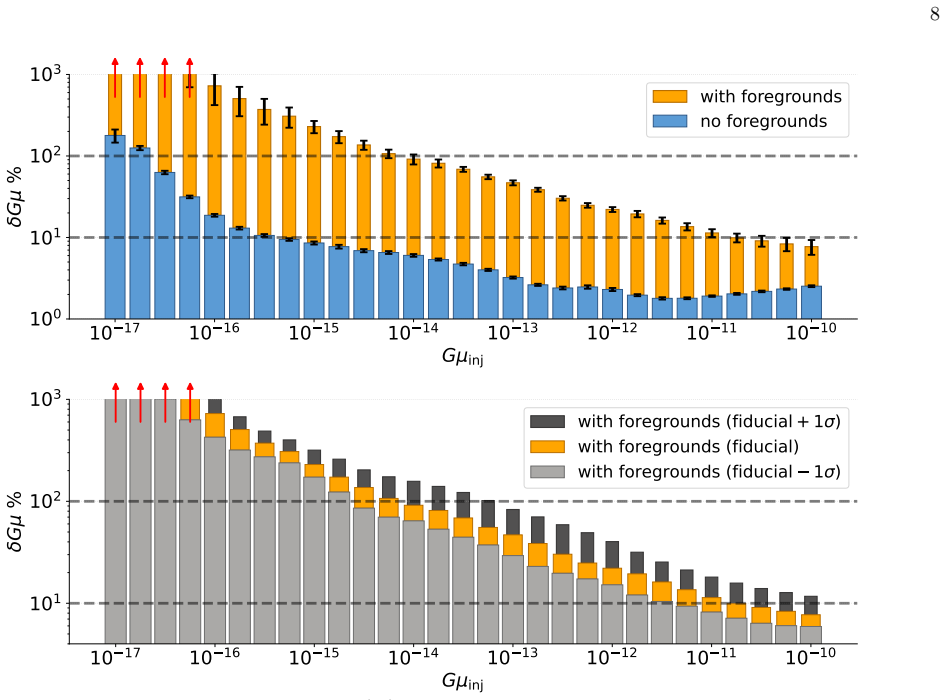
Reconstructing a conventional cosmic-string gravitational-wave background to 10% precision with LISA requires a string tension roughly 100,000 times larger once all expected astrophysical foregrounds are included.
Reviewed by Pith at T0; open to challenge. T0 means a machine referee read the full paper against a public rubric. the ladder, T0–T4 →
T0 review · deepseek-v4-flash
2026-08-01 23:50 UTC pith:ATTMXC7Q
load-bearing objection Carefully executed mock-data study with a genuinely new and likely important result: including ExWD+EMRI foregrounds moves LISA's 10%-precision reconstruction threshold for BOS cosmic strings to Gmu ~ 1e-11, roughly two orders worse than the SOBHB+WD-only budget; but the headline threshold inherits the authors' deliberately pessimistic ExWD spectral choice, which is never propagated, so treat the the 2 major comments →
Cosmic string gravitational wave backgrounds at LISA: II. Reconstruction of conventional signals over astrophysical foregrounds
The pith
A machine-rendered reading of the paper's core claim, the machinery that carries it, and where it could break.
Core claim
On the paper's own terms: with the full known astrophysical foreground budget, LISA's 10%-precision reconstruction threshold for the standard Nambu-Goto cosmic-string tension shifts from Gμ ≃ 4.2×10^-16 (no foregrounds) to Gμ ≃ 1.7×10^-11 (fiducial foregrounds); even the optimistic −1σ foreground model requires Gμ ≳ 3.9×10^-12, and the pessimistic +1σ model requires Gμ ≳ 2.3×10^-10, essentially at the current pulsar-timing bound. The dominant extra degradation comes from extragalactic white-dwarf binaries and EMRIs, not from the previously considered SOBHB plus WD budget. At Gμ = 10^-14 the foreground-aware reconstruction precision is roughly 90%, versus about 6% without foregrounds, and at
What carries the argument
The engine of the analysis is a joint posterior over the string tension log10 Gμ, LISA noise amplitudes, and the amplitudes of the WD, SOBHB, ExWD, and EMRI foregrounds, built with amortized simulation-based inference from hundreds of thousands of simulated LISA observations; the MBHB contribution is included as a fixed component. The cosmic-string signal uses the BOS template, a standard Nambu-Goto loop-network spectrum depending only on Gμ. Reconstruction precision is measured by δGμ, the width of the 95% highest-density interval on Gμ divided by the injected tension, and the results are cross-checked against MCMC and Fisher forecasts.
Load-bearing premise
The load-bearing assumption is that the fixed extragalactic-white-dwarf foreground spectrum used in the pipeline—a shallow-cutoff shape—is the right one in the frequency range where the cosmic-string signal peaks; the authors explicitly chose it over a newer spectrum with a sharper cutoff near 7 mHz, and that choice directly sets the headline threshold.
What would settle it
Run the identical reconstruction pipeline after replacing the extragalactic-white-dwarf foreground spectrum with the alternative model that cuts off sharply near 7 mHz. If the 10%-precision threshold falls well below Gμ ≈ 1.7×10^-11, the reported order-of-magnitude degradation is tied to the chosen foreground shape rather than to the mere presence of a full foreground budget.
If this is right
- LISA's 10%-precision reach on the conventional string tension is Gμ ≳ 1.7×10^-11 with the fiducial foreground model, rather than Gμ ≳ 4.2×10^-16 in the foreground-free case.
- The threshold moves with foreground amplitude: Gμ ≳ 3.9×10^-12 for a −1σ foreground shift and Gμ ≳ 2.3×10^-10 for a +1σ shift.
- Under the easier 100%-precision criterion for a barely reconstructible signal, the minimum tension rises from about 2.1×10^-17 to about 7.2×10^-15, a 2.5-order-of-magnitude shift.
- Extragalactic white dwarfs and EMRIs are the foregrounds that push the degradation beyond the previously studied WD plus SOBHB budget; omitting them understates the required tension by 1–2 orders of magnitude.
- Coverage checks show the amortized posteriors remain well calibrated with seven inferred parameters, so the reported degradation is not an artifact of the inference method.
Where Pith is reading between the lines
- If the newer extragalactic-white-dwarf spectrum with a sharper cutoff near 7 mHz is closer to reality, the headline thresholds would probably decrease substantially, because the paper deliberately chose the more conservative shallow-cutoff shape and did not propagate the newer model through the pipeline.
- For cosmic-string models with more spectral structure than the BOS template, foreground contamination is likely to be even more damaging than shown here, since parameter degeneracies already reduce reconstruction quality in the foreground-free case.
- A direct testable extension would rerun the same pipeline using the alternative ExWD spectrum, the newer WD foreground catalog, or a fully inferred MBHB component, to see how far the thresholds move.
Editorial analysis
A structured set of objections, weighed in public.
Referee Report
Summary. The paper presents a Simulation-Based Inference (SBI/NPE) framework, GWBackFinder, to reconstruct the cosmic-string tension Gμ from mock LISA data in the presence of the main astrophysical foregrounds: galactic white dwarfs (WDs), stellar-origin black-hole binaries (SOBHBs), extragalactic white dwarfs (ExWDs), extreme-mass-ratio inspirals (EMRIs), and massive black-hole binaries (MBHBs, held fixed). The authors jointly infer Gμ, the LISA instrumental noise amplitudes, and the foreground amplitudes, and quantify the 95% reconstruction precision δGμ as a function of injected Gμ. Their central result is that astrophysical foregrounds severely degrade reconstructions: achieving δGμ < 10% requires Gμ ≳ 1.7×10^{-11} in the fiducial foreground model, versus Gμ ≳ 4.2×10^{-16} without foregrounds — roughly 4–6 orders of magnitude — and about 2 orders of magnitude worse than a WD+SOBHB-only budget. The pipeline is validated via MCMC cross-checks, Fisher forecasts, and coverage tests.
Significance. If the headline thresholds hold, the paper is an important step for LISA cosmic-string science: it provides a quantitative, forward-model-based estimate of how the full astrophysical foreground budget impedes measurement of conventional (BOS) cosmic-string templates, and it corrects overly optimistic foreground-free projections. The strengths are substantial: a reusable amortized SBI pipeline, error bars from 20 independent mock realizations, independent MCMC validation, Fisher comparisons, and posterior-coverage checks. The main qualification is that the headline numbers are contingent on the adopted ExWD spectral shape, which is selected at the pessimistic end of available models; the paper is transparent about this choice but does not propagate the alternative shape through the analysis.
major comments (2)
- [Sec. II B c, Eq. (9); Sec. III] The ExWD foreground is fixed to the spectral shape of [25,26] (Eq. 9), and the newer [177] model, which has a sharper cutoff near 7 mHz, is explicitly rejected because the [25,26] foreground is 'more prominent'. Since Sec. III attributes most of the additional degradation (relative to WD+SOBHB-only) to ExWD and EMRI contributions, the headline thresholds Gμ ≳ 1.7×10^{-11} (fiducial) and Gμ ≳ 2.3×10^{-10} (pessimistic) are not expected values but conservative bounds under a deliberately pessimistic ExWD shape. The paper varies only foreground amplitudes, never the spectral shape; the [177] model is not run through SBI or MCMC. This is a load-bearing model contingency. I request either (i) a supplementary analysis with the [177] shape (at least a Fisher-matrix estimate, if a full SBI rerun is too costly), or (ii) an explicit restatement of the abstract/conclusions that these thresholds are
- [Abstract and Sec. IV] The summary-level claims — 'in the presence of the expected astrophysical foregrounds at LISA' and 'a dramatic 4–6 orders of magnitude increase' — are presented as robust expectations, but the magnitude of the shift is driven by the ExWD spectral choice discussed above. The authors are transparent about the choice in the body, but the abstract and conclusions do not carry the caveat. Since these statements are what will be cited, the conclusions should be rephrased to say that the 4–6 order-of-magnitude degradation is obtained for the [25,26]-type ExWD foreground, and that the exact factor is model-dependent; otherwise the reader may mistake a conservative foreground model for a measured expected level.
minor comments (6)
- [Sec. II B c] Typo: 'we strict to the result' should read 'we stick to the result'.
- [Sec. III, Table II] The text says MCMC agrees with SBI 'at a few % level for all tension values, except the smallest one'. Table II shows differences of ~13% at Gμ=10^{-15} (229.5% vs 200.1%) and ~11% at 10^{-13} (46.9% vs 52.1%). Although these are within realization scatter, the wording 'few %' is too strong; suggest 'within ~10–20% for the lower-tension cases'.
- [Appendix C vs Appendix D] The descriptions of the frequency rebinning differ slightly: App. C says 1000 macro-bins above 10^{-3} Hz plus fine bins below, while App. D says 1000 log-spaced bins in [10^{-3},0.5] Hz plus 970 fine bins in [3×10^{-5},10^{-3}] Hz. Both yield 1970 bins, but the wording should be harmonized for clarity.
- [General notation] Some variable names are inconsistent: AWD/AGal and ASOBHB/AExB are used interchangeably (Sec. II B and Table I). Also, the prior on log10 ASOBHB is quoted as 'AExB' in Sec. II B b.
- [Sec. II B e] The MBHB contribution is fixed to the HS scenario and not jointly inferred. This is justified as sub-leading, but the abstract's phrase 'joint inference on the LISA noise, foregrounds, and signal' could be misread. A one-sentence clarification in the abstract or introduction would help.
- [App. D] Typo: 'armotized' should be 'amortized'.
Circularity Check
No significant circularity: the reconstruction-precision thresholds are computed in-paper from the forward models and cross-validated with MCMC and coverage tests; headline numbers are model-contingent but not presupplied by construction.
full rationale
We walked the derivation chain. The cosmic-string GWB template is built from external Nambu-Goto simulation ingredients (Eqs. 2-4, Refs. [111,169,172]); the foreground spectral shapes and amplitude priors are taken from external population studies (Eqs. 5-11 and Table I, Refs. [22-27,174-176]); mock LISA data are generated from these same forward models (App. C); and the SBI/MCMC posteriors plus the reconstruction-precision metric deltaGmu (Eq. 13) are computed outputs, not inputs. The headline thresholds (Gmu ~ 1.7e-11 fiducial, 3.9e-12 optimistic, 2.3e-10 pessimistic for deltaGmu < 10%) are obtained by running the inference pipeline across injected tensions and reading off where the 95% HDI width crosses the threshold; they are not fitted parameters renamed as predictions. The foreground-free baseline is recomputed in-paper (Fig. 3 and Table II) rather than imported solely from Paper I, so the claimed 4-6 order-of-magnitude degradation is an internal comparison, not an input. Self-citations to Paper I supply the likelihood weighting, SBI implementation details, and the deltaGmu convention; these are methodological and are independently checked by the MCMC comparison and coverage calibration, so they are not load-bearing. The one substantive modeling caveat is the ExWD spectral choice: Sec. II B c explicitly adopts [25,26] over the newer [177] shape because the foreground effect is 'more prominent' there, and [177] is never propagated through the pipeline. This makes the exact thresholds model-contingent, i.e. conservative conditional forecasts, but it is a stated input-model selection rather than a step where an output is equivalent by construction to an input. We therefore find no circular step.
Axiom & Free-Parameter Ledger
free parameters (6)
- log10 A_WD (galactic white-dwarf foreground normalization) =
-7.84 (fiducial; prior σ=0.21)
- log10 A_SOBHB (stellar-origin black-hole binary foreground normalization) =
-12.38 (fiducial; prior σ=0.34)
- log10 A_ExWD (extragalactic white-dwarf foreground normalization) =
-11.06 (fiducial; prior σ=0.17)
- log10 A_EMRI (extreme-mass-ratio-inspiral foreground normalization at 3 mHz) =
-11.34 (fiducial; prior σ=0.5)
- A_acc, A_P (LISA instrumental noise amplitudes) =
A_acc=3, A_P=15 (fiducial; uniform priors ±20%)
- Gμ (cosmic-string tension) =
injected over [10^-18, 10^-9]
axioms (6)
- domain assumption Standard ΛCDM expansion history with Planck-2018 parameters and g*, g*s from [172] (Eq. 4)
- domain assumption BOS loop number density from NG simulation fits of [169] (Eq. 3) is the correct conventional cosmic-string model
- domain assumption Astrophysical foreground spectral shapes are known exactly; only their normalizations are uncertain (Eqs. 5–11)
- domain assumption The mixed Gaussian+log-normal likelihood with 1/3–2/3 weighting calibrated in Paper I is accurate (Eqs. E1–E3)
- domain assumption Mock LISA data can be represented as 94 independent Gaussian chunks, coarse-grained to 1970 bins (App. C)
- ad hoc to paper MBHB foreground can be fixed to the HS scenario of [27] without inference (Eq. 11)
read the original abstract
We study the reconstruction of conventional cosmic-string signals with LISA in the presence of all major known astrophysical foregrounds expected in the LISA band. These include stellar-origin black-hole binaries (SOBHBs), galactic (WDs) and extragalactic (ExWDs) white dwarfs, extreme-mass-ratio-inspirals (EMRIs), and massive black-hole binaries (MBHBs). Using the Simulation-based Inference package GWBackFinder, we perform a joint inference on the LISA noise, foregrounds, and signal, across a range of injected string tensions $G\mu$. We find that reconstructing tensions with an error $\lesssim 10\%$ requires values as large as $G\mu \gtrsim 10^{-11}$, i.e. a factor $\sim10^5$ larger than previous estimates with no foregrounds, and $\sim 10^2$ larger compared to estimates accounting only for SOBHB and WD foregrounds. This work is the second in a series initiated in Ref. arXiv:2508.05395, which aims to quantify LISA's ability to measure representative cosmic-string models.
Figures




Forward citations
Cited by 1 Pith paper
-
LISA Reconstruction Landscape for Metastable Cosmic Strings
LISA can reconstruct metastable cosmic-string tension and lifetime when it samples the tail-to-plateau transition, with residual κ_CS sensitivity possible even in high-SNR plateau-like spectra.
Reference graph
Works this paper leans on
-
[1]
A. Dimitriou, D. G. Figueroa, P. Simakachorn and B. Zaldivar,Cosmic string gravitational wave backgrounds at LISA: I. Signal survey, template reconstruction, and model comparison,JCAP05 (2026) 037 [2508.05395]. [2]LIGO Scientific, Virgocollaboration,Observation of Gravitational Waves from a Binary Black Hole Merger,Phys. Rev. Lett.116(2016) 061102 [1602.0...
Pith/arXiv arXiv 2026
-
[12]
D. J. Reardon et al.,Search for an Isotropic Gravitational-wave Background with the Parkes Pulsar Timing Array,Astrophys. J. Lett.951(2023) L6 [2306.16215]
Pith/arXiv arXiv 2023
-
[13]
H. Xu et al.,Searching for the Nano-Hertz Stochastic Gravitational Wave Background with the Chinese Pulsar Timing Array Data Release I,Res. Astron. Astrophys.23(2023) 075024 [2306.16216]
Pith/arXiv arXiv 2023
-
[14]
Hild et al.,Sensitivity Studies for Third-Generation Gravitational Wave Observatories,Class
S. Hild et al.,Sensitivity Studies for Third-Generation Gravitational Wave Observatories,Class. Quant. Grav. 28(2011) 094013 [1012.0908]
Pith/arXiv arXiv 2011
-
[15]
Punturo et al.,The Einstein Telescope: A third-generation gravitational wave observatory,Class
M. Punturo et al.,The Einstein Telescope: A third-generation gravitational wave observatory,Class. Quant. Grav.27(2010) 194002. [16]ETcollaboration,The Science of the Einstein Telescope,JCAP03(2026) 081 [2503.12263]. [17]LIGO Scientificcollaboration,Exploring the Sensitivity of Next Generation Gravitational Wave Detectors,Class. Quant. Grav.34(2017) 04400...
Pith/arXiv arXiv 2010
-
[18]
Reitze et al.,Cosmic Explorer: The U.S
D. Reitze et al.,Cosmic Explorer: The U.S. Contribution to Gravitational-Wave Astronomy beyond LIGO,Bull. Am. Astron. Soc.51(2019) 035 [1907.04833]. [19]LISAcollaboration,Laser Interferometer Space Antenna,1702.00786. [20]LISA Cosmology Working Groupcollaboration, Cosmology with the Laser Interferometer Space Antenna,Living Rev. Rel.26(2023) 5 [2204.05434...
Pith/arXiv arXiv 2019
-
[22]
V. Korol, N. Hallakoun, S. Toonen and N. Karnesis, Observationally driven Galactic double white dwarf population for LISA,Mon. Not. Roy. Astron. Soc.511 (2022) 5936 [2109.10972]
Pith/arXiv arXiv 2022
-
[23]
S. Babak, C. Caprini, D. G. Figueroa, N. Karnesis, P. Marcoccia, G. Nardini et al.,Stochastic gravitational wave background from stellar origin binary black holes in LISA,JCAP08(2023) 034 [2304.06368]
Pith/arXiv arXiv 2023
-
[24]
F. Pozzoli, S. Babak, A. Sesana, M. Bonetti and N. Karnesis,Computation of stochastic background from extreme-mass-ratio inspiral populations for LISA, Phys. Rev. D108(2023) 103039 [2302.07043]
Pith/arXiv arXiv 2023
-
[25]
S. Staelens and G. Nelemans,Likelihood of white dwarf binaries to dominate the astrophysical gravitational wave background in the mHz band,Astron. Astrophys. 683(2024) A139 [2310.19448]
Pith/arXiv arXiv 2024
-
[26]
S. Hofman and G. Nelemans,Uncertainty of the white dwarf astrophysical gravitational wave background, Astron. Astrophys.691(2024) A261 [2407.10642]
Pith/arXiv arXiv 2024
-
[27]
A. Perego, M. Bonetti, A. Sesana, S. Toonen and V. Korol,Assessing the performance of future space-based detectors: astrophysical foregrounds and individual sources,2510.18695
-
[28]
C. Caprini and D. G. Figueroa,Cosmological backgrounds of gravitational waves,Class. Quant. Grav.35(2018) 163001 [1801.04268]
Pith/arXiv arXiv 2018
-
[29]
L. P. Grishchuk,Amplification of gravitational waves in an isotropic universe,Sov. Phys. JETP40(1975) 409
1975
-
[30]
A. A. Starobinsky,Spectrum of relict gravitational radiation and the early state of the universe,JETP Lett.30(1979) 682
1979
-
[31]
V. A. Rubakov, M. V. Sazhin and A. V. Veryaskin, Graviton Creation in the Inflationary Universe and the Grand Unification Scale,Phys. Lett. B115(1982) 189
1982
-
[32]
Fabbri and M
R. Fabbri and M. d. Pollock,The Effect of Primordially Produced Gravitons upon the Anisotropy of the Cosmological Microwave Background Radiation, Phys. Lett. B125(1983) 445
1983
-
[33]
M. M. Anber and L. Sorbo,N-flationary magnetic fields,JCAP10(2006) 018 [astro-ph/0606534]
Pith/arXiv arXiv 2006
-
[34]
L. Sorbo,Parity violation in the Cosmic Microwave Background from a pseudoscalar inflaton,JCAP06 (2011) 003 [1101.1525]. 15
Pith/arXiv arXiv 2011
-
[35]
E. Pajer and M. Peloso,A review of Axion Inflation in the era of Planck,Class. Quant. Grav.30(2013) 214002 [1305.3557]
Pith/arXiv arXiv 2013
-
[36]
P. Adshead, E. Martinec and M. Wyman,Gauge fields and inflation: Chiral gravitational waves, fluctuations, and the Lyth bound,Phys. Rev. D88(2013) 021302 [1301.2598]
Pith/arXiv arXiv 2013
-
[37]
P. Adshead, E. Martinec and M. Wyman, Perturbations in Chromo-Natural Inflation,JHEP09 (2013) 087 [1305.2930]
Pith/arXiv arXiv 2013
-
[38]
A. Maleknejad,Axion Inflation with an SU(2) Gauge Field: Detectable Chiral Gravity Waves,JHEP07 (2016) 104 [1604.03327]
Pith/arXiv arXiv 2016
-
[39]
E. Dimastrogiovanni, M. Fasiello and T. Fujita, Primordial Gravitational Waves from Axion-Gauge Fields Dynamics,JCAP01(2017) 019 [1608.04216]
Pith/arXiv arXiv 2017
-
[40]
R. Namba, M. Peloso, M. Shiraishi, L. Sorbo and C. Unal,Scale-dependent gravitational waves from a rolling axion,JCAP01(2016) 041 [1509.07521]
Pith/arXiv arXiv 2016
-
[41]
R. Z. Ferreira, J. Ganc, J. Nore˜ na and M. S. Sloth,On the validity of the perturbative description of axions during inflation,JCAP04(2016) 039 [1512.06116]
Pith/arXiv arXiv 2016
-
[42]
M. Peloso, L. Sorbo and C. Unal,Rolling axions during inflation: perturbativity and signatures,JCAP 09(2016) 001 [1606.00459]
Pith/arXiv arXiv 2016
-
[43]
V. Domcke, M. Pieroni and P. Bin´ etruy,Primordial gravitational waves for universality classes of pseudoscalar inflation,JCAP06(2016) 031 [1603.01287]
Pith/arXiv arXiv 2016
-
[44]
R. R. Caldwell and C. Devulder,Axion Gauge Field Inflation and Gravitational Leptogenesis: A Lower Bound on B Modes from the Matter-Antimatter Asymmetry of the Universe,Phys. Rev. D97(2018) 023532 [1706.03765]
Pith/arXiv arXiv 2018
-
[45]
M. C. Guzzetti, N. Bartolo, M. Liguori and S. Matarrese,Gravitational waves from inflation,Riv. Nuovo Cim.39(2016) 399 [1605.01615]
Pith/arXiv arXiv 2016
-
[46]
Bartolo et al.,Science with the space-based interferometer LISA
N. Bartolo et al.,Science with the space-based interferometer LISA. IV: Probing inflation with gravitational waves,JCAP12(2016) 026 [1610.06481]
Pith/arXiv arXiv 2016
-
[47]
J. Fumagalli, S. Renaux-Petel and L. T. Witkowski, Oscillations in the stochastic gravitational wave background from sharp features and particle production during inflation,JCAP08(2021) 030 [2012.02761]
Pith/arXiv arXiv 2021
-
[48]
J. Fumagalli, G. A. Palma, S. Renaux-Petel, S. Sypsas, L. T. Witkowski and C. Zenteno,Primordial gravitational waves from excited states,JHEP03 (2022) 196 [2111.14664]
Pith/arXiv arXiv 2022
-
[49]
R. Easther and E. A. Lim,Stochastic gravitational wave production after inflation,JCAP04(2006) 010 [astro-ph/0601617]
Pith/arXiv arXiv 2006
-
[50]
J. Garcia-Bellido and D. G. Figueroa,A stochastic background of gravitational waves from hybrid preheating,Phys. Rev. Lett.98(2007) 061302 [astro-ph/0701014]
Pith/arXiv arXiv 2007
-
[51]
J. Garcia-Bellido, D. G. Figueroa and A. Sastre,A Gravitational Wave Background from Reheating after Hybrid Inflation,Phys. Rev. D77(2008) 043517 [0707.0839]
Pith/arXiv arXiv 2008
-
[52]
J. F. Dufaux, A. Bergman, G. N. Felder, L. Kofman and J.-P. Uzan,Theory and Numerics of Gravitational Waves from Preheating after Inflation,Phys. Rev. D 76(2007) 123517 [0707.0875]
Pith/arXiv arXiv 2007
-
[53]
J.-F. Dufaux, G. Felder, L. Kofman and O. Navros, Gravity Waves from Tachyonic Preheating after Hybrid Inflation,JCAP03(2009) 001 [0812.2917]
Pith/arXiv arXiv 2009
-
[54]
J.-F. Dufaux, D. G. Figueroa and J. Garcia-Bellido, Gravitational Waves from Abelian Gauge Fields and Cosmic Strings at Preheating,Phys. Rev. D82(2010) 083518 [1006.0217]
Pith/arXiv arXiv 2010
-
[55]
L. Bethke, D. G. Figueroa and A. Rajantie, Anisotropies in the Gravitational Wave Background from Preheating,Phys. Rev. Lett.111(2013) 011301 [1304.2657]
Pith/arXiv arXiv 2013
-
[56]
L. Bethke, D. G. Figueroa and A. Rajantie,On the Anisotropy of the Gravitational Wave Background from Massless Preheating,JCAP06(2014) 047 [1309.1148]
Pith/arXiv arXiv 2014
-
[57]
K. Enqvist, D. G. Figueroa and R. N. Lerner,Curvaton Decay by Resonant Production of the Standard Model Higgs,JCAP01(2013) 040 [1211.5028]
Pith/arXiv arXiv 2013
-
[58]
D. G. Figueroa and F. Torrenti,Gravitational wave production from preheating: parameter dependence, JCAP10(2017) 057 [1707.04533]
Pith/arXiv arXiv 2017
-
[59]
P. Adshead, J. T. Giblin and Z. J. Weiner, Gravitational waves from gauge preheating,Phys. Rev. D98(2018) 4 [1805.04550]
Pith/arXiv arXiv 2018
-
[60]
P. Adshead, J. T. Giblin, M. Pieroni and Z. J. Weiner, Constraining axion inflation with gravitational waves from preheating,Phys. Rev. D101(2020) 8 [1909.12842]
Pith/arXiv arXiv 2020
-
[61]
P. Adshead, J. T. Giblin, M. Pieroni and Z. J. Weiner, Constraining Axion Inflation with Gravitational Waves across 29 Decades in Frequency,Phys. Rev. Lett.124 (2020) 17 [1909.12843]
Pith/arXiv arXiv 2020
-
[62]
Giovannini,Gravitational waves constraints on postinflationary phases stiffer than radiation,Phys
M. Giovannini,Gravitational waves constraints on postinflationary phases stiffer than radiation,Phys. Rev. D58(1998) 083504 [hep-ph/9806329]
Pith/arXiv arXiv 1998
-
[63]
Giovannini,Production and detection of relic gravitons in quintessential inflationary models,Phys
M. Giovannini,Production and detection of relic gravitons in quintessential inflationary models,Phys. Rev. D60(1999) 123511 [astro-ph/9903004]
Pith/arXiv arXiv 1999
-
[64]
L. A. Boyle and A. Buonanno,Relating gravitational wave constraints from primordial nucleosynthesis, pulsar timing, laser interferometers, and the CMB: Implications for the early Universe,Phys. Rev. D78 (2008) 043531 [0708.2279]
Pith/arXiv arXiv 2008
-
[65]
B. Li, P. R. Shapiro and T. Rindler-Daller, Bose-Einstein-condensed scalar field dark matter and the gravitational wave background from inflation: new cosmological constraints and its detectability by LIGO, Phys. Rev. D96(2017) 063505 [1611.07961]
Pith/arXiv arXiv 2017
-
[66]
B. Li and P. R. Shapiro,Precision cosmology and the stiff-amplified gravitational-wave background from inflation: NANOGrav, Advanced LIGO-Virgo and the Hubble tension,JCAP10(2021) 024 [2107.12229]
Pith/arXiv arXiv 2021
-
[67]
D. G. Figueroa and E. H. Tanin,Inconsistency of an inflationary sector coupled only to Einstein gravity, JCAP10(2019) 050 [1811.04093]
Pith/arXiv arXiv 2019
-
[68]
D. G. Figueroa and E. H. Tanin,Ability of LIGO and LISA to probe the equation of state of the early Universe,JCAP08(2019) 011 [1905.11960]
Pith/arXiv arXiv 2019
-
[69]
Y. Gouttenoire, G. Servant and P. Simakachorn, Revealing the Primordial Irreducible Inflationary Gravitational-Wave Background with a Spinning Peccei-Quinn Axion,2108.10328
-
[70]
R. T. Co, D. Dunsky, N. Fernandez, A. Ghalsasi, L. J. Hall, K. Harigaya et al.,Gravitational wave and CMB probes of axion kination,JHEP09(2022) 116 16 [2108.09299]
Pith/arXiv arXiv 2022
-
[71]
Y. Gouttenoire, G. Servant and P. Simakachorn, Kination cosmology from scalar fields and gravitational-wave signatures,2111.01150
-
[72]
V. K. Oikonomou,Flat energy spectrum of primordial gravitational waves versus peaks and the NANOGrav 2023 observation,Phys. Rev. D108(2023) 043516 [2306.17351]
Pith/arXiv arXiv 2023
-
[73]
C. Er¨ oncel, Y. Gouttenoire, R. Sato, G. Servant and P. Simakachorn,Universal Bound on the Duration of a Kination Era,Phys. Rev. Lett.135(2025) 101002 [2501.17226]
arXiv 2025
-
[74]
J. Ghiglieri and M. Laine,Gravitational wave background from Standard Model physics: Qualitative features,JCAP07(2015) 022 [1504.02569]
Pith/arXiv arXiv 2015
-
[75]
J. Ghiglieri, G. Jackson, M. Laine and Y. Zhu, Gravitational wave background from Standard Model physics: Complete leading order,JHEP07(2020) 092 [2004.11392]
Pith/arXiv arXiv 2020
-
[76]
A. Ringwald, J. Sch¨ utte-Engel and C. Tamarit, Gravitational Waves as a Big Bang Thermometer, JCAP03(2021) 054 [2011.04731]
Pith/arXiv arXiv 2021
-
[77]
A. Ringwald and C. Tamarit,Revealing the cosmic history with gravitational waves,Phys. Rev. D106 (2022) 063027 [2203.00621]
Pith/arXiv arXiv 2022
-
[78]
J. Ghiglieri, J. Sch¨ utte-Engel and E. Speranza, Freezing-in gravitational waves,Phys. Rev. D109 (2024) 023538 [2211.16513]
Pith/arXiv arXiv 2024
-
[79]
J. Ghiglieri, M. Laine, J. Sch¨ utte-Engel and E. Speranza,Double-graviton production from Standard Model plasma,JCAP04(2024) 062 [2401.08766]
Pith/arXiv arXiv 2024
-
[80]
S.-Y. Zhou, E. J. Copeland, R. Easther, H. Finkel, Z.-G. Mou and P. M. Saffin,Gravitational Waves from Oscillon Preheating,JHEP10(2013) 026 [1304.6094]
Pith/arXiv arXiv 2013
-
[81]
S. Antusch, F. Cefala and S. Orani,Gravitational waves from oscillons after inflation,Phys. Rev. Lett. 118(2017) 011303 [1607.01314]
Pith/arXiv arXiv 2017
-
[82]
S. Antusch, F. Cefala and S. Orani,What can we learn from the stochastic gravitational wave background produced by oscillons?,JCAP03(2018) 032 [1712.03231]
Pith/arXiv arXiv 2018
-
[83]
J. Liu, Z.-K. Guo, R.-G. Cai and G. Shiu, Gravitational Waves from Oscillons with Cuspy Potentials,Phys. Rev. Lett.120(2018) 031301 [1707.09841]
Pith/arXiv arXiv 2018
-
[84]
M. A. Amin, J. Braden, E. J. Copeland, J. T. Giblin, C. Solorio, Z. J. Weiner et al.,Gravitational waves from asymmetric oscillon dynamics?,Phys. Rev. D98 (2018) 024040 [1803.08047]
Pith/arXiv arXiv 2018
-
[85]
M. Kamionkowski, A. Kosowsky and M. S. Turner, Gravitational radiation from first order phase transitions,Phys. Rev. D49(1994) 2837 [astro-ph/9310044]
Pith/arXiv arXiv 1994
-
[86]
C. Caprini, R. Durrer and G. Servant,Gravitational wave generation from bubble collisions in first-order phase transitions: An analytic approach,Phys. Rev. D 77(2008) 124015 [0711.2593]
Pith/arXiv arXiv 2008
-
[87]
S. J. Huber and T. Konstandin,Gravitational Wave Production by Collisions: More Bubbles,JCAP09 (2008) 022 [0806.1828]
Pith/arXiv arXiv 2008
-
[88]
M. Hindmarsh, S. J. Huber, K. Rummukainen and D. J. Weir,Gravitational waves from the sound of a first order phase transition,Phys. Rev. Lett.112 (2014) 041301 [1304.2433]
Pith/arXiv arXiv 2014
-
[89]
M. Hindmarsh, S. J. Huber, K. Rummukainen and D. J. Weir,Numerical simulations of acoustically generated gravitational waves at a first order phase transition,Phys. Rev. D92(2015) 123009 [1504.03291]
Pith/arXiv arXiv 2015
-
[90]
Caprini et al.,Science with the space-based interferometer eLISA
C. Caprini et al.,Science with the space-based interferometer eLISA. II: Gravitational waves from cosmological phase transitions,JCAP04(2016) 001 [1512.06239]
Pith/arXiv arXiv 2016
-
[91]
M. Hindmarsh, S. J. Huber, K. Rummukainen and D. J. Weir,Shape of the acoustic gravitational wave power spectrum from a first order phase transition, Phys. Rev. D96(2017) 103520 [1704.05871]
Pith/arXiv arXiv 2017
-
[92]
D. Cutting, M. Hindmarsh and D. J. Weir, Gravitational waves from vacuum first-order phase transitions: from the envelope to the lattice,Phys. Rev. D97(2018) 123513 [1802.05712]
Pith/arXiv arXiv 2018
-
[93]
D. Cutting, M. Hindmarsh and D. J. Weir,Vorticity, kinetic energy, and suppressed gravitational wave production in strong first order phase transitions,Phys. Rev. Lett.125(2020) 021302 [1906.00480]
Pith/arXiv arXiv 2020
-
[94]
A. Roper Pol, S. Mandal, A. Brandenburg, T. Kahniashvili and A. Kosowsky,Numerical simulations of gravitational waves from early-universe turbulence,Phys. Rev. D102(2020) 083512 [1903.08585]
Pith/arXiv arXiv 2020
-
[95]
C. Caprini et al.,Detecting gravitational waves from cosmological phase transitions with LISA: an update, JCAP03(2020) 024 [1910.13125]
Pith/arXiv arXiv 2020
discussion (0)
Sign in with ORCID, Apple, or X to comment. Anyone can read and Pith papers without signing in.