REVIEW 2 major objections 6 minor 286 references
X-ray polarization of Z-type neutron star low-mass X-ray binaries -- II. Spectropolarimetric analysis
T0 review · 2 major / 6 minor · reviewed 2026-08-01 · deepseek-v4-flash
Pith's one-line read For most Z-type neutron star X-ray binaries, the dominant polarized signal is Comptonized emission, reaching about 6% on the horizontal branch — higher than spreading-layer models predict.
desk verdict Careful, useful branch-resolved spectropolarimetric analysis with a real discovery claim, but the component-level polarization values inherit fixed priors that need a sensitivity test before the headline should be taken at face value. read the letter →
The pith
A machine-rendered reading of the paper's core claim, the machinery that carries it, and where it could break.
The reading
What carries the argument
The analysis uses a single spectral baseline for all sources — a thermal accretion disk model plus thermal Comptonization of a blackbody seed, with a relativistic reflection model (and occasionally an extra hard tail) added where needed — and fits the IXPE, NICER, and NuSTAR spectra separately for each branch of the color–color diagram. Polarization is then assigned component by component with a constant-polarization multiplicative model (polconst), with the reflected component's polarization degree fixed at 10% and its angle tied to the Comptonized component. This decomposition is the load-bearing device: it turns measured total Stokes parameters into per-component polarization degrees and
What would settle it
Take a bright Z-source (e.g., Cyg X-2) and leave the reflected component's polarization degree and angle free instead of fixing them at 10% and parallel to the Comptonized angle; if the best fit yields a reflection PD far below 10% or a PA that is not parallel to the Comptonized PA, the headline Comptonized PD values would not be reproduced. A second, weaker test: obtain high-signal branch-resolved data (e.g., with a more sensitive future polarimeter) and check whether the disk PA remains misaligned when it is not frozen to Comptonization+90°.
Extended reading notes
Core claim
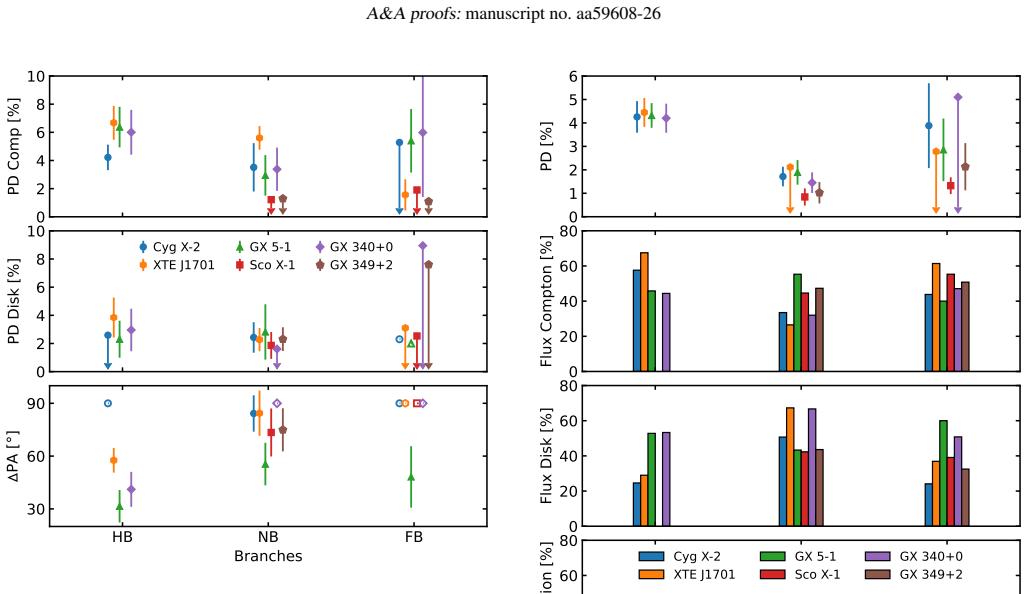
The central claim is that, for most of the sources and branches, the main contribution to the X-ray emission and polarization is due to Comptonization: moving from the horizontal branch to the normal branch, the polarization degree in the 2–8 keV band varies from about 6% to 3–4%, while the flaring branch is loosely constrained. These values are significantly higher than theoretical expectations for typical spreading or boundary layer configurations. The disk polarization is generally lower (below 3%) but still higher than the prediction for an electron scattering-dominated, plane-parallel atmosphere at the corresponding inclination. The polarization angle of the disk appears significantly m
Load-bearing premise
The component-level polarization results depend on the assumed spectral decomposition and on fixing the reflected component's polarization degree at 10% with its angle tied to the Comptonized angle; if the degeneracy between Comptonized and reflected emission is resolved differently, or the reflection polarization differs, the reported per-component degrees and angle misalignment would not hold.
Editorial extensions
If this is right
- If the high Comptonized polarization degrees (up to about 6–7% in the horizontal branch) are real, standard optically thick spreading-layer geometries, which predict only a few percent, are ruled out for most Z-sources and branches.
- The non-orthogonal disk and Comptonized polarization angles imply broken axial symmetry in the inner accretion flow, so inclination alone is insufficient to predict the observed polarization.
- Because the disk contribution rises as sources move from the horizontal to the normal branch, the branch-to-branch drop in total polarization can be explained partly by dilution from a weakly and misaligned polarized disk component.
- Including the reflected component in the polarization budget matters: even at 5–20% of the photon flux, highly polarized reflected photons can shift the inferred Comptonized polarization if omitted.
Reading between the lines
- If the fixed 10% reflection polarization and the parallel PA assumption are wrong — for example, if the reflection PA follows a warped disk's local normal — the quoted Comptonized polarization degrees would change; a future fit that frees the reflection PA on a bright source would settle this.
- The paper's claim that the disk is more polarized than a plane-parallel scattering atmosphere could be tested independently with spectropolarimetric atmosphere models that include absorption, since the measured values are still consistent with those.
- A natural extension is to model the Z-track as a continuous sequence of spreading-layer opening angles or covering fractions; if the covering fraction varies systematically along the track, the polarization evolution observed here may be reproduced without invoking an extra wind component.
- The strong HB-to-NB contrast suggests that dedicated observations of currently unobserved branches in Sco X-1-like sources could decide whether the two Z-source subclasses differ in polarization or only in sampling.
Signed reviews
Editorial analysis
A structured set of objections, weighed in public.
Referee Report
Summary. This paper presents the first branch-resolved spectropolarimetric analysis of a sample of six Z-type neutron star low-mass X-ray binaries observed with IXPE, NICER, and NuSTAR. The authors fit a common spectral model — TBabs*(diskbb+thcomp*bbodyrad), plus relxillNS reflection for all sources except GX 5–1 — to each branch of the Z-track, then fix the spectral parameters and apply polconst component-by-component to the IXPE Stokes spectra. They report a Comptonized-component PD of roughly 3–6% in the HB/NB, a disk PD generally below 3%, and a disk PA that is often not perpendicular to the Comptonization PA. They interpret the high Comptonized PD as evidence that the Comptonizing region is not a simple spreading layer, and they compare the disk PD with plane-parallel atmosphere predictions. They also find no correlation between polarization and inclination or reflection fraction.
Significance. If the component-level polarization values are robust, this is a valuable step: it is the first uniform, branch-resolved spectropolarimetric study of Z-sources, it includes a reflection component in the polarimetric decomposition, and it provides a direct observational test of spreading-layer/boundary-layer geometries. The paper also makes useful connections to ADC systems and winds. However, the central quantitative claims rest on priors for the reflection polarization and on only a subset of rows with free disk polarization angles. The paper itself acknowledges the Comptonization/reflection degeneracy and the difficulty of estimating component PD/PA. The significance of the results therefore depends on sensitivity checks that are not currently presented.
major comments (2)
- [§4, Table 2, Appendix A] The component-resolved PD/PA values in Table 2 are derived by fixing the spectral model and assigning polarization with polconst under three priors: reflection PD is fixed to 10%, reflection PA is tied to the Comptonization PA for every source and branch, and in several rows the disk PA is frozen to Comp+90 (Cyg X-2 HB/FB, XTE J1701–462 FB, Sco X-1 FB, GX 340+0 NB/FB). The central claim in the abstract and §4 — that the Comptonized PD is 3–6% and significantly above spreading-layer expectations of ~2% — is sensitive to these priors. Reflection contributes 5–32% of the 2–8 keV flux in the Appendix tables; e.g., Cyg X-2 HB has N_relxillNS/N_Tot = 17.8% and Table 2 gives Comp PD = 4.2±0.9. If the true reflection PD were 20% (a value the paper itself cites from Matt 1993 and Podgorný et al. 2025) with PA aligned to the Comptonization, the inferred Comptonized PD would shift downward by sever
- [§4, Table 2, §5] The claim that the disk PA is 'significantly misaligned and not perpendicular' to the Comptonization PA is only testable in rows where the disk PA was left free. In several rows the disk PA is frozen to Comp+90, so those rows cannot provide evidence for misalignment. Among the free rows, some are actually consistent with perpendicular orientation within the quoted 90% errors: for example, Cyg X-2 NB has disk PA = 54±15 and Comp PA = −42±7, giving ΔPA≈96°, consistent with 90° within errors. Moreover, the reflection PA is tied to the Comptonization PA in §4 under the assumption of an axisymmetric configuration, but the paper later invokes a possible break in axial symmetry to explain the absence of an inclination trend and the non-orthogonal PAs. In a non-axisymmetric geometry, the reflection PA would not in general be locked to the Comptonization PA. The present treatment therefore preclu
minor comments (6)
- [Table 1] The header 'XTE J1071–461' is a typo; the source is XTE J1701–462 throughout the text.
- [§3.5] There is a repeated word in 'also simultaneously observed the the source'; please correct.
- [§4, Table 2] The notation '=PA Comp +90' and bracketed values such as '[10]' should be defined explicitly in the table notes as frozen priors, not as measured quantities. This will avoid confusion about which entries are constraints and which are assumptions.
- [§3.4] The gray-filter correction E^{−ΔΓ} for Sco X-1 is mentioned but ΔΓ is not defined or described in terms of how it was constrained. Please clarify whether this factor is applied to the model I, Q, and U consistently and what value of ΔΓ was used.
- [Figures 2 and 4] The legend states that empty markers correspond to 'values frozen during the fits,' but it is not always clear whether the PD or the PA was frozen. Please make the legend more explicit, e.g., 'PD frozen' vs 'PA frozen'.
- [§4] The uncertainties in Table 2 are statistical only, since the spectral parameters are fixed to their best-fit values. The paper should state explicitly that the quoted errors do not include covariance with the spectral parameters, especially given the Comptonization/reflection degeneracy.
Circularity Check
No circular reduction: component-level PD/PA values are conditional on explicit priors, but the headline comparison rests on independent IXPE measurements and published external models.
full rationale
The paper's central derivation is observational: IXPE Stokes spectra are fit with polconst applied to a fixed spectral decomposition, and the resulting component PD/PA are compared with published theoretical models (Chandrasekhar atmospheres, spreading-layer/boundary-layer simulations). The measured total and branch-resolved polarization are external data, not outputs of the theories being tested. The model-dependent component decomposition in Table 2 does involve priors: relxillNS PD is fixed at 10% with PA tied to thcomp*bbodyrad, and in some rows the disk PA is frozen perpendicular to the Comptonization PA. These are assumptions, and the paper explicitly acknowledges the resulting degeneracy: 'it is difficult to estimate the PD and PA for each component due to the limited bandpass of IXPE and the degeneracy of some components' (Sect. 4) and 'Although there is strong degeneracy between the Comptonized and reflected components, as expected...' (Sect. 5). Frozen values are marked in Table 2 and Fig. 2, and the misalignment claim is restricted to rows 'when measurable,' so no prediction is silently forced by construction. Self-citations to G25 are prior data-analysis work (branch GTIs, model-independent PD) and serve as cross-checks, not as an unverified load-bearing premise. Thus the central claim is conditional on modeling choices but not circularly derived from its inputs. The score of 2 reflects these acknowledged model-dependence caveats and minor self-citation, not a circular reduction.
Assumptions & free parameters
free parameters (15)
- diskbb kT_in (per source/branch) =
0.65–1.26 keV
- diskbb normalization (R_d sqrt(cos i)) =
10–30 km
- thcomp electron temperature kT_e =
2.6–14.5 keV
- thcomp optical depth τ =
7.5–30
- thcomp covering fraction f =
0–1 (fixed to 1 or 0 in many branches; free values ~0.2–0.51)
- bbodyrad seed temperature kT =
0.99–1.57 keV
- bbodyrad normalization / R_bb =
8–29 km
- relxillNS inclination i =
30°–62°
- relxillNS inner radius R_in =
upper limits; fixed to ISCO in some branches
- relxillNS ionization log ξ =
1.5–3.0
- relxillNS iron abundance A_Fe =
1.4–9.7 (often fixed)
- reflection PD (fixed) =
10%
- NICER edge depth D =
0.015–0.079
- GX 5-1 powerlaw normalization N_pl =
0.44–0.47 (or upper limit 0.02)
- Cross-calibration constants (per DU/FPM/NICER) =
0.728–1.392
assumptions (9)
- domain assumption The spectral model TBabs*(diskbb+thcomp*bbodyrad)+relxillNS adequately describes the 1.5–30 keV spectra of all Z-sources (with source-specific additions like edge, powerlaw, apec).
- domain assumption The Comptonized component is produced by thcomp applied to bbodyrad seed photons from the NS surface/boundary layer; its covering fraction f is a valid descriptor.
- domain assumption relxillNS (single-temperature blackbody illuminating a disk at 45°) describes the reflection component, with spin fixed at 0.1, outer radius 1000 Rg, and reflection fraction −1.
- ad hoc to paper Reflected photons have PD = 10% and PA parallel to the Comptonization PA (axisymmetric geometry).
- domain assumption Chandrasekhar/Sobolev plane-parallel electron-scattering atmosphere predictions are the correct baseline for disk atmospheric polarization at the measured inclination.
- ad hoc to paper NICER residuals below 2 keV are instrumental and can be modeled with an absorption edge at ~1.839 keV (Al edge).
- ad hoc to paper For Sco X-1, the IXPE gray-filter residuals can be corrected by multiplying the model by E^{-ΔΓ}.
- domain assumption Branch classifications (HB/NB/FB) from G25 are correct; the GTIs split the data appropriately.
- domain assumption The adopted distances (2.1–11 kpc) used to convert normalizations to physical radii are correct.
invented entities (1)
-
Sub-relativistic or fully ionized accretion disk wind
Cite this review
Pith. "Pith review of X-ray polarization of Z-type neutron star low-mass X-ray binaries -- II. Spectropolarimetric analysis." pith.science (2026). https://pith.science/paper/7MF2N3CT
@misc{pith2026260716140,
  author       = {Pith},
  title        = {Pith review of: X-ray polarization of Z-type neutron star low-mass X-ray binaries -- II. Spectropolarimetric analysis},
  year         = {2026},
  howpublished = {\url{https://pith.science/paper/7MF2N3CT}},
  note         = {Machine review of arXiv:2607.16140}
}
read the original abstract
IXPE has provided for the first time detailed energy- and time-resolved X-ray polarimetry of Z-type neutron star low-mass X-ray binaries (NS-LMXBs) as they move along their color-color diagrams (CCDs). These sources can reach the highest polarization observed for NS-LXMBs in the 2-8 keV range when they move along the horizontal branch. In a previous paper, we characterized the spectral state of a sample of Z-sources using the CCD and estimated the polarization with model-independent analysis. Here, we present detailed spectropolarimetric analysis for each source on each branch using data from IXPE, NICER, and NuSTAR. The continuum X-ray emission of all the sources is well described with a combination of thermal accretion disk emission plus a harder Comptonized component. In addition, reflection features, in particular the relativistically broadened Fe line, are observed for our sources, except GX 5-1. For most of the sources and branches, the main contribution to the X-ray emission and polarization is due to Comptonization: moving from the horizontal branch (HB) to the normal branch (NB), the polarization degree (PD) in the 2-8 keV band varies from about 6% to 3-4%, while the PD is loosely constrained in the flaring branch (FB), due to the shorter exposures. These PD values are significantly higher than theoretical expectations for typical spreading or boundary layer configurations. The polarization of the disk is generally lower (below 3%) but still higher than predictions for an electron scattering-dominated, plane-parallel atmosphere above the disk observed at the corresponding inclination. Moreover, the polarization angle (PA) of the disk seems to be significantly misaligned and not perpendicular to that of Comptonization. We find no correlation between the polarization signal and the inclination, nor with the contribution of reflected photons throughout the Z-track.
Figures


Reference graph
Works this paper leans on
-
[1]
Model-independent, time-resolved X-ray polarimetry
X-ray polarization of Z-type neutron star low-mass X-ray binaries: I. Model-independent, time-resolved X-ray polarimetry. , year = 2025, month = jul, volume =
2025
-
[2]
Galaxies , year = 2024, month = aug, volume =
The IXPE View of Neutron Star Low-Mass X-ray Binaries. Galaxies , year = 2024, month = aug, volume =. doi:10.3390/galaxies12040043 , archivePrefix =. 2409.07161 , primaryClass =
arXiv 2024
-
[3]
Constraining the Size of the Corona with Fully Relativistic Calculations of Spectra of Extended Coronae. I. The Monte Carlo Radiative Transfer Code. , year = 2019, month = apr, volume =
2019
-
[4]
and Dovčiak, M
Zhang, W. and Dovčiak, M. and Bursa, M. and Karas, V. and Matt, G. and Ursini, F. , title = ". Monthly Notices of the Royal Astronomical Society , volume =. 2022 , month =
2022
-
[5]
and Ursini, F
Gnarini, A. and Ursini, F. and Matt, G. and Bianchi, S. and Capitanio, F. and Cocchi, M. and Farinelli, R. and Zhang, W. , title = ". , volume =. 2022 , month =
2022
-
[6]
Black Holes (Les Astres Occlus) , year = 1973, month = jan, pages =
Astrophysics of black holes. Black Holes (Les Astres Occlus) , year = 1973, month = jan, pages =
1973
-
[7]
, year = 1980, month = jan, volume =
Polarization features of X-ray radiation emitted near black holes. , year = 1980, month = jan, volume =
1980
-
[8]
, year = 2000, month = mar, volume =
Light Curves of Rapidly Rotating Neutron Stars. , year = 2000, month = mar, volume =
2000
Show all 286 references
-
[9]
Patruno and B
A. Patruno and B. Haskell and N. Andersson , title =. doi:10.3847/1538-4357/aa927a , year = 2017, month =
2017 doi
-
[10]
, year = 2021, month = mar, volume =
Spectral and polarization properties of black hole accretion disc emission: including absorption effects. , year = 2021, month = mar, volume =
2021
-
[11]
, year = 1987, month = may, volume =
The light curves of low-mass X-ray binaries. , year = 1987, month = may, volume =
1987
-
[12]
, year = 1988, month = jan, volume =
The X-Ray Spectral Properties of Accretion Disks in X-Ray Binaries. , year = 1988, month = jan, volume =
1988
-
[13]
, year = 1984, month = jan, volume =
Energy spectra of low-mass binary X-ray sources observed from Tenma. , year = 1984, month = jan, volume =
1984
-
[14]
, year = 1989, month = jan, volume =
Luminosity-related changes of the energy spectrum of X 1608-522. , year = 1989, month = jan, volume =
1989
-
[15]
, year = 1989, month = nov, volume =
Two patterns of correlated X-ray timing and spectral behaviour in low-mass X-ray binaries. , year = 1989, month = nov, volume =
1989
-
[16]
, year = 1989, month = jan, volume =
Quasi-periodic oscillations and noise in low-mass X-ray binaries. , year = 1989, month = jan, volume =
1989
-
[17]
, year = 1990, month = sep, volume =
Correlation of X-Ray Burst Properties with Source State in the ``Atoll'' Source 4U/MXB 1636-53. , year = 1990, month = sep, volume =
1990
-
[18]
, title =
van der Klis, M. , title =. X-ray Binaries , editor =
-
[19]
, year = 1995, month = dec, volume =
X-Ray Spectra of Z Sources. , year = 1995, month = dec, volume =
1995
-
[20]
, editor=
van der Klis, M. , editor=. Rapid X-ray variability , DOI=. Compact stellar X-ray sources , publisher =. 2006 , pages=
2006
-
[21]
, year = 2010, month = mar, volume =
On the nature of the Cygnus X-2 like Z-track sources. , year = 2010, month = mar, volume =
2010
-
[22]
, year = 2012, month = jan, volume =
Dipping - versus flaring in Z-track sources: resolving the controversy. , year = 2012, month = jan, volume =
2012
-
[23]
, year = 2012, month = oct, volume =
Spectral investigations of the nature of the Scorpius X-1 like sources. , year = 2012, month = oct, volume =
2012
-
[24]
, year = 2003, month = oct, volume =
Boundary layer, accretion disk and X-ray variability in the luminous LMXBs. , year = 2003, month = oct, volume =
2003
-
[25]
10.1051/0004-6361:20053964
Boundary layer emission and Z-track in the color-color diagram of luminous LMXBs , DOI= "10.1051/0004-6361:20053964", journal =
-
[26]
Revnivtsev, M. G. and Suleimanov, V. F. and Poutanen, J. , title = ". , volume =. 2013 , month =
2013
-
[27]
Everything you always wanted to know about accretion but were afraid to ask
Modelling the behaviour of accretion flows in X-ray binaries. Everything you always wanted to know about accretion but were afraid to ask. , year = 2007, month = dec, volume =
2007
-
[28]
, year = 2011, month = may, volume =
BeppoSAX view of the NS-LMXB GS 1826-238. , year = 2011, month = may, volume =
2011
-
[29]
, year = 1994, month = jun, volume =
Similarities in Neutron Star and Black Hole Accretion. , year = 1994, month = jun, volume =
1994
-
[30]
, year = 2006, month = feb, volume =
Jets in neutron star X-ray binaries: a comparison with black holes. , year = 2006, month = feb, volume =
2006
-
[31]
Handbook of X-ray and Gamma-ray Astrophysics , publisher =
Low-Magnetic-Field Neutron Stars in X-ray Binaries. Handbook of X-ray and Gamma-ray Astrophysics , publisher =
-
[32]
, year = 1977, month = jan, volume =
Soft X-ray emission from dwarf novae. , year = 1977, month = jan, volume =
1977
-
[33]
Astronomy Letters , year = 1999, month = may, volume =
Spread of matter over a neutron-star surface during disk accretion. Astronomy Letters , year = 1999, month = may, volume =
1999
-
[34]
and Poutanen, J
Suleimanov, V. and Poutanen, J. , title = ". , volume =. 2006 , month =
2006
-
[35]
, year = 2001, month = jan, volume =
Accretion Disk Boundary Layers around Neutron Stars: X-Ray Production in Low-Mass X-Ray Binaries. , year = 2001, month = jan, volume =
2001
-
[36]
, year = 1985, month = feb, volume =
Comptonization of low-frequency radiation in accretion disks Angular distribution and polarization of hard radiation. , year = 1985, month = feb, volume =
1985
-
[37]
A treatise on radiative transfer
-
[38]
, year = 2024, month = apr, volume =
The polarization of the boundary layer around weakly magnetized neutron stars in X-ray binaries. , year = 2024, month = apr, volume =
2024
-
[39]
, year = 2025, month = oct, volume =
A Monte Carlo spectropolarimetric model for the high-soft state of neutron star low-mass X-ray binaries. , year = 2025, month = oct, volume =
2025
-
[40]
, year = 2025, month = apr, volume =
Polarized radiation from the spreading layer of weakly magnetized neutron stars. , year = 2025, month = apr, volume =
2025
-
[41]
, year = 1982, month = jun, volume =
Accretion disk coronae. , year = 1982, month = jun, volume =
1982
-
[42]
, year = 1988, month = jan, volume =
X-ray orbital modulations from low-mass X-ray binaries. , year = 1988, month = jan, volume =
1988
-
[43]
Schnittman and Julian H
Jeremy D. Schnittman and Julian H. Krolik , title =. doi:10.1088/0004-637X/701/2/1175 , year =
-
[44]
, year = 1996, month = dec, volume =
Green's matrix for Compton reflection of polarized radiation from cold matter. , year = 1996, month = dec, volume =
1996
-
[45]
, year = 1993, month = feb, volume =
X-ray polarization properties of a centrally illuminated accretion disc. , year = 1993, month = feb, volume =
1993
-
[46]
, year = 1985, month = nov, volume =
Angular distribution and polarization of X-ray-burster radiation (during stationary and flash phases). , year = 1985, month = nov, volume =
1985
-
[47]
, year = 2024, month = jan, volume =
Reflecting on accretion in neutron star low-mass X-ray binaries. , year = 2024, month = jan, volume =
2024
-
[48]
, year = 2013, month = apr, volume =
Irradiation of an accretion disc by a jet: general properties and implications for spin measurements of black holes. , year = 2013, month = apr, volume =
2013
-
[49]
, year = 2014, month = oct, volume =
The role of the reflection fraction in constraining black hole spin. , year = 2014, month = oct, volume =
2014
-
[50]
, year = 2014, month = feb, volume =
Improved Reflection Models of Black Hole Accretion Disks: Treating the Angular Distribution of X-Rays. , year = 2014, month = feb, volume =
2014
-
[51]
, year = 2022, month = feb, volume =
Relativistic X-Ray Reflection Models for Accreting Neutron Stars. , year = 2022, month = feb, volume =
2022
-
[52]
, keywords =
Reflection spectra from an accretion disc illuminated by a neutron star X-ray burst. , keywords =
-
[53]
, year = 2016, month = oct, volume =
The effects of high density on the X-ray spectrum reflected from accretion discs around black holes. , year = 2016, month = oct, volume =
2016
-
[54]
, year = 2025, month = jun, volume =
A Persistent Disk Wind and Variable Jet Outflow in the Neutron-star Low-mass X-Ray Binary GX 13+1. , year = 2025, month = jun, volume =
2025
-
[55]
arXiv e-prints , year = 2025, month = jul, eid =
X-ray polarization of reflected thermal emission. arXiv e-prints , year = 2025, month = jul, eid =
2025
-
[56]
Direct radiation
Polarization properties of thermal accretion disk emission: I. Direct radiation. , year = 2026, month = jan, volume =
2026
-
[57]
, year = 2001, month = feb, volume =
High-Energy X-Ray Timing Experiment Detections of Hard X-Ray Tails in Scorpius X-1. , year = 2001, month = feb, volume =
2001
-
[58]
, year = 2006, month = nov, volume =
Average hard X-ray emission from NS LMXBs: observational evidence of different spectral states in NS LMXBs. , year = 2006, month = nov, volume =
2006
-
[59]
, year = 1966, month = aug, volume =
Cosmic X-Ray Sources-Galactic and Extragalactic. , year = 1966, month = aug, volume =
1966
-
[60]
, year = 1979, month = jul, volume =
The halo population X-ray source Cygnus X-2. , year = 1979, month = jul, volume =
1979
-
[61]
, year = 1990, month = aug, volume =
Optical spectroscopy of V 1341 Cygni, the optical counterpart of Cygnus X-2. , year = 1990, month = aug, volume =
1990
-
[62]
, year = 1998, month = jan, volume =
The Mass of the Neutron Star in Cygnus X-2 (V1341 Cygni). , year = 1998, month = jan, volume =
1998
-
[63]
, year = 2010, month = feb, volume =
On the mass of the neutron star in Cyg X-2. , year = 2010, month = feb, volume =
2010
-
[64]
, year = 1999, month = may, volume =
The optical light curves of Cygnus X-2 (V1341 Cyg) and the mass of its neutron star. , year = 1999, month = may, volume =
1999
-
[65]
, year = 1998, month = feb, volume =
Discovery of kHz Quasi-periodic Oscillations in the Z Source Cygnus X-2. , year = 1998, month = feb, volume =
1998
-
[66]
, year = 1998, month = may, volume =
A Type I Burst with Radius Expansion Observed from Cygnus X-2 with the Rossi X-Ray Timing Explorer. , year = 1998, month = may, volume =
1998
-
[67]
, year = 1986, month = aug, volume =
Spectral Variability of Cygnus X-2: Structure in the Circumsource Material. , year = 1986, month = aug, volume =
1986
-
[68]
, year = 1993, month = jun, volume =
Resolving the Iron K Line in Cygnus X-2: an Observation with BBXRT. , year = 1993, month = jun, volume =
1993
-
[69]
, year = 1997, month = jul, volume =
Low-energy line emission from Cygnus X-2 observed with the BeppoSAX LECS. , year = 1997, month = jul, volume =
1997
-
[70]
, year = 2002, month = may, volume =
On the spectral evolution of Cygnus X-2 along its color-color diagram. , year = 2002, month = may, volume =
2002
-
[71]
, year = 2009, month = may, volume =
The X-ray spectral evolution of Cygnus X-2 in the framework of bulk Comptonization. , year = 2009, month = may, volume =
2009
-
[72]
, year = 2010, month = sep, volume =
Relativistic Lines and Reflection from the Inner Accretion Disks Around Neutron Stars. , year = 2010, month = sep, volume =
2010
-
[73]
, year = 2018, month = feb, volume =
NuSTAR view of the Z-type neutron star low-mass X-ray binary Cygnus X-2. , year = 2018, month = feb, volume =
2018
-
[74]
R. M. Ludlam and E. M. Cackett and J. A. Garc. Radius Constraints from Reflection Modeling of Cygnus X-2 with. , volume =
-
[75]
, year = 2013, month = oct, volume =
Radio and X-ray observations of jet ejection in Cygnus X-2. , year = 2013, month = oct, volume =
2013
-
[76]
, year = 2026, month = jan, volume =
XRISM Observations of Accretion Disk Corona in Cyg X-2. , year = 2026, month = jan, volume =
2026
-
[77]
Journal of High Energy Astrophysics , year = 2026, month = mar, volume =
Decoding Cygnus X-2: The critical role of reflection in IXPE data. Journal of High Energy Astrophysics , year = 2026, month = mar, volume =
2026
-
[78]
, year = 2007, month = sep, volume =
The variable radio counterpart and possible large-scale jet of the new Z source XTE J1701-462. , year = 2007, month = sep, volume =
2007
-
[79]
The Astronomer's Telegram , keywords =
Radius expansion bursts from the neutron star transient XTE J1701-462; a new distance estimate. The Astronomer's Telegram , keywords =
-
[80]
The Astronomer's Telegram , keywords =
New X-ray Transient, XTE J1701-462. The Astronomer's Telegram , keywords =
-
[81]
The Astronomer's Telegram , keywords =
Continuing RXTE observations of XTE J1701-462: a new ``Z'' in town?. The Astronomer's Telegram , keywords =
-
[82]
The Astronomer's Telegram , keywords =
First detection of a type-I X-ray burst from the transient Z source XTE J1701-462. The Astronomer's Telegram , keywords =
-
[83]
The Astronomer's Telegram , keywords =
Rapid decay of the neutron star transient XTE J1701-462. The Astronomer's Telegram , keywords =
-
[84]
and Remillard, R
Lin, D. and Remillard, R. A. and Homan, J. , title =
-
[85]
and Altamirano, D
Lin, D. and Altamirano, D. and Homan, J. and Remillard, R. A. and Wijnands, R. and Belloni, T. , title =
-
[86]
, year = 2010, month = aug, volume =
XTE J1701-462 and Its Implications for the Nature of Subclasses in Low-magnetic-field Neutron Star Low-mass X-ray Binaries. , year = 2010, month = aug, volume =
2010
-
[87]
Monthly Notices of the Royal Astronomical Society , volume =
Sanna, Andrea and Méndez, Mariano and Altamirano, Diego and Homan, Jeroen and Casella, Piergiorgio and Belloni, Tomaso and Lin, Dacheng and van der Klis, Michiel and Wijnands, Rudy , title = ". Monthly Notices of the Royal Astronomical Society , volume =. 2010 , month =
2010
-
[88]
, year = 2014, month = jun, volume =
Cross-correlations between soft and hard light curves depending on luminosity in the transient neutron star XTE J1701-462. , year = 2014, month = jun, volume =
2014
-
[89]
The Astronomer's Telegram , keywords =
MAXI/GSC detection of a new X-ray outburst from XTE J1701-462. The Astronomer's Telegram , keywords =
-
[90]
The Astronomer's Telegram , keywords =
Swift/XRT confirms outburst of XTE J1701-462. The Astronomer's Telegram , keywords =
-
[91]
, year = 2024, month = jun, volume =
Constraining the physical parameters of XTE J1701-462 through NuSTAR observations. , year = 2024, month = jun, volume =
2024
-
[92]
, year = 1968, month = jun, volume =
Celestial Positions of X-Ray Sources in Sagittarius. , year = 1968, month = jun, volume =
1968
-
[93]
Two Topics in X-Ray Astronomy, Volume 1: X Ray Binaries
Non-Thermal Radio Emission of X-Ray Binaries. Two Topics in X-Ray Astronomy, Volume 1: X Ray Binaries. Volume 2: AGN and the X Ray Background , year = 1989, editor =
1989
-
[94]
, year = 1991, month = jul, volume =
Two hard X-ray sources in 100 square degrees around the Galactic Center. , year = 1991, month = jul, volume =
1991
-
[95]
, year = 1993, month = dec, volume =
Three Years of Monitoring GRS 1758-258: an Extremely Hard X-Ray Source near GX 5-1. , year = 1993, month = dec, volume =
1993
-
[96]
, year = 1994, month = sep, volume =
Spectral and correlated timing behaviour of GX5-1. , year = 1994, month = sep, volume =
1994
-
[97]
, year = 2000, month = jul, volume =
The infrared counterpart of the Z source GX 5-1. , year = 2000, month = jul, volume =
2000
-
[98]
, year = 2002, month = jul, volume =
Low- and high-frequency variability as a function of spectral properties in the bright X-ray binary GX 5-1. , year = 2002, month = jul, volume =. doi:10.1046/j.1365-8711.2002.05442.x , archivePrefix =. astro-ph/0202420 , primaryClass =
2002
-
[99]
, year = 2000, month = sep, volume =
The radio luminosity of persistent X-ray binaries. , year = 2000, month = sep, volume =
2000
-
[100]
, year = 2006, month = sep, volume =
The X-Ray Halo of GX 5-1. , year = 2006, month = sep, volume =
2006
-
[101]
, year = 2016, month = may, volume =
New orbital ephemerides for the dipping source 4U 1323-619: constraining the distance to the source. , year = 2016, month = may, volume =
2016
-
[102]
, year = 2018, month = jan, volume =
Monte Carlo Simulation of the X-Ray Halos of GX 5-1 and GX 13+1 to Test Models of Insterstellar Dust Grains. , year = 2018, month = jan, volume =
2018
-
[103]
, year = 2018, month = feb, volume =
Absence of Reflection Features in NuSTAR Spectra of the Luminous Neutron Star X-Ray Binary GX 5-1. , year = 2018, month = feb, volume =
2018
-
[104]
, year = 1999, month = jun, volume =
X-ray reflection spectra from ionized slabs. , year = 1999, month = jun, volume =
1999
-
[105]
and Gursky, H
Giacconi, R. and Gursky, H. and Paolini, F. R. and Rossi, B. B. , journal =. ``Evidence for X-Rays From Sources Outside the Solar System''. 1962 , publisher =
1962
-
[106]
, year = 1968, month = jun, volume =
Detection of Radio Emission from Scorpio X-1. , year = 1968, month = jun, volume =
1968
-
[107]
, year = 1979, month = sep, volume =
The linear X-ray polarization of Scorpius X-1. , year = 1979, month = sep, volume =
1979
-
[108]
, year = 2001, month = may, volume =
Scorpius X-1: Energy Transfer from the Core to the Radio Lobes. , year = 2001, month = may, volume =
2001
-
[109]
, year = 2001, month = sep, volume =
Scorpius X-1: The Evolution and Nature of the Twin Compact Radio Lobes. , year = 2001, month = sep, volume =
2001
-
[110]
Spectral Hardening during the Flaring Branch
X-Ray Spectral and Timing Behavior of Scorpius X-1. Spectral Hardening during the Flaring Branch. , year = 2014, month = jul, volume =
2014
-
[111]
, year = 2021, month = apr, volume =
Distances to Galactic X-ray binaries with Gaia DR2. , year = 2021, month = apr, volume =
2021
-
[112]
A Significant Detection of X-ray Polarization in Sco X-1 with
Xiangyun Long and Hua Feng and Hong Li and Jiahuan Zhu and Qiong Wu and Jiahui Huang and Massimo Minuti and Weichun Jiang and Dongxin Yang and Saverio Citraro and Hikmat Nasimi and Jiandong Yu and Ge Jin and Ming Zeng and Peng An and Jiachen Jiang and Enrico Costa and Luca Bal...
-
[113]
, year = 2006, month = oct, volume =
A Hard X-Ray View of Scorpius X-1 with INTEGRAL: Nonthermal Emission?. , year = 2006, month = oct, volume =
2006
-
[114]
, year = 2021, month = oct, volume =
Fe K and Fe K line detection in the NuSTAR spectrum of the ultra-bright Z source Scorpius X-1. , year = 2021, month = oct, volume =
2021
-
[115]
Science , year = 1967, month = apr, volume =
Distribution and Variability of Cosmic X-Ray Sources. Science , year = 1967, month = apr, volume =
1967
-
[116]
, year = 1971, month = nov, volume =
GX 349+2 and GX 340+0: Locations and X-Ray Pulsation Limits. , year = 1971, month = nov, volume =
1971
-
[117]
, year = 1993, month = jan, volume =
The radio counterpart of the Z source GX 340+0. , year = 1993, month = jan, volume =
1993
-
[118]
, year = 1994, month = jan, volume =
Simultaneous radio and X-ray observations of GX 340+0. , year = 1994, month = jan, volume =
1994
-
[119]
, year = 1996, month = oct, volume =
GX340+0 with EXOSAT: its correlated X-ray spectral and timing behaviour. , year = 1996, month = oct, volume =
1996
-
[120]
, year = 2000, month = oct, volume =
Simultaneous radio and X-ray observations of Galactic Centre low-mass X-ray binaries. , year = 2000, month = oct, volume =
2000
-
[121]
, year = 2000, month = jul, volume =
The Power Spectral Properties of the Z Source GX 340+0. , year = 2000, month = jul, volume =
2000
-
[122]
Nuclear Physics B Proceedings Supplements , year = 2004, month = jun, volume =
A BeppoSAX study of the Galactic Z-source GX 340+0. Nuclear Physics B Proceedings Supplements , year = 2004, month = jun, volume =
2004
-
[123]
, year = 2005, month = feb, volume =
2005
-
[124]
, year = 2009, month = mar, volume =
Disk Reflection Signatures in the Spectrum of the Bright Z-Source GX 340+0. , year = 2009, month = mar, volume =
2009
-
[125]
, year = 2013, month = mar, volume =
Stability of the Photon Indices in Z-source GX 340+0 for Spectral States. , year = 2013, month = mar, volume =
2013
-
[126]
, year = 2016, month = may, volume =
An Ultra-fast X-Ray Disk Wind in the Neutron Star Binary GX 340+0. , year = 2016, month = may, volume =
2016
-
[127]
, year = 2025, month = sep, volume =
The structure of the relativistic Fe line in GX 340+0 as viewed with XRISM/Resolve, NICER, and NuSTAR. , year = 2025, month = sep, volume =
2025
-
[128]
, year = 1998, month = apr, volume =
GX349+2 (ScoX-2): an odd-ball among the Z sources. , year = 1998, month = apr, volume =
1998
-
[129]
, year = 2001, month = jun, volume =
Detection of a Hard Tail in the X-Ray Spectrum of the Z Source GX 349+2. , year = 2001, month = jun, volume =
2001
-
[130]
Log(N)-Log(S) and luminosity function of X-ray binaries from RXTE/ASM data
The Milky Way in X-rays for an outside observer. Log(N)-Log(S) and luminosity function of X-ray binaries from RXTE/ASM data. , year = 2002, month = sep, volume =
2002
-
[131]
, year = 2003, month = dec, volume =
X-ray spectral evolution of low-mass X-ray binary GX 349+2. , year = 2003, month = dec, volume =
2003
-
[132]
, year = 2004, month = jan, volume =
Disappearance of Hard X-Ray Emission in the Last BeppoSAX Observation of the Z Source GX 349+2. , year = 2004, month = jan, volume =
2004
-
[133]
, year = 2008, month = feb, volume =
Relativistic Iron Emission Lines in Neutron Star Low-Mass X-Ray Binaries as Probes of Neutron Star Radii. , year = 2008, month = feb, volume =
2008
-
[134]
, year = 2009, month = jan, volume =
A Search for Iron Emission Lines in the Chandra X-Ray Spectra of Neutron Star Low-Mass X-Ray Binaries. , year = 2009, month = jan, volume =
2009
-
[135]
, year = 2009, month = oct, volume =
A ionized reflecting skin above the accretion disk of GX 349+2. , year = 2009, month = oct, volume =
2009
-
[136]
, year = 2018, month = nov, volume =
A NuSTAR Observation of the Low-mass X-Ray Binary GX 349+2 throughout the Z-track. , year = 2018, month = nov, volume =
2018
-
[137]
, year = 2023, month = aug, volume =
Broad-band spectro-temporal investigation of neutron star low-mass X-ray binary GX 349+2. , year = 2023, month = aug, volume =
2023
-
[138]
Space Telescopes and Instrumentation 2016: Ultraviolet to Gamma Ray , year = 2016, editor =
The Imaging X-ray Polarimetry Explorer (IXPE). Space Telescopes and Instrumentation 2016: Ultraviolet to Gamma Ray , year = 2016, editor =. doi:10.1117/12.2235240 , adsurl =
2016 doi
-
[139]
Journal of Astronomical Telescopes, Instruments, and Systems , year = 2020, month = oct, volume =
In-flight calibration system of imaging x-ray polarimetry explorer. Journal of Astronomical Telescopes, Instruments, and Systems , year = 2020, month = oct, volume =
2020
-
[140]
, year = 2021, month = nov, volume =
The Instrument of the Imaging X-Ray Polarimetry Explorer. , year = 2021, month = nov, volume =
2021
-
[141]
Weisskopf and Paolo Soffitta and Luca Baldini and Brian D
Martin C. Weisskopf and Paolo Soffitta and Luca Baldini and Brian D. Ramsey and Stephen L. O'Dell and Roger W. Romani and Giorgio Matt and William D. Deininger and Wayne H. Baumgartner and Ronaldo Bellazzini and Enrico Costa and Jeffery J. Kolodziejczak and Luca Latronico and ...
2022
-
[142]
, keywords =
An efficient photoelectric X-ray polarimeter for the study of black holes and neutron stars. , keywords =
-
[143]
SoftwareX , year = 2022, month = jul, volume =
ixpeobssim: A simulation and analysis framework for the imaging X-ray polarimetry explorer. SoftwareX , year = 2022, month = jul, volume =
2022
-
[144]
, year = 2022, month = apr, volume =
A Weighted Analysis to Improve the X-Ray Polarization Sensitivity of the Imaging X-ray Polarimetry Explorer. , year = 2022, month = apr, volume =
2022
-
[145]
, year = 2023, month = apr, volume =
Handling the Background in IXPE Polarimetric Data. , year = 2023, month = apr, volume =
2023
-
[146]
Science China Physics, Mechanics, and Astronomy , year = 2025, month = sep, volume =
Observatory science with eXTP. Science China Physics, Mechanics, and Astronomy , year = 2025, month = sep, volume =
2025
-
[147]
, year = 2023, month = mar, volume =
Accretion geometry of the neutron star low mass X-ray binary Cyg X-2 from X-ray polarization measurements. , year = 2023, month = mar, volume =
2023
-
[148]
10.1051/0004-6361/202346275
Discovery of strongly variable X-ray polarization in the neutron star low-mass X-ray binary transient XTE J1701-462 , DOI= "10.1051/0004-6361/202346275", url= "https://doi.org/10.1051/0004-6361/202346275", journal =
-
[149]
, year = 2025, month = mar, volume =
Correlated spectro-polarimetric study along the Z track in XTE J1701 462 puts constraints on its coronal geometry. , year = 2025, month = mar, volume =
2025
-
[150]
10.1051/0004-6361/202347374
Discovery of a variable energy-dependent X-ray polarization in the accreting neutron star GX 5-1 , DOI= "10.1051/0004-6361/202347374", url= "https://doi.org/10.1051/0004-6361/202347374", journal =
-
[151]
, year =
Highly Significant Detection of X-Ray Polarization from the Brightest Accreting Neutron Star Sco X-1. , year =
-
[153]
, submitted , keywords =
X-ray and Radio Campaign of the Z-source GX 340+0 II: the X-ray polarization in the normal branch. , submitted , keywords =
-
[154]
, year = 2024, month = nov, volume =
X-ray spectropolarimetric characterization of GX 340+0 in the horizontal branch: A highly inclined source?. , year = 2024, month = nov, volume =
2024
-
[155]
, year = 2025, month = oct, volume =
X-ray spectropolarimetric characterisation of the Z source GX 340+0 in the normal branch. , year = 2025, month = oct, volume =
2025
-
[156]
, year = 2025, month = jun, volume =
X-Ray Polarization Study of the Neutron Star Low-mass X-Ray Binary GX 349+2. , year = 2025, month = jun, volume =
2025
-
[157]
, year = 2025, month = oct, volume =
IXPE view of the Sco-like source GX 349+2 in the normal branch. , year = 2025, month = oct, volume =
2025
-
[158]
, year = 2025, month = dec, volume =
First X-Ray and Radio Polarimetry of the Neutron Star Low-mass X-Ray Binary GX 17+2. , year = 2025, month = dec, volume =
2025
-
[159]
, year = 2026, month = feb, volume =
Discovery of High X-Ray Polarization from the Neutron Star Low-mass X-Ray Binary Cyg X-2 on the Horizontal Branch. , year = 2026, month = feb, volume =
2026
-
[160]
, year = 2023, month = feb, volume =
Polarization Properties of the Weakly Magnetized Neutron Star X-Ray Binary GS 1826-238 in the High Soft State. , year = 2023, month = feb, volume =
2023
-
[161]
, year = 2023, month = aug, volume =
X-ray polarimetry and spectroscopy of the neutron star low-mass X-ray binary GX 9+9: An in-depth study with IXPE and NuSTAR. , year = 2023, month = aug, volume =
2023
-
[162]
2023 , month =
First Detection of X-Ray Polarization from the Accreting Neutron Star 4U 1820−303 , journal =. 2023 , month =. doi:10.3847/2041-8213/acec6e , url =
2023 doi
-
[163]
X-Ray Polarimetry of the Dipping Accreting Neutron Star 4U 1624-49. , doi =. 2024 , month =
2024
-
[164]
, year = 2024, month = oct, volume =
Constraining the geometry of the dipping atoll 4U 1624-49 with X-ray spectroscopy and polarimetry. , year = 2024, month = oct, volume =
2024
-
[165]
, year = 2024, month = oct, volume =
X-ray spectropolarimetry of the bright atoll Serpens X-1. , year = 2024, month = oct, volume =
2024
-
[166]
, year = 2025, month = may, volume =
Unveiling the reflection spectrum in the ultracompact LMXB 4U 1820-30. , year = 2025, month = may, volume =
2025
-
[167]
, year = 2024, month = dec, volume =
First spectropolarimetric observation of the neutron star low-mass X-ray binary GX 3+1. , year = 2024, month = dec, volume =
2024
-
[168]
, year = 2025, month = jun, volume =
X-ray spectro-polarimetry analysis of the weakly magnetized neutron star X-ray binary GX 9+1. , year = 2025, month = jun, volume =
2025
-
[169]
Kim and Andrea Marinucci and Herman L
John Rankin and Fabio La Monaca and Alessandro Di Marco and Juri Poutanen and Anna Bobrikova and Vadim Kravtsov and Fabio Muleri and Maura Pilia and Alexandra Veledina and Rob Fender and Philip Kaaret and Dawoon E. Kim and Andrea Marinucci and Herman L. Marshall and Alessandro...
-
[170]
, Submitted , keywords =
Exploring MAXI J1744-294: IXPE insights into a Newly Discovered X-ray Transient. , Submitted , keywords =
-
[171]
, Submitted , year = 2025, month = dec, doi =
The First X-Ray Polarimetry of an Eclipsing Low-Mass X-Ray Binary: Serendipitous IXPE Observation of AX J1745.6-2901. , Submitted , year = 2025, month = dec, doi =
2025
-
[172]
, year = 2015, month = jan, volume =
On the Fe K absorption - accretion state connection in the Galactic Centre neutron star X-ray binary AX J1745.6-2901. , year = 2015, month = jan, volume =
2015
-
[173]
, year = 2018, month = jan, volume =
NuSTAR + XMM-Newton monitoring of the neutron star transient AX J1745.6-2901. , year = 2018, month = jan, volume =
2018
-
[174]
, Submitted , year = 2025, month = sep, eid =
The detection of high X-ray polarization from an accretion disc corona source and its modelling via Monte Carlo radiation transfer simulation. , Submitted , year = 2025, month = sep, eid =
2025
-
[175]
, year = 2012, month = jul, volume =
Optical and infrared light curves of the eclipsing X-ray binary V395 Car = 2S 0921-630. , year = 2012, month = jul, volume =
2012
-
[176]
, keywords =
The Nuclear Spectroscopic Telescope Array (NuSTAR) High-energy X-Ray Mission. , keywords =. doi:10.1088/0004-637X/770/2/103 , archivePrefix =. 1301.7307 , primaryClass =
-
[177]
, year = 2004, month = jun, volume =
Evidence for a multizone warm absorber in the XMM-Newton spectrum of Markarian 304. , year = 2004, month = jun, volume =
2004
-
[178]
Space Telescopes and Instrumentation 2016: Ultraviolet to Gamma Ray , year = 2016, editor =
The Neutron star Interior Composition Explorer (NICER): design and development. Space Telescopes and Instrumentation 2016: Ultraviolet to Gamma Ray , year = 2016, editor =. doi:10.1117/12.2231304 , adsurl =
2016 doi
-
[179]
, keywords =
A NICER Spectrum of MAXI J1535-571: Near-maximal Black Hole Spin and Potential Disk Warping. , keywords =. doi:10.3847/2041-8213/aacc61 , archivePrefix =. 1806.04115 , primaryClass =
-
[180]
, keywords =
NICER Discovers mHz Oscillations in the Clocked Burster GS 1826-238. , keywords =
-
[181]
10.1051/0004-6361/201527395
Optimal binning of X-ray spectra and response matrix design , DOI= "10.1051/0004-6361/201527395", url= "https://doi.org/10.1051/0004-6361/201527395", journal =
-
[182]
HEAsoft: Unified Release of FTOOLS and XANADU
-
[183]
Astronomical Data Analysis Software and Systems V , year = 1996, series =
XSPEC: The First Ten Years. Astronomical Data Analysis Software and Systems V , year = 1996, series =
1996
-
[184]
, year = 1994, month = oct, volume =
Generalized Comptonization Models and Application to the Recent High-Energy Observations. , year = 1994, month = oct, volume =. doi:10.1086/174760 , adsurl =
1994 doi
-
[185]
, year = 2020, month = mar, volume =
Spectral and temporal properties of Compton scattering by mildly relativistic thermal electrons. , year = 2020, month = mar, volume =
2020
-
[186]
, keywords =
On the Absorption of X-Rays in the Interstellar Medium. , keywords =
-
[187]
Atomic Data for Astrophysics. II. New Analytic FITS for Photoionization Cross Sections of Atoms and Ions. , keywords =
-
[188]
2025, , 697, A83
Anitra , A., Gnarini , A., Di Salvo , T., et al. 2025, , 697, A83
2025
-
[189]
M., Papei , H., Barmby , P., Bahramian , A., & Gorski , M
Arnason , R. M., Papei , H., Barmby , P., Bahramian , A., & Gorski , M. D. 2021, , 502, 5455
2021
-
[190]
Arnaud , K. A. 1996, in ASP Conf. Ser., Vol. 101, Astronomical Data Analysis Software and Systems V, ed. G. H. Jacoby & J. Barnes (San Francisco: Astron. Soc. Pac.), 17--20
1996
-
[191]
A., Hynes , R
Ashcraft , T. A., Hynes , R. I., & Robinson , E. L. 2012, , 424, 620
2012
-
[192]
D., et al
Baldini , L., Bucciantini , N., Lalla , N. D., et al. 2022, SoftwareX, 19, 101194
2022
-
[193]
2024 a , , submitted, arXiv:2405.19324
Bhargava , Y., Ng , M., Zhang , L., et al. 2024 a , , submitted, arXiv:2405.19324
2024 arXiv
-
[194]
D., Ng , M., et al
Bhargava , Y., Russell , T. D., Ng , M., et al. 2024 b , , submitted, arXiv:2411.00350
2024 arXiv
-
[195]
2025, , 696, A181
Bobrikova , A., Poutanen , J., & Loktev , V. 2025, , 696, A181
2025
-
[196]
M., Romani , R
Braje , T. M., Romani , R. W., & Rauch , K. P. 2000, , 531, 447
2000
-
[197]
M., Miller , J
Cackett , E. M., Miller , J. M., Ballantyne , D. R., et al. 2010, , 720, 205
2010
-
[198]
2023, , 943, 129
Capitanio , F., Fabiani , S., Gnarini , A., et al. 2023, , 943, 129
2023
-
[199]
1960, Radiative transfer (New York: Dover Publications)
Chandrasekhar , S. 1960, Radiative transfer (New York: Dover Publications)
1960
-
[200]
J., Gibiec , A., Ba uci \'n ska-Church , M., & Jackson , N
Church , M. J., Gibiec , A., Ba uci \'n ska-Church , M., & Jackson , N. K. 2012, , 546, A35
2012
-
[201]
Clark , G. W. 2018, , 852, 121
2018
-
[202]
2023, , 674, L10
Cocchi , M., Gnarini , A., Fabiani , S., et al. 2023, , 674, L10
2023
-
[203]
M., Cackett , E
Coughenour , B. M., Cackett , E. M., Miller , J. M., & Ludlam , R. M. 2018, , 867, 64
2018
-
[204]
D'A \` , A., Iaria , R., Di Salvo , T., Matt , G., & Robba , N. R. 2009, , 693, L1
2009
-
[205]
L., Fabian , A
Dauser , T., Garcia , J., Parker , M. L., Fabian , A. C., & Wilms , J. 2014, , 444, L100
2014
-
[206]
2022, , 163, 170
Di Marco , A., Costa , E., Muleri , F., et al. 2022, , 163, 170
2022
-
[207]
2023 a , , 953, L22
Di Marco , A., La Monaca , F., Poutanen , J., et al. 2023 a , , 953, L22
2023
-
[208]
2023 b , , 165, 143
Di Marco , A., Soffitta , P., Costa , E., et al. 2023 b , , 165, 143
2023
-
[209]
2002, , 386, 535
Di Salvo , T., Farinelli , R., Burderi , L., et al. 2002, , 386, 535
2002
-
[210]
2024, in Handbook of X-ray and Gamma-ray Astrophysics, ed
Di Salvo , T., Papitto , A., Marino , A., Iaria , R., & Burderi , L. 2024, in Handbook of X-ray and Gamma-ray Astrophysics, ed. C. Bambi & A. Santangelo (Singapore: Springer), 4031--4103
2024
-
[211]
2024, , 684, A137
Fabiani , S., Capitanio , F., Iaria , R., et al. 2024, , 684, A137
2024
-
[212]
& Cocchi , M
Farinelli , R. & Cocchi , M. 2025, , 702, A272
2025
-
[213]
2023, , 519, 3681
Farinelli , R., Fabiani , S., Poutanen , J., et al. 2023, , 519, 3681
2023
-
[214]
2009, , 498, 509
Farinelli , R., Paizis , A., Landi , R., & Titarchuk , L. 2009, , 498, 509
2009
-
[215]
2024, , 684, A62
Farinelli , R., Waghmare , A., Ducci , L., & Santangelo , A. 2024, , 684, A62
2024
-
[216]
Fender , R. P. & Hendry , M. A. 2000, , 317, 1
2000
-
[217]
B., Geldzahler , B
Fomalont , E. B., Geldzahler , B. J., & Bradshaw , C. F. 2001 a , , 553, L27
2001
-
[218]
B., Geldzahler , B
Fomalont , E. B., Geldzahler , B. J., & Bradshaw , C. F. 2001 b , , 558, 283
2001
-
[219]
2014, , 782, 76
Garc \' a , J., Dauser , T., Lohfink , A., et al. 2014, , 782, 76
2014
-
[220]
A., Dauser , T., Ludlam , R., et al
Garc \' a , J. A., Dauser , T., Ludlam , R., et al. 2022, , 926, 13
2022
-
[221]
2024 a , , 692, A123
Gnarini , A., Farinelli , R., Ursini , F., et al. 2024 a , , 692, A123
2024
-
[222]
2024 b , , 690, A230
Gnarini , A., Lynne Saade , M., Ursini , F., et al. 2024 b , , 690, A230
2024
-
[223]
2026, , 997, 299
Gnarini , A., Ravi , S., Kaaret , P., et al. 2026, , 997, 299
2026
-
[224]
2025, , 699, A230
Gnarini , A., Ursini , F., Matt , G., et al. 2025, , 699, A230
2025
-
[225]
2022, , 514, 2561
Gnarini, A., Ursini, F., Matt, G., et al. 2022, , 514, 2561
2022
-
[226]
J., Gilfanov , M., & Sunyaev , R
Grimm , H. J., Gilfanov , M., & Sunyaev , R. 2002, , 391, 923
2002
-
[227]
& van der Klis , M
Hasinger , G. & van der Klis , M. 1989, , 225, 79
1989
-
[228]
F., Lin , D., et al
Homan , J., Steiner , J. F., Lin , D., et al. 2018, , 853, 157
2018
-
[229]
2009, , 505, 1143
Iaria , R., D'A \' , A., di Salvo , T., et al. 2009, , 505, 1143
2009
-
[230]
Kaastra , J. S. & Bleeker , J. A. M. 2016, , 587, A151
2016
-
[231]
J., Ng , M., et al
Kashyap , U., Maccarone , T. J., Ng , M., et al. 2025 a , , 986, 207
2025
-
[232]
J., Pattie , E
Kashyap , U., Maccarone , T. J., Pattie , E. C., et al. 2025 b , , 994, 221
2025
-
[233]
1994, , 289, 795
Kuulkers , E., van der Klis , M., Oosterbroek , T., et al. 1994, , 289, 795
1994
-
[234]
2025 a , , 702, A40
La Monaca , F., Bobrikova , A., Poutanen , J., et al. 2025 a , , 702, A40
2025
-
[235]
2025 b , , 702, A101
La Monaca , F., Di Marco , A., Coti Zelati , F., et al. 2025 b , , 702, A101
2025
-
[236]
M., et al
La Monaca , F., Di Marco , A., Ludlam , R. M., et al. 2024 a , , 691, A253
2024
-
[237]
2024 b , , 960, L11
La Monaca , F., Di Marco , A., Poutanen , J., et al. 2024 b , , 960, L11
2024
-
[238]
Lapidus , I. I. & Sunyaev , R. A. 1985, , 217, 291
1985
-
[239]
2007, The Astronomer's Telegram, 1183, 1
Lin , D., Homan , J., Remillard , R., & Wijnands , R. 2007, The Astronomer's Telegram, 1183, 1
2007
-
[240]
2026, Journal of High Energy Astrophysics, 51, 100548
Liu , H., Jiang , J., Ingram , A., et al. 2026, Journal of High Energy Astrophysics, 51, 100548
2026
-
[241]
2022, , 924, L13
Long, X., Feng, H., Li, H., et al. 2022, , 924, L13
2022
-
[242]
Ludlam , R. M. 2024, , 369, 16
2024
-
[243]
M., Ballhausen , R., Chakraborty , P., et al
Ludlam , R. M., Ballhausen , R., Chakraborty , P., et al. 2025, , 77, S117
2025
-
[244]
M., Cackett, E
Ludlam, R. M., Cackett, E. M., Garc \' a, J. A., et al. 2022, , 927, 112
2022
-
[245]
M., et al
Marra , L., Miku s incov \'a , R., Vincentelli , F. M., et al. 2025, , Submitted
2025
-
[246]
2026, , 705, A8
Marra , L., Podgorn \'y , J., Taverna , R., et al. 2026, , 705, A8
2026
-
[247]
1993, , 260, 663
Matt , G. 1993, , 260, 663
1993
-
[248]
M., Iaria , R., Di Salvo , T., et al
Mazzola , S. M., Iaria , R., Di Salvo , T., et al. 2021, , 654, A102
2021
-
[249]
2025, , Submitted
Miku s incov \'a , R., Marra , L., Manikantan , H., et al. 2025, , Submitted
2025
-
[250]
M., Gendreau , K., Ludlam , R
Miller , J. M., Gendreau , K., Ludlam , R. M., et al. 2018, , 860, L28
2018
-
[251]
M., Raymond , J., Cackett , E., Grinberg , V., & Nowak , M
Miller , J. M., Raymond , J., Cackett , E., Grinberg , V., & Nowak , M. 2016, , 822, L18
2016
-
[252]
1984, , 36, 741
Mitsuda , K., Inoue , H., Koyama , K., et al. 1984, , 36, 741
1984
-
[253]
1989, , 41, 97
Mitsuda , K., Inoue , H., Nakamura , N., & Tanaka , Y. 1989, , 41, 97
1989
-
[254]
2026, , 996, 49
Mizumoto , M., Takahashi , H., Behar , E., et al. 2026, , 996, 49
2026
-
[255]
Orosz , J. A. & Kuulkers , E. 1999, , 305, 132
1999
-
[256]
2006, , 459, 187
Paizis , A., Farinelli , R., Titarchuk , L., et al. 2006, , 459, 187
2006
-
[257]
Parmar , A. N. & White , N. E. 1988, , 59, 147
1988
-
[258]
2017, , 850, 106
Patruno, A., Haskell, B., & Andersson, N. 2017, , 850, 106
2017
-
[259]
2025, arXiv e-prints, arXiv:2507.23687
Podgorn \'y , J., Dov c iak , M., Goosmann , R., et al. 2025, arXiv e-prints, arXiv:2507.23687
2025 arXiv
-
[260]
2015, , 446, 1536
Ponti , G., Bianchi , S., Mu \ n oz-Darias , T., et al. 2015, , 446, 1536
2015
-
[261]
2018, , 473, 2304
Ponti , G., Bianchi , S., Mu \ n oz-Darias , T., et al. 2018, , 473, 2304
2018
-
[262]
N., & Svensson , R
Poutanen , J., Nagendra , K. N., & Svensson , R. 1996, , 283, 892
1996
-
[263]
K., & Miller , G
Psaltis , D., Lamb , F. K., & Miller , G. S. 1995, , 454, L137
1995
-
[264]
M., et al
Rogantini , D., Homan , J., Plotkin , R. M., et al. 2025, , 986, 41
2025
-
[265]
Schnittman, J. D. & Krolik, J. H. 2009, , 701, 1175
2009
-
[266]
Smale , A. P. 1998, , 498, L141
1998
-
[267]
K., Dame , T
Smith , R. K., Dame , T. M., Costantini , E., & Predehl , P. 2006, , 648, 452
2006
-
[268]
Sobolev , V. V. 1963, A treatise on radiative transfer
1963
-
[269]
E., Rushton , A
Spencer , R. E., Rushton , A. P., Ba uci \'n ska-Church , M., et al. 2013, , 435, L48
2013
-
[270]
E., Gendreau , K
Strohmayer , T. E., Gendreau , K. C., Altamirano , D., et al. 2018, , 865, 63
2018
-
[271]
2025, , 698, A245
Tarana , A., Capitanio , F., Gnarini , A., et al. 2025, , 698, A245
2025
-
[272]
2021, , 501, 3393
Taverna , R., Marra , L., Bianchi , S., et al. 2021, , 501, 3393
2021
-
[273]
T., Jirawala , K., Gudennavar , S
Thomas , N. T., Jirawala , K., Gudennavar , S. B., & Bubbly , S. G. 2024, , 531, 2237
2024
-
[274]
2025, , Submitted, arXiv:2509.26147
Tomaru , R., Done , C., & Odaka , H. 2025, , Submitted, arXiv:2509.26147
2025
-
[275]
2023, , 676, A20
Ursini , F., Farinelli , R., Gnarini , A., et al. 2023, , 676, A20
2023
-
[276]
2024 a , , 690, A200
Ursini , F., Gnarini , A., Bianchi , S., et al. 2024 a , , 690, A200
2024
-
[277]
2024 b , Galaxies, 12, 43
Ursini , F., Gnarini , A., Capitanio , F., et al. 2024 b , Galaxies, 12, 43
2024
-
[278]
1989, , 27, 517
van der Klis , M. 1989, , 27, 517
1989
-
[279]
A., Ferland , G
Verner , D. A., Ferland , G. J., Korista , K. T., & Yakovlev , D. G. 1996, , 465, 487
1996
-
[280]
C., Soffitta, P., Baldini, L., et al
Weisskopf, M. C., Soffitta, P., Baldini, L., et al. 2022, JATIS, 8, 1
2022
-
[281]
White , N. E. & Holt , S. S. 1982, , 257, 318
1982
-
[282]
E., Stella , L., & Parmar , A
White , N. E., Stella , L., & Parmar , A. N. 1988, , 324, 363
1988
-
[283]
1998, , 493, L87
Wijnands , R., Homan , J., van der Klis , M., et al. 1998, , 493, L87
1998
-
[284]
2000, , 542, 914
Wilms , J., Allen , A., & McCray , R. 2000, , 542, 914
2000
-
[285]
2025, , 695, A108
Yu , W., Bu , Q., Doroshenko , V., et al. 2025, , 695, A108
2025
-
[286]
A., Szanecki , M., Poutanen , J., Gierli \'n ski , M., & Biernacki , P
Zdziarski , A. A., Szanecki , M., Poutanen , J., Gierli \'n ski , M., & Biernacki , P. 2020, , 492, 5234
2020
-
[287]
2025, Science China Physics, Mechanics, and Astronomy, 68, 119507
Zhou , P., Mao , J., Zhang , L., et al. 2025, Science China Physics, Mechanics, and Astronomy, 68, 119507
2025
Reviewed August 1, 2026 · model on record in the stance chip above.
Discussion (0). Continue with ORCID to comment.