REVIEW 4 major objections 3 minor 69 references
SLT: Robust Quantum Neural Networks for Noisy-Label Medical Image Classification via Supermartingale-based Label Transition
T0 review · 4 major / 3 minor · reviewed 2026-08-02 · deepseek-v4-flash
Pith's one-line read A supermartingale view of predictive entropy lets quantum neural networks correct noisy labels in small medical images without anchor points, and the transition-matrix updates converge to a fixed point.
desk verdict Good empirical recipe buried under a convergence theorem that doesn't follow; the "supermartingale" is a relabeled running minimum. read the letter →
The pith
A machine-rendered reading of the paper's core claim, the machinery that carries it, and where it could break.
The reading
What carries the argument
The central object is the noise-transition matrix T, a row-stochastic K-by-K matrix whose entry T[j,k] estimates the probability that an instance predicted as class j carries noisy label k; it is used for forward loss correction. The trigger mechanism is the running minimum S(t) of normalized predictive entropy. Because S(t) is a monotone, bounded sequence, the paper models it as a supermartingale and invokes a standard martingale convergence theorem to argue that S(t) converges and that updates of T become asymptotically infrequent. Each update constructs an empirical co-occurrence matrix T' from current argmax predictions and noisy labels, then applies a moving-average update T ← (1-η)T +
What would settle it
Construct a small medical dataset with instance-dependent noise that makes the network confidently wrong about a recognizable subset from the first epochs. If SLT's entropy-triggered updates then lower test F1 relative to a fixed-transition baseline while the recorded entropy minimum keeps decreasing — that is, if the selected update epochs coincide with falling clean-label agreement on held-out data — the central claim that falling entropy tracks reliable confidence would be refuted.
Extended reading notes
Core claim
On its own terms, the paper's discovery is that the historical minimum of the model's normalized predictive entropy is a supermartingale: at every step, the expected next running minimum is no larger than the current one. Because the sequence is bounded in [0,1], a standard martingale convergence theorem gives a finite almost-sure limit, and the paper argues from this that the update rule for the noise-transition matrix — which is revised only in epochs where the entropy score beats all previous scores — becomes asymptotically infrequent and converges almost surely to a fixed matrix T*. The refinement itself is anchor-free: each entry is the empirical co-occurrence of predicted class j with
Load-bearing premise
The method's safety rests on the assumption that the model's most-confident predictions at entropy minima are reliable proxies for the latent clean labels; if the QNN is confidently wrong, whether by memorizing corrupted labels or by systematic bias, the co-occurrence counts poison the transition matrix and the corrected loss amplifies the mistake.
Editorial extensions
If this is right
- If the entropy-minimum process is indeed a supermartingale, the transition-refinement process has a guaranteed steady state, so an SLT-trained QNN does not chase oscillating label-noise estimates in late training.
- Because the transition matrix is built from predicted-versus-noisy co-occurrences rather than anchor points, the method applies to small medical datasets where clean anchors are unavailable.
- The reported experiments support that SLT improves QNN classification under uniform, cyclic, custom-mapping, and instance-dependent label noise, with gains that persist at high noise ratios.
- Temperature scaling of QNN outputs does not improve SLT, consistent with the claim that the intrinsic smoothness of quantum measurements already provides the right confidence-growth profile.
- On a sampled real-world chest X-ray set with automatically extracted labels, the entropy-triggered correction is reported to yield higher AUC and F1 than several generic noisy-label and domain-specific baselines.
Reading between the lines
- The convergence proof establishes that updates become rare, but not that the fixed matrix equals the true noise transition; under instance-dependent or feature-dependent noise the class-conditional matrix is misspecified, so the steady state could be stable yet biased.
- The same entropy-record trigger could be tested on calibrated classical networks: if calibration removes early overconfidence, the performance gap between classical and quantum backbones under SLT should shrink — a testable prediction the paper does not run.
- One could gate the trigger on an external signal such as validation accuracy or agreement with a small clean set; if new entropy minima still occur while clean-label accuracy drops, that would expose the assumption that confidence growth equals correctness growth.
- Adapting the moving-average step η to the observed rate of entropy decrease might give a better stability-adaptability balance than a fixed η tuned per dataset.
Editorial analysis
A structured set of objections, weighed in public.
Referee Report
Summary. The paper proposes SLT, a label-transition loss-correction method for QNNs under noisy labels. SLT tracks the historical minimum of predictive entropy, treats it as a supermartingale, and triggers an update of the noise transition matrix whenever a new entropy minimum is reached; the matrix is updated by a moving average of the empirical co-occurrence between predicted and noisy labels. The paper claims a convergence theorem (Theorem 2) that the transition sequence almost surely reaches a fixed point, and supports the method with experiments on five MedMNIST datasets and CheXpert under synthetic and real noise.
Significance. If the claims were supported, the paper would make a useful contribution: it provides a simple anchor-free mechanism tailored to QNN properties, broad empirical evaluation with multiple baselines, ablations over backbone, hyperparameters, and a real-world dataset. The method is parameter-efficient and the empirical gains over CE and Forward are consistent, especially on the small datasets. However, the theoretical foundation — advertised as a key contribution — is not established: Lemma 1 is tautological and Theorem 2's proof has a clear logical gap. The empirical claims appear plausible and the work is likely salvageable by weakening the theory or providing a real proof, but in its current form the paper overclaims.
major comments (4)
- [Appendix A, proof of Theorem 2] The proof asserts that lim_{t→∞} Δ(t)=0 makes {T(t)} Cauchy. This is invalid: update events can occur infinitely often with summable Δ(t) (e.g., at t_k=2^k with Δ(t_k)=1/k^2). The update rule (5) with T′ recomputed from current argmax predictions can then produce two accumulation points if T′ alternates between two matrices; nothing in the paper rules this out. The claimed almost-sure convergence to a fixed point T* is therefore unsupported.
- [Section 3, Lemma 1 / Eq. (3)–(5)] Lemma 1 is a tautology: since S(t)=min_{τ≤t} s(τ), S(t)≤S(t−1) with probability 1, so E[S(t)|F(t−1)]≤S(t−1) holds for any s(t). The 'supermartingale' property carries no information about prediction reliability or about the transition matrix. Doob's theorem only yields convergence of the running minimum, which already follows from monotonicity and boundedness. Thus the theorem does not provide the advertised stability guarantee for transition refinement.
- [Eq. (4) and Fig. 3] The transition estimator T′ treats current argmax predictions as proxies for latent clean labels. If the QNN is confidently wrong (or has memorized noise), T′ is biased and the corrected loss reinforces the error. The paper invokes 'natural smoothness' to justify this, but offers no empirical or formal evidence that entropy-record events coincide with increasing label-correct confidence. The ablation in Fig. 3 (classical backbones degrade under SLT) is consistent with this concern; a direct diagnostic (e.g., comparing T′ to the true noise matrix on synthetic noise) is needed to support the method's central mechanism.
- [Table 5, CheXpert experiments, Appendix B] The comparison on CheXpert may not be apples-to-apples. The implementation section states that all baselines use the same backbone QNN, but methods such as VisualCheXbert and BoMD include text/other modalities; it is unclear whether these were re-implemented on the QNN backbone or run in their native classical form. The paper should state the backbone for each CheXpert baseline; as written, the 'state-of-the-art' claim in Table 5 is not verifiable.
minor comments (3)
- [Algorithm 1 / Section 3] 'del' and 'pat' are used in the main text (Fig. 4) without definition; they are only explained in Appendix B. Please define or forward-reference them.
- [Section 2] The section promises an introduction to barren plateaus, but no discussion of barren plateaus follows. Either add the material or remove the phrase.
- [Typos] Several formatting issues: 'V olMinNet' contains a spurious space; 'T revision' and the reference [11] author name have similar spacing problems. Please proofread.
Circularity Check
The supermartingale/convergence claim is definitional: S(t) is the running entropy minimum, so its monotonicity and bounded convergence are true by construction; the transition-matrix fixed-point theorem is an unsupported leap rather than a derived consequence. Empirical comparisons are externally benchmarked and not circular.
-
self definitional
[Section 3, Eq. (3), Lemma 1; Appendix A, proof of Theorem 2]
"We define the historical minimum value up to iteration t as S(t) := min_{1≤τ≤t} s(τ) = min{s(0), s(1), ..., s(t)}. From this definition, S(t) is a monotonically non-increasing sequence. ... Next, we will show that the process {S(t)}t≥1 forms a supermartingale ... Lemma 1 ... Then, the sequence {S(t)}t≥1 is a supermartingale ..."
S(t) is defined to be the running minimum of s(τ), so Δ(t)=max(S(t−1)-s(t),0)≥0 and S(t)≤S(t−1) are identities, not learned properties. The supermartingale inequality E[S(t)|F(t-1)]≤S(t-1) simply restates S(t)≤S(t-1); Doob's theorem then only says a bounded monotone sequence converges. The paper presents this as a principled 'guaranteed convergence' of the transition-refinement process, but no property of the QNN or of label correctness is used. The subsequent jump from lim Δ(t)=0 to {T(t)} being Cauchy is an additional unsupported assertion, so the fixed-point conclusion neither follows from nor is tested by the definitional entropy-minimum argument.
full rationale
The main empirical claim—SLT improves QNN F1 on MedMNIST and CheXpert against CE, Forward, T-Revision, Dual-T, VolMinNet, TVR, BLTM, CCR, etc.—is compared with external baselines on independent test sets; it is not manufactured from the method's own fitted values. I find no fitted-parameter-called-prediction loop and no load-bearing self-citation chain (the prior NQNN citations are background references, not used to justify a uniqueness theorem or ansatz). The genuine circularity is narrower and definitional: the 'supermartingale' S(t) is the historical minimum of predictive entropy, so its monotonicity and almost-sure convergence are guaranteed by construction. Using that convergence to claim a stable, theoretically guaranteed transition refinement is a tautology for S and a non-sequitur for T: Δ(t)→0 only makes entropy-record updates sparse; it does not bound the size or direction of T-updates, so {T(t)} may fail to be Cauchy. That is a correctness concern in the advertised proof, but it is not itself a circular derivation. Weighing the definitional contribution against the independent empirical evaluation, a partial-circularity score of 4 is appropriate rather than a higher score, because the experimental results do not reduce to the tautological supermartingale statement.
Assumptions & free parameters
free parameters (6)
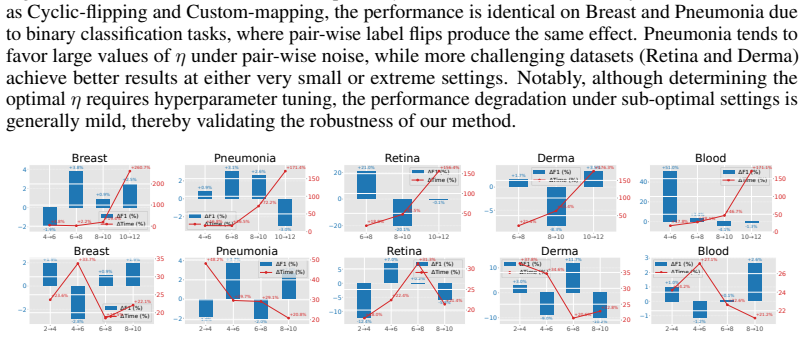
- η (transition moving-average step size) =
0.1–1.0 per dataset/noise (Table 8)
- del (NDU delay fraction) =
0.3, 0.5, or 0.7 (Table 8)
- pat (PTU patience) =
10, 15, or 20 (Table 8)
- QNN qubit count =
8 (swept 4–12)
- QNN layer count =
2 (swept 2–10)
- Warm-up epochs =
100
assumptions (6)
- domain assumption Class-conditional noise model: p(Ỹ|X)=p(Ŷ|X)T with row-stochastic T.
- ad hoc to paper Predictive entropy decrease indicates increasing reliability of predictions.
- ad hoc to paper Argmax predictions \hat y_i are valid proxies for latent true labels in Eq. (4).
- domain assumption QNN outputs are naturally smoother and less overconfident than DNNs due to the Born rule and limited Hilbert-space expressivity.
- standard math Doob's forward convergence theorem for L1-bounded supermartingales.
- standard math Completeness of the space of row-stochastic K×K matrices.
Cite this review
Pith. "Pith review of SLT: Robust Quantum Neural Networks for Noisy-Label Medical Image Classification via Supermartingale-based Label Transition." pith.science (2026). https://pith.science/paper/AVRBHV3L
@misc{pith2026260716293,
  author       = {Pith},
  title        = {Pith review of: SLT: Robust Quantum Neural Networks for Noisy-Label Medical Image Classification via Supermartingale-based Label Transition},
  year         = {2026},
  howpublished = {\url{https://pith.science/paper/AVRBHV3L}},
  note         = {Machine review of arXiv:2607.16293}
}
read the original abstract
Noisy-label learning in small-scale medical image classification is challenging and hinders the superiority of deep neural networks. Recent studies suggest that quantum neural networks (QNNs) have shown potential in limited-data regimes, yet their use for noisy-label learning remains under-explored. A key obstacle is QNNs' intrinsic "natural smoothness", which may regularize training but also obscure high-confidence samples needed for noise-transition estimation. We propose Supermartingale-based Label Transition (SLT), an anchor-free loss correction framework for robust QNN-based medical image classification under noisy labels. SLT models entropy reduction in predictive distributions as a supermartingale and uses its monotonic behavior to identify stable transition-matrix refinement steps. This enables dynamic transition updates while reducing noise-driven oscillations during QNN training. We further provide a convergence analysis showing that the proposed transition-refinement process reaches a steady state. Experiments on multiple public small-scale medical image datasets demonstrate that SLT consistently improves QNN-based classification and stably outperforms classic noise-label learning baselines under synthetic and real-world label noise.
Figures


Figures from the paper (9 more)




Reference graph
Works this paper leans on
-
[1]
Medical image diagnosis based on adaptive hybrid quantum cnn.BMC Medical Imaging, 23(1):126, 2023
Naim Ajlouni, Adem Özyava¸ s, Mustafa Takao˘glu, Faruk Takao˘glu, and Firas Ajlouni. Medical image diagnosis based on adaptive hybrid quantum cnn.BMC Medical Imaging, 23(1):126, 2023
2023
-
[2]
Metalabelnet: Learning to generate soft-labels from noisy- labels.IEEE Transactions on Image Processing, 31:4352–4362, 2022
Görkem Algan and Ilkay Ulusoy. Metalabelnet: Learning to generate soft-labels from noisy- labels.IEEE Transactions on Image Processing, 31:4352–4362, 2022
2022
-
[3]
Quantenmechanik der stoßvorgänge.Zeitschrift für physik, 38(11):803–827, 1926
Max Born. Quantenmechanik der stoßvorgänge.Zeitschrift für physik, 38(11):803–827, 1926
1926
-
[4]
Understanding and utilizing deep neural networks trained with noisy labels
Pengfei Chen, Ben Ben Liao, Guangyong Chen, and Shengyu Zhang. Understanding and utilizing deep neural networks trained with noisy labels. InInternational conference on machine learning, pages 1062–1070. PMLR, 2019
2019
-
[5]
Bomd: bag of multi-label descriptors for noisy chest x-ray classification
Yuanhong Chen, Fengbei Liu, Hu Wang, Chong Wang, Yuyuan Liu, Yu Tian, and Gustavo Carneiro. Bomd: bag of multi-label descriptors for noisy chest x-ray classification. InPro- ceedings of the IEEE/CVF international conference on computer vision, pages 21284–21295, 2023
2023
-
[6]
Class-dependent label-noise learning with cycle-consistency regularization
De Cheng, Yixiong Ning, Nannan Wang, Xinbo Gao, Heng Yang, Yuxuan Du, Bo Han, and Tongliang Liu. Class-dependent label-noise learning with cycle-consistency regularization. Advances in Neural Information Processing Systems, 35:11104–11116, 2022
2022
-
[7]
Ssr: an efficient and robust framework for learning with unknown label noise
Chen Feng, Georgios Tzimiropoulos, and Ioannis Patras. Ssr: an efficient and robust framework for learning with unknown label noise. In33rd British Machine Vision Conference Proceedings, BMVC 2022, 2022
2022
-
[8]
Instance- dependent noisy label learning via graphical modelling
Arpit Garg, Cuong Nguyen, Rafael Felix, Thanh-Toan Do, and Gustavo Carneiro. Instance- dependent noisy label learning via graphical modelling. InProceedings of the IEEE/CVF winter conference on applications of computer vision, pages 2288–2298, 2023
2023
Show all 69 references
-
[9]
On calibration of modern neural networks
Chuan Guo, Geoff Pleiss, Yu Sun, and Kilian Q Weinberger. On calibration of modern neural networks. InInternational conference on machine learning, pages 1321–1330. PMLR, 2017
2017
-
[10]
Co-teaching: Robust training of deep neural networks with extremely noisy labels
Bo Han, Quanming Yao, Xingrui Yu, Gang Niu, Miao Xu, Weihua Hu, Ivor Tsang, and Masashi Sugiyama. Co-teaching: Robust training of deep neural networks with extremely noisy labels. Advances in neural information processing systems, 31, 2018
2018
-
[11]
Supervised learning with quantum-enhanced feature spaces.Nature, 567(7747):209–212, 2019
V ojtˇech Havlíˇcek, Antonio D Córcoles, Kristan Temme, Aram W Harrow, Abhinav Kandala, Jerry M Chow, and Jay M Gambetta. Supervised learning with quantum-enhanced feature spaces.Nature, 567(7747):209–212, 2019
2019
-
[12]
Probabilistic instance dependent label refinement for noisy label learning.Machine Learning, 114(5):120, 2025
Hao-Yuan He, Yu Liu, Ren-Biao Liu, Zheng Xie, and Ming Li. Probabilistic instance dependent label refinement for noisy label learning.Machine Learning, 114(5):120, 2025
2025
-
[13]
Deep residual learning for image recognition
Kaiming He, Xiangyu Zhang, Shaoqing Ren, and Jian Sun. Deep residual learning for image recognition. InProceedings of the IEEE conference on computer vision and pattern recognition, pages 770–778, 2016
2016
-
[14]
Deep learning scaling is predictable, empirically.arXiv preprint arXiv:1712.00409, 2017
Joel Hestness, Sharan Narang, Newsha Ardalani, Gregory Diamos, Heewoo Jun, Hassan Kianinejad, Md Mostofa Ali Patwary, Yang Yang, and Yanqi Zhou. Deep learning scaling is predictable, empirically.arXiv preprint arXiv:1712.00409, 2017
2017 arXiv
-
[15]
Quantum convolutional neural network for classical data classification.Quantum Machine Intelligence, 4(1):3, 2022
Tak Hur, Leeseok Kim, and Daniel K Park. Quantum convolutional neural network for classical data classification.Quantum Machine Intelligence, 4(1):3, 2022
2022
-
[16]
A medical image classification model based on quantum-inspired genetic algorithm
Hussain K Ibrahim, Nizar Rokbani, Ali Wali, Khmaies Ouahada, Habib Chabchoub, and Adel M Alimi. A medical image classification model based on quantum-inspired genetic algorithm. Engineering, Technology & Applied Science Research, 14(5):16692–16700, 2024
2024
-
[17]
Distribution-aware multi-label fixmatch for semi-supervised learning on chexpert
Sontje Ihler, Felix Kuhnke, Timo Kuhlgatz, and Thomas Seel. Distribution-aware multi-label fixmatch for semi-supervised learning on chexpert. InProceedings of the IEEE/CVF Conference on Computer Vision and Pattern Recognition, pages 2295–2304, 2024. 10
2024
-
[18]
Chexpert: A large chest radiograph dataset with uncertainty labels and expert comparison
Jeremy Irvin, Pranav Rajpurkar, Michael Ko, Yifan Yu, Silviana Ciurea-Ilcus, Chris Chute, Henrik Marklund, Behzad Haghgoo, Robyn Ball, Katie Shpanskaya, et al. Chexpert: A large chest radiograph dataset with uncertainty labels and expert comparison. InProceedings of the AAAI c...
2019
-
[19]
Visu- alchexbert: addressing the discrepancy between radiology report labels and image labels
Saahil Jain, Akshay Smit, Steven QH Truong, Chanh DT Nguyen, Minh-Thanh Huynh, Mudit Jain, Victoria A Young, Andrew Y Ng, Matthew P Lungren, and Pranav Rajpurkar. Visu- alchexbert: addressing the discrepancy between radiology report labels and image labels. In Proceedings of t...
2021
-
[20]
How to handle noisy labels for robust learning from uncertainty.Neural networks, 143:209–217, 2021
Daehyun Ji, Dokwan Oh, Yoonsuk Hyun, Oh-Min Kwon, and Myeong-Jin Park. How to handle noisy labels for robust learning from uncertainty.Neural networks, 143:209–217, 2021
2021
-
[21]
Quantum neural network states: A brief review of methods and applications.Advanced Quantum Technologies, 2(7-8):1800077, 2019
Zhih-Ahn Jia, Biao Yi, Rui Zhai, Yu-Chun Wu, Guang-Can Guo, and Guo-Ping Guo. Quantum neural network states: A brief review of methods and applications.Advanced Quantum Technologies, 2(7-8):1800077, 2019
2019
-
[22]
Improving medical images classification with label noise using dual- uncertainty estimation.IEEE transactions on medical imaging, 41(6):1533–1546, 2022
Lie Ju, Xin Wang, Lin Wang, Dwarikanath Mahapatra, Xin Zhao, Quan Zhou, Tongliang Liu, and Zongyuan Ge. Improving medical images classification with label noise using dual- uncertainty estimation.IEEE transactions on medical imaging, 41(6):1533–1546, 2022
2022
-
[23]
Unicon: Combating label noise through uniform selection and contrastive learning
Nazmul Karim, Mamshad Nayeem Rizve, Nazanin Rahnavard, Ajmal Mian, and Mubarak Shah. Unicon: Combating label noise through uniform selection and contrastive learning. In Proceedings of the IEEE/CVF conference on computer vision and pattern recognition, pages 9676–9686, 2022
2022
-
[24]
Deep learning with noisy labels: Exploring techniques and remedies in medical image analysis.Medical image analysis, 65:101759, 2020
Davood Karimi, Haoran Dou, Simon K Warfield, and Ali Gholipour. Deep learning with noisy labels: Exploring techniques and remedies in medical image analysis.Medical image analysis, 65:101759, 2020
2020
-
[25]
Learning with noisy labels by efficient transition matrix estimation to combat label miscorrection
Seong Min Kye, Kwanghee Choi, Joonyoung Yi, and Buru Chang. Learning with noisy labels by efficient transition matrix estimation to combat label miscorrection. InEuropean Conference on Computer Vision, pages 717–738. Springer, 2022
2022
-
[26]
Quantum methods for neural networks and application to medical image classification.Quantum, 6:881, 2022
Jonas Landman, Natansh Mathur, Yun Yvonna Li, Martin Strahm, Skander Kazdaghli, Anupam Prakash, and Iordanis Kerenidis. Quantum methods for neural networks and application to medical image classification.Quantum, 6:881, 2022
2022
-
[27]
A quantum-inspired medical scalable convolutional neural network for intelligent pneumonia diagnosis.Biomedical Signal Processing and Control, 112: 108440, 2026
Dongfen Li, Yuchen Sun, Yuhang Yuan, Zhikang Hu, Qiuyu Xiang, Yangyang Jiang, Yonghao Zhu, You Fu, and Xiaoyu Hua. A quantum-inspired medical scalable convolutional neural network for intelligent pneumonia diagnosis.Biomedical Signal Processing and Control, 112: 108440, 2026
2026
-
[28]
Learning causal transition matrix for instance-dependent label noise
Jiahui Li, Tai-Wei Chang, Kun Kuang, Ximing Li, Long Chen, and Jun Zhou. Learning causal transition matrix for instance-dependent label noise. InProceedings of the AAAI Conference on Artificial Intelligence, volume 39, pages 18305–18313, 2025
2025
-
[29]
Dividemix: Learning with noisy labels as semi-supervised learning
Junnan Li, Richard Socher, and Steven CH Hoi. Dividemix: Learning with noisy labels as semi-supervised learning. InInternational Conference on Learning Representations, 2020
2020
-
[30]
Selective-supervised contrastive learning with noisy labels
Shikun Li, Xiaobo Xia, Shiming Ge, and Tongliang Liu. Selective-supervised contrastive learning with noisy labels. InProceedings of the IEEE/CVF conference on computer vision and pattern recognition, pages 316–325, 2022
2022
-
[31]
Provably end-to-end label-noise learning without anchor points
Xuefeng Li, Tongliang Liu, Bo Han, Gang Niu, and Masashi Sugiyama. Provably end-to-end label-noise learning without anchor points. InInternational conference on machine learning, pages 6403–6413. PMLR, 2021
2021
-
[32]
Disc: Learning from noisy labels via dynamic instance-specific selection and correction
Yifan Li, Hu Han, Shiguang Shan, and Xilin Chen. Disc: Learning from noisy labels via dynamic instance-specific selection and correction. InProceedings of the IEEE/CVF conference on computer vision and pattern recognition, pages 24070–24079, 2023. 11
2023
-
[33]
Early- learning regularization prevents memorization of noisy labels.Advances in neural information processing systems, 33:20331–20342, 2020
Sheng Liu, Jonathan Niles-Weed, Narges Razavian, and Carlos Fernandez-Granda. Early- learning regularization prevents memorization of noisy labels.Advances in neural information processing systems, 33:20331–20342, 2020
2020
-
[34]
Robust training under label noise by over- parameterization
Sheng Liu, Zhihui Zhu, Qing Qu, and Chong You. Robust training under label noise by over- parameterization. InInternational Conference on Machine Learning, pages 14153–14172. PMLR, 2022
2022
-
[35]
Classification with noisy labels by importance reweighting
Tongliang Liu and Dacheng Tao. Classification with noisy labels by importance reweighting. IEEE Transactions on pattern analysis and machine intelligence, 38(3):447–461, 2015
2015
-
[36]
Peer loss functions: Learning from noisy labels without knowing noise rates
Yang Liu and Hongyi Guo. Peer loss functions: Learning from noisy labels without knowing noise rates. InInternational conference on machine learning, pages 6226–6236. PMLR, 2020
2020
-
[37]
Identifiability of label noise transition matrix
Yang Liu, Hao Cheng, and Kun Zhang. Identifiability of label noise transition matrix. In International Conference on Machine Learning, pages 21475–21496. PMLR, 2023
2023
-
[38]
Benchmarking real-world medical image classification with noisy labels: Challenges, practice, and outlook.arXiv preprint arXiv:2512.09315, 2025
Yuan Ma, Junlin Hou, Chao Zhang, Yukun Zhou, Zongyuan Ge, Haoran Xie, and Lie Ju. Benchmarking real-world medical image classification with noisy labels: Challenges, practice, and outlook.arXiv preprint arXiv:2512.09315, 2025
2025 arXiv
-
[39]
Medical image classification via quantum neural networks
Natansh Mathur, Jonas Landman, Yun Yvonna Li, Martin Strahm, Skander Kazdaghli, Anupam Prakash, and Iordanis Kerenidis. Medical image classification via quantum neural networks. arXiv preprint arXiv:2109.01831, 2021
2021 arXiv
-
[40]
Hyperparam- eter importance and optimization of quantum neural networks across small datasets.Machine Learning, 113(4):1941–1966, 2024
Charles Moussa, Yash J Patel, Vedran Dunjko, Thomas Bäck, and Jan N Van Rijn. Hyperparam- eter importance and optimization of quantum neural networks across small datasets.Machine Learning, 113(4):1941–1966, 2024
1941
-
[41]
Noisy label learning with instance-dependent outliers: Identifiability via crowd wisdom.Advances in Neural Information Processing Systems, 37:97261–97298, 2024
Tri Nguyen, Shahana Ibrahim, and Xiao Fu. Noisy label learning with instance-dependent outliers: Identifiability via crowd wisdom.Advances in Neural Information Processing Systems, 37:97261–97298, 2024
2024
-
[42]
Confident learning: Estimating uncertainty in dataset labels.Journal of Artificial Intelligence Research, 70:1373–1411, 2021
Curtis Northcutt, Lu Jiang, and Isaac Chuang. Confident learning: Estimating uncertainty in dataset labels.Journal of Artificial Intelligence Research, 70:1373–1411, 2021
2021
-
[43]
Quantum neural network- assisted learning for small medical datasets: a case study in emphysema detection.The Journal of Supercomputing, 81(1):308, 2025
Safura Oviesi, Mohamad Jafar Tarokh, and Mohamad kazem Momeni. Quantum neural network- assisted learning for small medical datasets: a case study in emphysema detection.The Journal of Supercomputing, 81(1):308, 2025
2025
-
[44]
Making deep neural networks robust to label noise: A loss correction approach
Giorgio Patrini, Alessandro Rozza, Aditya Krishna Menon, Richard Nock, and Lizhen Qu. Making deep neural networks robust to label noise: A loss correction approach. InProceedings of the IEEE conference on computer vision and pattern recognition, pages 1944–1952, 2017
1944
-
[45]
Nqnn: Noise-aware quantum neural networks for medical image classification
Maqsudur Rahman and Jun Zhuang. Nqnn: Noise-aware quantum neural networks for medical image classification. Inproceedings of Medical Image Computing and Computer Assisted Intervention – MICCAI 2025, volume LNCS 15972. Springer Nature Switzerland, September 2025
2025
-
[46]
Nqnn: Noise-aware quantum neural networks for medical image classification
Maqsudur Rahman and Jun Zhuang. Nqnn: Noise-aware quantum neural networks for medical image classification. InInternational Conference on Medical Image Computing and Computer- Assisted Intervention, pages 433–442. Springer, 2025
2025
-
[47]
Ca2c: A prior-knowledge-free approach for robust label noise learning via asymmetric co-learning and co-training
Mengmeng Sheng, Zeren Sun, Tianfei Zhou, Xiangbo Shu, Jinshan Pan, and Yazhou Yao. Ca2c: A prior-knowledge-free approach for robust label noise learning via asymmetric co-learning and co-training. InProceedings of the IEEE/CVF International Conference on Computer Vision, pages...
2025
-
[48]
A survey of label-noise deep learning for medical image analysis.Medical image analysis, 95:103166, 2024
Jialin Shi, Kailai Zhang, Chenyi Guo, Youquan Yang, Yali Xu, and Ji Wu. A survey of label-noise deep learning for medical image analysis.Medical image analysis, 95:103166, 2024
2024
-
[49]
Learning from noisy labels with deep neural networks: A survey.IEEE transactions on neural networks and learning systems, 34(11):8135–8153, 2022
Hwanjun Song, Minseok Kim, Dongmin Park, Yooju Shin, and Jae-Gil Lee. Learning from noisy labels with deep neural networks: A survey.IEEE transactions on neural networks and learning systems, 34(11):8135–8153, 2022. 12
2022
-
[50]
Joint optimization framework for learning with noisy labels
Daiki Tanaka, Daiki Ikami, Toshihiko Yamasaki, and Kiyoharu Aizawa. Joint optimization framework for learning with noisy labels. InProceedings of the IEEE conference on computer vision and pattern recognition, pages 5552–5560, 2018
2018
-
[51]
Scalable penalized regression for noise detection in learning with noisy labels
Yikai Wang, Xinwei Sun, and Yanwei Fu. Scalable penalized regression for noise detection in learning with noisy labels. InProceedings of the IEEE/CVF conference on computer vision and pattern recognition, pages 346–355, 2022
2022
-
[52]
Combating noisy labels by agreement: A joint training method with co-regularization
Hongxin Wei, Lei Feng, Xiangyu Chen, and Bo An. Combating noisy labels by agreement: A joint training method with co-regularization. InProceedings of the IEEE/CVF conference on computer vision and pattern recognition, pages 13726–13735, 2020
2020
-
[53]
Mitigating neural network overconfidence with logit normalization
Hongxin Wei, Renchunzi Xie, Hao Cheng, Lei Feng, Bo An, and Yixuan Li. Mitigating neural network overconfidence with logit normalization. InInternational conference on machine learning, pages 23631–23644. PMLR, 2022
2022
-
[54]
Quantum machine learning in medical image analysis: A survey.Neurocomputing, 525:42–53, 2023
Lin Wei, Haowen Liu, Jing Xu, Lei Shi, Zheng Shan, Bo Zhao, and Yufei Gao. Quantum machine learning in medical image analysis: A survey.Neurocomputing, 525:42–53, 2023
2023
-
[55]
Cambridge university press, 1991
David Williams.Probability with martingales. Cambridge university press, 1991
1991
-
[56]
A topological filter for learning with label noise.Advances in neural information processing systems, 33:21382–21393, 2020
Pengxiang Wu, Songzhu Zheng, Mayank Goswami, Dimitris Metaxas, and Chao Chen. A topological filter for learning with label noise.Advances in neural information processing systems, 33:21382–21393, 2020
2020
-
[57]
Are anchor points really indispensable in label-noise learning?Advances in neural information processing systems, 32, 2019
Xiaobo Xia, Tongliang Liu, Nannan Wang, Bo Han, Chen Gong, Gang Niu, and Masashi Sugiyama. Are anchor points really indispensable in label-noise learning?Advances in neural information processing systems, 32, 2019
2019
-
[58]
Part-dependent label noise: Towards instance-dependent label noise.Advances in neural information processing systems, 33:7597–7610, 2020
Xiaobo Xia, Tongliang Liu, Bo Han, Nannan Wang, Mingming Gong, Haifeng Liu, Gang Niu, Dacheng Tao, and Masashi Sugiyama. Part-dependent label noise: Towards instance-dependent label noise.Advances in neural information processing systems, 33:7597–7610, 2020
2020
-
[59]
Combating noisy labels with sample selection by mining high-discrepancy examples
Xiaobo Xia, Bo Han, Yibing Zhan, Jun Yu, Mingming Gong, Chen Gong, and Tongliang Liu. Combating noisy labels with sample selection by mining high-discrepancy examples. In Proceedings of the IEEE/CVF international conference on computer vision, pages 1833–1843, 2023
2023
-
[60]
Promix: combating label noise via maximizing clean sample utility
Ruixuan Xiao, Yiwen Dong, Haobo Wang, Lei Feng, Runze Wu, Gang Chen, and Junbo Zhao. Promix: combating label noise via maximizing clean sample utility. InProceedings of the Thirty-Second International Joint Conference on Artificial Intelligence, pages 4442–4450, 2023
2023
-
[61]
Medmnist classification decathlon: A lightweight automl benchmark for medical image analysis
Jiancheng Yang, Rui Shi, and Bingbing Ni. Medmnist classification decathlon: A lightweight automl benchmark for medical image analysis. InIEEE 18th International Symposium on Biomedical Imaging (ISBI), pages 191–195, 2021
2021
-
[62]
Dynamic selection for reconstructing instance-dependent noisy labels.Pattern Recogni- tion, 156:110803, 2024
Jie Yang, Xiaoguang Niu, Yuanzhuo Xu, Zejun Zhang, Guangyi Guo, Steve Drew, and Ruizhi Chen. Dynamic selection for reconstructing instance-dependent noisy labels.Pattern Recogni- tion, 156:110803, 2024
2024
-
[63]
Estimating instance-dependent bayes-label transition matrix using a deep neural network
Shuo Yang, Erkun Yang, Bo Han, Yang Liu, Min Xu, Gang Niu, and Tongliang Liu. Estimating instance-dependent bayes-label transition matrix using a deep neural network. InInternational Conference on Machine Learning, pages 25302–25312. PMLR, 2022
2022
-
[64]
Dual t: Reducing estimation error for transition matrix in label-noise learning
Yu Yao, Tongliang Liu, Bo Han, Mingming Gong, Jiankang Deng, Gang Niu, and Masashi Sugiyama. Dual t: Reducing estimation error for transition matrix in label-noise learning. Advances in neural information processing systems, 33:7260–7271, 2020
2020
-
[65]
Which is better for learning with noisy labels: the semi-supervised method or modeling label noise? In International conference on machine learning, pages 39660–39673
Yu Yao, Mingming Gong, Yuxuan Du, Jun Yu, Bo Han, Kun Zhang, and Tongliang Liu. Which is better for learning with noisy labels: the semi-supervised method or modeling label noise? In International conference on machine learning, pages 39660–39673. PMLR, 2023
2023
-
[66]
A new quantum circuits of quantum convolutional neural network for x-ray images classification.IEEE access, 12: 65660–65671, 2024
Mohammed Yousif, Belal Al-Khateeb, and Begonya Garcia-Zapirain. A new quantum circuits of quantum convolutional neural network for x-ray images classification.IEEE access, 12: 65660–65671, 2024. 13
2024
-
[67]
Learning noise transition matrix from only noisy labels via total variation regularization
Yivan Zhang, Gang Niu, and Masashi Sugiyama. Learning noise transition matrix from only noisy labels via total variation regularization. InInternational conference on machine learning, pages 12501–12512. PMLR, 2021
2021
-
[68]
Clusterability as an alternative to anchor points when learning with noisy labels
Zhaowei Zhu, Yiwen Song, and Yang Liu. Clusterability as an alternative to anchor points when learning with noisy labels. InInternational Conference on Machine Learning, pages 12912–12923. PMLR, 2021
2021
-
[69]
no DR” is paired with “mild NPDR
Zhaowei Zhu, Jialu Wang, and Yang Liu. Beyond images: Label noise transition matrix estimation for tasks with lower-quality features. InInternational Conference on Machine Learning, pages 27633–27653. PMLR, 2022. 14 In the appendix, we first provide full proof for our theoreti...
2022
Reviewed August 2, 2026 · model on record in the stance chip above.
Discussion (0). Continue with ORCID to comment.