REVIEW 4 major objections 6 minor 296 references
Constraining the radial decay timescale of solar surface magnetic field through a comparative study of data-assimilative 2D surface flux transport and 3D dynamo models
T0 review · 4 major / 6 minor · reviewed 2026-08-01 · deepseek-v4-flash
Pith's one-line read The radial decay timescale of the Sun's surface magnetic field is not a single fitted number but a mode-dependent spectrum, and the paper derives it self-consistently from the 3D induction equation, finding effective values of about 2 years
desk verdict A clean eigenvalue extension to nonuniform diffusivity, but the headline τ constraint is a fit to the authors' own STABLE model, not an independent validation. read the letter →
The pith
A machine-rendered reading of the paper's core claim, the machinery that carries it, and where it could break.
The reading
What carries the argument
The central object is the decay-mode eigenvalue problem for the poloidal potential C(r,theta,phi,t) in a spherical shell: R''_nl + (lambda_nl/eta(r) - l(l+1)/r^2) R_nl = 0, with boundary conditions R'_nl(R_sun)=0 and R_nl(R_b)=0. It converts a given radial diffusivity profile eta(r) into a spectrum of decay timescales tau_nl = 1/lambda_nl. The depth-dependent two-step diffusivity profile, Profile-2, ties the surface horizontal diffusivity used in 2D SFT to the interior radial diffusion, supplying both the timescales and the effective angular modes that matter for polar field buildup.
What would settle it
A direct test would compare the predicted mode-dependent decay spectrum against the 3D STABLE model with meridional circulation artificially suppressed: if the diffusion-only eigenvalues then reproduce the 2D-3D polar field agreement, the assumption holds; alternatively, if measured surface-flux removal poleward of 75 degrees is dominated by subduction rather than diffusion, the effective tau values needed to match the 3D model would be shorter than the eigenvalue spectrum predicts.
Extended reading notes
Core claim
The central claim is that the radial decay timescale tau is not a free parameter but is determined by the radial turbulent diffusivity profile of the convection zone. Treating the surface-interior coupling as purely diffusive, separation of variables in the poloidal field equation leads to an eigenvalue problem whose eigenvalues give tau_nl for each radial and angular mode. For a two-step diffusivity profile, the dipole (l=1) mode decays on roughly 7 years while the l=8 mode decays on about 2 years, and these two timescales reproduce the polar field evolution of two distinct 2D SFT setups: daily magnetogram assimilation and discrete active-region driving. The paper states this is the first s
Load-bearing premise
The derivation assumes that radial surface-interior coupling is pure turbulent diffusion, with no significant advective transport; if the meridional flow subduction poleward of about 75 degrees removes a substantial share of surface flux, the diffusion-only tau spectrum is not the true decay timescale.
Editorial extensions
If this is right
- 2D SFT simulations with daily magnetogram assimilation should use an effective tau near 2 years, corresponding to the l=8 mode, when using a Profile-2-type diffusivity; using the slower dipole timescale leads to excess polar flux accumulation.
- Traditional active-region-driven SFT models should use tau near 7 years, the dipole decay timescale, which corrects the secular drift and delayed polar reversals seen in weak cycles.
- The eigenvalue framework can supply tau for any prescribed eta(r), allowing future SFT models to adopt diffusivity-specific decay timescales instead of tuning tau as a free parameter.
- A self-consistent tau strengthens confidence in century-long polar field reconstructions and in cycle-amplitude predictions that rely on SFT-generated polar fields.
- Since modes above l about 8 decay before reaching the polar caps, data-assimilated SFT parameterizations may need to include only the low-order modes in the decay operator.
Reading between the lines
- The two validated tau values (2 yr and 7 yr) suggest that the historical scatter in fitted tau values, from about 4.5 to 32 years, may reflect different source representations exciting different angular spectra; single-number tau estimates are not comparable unless the dominant l is specified.
- A testable extension is to run the eigenvalue derivation with advective radial transport included, especially the meridional subduction poleward of about 75 degrees, to see whether the diffusion-only tau values shift; the reported agreement may partially absorb subduction into an effective tau.
- The l-dependent spectrum could be implemented as a multi-mode decay operator in 2D SFT instead of a single tau, potentially reproducing the finer polar-region structures that a single decay timescale misses.
- If the diffusion-only assumption is violated by significant advective flux removal, the framework still yields useful effective parameters, but its self-consistent interpretation would need revision.
Editorial analysis
A structured set of objections, weighed in public.
Referee Report
Summary. The paper addresses the radial decay timescale tau in 2D surface flux transport (SFT) models. It derives a decay-mode spectrum by isolating the diffusive radial-transport part of the 3D induction equation (Eq. 4), solving the resulting poloidal-field eigenvalue problem (Eq. 9) for two radial diffusivity profiles, and reproducing the Baumann et al. (2006) values for the uniform Profile-1 while obtaining tau_01 ~7 yr for the nonuniform Profile-2. It then reports two applications: a data-assimilated 2D SFT (HipFT) compared with a data-assimilated 3D STABLE model, where tau = 2 yr matches the 3D unsigned flux and polar fields and is associated with l = 8 in Table 1; and a traditional active-region-driven SFT simulation for Cycles 23–25, where tau = 7 yr reproduces WSO polar fields and removes the secular drift. The paper claims a first self-consistent bridge between the 2D surface description and 3D interior dynamics.
Significance. The eigenvalue extension in Section 2 is a clean, reproducible formulation: it reproduces the known Baumann et al. (2006) results for the uniform profile and extends them to a more physical depth-dependent diffusivity. The paper uses open-source code (HipFT, MagMAP), specifies flow and diffusivity parameters, and reports numerical values in Table 1. If the central interpretation were fully supported, this would be a useful step toward fixing tau in SFT models rather than treating it as a free parameter. However, the validation logic is significantly weaker than the abstract claims: the key tau values come from fits to the authors' own 3D model under a diffusion-only reduction, and the independent checks do not specifically isolate the eigenvalues in Table 1. The contribution is therefore conditional on additional analysis.
major comments (4)
- [§2, Eq. (4)] The eigenvalue spectrum in Table 1 is derived by reducing Eq. (2) to pure diffusion and deleting the advective term ∇×(V×B). The paper itself acknowledges (§1 and §5) that poleward of ~75° the meridional return flow subducts surface flux and 'plays a significant role alongside radial diffusion.' Since −B_r/τ in Eq. (1) is the only radial-loss channel in the 2D model, it must represent both diffusive and advective removal if it is to mimic STABLE. Thus τ_nl in Table 1 are not established as the effective radial-loss timescales of the 3D system; the fitted τ=2 yr may be absorbing meridional subduction rather than representing the l=8 diffusion mode. A quantitative flux-budget comparison (diffusive vs. advective removal in the polar cap) or a reduced eigenvalue problem retaining the advective term is needed before the 'self-consistent bridge' claim is supportable.
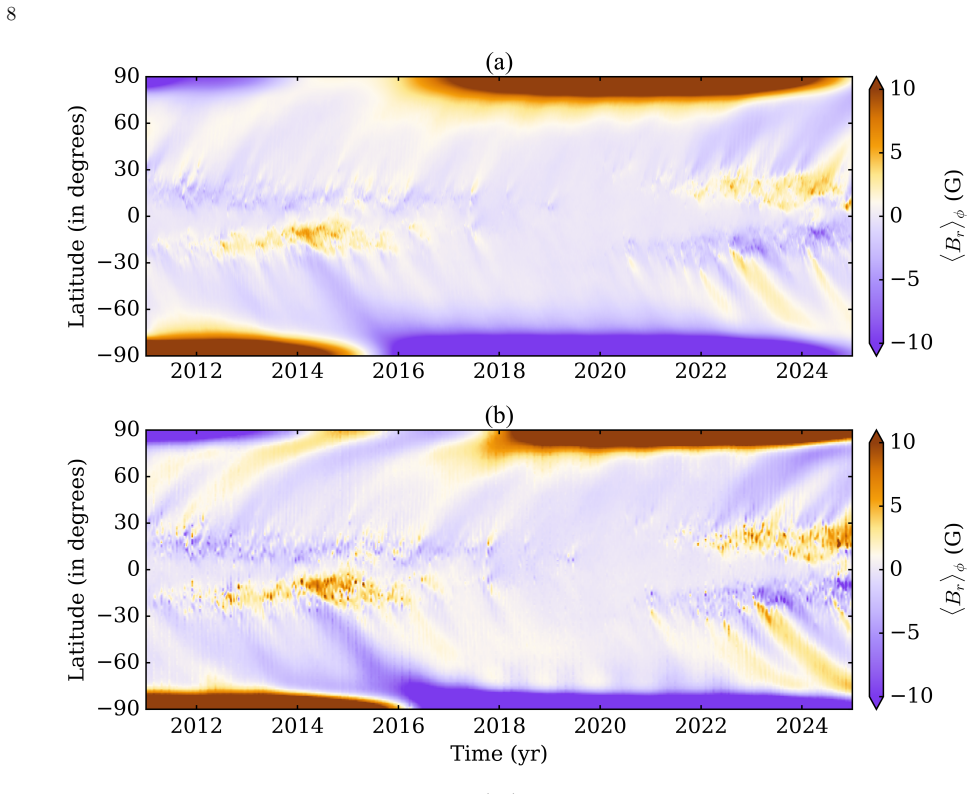
- [§3, Figure 2] The value τ=2 yr is not predicted by the spectrum; the paper states 'We perform many 2D SFT simulations with different τ to find an optimized τ,' and τ_relax=6 hr is likewise calibrated by matching unsigned flux. Reading l=8 from Table 1 after this fit is a reverse lookup, not an independent validation of the diffusion spectrum. No sensitivity of the inferred τ to τ_relax, grid resolution, or flow parameters is reported, so the agreement in Fig. 2 is not shown to be discriminative. The §5 statement that 'modes up to l=8 contribute' is also not directly tested by a mode-resolved or mode-truncation experiment; a single effective τ collapses the spectrum. Please add quantitative comparison metrics and a sensitivity scan over the fitted parameters.
- [§4, Eqs. (17)–(18)] This test uses different transport parameters from those used in the eigenvalue calculation and from the STABLE comparison: v0=11 m/s (Eq. 18) versus 19 m/s in Eq. (11), the Snodgrass–Ulrich differential rotation profile, and a different SFT code. Consequently, the WSO agreement at τ=7 yr cannot be attributed specifically to the Profile-2 dipole eigenvalue τ_01=7.01 yr. Many previously published τ values in the 4.5–10 yr range can also remove secular drift in SFT simulations. Unless the test is shown to be strongly discriminating in τ (e.g., by evaluating the fit quality across a range of τ values), it is a consistency check, not a validation of the dipole row of Table 1.
- [§2, Eq. (10) and Table 1] Profile-2 contains six freely chosen parameters (η_c, η_mid, η_H, r_da, r_db, d_a, d_b), and the headline results τ_01≈7 yr and τ_08≈2 yr are profile-dependent. No sensitivity analysis is provided, even though η_mid directly affects both the eigenvalues and the assumption that diffusion dominates advection. The authors should show how τ_nl vary over a plausible range of η_mid and η_H, because this determines whether the specific two-digit values in Table 1 are robust or artifacts of a single ad-hoc profile choice.
minor comments (6)
- [Abstract and text] The phrase 'angular model=8' should read 'angular mode l=8'; the same typo ('modelandn') occurs in §2 and §3.
- [References] Several references are duplicated: Hazra et al. (2017) appears twice, Jiang et al. (2023a/b) appears twice, Schrijver & De Rosa (2003a/b) is the same paper listed twice, and Yeates et al. (2023a/b) is likewise duplicated. Please consolidate.
- [§4 and Fig. 6] The text describes the polar field as 'poleward of ±65°', but the Fig. 6 caption states 'poleward of ±55°'. Please reconcile the threshold.
- [Table 1] The eigenvalues are quoted to two decimals, but no numerical tolerance, grid-convergence check, or error estimate is provided for the shooting/Brent solution of Eq. (9).
- [Figs. 3 and 5] The butterfly diagrams do not include a color-scale bar or explicit color limits, making quantitative comparison of panel intensities impossible.
- [§3, Figure 2] The agreement between the blue and red curves is described as 'close'/'well reproduced' visually; a quantitative metric such as RMS difference or correlation in the polar field or unsigned flux would strengthen the claim.
Circularity Check
The τ≈2 yr / l=8 constraint is a post-hoc fit to the authors' own 3D STABLE model, labeled via a diffusion-only eigenvalue table; the τ≈7 dipole mode retains independent WSO support.
-
fitted input called prediction
[Section 3, Figure 2, Table 1]
"We perform many 2D SFT simulations with differentτ to find an optimizedτfor which the 2D SFT and 3D stable results would be comparable. We present here results of 2D SFT simulations withτ=∞andτ= 2 yr for Cycle 24 and the rising phase of Cycle 25 (2011-2025), and compare the results with the 3D STABLE simulation. ... Referring to Table 1,τ= 2 yr corresponds to the decay timescale ofl= 8 mode"
τ=2 yr is obtained by tuning the 2D SFT decay term until its unsigned flux matches the 3D STABLE model; it is a fitted parameter, not an output of the eigenvalue analysis. The eigenvalue problem only provides a table that maps a chosen τ to a spherical-harmonic degree l. Calling the fitted value 'l=8 from our self-consistent estimate' is therefore a post-hoc labeling of a fit, not a prediction of the mode from first principles.
-
self citation load bearing
[Section 3, Abstract, Section 2]
"The unsigned flux in the data-assimilated 2D SFT model is matched to that of the 3D data-assimilated STABLE model within±75◦ latitude with a suitable data-assimilation interval for a consistent comparison of the resulting polar field between the two models."
The benchmark used to calibrate τ=2 yr is the authors' own data-assimilated 3D STABLE model from Chatterjee & Hazra (2026), a companion paper with overlapping authorship. The central quantitative claim of the present paper therefore rests on matching a self-cited model rather than on an independent observational or externally reproduced target. This makes the companion model load-bearing for the main constraint.
1 more flagged steps
-
other
[Section 2, Eq. (4); Section 5]
"if we assume that the coupling between the surface and interior convection zone is dominated by diffusion, then Equation 2 reduces to∂B/∂t =−∇×η(r)∇×B ... We validated the derived spectrum,τ nl through two complementary numerical experiments, since the subduction of flux by the meridional flow near the pole (poleward∼75◦) also plays a significant role alongside radial diffusion in transporting flux in the convection zone."
The eigenvalue spectrum that supplies τ≈2 yr / l=8 is derived from a diffusion-only operator with advection removed. Yet the validation benchmark, the 3D STABLE model, includes meridional-flow subduction poleward of ~75°, which the paper itself acknowledges is significant alongside diffusion. The fitted τ in the 2D model therefore absorbs both diffusive and advective removal, so its agreement with STABLE does not specifically validate the diffusion-only eigenvalue spectrum; the correspondence between τ=2 yr and l=8 is not uniquely established.
full rationale
The eigenvalue calculation itself (Eqs. 6–9) is mathematically self-contained: for a specified η(r), it yields decay timescales τ_nl, and the uniform-profile results match Baumann et al. (2006). The τ≈7 yr dipole-mode result is also partly independently supported by WSO polar-field observations in Section 4. However, the paper's headline constraint τ≈2 yr / l=8 is not the output of an independent prediction. Section 3 explicitly describes scanning many τ values and matching the unsigned flux to the authors' own data-assimilated 3D STABLE model (Chatterjee & Hazra 2026); Table 1 is then consulted to attach the label l=8 to the fitted value. The benchmark being a self-cited companion model, and the eigenvalue spectrum being computed under a diffusion-only assumption while the benchmark includes advective subduction, means the 'self-consistent bridge' claim is partially circular: the fitted τ is renamed as a modal prediction. Overall score 6 reflects this partial circularity, with the τ≈7 dipole test providing genuine external anchor.
Assumptions & free parameters
free parameters (5)
- Profile-2 diffusivity parameters =
η_c=2e10, η_mid=5e11, η_H=3e12 cm²/s; r_da=0.735R☉, r_db=0.956R☉, d_a=0.021R☉, d_b=0.05R☉
- τ_relax (assimilation relaxation timescale) =
6 hr
- τ (optimized decay timescale in Sec. 3) =
2 yr
- Flow profile coefficients =
m1=37.2 m/s, m5=-6 m/s, d0=130, d2=-170, d4=-400 m/s
- Active-region extraction parameters =
σ=3 grid cells, 40 G threshold
assumptions (6)
- domain assumption Surface–interior coupling is dominated by radial diffusion, so Eq. (2) reduces to ∂B/∂t = −∇×(η(r)∇×B)
- domain assumption The poloidal field evolution decouples and only the poloidal potential C with Br = −L²C/r² is needed
- standard math Boundary conditions R'_nl(R☉)=0 and R_nl(R_b)=0 at base 0.69R☉
- domain assumption The 3D STABLE model of Chatterjee & Hazra (2026) is an accurate enough representation of solar surface–interior coupling to serve as ground truth
- domain assumption In active-region-driven SFT, horizontal diffusion erodes small scales so the polar field is built exclusively by the l=1 dipole component
- ad hoc to paper Profile-2 η(r) with high η_mid ensures diffusion dominates advection in the bulk
Cite this review
Pith. "Pith review of Constraining the radial decay timescale of solar surface magnetic field through a comparative study of data-assimilative 2D surface flux transport and 3D dynamo models." pith.science (2026). https://pith.science/paper/GZN73ZZZ
@misc{pith2026260716939,
  author       = {Pith},
  title        = {Pith review of: Constraining the radial decay timescale of solar surface magnetic field through a comparative study of data-assimilative 2D surface flux transport and 3D dynamo models},
  year         = {2026},
  howpublished = {\url{https://pith.science/paper/GZN73ZZZ}},
  note         = {Machine review of arXiv:2607.16939}
}
abstract
The polar magnetic field is the most reliable precursor for predicting the amplitude of the solar cycle, and the 2D surface flux transport (SFT) model is widely used to reconstruct its evolution. Traditional 2D SFT models can not capture the surface-interior coupling of the surface field, causing delays in polar field reversals. This deficiency is conventionally corrected by adding a decay term $-B_r/\tau$ with a poorly constrained radial decay timescale $\tau$. Here, we present a self-consistent estimate of $\tau$ through a comparative study of radial flux transport in the 2D SFT model and the 3D kinematic dynamo model, STABLE. By keeping the same transport parameters for both models and assuming surface-interior coupling is diffusive, the poloidal field evolution equation reduces to an eigenvalue problem, which yields a spectrum of $\tau$ that decrease with increasing angular modes $l$. To capture realistic surface-interior coupling, we further perform data-assimilated 2D SFT simulations with real magnetograms and compare those results with that of the data-assimilated 3D STABLE model to constrain $\tau$ and effective decay modes. With our choice of transport parameters, a value of $\tau=~2~\text{yr}$ keeps the surface dynamics of the two models consistent, and this timescale corresponds to the angular mode $l=8$ from our self-consistent estimate. We also perform 2D SFT simulations with only large-scale active regions, as the source. We find that $\tau=7~\text{yr}$ accurately captures the radial decay of the dipole mode ($l=1$) and removes the secular drift in the polar fields.
Figures


Figures from the paper (3 more)


Reference graph
Works this paper leans on
-
[1]
The Astropy Project: Sustaining and Growing a Community-oriented Open-source Project and the Latest Major Release (v5.0) of the Core Package. , keywords =. doi:10.3847/1538-4357/ac7c74 , archivePrefix =. 2206.14220 , primaryClass =
-
[2]
The Astropy Project: Building an Open-science Project and Status of the v2.0 Core Package. , keywords =. doi:10.3847/1538-3881/aabc4f , archivePrefix =. 1801.02634 , primaryClass =
-
[3]
Astropy: A community Python package for astronomy. , keywords =. 2013. doi:10.1051/0004-6361/201322068 , archivePrefix =. 1307.6212 , primaryClass =
arXiv 2013
-
[4]
SExtractor: Software for source extraction. , keywords =. 1996. doi:10.1051/aas:1996164 , adsurl =
-
[5]
Quantifying the Observational Effort Required for the Radial Velocity Characterization of TESS Planets. , keywords =. 2018. doi:10.3847/1538-3881/aacea9 , archivePrefix =. 1807.01263 , primaryClass =
arXiv 2018
-
[6]
X-Ray Scattering Echoes and Ghost Halos from the Intergalactic Medium: Relation to the Nature of AGN Variability. , keywords =. 2015. doi:10.1088/0004-637X/805/1/23 , archivePrefix =. 1503.01475 , primaryClass =
arXiv 2015
-
[7]
, keywords =
The 2013 Release of Cloudy. , keywords =. 2013
2013
-
[8]
1989", month =
T _ E X and LAT _ E X Macro Definition Files for Astronomical Publications. , year = "1989", month = "Mar", pages =
1989
Show all 296 references
-
[9]
LaTeX: A Document Preparation System. 1994
1994
-
[10]
, keywords =
Quasi-periodic Fast Propagating Magnetoacoustic Waves during the Magnetic Reconnection Between Solar Coronal Loops. , keywords =. 2018. doi:10.3847/2041-8213/aaf167 , archivePrefix =. 1811.08553 , primaryClass =
2018 arXiv
-
[11]
, keywords =
Nominal Values for Selected Solar and Planetary Quantities: IAU 2015 Resolution B3. , keywords =. 2016. doi:10.3847/0004-6256/152/2/41 , archivePrefix =. 1605.09788 , primaryClass =
2015 arXiv
-
[12]
Swift X-Ray Observations of Classical Novae. II. The Super Soft Source Sample. , keywords =. 2011. doi:10.1088/0067-0049/197/2/31 , archivePrefix =. 1110.6224 , primaryClass =
2011 arXiv
-
[13]
, keywords =
Galaxy Emission Line Classification Using Three-dimensional Line Ratio Diagrams. , keywords =. 2014. doi:10.1088/0004-637X/793/2/127 , archivePrefix =. 1406.5186 , primaryClass =
2014 arXiv
-
[14]
Solar Physics , keywords =
Comparison of Line-of-Sight Magnetograms Taken by the Solar Dynamics Observatory/Helioseismic and Magnetic Imager and Solar and Heliospheric Observatory/Michelson Doppler Imager. Solar Physics , keywords =. doi:10.1007/s11207-012-9976-x , adsurl =
-
[15]
Solar Physics , keywords =
Observables Processing for the Helioseismic and Magnetic Imager Instrument on the Solar Dynamics Observatory. Solar Physics , keywords =. doi:10.1007/s11207-016-0957-3 , archivePrefix =. 1606.02368 , primaryClass =
-
[16]
Scientific Data , keywords =
Solar active region magnetogram image dataset for studies of space weather. Scientific Data , keywords =. doi:10.1038/s41597-023-02628-8 , archivePrefix =. 2305.09492 , primaryClass =
-
[17]
and Stulajter, Miko M
Caplan, Ronald M. and Stulajter, Miko M. and Linker, Jon A. and Downs, Cooper and Upton, Lisa A. and Jha, Bibhuti Kumar and Attie, Raphael and Arge, Charles N. and Henney, Carl J. , title =. doi:10.3847/1538-4365/adc080 , year =
-
[18]
Antia, H. M. and Basu, Sarbani , title =. doi:10.3847/1538-4357/ac32c3 , year =
-
[19]
The Astrophysical Journal Letters , keywords =
A Three-dimensional Babcock-Leighton Solar Dynamo Model. The Astrophysical Journal Letters , keywords =. doi:10.1088/2041-8205/785/1/L8 , archivePrefix =. 1401.6557 , primaryClass =
-
[20]
2016 , note =
A three-dimensional Babcock–Leighton solar dynamo model: Initial results with axisymmetric flows , journal =. 2016 , note =. doi:https://doi.org/10.1016/j.asr.2016.02.018 , author =
2016 doi
-
[21]
Clune and J.R
T.C. Clune and J.R. Elliott and M.S. Miesch and J. Toomre and G.A. Glatzmaier , keywords =. Computational aspects of a code to study rotating turbulent convection in spherical shells , journal =. 1999 , issn =. doi:https://doi.org/10.1016/S0167-8191(99)00009-5 , url =
1999 doi
-
[22]
, title=
Miesch, Mark S. , title=. Living Reviews in Solar Physics , year=. doi:10.12942/lrsp-2005-1 , url=
2005 doi
-
[23]
, keywords =
Full-sphere simulations of a circulation-dominated solar dynamo: Exploring the parity issue. , keywords =. doi:10.1051/0004-6361:20041199 , archivePrefix =. astro-ph/0405027 , primaryClass =
-
[24]
, title =
Hazra, Gopal and Choudhuri, Arnab Rai and Miesch, Mark S. , title =. 2017 , month =. doi:10.3847/1538-4357/835/1/39 , url =
2017 doi
-
[25]
and Hathaway, D
Jiang, J. and Hathaway, D. H. and Cameron, R. H. and Solanki, S. K. and Gizon, L. and Upton, L. , title=. Space Science Reviews , year=. doi:10.1007/s11214-014-0083-1 , url=
-
[26]
, title =
Upton, Lisa and Hathaway, David H. , title =. 2013 , month =. doi:10.1088/0004-637X/780/1/5 , url =
2013 doi
-
[27]
and Cameron, R
Jiang, J. and Cameron, R. H. and Schüssler, M. , title =. doi:10.1088/0004-637X/791/1/5 , year =
-
[28]
Upton, L. A. and Hathaway, D. H. , title =. Journal of Geophysical Research: Space Physics , volume =. doi:https://doi.org/10.1029/2023JA031681 , url =. https://agupubs.onlinelibrary.wiley.com/doi/pdf/10.1029/2023JA031681 , note =
-
[29]
Science , keywords =
The crucial role of surface magnetic fields for the solar dynamo. Science , keywords =. doi:10.1126/science.1261470 , archivePrefix =. 1503.08469 , primaryClass =
-
[30]
, keywords =
How well does surface magnetism represent deep Sun-like star dynamo action?. , keywords =. doi:10.1051/0004-6361/202347862 , archivePrefix =. 2401.10984 , primaryClass =
-
[31]
and Kosovichev, Alexander G
Pipin, Valery V. and Kosovichev, Alexander G. , title =. 2024 , month =. doi:10.3847/1538-4357/ad1590 , url =
2024 doi
-
[32]
The Astrophysical Journal , keywords =
Babcock-Leighton Solar Dynamo: The Role of Downward Pumping and the Equatorward Propagation of Activity. The Astrophysical Journal , keywords =. doi:10.3847/0004-637X/832/1/94 , archivePrefix =. 1605.06224 , primaryClass =
-
[34]
, year = 1919, month = apr, volume =
The Magnetic Polarity of Sun-Spots. , year = 1919, month = apr, volume =. doi:10.1086/142452 , adsurl =
1919 doi
-
[36]
, keywords =
The solar dynamo with meridional circulation. , keywords =
-
[37]
, keywords =
A theoretical model for tilts of bipolar magnetic regions. , keywords =
-
[39]
, year = 1969, month = apr, volume =
A Magneto-Kinematic Model of the Solar Cycle. , year = 1969, month = apr, volume =. doi:10.1086/149943 , adsurl =
1969 doi
-
[40]
, keywords =
Observationally Guided Models for the Solar Dynamo and the Role of the Surface Field. , keywords =. doi:10.1007/s11214-023-01004-7 , archivePrefix =. 2305.02253 , primaryClass =
-
[41]
Science China Physics, Mechanics, and Astronomy , keywords =
The meridional circulation of the Sun: Observations, theory and connections with the solar dynamo. Science China Physics, Mechanics, and Astronomy , keywords =. doi:10.1007/s11433-020-1628-1 , archivePrefix =. 2008.09347 , primaryClass =
2008 arXiv
-
[42]
Science , keywords =
Magnetic Flux Transport on the Sun. Science , keywords =. doi:10.1126/science.245.4919.712 , adsurl =
-
[43]
, keywords =
Predicting the Sun's Polar Magnetic Fields with a Surface Flux Transport Model. , keywords =. doi:10.1088/0004-637X/780/1/5 , archivePrefix =. 1311.0844 , primaryClass =
-
[44]
, keywords =
Evolution of the large-scale magnetic field on the solar surface: A parameter study. , keywords =. doi:10.1051/0004-6361:20048024 , adsurl =
-
[45]
, keywords =
Effects of the Scatter in Sunspot Group Tilt Angles on the Large-scale Magnetic Field at the Solar Surface. , keywords =. doi:10.1088/0004-637X/791/1/5 , archivePrefix =. 1406.5564 , primaryClass =
-
[46]
Space Science Reviews , keywords =
Magnetic Flux Transport at the Solar Surface. Space Science Reviews , keywords =. doi:10.1007/s11214-014-0083-1 , archivePrefix =. 1408.3186 , primaryClass =
-
[47]
Nature Communications , keywords =
Prediction of the strength and timing of sunspot cycle 25 reveal decadal-scale space environmental conditions. Nature Communications , keywords =. doi:10.1038/s41467-018-07690-0 , archivePrefix =. 1909.04537 , primaryClass =
1909 arXiv
-
[48]
A Coupled 2 2D Babcock-Leighton Solar Dynamo Model. I. Surface Magnetic Flux Evolution. , keywords =. doi:10.1088/0004-637X/810/1/78 , archivePrefix =. 1511.08548 , primaryClass =
-
[49]
A Coupled 2 2D Babcock-Leighton Solar Dynamo Model. II. Reference Dynamo Solutions. , keywords =. doi:10.3847/1538-4357/834/2/133 , archivePrefix =. 1606.07375 , primaryClass =
-
[50]
On a Babcock-Leighton Solar Dynamo Model with a Deep-seated Generating Layer for the Toroidal Magnetic Field. IV. , keywords =. doi:10.1086/304546 , adsurl =
-
[51]
, keywords =
A Double-ring Algorithm for Modeling Solar Active Regions: Unifying Kinematic Dynamo Models and Surface Flux-transport Simulations. , keywords =. doi:10.1088/2041-8205/720/1/L20 , archivePrefix =. 1006.4346 , primaryClass =
-
[52]
Kodai School on Solar Physics , year = 2007, editor =
An Elementary Introduction to Solar Dynamo Theory. Kodai School on Solar Physics , year = 2007, editor =. doi:10.1063/1.2756783 , adsurl =
2007 doi
-
[53]
Science , keywords =
Meridional flow in the Sun s convection zone is a single cell in each hemisphere. Science , keywords =. doi:10.1126/science.aaz7119 , adsurl =
-
[54]
, keywords =
Surface Flux Transport on the Sun. , keywords =. doi:10.1007/s11214-023-00978-8 , archivePrefix =. 2303.01209 , primaryClass =
-
[55]
2025 , howpublished =
2025
-
[56]
, keywords =
Surface Flux Transport Modeling for Solar Cycles 15-21: Effects of Cycle-Dependent Tilt Angles of Sunspot Groups. , keywords =. doi:10.1088/0004-637X/719/1/264 , archivePrefix =. 1006.3061 , primaryClass =
-
[57]
, keywords =
Data Assimilation in a Solar Dynamo Model Using Ensemble Kalman Filters: Sensitivity and Robustness in Reconstruction of Meridional Flow Speed. , keywords =. doi:10.3847/0004-637X/828/2/91 , adsurl =
-
[58]
, keywords =
Ensemble Kalman Filter Data Assimilation into the Surface Flux Transport Model to Infer Surface Flows: An Observing System Simulation Experiment. , keywords =. doi:10.3847/1538-4357/ad7eac , archivePrefix =. 2409.15233 , primaryClass =
-
[59]
, keywords =
Effects of Meridional Flow Variations on Solar Cycles 23 and 24. , keywords =. doi:10.1088/0004-637X/792/2/142 , archivePrefix =. 1408.0035 , primaryClass =
-
[60]
, keywords =
Predicting the Timing of the Solar Cycle 25 Polar Field Reversal. , keywords =. doi:10.3847/2041-8213/ad20d2 , archivePrefix =. 2401.10502 , primaryClass =
-
[61]
, keywords =
The Advective Flux Transport Model: Improving the Far Side with Active Regions Observed by STEREO 304 A. , keywords =. doi:10.3847/1538-4357/ad40a5 , archivePrefix =. 2404.04280 , primaryClass =
-
[62]
, keywords =
Photospheric and heliospheric magnetic fields. , keywords =. doi:10.1023/A:1022908504100 , adsurl =
-
[63]
Solar Wind 13 , year = 2013, editor =
Modeling the corona and solar wind using ADAPT maps that include far-side observations. Solar Wind 13 , year = 2013, editor =. doi:10.1063/1.4810977 , adsurl =
2013 doi
-
[64]
, keywords =
Data Assimilation in the ADAPT Photospheric Flux Transport Model. , keywords =. doi:10.1007/s11207-015-0666-3 , archivePrefix =. 1410.6185 , primaryClass =
-
[65]
Astronomy & Astrophysics , keywords =
Evolution of the Sun's non-axisymmetric toroidal field. Astronomy & Astrophysics , keywords =. doi:10.1051/0004-6361/201730509 , archivePrefix =. 1703.10075 , primaryClass =
-
[66]
Astronomy & Astrophysics , keywords =
Limits to solar cycle predictability: Cross-equatorial flux plumes. Astronomy & Astrophysics , keywords =. doi:10.1051/0004-6361/201321981 , archivePrefix =. 1308.2827 , primaryClass =
-
[67]
Astronomy & Astrophysics , keywords =
Active longitudes, nonaxisymmetric dynamos and phase mixing. Astronomy & Astrophysics , keywords =. doi:10.1051/0004-6361:20053454 , adsurl =
-
[68]
, keywords =
A Dynamo-based Forecast of Solar Cycle 25. , keywords =. doi:10.1007/s11207-019-1480-0 , adsurl =
-
[69]
, keywords =
Forecasting the solar cycle using variational data assimilation: Validation on cycles 22 to 25. , keywords =. doi:10.1051/0004-6361/202453431 , archivePrefix =. 2505.01053 , primaryClass =
-
[70]
, keywords =
Physical Models for Solar Cycle Predictions. , keywords =. doi:10.1007/s11214-023-00983-x , archivePrefix =. 2303.12648 , primaryClass =
-
[71]
Journal of Atmospheric and Solar-Terrestrial Physics , keywords =
Comparison of physics-based prediction models of solar cycle 25. Journal of Atmospheric and Solar-Terrestrial Physics , keywords =. doi:10.1016/j.jastp.2023.106018 , archivePrefix =. 2212.01158 , primaryClass =
2023
-
[72]
, keywords =
The magnetic field vector of the Sun-as-a-star. , keywords =. doi:10.1093/mnras/stw758 , archivePrefix =. 1603.09226 , primaryClass =
-
[73]
, keywords =
Radiative Magnetohydrodynamic Simulation of Sunspot Structure. , keywords =. doi:10.1088/0004-637X/691/1/640 , archivePrefix =. 0808.3294 , primaryClass =
-
[74]
, keywords =
On rising magnetic flux tube and formation of sunspots in a deep domain. , keywords =. doi:10.1093/mnras/staa844 , archivePrefix =. 2003.10583 , primaryClass =
2003 arXiv
-
[75]
Living Reviews in Solar Physics , keywords =
Magnetic fields in the solar convection zone. Living Reviews in Solar Physics , keywords =. doi:10.1007/s41116-021-00031-2 , adsurl =
-
[76]
, keywords =
Local Helioseismology of Sunspots: Current Status and Perspectives. , keywords =. doi:10.1007/s11207-012-9996-6 , archivePrefix =. 1010.4927 , primaryClass =
-
[77]
, keywords =
Modeling the Subsurface Structure of Sunspots. , keywords =. doi:10.1007/s11207-010-9630-4 , archivePrefix =. 0912.4982 , primaryClass =
-
[78]
Living Reviews in Solar Physics , keywords =
The Sun's Global Photospheric and Coronal Magnetic Fields: Observations and Models. Living Reviews in Solar Physics , keywords =. doi:10.12942/lrsp-2012-6 , archivePrefix =. 1211.6545 , primaryClass =
2012 arXiv
-
[79]
, year = 1964, month = nov, volume =
Transport of Magnetic Fields on the Sun. , year = 1964, month = nov, volume =. doi:10.1086/148058 , adsurl =
1964 doi
-
[80]
Living Reviews in Solar Physics , keywords =
Surface Evolution of the Sun's Magnetic Field: A Historical Review of the Flux-Transport Mechanism. Living Reviews in Solar Physics , keywords =. doi:10.12942/lrsp-2005-5 , adsurl =
2005 doi
-
[81]
, keywords =
The concentration of the large-scale solar magnetic field by a meridional surface flow. , keywords =. doi:10.1007/BF00157230 , adsurl =
-
[82]
, keywords =
Magnetic Flux Transport and the Sun's Dipole Moment: New Twists to the Babcock-Leighton Model. , keywords =. doi:10.1086/170240 , adsurl =
-
[83]
, keywords =
Parameter optimization for surface flux transport models. , keywords =. doi:10.1051/0004-6361/201730689 , archivePrefix =. 1708.01098 , primaryClass =
-
[84]
The solar magnetic field since 1700. II. Physical reconstruction of total, polar and open flux. , keywords =. doi:10.1051/0004-6361/201016168 , archivePrefix =. 1102.1270 , primaryClass =
-
[85]
, keywords =
Source of a Prominent Poleward Surge During Solar Cycle 24. , keywords =. doi:10.1007/s11207-015-0660-9 , archivePrefix =. 1502.04854 , primaryClass =
-
[86]
Reconstructing solar magnetic fields from historical observations. II. Testing the surface flux transport model. , keywords =. doi:10.1051/0004-6361/201730415 , adsurl =
-
[87]
, keywords =
Algebraic quantification of an active region contribution to the solar cycle. , keywords =. doi:10.1051/0004-6361/202140407 , archivePrefix =. 2104.04307 , primaryClass =
-
[88]
, keywords =
Improved Reconstruction of the Century-long Solar Magnetic Field by Incorporating Morphological Asymmetry in Sunspots. , keywords =. doi:10.3847/1538-4357/ae5930 , archivePrefix =. 2509.23691 , primaryClass =
-
[89]
, keywords =
An Updated Solar Cycle 25 Prediction With AFT: The Modern Minimum. , keywords =. doi:10.1029/2018GL078387 , archivePrefix =. 1808.04868 , primaryClass =
-
[90]
, keywords =
Surface flux evolution constraints for flux transport dynamos. , keywords =. doi:10.1051/0004-6361/201218906 , archivePrefix =. 1205.1136 , primaryClass =
-
[91]
, keywords =
Constraining the outer boundary condition for the Babcock-Leighton dynamo models. , keywords =. doi:10.1051/0004-6361/202558038 , archivePrefix =. 2512.09371 , primaryClass =
-
[92]
, keywords =
A necessary extension of the surface flux transport model. , keywords =. doi:10.1051/0004-6361:20053488 , adsurl =
-
[93]
, keywords =
Optimization of surface flux transport models for the solar polar magnetic field. , keywords =. doi:10.1051/0004-6361/201936099 , archivePrefix =. 1909.06125 , primaryClass =
1909 arXiv
-
[94]
, keywords =
Probing the Large-scale Magnetic Field inside the Sun from Three Decades of Observed Surface Magnetograms. , keywords =. doi:10.3847/2041-8213/ae3138 , archivePrefix =. 2509.23959 , primaryClass =
-
[95]
, keywords =
What Is Missing from Our Understanding of Long-Term Solar and Heliospheric Activity?. , keywords =. doi:10.1086/342247 , adsurl =
-
[96]
Induction Effects in Terrestrial Magnetism Part I. Theory. Physical Review , year = 1946, month = feb, volume =. doi:10.1103/PhysRev.69.106 , adsurl =
1946 doi
-
[97]
GONG+ 2002
Large scale flows through the solar cycle. GONG+ 2002. Local and Global Helioseismology: the Present and Future , year = 2003, editor =
2002
-
[98]
, keywords =
Solar Cycle 25: Another Moderate Cycle?. , keywords =. doi:10.3847/2041-8205/823/2/L22 , archivePrefix =. 1604.05405 , primaryClass =
-
[99]
, keywords =
Predictability of the Solar Cycle Over One Cycle. , keywords =. doi:10.3847/1538-4357/aad197 , archivePrefix =. 1807.01543 , primaryClass =
-
[100]
, keywords =
Meridional Flow and the Solar Cycle Variation of the Sun's Open Magnetic Flux. , keywords =. doi:10.1086/343845 , adsurl =
-
[101]
, keywords =
Rotation of Doppler Features in the Solar Photosphere. , keywords =. doi:10.1086/168467 , adsurl =
-
[102]
, keywords =
Modeling the Sun's open magnetic flux. , keywords =. doi:10.1051/0004-6361:20065871 , adsurl =
-
[103]
Living Reviews in Solar Physics , keywords =
Surface and interior meridional circulation in the Sun. Living Reviews in Solar Physics , keywords =. doi:10.1007/s41116-022-00034-7 , adsurl =
-
[104]
, keywords =
Probing the variations in the timing of the Sun's polar magnetic field reversals through observations and surface flux transport simulations. , keywords =. doi:10.1093/mnras/stad2254 , archivePrefix =. 2307.13452 , primaryClass =
-
[105]
, keywords =
Impact of Anomalous Active Regions on the Large-scale Magnetic Field of the Sun. , keywords =. doi:10.3847/1538-4357/acd77e , archivePrefix =. 2305.13145 , primaryClass =
-
[106]
Living Reviews in Solar Physics , keywords =
Space weather: the solar perspective: An update to Schwenn (2006). Living Reviews in Solar Physics , keywords =. doi:10.1007/s41116-021-00030-3 , archivePrefix =. 2104.04261 , primaryClass =
2006 arXiv
-
[107]
, keywords =
Grand Minima and Equatorward Propagation in a Cycling Stellar Convective Dynamo. , keywords =. doi:10.1088/0004-637X/809/2/149 , archivePrefix =. 1410.6547 , primaryClass =
-
[108]
The Astrophysical Journal , year = 1961, month = mar, volume =
The Topology of the Sun's Magnetic Field and the 22-YEAR Cycle. The Astrophysical Journal , year = 1961, month = mar, volume =. doi:10.1086/147060 , adsurl =
1961 doi
-
[109]
, keywords =
Chromospheric variations in main-sequence stars. , keywords =. doi:10.1086/175072 , adsurl =
-
[110]
, keywords =
Characteristics of Solar Meridional Flows during Solar Cycle 23. , keywords =. doi:10.1088/0004-637X/717/1/488 , archivePrefix =. 1005.3031 , primaryClass =
-
[111]
, keywords =
A New Component of Solar Dynamics: North-South Diverging Flows Migrating toward the Equator with an 11 Year Period. , keywords =. doi:10.1086/342636 , adsurl =
-
[112]
, keywords =
Chromospheric Activity in G and K Main-Sequence Stars, and What It Tells Us about Stellar Dynamos. , keywords =. doi:10.1086/510482 , adsurl =
-
[113]
, keywords =
Parity properties of an advection-dominated solar alpha ^ 2 Omega-dynamo. , keywords =. doi:10.1051/0004-6361:20020590 , archivePrefix =. astro-ph/0204308 , primaryClass =
-
[114]
Questioning the active branch of stellar activity cycles
Chromospheric activity catalogue of 4454 cool stars. Questioning the active branch of stellar activity cycles. , archivePrefix = "arXiv", eprint =. doi:10.1051/0004-6361/201629518 , adsurl =
-
[115]
Cool Stars, Stellar Systems, and the Sun , year = 1994, editor =
Stellar Dynamos: The Rossby Number Dependence. Cool Stars, Stellar Systems, and the Sun , year = 1994, editor =
1994
-
[116]
, keywords =
Time Evolution of the Magnetic Activity Cycle Period. , keywords =. doi:10.1086/311297 , adsurl =
-
[117]
, year = 2005, volume =
Astrophysical magnetic fields and nonlinear dynamo theory. , year = 2005, volume =
2005
-
[118]
Astronomische Nachrichten , year = 2015, volume =
Dynamical quenching with non-local and downward pumping. Astronomische Nachrichten , year = 2015, volume =
2015
-
[119]
, keywords =
Large Scale Flows in the Solar Convection Zone. , keywords =. doi:10.1007/s11214-008-9454-9 , adsurl =
-
[120]
, keywords =
Powering Stellar Magnetism: Energy Transfers in Cyclic Dynamos of Sun-like Stars. , keywords =. doi:10.3847/1538-4357/ac469b , archivePrefix =. 2201.13218 , primaryClass =
-
[121]
, keywords =
Three-dimensional non-kinematic simulation of the post-emergence evolution of bipolar magnetic regions and the Babcock-Leighton dynamo of the Sun. , keywords =. doi:10.1051/0004-6361/202244990 , archivePrefix =. 2209.08178 , primaryClass =
-
[122]
Emerging Flux Tubes in the Solar Convection Zone. I. Asymmetry, Tilt, and Emergence Latitude. , keywords =. doi:10.1086/175410 , adsurl =
-
[123]
, keywords =
Changes of the Solar Meridional Velocity Profile During Cycle 23 Explained by Flows Toward the Activity Belts. , keywords =. doi:10.1088/0004-637X/720/2/1030 , archivePrefix =. 1007.2548 , primaryClass =
-
[124]
, archivePrefix = "arXiv", eprint =
Surface flux evolution constraints for flux transport dynamos. , archivePrefix = "arXiv", eprint =. doi:10.1051/0004-6361/201218906 , adsurl =
-
[125]
Astronomy & Astrophysics , keywords =
Observing and modeling the poloidal and toroidal fields of the solar dynamo. Astronomy & Astrophysics , keywords =. doi:10.1051/0004-6361/201731481 , archivePrefix =. 1710.07126 , primaryClass =
-
[126]
Astronomy & Astrophysics , keywords =
The relationship between flux emergence and subsurface toroidal magnetic flux. Astronomy & Astrophysics , keywords =. doi:10.1051/0004-6361/201834852 , archivePrefix =. 1909.06828 , primaryClass =
1909 arXiv
-
[127]
, keywords =
The effects of magnetic fields on observational signatures of atmospheric escape in exoplanets: Double tail structures. , keywords =. doi:10.1093/mnras/stab2947 , archivePrefix =. 2110.05200 , primaryClass =
-
[128]
, keywords =
Determination of Magnetic Diffusivity from High-Resolution Solar Magnetograms. , keywords =. doi:10.1086/590074 , adsurl =
-
[129]
Fluctuations in Babcock-Leighton Dynamos. I. Period Doubling and Transition to Chaos. , keywords =. doi:10.1086/426385 , adsurl =
-
[130]
, year = 2016, month = jul, volume =
Solar physics: Dynamo theory questioned. , year = 2016, month = jul, volume =. doi:10.1038/535500a , adsurl =
2016 doi
-
[131]
Annual Review of Astronomy and Astrophysics , year = 2014, month = aug, volume =
Solar Dynamo Theory. Annual Review of Astronomy and Astrophysics , year = 2014, month = aug, volume =. doi:10.1146/annurev-astro-081913-040012 , adsurl =
2014 doi
-
[132]
, eprint =
Full-sphere simulations of a circulation-dominated solar dynamo: Exploring the parity issue. , eprint =. doi:10.1051/0004-6361:20041199 , adsurl =
-
[133]
, keywords =
The evolution of loop structures in flux rings within the solar convection zone. , keywords =. doi:10.1007/BF00149104 , adsurl =
-
[134]
, keywords =
A correction to Spruit's equation for the dynamics of thin flux tubes. , keywords =
-
[135]
, keywords =
Stochastic fluctuations of the solar dynamo. , keywords =
-
[136]
Philosophy and Foundations of Physics , year = 1998, month = nov, adsurl =
The physics of fluids and plasmas : an introduction for astrophysicists (Cambridge: Cambridge University Press). Philosophy and Foundations of Physics , year = 1998, month = nov, adsurl =
1998
-
[137]
Solar Physics , keywords =
On the Connection Between Mean Field Dynamo Theory and Flux Tubes. Solar Physics , keywords =. doi:10.1023/A:1024874816178 , archivePrefix =. astro-ph/0211591 , primaryClass =
-
[138]
Pramana , keywords =
The origin of the solar magnetic cycle. Pramana , keywords =. doi:10.1007/s12043-011-0113-4 , archivePrefix =. 1103.3385 , primaryClass =
-
[139]
Science China Physics, Mechanics, and Astronomy , keywords =
Starspots, stellar cycles and stellar flares: Lessons from solar dynamo models. Science China Physics, Mechanics, and Astronomy , keywords =. doi:10.1007/s11433-016-0413-7 , archivePrefix =. 1612.02544 , primaryClass =
-
[140]
, keywords =
A Theoretical Estimate of the Pole-Equator Temperature Difference and a Possible Origin of the Near-Surface Shear Layer. , keywords =. doi:10.1007/s11207-021-01784-7 , archivePrefix =. 2008.02983 , primaryClass =
2008 arXiv
-
[141]
, keywords =
Helicity of Solar Active Regions from a Dynamo Model. , keywords =. doi:10.1086/426054 , adsurl =
-
[142]
, keywords =
Solar Cycle Variations of Subsurface Meridional Flows in the Sun. , keywords =. doi:10.1086/323724 , adsurl =
-
[143]
, keywords =
The influence of the Coriolis force on flux tubes rising through the solar convection zone. , keywords =. doi:10.1086/165243 , adsurl =
-
[144]
, year = 1995, volume = 303, pages =
The solar dynamo with meridional circulation. , year = 1995, volume = 303, pages =
1995
-
[145]
Physical Review Letters , eprint =
Predicting Solar Cycle 24 With a Solar Dynamo Model. Physical Review Letters , eprint =. doi:10.1103/PhysRevLett.98.131103 , adsurl =
-
[146]
, keywords =
Why Does the Sun's Torsional Oscillation Begin before the Sunspot Cycle?. , keywords =. doi:10.1103/PhysRevLett.102.041102 , archivePrefix =. 0907.4842 , primaryClass =
-
[147]
Physical Review Letters , archivePrefix = "arXiv", eprint =
Origin of Grand Minima in Sunspot Cycles. Physical Review Letters , archivePrefix = "arXiv", eprint =. doi:10.1103/PhysRevLett.109.171103 , adsurl =
-
[148]
, archivePrefix = "arXiv", eprint =
Sunspot group tilt angles and the strength of the solar cycle. , archivePrefix = "arXiv", eprint =. doi:10.1051/0004-6361/201014301 , adsurl =
-
[149]
, keywords =
Spectropolarimetric observations of active stars. , keywords =. doi:10.1093/mnras/291.4.658 , adsurl =
-
[150]
Astronomy & Astrophysics , keywords =
A theoretical model for tilts of bipolar magnetic regions. Astronomy & Astrophysics , keywords =
-
[151]
, keywords =
A Babcock-Leighton Flux Transport Dynamo with Solar-like Differential Rotation. , keywords =. doi:10.1086/307269 , adsurl =
-
[152]
, keywords =
Flux-Transport Dynamos with -Effect from Global Instability of Tachocline Differential Rotation: A Solution for Magnetic Parity Selection in the Sun. , keywords =. doi:10.1086/322410 , adsurl =
-
[153]
Astronomische Nachrichten , archivePrefix = "arXiv", eprint =
Effects of turbulent pumping on stellar activity cycles. Astronomische Nachrichten , archivePrefix = "arXiv", eprint =. doi:10.1002/asna.201111623 , adsurl =
-
[154]
, year = 2001, volume =
On the transport of magnetic fields by solar-like stratified convection. , year = 2001, volume =
2001
-
[155]
, keywords =
On an estimate of the dynamo-generated magnetic fields in late-type stars. , keywords =. doi:10.1086/159633 , adsurl =
-
[156]
, year = 1995, volume = 160, pages =
On a Babcock-Leighton dynamo model with a deep-seated generating layer for the toroidal magnetic field. , year = 1995, volume = 160, pages =
1995
-
[157]
, year = 1996, volume =
On the Influence of Gradients in the Angular Velocity on the Solar Meridional Motions. , year = 1996, volume =
1996
-
[158]
The Astrophysical Journal , keywords =
The Origin of Morphological Asymmetries in Bipolar Active Regions. The Astrophysical Journal , keywords =. doi:10.1086/172370 , adsurl =
-
[159]
Physica D Nonlinear Phenomena , year = 1987, volume =
Large-scale flow driven by the anisotropic kinetic alpha effect. Physica D Nonlinear Phenomena , year = 1987, volume =
1987
-
[160]
, keywords =
Magnetic Cycles in Global Large-eddy Simulations of Solar Convection. , keywords =. doi:10.1088/2041-8205/715/2/L133 , adsurl =
-
[161]
Science , year = 2020, volume =
Meridional flow in the Sun s convection zone is a single cell in each hemisphere. Science , year = 2020, volume =
2020
-
[162]
Research in Astronomy and Astrophysics , keywords =
The hemispheric asymmetry of solar activity during the last century and the solar dynamo. Research in Astronomy and Astrophysics , keywords =. doi:10.1088/1674-4527/9/1/010 , archivePrefix =. 0712.3988 , primaryClass =
-
[163]
, year = 2012, volume =
Can We Predict the Global Magnetic Topology of a Pre-main-sequence Star from Its Position in the Hertzsprung-Russell Diagram?. , year = 2012, volume =
2012
-
[164]
, year = 1994, volume =
Self-consistent theory of mean-field electrodynamics. , year = 1994, volume =
1994
-
[165]
, keywords =
Kinematic solar dynamo models with a deep meridional flow. , keywords =. doi:10.1111/j.1365-2966.2004.07655.x , archivePrefix =. astro-ph/0402097 , primaryClass =
2004
-
[166]
, archivePrefix = "arXiv", eprint =
Turbulent magnetic pumping in a Babcock-Leighton solar dynamo model. , archivePrefix = "arXiv", eprint =. doi:10.1051/0004-6361:200809351 , adsurl =
-
[167]
Living Reviews in Solar Physics , year = 2022, volume =
Surface and interior meridional circulation in the Sun. Living Reviews in Solar Physics , year = 2022, volume =
2022
-
[168]
Science , keywords =
Variations in the Sun s Meridional Flow over a Solar Cycle. Science , keywords =. doi:10.1126/science.1181990 , adsurl =
-
[169]
LRSP , year = 2015, volume =
The Solar Cycle. LRSP , year = 2015, volume =
2015
-
[170]
Space Science Reviews , keywords =
Mean Field Models of Flux Transport Dynamo and Meridional Circulation in the Sun and Stars. Space Science Reviews , keywords =. doi:10.1007/s11214-023-00982-y , archivePrefix =. 2302.09390 , primaryClass =
-
[171]
Understanding The Behavior Of The Sun'S Large Scale Magnetic Field And Its Relation With The Meridional Flow
-
[172]
, keywords =
Exploring the Cycle Period and Parity of Stellar Magnetic Activity with Dynamo Modeling. , keywords =. doi:10.3847/1538-4357/ab4128 , archivePrefix =. 1909.01286 , primaryClass =
1909 arXiv
-
[174]
, keywords =
Influence of the Sun-like magnetic cycle on exoplanetary atmospheric escape. , keywords =. doi:10.1093/mnras/staa1815 , archivePrefix =. 2006.10634 , primaryClass =
2006 arXiv
-
[175]
Journal of Astrophysics and Astronomy , keywords =
Recent advances in the 3D kinematic Babcock-Leighton solar dynamo modeling. Journal of Astrophysics and Astronomy , keywords =. doi:10.1007/s12036-021-09738-y , archivePrefix =. 2009.03810 , primaryClass =
2009 arXiv
-
[176]
, keywords =
The impact of coronal mass ejections and flares on the atmosphere of the hot Jupiter HD189733b. , keywords =. doi:10.1093/mnras/stab3271 , archivePrefix =. 2111.04531 , primaryClass =
-
[177]
, keywords =
A theoretical model of the variation of the meridional circulation with the solar cycle. , keywords =. doi:10.1093/mnras/stx2152 , archivePrefix =. 1708.05204 , primaryClass =
-
[178]
, keywords =
A New Formula for Predicting Solar Cycles. , keywords =. doi:10.3847/1538-4357/ab2718 , archivePrefix =. 1811.01363 , primaryClass =
-
[179]
The Astrophysical Journal , keywords =
A Theoretical Study of the Build-up of the Sun s Polar Magnetic Field by using a 3D Kinematic Dynamo Model. The Astrophysical Journal , keywords =. doi:10.3847/1538-4357/835/1/39 , archivePrefix =. 1610.02726 , primaryClass =
-
[180]
The Astrophysical Journal , keywords =
Incorporating Surface Convection into a 3D Babcock-Leighton Solar Dynamo Model. The Astrophysical Journal , keywords =. doi:10.3847/1538-4357/aad556 , archivePrefix =. 1804.03100 , primaryClass =
-
[181]
, keywords =
Coronal X-ray emission and rotation of cool main-sequence stars. , keywords =
-
[182]
, keywords =
Correlation Between Decay Rate and Amplitude of Solar Cycles as Revealed from Observations and Dynamo Theory. , keywords =. doi:10.1007/s11207-015-0718-8 , archivePrefix =. 1410.8641 , primaryClass =
-
[183]
The Astrophysical Journal , keywords =
Is a Deep One-cell Meridional Circulation Essential for the Flux Transport Solar Dynamo?. The Astrophysical Journal , keywords =. doi:10.1088/0004-637X/782/2/93 , archivePrefix =. 1309.2838 , primaryClass =
-
[184]
The Astrophysical Journal , keywords =
Effect of Morphological Asymmetry between Leading and Following Sunspots on the Prediction of Solar Cycle Activity. The Astrophysical Journal , keywords =. doi:10.3847/1538-4357/ab3b04 , archivePrefix =. 1908.04474 , primaryClass =
1908 arXiv
-
[185]
, keywords =
A theoretical model of the near-surface shear layer of the Sun. , keywords =. doi:10.1093/mnras/stab1717 , archivePrefix =. 2105.14266 , primaryClass =
-
[186]
, keywords =
Solar activity forecast with a dynamo model. , keywords =. doi:10.1111/j.1365-2966.2007.12267.x , archivePrefix =. 0707.2258 , primaryClass =
2007
-
[187]
, keywords =
Nonlinear Mechanisms that Regulate the Solar Cycle Amplitude. , keywords =. doi:10.3847/1538-4357/abaa4b , archivePrefix =. 2007.07069 , primaryClass =
2007 arXiv
-
[188]
, keywords =
On the role of meridional flows in flux transport dynamo models. , keywords =. doi:10.1051/0004-6361:20077070 , archivePrefix =. 0712.3200 , primaryClass =
-
[189]
P _ rot relation with flux transport dynamo models of solar-like stars
Exploring the P _ cyc vs. P _ rot relation with flux transport dynamo models of solar-like stars. , archivePrefix = "arXiv", eprint =. doi:10.1051/0004-6361/200913103 , adsurl =
-
[190]
Magnetoconvection and dynamo coefficients. III. -effect and magnetic pumping in the rapid rotation regime. , eprint =. doi:10.1051/0004-6361:20064972 , adsurl =
-
[191]
, keywords =
Multiple dynamo modes as a mechanism for long-term solar activity variations. , keywords =. doi:10.1051/0004-6361/201527002 , archivePrefix =. 1507.05417 , primaryClass =
-
[192]
Research in Astronomy and Astrophysics , keywords =
A possible explanation of the Maunder minimum from a flux transport dynamo model. Research in Astronomy and Astrophysics , keywords =. doi:10.1088/1674-4527/9/9/001 , archivePrefix =. 0907.3106 , primaryClass =
-
[193]
, archivePrefix = "arXiv", eprint =
Importance of Meridional Circulation in Flux Transport Dynamo: The Possibility of a Maunder-like Grand Minimum. , archivePrefix = "arXiv", eprint =. doi:10.1088/0004-637X/724/2/1021 , adsurl =
-
[194]
, keywords =
The Waldmeier effect and the flux transport solar dynamo. , keywords =. doi:10.1111/j.1365-2966.2010.17531.x , archivePrefix =. 1008.0824 , primaryClass =
2010
-
[195]
, keywords =
Quenching of Meridional Circulation in Flux Transport Dynamo Models. , keywords =. doi:10.1007/s11207-012-9928-5 , archivePrefix =. 1111.1540 , primaryClass =
-
[196]
, keywords =
Flux Transport Dynamos: From Kinematics to Dynamics. , keywords =. doi:10.1007/s11214-014-0099-6 , adsurl =
-
[197]
, keywords =
Dynamo Saturation through the Latitudinal Variation of Bipolar Magnetic Regions in the Sun. , keywords =. doi:10.3847/2041-8213/abb93f , archivePrefix =. 2009.06969 , primaryClass =
-
[198]
, keywords =
Planet-induced radio emission from the coronae of M dwarfs: the case of Prox Cen and AU Mic. , keywords =. doi:10.1093/mnras/stab929 , archivePrefix =. 2103.16318 , primaryClass =
-
[199]
The Astrophysical Journal , archivePrefix = "arXiv", eprint =
Babcock-Leighton Solar Dynamo: The Role of Downward Pumping and the Equatorward Propagation of Activity. The Astrophysical Journal , archivePrefix = "arXiv", eprint =. doi:10.3847/0004-637X/832/1/94 , adsurl =
-
[200]
Astronomy Letters , year = 2016, volume =
Rotational shear near the solar surface as a probe for subphotospheric magnetic fields. Astronomy Letters , year = 2016, volume =
2016
-
[201]
Astronomische Nachrichten , year = 2011, volume =
Alleviation of catastrophic quenching in solar dynamo model with nonlocal alpha-effect. Astronomische Nachrichten , year = 2011, volume =
2011
-
[202]
, year = 2011, volume = 411, pages =
Differential rotation of main-sequence dwarfs and its dynamo efficiency. , year = 2011, volume = 411, pages =
2011
-
[203]
, year = 2012, month = jul, volume =
Differential rotation of main-sequence dwarfs: predicting the dependence on surface temperature and rotation rate. , year = 2012, month = jul, volume =
2012
-
[204]
, year = 2012, volume =
Solar Dynamo Model with Diamagnetic Pumping and Nonlocal -Effect. , year = 2012, volume =
2012
-
[205]
, keywords =
Modelling variability of solar activity cycles. , keywords =. doi:10.1051/0004-6361/201732549 , archivePrefix =. 1804.02833 , primaryClass =
-
[206]
, archivePrefix = "arXiv", eprint =
A Dynamo Model of Magnetic Activity in Solar-like Stars with Different Rotational Velocities. , archivePrefix = "arXiv", eprint =. doi:10.1088/0004-637X/791/1/59 , adsurl =
-
[207]
The Astrophysical Journal , keywords =
Solar Cycle Variability Induced by Tilt Angle Scatter in a Babcock-Leighton Solar Dynamo Model. The Astrophysical Journal , keywords =. doi:10.3847/1538-4357/aa8636 , archivePrefix =. 1706.08933 , primaryClass =
-
[208]
, archivePrefix = "arXiv", eprint =
Turbulent Pumping of Magnetic Flux Reduces Solar Cycle Memory and thus Impacts Predictability of the Sun's Activity. , archivePrefix = "arXiv", eprint =. doi:10.1088/2041-8205/761/1/L13 , adsurl =
-
[209]
Advances in Space Research , year = 2006, month = jan, volume =
Subsurface characteristics of sunspots. Advances in Space Research , year = 2006, month = jan, volume =. doi:10.1016/j.asr.2005.04.091 , adsurl =
2006 doi
-
[210]
Research in Astronomy and Astrophysics , archivePrefix = "arXiv", eprint =
Dynamo saturation in rapidly rotating solar-type stars. Research in Astronomy and Astrophysics , archivePrefix = "arXiv", eprint =. doi:10.1088/1674-4527/15/11/003 , adsurl =
-
[211]
, keywords =
Solar-Cycle Variation of Subsurface Meridional Flow Derived with Ring-Diagram Analysis. , keywords =. doi:10.1007/s11207-015-0729-5 , adsurl =
-
[212]
Astronomische Nachrichten , year = 1994, volume =
Turbulent viscosity, magnetic diffusivity, and heat conductivity under the influence of rotation and magnetic field. Astronomische Nachrichten , year = 1994, volume =
1994
-
[213]
, year = 1992, volume =
Magnetic-field advection in inhomogeneous turbulence. , year = 1992, volume =
1992
-
[214]
Research in Astronomy and Astrophysics , keywords =
The Dependence of Stellar Activity Cycles on Effective Temperature. Research in Astronomy and Astrophysics , keywords =. doi:10.1088/1674-4527/ac978010.48550/arXiv.2205.09952 , archivePrefix =. 2205.09952 , primaryClass =
-
[215]
Astronomy Letters , year = 2017, volume = 43, pages =
A joined model for solar dynamo and differential rotation. Astronomy Letters , year = 2017, volume = 43, pages =
2017
-
[216]
, year = 1994, volume =
Effective Amp \`e re force in developed magnetohydrodynamic turbulence. , year = 1994, volume =
1994
-
[217]
, year = 1973, volume =
The Solar Dynamo and Estimate of the Magnetic Diffusivity and the -effect. , year = 1973, volume =
1973
-
[218]
Mean-field magnetohydrodynamics and dynamo theory
-
[219]
, keywords =
Circulation-dominated solar shell dynamo models with positive alpha-effect. , keywords =. doi:10.1051/0004-6361:20010686 , adsurl =
-
[220]
, year = 1999, volume =
Anelastic Magnetohydrodynamic Equations for Modeling Solar and Stellar Convection Zones. , year = 1999, volume =
1999
-
[221]
Vol.10 of Landau and Lifshitz
Physical Kinetics. Vol.10 of Landau and Lifshitz. Course of Theoretical Physics
-
[222]
Astronomical Journal (USSR) , year =
Rotation of the Sun. Astronomical Journal (USSR) , year =
-
[223]
, year = 2002, month = jan, volume = 205, pages =
The Orientational Relaxation of Bipolar Active Regions. , year = 2002, month = jan, volume = 205, pages =. doi:10.1023/A:1013896013842 , adsurl =
2002 doi
-
[224]
, keywords =
Gyroscopic Pumping in the Solar Near-surface Shear Layer. , keywords =. doi:10.1088/0004-637X/743/1/79 , archivePrefix =. 1106.4107 , primaryClass =
-
[225]
, keywords =
Improved Measurements of the Sun's Meridional Flow and Torsional Oscillation from Correlation Tracking on MDI and HMI Magnetograms. , keywords =. doi:10.3847/1538-4357/ac0a80 , archivePrefix =. 2107.07731 , primaryClass =
-
[226]
, year = 2006, volume =
Solar Differential Rotation Influenced by Latitudinal Entropy Variations in the Tachocline. , year = 2006, volume =
2006
-
[227]
Magnetic field generation in electrically conducting fluids
-
[228]
, year = 2004, month = oct, volume = 224, pages =
Exploring Magnetic Activity from The Sun to the Stars. , year = 2004, month = oct, volume = 224, pages =. doi:10.1007/s11207-005-4990-x , adsurl =
2004 doi
-
[229]
Toward a Mean Field Formulation of the Babcock-Leighton Type Solar Dynamo. I. -Coefficient versus Durney's Double-Ring Approach. , keywords =. doi:10.1086/320057 , archivePrefix =. astro-ph/0107466 , primaryClass =
-
[230]
Science , year = 2002, volume =
Explaining the Latitudinal Distribution of Sunspots with Deep Meridional Flow. Science , year = 2002, volume =
2002
-
[231]
, keywords =
Rotation, convection, and magnetic activity in lower main-sequence stars. , keywords =. doi:10.1086/161945 , adsurl =
-
[232]
, keywords =
The relation between stellar rotation rate and activity cycle periods. , keywords =. doi:10.1086/162735 , adsurl =
-
[233]
Estimating occurrence frequencies and mass-loss rates
Stellar coronal mass ejections - I. Estimating occurrence frequencies and mass-loss rates. , keywords =. doi:10.1093/mnras/stx1969 , archivePrefix =. 1707.02165 , primaryClass =
-
[234]
, keywords =
Grand Minima and North-South Asymmetry of Solar Activity. , keywords =. doi:10.1088/0004-637X/777/1/71 , archivePrefix =. 1309.3063 , primaryClass =
-
[235]
Estimating activity cycles with probabilistic methods. II. The Mount Wilson Ca H&K data. , keywords =. doi:10.1051/0004-6361/201732525 , archivePrefix =. 1712.08240 , primaryClass =
-
[236]
Magnetoconvection and dynamo coefficients. II. Field-direction dependent pumping of magnetic field. , year = 2002, volume =
2002
-
[237]
The Astrophysical Journal , year = 1955, month = sep, volume = 122, pages =
Hydromagnetic Dynamo Models. The Astrophysical Journal , year = 1955, month = sep, volume = 122, pages =. doi:10.1086/146087 , adsurl =
1955 doi
-
[238]
, year = 1955, month = mar, volume = 121, pages =
The Formation of Sunspots from the Solar Toroidal Field. , year = 1955, month = mar, volume = 121, pages =. doi:10.1086/146010 , adsurl =
1955 doi
-
[239]
Cosmical magnetic fields: Their origin and their activity
-
[240]
, keywords =
Meridional Circulation Dynamics from 3D Magnetohydrodynamic Global Simulations of Solar Convection. , keywords =. doi:10.1088/2041-8205/800/1/L18 , archivePrefix =. 1502.01154 , primaryClass =
-
[241]
Geophysical and Astrophysical Fluid Dynamics , year = 2008, volume = 102, pages =
The mean electro-motive force and current helicity under the influence of rotation, magnetic field and shear. Geophysical and Astrophysical Fluid Dynamics , year = 2008, volume = 102, pages =
2008
-
[242]
, year = 2020, volume =
Torsional Oscillations in Dynamo Models with Fluctuations and Potential for Helioseismic Predictions of the Solar Cycles. , year = 2020, volume =
2020
-
[243]
, keywords =
On the effect of surface bipolar magnetic regions on the convection zone dynamo. , keywords =. doi:10.1093/mnras/stac1434 , archivePrefix =. 2112.09460 , primaryClass =
-
[244]
Living Reviews in Solar Physics , keywords =
Space Weather: Terrestrial Perspective. Living Reviews in Solar Physics , keywords =. doi:10.12942/lrsp-2007-1 , adsurl =
2007 doi
-
[245]
On the Electrodynamics of Conducting Fluids in Turbulent Motion. II. Turbulent Conductivity and Turbulent Permeability. Zeitschrift Naturforschung Teil A , year = 1968, volume =
1968
-
[246]
, year = 2015, volume =
Meridional Circulation in the Solar Convection Zone: Time-Distance Helioseismic Inferences from Four Years of HMI/SDO Observations. , year = 2015, volume =
2015
-
[247]
Average magnetic field measurements in 292 M dwarfs
Magnetism, rotation, and nonthermal emission in cool stars. Average magnetic field measurements in 292 M dwarfs. , keywords =. doi:10.1051/0004-6361/202243251 , archivePrefix =. 2204.00342 , primaryClass =
-
[248]
, year = 2005, volume =
Influence of Random Fluctuations in the -Effect on Meridional Flow and Differential Rotation. , year = 2005, volume =
2005
-
[249]
, keywords =
The Effect of Magnetic Topology on Thermally Driven Wind: Toward a General Formulation of the Braking Law. , keywords =. doi:10.1088/0004-637X/798/2/116 , archivePrefix =. 1410.8746 , primaryClass =
-
[250]
, keywords =
On the generation of magnetic fields in late-type stars - A local time-dependent dynamo model. , keywords =
-
[251]
Sun and the solar stars
Differential rotation and stellar convection. Sun and the solar stars
-
[252]
, year = 2005, volume =
The eddy heat-flux in rotating turbulent convection. , year = 2005, volume =
2005
-
[253]
Magnetic Processes in Astrophysics: theory, simulations, experiments
-
[254]
Astronomische Nachrichten , year = 2012, volume =
Suppression of the large-scale Lorentz force by turbulence. Astronomische Nachrichten , year = 2012, volume =
2012
-
[255]
Solar MHD Theory and Observations: A High Spatial Resolution Perspective , year = 2006, editor =
The Dynamical Disconnection of Sunspots from their Magnetic Roots. Solar MHD Theory and Observations: A High Spatial Resolution Perspective , year = 2006, editor =
2006
-
[256]
Stellar Coronae in the Chandra and XMM-NEWTON Era , year = 2002, series =
Stellar Dynamos: Scaling Laws and Coronal Connections. Stellar Coronae in the Chandra and XMM-NEWTON Era , year = 2002, series =
2002
-
[257]
Time Evolution of the Magnetic Activity Cycle Period. II. Results for an Expanded Stellar Sample. , keywords =. doi:10.1086/307794 , adsurl =
-
[258]
, keywords =
On the (in)stability of sunspots. , keywords =. doi:10.1051/0004-6361/202040199 , archivePrefix =. 2103.11487 , primaryClass =
-
[259]
, year = 1998, volume =
Helioseismic Studies of Differential Rotation in the Solar Envelope by the Solar Oscillations Investigation Using the Michelson Doppler Imager. , year = 1998, volume =
1998
-
[260]
, year = 2007, volume =
Turbulent Diamagnetism in Flowing Liquid Sodium. , year = 2007, volume =
2007
-
[261]
, keywords =
Motion of magnetic flux tubes in the solar convection zone and chromosphere. , keywords =
-
[262]
Progress of Theoretical Physics Supplement , year = 2012, month = jan, volume =
Theories of the Solar Cycle and Its Effect on Climate. Progress of Theoretical Physics Supplement , year = 2012, month = jan, volume =. doi:10.1143/PTPS.195.185 , adsurl =
2012 doi
-
[263]
, year = 2003, volume =
Origin of the torsional oscillation pattern of solar rotation. , year = 2003, volume =
2003
-
[264]
On the Dynamo Theory of Stellar and Planetary Magnetic Fields. I. AC Dynamos of Solar Type. Astronomische Nachrichten , keywords =. doi:10.1002/asna.19692910201 , adsurl =
-
[265]
, archivePrefix = "arXiv", eprint =
Bipolar Magnetic Regions on the Sun: Global Analysis of the SOHO/MDI Data Set. , archivePrefix = "arXiv", eprint =. doi:10.1088/0004-637X/745/2/129 , adsurl =
-
[266]
a rke v X B f \
Berechnung der mittleren Lorentz-Feldst \"a rke v X B f \"u r ein elektrisch leitendes Medium in turbulenter, durch Coriolis-Kr \"a fte beeinflu ter Bewegung ( A calculation of the mean electromotive force in an electrically conducting fluid in turbulent motion, under the infl...
1966 doi
-
[267]
Science , keywords =
Reconciling solar and stellar magnetic cycles with nonlinear dynamo simulations. Science , keywords =. doi:10.1126/science.aal3999 , archivePrefix =. 1707.04335 , primaryClass =
-
[268]
Advances in Space Research , keywords =
Characterisation of the turbulent electromotive force and its magnetically-mediated quenching in a global EULAG-MHD simulation of solar convection. Advances in Space Research , keywords =. doi:10.1016/j.asr.2016.03.041 , archivePrefix =. 1604.01533 , primaryClass =
2016 arXiv
-
[269]
, keywords =
Mean-field Analysis on Large-scale Magnetic Fields at High Reynolds Numbers. , keywords =. doi:10.3847/1538-4357/ac7e43 , archivePrefix =. 2207.01639 , primaryClass =
-
[270]
, year = 1998, volume =
Pumping of Magnetic Fields by Turbulent Penetrative Convection. , year = 1998, volume =
1998
-
[271]
, keywords =
Grand minima and maxima of solar activity: new observational constraints. , keywords =. doi:10.1051/0004-6361:20077704 , archivePrefix =. 0706.0385 , primaryClass =
-
[272]
Living Reviews in Solar Physics , keywords =
Space Weather: The Solar Perspective. Living Reviews in Solar Physics , keywords =. doi:10.12942/lrsp-2006-2 , adsurl =
2006 doi
-
[273]
, archivePrefix = "arXiv", eprint =
Stellar magnetism: empirical trends with age and rotation. , archivePrefix = "arXiv", eprint =. doi:10.1093/mnras/stu728 , adsurl =
-
[274]
, keywords =
M-dwarf stellar winds: the effects of realistic magnetic geometry on rotational evolution and planets. , keywords =. doi:10.1093/mnras/stt2265 , archivePrefix =. 1311.5063 , primaryClass =
-
[275]
, keywords =
A survey of chromospheric CA II H and K emission in field stars of the solar neighborhood. , keywords =. doi:10.1086/130683 , adsurl =
-
[276]
, keywords =
Transition from axi- to nonaxisymmetric dynamo modes in spherical convection models of solar-like stars. , keywords =. doi:10.1051/0004-6361/201732191 , archivePrefix =. 1710.10222 , primaryClass =
-
[277]
, keywords =
Evolution of the Sun's Polar Fields during Sunspot Cycle 21: Poleward Surges and Long-Term Behavior. , keywords =. doi:10.1086/168143 , adsurl =
-
[278]
, keywords =
A New Solar Cycle Model Including Meridional Circulation. , keywords =. doi:10.1086/170800 , adsurl =
-
[279]
, keywords =
Turbulent transport coefficients in spherical wedge dynamo simulations of solar-like stars. , keywords =. doi:10.1051/0004-6361/201628136 , archivePrefix =. 1601.03730 , primaryClass =
-
[280]
, keywords =
Dynamo cycles in global convection simulations of solar-like stars. , keywords =. doi:10.1051/0004-6361/201732413 , archivePrefix =. 1712.01248 , primaryClass =
-
[281]
, archivePrefix = "arXiv", eprint =
Solar-type dynamo behaviour in fully convective stars without a tachocline. , archivePrefix = "arXiv", eprint =. doi:10.1038/nature18638 , adsurl =
-
[282]
Astronomy & Astrophysics , keywords =
The need for active region disconnection in 3D kinematic dynamo simulations. Astronomy & Astrophysics , keywords =. doi:10.1051/0004-6361/201935986 , archivePrefix =. 1907.02762 , primaryClass =
1907 arXiv
-
[283]
Geophysical and Astrophysical Fluid Dynamics , keywords =
Periodic and aperiodic dynamo waves. Geophysical and Astrophysical Fluid Dynamics , keywords =. doi:10.1080/03091928408219262 , adsurl =
-
[284]
, keywords =
Chromospheric variations in main-sequence stars. , keywords =. doi:10.1086/156618 , adsurl =
-
[285]
, archivePrefix = "arXiv", eprint =
The Stellar-activity-Rotation Relationship and the Evolution of Stellar Dynamos. , archivePrefix = "arXiv", eprint =. doi:10.1088/0004-637X/743/1/48 , adsurl =
-
[286]
, keywords =
Kinematic active region formation in a three-dimensional solar dynamo model. , keywords =. doi:10.1093/mnras/stt1818 , archivePrefix =. 1309.6342 , primaryClass =
-
[287]
, keywords =
How Good Is the Bipolar Approximation of Active Regions for Surface Flux Transport?. , keywords =. doi:10.1007/s11207-020-01688-y , archivePrefix =. 2008.03203 , primaryClass =
2008 arXiv
-
[288]
, year = 1975, volume =
Solar-cycle dynamo wave propagation. , year = 1975, volume =
1975
-
[289]
Magnetic field in two-dimensional turbulence of conducting fluid. J. Exp. Theor. Phys. , year = 1957, volume =
1957
-
[290]
, keywords =
Detection of Equatorward Meridional Flow and Evidence of Double-cell Meridional Circulation inside the Sun. , keywords =. doi:10.1088/2041-8205/774/2/L29 , archivePrefix =. 1307.8422 , primaryClass =
-
[291]
, keywords =
A Babcock-Leighton-type Solar Dynamo Operating in the Bulk of the Convection Zone. , keywords =. doi:10.3847/1538-4357/ac6177 , archivePrefix =. 2204.14077 , primaryClass =
-
[292]
Living Reviews in Solar Physics , keywords =
Dynamo models of the solar cycle. Living Reviews in Solar Physics , keywords =. doi:10.1007/s41116-020-00025-6 , adsurl =
-
[293]
Gilman and Mark S
Peter A. Gilman and Mark S. Miesch , title =. 2004 , month =. doi:10.1086/421899 , url =
2004 doi
-
[294]
Garaud and N
P. Garaud and N. H. Brummell , title =. 2008 , month =. doi:10.1086/524837 , url =
2008 doi
-
[295]
, keywords =
Helioseismic Data Inclusion in Solar Dynamo Models. , keywords =. doi:10.1088/0004-637X/698/1/461 , archivePrefix =. 0811.3441 , primaryClass =
-
[296]
, keywords =
A Proposed Paradigm for Solar Cycle Dynamics Mediated via Turbulent Pumping of Magnetic Flux in Babcock-Leighton-type Solar Dynamos. , keywords =. doi:10.3847/0004-637X/832/1/9 , archivePrefix =. 1608.08167 , primaryClass =
-
[297]
The Astrophysical Journal , keywords =
Exploring the Physical Basis of Solar Cycle Predictions: Flux Transport Dynamics and Persistence of Memory in Advection- versus Diffusion-dominated Solar Convection Zones. The Astrophysical Journal , keywords =. doi:10.1086/524352 , archivePrefix =. 0709.1046 , primaryClass =
-
[298]
, keywords =
Latitude Quenching Nonlinearity in the Solar Dynamo. , keywords =. doi:10.3847/1538-4357/ad99d0 , archivePrefix =. 2412.02312 , primaryClass =
-
[299]
, keywords =
A 3D kinematic Babcock Leighton solar dynamo model sustained by dynamic magnetic buoyancy and flux transport processes. , keywords =. doi:10.1051/0004-6361/201834705 , archivePrefix =. 1901.04251 , primaryClass =
1901 arXiv
-
[300]
, keywords =
A Time Delay Model for Solar and Stellar Dynamos. , keywords =. doi:10.1086/508013 , adsurl =
Reviewed August 1, 2026 · model on record in the stance chip above.
Discussion (0). Continue with ORCID to comment.