REVIEW 3 major objections 4 minor 33 references
Feasibility-Aware Security-Constrained Unit Commitment via Hybrid Soft Actor-Critic with Quantum-Sampled Features
T0 review · 3 major / 4 minor · reviewed 2026-08-01 · deepseek-v4-flash
Pith's one-line read The paper argues that a reinforcement-learning policy can guide an exact security-constrained unit commitment solver only through a narrow interface: it proposes hourly on/off commitments, and the solver enforces just the first K of them as
desk verdict Honest, well-scoped diagnostic study of a fixed-cap RL-to-SCUC interface, but the K/Ng scaling claim is confounded by the actor never leaving maximum entropy; still deserves refereeing. read the letter →
The pith
A machine-rendered reading of the paper's core claim, the machinery that carries it, and where it could break.
The reading
What carries the argument
The load-bearing object is the partial commitment enforcement interface: a chronological list of policy-proposed binaries F_t, truncated to the first K=20 tuples and imposed as equality constraints in the SCUC recovery model, preceded by a capacity screen that requires enforced online capacity to cover at least 85% of each period's demand. Its formal behavior is the coverage decomposition N_full = floor(K/N_g), sigma_part = (K - N_full*N_g)/N_g, which converts the enforcement cap into a statement about how many complete commitment periods the solver ever sees. Everything else — the factorized Bernoulli actor, twin critics, potential-based shaping, quantum-sampled features — feeds this interf
What would settle it
Run the 118-bus case (Ng=54, K=20) with a sweep of beta from 0.70 to 0.95 while holding everything else fixed. If the rejection rate and recovered-cost distribution change substantially across that sweep, the coverage bottleneck is confounded by the screen's strictness; alternatively, replace the chronological first-K rule with a coverage-aware rule that enforces one complete period first (K=54 for a single period) and check whether the rejection rate drops toward the 57-bus level.
Extended reading notes
Core claim
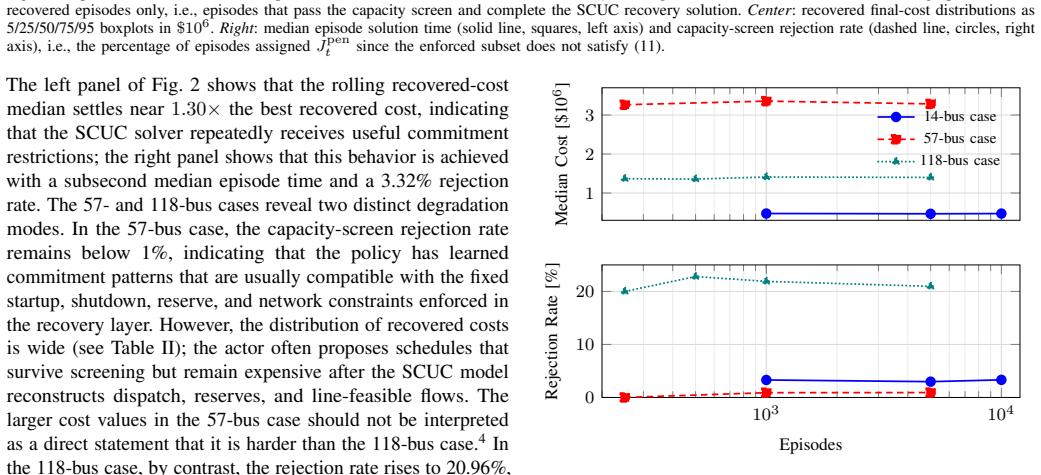
The central claim is that the amount of useful commitment information flowing from an exploratory Bernoulli policy to a fixing-and-recovery SCUC model is determined by a simple coverage formula: with a fixed cap K on enforced binaries, the number of fully enforced periods is floor(K/Ng), and the next period is only fractionally covered. In the 14-bus case (Ng=5, K=20) this yields four complete periods and stable recovery at the full-horizon optimum; in the 57-bus case (Ng=7) it yields two full periods plus 0.86 of a third, with very few screen rejections but wide recovered-cost tails; in the 118-bus case (Ng=54) it yields just 0.37 of period 1, the screen rejects 20.96% of episodes, and long
Load-bearing premise
The paper treats the capacity screen at beta=0.85 — which ignores network, ramping, and reserve limits — together with the chronological first-K enforcement rule, as a faithful proxy for the quality of the policy's commitment proposals, and it never sweeps beta to test whether the observed 118-bus rejection rate is caused by coverage or by the fixed threshold.
Editorial extensions
If this is right
- When the fleet size stays below the cap (Ng ≤ K), the interface can deliver at least one fully enforced commitment period, and in the 14-bus case the recovered schedule matches the unassisted full-horizon optimum.
- Once Ng exceeds K, the recovery model never receives a complete period of commitment guidance; in the 118-bus case it receives 37% of period 1 and the screen-rejection rate rises to ~21%.
- Extending training episodes does not remove the bottleneck: median recovered cost and rejection rate stay flat across 250–5,000 episodes, implying the limitation is structural, not a sample-size effect.
- Raising the screen threshold β above 0.85 converts more proposals into rejections and withholds cost feedback from the critic, while lowering β admits undercovered proposals whose recovered cost is dominated by solver-chosen commitments — so tuning β mainly shifts episodes between the rejection and recovered-cost tails.
- Proportional coverage (e.g., K = 2N_g) would be needed for multiperiod guidance on larger fleets, making the coverage ratio K/N_g, not the absolute cap, the operative design quantity.
Reading between the lines
- One testable extension the paper leaves implicit is an adaptive or sensitivity-ranked enforcement rule — e.g., first enforce a complete critical period, or select commitments by ramp, reserve, or congestion impact — which should restore full-period coverage without requiring K to scale linearly with the fleet.
- Because the quantum-sampled channel is itself distributionally equivalent to classical random features, a controlled ablation replacing it with a cheap classical binomial sampler of the same distribution should reproduce the reported numbers exactly; the paper does not run that control.
- The coverage formula (13) suggests a simple diagnostic for any future RL-to-MILP commitment interface: plot the rejection rate and the recovered-cost distribution against K/N_g. If the collapse at Ng > K is driven by coverage, the 118-bus rejection curve should also appear at any system where K is small relative to the fleet, regardless of RL details.
- The screen's beta=0.85 is never swept, so the 20.96% rejection rate conflates undercoverage with screen strictness; a beta sweep would separate the two and could reposition the paper's central claim as a property of the interface rather than of the screen's fixed threshold.
Editorial analysis
A structured set of objections, weighed in public.
Referee Report
Summary. The paper proposes a three-layer hybrid SCUC framework: a factorized Bernoulli HSAC policy proposes hourly commitment binaries, a quantum-sampled auxiliary feature channel (Hadamard measurements, explicitly replicable by classical random features) augments the state, and a native MILP SCUC recovery model enforces only the first K=20 chronological commitment tuples, subject to a capacity screen with β=0.85. The central claims are: (i) the interface is solver-compatible and preserves SCUC physical constraints; (ii) in the 14-bus case the best recovered schedule attains the full-horizon optimum, with the 57-bus case showing low rejection but heavy-tailed recovered costs, and the 118-bus case showing a sharp rejection-rate increase; (iii) the dominant scalability limitation is the temporal coverage ratio K/Ng, formalized in Eq. (13), rather than the number of RL episodes or the quantum channel. The paper is unusually candid about the absence of quantum advantage, the indicative nature of timing comparisons, and the fact that the exact solver is not the bottleneck at these benchmark sizes.
Significance. If the central diagnosis is correct, the paper makes a useful, controlled contribution to learning-assisted SCUC: it cleanly separates the policy-proposal mechanism from the feasibility-restoring solver, provides an explicit coverage formula for chronological enforcement, and honestly reports a negative-scalability result. The manuscript has several strengths that should be credited: the quantum layer is explicitly described as classically replicable and no quantum advantage is claimed; the 14-bus optimum is externally verified by coincidence with an unassisted full-horizon solve; the coverage formula (13) follows directly from the definition of firstK in (10) and is not circular; and the companion repository [27] is provided for reproducibility. The main weaknesses are evidentiary rather than logical: the central 'coverage bottleneck' conclusion is confounded by the policy's failure to leave maximum entropy, and the screen-rejection diagnostic depends on an unswept β=0.85 threshold.
major comments (3)
- [V, Table III and Fig. 3] The central scaling conclusion — that the coverage ratio K/Ng is the dominant limitation — is confounded by the fact that the trained actor never leaves its maximum-entropy initialization. Table III reports on-fraction ≈0.500 for all three systems, i.e., each Bernoulli mean remains near 0.5, and the text acknowledges that the entropy-regularized objective with α=0.05 'continues to favor exploration at these training lengths.' At the maximum-entropy point, enforced tuples are statistically indistinguishable from random coin flips, so the flat training curves in Fig. 3 can equally be read as RL non-learning rather than information starvation caused by K=20. Since the paper's claim is about useful commitment information, a control with K=54 (one fully enforced period in the 118-bus case) under identical hyperparameters is required; if the median-cost and rejection-rate curves remain flat wi
- [V, Eq. (11)] The 20.96% screen-rejection rate in the 118-bus case is attributed to coverage collapse, but β=0.85 is fixed and the screen deliberately ignores network, ramping, and reserve limits. The paper itself states that varying β 'mainly shifts episodes between the rejection-count and recovered-cost tails.' Without a controlled β sweep, the rejection rate cannot be read as a pure information-coverage diagnostic: a higher β could reject schedules the solver could complete economically, and a lower β could admit undercovered proposals whose recovered cost is dominated by the solver. A β sweep (e.g., 0.70–0.95) with K=20, reporting both rejection rate and recovered-cost distribution, is needed to show that the 118-bus degradation is not an artifact of the fixed threshold. This is load-bearing because the coverage-bottleneck conclusion in Section V relies on the cross-system rejection-rate contrast.
- [IV/V, Table II and Fig. 3] The representative results are single traces: one run per system in Table II and one training curve per system in Fig. 3. RL is seed-dependent, and the claim that 'longer training runs do not by themselves remove the dominant error mechanisms' is based on within-run rolling medians, not across-seed variation. The 118-bus 'flat band' and the 57-bus heavy tail need at least a few independent seeds or bootstrap intervals to support the conclusion that additional episodes are not the limiting factor. This matters because dismissing 'insufficient RL iterations' is an essential step in attributing the degradation to the coverage ratio rather than to learning failure.
minor comments (4)
- [Fig. 3 caption] The upper panel is described as the 'median episode objective over all episodes.' It should be clarified whether screen-rejected episodes contribute their penalty objective (12) to this median or are excluded; the lower panel reports the rejection rate separately, so the median definition should be explicit.
- [II-B, Eq. (7)] The next-action target uses the Bernoulli mean, while the actor update uses sampled actions. This is a known approximation in continuous-action SAC but is nonstandard for discrete Bernoulli policies; a brief note on its potential bias, or a comparison with a sampled target, would improve rigor.
- [III-A] The phrase 'quantum feature-map paradigm' might suggest a learned feature map, but the implemented Hadamard channel is state-independent and classically replicable. The text is honest about this, but the terminology could be sharpened to avoid overstating the connection to [30].
- [Table III] The 'Median shots' column is not directly tied to any reported result; clarifying whether it is a proxy for episode length or a separate diagnostic would help the reader interpret the table.
Circularity Check
No significant circularity: the coverage formula is a definitional consequence of the first-K rule, and the self-citation is only code availability.
full rationale
Walking the derivation chain: the SCUC objective (1) and constraints (2) define the recovery problem; the RL reward (4) uses the recovered solver objective along with explicit penalty, switching, timing, and shaping terms, so the reward is grounded in solver output rather than being a renamed fitted quantity. The coverage formula (13) is derived directly from the chronological first-K enforcement rule (10) and the per-stage append of Ng tuples; it is a definitional identity, not an empirical prediction built from the same data. The capacity screen (11) and penalty objective (12) are stated modeling assumptions, and the paper explicitly acknowledges their limitations ('it ignores network, ramping, and reserve limits...'). The 14-bus optimum is checked against an unassisted full-horizon solve, not fitted, and no hyperparameter is tuned to force the reported recovered cost. The only self-reference is the companion repository [27], which is used for code and trace availability and is not load-bearing; this is code-reproducibility evidence and does not raise circularity. The skeptic's concern—that on-fraction ≈ 0.5 means the Bernoulli actor remains near maximum entropy, so the flat training curves may reflect RL non-learning rather than the K/Ng coverage cap—is a legitimate experimental-design confound and a correctness risk, but it is not circularity: no equation in the paper reduces to its own input, and no fitted parameter is renamed as a prediction. Under the hard rules, no circular step can be exhibited, so the appropriate finding is no significant circularity.
Assumptions & free parameters
free parameters (5)
- K (enforcement cap) =
20
- beta (capacity screen threshold) =
0.85
- alpha (entropy weight) =
0.05
- lambda_c, lambda_sw, lambda_time, lambda_inf, lambda_Phi, kappa =
1, 0.5, 0.2, 1 (implied), 0.5, 1
- Nshot (quantum shots per query) =
128
assumptions (6)
- domain assumption The SCUC MILP (1), (2a)-(2k) as implemented in UnitCommitment.jl with the contingency list is a faithful market-grade model for the 14-, 57-, and 118-bus benchmarks.
- domain assumption The Bernoulli HSAC temporal-difference target (7), which uses the Bernoulli mean in the next-action target instead of sampled actions, is a valid SAC approximation for multi-binary actions.
- ad hoc to paper The capacity screen with beta=0.85 and the penalty objective (12) produce a training signal that does not qualitatively change the learned policy's behavior.
- domain assumption Gurobi's solve of the recovery problem with a subset of enforced binaries is used as ground truth for feasibility and cost, including when the policy fixes decisions that might be suboptimal.
- ad hoc to paper The representative trace with 10,000, 5,000, and 5,000 episodes (Table II) is sufficient to characterize the learned policy and the flat training trends.
- standard math The quantum feature map paradigm [30] and its claim that state-dependent parameterized circuits produce classically hard distributions are accepted as motivation.
invented entities (1)
-
Quantum-sampled auxiliary channel z_t (marginal measurement counts from Hadamard states)
Cite this review
Pith. "Pith review of Feasibility-Aware Security-Constrained Unit Commitment via Hybrid Soft Actor-Critic with Quantum-Sampled Features." pith.science (2026). https://pith.science/paper/LOO7NEUG
@misc{pith2026260717031,
  author       = {Pith},
  title        = {Pith review of: Feasibility-Aware Security-Constrained Unit Commitment via Hybrid Soft Actor-Critic with Quantum-Sampled Features},
  year         = {2026},
  howpublished = {\url{https://pith.science/paper/LOO7NEUG}},
  note         = {Machine review of arXiv:2607.17031}
}
read the original abstract
Security-constrained unit commitment (SCUC) couples binary commitment, economic dispatch, reserves, and network security over a multiperiod horizon, making an exact solution computationally expensive for realistic system sizes. This paper proposes a three-layer hybrid framework in which a Bernoulli hybrid soft actor-critic (HSAC) policy proposes hourly commitments, a quantum-sampled auxiliary channel augments the state, and a native SCUC mixed-integer linear program recovers dispatch and security variables after only a limited subset of commitment binaries is enforced. The method is therefore solver-compatible rather than an end-to-end replacement for exact optimization. We formalize the SCUC-to-reinforcement-learning interface, derive the temporal coverage induced by the fixed cap, and evaluate the 14- 57- and 118-bus benchmark cases. The results show stable, low-cost recovery in the 14-bus case, where the best recovered schedule attains the full-horizon optimum; a very low screen-rejection rate in the 57-bus case; and a clear coverage bottleneck in the 118-bus case once the enforcement cap no longer spans a complete commitment period. The study, therefore, identifies the amount of useful commitment information that reaches the recovery model, under an exploratory Bernoulli actor and a small enforcement cap, as the dominant limitation that governs scalability
Figures


Figures from the paper (1 more)

Reference graph
Works this paper leans on
-
[27]
QHSAC-Unit- Commitment,
G. Dimas, A. Masoumi, and M. Korkali, “QHSAC-Unit- Commitment,” GitHub repository, https://github.com/GeorgeDimas123/ QHSAC-Unit-Commitment, 2026
2026
-
[1]
Security-constrained unit commitment for electricity market: Modeling, solution methods, and future challenges,
Y . Chenet al., “Security-constrained unit commitment for electricity market: Modeling, solution methods, and future challenges,”IEEE Trans. Power Syst., vol. 38, no. 5, pp. 4668–4681, Sep. 2023
2023
-
[2]
Machine learning approaches to the unit commitment problem: Current trends, emerging challenges, and new strategies,
Y . Yang and L. Wu, “Machine learning approaches to the unit commitment problem: Current trends, emerging challenges, and new strategies,”Electr. J., vol. 34, no. 1, Jan.-Feb. 2021, Art. no. 106889
2021
-
[3]
Learning to solve large-scale security-constrained unit commitment problems,
Á. S. Xavier, F. Qiu, and S. Ahmed, “Learning to solve large-scale security-constrained unit commitment problems,”INFORMS J. Comput., vol. 33, no. 2, pp. 739–756, 2021
2021
-
[4]
Is learning for the unit commitment problem a low-hanging fruit?
S. Pineda and J. M. Morales, “Is learning for the unit commitment problem a low-hanging fruit?”Electr. Power Syst. Res., vol. 207, 2022, Art. no. 107851
2022
-
[5]
Deep reinforcement learning explanation-assisted integer variable reduction method for security-constrained unit commitment,
Y . Daiet al., “Deep reinforcement learning explanation-assisted integer variable reduction method for security-constrained unit commitment,” Eng. Appl. Artif. Intell., vol. 144, Mar. 2025, Art. no. 110139
2025
-
[6]
Feasibility-guaranteed machine learning unit commitment: Fuzzy optimization approaches,
B. Venkatesh, M. I. A. Shekeew, and J. Ma, “Feasibility-guaranteed machine learning unit commitment: Fuzzy optimization approaches,” Appl. Energy, vol. 379, Feb. 2025, Art. no. 124923
2025
-
[7]
G. Wanget al., “Structure-aware commitment reduction for network- constrained unit commitment with solver-preserving guarantees,”arXiv preprint arXiv:2604.02788, 2026
arXiv 2026
Show all 33 references
-
[8]
Successive fixing for large-scale security-constrained unit commitment using first-order methods,
J. Xionget al., “Successive fixing for large-scale security-constrained unit commitment using first-order methods,”arXiv preprint arXiv:2510.10891, 2025
2025
-
[9]
Applying reinforcement learning and tree search to the unit commitment problem,
P. de Mars and A. O’Sullivan, “Applying reinforcement learning and tree search to the unit commitment problem,”Appl. Energy, vol. 302, Nov. 2021, Art. no. 117519
2021
-
[10]
Reinforcement learning and A* search for the unit commitment problem,
P. de Mars and A. O’Sullivan, “Reinforcement learning and A* search for the unit commitment problem,”Energy AI, vol. 9, Aug. 2022, Art. no. 100179
2022
-
[11]
An optimization method-assisted ensemble deep reinforce- ment learning algorithm to solve unit commitment problems,
J. Qinet al., “An optimization method-assisted ensemble deep reinforce- ment learning algorithm to solve unit commitment problems,”IEEE Access, vol. 11, pp. 100 125–100 136, 2023
2023
-
[12]
Deep reinforcement learning-assisted convex programming for AC unit commitment and its variants,
A. R. Sayedet al., “Deep reinforcement learning-assisted convex programming for AC unit commitment and its variants,”IEEE Trans. Power Syst., vol. 39, no. 4, pp. 5561–5574, Jul. 2024
2024
-
[13]
Deep reinforcement learning based model-free optimization for unit commitment against wind power uncertainty,
G. Xuet al., “Deep reinforcement learning based model-free optimization for unit commitment against wind power uncertainty,”Int. J. Electr. Power Energy Syst., vol. 155, Jan. 2024, Art. no. 109526
2024
-
[14]
Look-ahead unit commitment with adaptive horizon based on deep reinforcement learning,
J. Yanet al., “Look-ahead unit commitment with adaptive horizon based on deep reinforcement learning,”IEEE Trans. Power Syst., vol. 39, no. 2, pp. 3673–3684, Mar. 2024
2024
-
[15]
Expert knowledge data-driven based actor-critic reinforcement learning framework to solve computationally expensive unit commitment problems with uncertain wind energy,
H. Liang, C. Lin, and A. Pang, “Expert knowledge data-driven based actor-critic reinforcement learning framework to solve computationally expensive unit commitment problems with uncertain wind energy,”Int. J. Electr. Power Energy Syst., vol. 159, Aug. 2024, Art. no. 110033
2024
-
[16]
Graph reinforcement learning with auxiliary temporal- graph convolutional neural network for unit commitment,
W. Luet al., “Graph reinforcement learning with auxiliary temporal- graph convolutional neural network for unit commitment,”Int. J. Electr. Power Energy Syst., vol. 176, Mar. 2026, Art. no. 111708
2026
-
[17]
Adapting quantum approximation optimization algorithm (QAOA) for unit commitment,
S. Koretskyet al., “Adapting quantum approximation optimization algorithm (QAOA) for unit commitment,” inProc. IEEE Int. Conf. Quantum Comput. Eng. (QCE), 2021, pp. 181–187
2021
-
[18]
Qubit-efficient quantum annealing for stochastic unit commitment,
W. Hong, W. Xu, and F. Teng, “Qubit-efficient quantum annealing for stochastic unit commitment,”arXiv preprint arXiv:2502.15917v2, 2026
2026 arXiv
-
[19]
Novel resolution of unit commitment problems through quantum surrogate Lagrangian relaxation,
F. Fenget al., “Novel resolution of unit commitment problems through quantum surrogate Lagrangian relaxation,”IEEE Trans. Power Syst., vol. 38, no. 3, pp. 2460–2471, May 2023
2023
-
[20]
A fast quantum algorithm for searching the quasi-optimal solutions of unit commitment,
X. Zheng, J. Wang, and M. Yue, “A fast quantum algorithm for searching the quasi-optimal solutions of unit commitment,”IEEE Trans. Power Syst., vol. 39, no. 2, pp. 4755–4758, Mar. 2024
2024
-
[21]
Exact quantum algorithm for unit commitment optimization based on partially connected quantum neural networks,
J. Liuet al., “Exact quantum algorithm for unit commitment optimization based on partially connected quantum neural networks,”Chin. Phys. B, vol. 34, no. 10, 2025, Art. no. 100303
2025
-
[22]
Quantum reinforcement learning based two-stage unit commitment with integration of virtual power plants and renewable energy,
X. Weiet al., “Quantum reinforcement learning based two-stage unit commitment with integration of virtual power plants and renewable energy,”J. Mod. Power Syst. Clean Energy, pp. 1–12, 2026, early access
2026
-
[23]
A new hybrid quantum-classical algorithm for solving the unit commitment problem,
W. Aboumradet al., “A new hybrid quantum-classical algorithm for solving the unit commitment problem,” inProc. IEEE Int. Conf. Quantum Comput. Eng. (QCE), 2025, pp. 1905–1915
2025
-
[24]
D 2-UC: A distributed-distributed quantum-classical framework for unit commitment,
M. Hasanzadeh and A. Kargarian, “D 2-UC: A distributed-distributed quantum-classical framework for unit commitment,”arXiv preprint arXiv:2511.03104, 2025
2025
-
[25]
Leveraging quantum comput- ing for accelerated classical algorithms in power systems optimization,
R. Barrass, H. Nagarajan, and C. Coffrin, “Leveraging quantum comput- ing for accelerated classical algorithms in power systems optimization,” inIntegration of Constraint Programming, Artificial Intelligence, and Operations Research (CPAIOR), G. Tack, Ed. Cham: Springer Nature...
2025
-
[26]
A survey on applications of quantum computing for unit commitment,
M. Hasanzadeh and A. Kargarian, “A survey on applications of quantum computing for unit commitment,”arXiv preprint arXiv:2601.01777, 2026
2026
-
[28]
UnitCommitment.jl: A Julia/JuMP optimization package for security-constrained unit commitment,
A. S. Xavieret al., “UnitCommitment.jl: A Julia/JuMP optimization package for security-constrained unit commitment,” Zenodo, 2024
2024
-
[29]
Attention is all you need,
A. Vaswaniet al., “Attention is all you need,” inProc. Adv. Neural Inf. Process. Syst. (NeurIPS), 2017, pp. 5998–6008
2017
-
[30]
Supervised learning with quantum-enhanced feature spaces,
V . Havlíˇceket al., “Supervised learning with quantum-enhanced feature spaces,”Nature, vol. 567, no. 7747, pp. 209–212, 2019
2019
-
[31]
Random features for large-scale kernel machines,
A. Rahimi and B. Recht, “Random features for large-scale kernel machines,” inProc. Adv. Neural Inf. Process. Syst. (NeurIPS), 2007, pp. 1177–1184
2007
-
[32]
Soft actor-critic: Off-policy maximum entropy deep reinforcement learning with a stochastic actor,
T. Haarnojaet al., “Soft actor-critic: Off-policy maximum entropy deep reinforcement learning with a stochastic actor,” inProc. 35th Int. Conf. Mach. Learn. (ICML), 2018, pp. 1861–1870
2018
-
[33]
JuMP 1.0: Recent improvements to a modeling language for mathematical optimization,
M. Lubinet al., “JuMP 1.0: Recent improvements to a modeling language for mathematical optimization,”Math. Program. Comput., vol. 15, pp. 581–589, 2023
2023
Reviewed August 1, 2026 · model on record in the stance chip above.
Discussion (0). Continue with ORCID to comment.