REVIEW 3 major objections 5 minor 1 cited by
HarmoHOI: Harmonizing Appearance and 3D Motion for Multi-view Hand-Object Interaction Synthesis
T0 review · 3 major / 5 minor · reviewed 2026-08-01 · deepseek-v4-flash
Pith's one-line read HarmoHOI is a unified diffusion framework that jointly generates synchronized multi-view hand-object interaction videos and globally aligned metric-scale 3D point tracks from a single reference image and target camera poses.
desk verdict Genuinely new multi-view HOI video+motion co-generation with a load-bearing scale-source gap at inference. read the letter →
The pith
A machine-rendered reading of the paper's core claim, the machinery that carries it, and where it could break.
The reading
What carries the argument
The load-bearing objects are two. First, the motion pseudo-video: 3D point tracks are depth-normalized, reverse-scaled, color-mapped into RGB-like frames, and VAE-encoded exactly like video frames, so the geometric signal shares a latent space with appearance. Second, the Global Motion Aligning Diffusion (GloMAD): a sparse-convolution point-cloud network with inter-view geometric attention that takes the coarse up-to-scale tracks from M2DiT and outputs globally aligned metric-scale trajectories. The two are wired into a closed loop: during denoising, GloMAD's refined tracks are projected back into pseudo-video and injected into M2DiT's next step, while M2DiT's estimated global scale token ma
What would settle it
Take a reference image with known ground-truth metric depth, run the pipeline, and compare the output 3D point tracks against motion-capture ground truth; if the tracks are off by a non-constant scale or more than a small rigid misalignment, the central claim fails. A simpler probe: scale the input depth by 0.5 and check whether the output tracks scale correspondingly—if the model ignores or hallucinates the scale, metric alignment is not actually happening.
Extended reading notes
Core claim
On its own terms, HarmoHOI claims that representing 3D point tracks as 'motion pseudo-videos' erases the domain gap between geometry and the latent space of video foundation models, so the same diffusion transformer can co-model 2D appearance and 3D motion. Co-denoising the two branches lets each constrain the other; inter-view geometric attention enforces epipolar consistency at every denoising step. GloMAD then refines the coarse tracks into metric-scale, globally aligned 3D trajectories, closing a loop by projecting refined tracks back into pseudo-video form to guide the next denoising step. With only a reference image, target cameras, and a text prompt, the framework outputs V synchroniz
Load-bearing premise
The method assumes that metric-scale depth of the reference image is available at inference, but the paper does not state how this depth is obtained; if only relative depth is available, the 'metric-scale' and 'globally aligned' parts of the claim lose their meaning.
Editorial extensions
If this is right
- A user supplies one reference image, target camera poses, and a text prompt; the model returns V synchronized videos and K metric-scale 3D point tracks in one pass.
- Multi-view geometric consistency is enforced during generation, not through post-hoc reconstruction or ICP alignment.
- Because point tracks are encoded as pseudo-videos, a pretrained video diffusion backbone can be adapted to generate 3D motion without training a separate 3D generator from scratch.
- The three-stage curriculum (single-view warm-up, multi-view appearance, then multi-view geometry) allows scarce multi-view HOI data to be supplemented by abundant single-view video.
- If the scale assumption is met, the 3D tracks have metric meaning, so they can be used directly for animation, simulation, or embodied-agent training.
Reading between the lines
- An extension left implicit: the pseudo-video representation is a general recipe; any dynamic 3D signal (object trajectories, human skeleton motion, scene flow) could be color-mapped and injected into a video DiT the same way, potentially turning other video generators into geometry-aware ones.
- The method's practical reach depends on resolving where metric reference depth comes from; a monocular depth network plus a scale calibration step could make the pipeline true RGB-only, a natural next step.
- The closed-loop design suggests a broader principle: rather than treating geometry as a conditioning side channel, feed a generator's own geometric output back as input at each denoising step—an idea that could transfer to other multi-view or 4D generation tasks.
Editorial analysis
A structured set of objections, weighed in public.
Referee Report
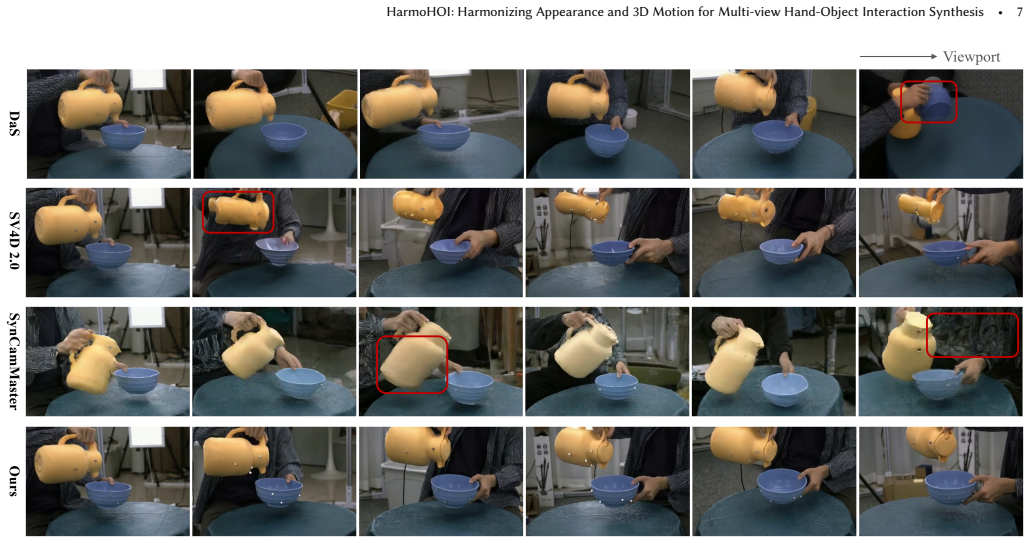
Summary. The paper proposes HarmoHOI, a unified diffusion framework for multi-view hand-object interaction (HOI) synthesis. From a single reference image, multi-view target camera poses, and a text prompt, the method jointly generates synchronized multi-view RGB videos and 3D point tracks claimed to be metric-scale and globally aligned. The architecture couples a Mixture of Multi-view Diffusion Transformer (M2DiT), which co-models RGB videos and motion pseudo-videos derived from point tracks, with a Global Motion Aligning Diffusion (GloMAD) module that refines coarse point tracks. A hybrid-data progressive curriculum uses single-view in-the-wild data, synthetic multi-view data, and lab-captured TACO data. Experiments report improved video quality, motion plausibility, and geometric consistency over several baselines on held-out TACO data, with ablations for each component.
Significance. If the claims hold, HarmoHOI is a substantial contribution: it is the first framework to jointly generate multi-view HOI videos and 3D point tracks in a single diffusion process, reuses video foundation model priors through pseudo-video representation, and explicitly targets metric-scale global alignment. The curriculum strategy is also a plausible way to mitigate the scarcity of paired multi-view video and 3D motion data. However, the central 'metric-scale globally aligned' claim depends on an inference-time depth/scale input that the paper never specifies, and the quantitative evidence is based solely on point estimates without error bars or significance tests. The conceptual framework is promising, but the manuscript currently overstates what is demonstrated.
major comments (3)
- [Sec. 3.3, Algorithm 1, Algorithm 2] The metric-scale claim is not supported by the stated inference inputs. Algorithm 1 consumes a reference depth d_ref and depth scale s to build motion pseudo-videos (lines 5-7), and Algorithm 2 lists only an 'averager depth scale s-bar' and the reference image. The task definition in Sec. 3 says input is a single reference image, camera poses, and text. A single RGB image is metrically ambiguous; the learnable scale tokens can at best regress a plausible scale from object priors, not recover true metric scale. The paper must state where d_ref and s come from at inference, and validate metric-scale alignment using that source (e.g., comparing outputs obtained with DA3-estimated depth vs. TACO ground-truth depth). If the method only produces up-to-scale geometry, the 'metric-scale' wording and the matching claims in the abstract and Sec. 4 must be revised.
- [Sec. 4.3, Tables 1-3] All quantitative comparisons are single point estimates with no error bars, confidence intervals, or significance tests. This is load-bearing for the 'state-of-the-art' claim, especially where margins are small (Table 1: CLIP-V 83.18 vs 83.01; Table 2: RPE 14.8 vs 16.7, non-contact rate 0.12 vs 0.15). Please report standard deviations over multiple evaluation seeds or test splits, state the number of test clips, and provide paired significance tests where appropriate. Table 3 also omits RPE for the row without GloMAD, making that ablation incomplete.
- [Sec. 4.3, Baselines] The baseline comparison protocol is underspecified. The text says baselines were fine-tuned on 'our data' but does not state whether the same TACO train/test split, reference images, and camera poses were used, nor the fine-tuning hyperparameters. SV4D 2.0 receives a source video and multi-view reference images, so its input is strictly richer; the paper should explain how this is accounted for. Without this detail, the reported gains over prior methods are hard to interpret.
minor comments (5)
- [Algorithm 2] 'averager depth scale s-bar' should be 'average depth scale s-bar'. Also, s-bar is never defined; please define it and explain how it is computed at inference.
- [Sec. 4.1 / Table 2] Table 2 has the typo 'Plaussibility' for 'Plausibility'. In addition, the column header 'Mat. Pix.' in Table 1 should match the metric name 'Matching Pixels' used in Sec. 4.1.
- [Sec. 4.1 / Table 2] Depth Anything 3 is used to produce pseudo-depth labels for HOIGen1M in Stage 1 and is also listed as a 3D motion baseline in Table 2. This creates a possible circularity; the paper should acknowledge this and discuss whether the comparison is affected.
- [Sec. 3.3] The name 'Mixture of Multi-view Diffusion Transformer' suggests a mixture-of-experts design, but the described architecture is a dual-branch transformer with inter-view attention. Please clarify the naming to avoid confusion.
- [Fig. 2] The figure uses abbreviations such as 'Bach Size', 'B', 't', 'V', 'hw', 'd' without a full legend. Please spell out 'Batch Size' and define all tensor-dimension symbols in the caption or text.
Circularity Check
No circular reduction in the derivation chain; metric-scale alignment is a supervised, held-out benchmarked output. Minor independence burdens come from same-group prior work (SViMo, TACO) and from Depth Anything 3 doubling as pseudo-label generator and baseline, but none of these make the central claim equivalent to its inputs by construction.
full rationale
The central claims are supported by supervised training objectives and external held-out evaluation, not by definitional equivalence. M2DiT is trained with Eq. (4), which jointly supervises the RGB velocity, the motion pseudo-video velocity, and the global metric scale s: ||ŝ - s||^2. The metric scale is therefore a learned regression target, not a quantity defined by the outputs. GloMAD refines coarse point tracks with a loss containing MSE and Chamfer distance against ground-truth M (Eq. 5), and the final 3D results are evaluated on a held-out TACO split using Chamfer distance, RPE, and inlier percentage. Thus the 'metric-scale, globally aligned 3D point tracks' are supervised predictions benchmarked against ground truth, not the same quantity as any fitted input. The skeptical concern about an unstated inference-time metric depth source is a correctness/assumption gap, not a circularity. Algorithm 1 consumes d_ref and s during training to build multi-view conditions; Algorithm 2 at inference uses the reference latent and predicted scale ŝ. The manuscript does not state where a metric d_ref would come from at inference, so the metric-scale property may degrade for arbitrary single RGB images. But this does not reduce the derivation to its own inputs: the paper never defines d_ref or s as the output, and the scale is not fitted to the final tracks. Self-citation is present but not load-bearing. SViMo (Dang et al. 2025) is a same-group prior method used as a related-work contrast and as a Table 1 baseline; TACO (Liu et al. 2024b) is co-authored by one of the present authors and used as the benchmark dataset. These are independence concerns, but the paper's central results are not justified by citing these works as theorems or as forced choices. The benchmark numbers come from held-out TACO ground truth with external metrics and additional external baselines. Similarly, Depth Anything 3 is used both to generate pseudo-labels in stage 1 and as a baseline in Table 2; this is a possible fairness/contamination issue, but the final TACO 3D evaluation uses ground-truth motion, so the headline quantitative result is not forced by that overlap. The explicit Limitation section concerns viewpoint density and future 4D Gaussian rendering, not a circular dependence. No uniqueness theorem is imported from the authors' prior work, no ansatz is smuggled in via a self-citation, and the pseudo-video representation is an architectural choice rather than a renaming of a kn
Assumptions & free parameters
free parameters (2)
- Global metric-scale tokens (two learnable tokens f_s)
- Average depth scale s̄
assumptions (5)
- domain assumption Depth-normalized, colormapped point tracks ('motion pseudo-videos') can be encoded by the same video VAE as RGB with sufficiently small information loss for 2D-to-3D co-generation.
- domain assumption The pretrained WAN 2.1 text-to-video DiT priors transfer to the motion pseudo-video branch and to multi-view joint generation without collapse.
- domain assumption Pseudo-geometric annotations from Depth Anything 3 on in-the-wild HOIGen1M are reliable enough to teach appearance-motion correspondence.
- ad hoc to paper Metric reference depth (or equivalent global scale) is available as an input at inference.
- domain assumption Multi-view epipolar consistency learned on synthetic UE5 and lab TACO data transfers to in-the-wild HOI scenes.
Cite this review
Pith. "Pith review of HarmoHOI: Harmonizing Appearance and 3D Motion for Multi-view Hand-Object Interaction Synthesis." pith.science (2026). https://pith.science/paper/5F5575OE
@misc{pith2026260717097,
  author       = {Pith},
  title        = {Pith review of: HarmoHOI: Harmonizing Appearance and 3D Motion for Multi-view Hand-Object Interaction Synthesis},
  year         = {2026},
  howpublished = {\url{https://pith.science/paper/5F5575OE}},
  note         = {Machine review of arXiv:2607.17097}
}
read the original abstract
Hand-Object Interaction (HOI) synthesis is a cornerstone for animation production and embodied AI. Despite the strong priors of video foundation models, multi-view consistent HOI synthesis remains challenging due to complex hand motions and occlusions. We present HarmoHOI, a unified diffusion framework that jointly and harmoniously generates synchronized multi-view HOI videos and globally aligned 3D point tracks. Our core insight is that robust multi-view consistency fundamentally requires globally aligned 3D geometry and motion. To this end, we propose a Mixture of Multi-view Diffusion Transformer that co-models RGB videos and 3D point tracks. By representing point tracks as pseudo-videos, we align 3D geometric signals with the 2D latent space of foundation models, thereby minimizing the domain gap and easing adaptation of priors. To further ensure geometry consistency, we introduce Global Motion Aligning Diffusion, which refines coarse point tracks into metric-scale, globally aligned 3D trajectories. HarmoHOI enables on-the-fly co-evolution of 2D appearance and 3D motion during denoising. To overcome the scarcity of multi-view HOI data, we employ a hybrid data curriculum learning strategy that successfully transfers generic priors from single-view data to synchronized multi-view generation. Experimental results show that HarmoHOI achieves state-of-the-art performance in visual quality, motion plausibility, and multi-view geometric consistency. Project page available at https://droliven.github.io/HarmoHOI_project.
Figures


Figures from the paper (7 more)


Forward citations
Cited by 1 Pith paper
-
StreamHOI: Interaction-aware Temporal Memory Adaptation for Streaming HOI Video Generation
A streaming image-to-video model that assigns block-specific sink/local memory and learned RoPE distance scaling preserves long human-object interactions under bounded latency.
Reference graph
Works this paper leans on
-
[1]
Deciding equivalances among conjunctive aggregate queries
Sarah Cohen and Werner Nutt and Yehoshua Sagic. Deciding equivalances among conjunctive aggregate queries. doi:10.1145/1219092.1219093
-
[2]
Special issue: Digital Libraries. 1996
1996
-
[3]
Understanding Policy-Based Networking
David Kosiur. Understanding Policy-Based Networking
-
[6]
The title of book two. doi:10.1007/3-540-09237-4
-
[7]
Asad Z. Spector. Achieving application requirements. Distributed Systems. doi:10.1145/90417.90738
-
[8]
Douglass and David Harel and Mark B
Bruce P. Douglass and David Harel and Mark B. Trakhtenbrot. Statecarts in use: structured analysis and object-orientation. Lectures on Embedded Systems. doi:10.1007/3-540-65193-4_29
-
[9]
Donald E. Knuth. The Art of Computer Programming, Vol. 1: Fundamental Algorithms (3rd. ed.)
-
[10]
Donald E. Knuth. The Art of Computer Programming
Show all 190 references
-
[11]
Structured Variational Inference Procedures and their Realizations (as incol)
Dan Geiger and Christopher Meek. Structured Variational Inference Procedures and their Realizations (as incol). Proceedings of Tenth International Workshop on Artificial Intelligence and Statistics, The Barbados
-
[12]
Stan W. Smith. An experiment in bibliographic mark-up: Parsing metadata for XML export. Proceedings of the 3rd. annual workshop on Librarians and Computers
-
[13]
Catch me, if you can: Evading network signatures with web-based polymorphic worms
Matthew Van Gundy and Davide Balzarotti and Giovanni Vigna. Catch me, if you can: Evading network signatures with web-based polymorphic worms. Proceedings of the first USENIX workshop on Offensive Technologies
-
[14]
Predicate Path expressions
Sten Andler. Predicate Path expressions. Proceedings of the 6th. ACM SIGACT-SIGPLAN symposium on Principles of Programming Languages. doi:10.1145/567752.567774
-
[15]
LOGICS of Programs: AXIOMATICS and DESCRIPTIVE POWER
David Harel. LOGICS of Programs: AXIOMATICS and DESCRIPTIVE POWER
-
[16]
Anisi , title =
David A. Anisi , title =
-
[17]
Clarkson
Kenneth L. Clarkson. Algorithms for Closest-Point Problems (Computational Geometry)
-
[18]
Introduction to Bayesian Statistics
Harry Thornburg. Introduction to Bayesian Statistics. 2001
2001
-
[19]
CLIFFORD: a Maple 11 Package for Clifford Algebra Computations, version 11
Rafal Ablamowicz and Bertfried Fauser. CLIFFORD: a Maple 11 Package for Clifford Algebra Computations, version 11. 2007
2007
-
[20]
Stats and Analysis
Poker-Edge.Com. Stats and Analysis. 2006
2006
-
[21]
A more perfect union
Barack Obama. A more perfect union
-
[22]
The fountain of youth
Joseph Scientist. The fountain of youth
-
[23]
Solder man
Dave Novak. Solder man. ACM SIGGRAPH 2003 Video Review on Animation theater Program: Part I - Vol. 145 (July 27--27, 2003). doi:10.945/woot07-S422
2003
-
[24]
Interview with Bill Kinder: January 13, 2005
Newton Lee. Interview with Bill Kinder: January 13, 2005. Comput. Entertain. doi:10.1145/1057270.1057278
2005
-
[25]
The Enabling of Digital Libraries
Bernard Rous. The Enabling of Digital Libraries. Digital Libraries
-
[27]
(new) Finding minimum congestion spanning trees , journal =
Werneck, Renato and Setubal, Jo\. (new) Finding minimum congestion spanning trees , journal =. doi:10.1145/351827.384253 , acmid = 384253, publisher =
-
[29]
and Mei, Alessandro , title =
Conti, Mauro and Di Pietro, Roberto and Mancini, Luigi V. and Mei, Alessandro , title =. Inf. Fusion , volume =. 2009 , issn =. doi:10.1016/j.inffus.2009.01.002 , acmid =
2009 doi
-
[30]
and Hutchful, David K
Li, Cheng-Lun and Buyuktur, Ayse G. and Hutchful, David K. and Sant, Natasha B. and Nainwal, Satyendra K. , title =. CHI '08 extended abstracts on Human factors in computing systems , year =. doi:10.1145/1358628.1358946 , acmid =
-
[31]
, title =
Hollis, Billy S. , title =. 1999 , isbn =
1999
-
[32]
Goossens, Michel and Rahtz, S. P. and Moore, Ross and Sutor, Robert S. , title =. 1999 , isbn =
1999
-
[33]
and Rosenberg, Arnold L
Buss, Jonathan F. and Rosenberg, Arnold L. and Knott, Judson D. , title =. 1987 , source =
1987
-
[34]
CHI '08: CHI '08 extended abstracts on Human factors in computing systems , year =
, note =. CHI '08: CHI '08 extended abstracts on Human factors in computing systems , year =
-
[35]
Algorithms for Closest-Point Problems (Computational Geometry) , year =
Clarkson, Kenneth Lee , advisor =. Algorithms for Closest-Point Problems (Computational Geometry) , year =
-
[36]
SIGCOMM Comput. Commun. Rev. , year =
-
[37]
2004 , isbn =
IEEE TCSC Executive Committee , booktitle =. 2004 , isbn =. doi:http://dx.doi.org/10.1109/ICWS.2004.64 , acmid =
2004 doi
-
[38]
Distributed systems (2nd Ed.) , year =
-
[39]
, title =
Petrie, Charles J. , title =. 1986 , source =
1986
-
[40]
Donald E. Knuth. Seminumerical Algorithms. 1981
1981
-
[41]
E-commerce and cultural values , year =
Kong, Wei-Chang , Title =. E-commerce and cultural values , year =
-
[42]
E-commerce and cultural values , year =
Kong, Wei-Chang , type =. E-commerce and cultural values , year =
-
[43]
Chapter 9 , booktitle =
Kong, Wei-Chang , editor =. Chapter 9 , booktitle =
-
[44]
E-commerce and cultural values , editor =
Kong, Wei-Chang , title =. E-commerce and cultural values , editor =. 2003 , isbn =
2003
-
[45]
E-commerce and cultural values - (InBook-num-in-chap) , chapter =
Kong, Wei-Chang , editor =. E-commerce and cultural values - (InBook-num-in-chap) , chapter =. 2004 , address =
2004
-
[46]
E-commerce and cultural values (Inbook-text-in-chap) , chapter =
Kong, Wei-Chang , editor =. E-commerce and cultural values (Inbook-text-in-chap) , chapter =. 2005 , address =
2005
-
[47]
E-commerce and cultural values (Inbook-num chap) , chapter =
Kong, Wei-Chang , editor =. E-commerce and cultural values (Inbook-num chap) , chapter =. 2006 , address =
2006
-
[48]
Microelectron
Mehdi Saeedi and Morteza Saheb Zamani and Mehdi Sedighi , title =. Microelectron. J. , volume =. 2010 , pages =
2010
-
[49]
Mehdi Saeedi and Morteza Saheb Zamani and Mehdi Sedighi and Zahra Sasanian , title =. J. Emerg. Technol. Comput. Syst. , volume =
-
[50]
Kirschmer, Markus and Voight, John , title =. SIAM J. Comput. , issue_date =. 2010 , issn =. doi:https://doi.org/10.1137/080734467 , acmid =
2010 doi
-
[51]
Hoare, C. A. R. , title =. Structured programming (incoll) , editor =. 1972 , isbn =
1972
-
[52]
History of programming languages I (incoll) , editor =
Lee, Jan , title =. History of programming languages I (incoll) , editor =. 1981 , isbn =. doi:http://doi.acm.org/10.1145/800025.1198348 , acmid =
1981
-
[53]
, title =
Dijkstra, E. , title =. Classics in software engineering (incoll) , year =
-
[54]
, title =
Wenzel, Elizabeth M. , title =. Multimedia interface design (incoll) , year =. doi:10.1145/146022.146089 , acmid =
-
[55]
, title =
Mumford, E. , title =. Critical issues in information systems research (incoll) , year =
-
[56]
and Golden, Donald G
McCracken, Daniel D. and Golden, Donald G. , title =. 1990 , isbn =
1990
-
[57]
The analysis of linear partial differential operators
H. The analysis of linear partial differential operators. 1985 , PAGES =
1985
-
[58]
IEEE", address =
A. Adya and P. Bahl and J. Padhye and A.Wolman and L. Zhou , title =. Proceedings of the IEEE 1st International Conference on Broadnets Networks (BroadNets'04) , publisher = "IEEE", address = "Los Alamitos, CA", year =
-
[59]
I. F. Akyildiz and W. Su and Y. Sankarasubramaniam and E. Cayirci , title =. Comm. ACM , volume = 38, number = "4", year =
-
[60]
I. F. Akyildiz and T. Melodia and K. R. Chowdhury , title =. Computer Netw. , volume = 51, number = "4", year =
-
[61]
ACM", address =
P. Bahl and R. Chancre and J. Dungeon , title =. Proceeding of the 10th International Conference on Mobile Computing and Networking (MobiCom'04) , publisher = "ACM", address = "New York, NY", year =
-
[62]
8 (Special Issue on Sensor Networks)
D. Culler and D. Estrin and M. Srivastava , title =. IEEE Comput. , volume = 37, number = "8 (Special Issue on Sensor Networks)", publisher = "IEEE", address = "Los Alamitos, CA", year =
-
[63]
Natarajan and M
A. Natarajan and M. Motani and B. de Silva and K. Yap and K. C. Chua , title =. Network Architectures , editor =. 960935712
-
[64]
Tzamaloukas and J
A. Tzamaloukas and J. J. Garcia-Luna-Aceves , title =
-
[65]
Zhou and J
G. Zhou and J. Lu and C.-Y. Wan and M. D. Yarvis and J. A. Stankovic , title =
-
[66]
Mapping Powerlists onto Hypercubes
Jacob Kornerup. Mapping Powerlists onto Hypercubes. 1994
1994
-
[67]
Automatic Parallelization for Distributed-Memory Multiprocessing Systems
Michael Gerndt. Automatic Parallelization for Distributed-Memory Multiprocessing Systems
-
[68]
J. E. Archer, Jr. and R. Conway and F. B. Schneider. User recovery and reversal in interactive systems. ACM Trans. Program. Lang. Syst
-
[69]
D. D. Dunlop and V. R. Basili. Generalizing specifications for uniformly implemented loops. ACM Trans. Program. Lang. Syst
-
[70]
Heering and P
J. Heering and P. Klint. Towards monolingual programming environments. ACM Trans. Program. Lang. Syst
-
[71]
Donald E. Knuth. The book
-
[72]
Korach and D
E. Korach and D. Rotem and N. Santoro. Distributed algorithms for finding centers and medians in networks. ACM Trans. Program. Lang. Syst
-
[73]
: A Document Preparation System
Leslie Lamport. : A Document Preparation System
-
[74]
F. Nielson. Program transformations in a denotational setting. ACM Trans. Program. Lang. Syst
-
[75]
Brian K. Reid. A high-level approach to computer document formatting. Proceedings of the 7th Annual Symposium on Principles of Programming Languages
-
[76]
and Abdelzaher, Tarek F
Zhou, Gang and Wu, Yafeng and Yan, Ting and He, Tian and Huang, Chengdu and Stankovic, John A. and Abdelzaher, Tarek F. , title =. ACM Trans. Embed. Comput. Syst. , issue_date =. doi:10.1145/1721695.1721705 , acmid = 1721705, publisher =
-
[77]
Institutional members of the Users Group
-
[78]
Boris Veytsman , title =
-
[79]
Robin Schneider , title =
-
[80]
and Peterson, Larry L
Bowman, Mic and Debray, Saumya K. and Peterson, Larry L. , title =. ACM Trans. Program. Lang. Syst. , volume =. 1993 , doi =
1993
-
[81]
TUGboat , volume =
Braams, Johannes , title =. TUGboat , volume =
-
[82]
Post Congress Tristesse
Malcolm Clark. Post Congress Tristesse. TeX90 Conference Proceedings
-
[83]
ACM Trans
Herlihy, Maurice , title =. ACM Trans. Program. Lang. Syst. , volume =. 1993 , doi =
1993
-
[84]
Salas and Einar Hille
S.L. Salas and Einar Hille. Calculus: One and Several Variable. 1978
1978
-
[85]
Publication quality tables in
Simon Fear , month =. Publication quality tables in
-
[86]
Using the amsthm Package , organization =
-
[87]
2019 , url =
R: A Language and Environment for Statistical Computing , author =. 2019 , url =
2019
-
[88]
Sam Anzaroot and Andrew McCallum , title =
-
[89]
Brad and Haunschild, Robin , title =
Bornmann, Lutz and Wray, K. Brad and Haunschild, Robin , title =
-
[90]
2014 , archivePrefix =
Sam Anzaroot and Alexandre Passos and David Belanger and Andrew McCallum , title =. 2014 , archivePrefix =. 1403.1349 , doi =
2014 arXiv
-
[91]
Proceedings of the 20th International Colloquium on Automata, Languages and Programming , series =
Maintaining Discrete Probability Distributions Optimally , author =. Proceedings of the 20th International Colloquium on Automata, Languages and Programming , series =
-
[92]
Reiser , year = 2014, title =
Brian J. Reiser , year = 2014, title =
2014
-
[93]
Baggett and M
R. Baggett and M. Simecek and C. Chambellan and K. Tsui and M. Fraune , year = 2025, title =
2025
-
[94]
Stochastic scene-aware motion prediction , author=
-
[95]
2022 , organization=
Couch: Towards controllable human-chair interactions , author=. 2022 , organization=
2022
-
[96]
DexYCB: A benchmark for capturing hand grasping of objects , author=
-
[97]
Hoi4d: A 4d egocentric dataset for category-level human-object interaction , author=
-
[98]
Hoidiffusion: Generating realistic 3d hand-object interaction data , author=
-
[99]
Oakink: A large-scale knowledge repository for understanding hand-object interaction , author=
-
[100]
Oakink2: A dataset of bimanual hands-object manipulation in complex task completion , author=
-
[101]
Taco: Benchmarking generalizable bimanual tool-action-object understanding , author=
-
[102]
2020 , organization=
GRAB: A dataset of whole-body human grasping of objects , author=. 2020 , organization=
2020
-
[103]
ARCTIC: A dataset for dexterous bimanual hand-object manipulation , author=
-
[104]
Gigahands: A massive annotated dataset of bimanual hand activities , author=
-
[105]
Hoigen-1m: A large-scale dataset for human-object interaction video generation , author=
-
[106]
Core4d: A 4d human-object-human interaction dataset for collaborative object rearrangement , author=
-
[107]
Gim: Learning generalizable image matcher from internet videos , author=
-
[108]
Vbench: Comprehensive benchmark suite for video generative models , author=
-
[109]
Cat4d: Create anything in 4d with multi-view video diffusion models , author=
-
[110]
GS-DiT: Advancing Video Generation with Dynamic 3D Gaussian Fields through Efficient Dense 3D Point Tracking , author=
-
[111]
Trajectorycrafter: Redirecting camera trajectory for monocular videos via diffusion models , author=
-
[112]
Free4D: Tuning-free 4D Scene Generation with Spatial-Temporal Consistency , author=
-
[113]
Reangle-a-video: 4d video generation as video-to-video translation , author=
-
[114]
Viewcrafter: Taming video diffusion models for high-fidelity novel view synthesis , author=
-
[115]
2023 , url=
UniMax: Fairer and More Effective Language Sampling for Large-Scale Multilingual Pretraining , author=. 2023 , url=
2023
-
[116]
Auto-encoding variational bayes , author=
-
[117]
Scaling rectified flow transformers for high-resolution image synthesis , author=
-
[118]
Proceedings of the IEEE/CVF international conference on computer vision , pages=
Scalable diffusion models with transformers , author=. Proceedings of the IEEE/CVF international conference on computer vision , pages=
-
[119]
2024 , author=
Video generation models as world simulators. 2024 , author=. URL https://openai.com/research/video-generation-models-as-world-simulators , volume=
2024
-
[120]
arXiv preprint arXiv:2503.09642 , year=
Open-sora 2.0: Training a commercial-level video generation model in 200 k , author=. arXiv preprint arXiv:2503.09642 , year=
-
[121]
arXiv preprint arXiv:2503.20314 , year=
Wan: Open and advanced large-scale video generative models , author=. arXiv preprint arXiv:2503.20314 , year=
-
[122]
2025 , url=
CogVideoX: Text-to-Video Diffusion Models with An Expert Transformer , author=. 2025 , url=
2025
-
[123]
arXiv preprint arXiv:2412.03603 , year=
Hunyuanvideo: A systematic framework for large video generative models , author=. arXiv preprint arXiv:2412.03603 , year=
-
[124]
arXiv preprint arXiv:2502.10248 , year=
Step-video-t2v technical report: The practice, challenges, and future of video foundation model , author=. arXiv preprint arXiv:2502.10248 , year=
-
[125]
URL https://deepmind.google/blog/genie-3-a-new-frontier-for-world-models/ , year =
Genie 3: A New Frontier for World Models , author =. URL https://deepmind.google/blog/genie-3-a-new-frontier-for-world-models/ , year =
-
[126]
arXiv preprint arXiv:2507.21809 , year=
Hunyuanworld 1.0: Generating immersive, explorable, and interactive 3d worlds from words or pixels , author=. arXiv preprint arXiv:2507.21809 , year=
-
[127]
Wonderworld: Interactive 3d scene generation from a single image , author=
-
[128]
Hila Chefer and Uriel Singer and Amit Zohar and Yuval Kirstain and Adam Polyak and Yaniv Taigman and Lior Wolf and Shelly Sheynin , booktitle=ICML, year=. Video
-
[129]
Vlogger: Multimodal diffusion for embodied avatar synthesis , author=
-
[130]
Animate anyone: Consistent and controllable image-to-video synthesis for character animation , author=
-
[131]
arXiv preprint arXiv:2411.17383 , year=
Anchorcrafter: Animate cyberanchors saling your products via human-object interacting video generation , author=. arXiv preprint arXiv:2411.17383 , year=
-
[132]
2024 , organization=
Champ: Controllable and consistent human image animation with 3d parametric guidance , author=. 2024 , organization=
2024
-
[133]
Manivideo: Generating hand-object manipulation video with dexterous and generalizable grasping , author=
-
[134]
TesserAct: learning 4D embodied world models , author=
-
[135]
arXiv preprint arXiv:2506.01103 , year=
DeepVerse: 4D Autoregressive Video Generation as a World Model , author=. arXiv preprint arXiv:2506.01103 , year=
-
[136]
SViMo: Synchronized Diffusion for Video and Motion Generation in Hand-object Interaction Scenarios , author=
-
[137]
SynCamMaster: Synchronizing Multi-Camera Video Generation from Diverse Viewpoints , url =
Bai, Jianhong and Xia, Menghan and WANG, Xintao and Yuan, Ziyang and Liu, Zuozhu and Hu, Haoji and Wan, Pengfei and ZHANG, Di , booktitle = ICLR, editor =. SynCamMaster: Synchronizing Multi-Camera Video Generation from Diverse Viewpoints , url =
-
[138]
2025 , pages =
Bai, Jianhong and Xia, Menghan and Fu, Xiao and Wang, Xintao and Mu, Lianrui and Cao, Jinwen and Liu, Zuozhu and Hu, Haoji and Bai, Xiang and Wan, Pengfei and Zhang, Di , title =. 2025 , pages =
2025
-
[139]
2025 , pages =
Yao, Chun-Han and Xie, Yiming and Voleti, Vikram and Jiang, Huaizu and Jampani, Varun , title =. 2025 , pages =
2025
-
[140]
4Real-Video: Learning generalizable photo-realistic 4D video diffusion , author=
-
[141]
Diffusion as shader: 3d-aware video diffusion for versatile video generation control , author=
-
[142]
OpenHOI: Open-World Hand-Object Interaction Synthesis with Multimodal Large Language Model , author=
-
[143]
InteractAnything: Zero-shot Human Object Interaction Synthesis via LLM Feedback and Object Affordance Parsing , author=
-
[144]
2022 , organization=
Dexmv: Imitation learning for dexterous manipulation from human videos , author=. 2022 , organization=
2022
-
[145]
2025 , url=
Gen2Act: Human Video Generation in Novel Scenarios enables Generalizable Robot Manipulation , author=. 2025 , url=
2025
-
[146]
arXiv preprint arXiv:2507.15597 , year=
Being-h0: vision-language-action pretraining from large-scale human videos , author=. arXiv preprint arXiv:2507.15597 , year=
-
[147]
Point transformer v3: Simpler faster stronger , author=
-
[148]
ACM Transactions on Graphics, (Proc
Embodied Hands: Modeling and Capturing Hands and Bodies Together , author =. ACM Transactions on Graphics, (Proc. SIGGRAPH Asia) , volume =. 2017 , month_numeric =
2017
-
[149]
Seminal Graphics Papers: Pushing the Boundaries, Volume 2 , pages=
SMPL: A skinned multi-person linear model , author=. Seminal Graphics Papers: Pushing the Boundaries, Volume 2 , pages=
-
[150]
Interact: Advancing large-scale versatile 3d human-object interaction generation , author=
-
[151]
Guiding Human-Object Interactions with Rich Geometry and Relations , author=
-
[152]
Intermimic: Towards universal whole-body control for physics-based human-object interactions , author=
-
[153]
2025 , publisher=
Manidext: Hand-object manipulation synthesis via continuous correspondence embeddings and residual-guided diffusion , author=. 2025 , publisher=
2025
-
[154]
2023 , url=
Human Motion Diffusion Model , author=. 2023 , url=
2023
-
[155]
Emdm: Efficient motion diffusion model for fast and high-quality motion generation , author=
-
[156]
Cg-hoi: Contact-guided 3d human-object interaction generation , author=
-
[157]
2024 , organization=
Controllable human-object interaction synthesis , author=. 2024 , organization=
2024
-
[158]
Coohoi: Learning cooperative human-object interaction with manipulated object dynamics , author=
-
[159]
Deepsimho: Stable pose estimation for hand-object interaction via physics simulation , author=
-
[160]
arXiv preprint arXiv:2405.04370 , year=
Diff-IP2D: Diffusion-based hand-object interaction prediction on egocentric videos , author=. arXiv preprint arXiv:2405.04370 , year=
-
[161]
GeneOH Diffusion: Towards Generalizable Hand-Object Interaction Denoising via Denoising Diffusion , author=
-
[162]
Omnigrasp: Grasping diverse objects with simulated humanoids , author=
-
[163]
Hierarchical generation of human-object interactions with diffusion probabilistic models , author=
-
[164]
arXiv preprint arXiv:2312.06553 , year=
Hoi-diff: Text-driven synthesis of 3d human-object interactions using diffusion models , author=. arXiv preprint arXiv:2312.06553 , year=
-
[165]
arXiv preprint arXiv:2312.09641 , year=
Ins-hoi: Instance aware human-object interactions recovery , author=. arXiv preprint arXiv:2312.09641 , year=
-
[166]
Interacted object grounding in spatio-temporal human-object interactions , author=
-
[167]
Interdiff: Generating 3d human-object interactions with physics-informed diffusion , author=
-
[168]
Interhandgen: Two-hand interaction generation via cascaded reverse diffusion , author=
-
[169]
Nifty: Neural object interaction fields for guided human motion synthesis , author=
-
[170]
ACM Transactions on Graphics (TOG) , volume=
Object motion guided human motion synthesis , author=. ACM Transactions on Graphics (TOG) , volume=. 2023 , publisher=
2023
-
[171]
arXiv preprint arXiv:2312.04393 , year=
Physhoi: Physics-based imitation of dynamic human-object interaction , author=. arXiv preprint arXiv:2312.04393 , year=
-
[172]
2024 International Conference on 3D Vision (3DV) , pages=
Physically plausible full-body hand-object interaction synthesis , author=. 2024 International Conference on 3D Vision (3DV) , pages=. 2024 , organization=
2024
-
[173]
Primitive-based 3D human-object interaction modelling and programming , author=
-
[174]
Proceedings of the IEEE/CVF Winter Conference on Applications of Computer Vision , pages=
Task-oriented human-object interactions generation with implicit neural representations , author=. Proceedings of the IEEE/CVF Winter Conference on Applications of Computer Vision , pages=
-
[175]
Text2hoi: Text-guided 3d motion generation for hand-object interaction , author=
-
[176]
Geo4d: Leveraging video generators for geometric 4d scene reconstruction , author=
-
[177]
Geometrycrafter: Consistent geometry estimation for open-world videos with diffusion priors , author=
-
[178]
4DGT: Learning a 4D Gaussian Transformer Using Real-World Monocular Videos , author=
-
[179]
arXiv preprint arXiv:2409.08273 , year=
Hand-Object Interaction Pretraining from Videos , author=. arXiv preprint arXiv:2409.08273 , year=
-
[180]
Interdreamer: Zero-shot text to 3d dynamic human-object interaction , author=
-
[181]
Proceedings of the SIGGRAPH Asia 2025 Conference Papers , pages=
Uni3c: Unifying precisely 3d-enhanced camera and human motion controls for video generation , author=. Proceedings of the SIGGRAPH Asia 2025 Conference Papers , pages=
2025
-
[182]
Proceedings of the SIGGRAPH Asia 2025 Conference Papers , pages=
MV-Performer: Taming Video Diffusion Model for Faithful and Synchronized Multi-view Performer Synthesis , author=. Proceedings of the SIGGRAPH Asia 2025 Conference Papers , pages=
2025
-
[183]
Minjung Shin and Hyunin Cho and Sooyeon Go and Jin-Hwa Kim and Youngjung Uh , booktitle=ICLR, year=
-
[184]
Taming Video Models for 3D and 4D Generation via Zero-Shot Camera Control , author=
-
[185]
NeoVerse: Enhancing 4D World Model with in-the-wild Monocular Videos , author=
-
[186]
Gen3c: 3d-informed world-consistent video generation with precise camera control , author=
-
[187]
WorldStereo: Bridging Camera-Guided Video Generation and Scene Reconstruction via 3D Geometric Memories , author=
-
[188]
arXiv preprint arXiv:2604.14148 , year=
Seedance 2.0: Advancing Video Generation for World Complexity , author=. arXiv preprint arXiv:2604.14148 , year=
-
[189]
ACM Transactions on Graphics (TOG) , year=
ISA4D: Interspatial Attention for Efficient 4D Human Video Generation , author=. ACM Transactions on Graphics (TOG) , year=
-
[190]
ACM Transactions on Graphics (TOG) , year=
360-degree Human Video Generation with 4D Diffusion Transformer , author=. ACM Transactions on Graphics (TOG) , year=
-
[191]
arXiv preprint arXiv:2512.03918 , year=
UniMo: Unifying 2D Video and 3D Human Motion with an Autoregressive Framework , author=. arXiv preprint arXiv:2512.03918 , year=
-
[192]
Depth anything 3: Recovering the visual space from any views , author=
-
[193]
arXiv preprint arXiv:2511.21631 , year=
Qwen3-vl technical report , author=. arXiv preprint arXiv:2511.21631 , year=
-
[194]
SC20: international conference for high performance computing, networking, storage and analysis , pages=
Zero: Memory optimizations toward training trillion parameter models , author=. SC20: international conference for high performance computing, networking, storage and analysis , pages=. 2020 , organization=
2020
Reviewed August 1, 2026 · model on record in the stance chip above.
Discussion (0). Sign in to comment.