REVIEW 5 major objections 4 minor 14 references
LLM queries on heterogeneous edge clusters are best served by choosing model, quantization, and device per query, minimizing predicted response time under accuracy and resource constraints.
Reviewed by Pith at T0; open to challenge. T0 means a machine referee read the full paper against a public rubric. the ladder, T0–T4 →
T0 review · deepseek-v4-flash
2026-08-01 18:49 UTC pith:LNVX7VTQ
load-bearing objection Solid systems paper with a useful benchmark and a clear direction, but the evaluation leaks training data into the live workload and the accuracy predictor's device dependence undermines the QoS argument. the 5 major comments →
LMEdge: QoS-Aware LLM Inference Orchestration on Edge Clusters
The pith
A machine-rendered reading of the paper's core claim, the machinery that carries it, and where it could break.
Core claim
LMEdge's central claim is that per-query orchestration - choosing model family, size, quantization, and device together - beats routing that only balances load or ignores QoS. The objective is predicted response time T = F + ((δ_in + L)/μ)·(1+λ·l_i/ρ_i), with F predicted inference time, μ bandwidth, l_i active inferences, ρ_i concurrency bound. Assignments must keep predicted accuracy within (1−θ) of the best available and satisfy compute, memory, bandwidth, and concurrency limits. A greedy heuristic sorts queries by their best-case T and assigns the feasible triple with minimal T. On 57 instances the paper reports lower response time, preserved accuracy, better resource utilization, and hig
What carries the argument
The load-bearing mechanism is the predicted response-time identity of Eq. (2): for every query-model-quantization-device combination, response time is estimated as inference time plus a transmission term (input size plus predicted output size over bandwidth) inflated by a congestion factor (1+λ·active_inferences/concurrency_limit). Five lightweight ML predictors supply the inference time, accuracy, compute demand, memory demand, and output size for each combination; the BILP (Eq. 9) minimizes the sum of these predicted times subject to accuracy (Eq. 4) and resource constraints (Eqs. 5-8), and Algorithm 1 approximates it greedily in O(|Q|·|M|·|C|·|I|) time. The identity sets the scheduler's p
Load-bearing premise
The premise is that the five predictors - especially the inference-time model, reported with R²=0.71 - remain accurate during live scheduling, so that minimizing predicted response time really minimizes measured response time.
What would settle it
Hold out a strict subset of the 1,422 queries (or better, entire datasets) before training the five predictors, then run LMEdge's scheduler on that held-out set under the same Poisson traffic and bandwidth replay; if the measured response times of chosen assignments are not ordered by the predicted T, or if chosen assignments are no faster than the average feasible assignment, the optimization objective has not carried over to live operation.
If this is right
- Edge clusters can serve LLM queries with per-query QoS (latency and accuracy) instead of coarse model-level or load-only routing.
- Lightweight ML predictors are sufficient to drive online scheduling: millisecond prediction and sub-second heuristic runtimes make the approach practical under Poisson arrivals.
- Resource-constrained devices (small boards and low-power nodes) can be used productively: the scheduler assigns simple queries to them and reserves larger models for accuracy-sensitive tasks.
- Deferring queries that cannot meet accuracy or resource bounds is a deliberate QoS mechanism, and the paper shows the serving ratio remains close to unconstrained random routing at higher arrival rates.
- The 59,000-row benchmark of query-model-quantization-device measurements is a reusable asset for comparing future edge LLM orchestration strategies.
Where Pith is reading between the lines
- Extension: the latency gains depend on a hand-tuned congestion multiplier (1+λ·l_i/ρ_i) with λ=0.5 standing in for a queueing model; replacing it with measured queueing delay would test whether the gains persist.
- Extension: because the accuracy predictor uses query and model features but not device features, the paper implicitly assumes device choice does not change correctness beyond the tolerated θ; a test on larger or newer hardware would check that assumption.
- Extension: the 59,000 training rows come from the same 1,422 queries used in the live workload; holding out entire datasets would reveal whether scheduling gains survive distribution shift.
- Extension: the architecture's registry and trace collection could support online retraining, so the five predictors would track query drift rather than relying on the static benchmark distribution.
Editorial analysis
A structured set of objections, weighed in public.
Referee Report
Summary. The paper presents LMEdge, an edge orchestration service that assigns each LLM query to a model family/size, quantization level, and execution device. The assignment problem is formulated as a BILP (Eqs. 1–9) minimizing predicted response time under accuracy, bandwidth, compute, memory, and concurrency constraints. For scalability, the authors train five ML predictors (inference time, accuracy, CPU/GPU usage, memory usage, response size) and propose a greedy heuristic (Alg. 1) that ranks queries and selects the cheapest feasible assignment. The system is evaluated on a Kubernetes testbed with 57 instances, 29 model configurations, and 1,422 queries from five datasets, generating a 59,000-row benchmark. The authors report reduced latency, preserved accuracy, improved resource utilization, and higher serving ratio relative to Random and Load-aware baselines, plus much lower scheduling time than the exact BILP.
Significance. If the results are sound, LMEdge is a useful contribution: it tackles the realistic problem of joint model-quantization-device selection in heterogeneous edge clusters, provides a reproducible 59,000-row dataset, and gives an unusually concrete testbed description (Kubernetes 1.32.3, Ollama, netem 4G traces, exact node counts). The BILP formulation is internally consistent, and the heuristic is a standard, clearly specified greedy algorithm. However, the central evaluation claims are weakened by methodological gaps in the predictor evaluation and by an apparent inconsistency between the reported serving-ratio result and the abstract. These issues need to be resolved before the core claims can be accepted.
major comments (5)
- [§6, §7] The paper does not describe any train/validation/test split for the five ML predictors. Section 6 states that the evaluation workload consists of 1,422 queries from five datasets, and that the 59,000-row benchmarking dataset is built from 'query, model, quantization, and device combinations' using those datasets. Section 7 then reports predictor R² / F1 values (e.g., inference-time R²=0.71, accuracy F1=0.81) with no indication of whether these are in-sample or out-of-sample. If the 59,000 rows are generated from the same 1,422 queries used in the live scheduling experiment, the predictor metrics in Table 2 may be in-sample, and the latency/accuracy gains reported in Fig. 4 would not generalize to unseen queries. Please report a proper split (e.g., by query ID or time) and evaluate the online scheduler on a held-out query set.
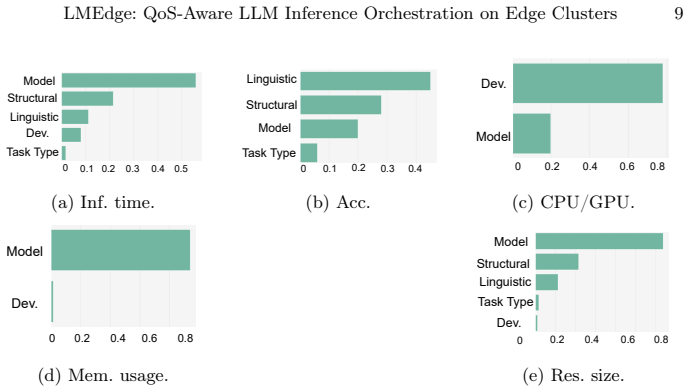
- [§3, Eq. (4); §7, Fig. 3b] The accuracy predictor includes device features ('Dev.' in Fig. 3b), yet Eq. (3) and Eq. (4) treat accuracy as a property of the query, model, and quantization (with superscript i). If execution device does not affect correctness, then device features in the accuracy model are fitting deployment artifacts and the accuracy constraint can mis-rank assignments arbitrarily as device features vary. This directly affects the correctness filter in Alg. 1, line 20, and hence the accuracy/latency trade-off measured in Fig. 4c. Please justify why device features belong in an accuracy predictor, or ablate them and show the accuracy model and scheduling results with and without device features.
- [Abstract; §7, Fig. 4b] The abstract claims LMEdge 'increases serving ratio compared to two baselines,' but Fig. 4b shows that Random attains the highest serving ratio at all arrival rates, and the text admits that LMEdge 'deliberately defers queries that violate accuracy or congestion requirements.' The claim as stated is therefore contradicted by the paper's own results. Please qualify the serving-ratio claim (e.g., 'among QoS-aware approaches' or 'approaches Random's throughput at higher rates') and discuss the latency/accuracy versus serving-ratio trade-off explicitly.
- [§3, Eq. (2); §6] The congestion-aware delay term (1 + λ·l_i/ρ_i) with a single hand-set λ=0.5 is used as a substitute for a queuing model, and it directly determines the objective minimized by both the BILP and Alg. 1. The paper provides no evidence that this simple multiplier produces response-time estimates that track measured latency under the Poisson workload and netem traces. Please report a calibration check (e.g., predicted T vs. measured end-to-end latency) and a sensitivity analysis over λ, or justify the choice with data.
- [§7, Fig. 4] The performance comparisons report point estimates without confidence intervals, error bars, or statistical tests. Given the high variance typical of LLM inference on heterogeneous edge devices (visible in the broad inference-time distribution in Fig. 2d), claims such as 'LMEdge consistently achieves the lowest response times' (Fig. 4a) need quantitative support. Please report per-trial distributions, significance tests (e.g., bootstrap or paired tests), or at least standard errors.
minor comments (4)
- [§7, Tables 2–3] There are formatting errors: 'Tables 2–2' should be 'Tables 2–3', and 'T able 3' has a stray space. Also, the tables do not report the train/validation/test split or cross-validation procedure for the predictor metrics.
- [§6] The TruthfulQA binarization threshold of 0.7 is arbitrary and should be justified or varied in a sensitivity analysis, since it directly defines the accuracy labels used for both training and evaluation.
- [§7] The BILP-vs-heuristic comparison reports 'speedups of up to 1565%' and '7012%' without stating the BILP's optimality gap or the time scale. Please clarify whether CPLEX solved the instances to proven optimality and report both solver time and heuristic time in absolute units.
- [§7, Fig. 5] The heatmaps are informative but lack a colorbar and quantitative values, making it hard to assess the claimed differences in query distribution across model configurations. Please add a color scale and, if possible, a numeric matrix.
Circularity Check
No construction-level circularity: the reported latency/accuracy results are measured on a live testbed, not read off the fitted predictors; the shared query pool is a validation concern, not a derivation identity.
full rationale
The paper's derivation chain is: define a BILP objective (Eq. 9) in terms of predicted response time T (Eq. 2), approximate it with the greedy Alg. 1, and evaluate the resulting assignments against Random and Load-aware baselines. The key question is whether the evaluation outcomes are forced by the construction. They are not. The response-time, accuracy, resource-utilization, and serving-ratio results in Fig. 4 are measured outcomes of actually executing the selected queries on the Kubernetes testbed under replayed 4G traces, not the predicted values used inside the scheduler. A poor predictor would produce poor assignments and worse measured latency; the empirical comparison is therefore external to the fitted models. The accuracy constraint (Eq. 4) constrains predicted accuracy only, while the claimed accuracy preservation in Fig. 4c is a measured property. There is no load-bearing self-citation: the related work and method citations are to external prior systems, and no self-cited uniqueness theorem or ansatz is invoked to force the model choice. The congestion multiplier (1 + λ·l_i/ρ_i) in Eq. 2 is presented as a hand-tuned control term, not imported from the authors' prior work. The main validity concern is that the 1,422 live-workload queries also generated the 59,000-row training data for the predictors, and Section 7 reports predictor metrics without a described train/validation/test split. This threatens generalization and the informativeness of the reported R² and F1 numbers, but it does not make the measured testbed comparison equal to the fitted inputs by construction. Under the required standard of exhibiting a specific reduction of a claimed result to its own inputs, no such reduction is present.
Axiom & Free-Parameter Ledger
free parameters (8)
- λ (congestion penalty) =
0.5
- θ (accuracy tolerance) =
0.1
- TruthfulQA binarization threshold =
0.7
- XGBoost hyperparameters (per task) =
ntrees 100–200, d_max 5–7, ψ 0.1–0.3
- ρ_i (per-device concurrency limit) =
CPU cores or empirically determined max GPU streams
- Scheduling epoch =
10 s
- Query feature vector φ_q =
structural + linguistic features
- 59K-row sampling scheme =
unspecified
axioms (8)
- domain assumption Eq. (2)'s multiplicative congestion term (1+λ·l_i/ρ_i) adequately captures queuing, serialization, and contention under load
- domain assumption Accuracy of a (query, model, quantization) triple is predictable and device-dependent
- domain assumption Ground-truth labels of MMLU subsets, GSM8K, CommonsenseQA, TruthfulQA, and HumanEval are reliable accuracy measures
- domain assumption Capacity constraints (Eqs. 5–8) with non-preemptive execution capture real instance limits
- domain assumption Replayed 4G LTE traces via tc/netem reproduce realistic edge network dynamics
- domain assumption Poisson arrivals at 0.4–1.0 queries/s/instance represent realistic workloads
- standard math BILP is NP-hard; greedy assignment after ranking is an acceptable approximation framework
- domain assumption 10-second Prometheus/cAdvisor monitoring granularity supports QoS decisions
read the original abstract
Large language model (LLM) services increasingly operate on edge infrastructure, enabling low-latency and privacy-preserving AI services. However, efficiently serving LLM requests across heterogeneous and resource-constrained edge devices require orchestration mechanisms that jointly determine model configuration (family, size, and quantization level) and execution placement while satisfying user- and system-level quality of service (QoS) requirements. This paper introduces LMEdge, a QoS-aware orchestration service that dynamically makes these decisions across heterogeneous edge devices. We formulate the problem as a binary integer linear programming (BILP) optimization that minimizes response time under accuracy, network, and resource constraints. To enable scalable online scheduling, we employ five lightweight machine learning (ML) models to predict query-specific latency, accuracy, resource usage, and response size for each model-size-quantization-device combination, and design a lightweight heuristic that approximates the BILP solution. We collect a comprehensive benchmarking dataset of over 59000 rows to train models and support reproducibility. Evaluation on a Kubernetes-based edge testbed with 57 instances and diverse query categories shows that LMEdge reduces latency, preserves accuracy, improves resource utilization, and increases serving ratio compared to two baselines.
Figures




Reference graph
Works this paper leans on
-
[2]
Demandsage,https://www.demandsage.com/chatgpt-statistics/, Retrieved: 2026-05-29
2026
-
[3]
NemoCurator Prompt Task and Complexity Classifier.https://huggingface.co/ nvidia/prompt-task-and-complexity-classifier, accessed: 2026-05-29
2026
-
[4]
In: Intl
Cai, F., et al.: Edge-llm: A Collaborative Framework for Large Language Model Serving in Edge Computing. In: Intl. Conf. on Web Services. IEEE (2024)
2024
-
[5]
arXiv preprint arXiv:2405.16587 (2024)
Dai, X., et al.: Cost-Effective Online Multi-LLM Selection with Versatile Reward Models. arXiv preprint arXiv:2405.16587 (2024)
Pith/arXiv arXiv 2024
-
[6]
arXiv preprint arXiv:2505.16508 (2025)
Jang, S., Morabito, R.: Edge-First Language Model Inference: Models, Metrics, and Tradeoffs. arXiv preprint arXiv:2505.16508 (2025)
Pith/arXiv arXiv 2025
-
[7]
In: Intl
Liu, Y., et al.: OptLLM: Optimal Assignment of Queries to Large Language Mod- els. In: Intl. Conf. on Web Services. IEEE (2024)
2024
-
[8]
In: Proc
Oh, H., et al.: ExeGPT: Constraint-Aware Resource Scheduling for LLM Inference. In: Proc. of the 29th ACM Intl. Conf. on Architectural Support for Programming Languages and Operating Systems (2024)
2024
-
[9]
In: The 13th Intl
Ong, I., et al.: RouteLLM: Learning to Route LLMs from Preference Data. In: The 13th Intl. Conf. on Learning Representations (2024)
2024
-
[10]
In: 51st Intl
Patel, P., et al.: Splitwise: Efficient Generative LLM Inference using Phase Split- ting. In: 51st Intl. Symp. on Computer Architecture. IEEE (2024)
2024
-
[11]
In: Proc
Raca,D.,etal.:BeyondThroughput:A4GLTEDatasetwithChannelandContext Metrics. In: Proc. of the 9th ACM Multimedia Systems Conf. (2018)
2018
-
[12]
In: Intl
Stojkovic, J., et al.: DynamoLLM: Designing LLM Inference Clusters for Perfor- mance and Energy Efficiency. In: Intl. Symp. on High Performance Computer Ar- chitecture. IEEE (2025)
2025
-
[13]
arXiv preprint arXiv:2501.14205 (2025)
Xu, M., et al.: Serving Long-Context LLMs at the Mobile Edge: Test-Time Rein- forcement Learning-based Model Caching and Inference Offloading. arXiv preprint arXiv:2501.14205 (2025)
Pith/arXiv arXiv 2025
-
[14]
Yao, Z., et al.: Enhancing LLM QoS through Cloud-Edge Collaboration: A Diffusion-based Multi-Agent Reinforcement Learning Approach. Tran. on Services Computing (2025)
2025
-
[15]
IEEE Internet of Things Journal (2024)
Zhang, M., et al.: Edgeshard: Efficient LLM Inference via Collaborative Edge Com- puting. IEEE Internet of Things Journal (2024)
2024
discussion (0)
Sign in with ORCID, Apple, or X to comment. Anyone can read and Pith papers without signing in.