REVIEW 3 major objections 6 minor 34 references
This paper claims that image manipulation localization is improved by fusing monocular reconstructed depth and surface normals into RGB features only where they are judged reliable, and that this selective 3D evidence generalizes better tha
Reviewed by Pith at T0; open to challenge. T0 means a machine referee read the full paper against a public rubric. the ladder, T0–T4 →
T0 review · deepseek-v4-flash
2026-08-01 16:14 UTC pith:O4NXH5YU
load-bearing objection GFrame makes a plausible, incremental case for reliability-gated monocular geometry in IML, but the ablation design leaves the central 'selective fusion' claim under-tested; worth expert review, not a desk reject. the 3 major comments →
When 2D Cues Fail: Improving Image Manipulation Localization with Reliable 3D Geometry
The pith
A machine-rendered reading of the paper's core claim, the machinery that carries it, and where it could break.
Core claim
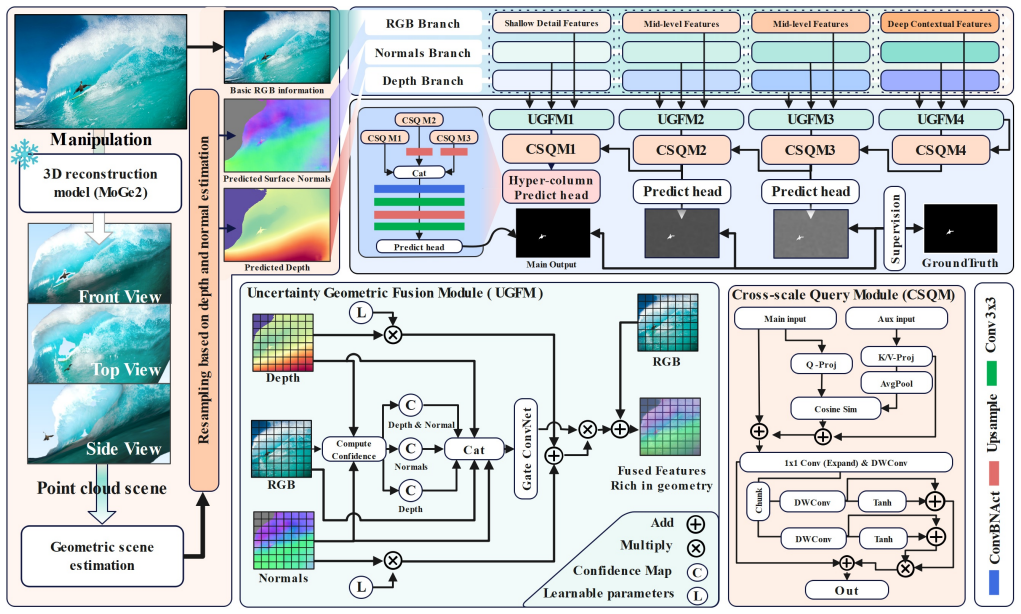
On the paper's own terms, the discovery is that reconstructed geometry should not be used as direct forensic evidence but as selectively exploited auxiliary information. GFrame reconstructs depth and surface normals from the input, derives confidence-inspired reliability cues from these maps themselves (depth Laplacian smoothness, normal unit-norm deviation, and depth-normal agreement), and uses them to build a spatial gate that controls the residual injection of geometric features into the RGB feature stream at each encoder stage. A cross-scale query module then propagates coarse structural context to fine resolutions, and a boundary-aware loss emphasizes mask transitions. The paper claims
What carries the argument
The central mechanism is a reliability-gated residual fusion: at each encoder stage, a sigmoid gate computed from RGB, depth, normal features and three hand-crafted confidence cues multiplies a weighted sum of depth and normal features before adding it to the RGB feature stream. The confidence cues are the depth Laplacian smoothness (exp(-|∇²D|)), the deviation of the normal magnitude from unit norm, and the agreement between depth-derived and reconstructed normals. These gates exist to admit geometry only where reconstruction is locally trustworthy, so that geometric noise is suppressed before it contaminates appearance-based learning; the cross-scale query module (CSQM) and boundary-aware
Load-bearing premise
The load-bearing premise is that the three hand-crafted reliability proxies—depth Laplacian smoothness, unit-norm deviation, and depth-normal agreement—actually mark where monocular reconstruction is trustworthy on manipulated images; the paper validates them only indirectly through end-task ablations, never against reconstruction error.
What would settle it
Compare the proxy maps (Eqs. 1–3) to per-pixel reconstruction error between estimated depth/normals and ground-truth geometry on manipulated images. If high-proxy regions do not correspond to low-error regions, the gating mechanism's premise fails. Alternatively, replace the gate with an always-open or random gate; if performance does not drop, selective fusion is not the cause of the reported gains.
If this is right
- With the same 20-epoch training budget, GFrame outperforms all compared baselines on both in-distribution and out-of-distribution averages, and it keeps improving in-distribution with 50 epochs (0.592 to 0.621).
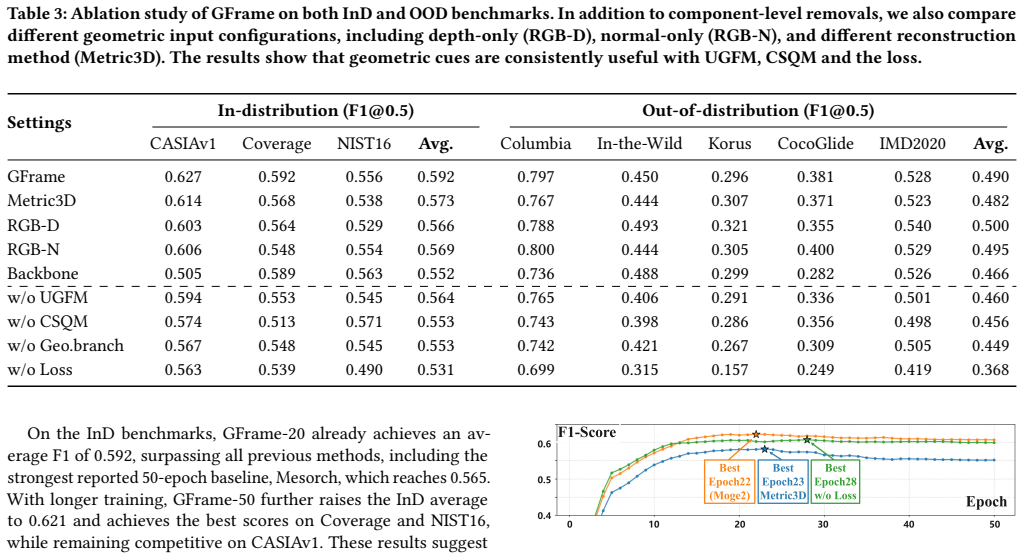
- Geometric information contributes even when depth or normals are used alone; removing the whole geometric branch drops in-distribution F1 by about 0.04 and out-of-distribution F1 by about 0.04.
- The framework remains comparatively strong under Gaussian noise, blur, JPEG compression, and social-media recompression, where local appearance statistics are degraded.
- Replacing the reconstruction backend changes accuracy, indicating that the reliability of the monocular geometry, not just the fusion design, drives the gain.
- The proposed boundary-aware loss helps the model reach peak validation performance earlier, suggesting that training objectives matter for absorbing geometric cues.
Where Pith is reading between the lines
- Editorial inference: The paper leaves implicit that the same reliability-gated fusion principle could transfer to other forensic tasks, such as deepfake detection or generalized anomaly localization, where monocular reconstruction is also noisy.
- Editorial inference: A natural testable extension would be replacing the hand-crafted confidence cues with learned uncertainty estimates from the reconstruction model, which might make the gate more accurate and further improve localization.
- Editorial inference: The strong out-of-distribution results suggest geometry acts as a domain-invariant cue; combining it with other geometric signals, such as lighting or vanishing points, could push the approach further.
- Editorial inference: The paper's ablations do not test the reliability proxies directly against reconstruction error; if the proxies are uncorrelated with actual error, the reported gains would need re-interpretation.
Editorial analysis
A structured set of objections, weighed in public.
Referee Report
Summary. The paper proposes GFrame, an image manipulation localization (IML) method that augments RGB features with monocular depth and surface normal maps. To handle the noise of reconstructed geometry, GFrame introduces an Uncertainty-aware Geometric Fusion Module (UGFM) that computes hand-crafted reliability cues (depth Laplacian smoothness, unit-norm deviation, and depth-normal agreement) and uses them, along with the geometric features, to produce a spatial gate that selectively injects geometric information into the RGB stream. A Cross-Scale Query Module (CSQM) propagates coarse structural context to fine resolutions, and a boundary-aware loss with margin regularization is used for training. Experiments on several in-distribution (InD) and out-of-distribution (OOD) datasets, all re-evaluated under a unified benchmark framework, report F1@0.5 improvements over six baselines. Ablations show that removing the geometric branch, UGFM, CSQM, or the proposed loss degrades performance.
Significance. If the central claims hold, this work would provide a practical and transferable way to exploit 3D geometry for IML, a direction that is relatively underexplored. The paper is notable for its systematic benchmarking under a common framework, its ablation of the whole geometric branch, and its explicit acknowledgment that reconstruction noise must be handled selectively. The code-release commitment is also a strength. However, the central mechanism — the reliability cues that gate geometric information — is not directly validated, and the reported quantitative advantages are not accompanied by statistical significance tests. The overall approach is plausible, but the evidence as presented does not yet establish that the specific reliability-gating mechanism, rather than the mere addition of geometric features and extra parameters, is responsible for the gains.
major comments (3)
- [§3.1, Eqs. (1)–(6) and Table 3] The paper's core claim is that reconstructed geometry should be exploited selectively, and that the confidence-inspired cues C_d, C_n, A_dn identify where geometry is trustworthy. However, the only UGFM ablation ('w/o UGFM') removes the entire fusion module, not merely the hand-crafted cues. Thus the improvement attributed to reliability gating could instead come from simply concatenating raw depth/normal features, from the added parameters, or from the boundary-aware loss. To support the 'selective' claim, the authors should either (a) directly validate the cues against reconstruction error on manipulated images, or (b) add ablations that keep the UGFM architecture but replace the reliability cues with constants, random values, or learned statistics not derived from the geometric maps. Without such experiments, the connection between Eqs. (1)–(3) and the observed performance gains is no
- [§4.1, dataset preparation] The statement 'the NIST16 data used in our experiments are manually cleaned to avoid data leakage' raises a serious validity concern. Manual cleaning of a standard benchmark can introduce subjective bias, and if the cleaning is not applied identically to all baselines, the comparisons are unfair. The paper must specify the exact cleaning criteria, the number of images removed or altered, and confirm that every baseline was evaluated on exactly the same cleaned set. It should also clarify what 'data leakage' means here and why the official NIST16 split is insufficient.
- [Tables 1, 3, 4, and 5] All F1 numbers are reported from single runs without error bars, multiple seeds, or significance tests. Given the small test sets (e.g., Coverage has 30 test images; NIST16 181), differences of 0.02–0.04 in averaged F1 may be within run-to-run variation. The central quantitative claim — that GFrame outperforms strong baselines — needs to be supported by at least three seeds with mean±std, or by a paired significance test across datasets. This is particularly important for comparisons where the margin is small (e.g., InD average 0.592 vs. Mesorch-50 0.565).
minor comments (6)
- [Table 1] The asterisk on 'GFrame 50*' is not explained in the table caption. Also, PIM has no 50-epoch row; this should be noted in the caption or text.
- [Eq. (3)] The derivation of the normal field N_d from the depth map is not described. Please define how the depth-derived normals are computed.
- [§4.2] The backbone is written 'PvtV2-B2' — presumably 'PvtV2-B2' (or 'PvT-V2'). Please correct. The name 'IMDLBenco' is also written inconsistently ('IMDLBenCo' elsewhere).
- [Figure 3] The validation F1 curves lack a y-axis label and do not specify which validation set is used. Please clarify whether these curves are on an InD or OOD split.
- [Eq. (11)] The signed prediction confidence S_p is not defined. If it is the pre-sigmoid logit, please state that explicitly.
- [General] The reference [9] lists incomplete author names ('J Hsu and SF Chang'). Please use full author names and the correct publication details.
Circularity Check
No significant circularity; derivation is self-contained and reliability cues are hand-specified rather than fitted.
full rationale
GFrame's derivation does not reduce to its own inputs. The reliability cues C_d, C_n, and A_dn (Eqs. 1-3) are hand-crafted functions of the reconstructed depth and normal maps and are never fit to ground-truth masks; the paper explicitly disclaims them as exact uncertainty estimates. The learned gate G^i (Eq. 5) is trained on labels, but the claim is about the end-to-end localization system, which is evaluated on held-out InD test splits and OOD datasets against baselines retrained under the same budget. Ablations (Table 3) remove components rather than revealing a fitted parameter renamed as prediction. No equation equals another by construction, and there are no self-citations: the reference list contains no work by the present authors. The skeptic's point that the reliability proxies are never validated against reconstruction error is a legitimate experimental-validity concern, but it is not circularity; a hand-specified heuristic that is not derived from the target labels cannot make the derivation circular. Hence score 0.
Axiom & Free-Parameter Ledger
free parameters (6)
- w_d, w_n (learnable scalar fusion weights) =
learned; values not reported
- tau (learnable temperature in cosine attention) =
learned; value not reported
- lambda (boundary weighting) =
unspecified
- m (margin in margin loss) =
unspecified
- loss weights for auxiliary supervisions =
'normal weights' only
- reconstruction backend selection =
MoGe2 selected as default
axioms (6)
- domain assumption Well-blended manipulations that preserve local appearance still violate scene geometry that is recoverable from monocular depth/normals.
- domain assumption Monocular reconstruction on manipulated images retains enough true scene geometry for those inconsistencies to be detectable despite reconstruction noise.
- domain assumption Depth Laplacian smoothness is a proxy for local reconstruction reliability.
- domain assumption Deviation of reconstructed surface normals from unit length indicates reconstruction instability.
- domain assumption Agreement between depth-derived normals and estimated normals indicates mutual reliability.
- domain assumption Boundary emphasis and margin regularization improve learning of geometry-aware cues.
Cite this review
Pith. "Pith review of When 2D Cues Fail: Improving Image Manipulation Localization with Reliable 3D Geometry." pith.science (2026). https://pith.science/paper/O4NXH5YU
@misc{pith2026260718040,
  author       = {Pith},
  title        = {Pith review of: When 2D Cues Fail: Improving Image Manipulation Localization with Reliable 3D Geometry},
  year         = {2026},
  howpublished = {\url{https://pith.science/paper/O4NXH5YU}},
  note         = {Machine review of arXiv:2607.18040}
}
read the original abstract
Existing image manipulation localization (IML) methods rely heavily on 2D forensic cues, such as low-level artifacts, noise traces, and semantic inconsistencies in the manipulated image. While effective in many cases, these cues become much less discriminative when manipulated regions are well blended with their surrounding context in appearance. In such cases, a manipulated region may remain locally appearance-consistent, but still violate the geometric structure of the surrounding scene. This limitation motivates us to go beyond purely 2D evidence and introduce geometric reasoning into IML. To this end, we leverage monocular reconstruction to obtain auxiliary geometric cues, including depth and surface normals. However, a key challenge lies in the fact that reconstructed geometry on manipulated images is inherently noisy and cannot be used naively. Rather than treating depth and normals as direct evidence, we estimate their reliability and exploit them selectively for localization. Based on this principle, we design a geometry-aware framework (GFrame) that fuses reliable geometric cues with RGB features and propagates them across scales to improve fine-grained localization. Extensive experiments show that the proposed method achieves excellent performance under limited budget constraints. These results indicate that reliable 3D geometry provides complementary forensic evidence beyond traditional 2D cues for IML. Related code will be released.
Figures


Reference graph
Works this paper leans on
-
[1]
Tiziano Bianchi and Alessandro Piva. 2012. Image forgery localization via block- grained analysis of JPEG artifacts.IEEE Transactions on Information Forensics and Security7, 3 (2012), 1003–1017
2012
-
[2]
Chengbo Dong, Xinru Chen, Ruohan Hu, Juan Cao, and Xirong Li. 2022. Mvss-net: Multi-view multi-scale supervised networks for image manipulation detection. IEEE Transactions on Pattern Analysis and Machine Intelligence45, 3 (2022), 3539– 3553
2022
-
[3]
Jing Dong, Wei Wang, and Tieniu Tan. 2013. Casia image tampering detection evaluation database. In2013 IEEE China summit and international conference on signal and information processing. IEEE, 422–426
2013
-
[4]
Pasquale Ferrara, Tiziano Bianchi, Alessia De Rosa, and Alessandro Piva. 2012. Image forgery localization via fine-grained analysis of CFA artifacts.IEEE Trans- actions on Information Forensics and Security7, 5 (2012), 1566–1577
2012
-
[5]
Huazhu Fu and Xiaochun Cao. 2012. Forgery authentication in extreme wide- angle lens using distortion cue and fake saliency map.IEEE Transactions on Information Forensics and Security7, 4 (2012), 1301–1314
2012
-
[6]
Thomas Gloe, Karsten Borowka, and Antje Winkler. 2010. Efficient estimation and large-scale evaluation of lateral chromatic aberration for digital image forensics. InMedia Forensics and Security II, Vol. 7541. SPIE, 62–74
2010
-
[7]
Haiying Guan, Mark Kozak, Eric Robertson, Yooyoung Lee, Amy N Yates, Andrew Delgado, Daniel Zhou, Timothee Kheyrkhah, Jeff Smith, and Jonathan Fiscus
-
[8]
Fabrizio Guillaro, Davide Cozzolino, Avneesh Sud, Nicholas Dufour, and Luisa Verdoliva. 2023. Trufor: Leveraging all-round clues for trustworthy image forgery detection and localization. InProceedings of the IEEE/CVF conference on computer vision and pattern recognition. 20606–20615
2023
-
[9]
J Hsu and SF Chang. 2006. Columbia uncompressed image splicing detection evaluation dataset.Columbia DVMM Research Lab6 (2006)
2006
-
[10]
Xuefeng Hu, Zhihan Zhang, Zhenye Jiang, Syomantak Chaudhuri, Zhenheng Yang, and Ram Nevatia. 2020. SPAN: Spatial pyramid attention network for image manipulation localization. InEuropean conference on computer vision. Springer, 312–328
2020
-
[11]
Minyoung Huh, Andrew Liu, Andrew Owens, and Alexei A Efros. 2018. Fighting fake news: Image splice detection via learned self-consistency. InProceedings of the European conference on computer vision (ECCV). 101–117
2018
-
[12]
Tero Karras, Samuli Laine, Miika Aittala, Janne Hellsten, Jaakko Lehtinen, and Timo Aila. 2020. Analyzing and Improving the Image Quality of StyleGAN. In Proc. CVPR
2020
-
[13]
Chenqi Kong, Anwei Luo, Shiqi Wang, Haoliang Li, Anderson Rocha, and Alex C Kot. 2025. Pixel-inconsistency modeling for image manipulation localization. IEEE Transactions on Pattern Analysis and Machine Intelligence(2025)
2025
-
[14]
Paweł Korus and Jiwu Huang. 2016. Evaluation of random field models in multi- modal unsupervised tampering localization. In2016 IEEE international workshop on information forensics and security (WIFS). IEEE, 1–6
2016
-
[15]
Xiaohong Liu, Yaojie Liu, Jun Chen, and Xiaoming Liu. 2022. PSCC-Net: Progres- sive spatio-channel correlation network for image manipulation detection and localization.IEEE Transactions on Circuits and Systems for Video Technology32, 11 (2022), 7505–7517
2022
-
[16]
Xiaochen Ma, Bo Du, Zhuohang Jiang, Ahmed Y Al Hammadi, and Jizhe Zhou
-
[17]
Xiaochen Ma, Xuekang Zhu, Lei Su, Bo Du, Zhuohang Jiang, Bingkui Tong, Zeyu Lei, Xinyu Yang, Chi-Man Pun, Jiancheng Lv, et al . 2024. Imdl-benco: A comprehensive benchmark and codebase for image manipulation detection & localization.Advances in Neural Information Processing Systems37 (2024), 134591–134613
2024
-
[18]
Alex Nichol, Prafulla Dhariwal, Aditya Ramesh, Pranav Shyam, Pamela Mishkin, Bob McGrew, Ilya Sutskever, and Mark Chen. 2021. Glide: Towards photorealistic image generation and editing with text-guided diffusion models.arXiv preprint arXiv:2112.10741(2021)
Pith/arXiv arXiv 2021
-
[19]
Adam Novozamsky, Babak Mahdian, and Stanislav Saic. 2020. IMD2020: A Large- Scale Annotated Dataset Tailored for Detecting Manipulated Images. In2020 IEEE Winter Applications of Computer Vision Workshops (W ACVW). 71–80
2020
-
[20]
René Ranftl, Alexey Bochkovskiy, and Vladlen Koltun. 2021. Vision transformers for dense prediction. InProceedings of the IEEE/CVF international conference on computer vision. 12179–12188
2021
-
[21]
Robin Rombach, Andreas Blattmann, Dominik Lorenz, Patrick Esser, and Björn Ommer. 2022. High-resolution image synthesis with latent diffusion models. In Proceedings of the IEEE/CVF conference on computer vision and pattern recognition. 10684–10695
2022
-
[22]
Lei Su, Xiaochen Ma, Xuekang Zhu, Chaoqun Niu, Zeyu Lei, and Ji-Zhe Zhou
-
[23]
Qingwei Wang, Jinyu Yang, Xiaosheng Yu, Fangyi Wang, Peng Chen, and Feng Zheng. 2023. Depth-aided Camouflaged Object Detection. InProceedings of the 31st ACM International Conference on Multimedia (ACM MM). 3297–3306. doi:10.1145/3581783.3611874
arXiv 2023
-
[24]
Ruicheng Wang, Sicheng Xu, Cassie Dai, Jianfeng Xiang, Yu Deng, Xin Tong, and Jiaolong Yang. 2025. Moge: Unlocking accurate monocular geometry estimation for open-domain images with optimal training supervision. InProceedings of the Computer Vision and Pattern Recognition Conference. 5261–5271
2025
-
[25]
Ruicheng Wang, Sicheng Xu, Yue Dong, Yu Deng, Jianfeng Xiang, Zelong Lv, Guangzhong Sun, Xin Tong, and Jiaolong Yang. 2025. MoGe-2: Accurate Monoc- ular Geometry with Metric Scale and Sharp Details. arXiv:2507.02546 [cs.CV] https://arxiv.org/abs/2507.02546
Pith/arXiv arXiv 2025
-
[26]
Bihan Wen, Ye Zhu, Ramanathan Subramanian, Tian-Tsong Ng, Xuanjing Shen, and Stefan Winkler. 2016. COVERAGE—A novel database for copy-move forgery detection. In2016 IEEE international conference on image processing (ICIP). IEEE, 161–165
2016
-
[27]
Yue Wu, Wael AbdAlmageed, and Premkumar Natarajan. 2019. Mantra-net: Manipulation tracing network for detection and localization of image forgeries with anomalous features. InProceedings of the IEEE/CVF conference on computer vision and pattern recognition. 9543–9552
2019
-
[28]
Wei Yin, Chi Zhang, Hao Chen, Zhipeng Cai, Gang Yu, Kaixuan Wang, Xiaozhi Chen, and Chunhua Shen. 2023. Metric3d: Towards zero-shot metric 3d prediction from a single image. InProceedings of the IEEE/CVF international conference on computer vision. 9043–9053
2023
-
[29]
Zhenyu Zhang, Zhen Cui, Chunyan Xu, Yan Yan, Nicu Sebe, and Jian Yang
-
[30]
Xuekang Zhu, Xiaochen Ma, Lei Su, Zhuohang Jiang, Bo Du, Xiwen Wang, Zeyu Lei, Wentao Feng, Chi-Man Pun, and Ji-Zhe Zhou. 2025. Mesoscopic insights: orchestrating multi-scale & hybrid architecture for image manipulation localization. InProceedings of the AAAI Conference on Artificial Intelligence, Vol. 39. 11022–11030
2025
-
[33]
InProceedings of the IEEE/CVF Conference on Computer Vision and Pattern Recognition (CVPR)
Pattern-Affinitive Propagation across Depth, Surface Normal and Semantic Segmentation. InProceedings of the IEEE/CVF Conference on Computer Vision and Pattern Recognition (CVPR). 7144–7153
-
[2019]
In2019 IEEE Winter Applications of Computer Vision Workshops (W ACVW)
MFC datasets: Large-scale benchmark datasets for media forensic chal- lenge evaluation. In2019 IEEE Winter Applications of Computer Vision Workshops (W ACVW). IEEE, 63–72
-
[2023]
IML-ViT: Benchmarking Image Manipulation Localization by Vision Trans- former.arXiv preprint arXiv:2307.14863(2023)
Pith/arXiv arXiv 2023
-
[2025]
InProceedings of the AAAI Conference on Artificial Intelligence, Vol
Can we get rid of handcrafted feature extractors? sparsevit: Nonsemantics- centered, parameter-efficient image manipulation localization through spare- coding transformer. InProceedings of the AAAI Conference on Artificial Intelligence, Vol. 39. 7024–7032
discussion (0)
Sign in with ORCID, Apple, or X to comment. Anyone can read and Pith papers without signing in.