REVIEW 4 major objections 5 minor 73 references
Trajectory-Aware Clinical Risk Prediction via Severity-Grounded Knowledge Graphs and Retrieval-Augmented Generation
T0 review · 4 major / 5 minor · reviewed 2026-08-02 · deepseek-v4-flash
Pith's one-line read TRACER claims that augmenting a patient's sparse visit history with severity-weighted knowledge-graph trajectories, filtered clinical-note passages, and similar-patient cases lets an LLM predict mortality and readmission substantially bette
desk verdict TRACER is a genuinely assembled RAG pipeline with a plausible severity-grounded design, but the empirical section has internal inconsistencies (cohort stats vs. stated exclusion, two different TRACER configurations) that make the headline gains unverifiable as written. read the letter →
The pith
A machine-rendered reading of the paper's core claim, the machinery that carries it, and where it could break.
The reading
What carries the argument
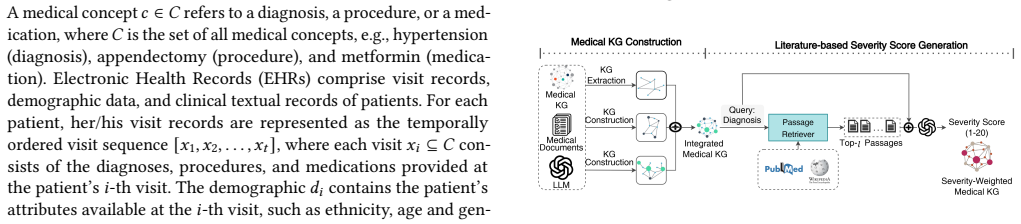
The load-bearing object is the severity-weighted medical knowledge graph (SMKG): a medical knowledge graph whose diagnosis nodes carry literature-grounded severity scores. Given a patient's visits, trajectory retrieval enumerates shortest paths (up to 3 hops) between concepts in adjacent visits, scores each trajectory with a linear combination of semantic relevance to a risk (or protective) query and the average severity of its diagnoses, and this ranking selects the 'key supporting trajectories' the LLM reasons over. The severity score acts as a retrieval prior, not as a standalone prognostic label.
What would settle it
Recompute both label sets on the MIMIC-III dataset using the original uncorrected preprocessing rules and run TRACER under those labels, or run the strongest baseline pipeline with the paper's corrected labels but no other change. If TRACER's Macro F1 advantage over that baseline collapses to within noise in either condition, the central claim fails.
Extended reading notes
Core claim
The paper claims that modeling a patient's history as a sequence of severity-weighted paths through a medical knowledge graph—rather than as a flat bag of diagnoses—substantially improves mortality and 15-day readmission prediction, and that adding retrieved clinical-note passages and similar-patient trajectories produces further complementary gains. TRACER constructs a severity-weighted medical knowledge graph (SMKG) by having an LLM assign each diagnosis a severity score from 1 to 20, retrieves risk and protective trajectories (shortest paths linking concepts across consecutive visits up to 3 hops), reranks them with maximal marginal relevance and an NLI-based stopping rule, retrieves rele
Load-bearing premise
The comparison stands or falls on the claim that prior benchmark preprocessing mislabeled outcomes by sorting visits by an internal row id instead of discharge time and computing readmission gaps from admission time only; the paper's reported gains are all measured under its corrected labels.
Editorial extensions
If this is right
- If the claim holds, patients with very few recorded visits can be risk-stratified using paths through a disease graph rather than relying on visit count alone.
- Clinical notes can be filtered down to task-relevant passages, countering the noise that long unstructured notes introduce to LLM prompts.
- Retrieving similar patients by recent-visit Jaccard overlap is a cheap and effective alternative to sequence-level embeddings for cohort context.
- The severity-weighted graph transfers to other downstream tasks: swapping a standard medical terminology graph for the severity-weighted graph improved accuracy on medical question-answering benchmarks in the paper's transfer experiment.
- Path-level explanations give clinicians a concrete chain of evidence per prediction, not just a score.
Reading between the lines
- If the label-correction claim is independently verified, several previously published benchmark numbers on these EHR tasks were computed under different outcome definitions and are not directly comparable to newer results.
- Because severity scoring is LLM-generated and validated only against a coarse four-level severity framework, a natural extension is a clinical-outcome calibration test on a held-out cohort with hard endpoints.
- The same retrieval scaffold (weighted graph + trajectory paths + peer cases + note passages) could be lifted to other sequential clinical tasks such as deterioration prediction, length-of-stay forecasting, or treatment-response prediction.
- The paper's use of a conservative decision regulator in the prompts suggests that the 'default to none' prior can be tuned; a testable extension is varying this prior explicitly to measure the sensitivity-precision trade-off rather than leaving it to prompt phrasing.
Editorial analysis
A structured set of objections, weighed in public.
Referee Report
Summary. The paper proposes TRACER, a retrieval-augmented LLM framework for in-hospital mortality and 15-day readmission prediction from EHRs. It constructs a severity-weighted medical knowledge graph (SMKG) by having an LLM assign severity scores to diagnoses using PubMed/Wikipedia passages; retrieves risk and protective 'trajectories' as severity-weighted paths across consecutive visits; augments the prompt with retrieved clinical-note passages and similar-patient contexts; and uses GPT-4o-mini as the backbone LLM for prediction. On MIMIC-III and MIMIC-IV, the paper reports large gains over state-of-the-art baselines, including up to 28.5% relative Macro F1 improvement for mortality and 19.7% for readmission, with extensive ablations and robustness analyses.
Significance. If the empirical claims hold, TRACER would be a substantive contribution: it directly addresses EHR data sparsity via severity-grounded trajectories, makes productive use of clinical notes, and provides path-level interpretability. Strengths include the public code release (stated in Resource Availability), the transfer experiment in which replacing UMLS with SMKG improves MedGraphRAG on three medical QA benchmarks, and a broad ablation/robustness suite. However, the paper as written contains internal numeric inconsistencies in the central result tables and cohort statistics, and the headline comparison depends on an externally unverifiable re-labeling of MIMIC outcomes. These are load-bearing issues: until they are resolved, the magnitude of the reported gains cannot be assessed from the manuscript alone.
major comments (4)
- [Appendix C.2 / Table 10 / footnote 4] The stated inclusion criterion is contradicted by the reported dataset statistics. Footnote 4 of §4.3.1 and Appendix C.2 say that only patients with at least two visits are retained and that single-visit patients are excluded from the main cohort. Table 10 reports mean visits per patient of 1.86 (MIMIC-III mortality train), 1.77 (MIMIC-III mortality test), and 1.32 (MIMIC-IV readmission train). A mean below 2 is impossible under that filter. Figure 1 also reports 68.6% single-visit patients in MIMIC-III, and Appendix F groups patients by exact visit count including 1. Since trajectory retrieval is defined only for adjacent visits (t from 2 to T), the cohort composition is essential: if single-visit patients are included, the method and Figure 1 need re-analysis; if excluded, Table 10 is incorrect. Either way, the baseline comparison is confounded unless the exact cohort is specified and
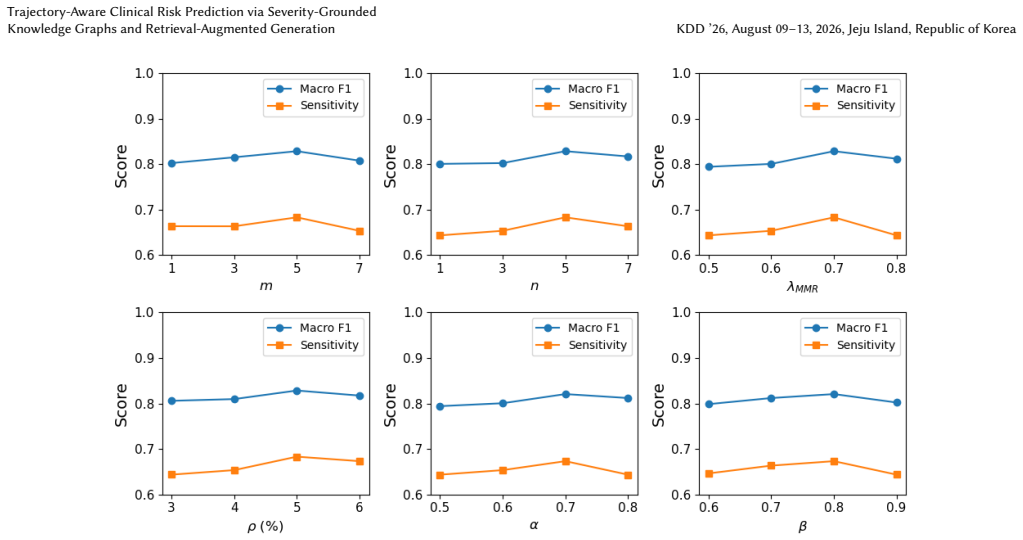
- [Tables 1, 3, 11, 13 and §5.1/Appendix J] TRACER's headline configuration is not uniquely specified. Table 1 reports mortality Macro F1 0.8197 and sensitivity 0.7128; Table 11 ('Ours') reports 0.8284 and 0.6831; Table 3 uses 0.8197/0.7128; Tables 13 and Appendix J report 0.8284/0.6831 as the tuned model. Section 5.1 sets α=0.8 and β=0.2, while Appendix J states that the optimal values are α=0.7 and β=0.3; Appendix H further shows that the best severity scale (1–100) gives the 0.8284/0.6831 numbers, whereas §4.2 specifies 1–20. Because the abstract's 28.5% gain is computed from one of these configurations, the paper must state the exact final configuration and report all main tables, ablations, and sensitivity analyses from that same configuration.
- [Appendix A.1] The evaluation rests on a large re-labeling of the benchmark. Appendix A.1 states that PyHealth's preprocessing mis-sorted visits and miscomputed readmission intervals, changing MIMIC-III positive rates from 5.42% to 10.83% (mortality) and 54.82% to 21.60% (readmission). The text asserts that all baselines were rerun, retuned, and that 'all reported baseline results are based on the corrected label-definition protocol,' but no diff, cohort manifest, or preprocessing code is supplied, making this externally unverifiable. A label change of this magnitude changes the predictive task itself. To support the central claim, the authors should (i) release the corrected preprocessing and cohort construction; (ii) state which tables use which label definition; and (iii) also report results under the original PyHealth protocol to separate re-labeling effects from the methodological contribution.
- [§5.2 / Table 6] Several quantitative statements are internally inconsistent. §5.2 says 'sensitivity and Macro F1 score improve by 28.5% and 19.7%, respectively'; from Table 1, sensitivity improves from 0.3711 to 0.7128 (about +92% relative), while Macro F1 improves from 0.6375 to 0.8197 (about +28.6%). The abstract's 28.5% and 19.7% appear to be Macro F1 improvements for the two tasks, so the sentence should be corrected. In Table 6, TRACER is described as 'approximately 33% faster' than KARE based on 117s vs 88s, which is a 24.8% reduction; the retrieval-time reduction (92s to 60s) is 34.8%. These numbers should be reconciled.
minor comments (5)
- [Appendix H and §4.2] The severity-score range is specified as 1–20 in §4.2, but Appendix H's best-performing variant uses a 1–100 scale with a '5-level prompt.' Clarify whether the default SMKG uses 1–20 or 1–100, and whether the correlations in Appendix K are computed with the final deployed scores.
- [Appendix F / Figure 1] The consistency of the 'visit length' grouping should be fixed. Figure 1 and Appendix F group patients by visit count including 1, but the analysis cohort is said to exclude single-visit patients. Define the group structure explicitly after the two-visit filter.
- [Table 10] The dataset statistics show mean 'Visits / Patient' below 2 in several cells. Even after the cohort filtering is clarified, consider reporting the distribution of visit counts rather than only the mean, since the trajectory mechanism applies only to patients with at least one historical visit.
- [§4.3.1] The Cartesian product P2 × ... × PT could be combinatorial for patients with many visits. A sentence on pruning or worst-case size would help reproducibility, especially since patients with up to 10 visits are retained.
- [Section 6.4 / Figure 5] Figure 5 and Appendix J report the same hyperparameter sweeps but the main text says 'Figure 5 shows' while Appendix J gives the detailed tables. Please cross-check the α/β values in the figure caption and text against Appendix J.
Circularity Check
No significant circularity: TRACER's predictions are produced by an LLM from externally grounded severity scores and retrieved evidence, with no fitted-parameter-equals-prediction reduction or self-citation chain.
full rationale
The paper's derivation chain is self-contained with respect to circularity as defined: severity scores are generated by an LLM from PubMed/Wikipedia abstracts, trajectory retrieval scores combine cosine similarity with those severity scores, and the final prediction is an LLM output conditioned on retrieved trajectories, clinical notes, demographics, and similar-patient context. None of the paper's equations defines the outcome label as a function of a fitted parameter, and no parameter is fit to the mortality or readmission labels. Hyperparameters are tuned on the validation set rather than derived from the test labels, which is standard practice and not circular. The Appendix K correlation between severity scores and mortality is a post-hoc validation, not a fitting step, and the same severity scores are independently shown to improve performance on external MedQA/MedMCQA/PubMedQA benchmarks, providing evidence that the severity construct has external content. The internal inconsistencies the skeptic identifies—Table 10 mean visits per patient contradicting the stated two-visit minimum, differing TRACER numbers between Table 1 and Appendix E, and α/β values differing between §5.1 and Appendix J—are correctness/reproducibility concerns, not circularity. There are no load-bearing self-citations, no imported uniqueness theorems, and no renaming of known results. Therefore the circularity score is 0.
Assumptions & free parameters
free parameters (7)
- severity_score_per_diagnosis =
1–20 scale (1–100 variant in Appendix H)
- alpha_risk_weight =
0.8 in §5.1; 0.7 in Appendix J.1
- beta_protective_weight =
0.2 in §5.1; 0.3 in Appendix J.2
- lambda_MMR =
0.7
- n_notes_m_patients_rho =
n=5, m=5, rho=5%
- lambda_max_lambda_min =
0.5 / 0.05
- hop_limit =
3
assumptions (5)
- domain assumption KG edges encode clinically plausible disease-progression relations.
- ad hoc to paper LLM-generated severity scores approximate true clinical severity.
- domain assumption Corrected label definitions are the true ground truth.
- domain assumption Similar patients retrieved by recent-visit Jaccard are clinically informative without leaking labels.
- domain assumption Pretrained encoders and GPT-4o-mini zero-shot reasoning are reliable for retrieval and prediction.
Cite this review
Pith. "Pith review of Trajectory-Aware Clinical Risk Prediction via Severity-Grounded Knowledge Graphs and Retrieval-Augmented Generation." pith.science (2026). https://pith.science/paper/KDUMNGXV
@misc{pith2026260718270,
  author       = {Pith},
  title        = {Pith review of: Trajectory-Aware Clinical Risk Prediction via Severity-Grounded Knowledge Graphs and Retrieval-Augmented Generation},
  year         = {2026},
  howpublished = {\url{https://pith.science/paper/KDUMNGXV}},
  note         = {Machine review of arXiv:2607.18270}
}
read the original abstract
While Electronic Health Records (EHRs) offer a wealth of clinical data, effectively augmenting a patient's records with heterogeneous external knowledge to predict the patient's clinical risk remains a significant challenge. Existing methods fail to capture disease severity, treatment responses, and nuanced clinical progression, due to data sparsity and the underutilization of unstructured clinical notes. To address these challenges, we propose TRACER (a trajectory-aware and clinically grounded prediction framework) that (1) constructs a medical knowledge graph enriched with severity information from medical literature, (2) retrieves clinically relevant, severity-weighted paths of a patient's progression from the knowledge graph, (3) extracts clinically relevant events from unstructured clinical notes, and (4) augments patient context with similar peer cases. Experiments on the MIMIC-III and MIMIC-IV datasets demonstrate large gains over state-of-the-art baselines, with up to 28.5% increase in Macro F1 score for the mortality prediction task, and 19.7% increase for the readmission prediction task.
Figures


Figures from the paper (10 more)




Reference graph
Works this paper leans on
-
[1]
Ahmed Allam, Mate Nagy, George Thoma, and Michael Krauthammer. 2019. Neural networks versus Logistic regression for 30 days all-cause readmission prediction.Sci. Rep.9, 1 (June 2019), 9277
2019
-
[2]
Zico Kolter, and Vladlen Koltun
Shaojie Bai, J. Zico Kolter, and Vladlen Koltun. 2018. An Empirical Evalua- tion of Generic Convolutional and Recurrent Networks for Sequence Modeling. arXiv:1803.01271 [cs.LG] https://arxiv.org/abs/1803.01271
arXiv 2018
-
[3]
Olivier Bodenreider. 2004. The unified medical language system (UMLS): in- tegrating biomedical terminology.Nucleic acids research32, suppl_1 (2004), D267–D270
2004
-
[4]
2013.PubMed: the bibliographic database(2nd ed.)
Kathi Canese and Sarah Weis. 2013.PubMed: the bibliographic database(2nd ed.). National Center for Biotechnology Information (US), Bethesda, MD, Chapter 2(1). https://www.ncbi.nlm.nih.gov/books/NBK153385/ Created Oct 9 2002; Updated Mar 20 2013
2013
-
[5]
Kyunghyun Cho, Bart van Merriënboer, Caglar Gulcehre, Dzmitry Bahdanau, Fethi Bougares, Holger Schwenk, and Yoshua Bengio. 2014. Learning Phrase Representations using RNN Encoder–Decoder for Statistical Machine Translation. InProceedings of the 2014 Conference on Empirical Methods in Natural Language Processing (EMNLP), Alessandro Moschitti, Bo Pang, and ...
2014
-
[6]
Kulas, Andy Schuetz, Wal- ter F
Edward Choi, Mohammad Taha Bahadori, Joshua A. Kulas, Andy Schuetz, Wal- ter F. Stewart, and Jimeng Sun. 2016. RETAIN: an interpretable predictive model for healthcare using reverse time attention mechanism. InProceedings of the 30th International Conference on Neural Information Processing Systems(Barcelona, Spain)(NIPS’16). Curran Associates Inc., Red H...
2016
-
[7]
Edward Choi, Mohammad Taha Bahadori, Le Song, Walter F. Stewart, and Ji- meng Sun. 2017. GRAM: Graph-based Attention Model for Healthcare Rep- resentation Learning. InProceedings of the 23rd ACM SIGKDD International Conference on Knowledge Discovery and Data Mining(Halifax, NS, Canada) (KDD ’17). Association for Computing Machinery, New York, NY, USA, 787...
arXiv 2017
- [8]
Show all 73 references
-
[9]
Sajad Darabi, Mohammad Kachuee, Shayan Fazeli, and Majid Sarrafzadeh. 2020. TAPER: Time-Aware Patient EHR Representation.IEEE Journal of Biomedical and Health Informatics24, 11 (2020), 3268–3275. doi:10.1109/JBHI.2020.2984931
2020
-
[10]
Glass, and Jimeng Sun
Junyi Gao, Cao Xiao, Yasha Wang, Wen Tang, Lucas M. Glass, and Jimeng Sun
-
[11]
Tianyu Gao, Xingcheng Yao, and Danqi Chen. 2021. SimCSE: Simple Contrastive Learning of Sentence Embeddings. InProceedings of the 2021 Conference on Em- pirical Methods in Natural Language Processing, Marie-Francine Moens, Xuanjing Huang, Lucia Specia, and Scott Wen-tau Yih (E...
2021 doi
-
[12]
Kexin Huang, Jaan Altosaar, and Rajesh Ranganath. 2020. ClinicalBERT: Modeling Clinical Notes and Predicting Hospital Readmission. arXiv:1904.05342 [cs.CL] https://arxiv.org/abs/1904.05342
2020 arXiv
-
[13]
Huang, A
W. Huang, A. Nurhafizah, A. Frederich, A. R. Khairunnisa, C. Kezia, M. I. Fathoni, S. Samban, and S. Flindy. 2025. Risk and Protective Factors of Poor Clinical Outcomes in Heart Failure with Improved Ejection Fraction Population: A Sys- tematic Review and Meta-Analysis.Current...
2025 doi
-
[14]
Pengcheng Jiang, Cao Xiao, Adam Richard Cross, and Jimeng Sun. 2024. Graph- Care: Enhancing Healthcare Predictions with Personalized Knowledge Graphs. InThe Twelfth International Conference on Learning Representations. https: //openreview.net/forum?id=tVTN7Zs0ml
2024
-
[15]
Pengcheng Jiang, Cao Xiao, Minhao Jiang, Parminder Bhatia, Taha Kass-Hout, Jimeng Sun, and Jiawei Han. 2025. Reasoning-Enhanced Healthcare Predic- tions with Knowledge Graph Community Retrieval. InThe Thirteenth Interna- tional Conference on Learning Representations. https://o...
2025
-
[16]
Di Jin, Eileen Pan, Nassim Oufattole, Wei-Hung Weng, Hanyi Fang, and Peter Szolovits. 2021. What Disease Does This Patient Have? A Large-Scale Open Domain Question Answering Dataset from Medical Exams.Applied Sciences11, 14 (2021). doi:10.3390/app11146421
2021 doi
- [17]
-
[18]
Qiao Jin, Bhuwan Dhingra, Zhengping Liu, William Cohen, and Xinghua Lu
-
[19]
Alistair EW Johnson, Lucas Bulgarelli, Lu Shen, Alvin Gayles, Ayad Shammout, Steven Horng, Tom J Pollard, Sicheng Hao, Benjamin Moody, Brian Gow, et al
-
[20]
Alistair EW Johnson, Tom J Pollard, Lu Shen, Li-wei H Lehman, Mengling Feng, Mohammad Ghassemi, Benjamin Moody, Peter Szolovits, Leo Anthony Celi, and Roger G Mark. 2016. MIMIC-III, a freely accessible critical care database.Scientific data3, 1 (2016), 1–9
2016
-
[21]
Kazdin, David R
Helena Chmura Kraemer, Alan E. Kazdin, David R. Offord, Ronald C. Kessler, Peter S. Jensen, and David J. Kupfer. 1997. Coming to Terms With the Terms of Risk.Archives of General Psychiatry54, 4 (1997), 337–343. doi:10.1001/archpsyc. 1997.01830160065009
1997
-
[22]
G. A. Lazarin, F. Hawthorne, N. S. Collins, E. A. Platt, E. A. Evans, and I. S. Haque
-
[23]
Yue Ling. 2023. Bio+Clinical BERT, BERT Base, and CNN Performance Com- parison for Predicting Drug-Review Satisfaction.ArXivabs/2308.03782 (2023). https://api.semanticscholar.org/CorpusID:260704314
2023 arXiv
-
[24]
Liu, Kevin Lin, John Hewitt, Ashwin Paranjape, Michele Bevilacqua, Fabio Petroni, and Percy Liang
Nelson F. Liu, Kevin Lin, John Hewitt, Ashwin Paranjape, Michele Bevilacqua, Fabio Petroni, and Percy Liang. 2024. Lost in the Middle: How Language Models Use Long Contexts.Transactions of the Association for Computational Linguistics 12 (2024), 157–173. doi:10.1162/tacl_a_00638
2024 doi
-
[25]
Chang Lu, Tian Han, and Yue Ning. 2022. Context-aware health event prediction via transition functions on dynamic disease graphs.Proc. Conf. AAAI Artif. Intell. 36, 4 (June 2022), 4567–4574
2022
-
[26]
Junyu Luo, Muchao Ye, Cao Xiao, and Fenglong Ma. 2020. HiTANet: Hierarchical Time-Aware Attention Networks for Risk Prediction on Electronic Health Records. InProceedings of the 26th ACM SIGKDD International Conference on Knowledge Dis- covery & Data Mining(Virtual Event, CA, ...
2020
-
[27]
Weimin Lyu, Xinyu Dong, Rachel Wong, Songzhu Zheng, Kayley Abell-Hart, Fusheng Wang, and Chao Chen. 2022. A multimodal transformer: Fusing clinical notes with structured EHR data for interpretable in-hospital mortality prediction. AMIA Annu. Symp. Proc.2022 (2022), 719–728
2022
-
[28]
Fenglong Ma, Quanzeng You, Houping Xiao, Radha Chitta, Jing Zhou, and Jing Gao. 2018. KAME: Knowledge-based Attention Model for Diagnosis Prediction in Healthcare. InProceedings of the 27th ACM International Conference on Information and Knowledge Management(Torino, Italy)(CIK...
2018
-
[29]
Liantao Ma, Junyi Gao, Yasha Wang, Chaohe Zhang, Jiangtao Wang, Wenjie Ruan, Wen Tang, Xin Gao, and Xinyu Ma. 2020. AdaCare: Explainable Clinical Health Status Representation Learning via Scale-Adaptive Feature Extraction and Recalibration.Proceedings of the AAAI Conference on...
2020 doi
-
[30]
Liantao Ma, Chaohe Zhang, Yasha Wang, Wenjie Ruan, Jiangtao Wang, Wen Tang, Xinyu Ma, Xin Gao, and Junyi Gao. 2020. ConCare: Personalized Clinical Feature Embedding via Capturing the Healthcare Context.Proceedings of the AAAI Conference on Artificial Intelligence34, 01 (Apr. 2...
2020
-
[32]
Naliyatthaliyazchayil, R
P. Naliyatthaliyazchayil, R. Muthyala, J. W. Gichoya, and S. Purkayastha. 2025. Evaluating the Reasoning Capabilities of Large Language Models for Medical Cod- ing and Hospital Readmission Risk Stratification: Zero-Shot Prompting Approach. Journal of Medical Internet Research2...
2025 doi
-
[33]
2017.Deepr: A Convolutional Net for Medical Records.IEEE Journal of Biomedical and Health Informatics21, 1 (2017), 22–30
Phuoc Nguyen, Truyen Tran, Nilmini Wickramasinghe, and Svetha Venkatesh. 2017.Deepr: A Convolutional Net for Medical Records.IEEE Journal of Biomedical and Health Informatics21, 1 (2017), 22–30. doi:10.1109/JBHI.2016.2633963
2017
-
[34]
OpenAI, Josh Achiam, Steven Adler, Sandhini Agarwal, et al. 2024. GPT-4 Tech- nical Report. arXiv:2303.08774 [cs.CL] https://arxiv.org/abs/2303.08774
2024 arXiv
-
[35]
Ankit Pal, Logesh Kumar Umapathi, and Malaikannan Sankarasubbu. 2022. Medmcqa: A large-scale multi-subject multi-choice dataset for medical domain question answering. InConference on health, inference, and learning. PMLR, 248– 260
2022
-
[36]
Chantal Pellegrini, Ege Özsoy, David Bani-Harouni, Matthias Keicher, and Nassir Navab. 2025. From EHRs to Patient Pathways: Scalable Modeling of Longitudinal Health Trajectories with LLMs. arXiv:2506.04831 [cs.LG] https://arxiv.org/abs/ 2506.04831 Trajectory-Aware Clinical Ris...
2025
-
[37]
Samir, Jaroslaw Was, Quanzheng Li, David W
Pawel Renc, Yugang Jia, Anthony E. Samir, Jaroslaw Was, Quanzheng Li, David W. Bates, and Arkadiusz Sitek. 2024. Zero Shot Health Trajectory Prediction Using Transformer.npj Digital Medicine7 (2024), 256. doi:10.1038/s41746-024-01235-0
2024 doi
-
[38]
Ofir Ben Shoham and Nadav Rappoport. 2024. CPLLM: Clinical Prediction with Large Language Models. arXiv:2309.11295 [cs.CL] https://arxiv.org/abs/2309. 11295
2024 arXiv
-
[39]
Gomez, Łukasz Kaiser, and Illia Polosukhin
Ashish Vaswani, Noam Shazeer, Niki Parmar, Jakob Uszkoreit, Llion Jones, Aidan N. Gomez, Łukasz Kaiser, and Illia Polosukhin. 2017. Attention is all you need. InProceedings of the 31st International Conference on Neural Information Processing Systems(Long Beach, California, US...
2017
-
[40]
Xiaohua Wang, Zhenghua Wang, Xuan Gao, Feiran Zhang, Yixin Wu, Zhibo Xu, Tianyuan Shi, Zhengyuan Wang, Shizheng Li, Qi Qian, Ruicheng Yin, Changze Lv, Xiaoqing Zheng, and Xuanjing Huang. 2024. Searching for Best Practices in Retrieval-Augmented Generation. InProceedings of the...
2024 doi
-
[41]
Zixiang Wang, Yinghao Zhu, Junyi Gao, Xiaochen Zheng, Yuhui Zeng, Wen Tang, Yasha Wang, Ewen M Harrison, Chengwei Pan, Liantao Ma, and Ling Wang. 2024. RetCare: Towards Interpretable Clinical Decision Making through LLM-Driven Medical Knowledge Retrieving. InArtificial Intelli...
2024
-
[42]
Zixiang Wang, Yinghao Zhu, Huiya Zhao, Xiaochen Zheng, Dehao Sui, Tian- long Wang, Wen Tang, Yasha Wang, Ewen Harrison, Chengwei Pan, Junyi Gao, and Liantao Ma. 2025. ColaCare: Enhancing Electronic Health Record Model- ing through Large Language Model-Driven Multi-Agent Collab...
2025
-
[43]
Junde Wu, Jiayuan Zhu, Yunli Qi, Jingkun Chen, Min Xu, Filippo Menolascina, Yueming Jin, and Vicente Grau. 2025. Medical Graph RAG: Evidence-based Medical Large Language Model via Graph Retrieval-Augmented Generation. InProceedings of the 63rd Annual Meeting of the Association...
2025
-
[44]
Guangzhi Xiong, Qiao Jin, Zhiyong Lu, and Aidong Zhang. 2024. Benchmarking Retrieval-Augmented Generation for Medicine. InFindings of the Association for Computational Linguistics: ACL 2024, Lun-Wei Ku, Andre Martins, and Vivek Srikumar (Eds.). Association for Computational Li...
2024 doi
-
[45]
Fangyuan Xu, Weijia Shi, and Eunsol Choi. 2023. RECOMP: Improving Retrieval-Augmented LMs with Compression and Selective Augmentation. arXiv:2310.04408 [cs.CL] https://arxiv.org/abs/2310.04408
2023 arXiv
-
[46]
Ran Xu, Wenqi Shi, Yue Yu, Yuchen Zhuang, Bowen Jin, May Dongmei Wang, Joyce Ho, and Carl Yang. 2024. RAM-EHR: Retrieval Augmentation Meets Clini- cal Predictions on Electronic Health Records. InProceedings of the 62nd Annual Meeting of the Association for Computational Lingui...
2024 doi
-
[47]
Yongxin Xu, Xu Chu, Kai Yang, Zhiyuan Wang, Peinie Zou, Hongxin Ding, Junfeng Zhao, Yasha Wang, and Bing Xie. 2023. SeqCare: Sequential Training with External Medical Knowledge Graph for Diagnosis Prediction in Healthcare Data. InProceedings of the ACM Web Conference 2023(Aust...
2023
-
[48]
Yongxin Xu, Xinke Jiang, Xu Chu, Rihong Qiu, Yujie Feng, Hongxin Ding, Jun- feng Zhao, Yasha Wang, and Bing Xie. 2025. DearLLM: Enhancing Personalized Healthcare via Large Language Models-Deduced Feature Correlations.Proceed- ings of the AAAI Conference on Artificial Intellige...
2025 doi
-
[49]
Fan Yang, Jian Zhang, Wanyi Chen, Yongxuan Lai, Ying Wang, and Quan Zou
-
[50]
Kai Yang, Yongxin Xu, Peinie Zou, Hongxin Ding, Junfeng Zhao, Yasha Wang, and Bing Xie. 2023. KerPrint: Local-Global Knowledge Graph Enhanced Diagnosis Prediction for Retrospective and Prospective Interpretations.Proceedings of the AAAI Conference on Artificial Intelligence37,...
2023
-
[51]
Muchao Ye, Suhan Cui, Yaqing Wang, Junyu Luo, Cao Xiao, and Fenglong Ma
-
[52]
Chaohe Zhang, Xin Gao, Liantao Ma, Yasha Wang, Jiangtao Wang, and Wen Tang
-
[54]
Harrison, Liantao Ma, and Chengwei Pan
Yinghao Zhu, Zixiang Wang, Junyi Gao, Yuning Tong, Jingkun An, Weibin Liao, Ewen M. Harrison, Liantao Ma, and Chengwei Pan. 2024. Prompting Large Language Models for Zero-Shot Clinical Prediction with Structured Longitu- dinal Electronic Health Record Data.arXiv preprint arXiv...
2024 arXiv
-
[55]
survival
Yinghao Zhu, Zixiang Wang, Long He, Shiyun Xie, Xiaochen Zheng, Liantao Ma, and Chengwei Pan. 2024. PRISM: Mitigating EHR Data Sparsity via Learning from Missing Feature Calibrated Prototype Patient Representations. InProceedings of the 33rd ACM International Conference on Inf...
2024
-
[59]
doi:10.1609/ aaai.v35i1.16152
GRASP: Generic Framework for Health Status Representation Learning Based on Incorporating Knowledge from Similar Patients.Proceedings of the AAAI Conference on Artificial Intelligence35, 1 (May 2021), 715–723. doi:10.1609/ aaai.v35i1.16152
2021
-
[63]
Survival (0)
Other models (Figure 9) incorporate exemplar patients as struc- tured EHR instances, typically including diagnoses, procedures, medications, and outcomes, but without trajectory modeling or demographic alignment. To highlight this contrast, both represen- tations are shown in ...
2026
-
[64]
Review protective and risk paths
-
[65]
Determine severity and progression
-
[66]
Match against mortality criteria
-
[67]
Compare with similar patients
-
[68]
Weigh protective signals
-
[69]
No Readmission (0)
Decide conservatively ### Output (Reasoning and Final prediction) # Reasoning # # Final prediction # (If any information of demographics is out of bounds, ignore it.) Figure 12: Prompt for Mortality Risk Reasoning. Trajectory-Aware Clinical Risk Prediction via Severity-Grounde...
2026
-
[70]
risk paths
Review protective vs. risk paths
-
[71]
Assess severity and trajectory
-
[72]
Match against readmission criteria
-
[73]
Contrast with similar patients
-
[74]
Evaluate discharge planning
-
[75]
Decide conservatively ### Output (Reasoning and Final Prediction) # Reasoning # # Final prediction # Figure 13: Prompt for Readmission Risk Reasoning
-
[2014]
doi:10.1371/journal
Systematic Classification of Disease Severity for Evaluation of Expanded Carrier Screening Panels.PLoS ONE9, 12 (2014), e114391. doi:10.1371/journal. pone.0114391
2014 doi
-
[2019]
PubMedQA: A Dataset for Biomedical Research Question Answering. In Proceedings of the 2019 Conference on Empirical Methods in Natural Language Processing and the 9th International Joint Conference on Natural Language Pro- cessing (EMNLP-IJCNLP), Kentaro Inui, Jing Jiang, Vince...
2019 doi
-
[2020]
In Proceedings of The Web Conference 2020(Taipei, Taiwan)(WWW ’20)
StageNet: Stage-Aware Neural Networks for Health Risk Prediction. In Proceedings of The Web Conference 2020(Taipei, Taiwan)(WWW ’20). Association for Computing Machinery, New York, NY, USA, 530–540. doi:10.1145/3366423. 3380136
2020 doi
-
[2021]
InProceedings of the 30th ACM International Conference on Information & Knowledge Management(Virtual Event, Queensland, Australia)(CIKM ’21)
MedRetriever: Target-Driven Interpretable Health Risk Prediction via Re- trieving Unstructured Medical Text. InProceedings of the 30th ACM International Conference on Information & Knowledge Management(Virtual Event, Queensland, Australia)(CIKM ’21). Association for Computing ...
-
[2022]
BMC Bioinformatics23, 1 (Oct
DeepMPM: a mortality risk prediction model using longitudinal EHR data. BMC Bioinformatics23, 1 (Oct. 2022), 423
2022
-
[2023]
MIMIC-IV, a freely accessible electronic health record dataset.Scientific data10, 1 (2023), 1
2023
Reviewed August 2, 2026 · model on record in the stance chip above.
Discussion (0). Continue with ORCID to comment.