REVIEW 4 major objections 5 minor 135 references
A human-AI system that walks chemists through reasoned steps produces higher-quality, more diverse drug candidates than a baseline with the same generative model.
Reviewed by Pith at T0; open to challenge. T0 means a machine referee read the full paper against a public rubric. the ladder, T0–T4 →
T0 review · deepseek-v4-flash
2026-08-01 15:00 UTC pith:DYBYJQG3
load-bearing objection A solid HCI systems paper with a genuinely new co-abduction framework and a competent expert study; the 'higher-quality molecules' headline is over-claimed because it rests on the same surrogate model the system helps users optimize. the 4 major comments →
HALO: Interactive Co-abductive Reasoning in Scientific Hypothesis Generation
The pith
A machine-rendered reading of the paper's core claim, the machinery that carries it, and where it could break.
Core claim
The paper claims that human-AI collaboration can operationalize abductive reasoning—inference to the most plausible explanation—as a three-stage loop, and that this loop, embodied in the HALO system, measurably improves molecular hypothesis generation. In a within-subjects study with ten medicinal chemists, HALO users rated the system significantly higher on efficient observation, systematic strategy identification, and coherent multi-strategy composition, and the molecules they submitted improved more of four target properties while being more structurally diverse, compared with a baseline that had the same generative model but no abductive structure. The authors also observed "abductive le
What carries the argument
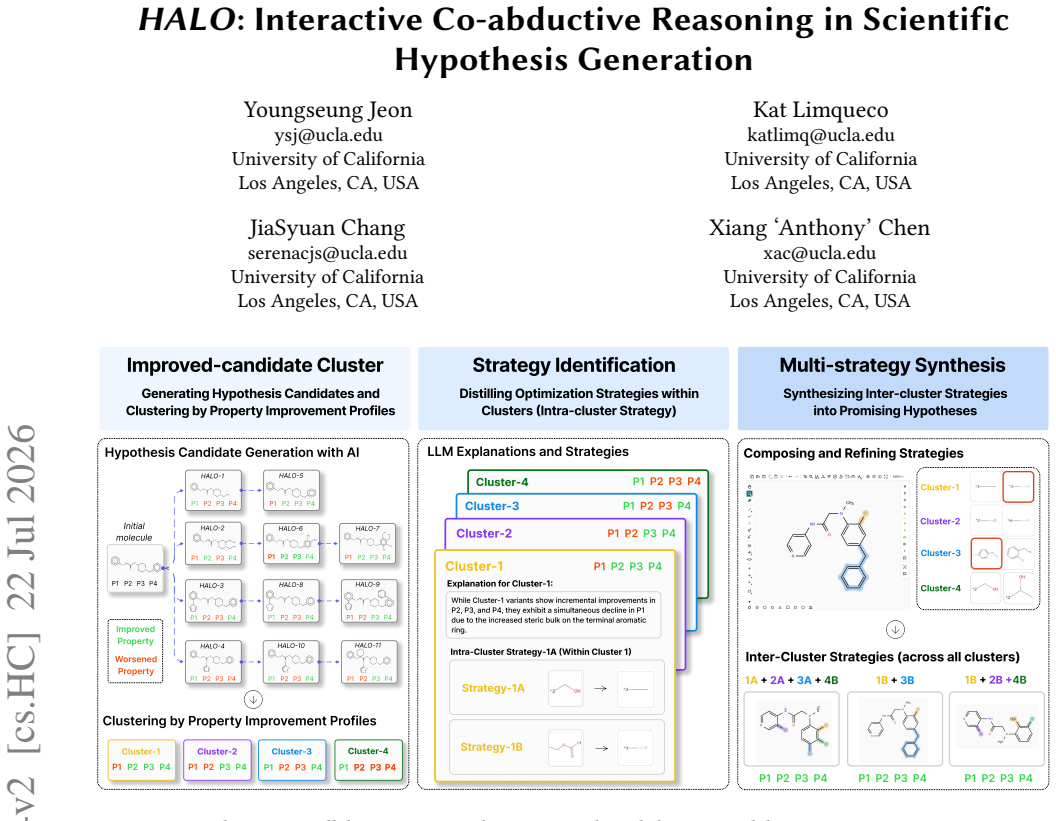
The central object is the co-abduction framework, a decomposition of abductive reasoning into three stages: (1) clustering hypothesis candidates by which target properties they improve or worsen; (2) distilling optimization strategies within each cluster via LLM-generated explanations of fragment–property relationships; and (3) synthesizing strategies across clusters into new candidates. In HALO, this is realized through a clustering module that groups molecules by property-improvement profiles, a strategy module that computes shared scaffolds and R-group fragment libraries and prompts a large language model for actionable strategies, and a synthesis module that recombines intra- and inter-c
Load-bearing premise
The central claim assumes that the number of target properties a molecule improves, as scored by a machine-learning ADMET predictor, is a valid measure of drug-candidate quality; the paper acknowledges that wet-lab validation is needed.
What would settle it
Take the molecules that HALO users submitted, synthesize them, and measure the target properties in vitro or in vivo; if the predicted property improvements (e.g., lower liver toxicity, better solubility) do not reproduce, the paper's quality claim collapses.
If this is right
- If co-abduction works as described, AI tools for scientific discovery should focus less on generating more candidates and more on structuring the reasoning over those candidates.
- Clustering by property-improvement profiles makes the optimization landscape legible, letting researchers quickly see which properties are hard to improve and which clusters to focus on.
- LLM-generated, fragment-grounded strategies reduce reliance on manual and heuristic inspection, giving experts evidence-based directions they might not have considered.
- Recombining strategies across clusters with real-time property updates preserves structural coherence and supports iterative refinement toward multi-property goals.
- The observed post-insight shift from AI generation to manual editing suggests that AI should be more proactive before an abductive leap and more restrained afterward.
Where Pith is reading between the lines
- My inference: the co-abduction loop is a general reasoning scaffold, not a drug-discovery tool; it should transfer to materials discovery, protein design, or any domain where candidates are scored on competing properties and strategies can be recombined.
- My inference: the paper's 'leap' finding implies an adaptive-interaction design principle—systems could detect when a user has formed a hypothesis and automatically lower AI initiative to avoid interference.
- My inference: a stronger test would compare HALO against a baseline that shows the same LLM strategies without the clustering step, isolating whether the observed benefit comes from clustering or from strategy content alone.
- My inference: because quality is measured by a machine-learning property predictor, the magnitude of the quality gain is an upper bound; wet-lab validation could shrink or eliminate it.
Editorial analysis
A structured set of objections, weighed in public.
Referee Report
Summary. The paper introduces co-abduction, a human-AI collaborative framework for abductive reasoning in scientific hypothesis generation, and implements it in HALO, a system for molecular lead optimization in drug discovery. HALO operationalizes three co-abductive stages: clustering generated molecules by property improvement profiles (MolCluster), identifying intra-cluster optimization strategies via an LLM (MolStrategy), and synthesizing strategies across clusters (MolSynthesis). The authors evaluate HALO in a within-subjects study with 10 medicinal chemists, comparing it against a baseline that includes the same AI generation and property scoring infrastructure but omits the three co-abductive components. They report significant advantages for HALO on self-reported measures of observation, strategy identification, and multi-strategy synthesis, and on objective measures of submitted molecule quality (ADMET-AI-improved property count) and diversity (lower Tanimoto similarity). The paper also analyzes 'abductive leap' events logged via an Insight button, finding reduced AI generation and increased manual editing after the first leap.
Significance. If the findings hold, the work is a useful contribution to HCI and AI-assisted scientific discovery: it targets the reasoning process around candidate generation rather than only candidate generation itself, and it provides a concrete system design and a controlled comparison that isolates co-abductive features. Strengths include the within-subjects counterbalanced study, the baseline designed to separate the three stages, the use of both self-report and interaction-log measures, the computational pre-evaluation of the molecule generator, and the authors' explicit acknowledgment of several limitations. The main risk is that the headline 'higher-quality molecules' claim in the abstract and conclusion rests on a quality metric computed with the same ADMET-AI oracle that is embedded in the system's scoring displays, and one of the two RQ2 analyses uses an unpaired test on paired data. These issues are fixable but currently weaken the central quantitative contribution.
major comments (4)
- [§6.2.4, Table 1; §7.4; Abstract] RQ2 quality is measured as the number of four ADMET-AI-predicted properties improved relative to the starting lead. ADMET-AI is the same oracle that powers real-time property displays, cluster coloring, and strategy feedback in both HALO and the baseline (§5, §A.5). Participants can thus hill-climb on ADMET-AI's scoring function more effectively in HALO, and the 'higher-quality molecules' claim does not follow if ADMET-AI diverges from wet-lab pharmacology. §7.4 acknowledges this limitation, yet the abstract and conclusion retain unqualified 'higher-quality' wording. Please soften the claim to 'higher predicted ADMET-AI property scores' or provide external validation with an independent oracle or experimental data.
- [§6.2.4, Table 1] The quality comparison uses the paired Wilcoxon signed-rank test, which is appropriate for the within-subjects design. The diversity comparison, however, uses the unpaired Wilcoxon rank-sum test, which assumes independent samples. Because the same 10 participants produced both conditions, the paired signed-rank test should be used. Please re-analyze with the correct paired test and report exact p-values and an effect size (e.g., matched-pairs rank-biserial correlation). The reported diversity result may change substantially.
- [§6.1.3, Figure 4] Twelve Likert items are analyzed individually at α=0.05 without any correction for multiple comparisons. With N=10, the probability of at least one spurious significant result across 12 tests is non-negligible. Please apply a multiplicity correction (e.g., Holm-Bonferroni) or pre-specify a small set of composite outcomes, and report effect sizes. The consistent unidirectional pattern across all 12 items is reassuring, but the current reporting overstates the strength of evidence for the RQ1 claims.
- [§2.3 vs §4.1] Section 2.3 states that the formative study was conducted with 'ten medicinal chemists,' but Section 4.1 reports five participants (Table 4 also lists only five formative-study participants). This is a factual inconsistency that should be corrected; it affects the reader's understanding of the design rationale.
minor comments (5)
- [Abstract] The phrase 'we present a co-abduction' should read 'we present co-abduction' (unnecessary article).
- [Table 1] The row labeled 'Diversity' reports average pairwise Tanimoto similarity; lower values indicate higher diversity. Consider renaming it 'Average Pairwise Similarity (lower = more diverse)' or reporting diversity as 1−similarity to avoid confusion.
- [Figure 5] The legend uses similar shapes/colors for MolCluster, MolStrategy, and MolSynthesis. Please increase visual distinction and consider annotating example rows with participant IDs for readability.
- [§6.1.2] 'Both corresponding interfaces' is awkward; rephrase to 'both interfaces' or 'the HALO and baseline interfaces.'
- [§A.2] Task B has a high hallucination rate (29.7–39.8% RDKit parsing failures). The paper reports this, but it would be useful to state whether the user study pipeline filtered these outputs and whether the difference in generation reliability between Task A and Task B affected the user experience.
Circularity Check
No load-bearing circularity; RQ2's ADMET-AI-based quality metric is an acknowledged surrogate-oracle limitation, not a derivation that reduces to its own inputs.
full rationale
The paper contains no mathematical derivation, no fitted-parameter chain, and no invocation of a uniqueness theorem; the core claims rest on a user study with expert ratings, log analysis, and an oracle-based quality surrogate. The nearest circularity-adjacent point is RQ2: quality is measured by counting how many of four properties improve according to ADMET-AI ("For quality, we evaluated how many of the four properties were improved, using ADMET-AI [103], which is also used in HALO (Δ=after−before)", §6.2.4), and ADMET-AI is also the model behind property displays in both HALO and the baseline (§A.5). This means the headline 'higher-quality molecules' claim is limited by the oracle's fidelity, but it is not a construction-level reduction: no parameter is fitted from the outcome and then reported as a prediction, and the baseline also exposes ADMET-AI scores, so the comparison retains its internal meaning as an interface comparison. The authors explicitly flag this limitation in §7.4: "evaluating the quality of compounds generated by HALO solely using model-based scores and counts is inherently limited. Definitive assessment requires scientific validation through wet-lab experiments." The self-citations in the paper (e.g., [53], [66]) are illustrative and not load-bearing for the central claim. No circular step can be exhibited from the paper's own equations or definitions.
Axiom & Free-Parameter Ledger
free parameters (3)
- MCS coverage threshold =
0.6
- Top-k source/strategy selection =
top 3 sources; up to 3 cores
- User study protocol constants =
30-min task; 7 submitted molecules; N=10; 12 Likert items
axioms (5)
- domain assumption Abductive reasoning, with stages observation → pattern identification → hypothesis generation, is an accurate model of scientific hypothesis generation.
- domain assumption ADMET-AI predicted property scores are a valid proxy for real pharmacological properties.
- domain assumption LLM-generated cluster explanations and strategies are chemically plausible enough to support reasoning.
- domain assumption Participants' Likert ratings and self-reported 'aha' clicks measure actual abductive reasoning.
- domain assumption The fine-tuned Llama generation model produces sufficiently valid, scaffold-preserving candidates during user sessions.
invented entities (1)
-
co-abduction framework
no independent evidence
read the original abstract
Scientific discovery is essential yet inefficient, primarily because generating hypotheses within a vast search space hinders breakthroughs. While current AI systems assist in generating new hypothesis candidates, they lack interactive support for the reasoning process by which users develop these outputs into promising hypotheses, resulting in surface-level hypotheses. To address this issue, we present co-abduction, a human-AI collaborative framework for abductive reasoning in scientific hypothesis generation. To operationalize co-abduction, we build HALO, a human-AI collaborative system for molecular hypothesis generation in drug discovery, enabling improved candidate clustering, strategy identification, and multi-strategy synthesis. In expert studies involving 10 medicinal chemists, HALO significantly facilitated abductive reasoning for hypothesis generation -- efficient candidate observation, systematic strategy identification, and coherent multi-strategy composition -- and enabled participants to produce higher-quality, more diverse candidate molecules.
Figures


Reference graph
Works this paper leans on
-
[1]
[n. d.]. Nvida - bionemo. https://www.nvidia.com/en-us/clara/bionemo/. Ac- cessed: 2024-07-31
2024
-
[2]
Atilla Kaan Alkan, Shashwat Sourav, Maja Jablonska, Simone Astarita, Rishabh Chakrabarty, Nikhil Garuda, Pranav Khetarpal, Maciej Pióro, Dimitrios Tanog- lidis, Kartheik G Iyer, et al . 2025. A Survey on Hypothesis Generation for Scientific Discovery in the Era of Large Language Models.arXiv preprint arXiv:2504.05496(2025)
Pith/arXiv arXiv 2025
-
[3]
Dana F AlKharboush, Frank Kozielski, Geoffrey Wells, and Exequiel OJ Porta
-
[4]
Shm Garanganao Almeda, JD Zamfirescu-Pereira, Kyu Won Kim, Pradeep Mani Rathnam, and Bjoern Hartmann. 2024. Prompting for discovery: Flexible sense-making for ai art-making with dreamsheets. InProceedings of the 2024 CHI Conference on Human Factors in Computing Systems. 1–17
2024
-
[5]
Saleema Amershi, Maya Cakmak, W Bradley Knox, and Todd Kulesza. 2014. Power to the people: The role of humans in interactive machine learning.AI magazine35, 4 (2014), 105–120
2014
-
[6]
Saleema Amershi, Dan Weld, Mihaela Vorvoreanu, Adam Fourney, Besmira Nushi, Penny Collisson, Jina Suh, Shamsi Iqbal, Paul N Bennett, Kori Inkpen, et al. 2019. Guidelines for human-AI interaction. InProceedings of the 2019 chi conference on human factors in computing systems. 1–13
2019
-
[7]
Ian Arawjo, Chelse Swoopes, Priyan Vaithilingam, Martin Wattenberg, and Elena L Glassman. 2024. Chainforge: A visual toolkit for prompt engineering and llm hypothesis testing. InProceedings of the 2024 CHI Conference on Human Factors in Computing Systems. 1–18
2024
-
[8]
Sara Barrena and Jaime Nubiola. 2019. Abduction: The Logic of Creativity. In The Bloomsbury Companion to Contemporary Peircean Semiotics. Bloomsbury, 185–203
2019
-
[9]
Berman et al
Helen M. Berman et al. 2000. The Protein Data Bank.Nucleic Acids Research28, 1 (2000), 235–242
2000
-
[10]
G Richard Bickerton, Gaia V Paolini, Jérémy Besnard, Sorel Muresan, and An- drew L Hopkins. 2012. Quantifying the chemical beauty of drugs.Nature chemistry4, 2 (2012), 90–98
2012
-
[11]
Camille Bilodeau, Wengong Jin, Tommi Jaakkola, Regina Barzilay, and Klavs F Jensen. 2022. Generative models for molecular discovery: Recent advances and challenges.Wiley Interdisciplinary Reviews: Computational Molecular Science12, 5 (2022), e1608
2022
-
[12]
Jesse D Bloom, Sy T Labthavikul, Christopher R Otey, and Frances H Arnold
-
[13]
Paul E Blower Jr, Kevin P Cross, Michael A Fligner, Glenn J Myatt, Joseph S Verducci, and Chihae Yang. 2004. Systematic analysis of large screening sets in drug discovery.Current Drug Discovery Technologies1, 1 (2004), 37–47
2004
-
[14]
Keith T Butler, Daniel W Davies, Hugh Cartwright, Olexandr Isayev, and Aron Walsh. 2018. Machine learning for molecular and materials science.Nature559, 7715 (2018), 547–555
2018
-
[15]
Wesley Carpenter. 2019. The aha! moment: The science behind creative insights. InToward super-creativity-improving creativity in humans, machines, and human- machine collaborations. IntechOpen
2019
-
[16]
Fengming Chen, Ranran Zhao, Xingxing Han, Huan Li, and Zhishu Tang. 2026. Harnessing AI to fuse phenotypic signatures for drug target identification: progress in computational modeling.Briefings in Bioinformatics27, 1 (2026), bbag045
2026
-
[17]
Minjun Chen, Jürgen Borlak, and Weida Tong. 2013. High lipophilicity and high daily dose of oral medications are associated with significant risk for drug-induced liver injury.Hepatology58, 1 (2013), 388–396
2013
-
[18]
Minjun Chen, Ayako Suzuki, Jürgen Borlak, Raúl J Andrade, and M Isabel Lucena
-
[19]
Ziqi Chen, Martin Renqiang Min, Srinivasan Parthasarathy, and Xia Ning. 2021. A deep generative model for molecule optimization via one fragment modifica- tion.Nature machine intelligence3, 12 (2021), 1040–1049
2021
-
[20]
Lydia B Chilton, Juho Kim, Paul André, Felicia Cordeiro, James A Landay, Daniel S Weld, Steven P Dow, Robert C Miller, and Haoqi Zhang. 2014. Frenzy: collaborative data organization for creating conference sessions. InProceedings of the SIGCHI Conference on Human Factors in Computing Systems. 1255–1264
2014
-
[21]
Lydia B Chilton, Greg Little, Darren Edge, Daniel S Weld, and James A Landay
-
[22]
José A Cisneros, Michael J Robertson, Brandon Q Mercado, and William L Jorgensen. 2017. Systematic study of effects of structural modifications on the aqueous solubility of drug-like molecules.ACS medicinal chemistry letters8, 1 (2017), 124–127
2017
-
[23]
Victoria Clarke, Virginia Braun, and Nikki Hayfield. 2015. Thematic analysis. Qualitative Psychology: A Practical Guide to Research Methods(2015), 222–248
2015
-
[24]
Kai-Hendrik Cohrs, Emiliano Diaz, Vasileios Sitokonstantinou, Gherardo Varando, and Gustau Camps-Valls. 2025. Large language models for causal hypothesis generation in science.Machine Learning: Science and Technology6, 1 (2025), 013001
2025
-
[25]
The UniProt Consortium. 2023. UniProt: the Universal Protein Knowledgebase in 2023.Nucleic Acids Research51, D1 (2023), D523–D531
2023
-
[26]
Gabriele Corso, Hannes Stärk, Bowen Jing, Regina Barzilay, and Tommi Jaakkola
-
[27]
Stefano Curtarolo et al . 2012. AFLOW: an automatic framework for high- throughput materials discovery.Computational Materials Science58 (2012), 218–226
2012
-
[28]
Daniel W Davies, Keith T Butler, Adam J Jackson, Andrew Morris, Jarvist M Frost, Jonathan M Skelton, and Aron Walsh. 2016. Computational screening of all stoichiometric inorganic materials.Chem1, 4 (2016), 617–627
2016
-
[29]
Vishal Dey, Xiao Hu, and Xia Ning. 2025. GeLLM 3O: Generalizing Large Language Models for Multi-property Molecule Optimization.arXiv preprint arXiv:2502.13398(2025)
Pith/arXiv arXiv 2025
-
[30]
Vishal Dey, Xiao Hu, and Xia Ning. 2025. Large language models for controllable multi-property multi-objective molecule optimization.molecules1, 331,586 (2025), 433–166
2025
-
[31]
The Diagram is like Guardrails
Zijian Ding, Michelle Brachman, Joel Chan, and Werner Geyer. 2025. " The Diagram is like Guardrails": Structuring GenAI-assisted Hypotheses Exploration with an Interactive Shared Representation. InProceedings of the 2025 Conference on Creativity and Cognition. 606–625
2025
-
[32]
Chris Donahue and Yewon Kim. 2025. AMUSE: AI-Integrated Songwriting Workflows. InProceedings of the CHI Conference on Human Factors in Computing Systems
2025
-
[33]
Jurgen Drews. 2000. Drug discovery: a historical perspective.science287, 5460 (2000), 1960–1964
2000
-
[34]
David TF Dryden, Andrew R Thomson, and John H White. 2008. How much of protein sequence space has been explored by life on Earth?Journal of The Royal Society Interface5, 25 (2008), 953–956
2008
-
[35]
Kevin Dunbar. 1993. Concept discovery in a scientific domain.Cognitive science 17, 3 (1993), 397–434
1993
-
[36]
Kevin Dunbar. 1995. How scientists really reason: Scientific reasoning in real- world laboratories. (1995)
1995
-
[37]
Anna Fedor, Eörs Szathmáry, and Michael Öllinger. 2015. Problem solving stages in the five square problem.Frontiers in psychology6 (2015), 1050
2015
-
[38]
Jacob G Foster, Andrey Rzhetsky, and James A Evans. 2015. Tradition and innovation in scientists’ research strategies.American sociological review80, 5 (2015), 875–908
2015
-
[39]
Jie Gao, Yuchen Guo, Gionnieve Lim, Tianqin Zhang, Zheng Zhang, Toby Jia-Jun Li, and Simon Tangi Perrault. 2024. CollabCoder: A Lower-barrier, Rigorous Workflow for Inductive Collaborative Qualitative Analysis with Large Language Models. InProceedings of the 2024 CHI Conference on Human Factors in Computing Systems. 1–29
2024
-
[40]
Massimo Garbuio and Nidthida Lin. 2021. Innovative idea generation in prob- lem finding: Abductive reasoning, cognitive impediments, and the promise of artificial intelligence.Journal of Product Innovation Management38, 6 (2021), 701–725
2021
-
[41]
Anna Gaulton et al. 2012. ChEMBL: a large-scale bioactivity database for drug discovery.Nucleic Acids Research40, D1 (2012), D1100–D1107
2012
-
[42]
Katy Ilonka Gero, Chelse Swoopes, Ziwei Gu, Jonathan K Kummerfeld, and Elena L Glassman. 2024. Supporting sensemaking of large language model outputs at scale. InProceedings of the 2024 CHI Conference on Human Factors in Computing Systems. 1–21
2024
-
[43]
Elena L Glassman, Jeremy Scott, Rishabh Singh, Philip J Guo, and Robert C Miller
-
[44]
Ziwei Gu, Joyce Zhou, Ning-Er Lei, Jonathan K Kummerfeld, Mahmood Jasim, Narges Mahyar, and Elena L Glassman. 2025. AbstractExplorer: Leveraging Structure-Mapping Theory to Enhance Comparative Close Reading at Scale. In Proceedings of the 38th Annual ACM Symposium on User Interface Software and Technology. 1–25
2025
-
[45]
Zhangxu He, Weiguang Yang, Feifei Yang, Jingyu Zhang, and Liying Ma. 2024. In- novative medicinal chemistry strategies for enhancing drug solubility.European Journal of Medicinal Chemistry279 (2024), 116842
2024
-
[46]
Izumi V Hinkson, Benjamin Madej, and Eric A Stahlberg. 2020. Accelerating therapeutics for opportunities in medicine: a paradigm shift in drug discovery. Frontiers in pharmacology11 (2020), 770
2020
-
[47]
David Hitchcock. 1979. Deductive and inductive: Types of validity, not types of argument.Informal Logic2, 3 (1979)
1979
-
[48]
Samuel C Hoffman, Vijil Chenthamarakshan, Kahini Wadhawan, Pin-Yu Chen, and Payel Das. 2022. Optimizing molecules using efficient queries from property evaluations.Nature Machine Intelligence4, 1 (2022), 21–31. Conference acronym ’XX, June 03–05, 2025, Woodstock, NY Jeon et al
2022
-
[49]
OverCode: Visualizing variation in student solutions to programming problems at scale.ACM Transactions on Computer-Human Interaction (TOCHI) 22, 2 (2015), 1–35
2015
-
[50]
Ross Irwin, Spyridon Dimitriadis, Jiazhen He, and Esben Jannik Bjerrum. 2022. Chemformer: a pre-trained transformer for computational chemistry.Machine Learning: Science and Technology3, 1 (2022), 015022
2022
-
[51]
Anubhav Jain, Shyue Ping Ong, Geoffroy Hautier, Wei Chen, William Davidson Richards, Stephen Dacek, Shreyas Cholia, Dan Gunter, David Skinner, Gerbrand Ceder, et al. 2013. Commentary: The Materials Project: A materials genome approach to accelerating materials innovation.APL materials1, 1 (2013)
2013
-
[52]
Pouria Jandaghi, Hamed S Najafabadi, Andrea S Bauer, Andreas I Papadakis, Matteo Fassan, Anita Hall, Anie Monast, Magnus von Knebel Doeberitz, John P Neoptolemos, Eithne Costello, et al. 2016. Expression of DRD2 is increased in human pancreatic ductal adenocarcinoma and inhibitors slow tumor growth in mice.Gastroenterology151, 6 (2016), 1218–1231
2016
-
[53]
Youngseung Jeon, Matthew K Hong, Yan-Ying Chen, Kalani Murakami, Jonathan Q Li, Xiang Anthony Chen, and Matthew Klenk. 2024. Weaving ml with human aesthetic assessments to augment design space exploration: An automotive wheel design case study. InExtended Abstracts of the CHI Conference on Human Factors in Computing Systems. 1–10
2024
-
[54]
Tingting Jiang, Zhumo Sun, Shiting Fu, and Yan Lv. 2024. Human-AI inter- action research agenda: A user-centered perspective.Data and Information Management8, 4 (2024), 100078
2024
-
[55]
Tom Hosack, Djamil Damry, and Sujata Biswas. 2023. Drug-induced liver injury: a comprehensive review.Therapeutic advances in gastroenterology16 (2023), 17562848231163410
2023
-
[56]
Hyeonsu B Kang, Nouran Soliman, Matt Latzke, Joseph Chee Chang, and Jonathan Bragg. 2023. ComLittee: Literature Discovery with Personal Elected Author Committees. InProceedings of the 2023 CHI Conference on Human Factors in Computing Systems. 1–20
2023
-
[57]
Abdul Karim, Matthew Lee, Thomas Balle, and Abdul Sattar. 2021. CardioTox net: a robust predictor for hERG channel blockade based on deep learning meta-feature ensembles.Journal of Cheminformatics13, 1 (2021), 60
2021
-
[58]
Nabin Khanal, Chun Meng Yu, Jui-Cheng Chiu, Anav Chaudhary, Ziyue Zhang, Kakani Katija, and Angus G Forbes. 2024. FathomGPT: A natural language interface for interactively exploring ocean science data. InProceedings of the 37th Annual ACM Symposium on User Interface Software and Technology. 1–15
2024
-
[59]
Juho Kim, Haoqi Zhang, Paul André, Lydia B Chilton, Wendy Mackay, Michel Beaudouin-Lafon, Robert C Miller, and Steven P Dow. 2013. Cobi: A community- informed conference scheduling tool. InProceedings of the 26th annual ACM symposium on User interface software and technology. 173–182
2013
-
[60]
Sunghwan Kim et al. 2021. PubChem in 2021: new data content and improved web interfaces.Nucleic Acids Research49, D1 (2021), D1388–D1395
2021
-
[61]
John Jumper, Richard Evans, Alexander Pritzel, Tim Green, Michael Figurnov, Olaf Ronneberger, Kathryn Tunyasuvunakool, Russ Bates, Augustin Žídek, Anna Potapenko, et al. 2021. Highly accurate protein structure prediction with AlphaFold.nature596, 7873 (2021), 583–589
2021
-
[62]
David Klahr and Kevin Dunbar. 1988. Dual space search during scientific reasoning.Cognitive science12, 1 (1988), 1–48
1988
-
[63]
Paris Koloveas, Serafeim Chatzopoulos, Dionysis Diamantis, Christos Try- fonopoulos, and Thanasis Vergoulis. 2025. Accelerating Scientific Discovery with Multi-Document Summarization of Impact-Ranked Papers.arXiv preprint arXiv:2508.03962(2025)
Pith/arXiv arXiv 2025
-
[64]
Ehud Kroll and Lauri Koskela. 2017. Studying design abduction in the context of novelty. InDS 87-7 Proceedings of the 21st International Conference on Engineering Design (ICED 17) Vol 7: Design Theory and Research Methodology, Vancouver, Canada, 21-25.08. 2017. The Design Society, 61–70
2017
-
[65]
Yoonjoo Lee, Hyeonsu B Kang, Matt Latzke, Juho Kim, Jonathan Bragg, Joseph Chee Chang, and Pao Siangliulue. 2024. PaperWeaver: Enriching Topi- cal Paper Alerts by Contextualizing Recommended Papers with User-collected Papers. InProceedings of the CHI Conference on Human Factors in Computing Systems. 1–19
2024
-
[66]
Ziwen Li, Xiang Chen, and Youngseung Jeon. 2025. GraPPI: a retrieve-divide- solve GraphRAG framework for large-scale protein-protein interaction explo- ration. InFindings of the Association for Computational Linguistics: NAACL 2025. 3635–3648
2025
-
[67]
Douglas B Kitchen, Hélène Decornez, John R Furr, and Jürgen Bajorath. 2004. Docking and scoring in virtual screening for drug discovery: methods and applications.Nature reviews Drug discovery3, 11 (2004), 935–949
2004
-
[68]
Yiren Liu, Pranav Sharma, Mehul Oswal, Haijun Xia, and Yun Huang. 2025. PersonaFlow: Designing LLM-Simulated Expert Perspectives for Enhanced Research Ideation. InProceedings of the 2025 ACM Designing Interactive Systems Conference. 1–29
2025
-
[69]
Ricardo Macarron, Martyn N Banks, Dejan Bojanic, David J Burns, Dragan A Cirovic, Tina Garyantes, Darren VS Green, Robert P Hertzberg, William P Janzen, Jeff W Paslay, et al. 2011. Impact of high-throughput screening in biomedical research.Nature reviews Drug discovery10, 3 (2011), 188–195
2011
-
[70]
Gerald Maggiora, Martin Vogt, Dagmar Stumpfe, and Jurgen Bajorath. 2014. Molecular similarity in medicinal chemistry: miniperspective.Journal of medic- inal chemistry57, 8 (2014), 3186–3204
2014
-
[71]
Lorenzo Magnani. 2009. Creative abduction and hypothesis withdrawal. In Models of discovery and creativity. Springer, 95–126
2009
-
[72]
Nikolas Martelaro, David Chuan-En Lin, and Hyeonsu B. Kang. 2025. Inkspire: A Sketch-Driven AI Tool for Design Ideation. InProceedings of the CHI Conference on Human Factors in Computing Systems
2025
-
[73]
Junyong Lin, Lu Dai, Ruiqian Han, Yijie Sui, Ruilin Wang, Xingliang Sun, Qinglin Wu, Min Feng, Hao Liu, and Hui Xiong. 2025. ScIRGen: Synthesize Realistic and Large-Scale RAG Dataset for Scientific Research. InProceedings of the 31st ACM SIGKDD Conference on Knowledge Discovery and Data Mining V. 2. 5619–5630
2025
-
[74]
Gordon E Moore et al . 1965. Cramming more components onto integrated circuits
1965
-
[75]
David F Nippa, Kenneth Atz, Yannick Stenzhorn, Alex T Müller, Andreas Tosstorff, Jörg Benz, Hayley Binch, Markus Bürkler, Achi Haider, Dominik Heer, et al. 2025. Expediting hit-to-lead progression in drug discovery through reac- tion prediction and multi-dimensional optimization.Nature Communications (2025)
2025
-
[76]
Stellan Ohlsson. 1992. Information-processing explanations of insight and related phenomena.Advances in the psychology of thinking1 (1992), 1–44
1992
-
[77]
Charles O’Neill, Tirthankar Ghosal, Roberta Răileanu, Mike Walmsley, Thang Bui, Kevin Schawinski, and Ioana Ciucă. 2025. Sparks of science: Hypothesis generation using structured paper data.arXiv preprint arXiv:2504.12976(2025)
Pith/arXiv arXiv 2025
-
[78]
Antonio J Osuna-Mascaró and Alice MI Auersperg. 2021. Current understanding of the “insight” phenomenon across disciplines.Frontiers in Psychology12 (2021), 791398
2021
-
[79]
Kristin McEuen, Jürgen Borlak, Weida Tong, and Minjun Chen. 2017. Associa- tions of drug lipophilicity and extent of metabolism with drug-induced liver injury.International journal of molecular sciences18, 7 (2017), 1335
2017
-
[80]
1934.Collected papers of charles sanders peirce
Charles Sanders Peirce. 1934.Collected papers of charles sanders peirce. Vol. 5. Harvard University Press
1934
discussion (0)
Sign in with ORCID, Apple, or X to comment. Anyone can read and Pith papers without signing in.