REVIEW 3 major objections 4 minor 9 references
Benchmarking Confidential GPU Inference on NVIDIA H100 under Intel TDX
T0 review · 3 major / 4 minor · reviewed 2026-08-02 · deepseek-v4-flash
Pith's one-line read Confidential mode on NVIDIA H100 GPUs costs 21–30% extra latency and 18–21% token throughput.
desk verdict Useful operational data on a narrow H100/TDX configuration, but the fixed-rate throughput table has a definitional inconsistency that the authors need to resolve before the headline numbers can be trusted. read the letter →
The pith
A machine-rendered reading of the paper's core claim, the machinery that carries it, and where it could break.
The reading
What carries the argument
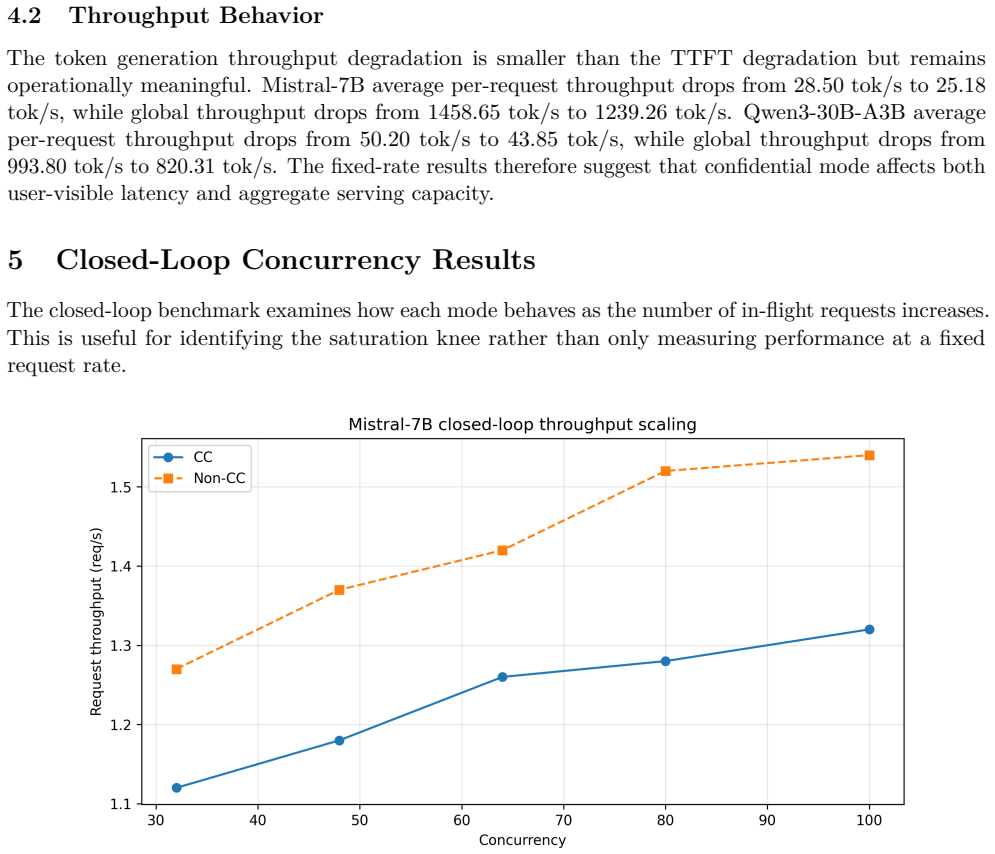
The load-bearing apparatus is a paired benchmark design: the same models, same machine type, same GPU, run in Non-CC and CC modes under two load generators. The fixed request-rate generator (10 req/s for Mistral, 5 req/s for Qwen) isolates per-request latency and token throughput; the closed-loop generator holds N in-flight requests to expose throughput saturation curves. The analytic concept that carries the argument is the saturation knee — the concurrency where throughput stops scaling — because the paper uses its left/right position to explain TTFT anomalies (e.g., Qwen CC TTFT of 20.8 s at c=32 vs 2.9 s Non-CC) and to argue for model-specific capacity planning.
What would settle it
Re-run the closed-loop Qwen3-30B-A3B experiment at c=32 with, say, ten trials, explicit warmup, and fresh instance placement; if CC p50 TTFT drops from the reported 20.8 s to near the Non-CC value, the 'earlier saturation knee under CC' conclusion would still be supported by the throughput plateau at 0.84 req/s, but the extreme TTFT anomaly would be an artifact rather than a steady-state property.
Extended reading notes
Core claim
The central claim is that confidential mode on this H100/TDX configuration has a measurable, user-visible cost and that the cost is not a single multiplier. Fixed request-rate measurements show a latency overhead of about 21% for Mistral-7B and 27–30% for Qwen3-30B-A3B, plus global token throughput gaps of 17.7% and 21.1%. Closed-loop concurrency tests show a throughput gap between 11.5% and 20.2%, but also show that Qwen3-30B-A3B saturates around c=32 in CC mode while Non-CC keeps improving to c=40. The paper concludes that confidential GPU inference is operationally feasible but must be capacity-planned model-by-model, and that TTFT comparisons are only meaningful when both modes are at th
Load-bearing premise
The results assume that three averaged trials per concurrency level give stable p50 latency and throughput estimates, and that the TDX instance differs from the Non-CC instance only by confidential mode; a single noisy trial — like the c=32 Qwen3 TTFT — could shift the saturation-knee conclusion.
Editorial extensions
If this is right
- A serving team can start capacity planning for single-H100 confidential inference by reserving 15–25% throughput headroom, then validating with workload-specific traces.
- Larger models may hit their saturation knee at lower concurrency in CC mode, so sizing from low-load measurements can under-provision production traffic.
- TTFT comparisons between CC and Non-CC are only interpretable when both modes are in the same operating regime relative to their saturation knee.
- Confidential mode does not make the GPU unusable: at moderate concurrency both models still serve requests with a throughput gap mostly in the 12–20% range.
- The stable across-model gaps support treating confidential mode as a performance profile to be tuned rather than a binary overhead.
Reading between the lines
- If the overhead source is CPU-GPU transfer or memory encryption (as prior work suggests), then workloads with high prompt-token volume or frequent KV-cache transfers could see larger gaps than these two models show; the paper's own Section 7 lists this as an unmeasured factor.
- A natural extension is to repeat the closed-loop tests with more trials and warmup, and to report p90/p99 tail latencies; if the c=32 Qwen3 TTFT outlier is a scheduling artifact rather than steady-state, the saturation-knee story still holds but the magnitude of the CC penalty at the knee would need revision.
- The 15–25% reserve heuristic is likely configuration-specific; a testable extension is to run the same protocol on multi-GPU or NVLink-connected systems, where peer-memory encryption may change both the gap and the knee location.
Editorial analysis
A structured set of objections, weighed in public.
Referee Report
Summary. This paper compares confidential (CC) and non-confidential (Non-CC) LLM inference on a single NVIDIA H100 80GB GPU hosted in an Intel TDX confidential VM. Using Mistral-7B v0.1 and Qwen3-30B-A3B, it reports fixed-rate TTFT/request-latency overheads of 21–30%, global token-throughput gaps of 17.7% and 21.1%, and closed-loop throughput gaps of 11.5–20.2%, concluding that CC mode is operationally feasible but requires 15–25% extra capacity headroom and model-specific saturation planning. The paper is candid about its limited scope, missing tail-latency data, and disabled Secure Boot. However, the central fixed-rate results in Table 2 are not internally coherent under any consistent unit/metric interpretation, which undermines the headline quantitative claims until the table is reconciled.
Significance. If the measurements hold, the paper would provide a useful, concrete data point for capacity planners evaluating confidential GPU inference on H100/TDX, and its separation of fixed-rate and closed-loop load models is methodologically sensible. The paper also explicitly lists reproducibility and tail-latency limitations, and it does not fit any free parameters to its claims. That said, the significance is conditional: the main overhead percentages and the 15–25% heuristic are direct arithmetic products of Table 2, so the table's metric incoherence must be resolved before those conclusions can be accepted.
major comments (3)
- [§3.3, Table 2] The fixed-rate table cannot support the headline overheads as reported. The paper states that the artifact labels fixed-rate latency metrics in seconds and that units are preserved. If TTFT/latency are seconds, a 279.56 s TTFT at 10 req/s is physically implausible and implies over three thousand in-flight requests. If the values are milliseconds, then per-request throughput of 28.50 tok/s over a 314.72 ms request gives roughly 9 generated tokens per request, while global throughput of 1458.65 tok/s at 10 req/s implies about 146 tokens per request, a ~16-fold discrepancy. The same issue appears for Qwen3: 5 req/s × 50.20 tok/s × 0.41451 s ≈ 104 tok/s vs. reported 993.8 tok/s. The only way to reconcile these numbers is if 'global throughput' includes prompt tokens or uses a different time window, but the paper never defines this metric or reports prompt/output length distributions. Please
- [§3.4, §5.2, Table 4] All closed-loop conclusions rest on three-trial averages per concurrency level, with no standard deviations, confidence intervals, or per-trial data. The Qwen3 c=32 TTFT anomaly (CC 20,823 ms vs. Non-CC 2,874 ms) is excluded as a saturation artifact, but without variance information a reader cannot tell whether this is a stable regime difference or a single noisy trial. The 'earlier saturation knee' claim for Qwen3 also depends on the small throughput differences at c=32 (0.84 vs. 0.97 req/s). Please provide per-trial values or at least min/max and standard deviation for all closed-loop points, and justify the exclusion of the c=32 TTFT point with data rather than assertion.
- [§4.2, §6.4, §9] The 17.7% and 21.1% global-throughput gaps and the 15–25% capacity-planning rule are directly computed from Table 2 values whose definitions are unresolved. Consequently, even if the closed-loop results are sound, the paper's central quantitative takeaways are not verifiable from the manuscript as written. Please either correct Table 2 with coherent metric definitions and recompute all derived percentages, or restrict the conclusions to the closed-loop measurements whose units and Little's-law consistency can be checked.
minor comments (4)
- [§3.3] The phrase 'positive overhead is interpreted as the relative increase of CC over Non-CC' followed by the throughput-gap formula (Non-CC − CC)/CC is unconventional. Calling a 17.7% value a 'drop' in the abstract and conclusion is misleading; it is a 17.7% gap relative to CC, not a 17.7% reduction relative to Non-CC. Please use consistent wording, e.g., 'CC global throughput is 17.7% lower than Non-CC.'
- [Table 2] The column header 'A vg overhead/gap' appears to contain a typo; the p50 latency and TTFT values should also specify whether these are trial-averaged p50s, as in the closed-loop table.
- [Appendix B] The reproducibility notes describe the artifact but do not provide a URL, checksum, or data-release identifier. If the artifact can be shared, please include a link or DOI.
- [§4.1] The text says 'average TTFT from 279.56 to 340.64' without units. Given the confusion in §3.3, please state units in every table and every mention of these values.
Circularity Check
No significant circularity: the paper is a direct empirical benchmark whose overhead claims are arithmetic restatements of its own measurements, with no fitted parameters or self-referential derivation chain.
full rationale
The paper is a straightforward measurement study. Its central claims (TTFT/latency overheads of 21–30%, global-throughput gaps of 17.7%/21.1%, closed-loop saturation behavior) are computed directly from the reported benchmark tables via the explicit definitions in Section 3.3: overhead is (CC−Non-CC)/Non-CC for latency and (Non-CC−CC)/CC for throughput. No model parameter is fitted to a subset of data and then used to predict a closely related quantity; no uniqueness theorem or prior result by the same authors is invoked as the justification for the conclusions. The 'saturation knee' is a descriptive characterization of the measured closed-loop curves, and identifying it from the same data is inherent to empirical benchmarking rather than circular. Related-work citations to Zhu et al. and Martinez Ibarra et al. are contextual and not load-bearing for the paper's own measurements. The limitations section candidly notes missing tail-latency data, disabled Secure Boot, and lack of low-level profiling; these are validity threats, not circularity. The internal-consistency concerns about Table 2 units (e.g., whether global token throughput includes prompt tokens) are correctness/definitional issues that would affect the validity of the conclusions, but they are not instances of the paper deriving X from Y where Y was defined in terms of X. Accordingly, the circularity score is 0.
Assumptions & free parameters
free parameters (3)
- Mistral-7B fixed request rate =
10.0 req/s
- Qwen3-30B-A3B fixed request rate =
5.0 req/s
- Concurrency levels tested =
Mistral: 32,48,64,80,100; Qwen3: 24,32,40,50
assumptions (3)
- domain assumption The cc_benchmarks tool accurately records TTFT, latency, and throughput
- domain assumption The TDX instance differs from Non-CC only in confidential mode
- domain assumption Three trials per concurrency level yield stable p50 and average estimates
Cite this review
Pith. "Pith review of Benchmarking Confidential GPU Inference on NVIDIA H100 under Intel TDX." pith.science (2026). https://pith.science/paper/FGTEOQJV
@misc{pith2026260719353,
  author       = {Pith},
  title        = {Pith review of: Benchmarking Confidential GPU Inference on NVIDIA H100 under Intel TDX},
  year         = {2026},
  howpublished = {\url{https://pith.science/paper/FGTEOQJV}},
  note         = {Machine review of arXiv:2607.19353}
}
read the original abstract
Confidential computing is becoming a practical deployment requirement for AI inference workloads that process sensitive inputs or protect proprietary model assets. However, the performance cost of enabling confidential execution for GPU-accelerated large language model serving remains workload dependent and operationally important. This paper presents a benchmark study comparing standard non-confidential execution with confidential computing mode on a single NVIDIA H100 80GB GPU hosted in an Intel TDX confidential instance. The evaluation uses two representative language models, Mistral-7B v0.1 and Qwen3-30B-A3B, and measures time to first token, end-to-end request latency, per-request token generation throughput, global token throughput, and closed-loop request throughput under increasing concurrency. In fixed request-rate experiments, confidential mode increases average TTFT by 21.8% for Mistral-7B and 27.8% for Qwen3-30B-A3B, while global token throughput drops by 17.7% and 21.1%, respectively. In closed-loop concurrency experiments, throughput gaps remain in the 11.5-20.2% range, but the larger model reaches its saturation knee earlier under confidential mode. The results suggest that confidential GPU inference can retain usable throughput under load, but capacity planning must account for both the steady throughput penalty and the earlier saturation behavior observed for larger models.
Figures


Figures from the paper (2 more)


Reference graph
Works this paper leans on
-
[1]
Confidential Computing on NVIDIA Hopper GPUs: A Performance Benchmark Study,
J. Zhu, H. Yin, P. Deng, A. Almeida, and S. Zhou, “Confidential Computing on NVIDIA Hopper GPUs: A Performance Benchmark Study,” arXiv:2409.03992, 2024. doi:https://doi.org/10. 48550/arXiv.2409.03992
-
[2]
Performance of Confidential Computing GPUs,
A. Martínez Ibarra, J. J. Stephen, A. González Vidal, K. R. Jayaram, and A. F. Skarmeta Gómez, “Performance of Confidential Computing GPUs,” arXiv:2505.16501, 2025. doi:https: //doi.org/10.48550/arXiv.2505.16501
-
[3]
Confidential Compute on NVIDIA Hopper H100,
NVIDIA, “Confidential Compute on NVIDIA Hopper H100,” White Paper WP-11459-001, 2023. https://images.nvidia.com/aem-dam/en-zz/Solutions/data-center/HCC-Whitepaper-v1. 0.pdf
2023
-
[4]
Confidential Computing on H100 GPUs for Se- cure and Trustworthy AI,
NVIDIA Developer Blog, “Confidential Computing on H100 GPUs for Se- cure and Trustworthy AI,” 2023. https://developer.nvidia.com/blog/ confidential-computing-on-h100-gpus-for-secure-and-trustworthy-ai/
2023
-
[5]
Intel Trust Domain Extensions (Intel TDX),
Intel, “Intel Trust Domain Extensions (Intel TDX),” developer documentation.https://www.intel. com/content/www/us/en/developer/tools/trust-domain-extensions/overview.html
-
[6]
Create a Confidential VM instance with GPU,
Google Cloud, “Create a Confidential VM instance with GPU,” documentation. https://docs.cloud.google.com/confidential-computing/confidential-vm/docs/ create-a-confidential-vm-instance-with-gpu
-
[7]
A. Q. Jiang, A. Sablayrolles, A. Mensch, C. Bamford, D. S. Chaplot, D. de las Casas, F. Bressand, G. Lengyel, G. Lample, L. Saulnier, L. R. Lavaud, M.-A. Lachaux, P. Stock, T. Le Scao, T. Lavril, T. Wang, T. Lacroix, and W. El Sayed, “Mistral 7B,” arXiv:2310.06825, 2023. doi:https: //doi.org/10.48550/arXiv.2310.06825
-
[8]
A. Yang et al., “Qwen3 Technical Report,” arXiv:2505.09388, 2025. doi:https://doi.org/10. 48550/arXiv.2505.09388
Show all 9 references
-
[9]
Efficient Memory Management for Large Language Model Serving with PagedAttention,
W. Kwon, Z. Li, S. Zhuang, Y. Sheng, L. Zheng, C. H. Yu, J. E. Gonzalez, H. Zhang, and I. Stoica, “Efficient Memory Management for Large Language Model Serving with PagedAttention,” inProceedings of the ACM Symposium on Operating Systems Principles (SOSP), 2023. doi: https: //...
2023
Reviewed August 2, 2026 · model on record in the stance chip above.
Discussion (0). Continue with ORCID to comment.