REVIEW 4 major objections 5 minor 34 references
The paper claims that a local LLM's agreement across a handful of prompt-varied responses is enough to decide when to offload to the cloud, making trained routers unnecessary.
Reviewed by Pith at T0; open to challenge. T0 means a machine referee read the full paper against a public rubric. the ladder, T0–T4 →
T0 review · deepseek-v4-flash
2026-08-02 12:39 UTC pith:YI3HWBQH
load-bearing objection New training-free routing idea worth taking seriously; evaluation protocol and Bayesian overclaim need fixing before the headline results are accepted. the 4 major comments →
Routing Without Training: Controllable-Ratio LLM Offloading via Reliability Gating
The pith
A machine-rendered reading of the paper's core claim, the machinery that carries it, and where it could break.
Core claim
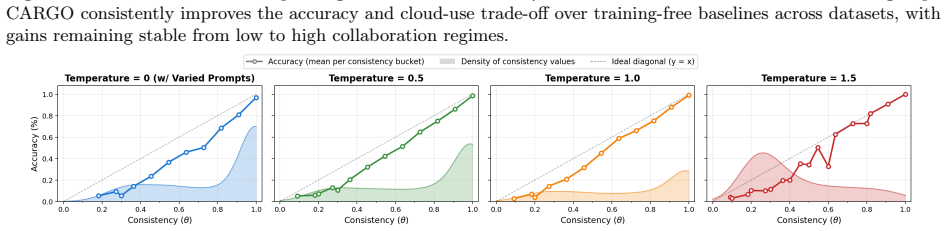
The paper argues that the fraction of times a local model produces the same answer across several prompt-varied deterministic generations, called the agreement level, is a reliable and transferable signal for whether the local answer can be trusted. From this signal, CARGO builds a probabilistic router: generate responses with diverse reasoning-style prompts at temperature zero, track the empirical mode mass, stop early once a Beta-posterior credible interval is sufficiently narrow, then set the offload probability as a decreasing function of agreement. A warmup phase calibrates the routing threshold to any desired collaboration ratio. In experiments with Llama, Qwen, and Phi backbones on ma
What carries the argument
The central mechanism is the empirical mode mass, θ̂_k = max_a c_a/k, estimated from prompt-varied deterministic samples and treated as a Beta posterior. A Bayesian credible-interval stopping rule decides when enough samples have been drawn, and a sigmoid mapping σ(γ(λ−θ̂)) converts agreement into an offload probability, with the intercept λ calibrated by stochastic approximation during a warmup phase to hit a target collaboration ratio or token budget.
Load-bearing premise
Section 3's Bayesian early stopper assumes that, after conditioning on the empirical majority answer, the indicators for whether each sampled response matches that majority are independent Bernoulli draws with a fixed probability; because the majority is chosen from the same sample, the indicators are dependent and the Beta posterior is not the true posterior. If this assumption fails, the credible-interval rule is a heuristic and the contraction guarantee in Lemma 3.1 does n
What would settle it
Take a large set of queries with known correct answers, run CARGO, and record for each stopped query whether the reported 1−δ credible interval for the mode mass actually contains the true mode mass estimated from a very large sample. If the empirical coverage is substantially below 1−δ, the Bayesian guarantee is false. As a second check, replace the Bayesian early stopper with a fixed sample count matched to CARGO's average stopping round; if accuracy and routing behavior change little, the stopping rule is not the source of the reported gains.
If this is right
- A router can be added at inference time to any local LLM without training data or task-specific supervision, making it usable with off-the-shelf and finetuned models alike.
- Target collaboration ratios (e.g., 10%, 30%, 50%) become controllable at deployment time via a short warmup, so the same system adapts to changing budgets and latency constraints.
- The Bayesian early stopper reduces the average number of local generations per query, lowering the compute and latency overhead of agreement-based routing.
- The same agreement principle extends to token-budgeted offloading, allowing control over total cloud token consumption rather than just the fraction of queries offloaded.
- Because the method operates only through prompts and outputs, it can be applied as an inference-time wrapper to existing LLM or agent-based applications without modifying the underlying models.
Where Pith is reading between the lines
- Inference: The independence assumption behind the Beta posterior is violated in practice because the majority answer is selected from the same sample used to estimate the mode mass; the credible interval should be treated as a heuristic, and its actual coverage deserves empirical measurement rather than presumption.
- Inference: The agreement signal could plausibly be combined with verifier-based or program-based self-consistency refinements to sharpen routing on math tasks, since those methods improve answer aggregation in the local-only setting.
- Inference: The same calibration machinery could be adapted to other resource objectives beyond query count or token count, such as latency budgets, energy limits, or monetary cost, by changing the warmup objective function.
- Inference: The paper's noted capability floor suggests a hybrid practical design: use agreement-based routing only when the local model passes a coarse capability screen on a small held-out set, reserving trained routing for very weak local models.
Editorial analysis
A structured set of objections, weighed in public.
Referee Report
Summary. The paper proposes CARGO, a training-free router for local-cloud LLM offloading. CARGO estimates the local model's reliability by sampling responses under varied system prompts, uses a Beta posterior on the empirical agreement (mode mass) with a credible-interval early-stopping rule to limit per-query samples, and calibrates a logistic offloading parameter λ during a warmup batch to meet a target cloud collaboration ratio. The authors evaluate on math and QA benchmarks across several local LLMs (Qwen, Phi, Llama families) using DeepSeek-R1 as the cloud model, comparing against random offloading, self-confidence routing, CoT-step routing, and a supervised DeBERTa learned router. They report that CARGO consistently outperforms training-free baselines and in several settings outperforms the learned router at fixed offload ratios (e.g., ρ=0.3), and they include a token-budget variant, ablations on prompt-varied sampling, and a limitation study on very small local models.
Significance. If the claimed results hold, this is a meaningful contribution: it suggests that an intrinsic, training-free signal—prompt-varied response agreement—can support controllable local-cloud routing without a learned router or collaboration-aware fine-tuning. The paper is commendably thorough in scope: multiple model families and scales, several benchmarks, a token-budget extension, ablation of the sampling mechanism, and an explicit boundary condition for weak local models. The central idea is plausible and the experimental design is extensive. However, the evaluation protocol and the statistical justification of the early-stopping rule contain load-bearing gaps that must be addressed before the headline claims can be accepted.
major comments (4)
- [§4, Baselines paragraph] The sentence 'we randomly flip a small number of decisions when needed so that every method matches the same prescribed collaboration ratio exactly' is not innocuous and is not quantified anywhere. If a method's natural offload rate differs from ρ, the reported accuracy is the accuracy of a stochastic mixture of that policy and random routing. For a method with natural rate below ρ, the random flips convert high-agreement/easy queries from local to cloud, which can inflate measured accuracy; for a method with rate above ρ, the flips convert low-agreement/hard queries from cloud to local, which can depress accuracy. Since CARGO's λ is calibrated on a finite warmup batch, its deployment-time natural rate may deviate from ρ, and the paper does not report natural rates or flip counts for any method, including baselines. Without these numbers, the margins in Tables 1–2 and Figure 3 could refl
- [§3, 'Bayesian Estimation of Mode Mass', Eq. (2)] The Beta posterior in Eq. (2) is not the posterior of the mode mass θ = P(A=â_k | x) because it conditions on the empirical majority answer â_k, which is selected from the same sample used to estimate θ. The indicators Z_i = 1{A_i=â_k} are not unconditionally independent Bernoulli(θ) with a fixed θ; the selection of â_k introduces a data-dependent target and a multiplicity effect. Consequently, the credible interval [L_k, U_k] is not a valid (1−δ) posterior interval, and Lemma 3.1/Theorem 3.2 do not license the claimed uncertainty guarantee for the stopping rule. The routing procedure may still work as a heuristic, and the empirical agreement estimator is justified by the SLLN, but the paper should either weaken the statistical claims or provide a selection-adjusted uncertainty quantification (e.g., bootstrap or post-selection inference).
- [§4, 'Experimental Setup' and Figure 5] The headline comparison is accuracy at a fixed offload ratio, but it ignores local compute and latency. CARGO performs up to K_max local generations per query (with early stopping), while all baselines use a single local generation (plus possibly a confidence token or CoT step count). Figure 5 reports mean stopping round but does not translate it into end-to-end latency or local FLOPs, and Table 1 gives no accuracy-versus-local-cost trade-off. CARGO's advantage could partly be the result of spending more local compute per query. Please report mean samples per query for all methods and provide accuracy as a function of local inference cost or latency, not only as a function of offload ratio.
- [Algorithm 1, lines 2–6 and Section 3 'Warmup Calibration'] The warmup batch B is described only as 'a fixed batch of B warmup queries'; the source (training, validation, random deployment queries) and the values of B, T0, and η_λ are not reported. This matters because the calibrated λ is fixed for deployment, and the paper does not report the realized offload ratio before the post-hoc flips. If B is small or unrepresentative, the target-ratio guarantee is not established. Please specify the warmup protocol, report the realized natural offload rates, and show the sensitivity of the final accuracy to B and T0.
minor comments (5)
- [§1, Contributions bullet] Typo: 'greater correctness and consistency than than self-reported confidence' should read 'than self-reported confidence'.
- [Appendix A, Proof of Lemma 3.1] The proof argues asymptotically with O(k) notation, but the claimed bound Var(θ|A_k) ≤ 1/[4(k+α0+β0+1)] follows directly from ab ≤ (a+b)^2/4. The current asymptotic argument does not establish the stated constant; please replace it with the direct inequality.
- [Theorem 3.2] The proof assumes a unique maximizer 'a⋆' with a positive gap Δ to all other answers, but this is not stated in the theorem. If there are ties for the mode, the empirical majority answer may not converge to a single answer, and the claim that 'with probability one there exists a finite K...' needs a different argument or an added uniqueness assumption.
- [Algorithm 1, inputs and lines 11–12] The algorithm input lists a temperature T, but prompt-varied sampling is described as deterministic decoding with T=0. Please state this explicitly in the algorithm or remove T from the input list.
- [§4.1, 'Performance Across Collaboration Ratios'] The phrase 'Randomvaries from query offloading' is missing a space and a period; it should read 'while Random varies from query offloading.' Also, the three-trial variance band is reported only for CARGO; please add variance or standard errors for baselines in Figure 3.
Circularity Check
No significant circularity: the central accuracy claims rest on external benchmark evaluations, not on reductions of fitted inputs or self-citations.
full rationale
CARGO's derivation chain is self-contained. The only fitted quantity is the routing intercept λ, updated by Eq. (3) to match a target offload ratio on a warmup batch; the reported accuracies on held-out benchmarks (Tables 1–2, Figure 3) are not derived from that fit, so the central comparison does not reduce to its inputs. The Bayesian early-stopping analysis (Lemma 3.1, Theorem 3.2) is a heuristic for estimating agreement, and even if the conditional-independence assumption is imperfect after conditioning on the empirical majority answer, that is a statistical-validity caveat, not a case where a prediction is defined as its input. The self-citations ([7], [12]) are used as baselines or related work and are not load-bearing for the paper's core claim. The paper's Appendix C.2 explicitly limits the method to local models with nontrivial reasoning ability, and Section 4's random-flip ratio matching is a legitimate experimental-design concern because reported accuracy can be a stochastic mixture with random routing, but that is a comparison-validity issue rather than circular derivation. No enumerated circularity pattern is present.
Axiom & Free-Parameter Ledger
free parameters (7)
- Beta prior shapes α0, β0
- Credible interval width threshold ε
- Logistic slope γ
- Maximum samples K_max
- Warmup batch size B, iterations T0, step size ηλ
- Hand-designed prompt set S =
9-10 prompt variants
- Token weights α, β (token-budget variant)
axioms (5)
- ad hoc to paper Conditioned on empirical majority answer â_k, indicators Z_i are independent Bernoulli(θ)
- domain assumption Decoding samples are conditionally independent given query under prompt sampling
- domain assumption The true mode a⋆ is unique (or eventually identified)
- standard math Stochastic approximation for λ converges to target ratio
- ad hoc to paper Beta prior is an adequate model for mode mass
read the original abstract
Local-cloud collaboration is a practical way to deploy large language models under resource constraints, but existing methods often rely on trained routers or collaboration-aware finetuning that tie routing behavior to a particular operating regime. In this work, we show that such training may be unnecessary: the local model's own inference-time agreement across sampled responses already provides a strong signal for deciding when to trust local execution and when to offload to a stronger cloud model. We propose CARGO, a training-free routing framework that estimates this agreement through prompt-varied sampling, applies Bayesian early stopping for sample-efficient uncertainty control, and supports arbitrary target collaboration ratios through lightweight deployment-time calibration. Across diverse reasoning and question-answering tasks, multiple local LLM families and scales, and both pretrained and finetuned local models, CARGO consistently outperforms other training-free baselines and in several settings surpasses supervised learned routers. These results suggest that effective and adaptable local-cloud collaboration can emerge directly from the local model's intrinsic response behavior, without requiring an additional trained router.
Figures




Reference graph
Works this paper leans on
-
[1]
Llm cascade with multi-objective optimal consideration,
K. Zhang, L. Peng, C. Wang, A. Go, and X. Liu, “Llm cascade with multi-objective optimal consideration,” 2024
2024
-
[2]
Llava-phi: Efficient multi-modal assistant with small language model,
Y. Zhu, M. Zhu, N. Liu, Z. Xu, and Y. Peng, “Llava-phi: Efficient multi-modal assistant with small language model,” inProceedings of the 1st International Workshop on Efficient Multimedia Computing under Limited, 2024, pp. 18–22
2024
-
[3]
Tinyllama: An open-source small language model,
P. Zhang, G. Zeng, T. Wang, and W. Lu, “Tinyllama: An open-source small language model,”arXiv preprint arXiv:2401.02385, 2024
Pith/arXiv arXiv 2024
-
[4]
Mobilellm: Optimizing sub-billion parameter language models for on-device use cases,
Z. Liu, C. Zhao, F. Iandola, C. Lai, Y. Tian, I. Fedorov, Y. Xiong, E. Chang, Y. Shi, R. Krishnamoorthi et al., “Mobilellm: Optimizing sub-billion parameter language models for on-device use cases,” in Forty-first International Conference on Machine Learning, 2024
2024
-
[5]
On-device language models: A comprehensive review,
J. Xu, Z. Li, W. Chen, Q. Wang, X. Gao, Q. Cai, and Z. Ling, “On-device language models: A comprehensive review,”arXiv preprint arXiv:2409.00088, 2024
Pith/arXiv arXiv 2024
-
[6]
Edgellm: Fast on-device llm inference with speculative decoding,
D. Xu, W. Yin, H. Zhang, X. Jin, Y. Zhang, S. Wei, M. Xu, and X. Liu, “Edgellm: Fast on-device llm inference with speculative decoding,”IEEE Transactions on Mobile Computing, 2024
2024
-
[7]
Bridging on-device and cloud llms for collaborative reasoning: A unified methodology for local routing and post-training
W. Fang, D.-J. Han, L. Yuan, E. Chen, and C. G. Brinton, “Bridging on-device and cloud llms for collaborative reasoning: A unified methodology for local routing and post-training.”
-
[8]
Hybrid llm: Cost-efficient and quality-aware query routing,
D. Ding, A. Mallick, C. Wang, R. Sim, S. Mukherjee, V. Ruhle, L. V. Lakshmanan, and A. H. Awadallah, “Hybrid llm: Cost-efficient and quality-aware query routing,”arXiv preprint arXiv:2404.14618, 2024
Pith/arXiv arXiv 2024
-
[9]
Routellm: Learning to route llms with preference data,
I. Ong, A. Almahairi, V. Wu, W.-L. Chiang, T. Wu, J. E. Gonzalez, M. W. Kadous, and I. Stoica, “Routellm: Learning to route llms with preference data,”arXiv preprint arXiv:2406.18665, 2024
Pith/arXiv arXiv 2024
-
[10]
Frugalgpt: How to use large language models while reducing cost and improving performance,
L. Chen, M. Zaharia, and J. Zou, “Frugalgpt: How to use large language models while reducing cost and improving performance,”arXiv preprint arXiv:2305.05176, 2023
Pith/arXiv arXiv 2023
-
[11]
Repic: Reinforced post-training for personalizing multi-modal language models,
Y. Oh, D. Chung, J. Shin, S. Park, J. Barthelemy, J. Mok, and S. Yoon, “Repic: Reinforced post-training for personalizing multi-modal language models,” 2025, to appear; arXiv:2506.18369
arXiv 2025
-
[12]
E. Chen, W. Fang, S. Wang, and C. Brinton, “Joint continual learning of local language models and cloud offloading decisions with budget constraints,”arXiv preprint arXiv:2602.00166, 2026
arXiv 2026
-
[13]
Universal self-consistency for large language model generation,
X. Chen, R. Aksitov, U. Alon, J. Ren, K. Xiao, P. Yin, S. Prakash, C. Sutton, X. Wang, and D. Zhou, “Universal self-consistency for large language model generation,”arXiv preprint arXiv:2311.17311, 2023
Pith/arXiv arXiv 2023
-
[14]
Self-consistency improves chain of thought reasoning in language models,
X. Wang, J. Wei, D. Schuurmans, Q. Le, E. Chi, S. Narang, A. Chowdhery, and D. Zhou, “Self-consistency improves chain of thought reasoning in language models,”arXiv preprint arXiv:2203.11171, 2022
Pith/arXiv arXiv 2022
-
[15]
Confidence improves self-consistency in llms,
A. Taubenfeld, T. Sheffer, E. Ofek, A. Feder, A. Goldstein, Z. Gekhman, and G. Yona, “Confidence improves self-consistency in llms,” inFindings of the Association for Computational Linguistics: ACL 2025, 2025, pp. 20090–20111
2025
-
[16]
V. Y. Toh, D. Ghosal, and S. Poria, “Not all votes count! programs as verifiers improve self-consistency of language models for math reasoning,”arXiv preprint arXiv:2410.12608, 2024
Pith/arXiv arXiv 2024
-
[17]
Can llms express their uncertainty? an empirical evaluation of confidence elicitation in llms,
M. Xiong, Z. Hu, X. Lu, Y. Li, J. Fu, J. He, and B. Hooi, “Can llms express their uncertainty? an empirical evaluation of confidence elicitation in llms,”arXiv preprint arXiv:2306.13063, 2023
Pith/arXiv arXiv 2023
-
[18]
Fact-and-reflection (far) improves confidence calibration of large language models,
X. Zhao, H. Zhang, X. Pan, W. Yao, D. Yu, T. Wu, and J. Chen, “Fact-and-reflection (far) improves confidence calibration of large language models,” inFindings of the Association for Computational Linguistics: ACL 2024, 2024, pp. 8702–8718. 11
2024
-
[19]
When to trust llms: Aligning confidence with response quality,
S. Tao, L. Yao, H. Ding, Y. Xie, Q. Cao, F. Sun, J. Gao, H. Shen, and B. Ding, “When to trust llms: Aligning confidence with response quality,” inFindings of the Association for Computational Linguistics: ACL 2024, 2024, pp. 5984–5996
2024
-
[20]
Measuring mathematical problem solving with the math dataset,
D. Hendrycks, C. Burns, S. Kadavath, A. Arora, S. Basart, E. Tang, D. Song, and J. Steinhardt, “Measuring mathematical problem solving with the math dataset,”arXiv preprint arXiv:2103.03874, 2021
Pith/arXiv arXiv 2021
-
[21]
Are nlp models really able to solve simple math word problems?
A. Patel, S. Bhattamishra, and N. Goyal, “Are nlp models really able to solve simple math word problems?” inProceedings of the 2021 conference of the North American chapter of the association for computational linguistics: human language technologies, 2021, pp. 2080–2094
2021
-
[22]
Training verifiers to solve math word problems,
K. Cobbe, V. Kosaraju, M. Bavarian, M. Chen, H. Jun, L. Kaiser, M. Plappert, J. Tworek, J. Hilton, R. Nakanoet al., “Training verifiers to solve math word problems,”arXiv preprint arXiv:2110.14168, 2021
Pith/arXiv arXiv 2021
-
[23]
H. Lightman, V. Kosaraju, Y. Burda, H. Edwards, B. Baker, T. Lee, J. Leike, J. Schulman, I. Sutskever, and K. Cobbe, “Let’s verify step by step,”arXiv preprint arXiv:2305.20050, 2023
Pith/arXiv arXiv 2023
-
[24]
Agieval: A human-centric benchmark for evaluating foundation models,
W. Zhong, R. Cui, Y. Guo, Y. Liang, S. Lu, Y. Wang, A. Saied, W. Chen, and N. Duan, “Agieval: A human-centric benchmark for evaluating foundation models,” inFindings of the association for computational linguistics: NAACL 2024, 2024, pp. 2299–2314
2024
-
[25]
A diverse corpus for evaluating and developing english math word problem solvers,
S.-Y. Miao, C.-C. Liang, and K.-Y. Su, “A diverse corpus for evaluating and developing english math word problem solvers,” inProceedings of the 58th annual meeting of the Association for Computational Linguistics, 2020, pp. 975–984
2020
-
[26]
Think you have solved question answering? try arc, the ai2 reasoning challenge,
P. Clark, I. Cowhey, O. Etzioni, T. Khot, A. Sabharwal, C. Schoenick, and O. Tafjord, “Think you have solved question answering? try arc, the ai2 reasoning challenge,”arXiv preprint arXiv:1803.05457, 2018
Pith/arXiv arXiv 2018
-
[27]
Measuring massive multitask language understanding,
D. Hendrycks, C. Burns, S. Basart, A. Zou, M. Mazeika, D. Song, and J. Steinhardt, “Measuring massive multitask language understanding,”arXiv preprint arXiv:2009.03300, 2020
Pith/arXiv arXiv 2009
-
[28]
Solving quantitative reasoning problems with language models,
A. Lewkowycz, A. Andreassen, D. Dohan, E. Dyer, H. Michalewski, V. Ramasesh, A. Slone, C. Anil, I. Schlag, T. Gutman-Soloet al., “Solving quantitative reasoning problems with language models,” Advances in neural information processing systems, vol. 35, pp. 3843–3857, 2022
2022
-
[29]
Squad: 100,000+ questions for machine comprehension of text,
P. Rajpurkar, J. Zhang, K. Lopyrev, and P. Liang, “Squad: 100,000+ questions for machine comprehension of text,” inProceedings of the 2016 conference on empirical methods in natural language processing, 2016, pp. 2383–2392
2016
-
[30]
Llama: Open and efficient foundation language models,
H. Touvron, T. Lavril, G. Izacard, X. Martinet, M.-A. Lachaux, T. Lacroix, B. Rozière, N. Goyal, E. Hambro, F. Azharet al., “Llama: Open and efficient foundation language models,”arXiv preprint arXiv:2302.13971, 2023
Pith/arXiv arXiv 2023
-
[31]
J. Bai, S. Bai, Y. Chu, Z. Cui, K. Dang, X. Deng, Y. Fan, W. Ge, Y. Han, F. Huanget al., “Qwen technical report,”arXiv preprint arXiv:2309.16609, 2023
Pith/arXiv arXiv 2023
-
[32]
Phi-3 technical report: A highly capable language model locally on your phone,
M. Abdin, J. Aneja, H. Awadalla, A. Awadalla, A. A. Awan, N. Bach, A. Bahree, A. Bakhtiari, H. Behl, A. Benhaimet al., “Phi-3 technical report: A highly capable language model locally on your phone,” arXiv preprint arXiv:2404.14219, 2024
Pith/arXiv arXiv 2024
-
[33]
Deepseek-r1: Incentivizing reasoning capability in llms via reinforcement learning,
D. Guo, D. Yang, H. Zhang, J. Song, P. Wang, Q. Zhu, R. Xu, R. Zhang, S. Ma, X. Biet al., “Deepseek-r1: Incentivizing reasoning capability in llms via reinforcement learning,”arXiv preprint arXiv:2501.12948, 2025
Pith/arXiv arXiv 2025
-
[34]
Deberta: Decoding-enhanced bert with disentangled attention,
P. He, X. Liu, J. Gao, and W. Chen, “Deberta: Decoding-enhanced bert with disentangled attention,” arXiv preprint arXiv:2006.03654, 2020. 12 Appendix A Proof for Lemma 3.1 14 B Proof for Theorem 3.2 14 C Additional Experiments 15 C.1 Fixed Collaboration Ratio on more datasets . . . . . . . . . . . . . . . . . . . . . . . . . . . . 15 C.2 Performance of Tr...
Pith/arXiv arXiv 2006
discussion (0)
Sign in with ORCID, Apple, or X to comment. Anyone can read and Pith papers without signing in.