REVIEW 4 major objections 5 minor 1 cited by
Monte Carlo Studies of Twisted Bilayer Graphene: Strain and Thermal Fluctuations
T0 review · 4 major / 5 minor · reviewed 2026-08-01 · deepseek-v4-flash
Pith's one-line read Using sign-problem-free quantum Monte Carlo, this paper establishes the neutrality phase diagram of twisted bilayer graphene: a continuous Dirac-semimetal to KIVC transition on approaching the magic angle, a strain-driven transition into an
desk verdict A solid finite-T QMC study of TBG at neutrality with a real tension between the T=0 phase diagram and the authors' own Fermi-surface instability caveat. read the letter →
The pith
A machine-rendered reading of the paper's core claim, the machinery that carries it, and where it could break.
The reading
What carries the argument
The load-bearing object is the particle-hole-symmetric continuum model of the two flat moiré bands with projected dual-gated Coulomb interactions, formulated in momentum space to circumvent the Wannier obstruction; dropping the O(θ) rotation of the sublattice Pauli matrices makes the model exactly particle-hole symmetric and hence free of the fermion sign problem at charge neutrality, even under heterostrain. The numerical engine is determinant quantum Monte Carlo with a newly introduced hybrid Monte Carlo update that allows system sizes up to L=12; the KIVC order parameter, a momentum-space fermion bilinear with form factors, is used with correlation-length finite-size scaling to locate pha
What would settle it
Measure the specific heat (entropy) per moiré cell of a clean, unstrained near-magic-angle device at charge neutrality from 2 to 60 K: the claim requires a sharp entropy rise near 10 K and a plateau near kB ln(8 choose 4) up to ≈40 K; absence of the plateau would falsify the Mott-regime claim.
Extended reading notes
Core claim
The paper's central claim is that at charge neutrality the T→0 ground state of the projected TBG model is a gapped KIVC state in an intermediate twist-angle window, bounded on the large-angle side by a Dirac semimetal and on the small-angle side — only when uniaxial heterostrain is present — by an anisotropic semimetal whose gapless excitations sit near Γ_M rather than ±K_M; both transitions are continuous and are located by finite-size scaling of the KIVC correlation length, at θ≈1.23° and θ≈1.14° for the strain studied. At finite temperature, the paper claims the KIVC regime exhibits a broad entropy plateau, S ≈ kB ln(8 choose 4) per moiré cell for 15 K ≲ T ≲ 40 K, reflecting a Mott-like s
Load-bearing premise
The whole construction rests on dropping the O(θ)≈0.02 rad rotation of the sublattice Pauli matrices to secure particle-hole symmetry and a sign-free simulation; if those terms, or the neglected remote bands and chosen screening parameters, appreciably shift the KIVC gap or the strain-induced Dirac-point motion, the predicted phase boundaries and 15–40 K entropy plateau could move or disappear.
Editorial extensions
If this is right
- The exact ground state at neutrality is KIVC between a Dirac semimetal and (under strain) an anisotropic semimetal; strain is therefore a control knob that can destroy the insulator without doping.
- The entropy plateau at kB ln(8 choose 4) between 15 and 40 K is a distinctive thermodynamic fingerprint: measurements of the entropy per moiré cell can detect the Mott-like flavor-incoherent regime even where KIVC order is suppressed.
- The spectral function's continuous evolution means that a gapped spectrum at K_M and a Γ_M-centered gap closing are both expected as θ approaches the magic angle; quantum twisting microscope data at low temperature can locate the phase boundaries.
- Cooling the Mott semimetal should open a gap, whereas the anisotropic semimetal stays gapless to much lower T; a Zeeman field distinguishes them by spin-splitting vs. opening a gap ∝ U B/T.
- The phase boundaries computed with and without the Hartree-Fock subtraction scheme coincide when strain is expressed as the energy splitting E_str, indicating the diagram is robust to the renormalization convention used for the single-particle dispersion.
Reading between the lines
- The paper's finite-T results suggest a practical diagnostic: a specific-heat or entropy measurement in the 15–40 K window on a nominally unstrained device could detect local strain variations, since strained (anisotropic semimetal) regions have much lower entropy at the same temperature — effectively making the entropy plateau a strain microscope.
- The reported reentrant enhancement of KIVC correlations near θ≈1.06°, where the strain-meandering Dirac cones meet at Γ_M, hints that tuning strain alone could drive an insulator-to-semimetal-to-insulator sequence at fixed twist angle; a dedicated finite-size scaling scan in that corner of the phase diagram would settle whether that is a genuine phase or a finite-size effect.
- The coexistence of a gapped single-particle spectrum with a high-entropy local-moment plateau suggests that the entropy is carried by flavor (spin/valley/orbital) degrees of freedom that are invisible to single-particle probes; measurements of the spin susceptibility or magnetic entropy would isolate this contribution.
- If the small-s² picture is right, the same concentrated-Berry-curvature mechanism that protects the Wannier obstruction also produces the nonlocal trion-like carriers responsible for the Γ_M spectral weight; this implies the 'missing' electron spectral weight in tunneling experiments could be recovered in three-particle (trion) correlation functions.
Editorial analysis
A structured set of objections, weighed in public.
Referee Report
Summary. The manuscript reports sign-problem-free determinant quantum Monte Carlo simulations of a projected, particle-hole-symmetric continuum model of twisted bilayer graphene at charge neutrality, including uniaxial heterostrain and dual-gated Coulomb interactions. The central claims are: (i) at T=0 and zero strain there is a continuous Dirac-semimetal to Kramers inter-valley coherent (KIVC) transition as the twist angle decreases; (ii) under finite strain the KIVC phase gives way at smaller angles to an anisotropic semimetal with gapless excitations near the moiré Brillouin zone center; (iii) in the KIVC regime the entropy rises with temperature and plateaus near k_B ln C(8,4) between about 15 K and 40 K, indicating a flavor-incoherent Mott-like regime; and (iv) the single-particle spectral function evolves continuously with twist angle and at intermediate temperatures resembles either an anisotropic semimetal or a Mott semimetal. The paper includes a new hybrid Monte Carlo variant, details of the KIVC correlation-length analysis, entropy calculation, and an analytic small-s Appendix G that yields a Mott semimetal self-energy.
Significance. If the central results hold, this is a valuable numerically exact benchmark for TBG at charge neutrality: it treats interactions in a projected model without a Wannier basis, extends to L=12 via a new HMC approach, and compares renormalized and unrenormalized band-structure schemes. The entropy plateau compared with the parameter-free combinatorial value ln C(8,4) is a clean and falsifiable prediction, and the spectral-function comparison to an analytic self-energy is a useful cross-check. However, the paper's own Discussion contains a statement that directly undermines the T=0 phase diagram: the anisotropic semimetal is said to be expected to be unstable at T=0 toward excitonic order, which contradicts the abstract and Fig. 1(a). This, together with missing error bars in the central entropy calculation and unresolved finite-size issues in the reentrant KIVC region, means the paper requires substantive revision before its main claims are established.
major comments (4)
- [Discussion (final paragraph); Fig. 1(a); End Matter A.1] The Discussion says the anisotropic semimetal 'exhibits (small) electron and hole Fermi surfaces; it is thus expected to be unstable at T=0 [103] towards an excitonic order, most likely some form of IVC.' This is in direct tension with the abstract and Fig. 1(a), where the anisotropic semimetal is presented as a T=0 ground state and the KIVC-to-anisotropic-semimetal boundary near θ≈1.14° is called a continuous transition. If Ref. [103] applies to this model, the T=0 ground state in that region should be ordered, not semimetallic, and the transition would be between two ordered states. The phase identification in Fig. 4(b) rests on the absence of KIVC order at T=1.8 K for L≤12, not on a measurement of the competing excitonic order parameter. This must be resolved: either the phase diagram should be explicitly reframed as a finite-T (1.8 K) phase diagram, or the excitonic instability shoul
- [End Matter A.1, Appendix F (Fig. 8), Appendix D] The reentrant KIVC correlations at θ=1.06° are acknowledged in footnote [106] to require finer θ and larger L to establish, and Appendix F admits that 'we cannot reach system sizes large enough to faithfully resolve those Fermi surfaces' of the anisotropic semimetal. Since the KIVC-to-anisotropic-semimetal boundary is extracted from finite-size crossings at L≤12, the possibility of a reentrant or competing ordered phase in the small-θ strained region is not excluded. The phase boundary drawn in Fig. 1(a)/Fig. 4(a) is therefore less secure than the central claim requires. The authors should either provide a quantitative finite-size analysis of the reentrant region or explicitly state the resulting uncertainty in the phase diagram.
- [Appendix F, Eq. (F3); Fig. 2(b-d); Fig. 8(b-d)] The entropy curves are obtained from Eq. (F3), which integrates the internal energy ⟨H⟩_β over inverse temperature starting from the infinite-temperature limit. This is numerically delicate because the integrand is a difference of large energies at low T, yet no error bars, jackknife estimates, or sensitivity checks (e.g., dependence on β range, Trotter step, or HMC trajectory length) are shown in any entropy panel. Since the ln C(8,4) plateau is one of the three headline results, the existence, width, and value of the plateau need to be supported by error bars or an equivalent uncertainty analysis.
- [Appendix G, Eqs. (G11)-(G16); Fig. 3] The 'Mott semimetal' identification at T=30 K rests on comparing DQMC spectra with the analytic self-energy Eq. (G16), derived from the small-s wavefunction ansatz Eq. (G2) with s≈0.25 and the classical Hamiltonian Eq. (G11). At s≈0.25 the expansion parameter s²≈0.06 is not extremely small, so the agreement in Fig. 3 is a consistency check rather than a rigorous confirmation. Furthermore, the statement that the Γ-point gap 'closely tracks' the single-particle dispersion may be partly built into the analytic Green's function (G17), whose quasiparticle branch approaches ω=E_BM(1-|λ_k|²) as k→0. The authors should provide a quantitative measure of agreement between the DQMC spectrum and Eq. (G17), or soften the claim that the QMC spectra identify a Mott semimetal.
minor comments (5)
- [Abstract] Typographical errors: 'The later can be a anisotropic' should be 'The latter can be an anisotropic'; 'distiguish' should be 'distinguish'; 'heterstrain' appears elsewhere and should be 'heterostrain'.
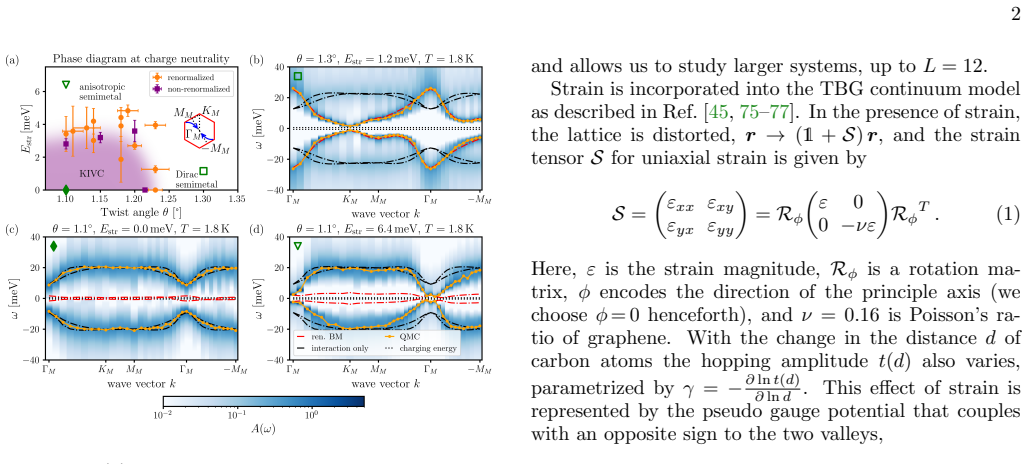
- [Fig. 1 caption] The caption says 'green symbols indicate the parameters of panels (b-d)', but the green symbols are not clearly visible or labeled in the rendered figure. Please ensure the markers are identifiable.
- [Appendix D, Eq. (D2)] The moiré lattice constant a_M is used in Eq. (D2) but not explicitly defined before this equation. Please define it in the text or in the caption.
- [Fig. 2 caption] The caption refers to 'dashed horizontal lines' representing entropy from the flat-band-limit ground-state degeneracy, but does not explain which line corresponds to which system size or how the quoted U(4) degeneracy is computed. Please clarify.
- [End Matter A.2 / Appendix B] The distinction between 'renormalized' and 'unrenormalized' bands is central to Fig. 1(a) and Appendix A.2, but the main text could make clearer which scheme is used for the later quantitative claims (entropy, spectral functions). A one-sentence summary in the main text would help.
Circularity Check
No significant circularity: central phase diagram and entropy plateau are direct QMC measurements; analytic comparison curves are not fitted to QMC data.
full rationale
The paper's central claims are extracted directly from sign-problem-free DQMC: the phase diagram comes from finite-size scaling of the KIVC correlation length ξ_KIVC (Appendix D, Eq. D2), the entropy is obtained by integrating ⟨H⟩ over β (Eq. F3), and the plateau is compared to the parameter-free value k_B ln C(8,4), not to a fitted model. The atomic-limit Hubbard U=33/35 meV is explicitly fit to the entropy for a comparison curve only ('the black curve represents the high temperature behavior obtained from a single-site SU(8) Hubbard model with U=33meV and U=35meV'), and is not used to generate a prediction. The analytic Mott self-energy Eq. (G16) is adopted from self-cited Refs [71,86], but the small parameter s≈0.25 was fixed by matching the single-particle TBG Bloch wavefunctions, not by fitting QMC observables; the QMC spectral functions are then compared to these analytic curves, so the comparison is a genuine check rather than a reduction-by-construction. Self-citations to [69] for the sign-problem-free property are supported by the explicit particle-hole symmetry transformation stated in Appendix B, and the QMC algorithm is described self-containedly in Appendix C. The only notable tension is a correctness/consistency issue, not circularity: the Discussion states the anisotropic semimetal is 'expected to be unstable at T=0 [103] towards an excitonic order, most likely some form of IVC,' which appears to conflict with the T=0 phase diagram labeling that region as a stable semimetal. This is flagged as a scientific risk (the boundary is inferred from absence of KIVC order at T=1.8 K and limited L), but it is not an equation-level circular reduction. Model approximations such as dropping θ-order terms (Appendix B) and the HF subtraction scheme are stated assumptions, not circular steps.
Assumptions & free parameters
free parameters (6)
- Hubbard U (atomic-limit comparison) =
33 meV (θ=1.1°), 35 meV (θ=1.15°)
- Small-s wavefunction parameter =
s≈0.25
- Angular shift Δθ between renormalized and unrenormalized schemes =
0.05°
- Screening parameters (ε_r, d0) =
ε_r=10, d0=20 nm
- Strain hopping parameter γ =
γ=2
- Poisson ratio ν =
0.16
assumptions (7)
- domain assumption The Bistritzer-MacDonald continuum model projected to the two narrow moiré bands per spin/valley captures the physics of TBG near the magic angle.
- domain assumption After dropping θ-order terms, the Hamiltonian has exact particle-hole symmetry C (Eq. B3), which guarantees absence of the sign problem at charge neutrality.
- domain assumption T=1.8 K is sufficiently low, and finite-size scaling of ξ_KIVC/L with L up to 12 correctly identifies the T=0 continuous transitions.
- standard math The entropy can be obtained by integrating the temperature derivative of ⟨H⟩ from the infinite-temperature limit S(β0)=8k_B L^2 ln 2 (Appendix F).
- domain assumption Maximum-entropy analytic continuation of imaginary-time QMC data provides reliable real-frequency spectral functions at the displayed energy scales.
- ad hoc to paper The small-s wavefunction ansatz (Eq. G2, s≈0.25) and the resulting classical Hamiltonian (Eq. G11) describe the flavor-incoherent state and yield the Mott semimetal self-energy (Eq. G16).
- domain assumption The Hartree-Fock subtraction scheme (Eq. B5) using the decoupled-layer HF potential avoids double counting without biasing the correlated phase diagram.
invented entities (1)
-
Dirac trion excitation
Cite this review
Pith. "Pith review of Monte Carlo Studies of Twisted Bilayer Graphene: Strain and Thermal Fluctuations." pith.science (2026). https://pith.science/paper/LUMQLGIQ
@misc{pith2026260720619,
  author       = {Pith},
  title        = {Pith review of: Monte Carlo Studies of Twisted Bilayer Graphene: Strain and Thermal Fluctuations},
  year         = {2026},
  howpublished = {\url{https://pith.science/paper/LUMQLGIQ}},
  note         = {Machine review of arXiv:2607.20619}
}
abstract
We study the phase diagram of twisted bilayer graphene at charge neutrality as a function of twist angle $\theta$, uniaxial heterostrain $\varepsilon$, and temperature $T$ using sign-problem-free quantum Monte Carlo simulations. At $T=0$ and zero strain, we find a continuous transition from a Dirac semimetal to a gapped Kramers inter-valley coherent (KIVC) phase as $\theta$ decreases toward the magic angle. With finite strain, the KIVC phase undergoes a further continuous transition at smaller $\theta$ into an anisotropic semimetal with gapless excitations near the center of the moir\'{e} Brillouin zone. In the KIVC regime, the entropy rises sharply with temperature and plateaus at $15\,\text{K} \lesssim T \lesssim 40\,\text{K}$ near the value expected from a Mott-like regime of localized electrons with nearly uncorrelated spin, valley, and orbital degrees of freedom, despite the topological obstruction preventing a localized tight-binding description of the active bands. The spectral function evolves continuously with $\theta$: at low $T$, a gap opens at the $K$ points and the minimal gap shifts to $\Gamma$ as $\theta$ decreases; at intermediate $T$, the spectral function smoothly interpolates between a Dirac semimetal spectrum with coherent $K$-point quasiparticles and a spectrum with gapless $\Gamma$-centered quasiparticles near the magic angle. The later can be a anisotropic or a Mott semimetal and we discuss how to distiguish them in experiment.
Figures


Figures from the paper (5 more)


Forward citations
Cited by 1 Pith paper
-
Trion Excitations in Twisted Bilayer Graphene: A Quantum Monte Carlo Study
Finite-temperature QMC of twisted bilayer graphene finds gapless 'Dirac trion' three-particle excitations in the normal state, exactly orthogonal to electrons at the Γ point.
Reference graph
Works this paper leans on
-
[103]
Grossman and E
O. Grossman and E. Berg, Robust fermi-liquid instabil- ities in sign problem-free models, Phys. Rev. Lett.131, 056501 (2023)
2023
-
[106]
More detailed calculations, including a finerθ grid and largerL, are needed to establish whether this is a true re-entrant KIVC phase
This may be related to the fact that, near this twist an- gle and strain, the two Dirac points meet at Γ M , which can enhance the tendency of the system towards KIVC order. More detailed calculations, including a finerθ grid and largerL, are needed to establish whether this is a true re-entrant KIVC phase
-
[1]
G. Li, A. Luican, J. Lopes dos Santos, A. Castro Neto, A. Reina, J. Kong, and E. Andrei, Observation of Van Hove singularities in twisted graphene layers, Nature physics6, 109 (2010)
2010
-
[2]
Bistritzer and A
R. Bistritzer and A. H. MacDonald, Moir´ e bands in twisted double-layer graphene, Proceedings of the Na- tional Academy of Sciences108, 12233 (2011)
2011
-
[3]
J. M. B. Lopes dos Santos, N. M. R. Peres, and A. H. Castro Neto, Continuum model of the twisted graphene bilayer, Phys. Rev. B86, 155449 (2012)
2012
-
[4]
Y. Cao, V. Fatemi, A. Demir, S. Fang, S. L. Tomarken, J. Y. Luo, J. D. Sanchez-Yamagishi, K. Watanabe, T. Taniguchi, E. Kaxiras, R. C. Ashoori, and P. Jarillo- Herrero, Correlated insulator behaviour at half-filling in magic-angle graphene superlattices, Nature556, 80 (2018)
2018
-
[5]
Y. Cao, V. Fatemi, S. Fang, K. Watanabe, T. Taniguchi, E. Kaxiras, and P. Jarillo-Herrero, Unconventional su- perconductivity in magic-angle graphene superlattices, Nature556, 43 (2018)
2018
-
[6]
Balents, C
L. Balents, C. R. Dean, D. K. Efetov, and A. F. Young, Superconductivity and strong correlations in moir´ e flat bands, Nature Physics16, 725 (2020)
2020
Show all 122 references
-
[7]
H. Yang, L. Liu, H. Yang, Y. Zhang, X. Wu, Y. Huang, H.-J. Gao, and Y. Wang, Advance in two-dimensional twisted moir´ e materials: Fabrication, properties, and applications, Nano Research16, 2579 (2023)
2023
-
[8]
B. A. Bernevig and D. K. Efetov, Twisted bilayer graphene’s gallery of phases, Physics Today77, 38 (2024)
2024
-
[9]
X. Lu, P. Stepanov, W. Yang, M. Xie, M. A. Aamir, I. Das, C. Urgell, K. Watanabe, T. Taniguchi, G. Zhang, A. Bachtold, A. H. MacDonald, and D. K. Efetov, Su- perconductors, orbital magnets and correlated states in magic-angle bilayer graphene, Nature574, 653 (2019)
2019
-
[10]
Y. Xie, B. Lian, B. J¨ ack, X. Liu, C.-L. Chiu, K. Watan- 6 abe, T. Taniguchi, B. A. Bernevig, and A. Yazdani, Spectroscopic signatures of many-body correlations in magic-angle twisted bilayer graphene, Nature572, 101 (2019)
2019
-
[11]
Y. Choi, J. Kemmer, Y. Peng, A. Thomson, H. Arora, R. Polski, Y. Zhang, H. Ren, J. Alicea, G. Refael, F. von Oppen, K. Watanabe, T. Taniguchi, and S. Nadj-Perge, Electronic correlations in twisted bilayer graphene near the magic angle, Nature Physics 10.1038/s41567-019- 0606-5 (2019)
2019 doi
-
[12]
Jiang, X
Y. Jiang, X. Lai, K. Watanabe, T. Taniguchi, K. Haule, J. Mao, and E. Y. Andrei, Charge order and bro- ken rotational symmetry in magic-angle twisted bilayer graphene, Nature573, 91 (2019)
2019
-
[13]
Serlin, C
M. Serlin, C. Tschirhart, H. Polshyn, Y. Zhang, J. Zhu, K. Watanabe, T. Taniguchi, L. Balents, and A. Young, Intrinsic quantized anomalous hall effect in a moir´ e het- erostructure, Science367, 900 (2020)
2020
-
[14]
A. L. Sharpe, E. J. Fox, A. W. Barnard, J. Finney, K. Watanabe, T. Taniguchi, M. Kastner, and D. Goldhaber-Gordon, Emergent ferromagnetism near three-quarters filling in twisted bilayer graphene, Sci- ence365, 605 (2019)
2019
-
[15]
E. Y. Andrei and A. H. MacDonald, Graphene bilayers with a twist, Nature materials19, 1265 (2020)
2020
-
[16]
Zondiner, A
U. Zondiner, A. Rozen, D. Rodan-Legrain, Y. Cao, R. Queiroz, T. Taniguchi, K. Watanabe, Y. Oreg, F. von Oppen, A. Stern,et al., Cascade of phase transitions and dirac revivals in magic-angle graphene, Nature582, 203 (2020)
2020
-
[17]
D. Wong, K. P. Nuckolls, M. Oh, B. Lian, Y. Xie, S. Jeon, K. Watanabe, T. Taniguchi, B. A. Bernevig, and A. Yazdani, Cascade of electronic transitions in magic-angle twisted bilayer graphene, Nature582, 198 (2020)
2020
-
[18]
Y. Xie, A. T. Pierce, J. M. Park, D. E. Parker, E. Kha- laf, P. Ledwith, Y. Cao, S. H. Lee, S. Chen, P. R. For- rester,et al., Fractional chern insulators in magic-angle twisted bilayer graphene, Nature600, 439 (2021)
2021
-
[19]
J. Yu, B. A. Foutty, Z. Han, M. E. Barber, Y. Schattner, K. Watanabe, T. Taniguchi, P. Phillips, Z.-X. Shen, S. A. Kivelson,et al., Correlated hofstadter spectrum and flavour phase diagram in magic-angle twisted bi- layer graphene, Nature Physics18, 825 (2022)
2022
-
[20]
Grover, M
S. Grover, M. Bocarsly, A. Uri, P. Stepanov, G. Di Bat- tista, I. Roy, J. Xiao, A. Y. Meltzer, Y. Myasoedov, K. Pareek,et al., Chern mosaic and berry-curvature magnetism in magic-angle graphene, Nature physics18, 885 (2022)
2022
-
[21]
K. P. Nuckolls, R. L. Lee, M. Oh, D. Wong, T. Soejima, J. P. Hong, D. C˘ alug˘ aru, J. Herzog-Arbeitman, B. A. Bernevig, K. Watanabe,et al., Quantum textures of the many-body wavefunctions in magic-angle graphene, Na- ture620, 525 (2023)
2023
-
[22]
Guinea and N
F. Guinea and N. R. Walet, Electrostatic effects, band distortions, and superconductivity in twisted graphene bilayers, Proceedings of the National Academy of Sci- ences115, 13174 (2018)
2018
-
[23]
H. C. Po, L. Zou, A. Vishwanath, and T. Senthil, Ori- gin of Mott Insulating Behavior and Superconductivity in Twisted Bilayer Graphene, Phys. Rev. X8, 031089 (2018)
2018
-
[24]
Z. Song, Z. Wang, W. Shi, G. Li, C. Fang, and B. A. Bernevig, All magic angles in twisted bilayer graphene are topological, Phys. Rev. Lett.123, 036401 (2019)
2019
-
[26]
Koshino, N
M. Koshino, N. F. Q. Yuan, T. Koretsune, M. Ochi, K. Kuroki, and L. Fu, Maximally localized wannier or- bitals and the extended hubbard model for twisted bi- layer graphene, Phys. Rev. X8, 031087 (2018)
2018
-
[27]
N. F. Q. Yuan and L. Fu, Model for the metal-insulator transition in graphene superlattices and beyond, Phys. Rev. B98, 045103 (2018)
2018
-
[28]
J. F. Dodaro, S. A. Kivelson, Y. Schattner, X. Q. Sun, and C. Wang, Phases of a phenomenological model of twisted bilayer graphene, Phys. Rev. B98, 075154 (2018)
2018
-
[29]
Padhi, C
B. Padhi, C. Setty, and P. W. Phillips, Doped twisted bi- layer graphene near magic angles: Proximity to wigner crystallization, not mott insulation, Nano letters18, 6175 (2018)
2018
-
[30]
Tarnopolsky, A
G. Tarnopolsky, A. J. Kruchkov, and A. Vishwanath, Origin of magic angles in twisted bilayer graphene, Phys. Rev. Lett.122, 106405 (2019)
2019
-
[31]
S. Carr, S. Fang, Z. Zhu, and E. Kaxiras, Exact contin- uum model for low-energy electronic states of twisted bilayer graphene, Phys. Rev. Res.1, 013001 (2019)
2019
-
[32]
S. Carr, S. Fang, H. C. Po, A. Vishwanath, and E. Kaxi- ras, Derivation of wannier orbitals and minimal-basis tight-binding hamiltonians for twisted bilayer graphene: First-principles approach, Phys. Rev. Res.1, 033072 (2019)
2019
-
[33]
H. C. Po, L. Zou, T. Senthil, and A. Vishwanath, Faith- ful tight-binding models and fragile topology of magic- angle bilayer graphene, Phys. Rev. B99, 195455 (2019)
2019
-
[34]
Rademaker, D
L. Rademaker, D. A. Abanin, and P. Mellado, Charge smoothening and band flattening due to hartree correc- tions in twisted bilayer graphene, Phys. Rev. B100, 205114 (2019)
2019
-
[35]
T. Cea, N. R. Walet, and F. Guinea, Twists and the electronic structure of graphitic materials,Nano Letters, Nano Letters19, 8683 (2019)
2019
-
[36]
K. Seo, V. N. Kotov, and B. Uchoa, Ferromagnetic mott state in twisted graphene bilayers at the magic angle, Phys. Rev. Lett.122, 246402 (2019)
2019
-
[37]
A. O. Sboychakov, A. V. Rozhkov, A. L. Rakhmanov, and F. Nori, Many-body effects in twisted bilayer graphene at low twist angles, Phys. Rev. B100, 045111 (2019)
2019
-
[38]
Thomson, S
A. Thomson, S. Chatterjee, S. Sachdev, and M. S. Scheurer, Triangular antiferromagnetism on the honey- comb lattice of twisted bilayer graphene, Phys. Rev. B 98, 075109 (2018)
2018
-
[39]
Y. Cao, D. Chowdhury, D. Rodan-Legrain, O. Rubies- Bigorda, K. Watanabe, T. Taniguchi, T. Senthil, and P. Jarillo-Herrero, Strange metal in magic-angle graphene with near planckian dissipation, Phys. Rev. Lett.124, 076801 (2020)
2020
-
[40]
Xie and A
M. Xie and A. H. MacDonald, Nature of the correlated insulator states in twisted bilayer graphene, Phys. Rev. Lett.124, 097601 (2020)
2020
-
[41]
Wu and S
F. Wu and S. Das Sarma, Collective excitations of quantum anomalous hall ferromagnets in twisted bilayer graphene, Phys. Rev. Lett.124, 046403 (2020)
2020
-
[42]
B. A. Bernevig, Z.-D. Song, N. Regnault, and B. Lian, 7 Twisted bilayer graphene. i. matrix elements, approx- imations, perturbation theory, and ak·ptwo-band model, Phys. Rev. B103, 205411 (2021)
2021
-
[43]
P. J. Ledwith, E. Khalaf, and A. Vishwanath, Strong coupling theory of magic-angle graphene: A pedagogical introduction, Annals of Physics435, 168646 (2021)
2021
-
[44]
S. Liu, E. Khalaf, J. Y. Lee, and A. Vishwanath, Ne- matic topological semimetal and insulator in magic- angle bilayer graphene at charge neutrality, Phys. Rev. Res.3, 013033 (2021)
2021
-
[45]
D. E. Parker, T. Soejima, J. Hauschild, M. P. Zaletel, and N. Bultinck, Strain-induced quantum phase tran- sitions in magic-angle graphene, Phys. Rev. Lett.127, 027601 (2021)
2021
-
[46]
Y. H. Kwan, G. Wagner, T. Soejima, M. P. Zaletel, S. H. Simon, S. A. Parameswaran, and N. Bultinck, Kekul´ e spiral order at all nonzero integer fillings in twisted bi- layer graphene, Phys. Rev. X11, 041063 (2021)
2021
-
[47]
Shavit, E
G. Shavit, E. Berg, A. Stern, and Y. Oreg, Theory of correlated insulators and superconductivity in twisted bilayer graphene, Phys. Rev. Lett.127, 247703 (2021)
2021
-
[48]
Liu and X
J. Liu and X. Dai, Theories for the correlated insulating states and quantum anomalous hall effect phenomena in twisted bilayer graphene, Phys. Rev. B103, 035427 (2021)
2021
-
[49]
Wagner, Y
G. Wagner, Y. H. Kwan, N. Bultinck, S. H. Simon, and S. A. Parameswaran, Global phase diagram of the nor- mal state of twisted bilayer graphene, Phys. Rev. Lett. 128, 156401 (2022)
2022
-
[50]
Vafek and J
O. Vafek and J. Kang, Continuum effective hamiltonian for graphene bilayers for an arbitrary smooth lattice de- formation from microscopic theories, Phys. Rev. B107, 075123 (2023)
2023
-
[51]
C. N. Breiø and B. M. Andersen, Chern insulator phases and spontaneous spin and valley order in a moir´ e lattice model for magic-angle twisted bilayer graphene, Phys. Rev. B107, 165114 (2023)
2023
-
[52]
Sheffer, R
Y. Sheffer, R. Queiroz, and A. Stern, Symmetries as the guiding principle for flattening bands of dirac fermions, Phys. Rev. X13, 021012 (2023)
2023
-
[53]
J. Zhu, I. Torre, M. Polini, and A. H. MacDonald, Weak- coupling theory of magic-angle twisted bilayer graphene, Phys. Rev. B110, L121117 (2024)
2024
-
[54]
K. D. Stubbs, M. Ragone, A. H. MacDonald, and L. Lin, The many-body ground state manifold of flat band in- teracting hamiltonian for magic angle twisted bilayer graphene (2025), arXiv:2503.20060 [math-ph]
2025 arXiv
-
[55]
Haule, E
M. Haule, E. Y. Andrei, and K. Haule, The Mott- semiconducting state in the magic angle bilayer graphene (2019), arXiv:1901.09852 [cond-mat.str-el]
2019 arXiv
-
[56]
Kang and O
J. Kang and O. Vafek, Non-abelian dirac node braiding and near-degeneracy of correlated phases at odd integer filling in magic-angle twisted bilayer graphene, Phys. Rev. B102, 035161 (2020)
2020
-
[57]
Potasz, M
P. Potasz, M. Xie, and A. H. MacDonald, Exact di- agonalization for magic-angle twisted bilayer graphene, Phys. Rev. Lett.127, 147203 (2021)
2021
-
[58]
Da Liao, J
Y. Da Liao, J. Kang, C. N. Breiø, X. Y. Xu, H.-Q. Wu, B. M. Andersen, R. M. Fernandes, and Z. Y. Meng, Correlation-induced insulating topological phases at charge neutrality in twisted bilayer graphene, Phys. Rev. X11, 011014 (2021)
2021
-
[59]
F. Xie, A. Cowsik, Z.-D. Song, B. Lian, B. A. Bernevig, and N. Regnault, Twisted bilayer graphene. vi. an exact diagonalization study at nonzero integer filling, Phys. Rev. B103, 205416 (2021)
2021
-
[60]
Pahlevanzadeh, P
B. Pahlevanzadeh, P. Sahebsara, and D. S´ en´ echal, Charge order and antiferromagnetism in twisted bilayer graphene from the variational cluster approximation, SciPost Phys.13, 040 (2022)
2022
-
[61]
F. Xie, J. Kang, B. A. Bernevig, O. Vafek, and N. Reg- nault, Phase diagram of twisted bilayer graphene at fill- ing factorν=±3, Phys. Rev. B107, 075156 (2023)
2023
-
[62]
T. Wang, D. E. Parker, T. Soejima, J. Hauschild, S. Anand, N. Bultinck, and M. P. Zaletel, Ground-state order in magic-angle graphene at fillingν=−3: A full- scale density matrix renormalization group study, Phys. Rev. B108, 235128 (2023)
2023
-
[63]
Zhang, G
X. Zhang, G. Pan, B.-B. Chen, H. Li, K. Sun, and Z. Y. Meng, Polynomial sign problem and topological mott insulator in twisted bilayer graphene, Phys. Rev. B107, L241105 (2023)
2023
-
[64]
F. M. Faulstich, K. D. Stubbs, Q. Zhu, T. Soejima, R. Dilip, H. Zhai, R. Kim, M. P. Zaletel, G. K.-L. Chan, and L. Lin, Interacting models for twisted bilayer graphene: A quantum chemistry approach, Phys. Rev. B107, 235123 (2023)
2023
-
[65]
Datta, M
A. Datta, M. J. Calderon, A. Camjayi, and E. Bascones, Heavy quasiparticles and cascades without symmetry breaking in twisted bilayer graphene, Nature Commu- nications14, 5036 (2023)
2023
-
[66]
G. Rai, L. Crippa, D. C˘ alug˘ aru, H. Hu, F. Paoletti, L. de’ Medici, A. Georges, B. A. Bernevig, R. Valent ´ ı, G. Sangiovanni, and T. Wehling, Dynamical correla- tions and order in magic-angle twisted bilayer graphene, Phys. Rev. X14, 031045 (2024)
2024
-
[67]
M. J. Calderon, A. Camjayi, A. Datta, and E. Bas- cones, Cascades in transport and optical conductivity of twisted bilayer graphene (2025), arXiv:2412.20855 [cond-mat.str-el]
2025 arXiv
-
[68]
Xiao and S
Z.-Y. Xiao and S. Zhang, Correlation effects in magic- angle twisted bilayer graphene: An auxiliary-field quan- tum monte carlo study, Phys. Rev. Res.7, 013103 (2025)
2025
-
[69]
J. S. Hofmann, E. Khalaf, A. Vishwanath, E. Berg, and J. Y. Lee, Fermionic Monte Carlo Study of a Realistic Model of Twisted Bilayer Graphene, Phys. Rev. X12, 011061 (2022)
2022
-
[70]
Zhang, G
X. Zhang, G. Pan, Y. Zhang, J. Kang, and Z. Y. Meng, Momentum space quantum Monte Carlo on twisted bilayer graphene, Chinese Physics Letters38, 077305 (2021)
2021
-
[71]
P. J. Ledwith, J. Dong, A. Vishwanath, and E. Khalaf, Nonlocal Moments and Mott Semimetal in the Chern Bands of Twisted Bilayer Graphene, Phys. Rev. X15, 021087 (2025)
2025
-
[72]
Hu, Z.-D
H. Hu, Z.-D. Song, and B. A. Bernevig, Projected and Solvable: Topological Heavy Fermion Model of Twisted Bilayer Graphene (2025), arXiv:2502.14039 [cond-mat.str-el]
2025
-
[73]
Such particle-hole symmetry breaking terms contain those originating from the rotation of the Dirac Pauli matrices, proportional toθ
-
[74]
Z. Wang, M. P. Zaletel, R. S. K. Mong, and F. F. As- saad, Phases of the (2+1) Dimensional SO(5) Nonlinear Sigma Model with Topological Term, Phys. Rev. Lett. 126, 045701 (2021)
2021
-
[75]
Balents, General continuum model for twisted bilayer 8 graphene and arbitrary smooth deformations, SciPost Physics7, 048 (2019)
L. Balents, General continuum model for twisted bilayer 8 graphene and arbitrary smooth deformations, SciPost Physics7, 048 (2019)
2019
-
[76]
Z. Bi, N. F. Q. Yuan, and L. Fu, Designing flat bands by strain, Phys. Rev. B100, 035448 (2019)
2019
-
[77]
Antebi, A
O. Antebi, A. Stern, and E. Berg, In-plane orbital mag- netization as a probe for symmetry breaking in strained twisted bilayer graphene, Phys. Rev. B105, 104423 (2022)
2022
-
[78]
K. S. D. Beach, Identifying the maximum entropy method as a special limit of stochastic analytic con- tinuation, arXiv e-prints , cond-mat/0403055 (2004), arXiv:cond-mat/0403055 [cond-mat.str-el]
2004 arXiv
-
[79]
Bultinck, E
N. Bultinck, E. Khalaf, S. Liu, S. Chatterjee, A. Vish- wanath, and M. P. Zaletel, Ground state and hidden symmetry of magic-angle graphene at even integer fill- ing, Phys. Rev. X10, 031034 (2020)
2020
-
[80]
In realistic samples, weak inter-valley Hund’s coupling breaks this symmetry and lifts the degeneracy, se- lecting either a singlet KIVC—which then exhibits a finite-temperature Berezinskii–Kosterlitz–Thouless transition—or a triplet KIVC, which remains disordered for allT >0
-
[81]
M. J. Calder´ on and E. Bascones, Interactions in the 8- orbital model for twisted bilayer graphene, Phys. Rev. B102, 155149 (2020)
2020
-
[82]
Song and B
Z.-D. Song and B. A. Bernevig, Magic-Angle Twisted Bilayer Graphene as a Topological Heavy Fermion Prob- lem, Phys. Rev. Lett.129, 047601 (2022)
2022
-
[83]
J.-Y. Zhao, B. Zhou, and Y.-H. Zhang, Mixed valence mott insulator and composite excitation in twisted bi- layer graphene (2025), arXiv:2507.00139 [cond-mat.str- el]
2025 arXiv
-
[84]
J. Xiao, A. Inbar, J. Birkbeck, N. Gershon, Y. Zamir, T. Taniguchi, K. Watanabe, E. Berg, and S. Ilani, The Interacting Energy Bands of Magic Angle Twisted Bi- layer Graphene Revealed by the Quantum Twisting Mi- croscope (2025), arXiv:2506.20738 [cond-mat.mes-hall]
2025 arXiv
-
[85]
By “gapped” we mean that the spectral function is peaked at a non-zero frequency
Strictly speaking, there is no true gap atT >0. By “gapped” we mean that the spectral function is peaked at a non-zero frequency
-
[86]
P. J. Ledwith, A. Vishwanath, and E. Khalaf, Exotic carriers from concentrated topology: Dirac trions as the origin of the missing spectral weight in twisted bilayer graphene (2025), arXiv:2505.08779 [cond-mat.str-el]
2025 arXiv
-
[87]
L. Zou, H. C. Po, A. Vishwanath, and T. Senthil, Band structure of twisted bilayer graphene: Emergent sym- metries, commensurate approximants, and wannier ob- structions, Phys. Rev. B98, 085435 (2018)
2018
-
[88]
Z.-D. Song, B. Lian, N. Regnault, and B. A. Bernevig, Twisted bilayer graphene. ii. stable symmetry anomaly, Phys. Rev. B103, 205412 (2021)
2021
-
[89]
J. Yu, M. Xie, B. A. Bernevig, and S. Das Sarma, Magic- angle twisted symmetric trilayer graphene as a topolog- ical heavy-fermion problem, Phys. Rev. B108, 035129 (2023)
2023
-
[90]
H. Hu, B. A. Bernevig, and A. M. Tsvelik, Kondo lattice model of magic-angle twisted-bilayer graphene: Hund’s rule, local-moment fluctuations, and low-energy effec- tive theory, Phys. Rev. Lett.131, 026502 (2023)
2023
-
[91]
H. Hu, G. Rai, L. Crippa, J. Herzog-Arbeitman, D. C˘ alug˘ aru, T. Wehling, G. Sangiovanni, R. Valent ´ ı, A. M. Tsvelik, and B. A. Bernevig, Symmetric kondo lattice states in doped strained twisted bilayer graphene, Phys. Rev. Lett.131, 166501 (2023)
2023
-
[92]
Herzog-Arbeitman, J
J. Herzog-Arbeitman, J. Yu, D. C˘ alug˘ aru, H. Hu, N. Regnault, C. Liu, O. Vafek, P. Coleman, A. Tsve- lik, Z. da Song, and B. A. Bernevig, Topological heavy fermion principle for flat (narrow) bands with con- centrated quantum geometry (2024), arXiv:2404.07253 [cond-mat.str-el]
2024 arXiv
-
[93]
C˘ alug˘ aru, H
D. C˘ alug˘ aru, H. Hu, L. Crippa, G. Rai, N. Regnault, T. O. Wehling, R. Valent ´ ı, G. Sangiovanni, and B. A. Bernevig, Obtaining the Spectral Function of Moir´ e Graphene Heavy-Fermions Using Iterative Perturbation Theory (2025), arXiv:2509.18256 [cond-mat]
2025
-
[94]
L. L. H. Lau and P. Coleman, Topological mixed valence model for twisted bilayer graphene, Phys. Rev. X15, 021028 (2025)
2025
-
[95]
J.-Y. Zhao, B. Zhou, and Y.-H. Zhang, Ancilla theory of twisted bilayer graphene i: topological mott localization and pseudogap metal in twisted bilayer graphene (2025), arXiv:2502.17430 [cond-mat.str-el]
2025 arXiv
-
[96]
Vituri and E
Y. Vituri and E. Berg, Controlled loop expansion for the topological heavy fermion model, arXiv preprint arXiv:2604.14278 (2026)
2026 arXiv
-
[97]
H. Hu, Y. Shao, L. Crippa, D. C˘ alug˘ aru, G. Sangio- vanni, T. Wehling, L. I. Glazman, and B. A. Bernevig, Twisted bilayer graphene lifetimes at integer fillings: An analytic result, arXiv preprint arXiv:2604.14303 (2026)
2026 arXiv
-
[98]
N. Wei, F. von Oppen, and L. I. Glazman, Lifetime and spectral function of topological heavy fermions, arXiv preprint arXiv:2604.14369 (2026)
2026 arXiv
-
[99]
P. A. Nosov, E. Khalaf, and P. Ledwith, Controlled ex- pansion for correlated electrons with concentrated kine- matics (2026), arXiv:2605.20171 [cond-mat.str-el]
2026 arXiv
-
[100]
Rozen, J
A. Rozen, J. M. Park, U. Zondiner, Y. Cao, D. Rodan- Legrain, T. Taniguchi, K. Watanabe, Y. Oreg, A. Stern, E. Berg, P. Jarillo-Herrero, and S. Ilani, Entropic evidence for a Pomeranchuk effect in magic-angle graphene, Nature592, 214 (2021)
2021
-
[101]
Saito, F
Y. Saito, F. Yang, J. Ge, X. Liu, K. Watanabe, T. Taniguchi, J. I. A. Li, E. Berg, and A. F. Young, Isospin Pomeranchuk effect in twisted bilayer graphene, Nature592, 191 (2021)
2021
-
[102]
Inbar, J
A. Inbar, J. Birkbeck, J. Xiao, T. Taniguchi, K. Watan- abe, B. Yan, Y. Oreg, A. Stern, E. Berg, and S. Ilani, The Quantum Twisting Microscope, Nature614, 682 (2023)
2023
-
[104]
F. F. Assaad, M. Bercx, F. Goth, A. G¨ otz, J. S. Hof- mann, E. Huffman, Z. Liu, F. Parisen Toldin, J. Sta- fusa, E. Portela, and J. Schwab, The ALF (Algorithms for Lattice Fermions) project release 2.0, SciPost Phys. Codebases1, 10.21468/SciPostPhysCodeb.1 (2022)
2022 doi
-
[105]
Huang, N
C. Huang, N. Parthenios, M. Ulybyshev, X. Zhang, F. F. Assaad, L. Classen, and Z. Y. Meng, Angle- Tuned Gross-Neveu Quantum Criticality in Twisted Bi- layer Graphene: A Quantum Monte Carlo Study (2025), arXiv:2412.11382 [cond-mat.str-el]
2025 arXiv
-
[107]
R. T. Scalettar, D. J. Scalapino, R. L. Sugar, and 9 D. Toussaint, Hybrid molecular-dynamics algorithm for the numerical simulation of many-electron systems, Phys. Rev. B36, 8632 (1987)
1987
-
[108]
Kogut and L
J. Kogut and L. Susskind, Hamiltonian formulation of Wilson’s lattice gauge theories, Phys. Rev. D11, 395 (1975)
1975
-
[109]
S. Beyl, F. Goth, and F. F. Assaad, Revisiting the hy- brid quantum Monte Carlo method for Hubbard and electron-phonon models, Phys. Rev. B97, 85144 (2018)
2018
-
[110]
Lunts, M
P. Lunts, M. S. Albergo, and M. Lindsey, Non-Hertz- Millis scaling of the antiferromagnetic quantum critical metal via scalable Hybrid Monte Carlo, Nature Com- munications14, 2547 (2023)
2023
-
[111]
Parisen Toldin, M
F. Parisen Toldin, M. Hohenadler, F. F. Assaad, and I. F. Herbut, Fermionic quantum criticality in honey- comb andπ-flux Hubbard models: Finite-size scaling of renormalization-group-invariant observables from quan- tum Monte Carlo, Physical Review B91, 165108 (2015)
2015
-
[112]
WhileZdetermines the relative weight of configura- tions, its normalization is unknown and not required for detailed balance
-
[113]
Lian, Z.-D
B. Lian, Z.-D. Song, N. Regnault, D. K. Efetov, A. Yaz- dani, and B. A. Bernevig, Tbg iv: Exact insulator ground states and phase diagram of twisted bilayer graphene (2020), arXiv:2009.13530 [cond-mat.str-el]
2020 arXiv
-
[114]
Vafek and J
O. Vafek and J. Kang, Renormalization group study of hidden symmetry in twisted bilayer graphene with coulomb interactions, Phys. Rev. Lett.125, 257602 (2020)
2020
-
[115]
Zhang, S
Z. Zhang, S. Wu, D. C˘ alug˘ aru, H. Hu, T. Taniguchi, K. Wanatabe, A. B. Bernevig, and E. Y. Andrei, Heavy fermions, mass renormalization and local moments in magic-angle twisted bilayer graphene via planar tunnel- ing spectroscopy (2025), arXiv:2503.17875 [cond-mat]
2025 arXiv
-
[116]
Haldane, A modular-invariant modified weierstrass sigma-function as a building block for lowest-landau- level wavefunctions on the torus, Journal of Mathemat- ical Physics59(2018)
F. Haldane, A modular-invariant modified weierstrass sigma-function as a building block for lowest-landau- level wavefunctions on the torus, Journal of Mathemat- ical Physics59(2018). 10 Appendix A: End Matter
2018
-
[117]
strain and KIVC correlation length In Fig
Phase diagram vs. strain and KIVC correlation length In Fig. 4(a), we present the same data as in Fig. 1(a) of the main text, but as a function of the parameters θandϵinstead of the energy scales. The color map in green-yellow visualizes the strain energy scale,E str(θ, ϵ), th...
-
[118]
Renormalized and unrenormalized BM bands with heterostrain In this Appendix, we examine the single-particle band- structure in the presence of strain, using either the bare FIG. 4.(a) Phase diagram.A gapped KIVC phase (or- ange) borders an anisotropic semimetal (transparent), ...
-
[119]
sublattice basis
Smalls 2 in TBG We now review how to identify a small parameters2 ≪ 1 in TBG[71]. We begin by restating the band projected model (B5) ˆH= X k c† khsp k ck + ˆV , ˆV= 1 2 X q ρqVqρ−q (G1) whereh sp k is the (renormalized) single particle dispersion matrix. Because the TBG bands...
-
[120]
Hartree-Fock
Green’s function and Schwinger-Dyson Equation We now set up notation and discuss a general identity that we will use to compute the electron spectral func- tion. All results stated in this subsection are fully general and do not rely ons 2 ≪1. We will need to compute the Green...
-
[121]
We emphasize again that all statements above are exact
for the equivalent identity in a Hubbard-Stratonovich framework. We emphasize again that all statements above are exact. We now use smalls 2 to evaluate (G10) for the symmetric Mott state
-
[122]
Thus, the electron momentumkis always split between at least two internal lines, e.g.k−q andq, with the relative momentaqintegrated over as a loop integral
Evaluation of Mott Self-Energy Usings 2 ≪1 To begin, we note that all diagrams contributing to the 1PI correlator (G10) remain connected after cutting any internal electron line. Thus, the electron momentumkis always split between at least two internal lines, e.g.k−q andq, wit...
-
[123]
ForE str nonzero, one obtains a crossover[86] between the Mott semimetal (E str ≪T) and the anisotropic semimetal (Estr ≫T)
Anisotropic semimetal and KIVC Insulator We close by commenting on the anisotropic semimetal and KIVC states. ForE str nonzero, one obtains a crossover[86] between the Mott semimetal (E str ≪T) and the anisotropic semimetal (Estr ≫T). The crossover is driven by the magnetizati...
Reviewed August 1, 2026 · model on record in the stance chip above.
Discussion (0). Continue with ORCID to comment.