REVIEW 4 major objections 5 minor 74 references
Two starless hydrogen clouds near M51 are promising dark-matter halo candidates.
Reviewed by Pith at T0; open to challenge. T0 means a machine referee read the full paper against a public rubric. the ladder, T0–T4 →
T0 review · deepseek-v4-flash
2026-08-01 08:38 UTC pith:VUV2CZD2
load-bearing objection Two new HI clouds plausibly placed in the RELHIC framework, with honest caveats; the unresolved beam and selection circularity keep this at 'candidate' level, but the discovery is solid. the 4 major comments →
A RELHIC twin candidate near the galaxy M51
The pith
A machine-rendered reading of the paper's core claim, the machinery that carries it, and where it could break.
Core claim
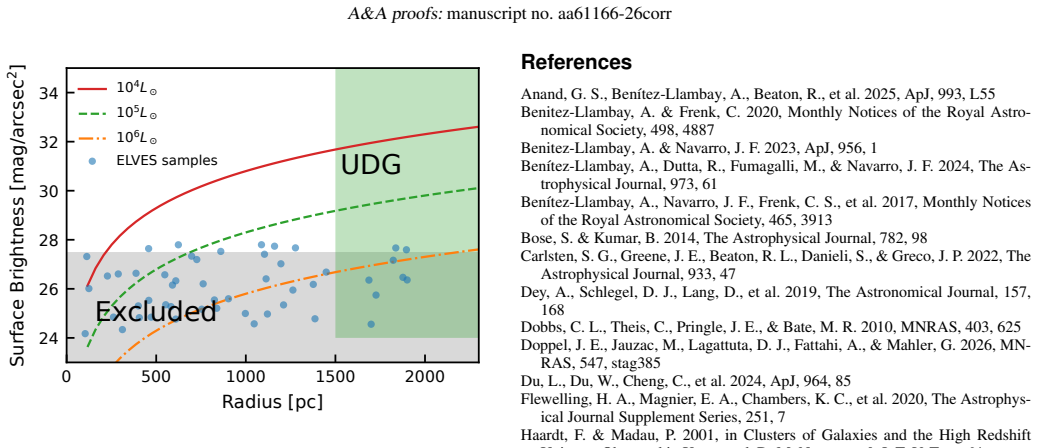
Using deep 21-centimetre observations from a large single-dish radio telescope, the authors identified two compact hydrogen clouds at projected distances of 70-90 kpc from M51. Each cloud has an H I mass of about 10^6.5 solar masses and a velocity dispersion near 20 km/s. Cross-matching against deep optical imaging finds no stellar counterpart down to a g-band surface brightness of roughly 27.5 mag arcsec^-2, implying a stellar luminosity below about 10^5 solar luminosities. Modelling the clouds as hydrostatic gas embedded in Navarro-Frenk-White dark-matter halos, with heating by the ultraviolet background and self-shielding, gives best-fit halo masses of about 3.7 ± 0.4 × 10^9 solar masses
What carries the argument
The central object is the RELHIC model: reionization-limited H I clouds, defined as gas in low-mass dark-matter halos that remains gravitationally bound after reionization, settles into hydrostatic equilibrium with the ultraviolet background, and never cools enough to form stars. The argument uses the hydrostatic equilibrium equation for gas in an NFW dark-matter halo, a temperature-density relation set by photoionisation from the ultraviolet background, and a self-shielding prescription to compute the neutral hydrogen fraction and column density profile. The predicted profiles are convolved with the telescope beam and matched to the observed clouds; the inferred halo masses fall in the narr
Load-bearing premise
The interpretation depends on each cloud being a single gravitationally bound object; the observations do not resolve their internal structure, so several tidal gas clumps blended together could mimic one cloud.
What would settle it
Arcsecond-resolution 21-centimetre mapping of Cloud S and Cloud N: if they resolve into compact, roughly spherical cores with quiet, thermally broadened velocity fields, the RELHIC reading is supported; if they break into filaments or show velocity gradients linking them to M51's tidal debris, the dark-halo interpretation fails.
If this is right
- If Cloud S and Cloud N are confirmed as RELHICs, they would almost double the number of credible starless dark-matter halo candidates and strengthen the case that galaxy formation shuts off near 10^9 solar masses.
- Their inferred halo masses sit in the predicted sweet spot: massive enough for the ultraviolet background to leave a detectable neutral core, yet light enough that cooling and star formation have not switched on.
- The model predicts intrinsic neutral-hydrogen column densities two to three orders of magnitude above the blurred values seen by the current telescope, so higher-resolution observations should detect the compact cores if the halos are real.
- The clouds are kinematically consistent with the M51 system at a distance of 8 Mpc, so if they are gravitationally bound they could serve as dynamical tracers of M51's dark-matter distribution.
- If follow-up observations instead resolve them as tidal debris, the same data will constrain how much neutral gas was stripped from M51 during its interaction and where that gas now sits.
Where Pith is reading between the lines
- If the RELHIC interpretation is right, similar searches around other massive, gas-rich spirals should find such clouds routinely; the M51 pair may be the first of a population rather than a rare accident.
- The two clouds have nearly identical gas masses and line widths but different apparent velocity gradients, so high-resolution kinematics could separate pressure-supported dark halos from rotating or shearing tidal debris more cleanly than mass alone.
- The quoted halo mass depends on the assumed ultraviolet-background model and the adopted mass-concentration relation; independent dynamical masses from resolved kinematics would test whether the 3.7×10^9 solar-mass estimate is robust.
- Deep optical imaging that resolves individual stars could push the stellar-mass limit below 10^5 solar masses and reveal whether any star formation has ever occurred, deciding between a truly dark halo and a failed galaxy with an extremely faint stellar component.
Editorial analysis
A structured set of objections, weighed in public.
Referee Report
Summary. The manuscript reports the detection of two compact H I clouds, Cloud S and Cloud N, in FEASTS FAST observations of the M51 system. After removing sources with optical counterparts in DESI Legacy Surveys and applying morphological and line-width criteria, the authors identify these two clouds as candidate reionisation-limited H I clouds (RELHICs). They model each cloud as hydrostatic H I embedded in an NFW dark-matter halo within the Benítez-Llambay et al. (2017) framework and infer host halo masses M200 ~ 3.7 ± 0.4 × 10^9 M⊙. They validate the mass-inference method against starless TNG50 subhalos and compare mock beam-convolved gas kinematics with the observations. They conclude that the clouds are promising but not definitive RELHIC candidates, explicitly leaving open a tidal origin in the interacting M51 system.
Significance. If the two clouds are genuinely single, gravitationally bound, dark-matter-dominated systems with no stars, they would add two objects to the sparse catalogue of dark galaxy candidates and would support the predicted suppression of star formation in low-mass ΛCDM halos. The paper's strengths are its honest hedging, the use of TNG50 to sanity-check the mass estimator, and the explicit statement of the tidal alternative. Its central limitation is that FAST does not resolve the clouds: the 3.24′ beam corresponds to ~7.5 kpc at 8 Mpc, so the fundamental assumption that each detection is one coherent structure is untested. The claimed consistency with RELHIC predictions is also partly built into the source selection and into the mass-fitting procedure that uses the observed H I mass as input.
major comments (4)
- [Section 2, criterion (iii), and Table 1] Criterion (iii) requires velocity dispersions 'of order ~20 km/s, as expected for thermally broadened neutral gas in RELHICs.' The later statement that the measured W50 values are compatible with RELHIC predictions is therefore not an independent test. In particular, Cloud N has W50 = 29.3 km/s, above the fiducial thermal value. Please report how many optical-dark, morphologically round H I sources in the full FEASTS sample were rejected only by this criterion, and show the observed spectra with single-Gaussian fits. Without this, the reader cannot assess how strongly the candidate selection has pre-biased the sample toward RELHIC-like line widths.
- [Section 3.1 and Appendix A] The hydrostatic RELHIC model assumes each cloud is a single spherical gas core in one NFW halo, but the data do not resolve the clouds; Section 3.1 explicitly states that 'the intrinsic cloud shapes remained unresolved by FAST.' If a 'cloud' is a blend of unresolved tidal filaments, the integrated M_HI and W50 are not meaningful inputs to Eq. (A.1), and the inferred M200 is meaningless. The paper acknowledges this in the Conclusions, but the quoted uncertainty (3.7 ± 0.4 × 10^9 M⊙) reflects only concentration scatter, not the blending systematic. This systematic should be stated as the dominant uncertainty. Please add any available diagnostics for blending: spectral Gaussianity/asymmetry, whether the P-V diagrams in Fig. C.2 can be described by two overlapping components, and a quantitative statement of how beam dilution affects the inferred central column density.
- [Appendix A, Fig. A.1 and Section 3.1] The halo mass is essentially derived by requiring the model M_HI to match the observed M_HI at the adopted concentration (or within the Ludlow+16 scatter). The radial-profile comparison in Fig. 2 is weak because the intrinsic RELHIC size is much smaller than the FAST beam, so the beam-convolved profiles differ mainly in normalization, not in shape. Thus the claimed 'consistency' is a one-parameter reproduction of the observed H I mass, not a multi-property prediction. The TNG50 check in Appendix B shows that the mass estimator recovers M200 within a factor of two for simulated starless halos, but only under the assumption that each real cloud is a single such halo; it does not test the tidal-blend scenario. A stronger test would be to compare the model-predicted W50 and line profile with the observed values, rather than only the total H I mass.
- [Appendix B, Fig. B.1] The comparison with TNG50 starless halos shows that Cloud S and Cloud N lie inside a broad range of simulated v_rot–σ_z values. As stated, this is a very weak consistency test: a wide simulated distribution will contain almost any observed point. Please report the fraction of simulated halos that are as extreme as Cloud N in v_rot and σ_z, and, ideally, compare against mock observations of tidal debris from an M51-like interaction simulation. Without such a control sample, Fig. B.1 does not provide evidence that a tidal origin is excluded, and this should be stated explicitly.
minor comments (5)
- [Throughout] There are numerous formatting issues: 'Himass' should be 'H I mass'; 'V olume' appears in the Introduction; and the H I / Hi spacing is inconsistent. Please run a careful copyedit.
- [Table 1] The table lists W50 without uncertainties or a statement of whether the values are corrected for the 1.61 km/s channel width. Barycentric velocities are given without formal errors. Please add this information.
- [Section 3.2] The effective-radius assumption for the luminosity limit is important: L_lim ~ 10^5 L⊙ depends on adopting r_e ~ 500 pc, and the text notes that a more extended stellar component would raise the limit. The notation '10′′×10′′' and '10 ′′ scale' is inconsistent. Please clarify the exact scale and explicitly state that the quoted M_HI/L limit is conditional on the assumed effective radius.
- [Appendix A] The boundary condition 'gas pressure at large radii matches the IGM pressure at the mean density of the Universe' is not fully defined. For reproducibility, specify how the IGM pressure, mean density, and temperature are computed (e.g., from the chosen UVB model and redshift).
- [Figure C.1] The rightmost column is described as the velocity dispersion map (moment 2), but the axis label reads 'v [km/s]' and the color bar spans 0–24. Please relabel this panel as σ or σ_v to avoid confusion with the moment-1 map.
Circularity Check
The main quantitative 'consistency with RELHIC predictions' is partly built in: candidates were preselected to have ~20 km/s velocity dispersions, and the halo masses are obtained by matching the observed HI mass, then the same values are quoted as support.
specific steps
-
fitted input called prediction
[Sec. 2 selection criterion (iii); Sec. 4 point 1]
"(iii) velocity dispersions of order ∼20 km s−1, as expected for thermally broadened neutral gas in RELHICs. ... The observed HI masses (∼10^6.5 M⊙) and velocity dispersions (∼20 km s−1) are compatible with the theoretical predictions of the RELHIC model."
The velocity dispersion was a pre-selection filter: only sources with ~20 km/s dispersions survived criterion (iii). The same measured property is then cited in Sec. 4 as evidence of compatibility with RELHIC predictions. For that property the 'test' is tautological because the sample was constructed to satisfy it. The HI mass and the lack of an optical counterpart were not selection criteria, so the circularity is only partial, but the line-width compatibility claim is not an independent confirmation.
-
fitted input called prediction
[Abstract; Appendix A and Fig. A.1 caption; Sec. 3.1]
"The red contour marks models with M_HI = 10^6.5 M⊙, corresponding to the observed HI mass of Cloud N and Cloud S. ... The intersection between the observed-HI contour and the allowed concentration range constrains the halo mass to M200 ≃ 3.7±0.4×10^9 M⊙. ... Their H I properties are consistent with RELHIC predictions, corresponding to host halo masses of 3.7 ± 0.4 × 10^9 M⊙."
The halo mass M200 is not independently predicted; it is the parameter adjusted so that the model's HI mass equals the measured 10^6.5 M⊙. Saying that the clouds 'correspond to' M200 ≈ 3.7×10^9 M⊙ is simply inverting the model's M_HI(M200, c) relation. The abstract then presents this same match as consistency with RELHIC predictions. Because FAST leaves the clouds unresolved ('the intrinsic cloud shapes remained unresolved by FAST', Sec. 3.1), the beam-convolved radial-profile comparison in Fig. 2 is essentially a point-source/flux match and adds no independent shape constraint. Thus the central quantitative consistency reduces to the observed HI mass used as input.
full rationale
The paper is honest about its limitations and is not built on a load-bearing self-citation chain: the RELHIC framework is taken from external work (Benítez-Llambay et al. 2017, Rahmati et al. 2013, Haardt & Madau 2001, Ludlow et al. 2016), and the TNG50 comparison is an external, parameter-free benchmark that lies within a factor of two. The no-optical-counterpart constraint, the isolation of the clouds, and the absence of a stellar counterpart are also independent of the RELHIC model. Nevertheless, the paper's positive case contains two places where the evidence is partly circular by construction: the ~20 km/s velocity dispersion was a source-selection criterion and is then reported as model agreement, and the ~3.7×10^9 M⊙ halo masses are fitted to reproduce the observed HI masses and then counted as consistency. These two quantities carry much of the abstract's and Sec. 4's claim that the clouds are 'consistent with RELHIC predictions.' The paper does not overclaim—it explicitly labels the clouds as 'promising, but not definitive' and acknowledges that a tidal origin remains a serious alternative—so the circularity is partial rather than total, warranting a score of 6 rather than higher.
Axiom & Free-Parameter Ledger
free parameters (3)
- Host halo mass M200 (per cloud) =
~3.7 ± 0.4 × 10^9 M⊙
- NFW concentration c =
c = 12.8 median (Ludlow+16)
- Assumed effective radius for optical luminosity limit =
~500 pc
axioms (6)
- standard math NFW halo profile and hydrostatic equilibrium equation (Eq. A.1) describe RELHIC gas.
- domain assumption Gas is in thermal and ionization equilibrium with the Haardt & Madau (2001) UV background, with ionization from Rahmati et al. (2013).
- domain assumption Cloud S and Cloud N are at the M51 distance (8 Mpc) and physically associated with M51.
- ad hoc to paper Each FAST detection is a single bound object, not unresolved tidal debris.
- standard math Mass-concentration relation of Ludlow et al. (2016) applies to the candidate host halos.
- domain assumption TNG50 starless Hi subhalos are representative of real RELHICs for validating the mass estimator.
read the original abstract
We report the discovery of a pair of H I clouds near M51 (NGC 5194) using the Five-hundred-meter Aperture Spherical radio Telescope (FAST). These clouds have no optical counterparts and are potential candidates for Reionization-Limited H I Clouds (RELHICs). We search for compact H I sources in deep FEASTS observations using SoFiA and remove objects with optical counterparts through cross-matching with the DESI Legacy Imaging Surveys. The remaining candidates are modelled as hydrostatic H I structures embedded in Navarro-Frenk-White dark matter haloes and compared with RELHIC predictions and TNG50 simulations. We identify two H I clouds, Cloud S and Cloud N, at projected distances of 70--90 kpc from M51. Each cloud has an H I mass of approximately 10^6.5 solar masses, a velocity dispersion of about 20 km/s, and no detectable optical counterpart down to a g-band surface brightness limit of approximately 27.5 mag arcsec^-2. Their stellar luminosities are constrained to be below 10^5 solar luminosities. Their H I properties are consistent with RELHIC predictions, corresponding to host halo masses of 3.7 +- 0.4 * 10^9 solar masses. Cloud S and Cloud N are promising but not definitive RELHIC candidates. A tidal origin remains possible in the interacting M51 system, especially because the clouds are unresolved by FAST and Cloud N may show a velocity gradient. Future high-resolution interferometric observations will be crucial for distinguishing between starless dark matter haloes and tidal debris.
Figures


Reference graph
Works this paper leans on
-
[1]
ApJ , fjournal=
Fournier, Paul , title=. ApJ , fjournal=
-
[2]
An important paper , journal=
-
[3]
The Journal of Open Source Software , keywords =
MARTINI: Mock Array Radio Telescope Interferometry of the Neutral ISM. The Journal of Open Source Software , keywords =. doi:10.21105/joss.06860 , adsurl =
-
[4]
The mass-concentration-redshift relation of cold and warm dark matter haloes. , keywords =. doi:10.1093/mnras/stw1046 , archivePrefix =. 1601.02624 , primaryClass =
-
[5]
Another Unreal Paper , journal=
-
[6]
A Last Unreal Paper , journal=
-
[7]
FEASTS: Radial Distribution of H I Surface Densities Down to 0.01 M _ pc ^ - 2 of 35 Nearby Galaxies. , keywords =. doi:10.3847/1538-4357/ada95a , archivePrefix =. 2501.01289 , primaryClass =
-
[8]
High-sensitivity H i image of diffuse gas and new tidal features in M51 observed by FAST , volume =
Haiyang Yu and Ming Zhu and Jin Long Xu and Mei Ai and Peng Jiang and Yanbin Yang , issn =. High-sensitivity H i image of diffuse gas and new tidal features in M51 observed by FAST , volume =. Monthly Notices of the Royal Astronomical Society , keywords =
-
[9]
Baryonic solutions and challenges for cosmological models of dwarf galaxies. Nature Astronomy , keywords =. doi:10.1038/s41550-022-01689-w , archivePrefix =. 2206.05295 , primaryClass =
-
[10]
Science China: Physics, Mechanics and Astronomy , title =
Chuan Peng Zhang and Ming Zhu and Peng Jiang and Cheng Cheng and Jing Wang and Jie Wang and Jin Long Xu and Xiao Lan Liu and Nai Ping Yu and Lei Qian and Haiyang Yu and Mei Ai and Yingjie Jing and Chen Xu and Ziming Liu and Xin Guan and Chun Sun and Qingliang Yang and Menglin Huang and Qiaoli Hao , doi =. Science China: Physics, Mechanics and Astronomy , title =
-
[11]
H. A. Flewelling and E. A. Magnier and K. C. Chambers and J. N. Heasley and C. Holmberg and M. E. Huber and W. Sweeney and C. Z. Waters and A. Calamida and S. Casertano and X. Chen and D. Farrow and G. Hasinger and R. Henderson and K. S. Long and N. Metcalfe and G. Narayan and M. A. Nieto-Santisteban and P. Norberg and A. Rest and R. P. Saglia and A. Szal...
-
[12]
Scott G. Carlsten and Jenny E. Greene and Rachael L. Beaton and Shany Danieli and Johnny P. Greco , title =. The Astrophysical Journal , abstract =. 2022 , month =. doi:10.3847/1538-4357/ac6fd7 , url =
-
[13]
Navarro and Carlos S
Alejandro Benítez-Llambay and Julio F. Navarro and Carlos S. Frenk and Till Sawala and Kyle Oman and Azadeh Fattahi and Matthieu Schaller and Joop Schaye and Robert A. Crain and Tom Theuns , doi =. The properties of 'dark' CDM haloes in the Local Group , volume =. Monthly Notices of the Royal Astronomical Society , keywords =
-
[14]
Pawlik and Milan Raicevic and Joop Schaye , doi =
Alireza Rahmati and Andreas H. Pawlik and Milan Raicevic and Joop Schaye , doi =. On the evolution of the Hi column density distribution in cosmological simulations , volume =. Monthly Notices of the Royal Astronomical Society , month =
-
[15]
and Staveley-Smith, Lister and Courtois, Hélène , year=
Serra, Paolo and Westmeier, Tobias and Giese, Nadine and Jurek, Russell and Flöer, Lars and Popping, Attila and Winkel, Benjamin and van der Hulst, Thijs and Meyer, Martin and Koribalski, Bärbel S. and Staveley-Smith, Lister and Courtois, Hélène , year=. SoFiA: a flexible source finder for 3D spectral line data , volume=. Monthly Notices of the Royal Astr...
-
[16]
New lessons from the H I size-mass relation of galaxies. , keywords =. doi:10.1093/mnras/stw1099 , archivePrefix =. 1605.01489 , primaryClass =
-
[17]
Schlegel and Dustin Lang and Robert Blum and Kaylan Burleigh and Xiaohui Fan and Joseph R
Arjun Dey and David J. Schlegel and Dustin Lang and Robert Blum and Kaylan Burleigh and Xiaohui Fan and Joseph R. Findlay and Doug Finkbeiner and David Herrera and Stéphanie Juneau and Martin Landriau and Michael Levi and Ian McGreer and Aaron Meisner and Adam D. Myers and John Moustakas and Peter Nugent and Anna Patej and Edward F. Schlafly and Alistair ...
-
[18]
Benitez-Llambay, Alejandro and Frenk, Carlos , urldate =. The detailed structure and the onset of galaxy formation in low-mass gaseous dark matter haloes , volume =. Monthly Notices of the Royal Astronomical Society , shortjournal =. doi:10.1093/mnras/staa2698 , abstract =
-
[19]
Discovery of an Isolated Dark Dwarf Galaxy in the Nearby Universe. , keywords =. doi:10.3847/2041-8213/acb932 , archivePrefix =. 2302.02646 , primaryClass =
Pith/arXiv arXiv 2041
-
[20]
Is a Recently Discovered H I Cloud near M94 a Starless Dark Matter Halo?. , keywords =. doi:10.3847/1538-4357/acf767 , archivePrefix =. 2309.03253 , primaryClass =
-
[21]
Universal structure of dark matter haloes over a mass range of 20 orders of magnitude. , keywords =. doi:10.1038/s41586-020-2642-9 , archivePrefix =. 1911.09720 , primaryClass =
arXiv 1911
-
[22]
The dark matter haloes of dwarf galaxies: a challenge for the cold dark matter paradigm?. , keywords =. doi:10.1111/j.1365-2966.2012.21623.x , archivePrefix =. 1111.6609 , primaryClass =
arXiv 2012
-
[23]
The Structure of Cold Dark Matter Halos. , keywords =. doi:10.1086/177173 , archivePrefix =. astro-ph/9508025 , primaryClass =
-
[24]
Formation of dwarf galaxies in tidal tails , volume =. Nature , author =. 1992 , langid =. doi:10.1038/360715a0 , abstract =
doi:10.1038/360715a0 1992
-
[25]
and Schaller, Matthieu and Barber, Christopher , urldate =
Ploeckinger, Sylvia and Sharma, Kuldeep and Schaye, Joop and Crain, Robert A. and Schaller, Matthieu and Barber, Christopher , urldate =. Tidal dwarf galaxies in cosmological simulations , volume =. Monthly Notices of the Royal Astronomical Society , shortjournal =. 2018 , file =. doi:10.1093/mnras/stx2787 , abstract =
-
[26]
Kormendy, John and Ho, Luis C. , year =. Coevolution (. Annual Review of Astronomy and Astrophysics , volume =. doi:10.1146/annurev-astro-082708-101811 , urldate =
-
[27]
FAST Reveals New Evidence for M94 as a Merger. , keywords =. doi:10.3847/1538-4357/acdcf5 , archivePrefix =. 2306.05080 , primaryClass =
-
[28]
Benítez-Llambay, Alejandro and Dutta, Rajeshwari and Fumagalli, Michele and Navarro, Julio F. , title =. The Astrophysical Journal , abstract =. 2024 , month =. doi:10.3847/1538-4357/ad65d9 , url =
-
[29]
Fabian, A.C. , year =. Observational. Annual Review of Astronomy and Astrophysics , volume =. doi:10.1146/annurev-astro-081811-125521 , urldate =
-
[30]
Harrison, C. M. and Costa, T. and Tadhunter, C. N. and Fl. 2018 , month = mar, journal =. doi:10.1038/s41550-018-0403-6 , urldate =
-
[31]
Cold Gas in Massive Galaxies as a Critical Test of Black Hole Feedback Models. , keywords =. doi:10.3847/1538-4357/ac51d5 , archivePrefix =. 2202.01376 , primaryClass =
-
[32]
The Astrophysical Journal , volume=
The effect of AGNs on the global H i content of isolated low-mass galaxies , author=. The Astrophysical Journal , volume=. 2018 , publisher=
2018
-
[33]
The Astronomical Journal , volume=
Atomic hydrogen properties of active galactic nuclei host galaxies: H i in 16 NUclei of GAlaxies (NUGA) sources , author=. The Astronomical Journal , volume=. 2007 , publisher=
2007
-
[34]
The Astronomical Journal , volume=
SPARC: Mass models for 175 disk galaxies with Spitzer photometry and accurate rotation curves , author=. The Astronomical Journal , volume=. 2016 , publisher=
2016
-
[35]
H I content of the host galaxies of active galactic nuclei
Arecibo Legacy Fast ALFA H I data stacking - II. H I content of the host galaxies of active galactic nuclei. , keywords =. doi:10.1111/j.1365-2966.2011.18825.x , archivePrefix =. 1104.0414 , primaryClass =
arXiv 2011
-
[36]
The Astrophysical Journal , volume=
Properties of active galaxies deduced from HI observations , author=. The Astrophysical Journal , volume=. 2008 , publisher=
2008
-
[37]
The Astrophysical Journal , volume=
xGASS: H i Fueling of Star Formation in Disk-dominated Galaxies , author=. The Astrophysical Journal , volume=. 2020 , publisher=
2020
-
[38]
Monthly Notices of the Royal Astronomical Society , volume=
New lessons from the H i size--mass relation of galaxies , author=. Monthly Notices of the Royal Astronomical Society , volume=. 2016 , publisher=
2016
-
[39]
Monthly Notices of the Royal Astronomical Society , volume=
An observational and theoretical view of the radial distribution of H i gas in galaxies , author=. Monthly Notices of the Royal Astronomical Society , volume=. 2014 , publisher=
2014
-
[40]
Monthly Notices of the Royal Astronomical Society , volume=
Atomic gas fractions in active galactic nucleus host galaxies , author=. Monthly Notices of the Royal Astronomical Society , volume=. 2019 , publisher=
2019
-
[41]
The Astrophysical Journal Letters , volume=
Cold Gas Reservoirs of Low-and High-mass Central Galaxies Differ in Response to Active Galactic Nucleus Feedback , author=. The Astrophysical Journal Letters , volume=. 2022 , publisher=
2022
-
[42]
Monthly Notices of the Royal Astronomical Society , volume=
Automated kinematic modelling of warped galaxy discs in large H i surveys: 3D tilted-ring fitting of H i emission cubes , author=. Monthly Notices of the Royal Astronomical Society , volume=. 2015 , publisher=
2015
-
[43]
The Host Galaxies of Active Galactic Nuclei , author =. 2003 , month = dec, journal =. doi:10.1111/j.1365-2966.2003.07154.x , urldate =
arXiv 2003
-
[44]
The Host Galaxies and Classification of Active Galactic Nuclei , author =. 2006 , month = nov, journal =. doi:10.1111/j.1365-2966.2006.10859.x , urldate =
arXiv 2006
-
[45]
Radio observations of the circumnuclear ring in NGC 6951. , keywords =. doi:10.1051/0004-6361:20011710 , archivePrefix =. astro-ph/0201079 , primaryClass =
-
[46]
Dynamical Evolution of AGN Host Galaxies Gas In/Out-Flow Rates in Seven NUGA Galaxies. , keywords =. doi:10.1088/0004-637X/692/2/1623 , archivePrefix =. 0811.1988 , primaryClass =
Pith/arXiv arXiv 1988
-
[47]
Properties of Galaxies Reproduced by a Hydrodynamic Simulation , author =. 2014 , month = may, journal =. doi:10.1038/nature13316 , urldate =
-
[48]
Completely dark galaxies: their existence, properties and strategies for finding them. , keywords =. doi:10.1046/j.1365-8711.2001.04158.x , archivePrefix =. astro-ph/0010545 , primaryClass =
arXiv 2001
-
[49]
Dark galaxies, spin bias and gravitational lenses. , keywords =. doi:10.1093/mnras/292.1.L5 , archivePrefix =. astro-ph/9709050 , primaryClass =
-
[50]
Nelson, Dylan and Pillepich, Annalisa and Springel, Volker and Pakmor, Rüdiger and Weinberger, Rainer and Genel, Shy and Torrey, Paul and Vogelsberger, Mark and Marinacci, Federico and Hernquist, Lars , year=. First results from the TNG50 simulation: galactic outflows driven by supernovae and black hole feedback , volume=. Monthly Notices of the Royal Ast...
-
[51]
Pillepich, Annalisa and Nelson, Dylan and Springel, Volker and Pakmor, Rüdiger and Torrey, Paul and Weinberger, Rainer and Vogelsberger, Mark and Marinacci, Federico and Genel, Shy and van der Wel, Arjen and Hernquist, Lars , year=. First results from the TNG50 simulation: the evolution of stellar and gaseous discs across cosmic time , volume=. Monthly No...
-
[52]
Tiny galaxies and dark substructures: exploring the 'dark' subhaloes in TNG50. , keywords =. doi:10.1093/mnras/stag385 , archivePrefix =. 2506.09122 , primaryClass =
-
[53]
Clusters of Galaxies and the High Redshift Universe Observed in X-rays , year = 2001, editor =
Modelling the UV/X-ray cosmic background with CUBA. Clusters of Galaxies and the High Redshift Universe Observed in X-rays , year = 2001, editor =. doi:10.48550/arXiv.astro-ph/0106018 , archivePrefix =. astro-ph/0106018 , primaryClass =
-
[54]
DISTANCE DETERMINATION TO EIGHT GALAXIES USING EXPANDING PHOTOSPHERE METHOD , volume=
Bose, Subhash and Kumar, Brijesh , year=. DISTANCE DETERMINATION TO EIGHT GALAXIES USING EXPANDING PHOTOSPHERE METHOD , volume=. The Astrophysical Journal , publisher=. doi:10.1088/0004-637x/782/2/98 , number=
-
[55]
Schaye, Joop and Crain, Robert A. and Bower, Richard G. and Furlong, Michelle and Schaller, Matthieu and Theuns, Tom and Dalla Vecchia, Claudio and Frenk, Carlos S. and McCarthy, I. G. and Helly, John C. and Jenkins, Adrian and. The. 2015 , month = jan, journal =. doi:10.1093/mnras/stu2058 , urldate =
-
[56]
Dav. Simba:. 2019 , month = jun, journal =. doi:10.1093/mnras/stz937 , urldate =
-
[57]
Ionised Gas Kinematics in. 2022 , month = mar, journal =. doi:10.1051/0004-6361/202140613 , urldate =
-
[58]
Outflows in Sodium Excess Objects. , keywords =. doi:10.1088/0004-637X/809/1/91 , archivePrefix =. 1507.03342 , primaryClass =
-
[59]
The Pan-STARRS1 Database and Data Products. , keywords =. doi:10.3847/1538-4365/abb82d , archivePrefix =. 1612.05243 , primaryClass =
-
[60]
Keim, Michael A. and Dokkum, Pieter van and Danieli, Shany and Lokhorst, Deborah and Li , Jiaxuan and Shen, Zili and Abraham, Roberto and Chen, Seery and Gilhuly, Colleen and Liu , Qing and Merritt, Allison and Miller, Tim B. and Pasha, Imad and Polzin, Ava , year=. Tidal Distortions in NGC1052-DF2 and NGC1052-DF4: Independent Evidence for a Lack of Dark ...
-
[61]
FEASTS: IGM Cooling Triggered by Tidal Interactions through the Diffuse H I Phase around NGC 4631. , keywords =. doi:10.3847/1538-4357/acafe8 , archivePrefix =. 2301.00937 , primaryClass =
-
[62]
Almost Optically Dark Galaxies in DECaLS (I): Detection, Optical Properties, and Possible Origins. , keywords =. doi:10.3847/1538-4357/ad234f , archivePrefix =. 2403.12130 , primaryClass =
-
[63]
HIDES. I. The Population and Diversity of H I-rich Faint Dwarf Galaxies in the HESTIA and Auriga Simulations. , keywords =. doi:10.3847/1538-4357/ae6b84 , archivePrefix =. 2511.16726 , primaryClass =
-
[64]
Understanding the Formation and Evolution of Dark Galaxies in a Simulated Universe. , keywords =. doi:10.3847/1538-4357/ad1e5d , archivePrefix =. 2401.07007 , primaryClass =
-
[65]
Searching for Dark Galaxies with H I Detection from the Arecibo Legacy Fast ALFA (ALFALFA) Survey. , keywords =. doi:10.3847/1538-4365/ade0b8 , archivePrefix =. 2506.03678 , primaryClass =
-
[66]
FASHI: A Search for Extragalactic OH Megamasers with FAST. , keywords =. doi:10.3847/1538-4357/ad59a5 , archivePrefix =. 2401.15397 , primaryClass =
-
[67]
Monthly Notices of the Royal Astronomical Society , volume =
Monaci, Marco and Forbes, Duncan A and Gannon, Jonah S and Koribalski, Bärbel S and Bekki, Kenji and Brodie, Jean P and Couch, Warrick J , title =. Monthly Notices of the Royal Astronomical Society , volume =. 2026 , month =. doi:10.1093/mnras/stag732 , url =
-
[68]
On the Nature of Sodium Excess Objects. I. Data and Observed Trends. , keywords =. doi:10.1088/0067-0049/208/1/7 , archivePrefix =. 1307.1472 , primaryClass =
-
[69]
Discovery of a high-velocity cloud of the Milky Way as a potential dark galaxy. Science Advances , keywords =. doi:10.1126/sciadv.ads4057 , archivePrefix =. 2504.09419 , primaryClass =
-
[70]
Discovery of a galaxy associated with the HI cloud FAST J0139+4328. , keywords =. doi:10.1051/0004-6361/202558391 , archivePrefix =. 2512.24924 , primaryClass =
-
[71]
Not so-dark: High resolution H I imaging of J0139+4328 and identification of an optical counterpart. , keywords =. doi:10.1051/0004-6361/202556900 , archivePrefix =. 2601.12513 , primaryClass =
-
[72]
Simulations of the grand design galaxy M51: a case study for analysing tidally induced spiral structure. , keywords =. doi:10.1111/j.1365-2966.2009.16161.x , archivePrefix =. 0912.1201 , primaryClass =
arXiv 2009
-
[73]
High-sensitivity H I image of diffuse gas and new tidal features in M51 observed by FAST. , keywords =. doi:10.1093/mnras/stad436 , archivePrefix =. 2302.03270 , primaryClass =
-
[74]
The First RELHIC? Cloud-9 is a Starless Gas Cloud. , keywords =. doi:10.3847/2041-8213/ae1584 , archivePrefix =. 2508.20157 , primaryClass =
arXiv 2041
discussion (0)
Sign in with ORCID, Apple, or X to comment. Anyone can read and Pith papers without signing in.