REVIEW 3 major objections 4 minor 160 references
Design and Optimization of Metasurfaces for Silicon Photonics: PhD Thesis
T0 review · 3 major / 4 minor · reviewed 2026-08-01 · deepseek-v4-flash
Pith's one-line read This thesis argues that generative inverse design—diffusion models and Schrödinger bridges guided by a differentiable surrogate and amplitude constraints—can synthesize silicon metasurfaces whose far-field intensity matches targets at R²≈0.
desk verdict A well-executed thesis whose strongest scaling claim rests on a surrogate evaluating itself; the moderate-scale core is credible and worth engaging with. read the letter →
The pith
A machine-rendered reading of the paper's core claim, the machinery that carries it, and where it could break.
The reading
What carries the argument
The load-bearing object is a differentiable fully convolutional surrogate (a residual U-Net style network) trained on FDTD near fields of 23×23 pillar metasurfaces, used both as a fast forward model and as the guidance signal during generative sampling. Around it sits the generative machinery: diffusion models and diffusion Schrödinger bridges (stochastic-transport generative models), plus amplitude-constrained posterior sampling—spherical, disk, and ring Gaussian constraints with Monte Carlo or stabilized gradient estimators—that keep sampled pillar radii inside the fabrication-allowed range while steering the far field toward the target. The first chapter's machinery is the reconstructed-p
What would settle it
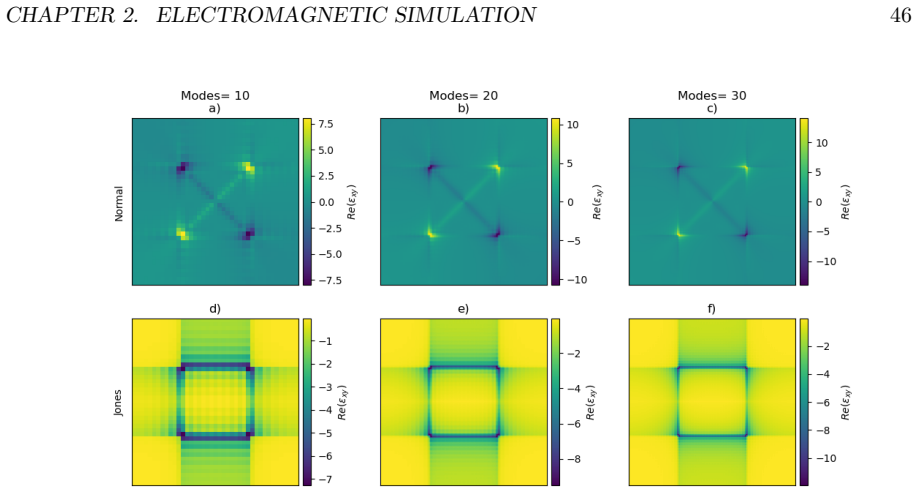
Take a handful of the paper's inverse-designed pillar maps at, say, 200×200 and 500×500 pillars, simulate them with an independent full-wave Maxwell solver, and compute the R² between simulated and target far-field intensity; if R² falls well below 0.97 or systematically degrades with aperture, the scale-invariance claim fails. Separately, for the RCWA artifact claim, reconstruct the real-space permittivity of a dielectric and a plasmonic grating at truncation order N=30: if no induced anisotropy or zero-crossing oscillations appear in the reconstructed profile, the diagnosis is wrong.
Extended reading notes
Core claim
The paper establishes scale-invariant inverse design of large metasurfaces by pairing a generative model with a differentiable surrogate. RCWA with Li's factorization rules can look spectrally converged while its reconstructed permittivity is distorted—Gibbs oscillations, induced anisotropy, zero-crossings seeding unphysical modes, worst for plasmonic structures—so FDTD is ground truth. A convolutional surrogate trained on 23×23 FDTD arrays predicts near fields in one pass and transfers to larger apertures. In a shared R² benchmark, phase-retrieval-plus-local-model plateaus at 0.925, heuristic-initialized gradient descent at 0.975, and diffusion/Schrödinger-bridge models with hybrid posterio
Load-bearing premise
The claim rests on trusting that the neural-network surrogate used to steer the design also stays accurate when predicting light fields on surfaces hundreds of times larger than any it trained on—the paper's large-scale fidelity numbers are computed with that same surrogate rather than with independent full-wave simulation.
Editorial extensions
If this is right
- Metasurface design no longer needs a full-wave simulation per candidate design: the surrogate plus generative sampler replaces the FDTD-in-the-loop cost, and the convolutional architecture transfers a 23×23-trained model to apertures that are 230× larger.
- Gradient-descent-based inverse design, when initialized with a physics-informed phase-retrieval/local-model solution, holds R²≈0.975 from small arrays up to the largest tested surrogate-evaluated apertures.
- Improving the training database (target-driven synthesis rather than uniform sampling) raises every benchmarked method to R²≈0.97, so database quality, not the optimizer, becomes the main lever on performance.
- Amplitude-constrained posterior sampling produces fabrication-tolerant designs: fidelity stays stable under injected stochasticity until the guidance term contributes less than about one-third of the update.
- The RCWA analysis warns that spectral convergence is not a sufficient validity check for Fourier-based solvers; reconstructed-permittivity diagnostics should accompany convergence studies, especially for plasmonic or high-contrast geometries.
Reading between the lines
- Because the headline 230× scaling and R²≈0.97 numbers are evaluated with the same surrogate that guides the sampling, the strongest version of the claim—actual millimeter-scale devices—still awaits independent full-wave verification at intermediate apertures; nothing in the paper contradicts that the claim could hold, but the evidence at the extreme scale is surrogate-internal.
- The symmetry-based database augmentation (quadrupling samples via reflection equivariance) is a transferable trick: any electromagnetic forward operator that respects reflection symmetry could be augmented the same way, which should apply to other pillar-based photonic and acoustic inverse-design pipelines.
- The convergence of all enhanced methods to R²≈0.97 hints at a shared error floor—probably the surrogate's approximation error or the R² metric's insensitivity to absolute intensity—rather than a fundamental limit of any one inverse-design approach; a natural next test is to swap the loss to a perceptually or radiometrically weighted metric.
- The diversity/stability trade-off controlled by the stochasticity coefficient suggests a practical manufacturing knob: sweeping that coefficient while measuring fabricated-device yield could let engineers choose designs that are simultaneously high-fidelity and robust to lithography variation.
Editorial analysis
A structured set of objections, weighed in public.
Referee Report
Summary. The thesis develops a three-stage pipeline for metasurface inverse design: (i) a critical comparison of RCWA implementations of Li's factorization rules, concluding that spectral convergence does not imply physical fidelity and adopting FDTD as ground truth; (ii) a local phase-approximation model and fully convolutional, FDTD-trained surrogate networks that predict near fields and generalize to larger apertures; and (iii) an inverse-design benchmark comparing Gerchberg–Saxton phase retrieval with the local model (R²≈0.925), heuristic-initialized surrogate-based gradient descent (R²≈0.975), and diffusion-model/Schrödinger-bridge generative frameworks with hybrid posterior sampling and amplitude constraints. The headline claim is that the generative framework restores 'scale-invariant fidelity' on surfaces over 230× larger than the 23×23 training cases, with database enhancement lifting all methods to R²≈0.97.
Significance. If fully substantiated, the work would be a valuable step toward generative inverse design of large-area, fabrication-tolerant silicon metasurfaces without per-device full-wave simulation. The manuscript has real strengths: the moderate-aperture results are validated by FDTD under a common protocol; the surrogate architecture study and symmetry-based database augmentation are carefully documented; the RCWA permittivity-reconstruction analysis provides a useful diagnostic for Fourier factorization artifacts; and the thesis is unusually transparent about where 'direct numerical simulation becomes computationally prohibitive.' These strengths are substantial, but the flagship large-aperture claim currently rests on the same learned surrogate that provides the gradient guidance, so the physical evidence for scale-invariance is incomplete. The paper is publishable after the validation gap is closed or the claims are appropriately bounded.
major comments (3)
- [§4.12.7, Figs. 4.26–4.27] The central claim of scale-invariant fidelity on surfaces 'over 230 times larger than training' is evaluated with the surrogate Sφ, and the same Sφ is used as the differentiable guidance model during posterior sampling in §4.11. This makes the reported R²≈0.97 at large apertures a measure of the surrogate's internal consistency rather than physical fidelity. The coupling-range analysis of §3.4.2 establishes that 23×23 is sufficient for the PBC coupling range under a 1% error criterion; it does not establish that error does not accumulate when the learned filterbank is applied at 1200×1200. Please provide full-wave FDTD (or an independent Maxwell solver) validation at intermediate apertures at least, and report the surrogate-vs-FDTD difference on optimized designs, not only on training-distribution samples. Without this, the abstract's scale-invariance statement overstates the evidence.
- [§4.11 and §4.12.5, Fig. 4.11] The same conflation affects the gradient-descent scalability results: Fig. 4.11 shows performance up to 1200×1200 pillars using surrogate-predicted far fields, while the FDTD figures in Appendix A.2.1 (Figs. A.21–A.24) appear to cover only moderate apertures. Because the design is optimized against the surrogate, the surrogate-predicted R² can be biased upward relative to the true FDTD R² even at moderate scales. The thesis itself labels §4.12.7 as surrogate-based evaluation and §5.3 acknowledges computational limits; I count this transparency as a strength, but it also identifies precisely the gap that must be filled before the headline claim is supported. A concrete test: evaluate a few large-aperture designs (e.g., 99×99 and 199×199) with FDTD and report the R² gap versus Sφ.
- [§4.12.3, Tables 4.2–4.3] The 'fabrication-tolerant' and comparative claims are presented without statistical uncertainty. Diffusion posterior sampling and Schrödinger-bridge sampling are stochastic: different seeds will produce different R² values, yet Tables 4.2 and 4.3 report single numbers and the Hessian spectral analysis in §4.12.3 is performed on the surrogate-guided landscape. To support the claim that 'database enhancement lifts every approach to R²≈0.97,' please report means, standard deviations, and repeated-seed counts for each method and condition. Without these, the observed differences between closely ranked methods (e.g., DSB Robust5 vs. DM Robust5) are not assessable.
minor comments (4)
- [Abstract and §4.12.5] The phrase 'over 230 times larger than training' is ambiguous: does it refer to linear dimension, area, or degrees of freedom? The training aperture is 23×23 and the largest reported is 1200×1200; specifying the scaling metric would clarify the claim.
- [§4.14?] The text contains typos and grammatical slips, e.g., 'symetries' in §3.4.3, 'peridic' in §3.4.8, and the caption of Fig. 4.14: 'both ... slightly outperform their normalized counterparts when using non-normalized guidance' is logically confusing and should be rephrased.
- [§4.4.2] The comparison between raw and hybrid Gerchberg–Saxton variants is stated in terms of R² and oscillation standard deviation, but the manuscript does not specify whether R² is computed on the full far-field image or a masked region. Please state the metric definition explicitly in the validation protocol (§4.3).
- [§2.7 and §3.4.5] The 'reordering' reconstruction in Chapter 2 and the FFT downsampling phase correction in Eq. (3.2) are described clearly, but the sign convention of the phase factor in Eq. (3.2) should be checked against the figures: a one-pixel offset in the sign would produce a systematic drift. A short derivation or a numerical consistency check would remove ambiguity.
Circularity Check
The 230× scale-invariance claim is evaluated with the same surrogate Sϕ that provides the posterior-sampling gradient guidance, so the headline R² measures the optimizer's own objective rather than independent full-wave fidelity.
-
fitted input called prediction
[§4.12.7 (Figs. 4.26–4.27); guidance in §4.11 (Fig. 4.15)]
"Performance is quantified via the surrogate model Sϕ, enabling a rigorous assessment of generative fidelity at extrapolated scales where direct numerical simulation becomes computationally prohibitive."
The posterior-sampling guidance used to create the evaluated designs is qt ∝ 1/||c − Sϕ(x̂0|t)||² (Fig. 4.15), i.e., the sampling directly minimizes the surrogate prediction error against the target c. The large-aperture R² reported in §4.12.7 is then computed from the same Sϕ's own far-field output against the same target c. The headline 'scale-invariant fidelity on surfaces over 230 times larger than training' is therefore, by construction, a measure of how well the optimizer minimized its own surrogate objective, not an independent physical-fidelity check. The thesis labels the section 'Extrapolative Scaling and Surrogate-Based Evaluation' and limits FDTD validation to ~100×100; no independent full-wave verification exists at the claimed 230× scale.
-
fitted input called prediction
[§4.5.1, Fig. 4.11]
"While rigorous full-wave validation via FDTD is computationally limited to metasurfaces of approximately 100×100 unit cells, we leverage the neural network surrogate Sϕ to evaluate the scaling behavior across much larger apertures."
The surrogate-based gradient descent (Eq. 4.1) minimizes the MSE between the target far-field and Sϕ's predicted intensity, and the large-aperture scaling claim (up to 1200×1200 pillars) is then 'evaluated' with this same Sϕ. Thus the reported R²≈0.975 at large scale is the minimized training loss of the optimization reported as a scaling result: the same learned function appears both as the differentiable design objective and as the evaluator, so the large-scale 'prediction' is forced by construction and lacks independent FDTD confirmation.
full rationale
The circularity is real but partial. The RCWA/Li-rule analysis (Ch. 2) is an independent numerical diagnostic, not circular. The moderate-aperture inverse-design benchmarks (23×23 and ~100×100) are validated with full-wave FDTD and provide genuine independent content. The circular reduction is confined to the extrapolated-scale headline claims: the same convolutional surrogate Sϕ is used (i) as the differentiable guidance model during posterior sampling and gradient descent, minimizing ||c − Sϕ(x)||², and (ii) as the evaluator producing the reported R² at scales where FDTD is said to be 'computationally prohibitive' (§4.12.7, Figs. 4.26–4.27; §4.5.1, Fig. 4.11). The 230× scale-invariance and large-aperture R²≈0.97 claims therefore reduce by construction to the surrogate's internal consistency with its own training objective, exactly the pattern of a fitted input renamed as a prediction. The paper's own section titles ('Extrapolative Scaling and Surrogate-Based Evaluation') concede this. Because substantial FDTD-verified results exist at moderate apertures and the surrogate is a legitimate forward model there, the paper is not wholly circular; but its most prominent novelty—scale-invariant fidelity far beyond training—is self-referential as reported.
Assumptions & free parameters
free parameters (6)
- Surrogate architecture hyperparameters (width c, depth N) =
c∈{32,64,128}, N varied; final model parameters not fixed in excerpt
- Near-field amplitude constraint μ for Gerchberg-Saxton phase retrieval =
Mean of transmission amplitude distribution (Fig. 4.2b)
- Posterior-sampling guidance normalization (qt∝1/||·||² vs q=1) =
Normalized variant preferred for scaling
- Stochasticity/diversity coefficient α in guided sampling =
α=1 used in final comparisons
- Consistency loss schedule/weight =
Uniform vs scheduled variants; explicit values not stated in excerpt
- Noise variance schedule for DMs/DSBs =
Not specified in excerpt
assumptions (6)
- domain assumption FDTD is treated as artifact-free ground truth for the entire pipeline.
- domain assumption The near field is adequately represented by one complex value per pillar after FFT downsampling.
- standard math The far field is obtained from the near field via a Fourier transform (Fraunhofer approximation).
- domain assumption Symmetry equivariance F(s(radius map))=s(F(radius map)) holds for flips under normal incidence.
- domain assumption A surrogate trained on 23×23 patches generalizes to apertures of 1,200×1,200 pillars.
- domain assumption The staircase discretized geometry is the correct reference for scoring reconstructed RCWA permittivity.
Cite this review
Pith. "Pith review of Design and Optimization of Metasurfaces for Silicon Photonics: PhD Thesis." pith.science (2026). https://pith.science/paper/HQD5JEAE
@misc{pith2026260721091,
  author       = {Pith},
  title        = {Pith review of: Design and Optimization of Metasurfaces for Silicon Photonics: PhD Thesis},
  year         = {2026},
  howpublished = {\url{https://pith.science/paper/HQD5JEAE}},
  note         = {Machine review of arXiv:2607.21091}
}
abstract
Metasurfaces, two-dimensional arrangements of subwavelength nanopillars, provide local control over the phase of light, enabling flat optical functions beyond conventional refractive components. Their inverse design, finding the pillar distribution producing a target response, faces two obstacles: the immense dimensionality of the design space and the prohibitive cost of rigorous electromagnetic simulations, precluding exhaustive exploration at device scale. This thesis addresses the challenge in three stages. The first assesses the reliability of rigorous Maxwell solvers: comparing three implementations of Li's factorization rules for RCWA shows that spectral convergence does not guarantee physical fidelity, as these rules implicitly distort the simulated permittivity, most severely in the plasmonic regime. FDTD, immune to such artifacts, is retained as ground truth throughout. The second stage removes the computational bottleneck: a local phase-approximation model, then fully convolutional surrogates trained on FDTD simulations of large pillar metasurfaces, predict the near field almost instantaneously. Exploiting problem symmetries quadruples the training database, and the surrogates generalize to much larger apertures while remaining differentiable. The third stage benchmarks three strategies under a common FDTD protocol ($R^2$ between realized and target far fields): Gerchberg-Saxton retrieval and Local Model ($R^2\approx0.925$), surrogate-based and heuristic-initialized gradient descent ($R^2\approx0.975$), and a generative framework based on diffusion models and Schr\"odinger bridges. Hybrid posterior sampling and amplitude constraints restore scale-invariant fidelity on surfaces over 230 times larger than training, with diverse, fabrication-tolerant designs. Database enhancement lifts every approach to $R^2\approx0.97$.
Figures


Figures from the paper (70 more)




Reference graph
Works this paper leans on
-
[1]
Design framework for polarization-insensitive multi- functional achromatic metalenses.Nanophotonics, 11(3):583–591, 2022
Jacob T Heiden and Min Seok Jang. Design framework for polarization-insensitive multi- functional achromatic metalenses.Nanophotonics, 11(3):583–591, 2022
2022
-
[2]
Achromatic and coma-corrected hybrid meta-optics for high-performance ther- mal imaging.Nano Letters, 24(25):7609–7615, 2024
Mingze Liu, Weixing Zhao, Yilin Wang, Pengcheng Huo, Hui Zhang, Yan-qing Lu, and Ting Xu. Achromatic and coma-corrected hybrid meta-optics for high-performance ther- mal imaging.Nano Letters, 24(25):7609–7615, 2024
2024
-
[3]
On metalenses with arbitrarily wide field of view.Acs Photonics, 7(8):2073–2079, 2020
Augusto Martins, Kezheng Li, Juntao Li, Haowen Liang, Donato Conteduca, Ben-Hur V Borges, Thomas F Krauss, and Emiliano R Martins. On metalenses with arbitrarily wide field of view.Acs Photonics, 7(8):2073–2079, 2020
-
[4]
Inverse designed extended depth of focus meta-optics for broadband imaging in the visible.Nanophotonics, 11(11):2531–2540, 2022
Elyas Bayati, Raphaël Pestourie, Shane Colburn, Zin Lin, Steven G Johnson, and Arka Majumdar. Inverse designed extended depth of focus meta-optics for broadband imaging in the visible.Nanophotonics, 11(11):2531–2540, 2022
2022
-
[5]
Design and analysis of extended depth of focus metalenses for achromatic computational imaging
Luocheng Huang, James Whitehead, Shane Colburn, and Arka Majumdar. Design and analysis of extended depth of focus metalenses for achromatic computational imaging. Photonics Research, 8(10):1613–1623, 2020
2020
-
[6]
Metalenses at visible wavelengths: Diffraction-limited focusing and subwavelength resolution imaging.Science, 352(6290):1190–1194, 2016
Mohammadreza Khorasaninejad, Wei Ting Chen, Robert C Devlin, Jaewon Oh, Alexan- der Y Zhu, and Federico Capasso. Metalenses at visible wavelengths: Diffraction-limited focusing and subwavelength resolution imaging.Science, 352(6290):1190–1194, 2016
2016
-
[7]
Immersion meta-lenses at visible wavelengths for nanoscale imaging.Nano letters, 17(5):3188–3194, 2017
Wei Ting Chen, Alexander Y Zhu, Mohammadreza Khorasaninejad, Zhujun Shi, Vyshakh Sanjeev, and Federico Capasso. Immersion meta-lenses at visible wavelengths for nanoscale imaging.Nano letters, 17(5):3188–3194, 2017
2017
-
[8]
An achromatic metasurface waveguide for augmented reality displays.Light: Science & Ap- plications, 14(1):94, 2025
Zhongtao Tian, Xiuling Zhu, Philip A Surman, Zhidong Chen, and Xiao Wei Sun. An achromatic metasurface waveguide for augmented reality displays.Light: Science & Ap- plications, 14(1):94, 2025
2025
Show all 160 references
-
[9]
High-efficiency surface plasmon meta-couplers: concept and microwave-regime realizations.Light: Science & Applications, 5(1):e16003–e16003, 2016
Wujiong Sun, Qiong He, Shulin Sun, and Lei Zhou. High-efficiency surface plasmon meta-couplers: concept and microwave-regime realizations.Light: Science & Applications, 5(1):e16003–e16003, 2016
2016
-
[10]
Compact silicon waveguide mode converter employing dielectric metasurface structure.Advanced Optical Materials, 7(4):1801191, 2019
Hongwei Wang, Yong Zhang, Yu He, Qingming Zhu, Lu Sun, and Yikai Su. Compact silicon waveguide mode converter employing dielectric metasurface structure.Advanced Optical Materials, 7(4):1801191, 2019
2019
-
[11]
Angle-and polarization-tolerant metasurface designs based on the aperiodic tiling.Advanced Optical Materials, 13(20):2500455, 2025
Minyeul Lee, Suwan Jeon, and Jonghwa Shin. Angle-and polarization-tolerant metasurface designs based on the aperiodic tiling.Advanced Optical Materials, 13(20):2500455, 2025
2025
-
[12]
Nanostructured color filters: a review of recent developments.Nanomaterials, 10(8):1554, 2020
Ayesha Shaukat, Frazer Noble, and Khalid Mahmood Arif. Nanostructured color filters: a review of recent developments.Nanomaterials, 10(8):1554, 2020. 139 BIBLIOGRAPHY140
2020
-
[13]
Design rules for structural colors in all-dielectric metasurfaces: from individual resonators to collective resonances and color multiplexing.ACS photonics, 11(2):470–483, 2024
Kévin Vilayphone, Mohamed Amara, Regis Orobtchouk, Fabien Mandorlo, Serge Mazau- ric, Xavier Letartre, Sébastien Cueff, Hai Son Nguyen, and Thomas Wood. Design rules for structural colors in all-dielectric metasurfaces: from individual resonators to collective resonances and c...
2024
-
[14]
Approaches to simulating meta-surfaces for flat optical devices: The transition to solutions based on neural networks
Denis Rideau, Mathys Le Grand, Louis Henri Fernandez Mouron, Valerie Serradeil, Loumi Tremas, Pascal Urard, Damien Maitre, Habib Mohamad, Lucie Dilhan, Enrico Giuseppe Carnemolla, et al. Approaches to simulating meta-surfaces for flat optical devices: The transition to solutio...
2024
-
[15]
Intelligent metasurface imager and recognizer.Light: science & applications, 8(1):97, 2019
Lianlin Li, Ya Shuang, Qian Ma, Haoyang Li, Hanting Zhao, Menglin Wei, Che Liu, Chenglong Hao, Cheng-Wei Qiu, and Tie Jun Cui. Intelligent metasurface imager and recognizer.Light: science & applications, 8(1):97, 2019
2019
-
[16]
Controlling sound with acoustic metamaterials.Nature Reviews Materials, 1(3):1–13, 2016
Steven A Cummer, Johan Christensen, and Andrea Alù. Controlling sound with acoustic metamaterials.Nature Reviews Materials, 1(3):1–13, 2016
2016
-
[17]
Reflected wave- front manipulation based on ultrathin planar acoustic metasurfaces.Scientific reports, 3(1):2546, 2013
Yong Li, Bin Liang, Zhong-ming Gu, Xin-ye Zou, and Jian-chun Cheng. Reflected wave- front manipulation based on ultrathin planar acoustic metasurfaces.Scientific reports, 3(1):2546, 2013
2013
-
[18]
Subwavelength total acoustic absorption with degenerate resonators.Applied Physics Letters, 107(10), 2015
MinYang, ChongMeng, CaixingFu, YongLi, ZhiyuYang, andPingSheng. Subwavelength total acoustic absorption with degenerate resonators.Applied Physics Letters, 107(10), 2015
2015
-
[19]
Superabsorption of acoustic waves with bubble metascreens.Physical Review B, 91(2):020301, 2015
Valentin Leroy, Anatoliy Strybulevych, Maxime Lanoy, Fabrice Lemoult, Arnaud Tourin, and John H Page. Superabsorption of acoustic waves with bubble metascreens.Physical Review B, 91(2):020301, 2015
2015
-
[20]
Theoretical requirements for broadband perfect absorption of acoustic waves by ultra-thin elastic meta-films.Scientific Reports, 5(1):12139, 2015
Yuetao Duan, Jie Luo, Guanghao Wang, Zhi Hong Hang, Bo Hou, Jensen Li, Ping Sheng, and Yun Lai. Theoretical requirements for broadband perfect absorption of acoustic waves by ultra-thin elastic meta-films.Scientific Reports, 5(1):12139, 2015
2015
-
[21]
Acoustic coherent perfect absorbers.New Journal of Physics, 16(3):033026, 2014
JZ Song, P Bai, ZH Hang, and Yun Lai. Acoustic coherent perfect absorbers.New Journal of Physics, 16(3):033026, 2014
2014
-
[22]
Underwater acoustic omnidirectional absorber.Applied Physics Letters, 104(7), 2014
Christina J Naify, Theodore P Martin, Christopher N Layman, Michael Nicholas, Abel L Thangawng, David C Calvo, and Gregory J Orris. Underwater acoustic omnidirectional absorber.Applied Physics Letters, 104(7), 2014
2014
-
[23]
Broad- band acoustic hyperbolic metamaterial.Physical review letters, 115(25):254301, 2015
Chen Shen, Yangbo Xie, Ni Sui, Wenqi Wang, Steven A Cummer, and Yun Jing. Broad- band acoustic hyperbolic metamaterial.Physical review letters, 115(25):254301, 2015
2015
-
[24]
Three-dimensional acoustic metamaterial luneburg lenses for broadband and wide-angle underwater ultrasound imaging.Mechanical Systems and Signal Processing, 179:109374, 2022
Jung-Woo Kim, Gunn Hwang, Seong-Jin Lee, Sang-Hoon Kim, and Semyung Wang. Three-dimensional acoustic metamaterial luneburg lenses for broadband and wide-angle underwater ultrasound imaging.Mechanical Systems and Signal Processing, 179:109374, 2022
2022
-
[25]
A review of research on seismic meta- materials.Advanced Engineering Materials, 22(4):1901148, 2020
Di Mu, Haisheng Shu, Lei Zhao, and Shuowei An. A review of research on seismic meta- materials.Advanced Engineering Materials, 22(4):1901148, 2020
2020
-
[26]
Seismic waveguide of metamaterials.Modern Physics Letters B, 26(17):1250105, 2012
Sang-Hoon Kim and Mukunda P Das. Seismic waveguide of metamaterials.Modern Physics Letters B, 26(17):1250105, 2012. BIBLIOGRAPHY141
2012
-
[27]
Dielectric metasurfaces for complete and independent control of the optical amplitude and phase.Light: Science & Applications, 8(1):92, 2019
Adam C Overvig, Sajan Shrestha, Stephanie C Malek, Ming Lu, Aaron Stein, Changxi Zheng, and Nanfang Yu. Dielectric metasurfaces for complete and independent control of the optical amplitude and phase.Light: Science & Applications, 8(1):92, 2019
2019
-
[28]
Shape optimization for high efficiency metasurfaces: theory and implementation.Light: Science & Applications, 13(1):300, 2024
Paulo Dainese, Louis Marra, Davide Cassara, Ary Portes, Jaewon Oh, Jun Yang, Alfonso Palmieri, Janderson Rocha Rodrigues, Ahmed H Dorrah, and Federico Capasso. Shape optimization for high efficiency metasurfaces: theory and implementation.Light: Science & Applications, 13(1):300, 2024
2024
-
[29]
Robust freeform metasurface design based on progressively growing generative networks.Acs Photonics, 7(8):2098–2104, 2020
Fufang Wen, Jiaqi Jiang, and Jonathan A Fan. Robust freeform metasurface design based on progressively growing generative networks.Acs Photonics, 7(8):2098–2104, 2020
-
[30]
Freeform metasurface color router for deep submicron pixel image sensors.Science Advances, 10(22):eadn9000, 2024
Changhyun Kim, Jongwoo Hong, Junhyeok Jang, Gun-Yeal Lee, Youngjin Kim, Yoonchan Jeong, and Byoungho Lee. Freeform metasurface color router for deep submicron pixel image sensors.Science Advances, 10(22):eadn9000, 2024
2024
-
[31]
Planar aperi- odic arrays as metasurfaces for optical near-field patterning.ACS nano, 13(5):5646–5654, 2019
Mario Miscuglio, Nicholas J Borys, Davide Spirito, Beatriz Martín-García, Remo Proietti Zaccaria, Alexander Weber-Bargioni, P James Schuck, and Roman Krahne. Planar aperi- odic arrays as metasurfaces for optical near-field patterning.ACS nano, 13(5):5646–5654, 2019
2019
-
[32]
Light in correlated disordered media.Reviews of Modern Physics, 95(4):045003, 2023
Kevin Vynck, Romain Pierrat, Rémi Carminati, Luis S Froufe-Pérez, Frank Scheffold, Riccardo Sapienza, Silvia Vignolini, and Juan José Sáenz. Light in correlated disordered media.Reviews of Modern Physics, 95(4):045003, 2023
2023
-
[33]
Broadband high- efficiency aperiodic metasurface for the vortex waves generation.Applied Physics Letters, 126(14), 2025
Volodymyr I Fesenko, Erick R Baca-Montero, and Oleksiy V Shulika. Broadband high- efficiency aperiodic metasurface for the vortex waves generation.Applied Physics Letters, 126(14), 2025
2025
-
[34]
Ultra-high-q resonances in plasmonic metasurfaces.Nature communications, 12(1):974, 2021
M Saad Bin-Alam, Orad Reshef, Yaryna Mamchur, M Zahirul Alam, Graham Carlow, Jeremy Upham, Brian T Sullivan, Jean-Michel Ménard, Mikko J Huttunen, Robert W Boyd, et al. Ultra-high-q resonances in plasmonic metasurfaces.Nature communications, 12(1):974, 2021
2021
-
[35]
Plasmonic metasurfaces: Light-matter interactions, fabrication, applications and future outlooks
Fan Yang, Wei Cao, Guangchao Zheng, Li Qiu, Zhihong Nie, and Yue Li. Plasmonic metasurfaces: Light-matter interactions, fabrication, applications and future outlooks. Progress in Materials Science, 154:101508, 2025
2025
-
[36]
Morgan & Claypool Publishers, 2011
Stephen D Gedney.Introduction to the finite-difference time-domain (FDTD) method for electromagnetics, volume 27. Morgan & Claypool Publishers, 2011
2011
-
[37]
Artech House, 2013
BM Azizur Rahman and Arti Agrawal.Finite element modeling methods for photonics. Artech House, 2013
2013
-
[38]
Analysis and applications of optical diffraction by gratings.Proceedings of the IEEE, 73(5):894–937, 1985
Thomas K Gaylord and MG Moharam. Analysis and applications of optical diffraction by gratings.Proceedings of the IEEE, 73(5):894–937, 1985
1985
-
[39]
Maxwellnet: Physics-driven deep neural network train- ing based on maxwell’s equations.Apl Photonics, 7(1), 2022
Joowon Lim and Demetri Psaltis. Maxwellnet: Physics-driven deep neural network train- ing based on maxwell’s equations.Apl Photonics, 7(1), 2022
2022
-
[40]
Deep learning meets nanophotonics: a generalized accurate predictor for near fields and far fields of arbitrary 3d nanostructures.Nano letters, 20(1):329–338, 2019
Peter R Wiecha and Otto L Muskens. Deep learning meets nanophotonics: a generalized accurate predictor for near fields and far fields of arbitrary 3d nanostructures.Nano letters, 20(1):329–338, 2019
2019
-
[41]
Mohannad Elhamod, Jie Bu, Christopher Singh, Matthew Redell, Abantika Ghosh, Viktor Podolskiy, Wei-Cheng Lee, and Anuj Karpatne. Cophy-pgnn: Learning physics-guided neural networks with competing loss functions for solving eigenvalue problems.ACM Transactions on Intelligent Sy...
2022
-
[42]
Wavey-net: physics-augmented deep-learning for high- speed electromagnetic simulation and optimization
Mingkun Chen, Robert Lupoiu, Chenkai Mao, Der-Han Huang, Jiaqi Jiang, Philippe Lalanne, and Jonathan A Fan. Wavey-net: physics-augmented deep-learning for high- speed electromagnetic simulation and optimization. InHigh Contrast Metastructures XI, volume 12011, pages 63–66. SPIE, 2022
2022
-
[43]
A tutorial on inverse design methods for metasurfaces.Current Optics and Photonics, 8(6):531–544, 2024
Jin-Young Jeong, Sabiha Latif, and Sunae So. A tutorial on inverse design methods for metasurfaces.Current Optics and Photonics, 8(6):531–544, 2024
2024
-
[44]
Em- powering metasurfaces with inverse design: principles and applications.Acs Photonics, 9(7):2178–2192, 2022
Zhaoyi Li, Raphaël Pestourie, Zin Lin, Steven G Johnson, and Federico Capasso. Em- powering metasurfaces with inverse design: principles and applications.Acs Photonics, 9(7):2178–2192, 2022
2022
-
[45]
Exploring ai in metasurface structures with forward and inverse design.Iscience, 28(3), 2025
Guantai Yang, Qingxiong Xiao, Zhilin Zhang, Zhe Yu, Xiaoxu Wang, and Qianbo Lu. Exploring ai in metasurface structures with forward and inverse design.Iscience, 28(3), 2025
2025
-
[46]
From per- formance to structure: a comprehensive survey of advanced metasurface design for next- generation imaging.npj Nanophotonics, 2(1):39, 2025
Yunhui Zeng, Haopeng Zhong, Zhenwei Long, Hongkun Cao, and Xin Jin. From per- formance to structure: a comprehensive survey of advanced metasurface design for next- generation imaging.npj Nanophotonics, 2(1):39, 2025
2025
-
[47]
A newcomer’s guide to deep learning for inverse design in nano-photonics.Nanophotonics, 12(24):4387–4414, 2023
Abdourahman Khaireh-Walieh, Denis Langevin, PaulineBennet, Olivier Teytaud, Antoine Moreau, and Peter R Wiecha. A newcomer’s guide to deep learning for inverse design in nano-photonics.Nanophotonics, 12(24):4387–4414, 2023
2023
-
[48]
Deeplearning enabled inverse design in nanophotonics.Nanophotonics, 9(5):1041–1057, 2020
SunaeSo, TrevonBadloe, JaebumNoh, JorgeBravo-Abad, andJunsukRho. Deeplearning enabled inverse design in nanophotonics.Nanophotonics, 9(5):1041–1057, 2020
2020
-
[49]
Inverse design of large-area metasurfaces.Optics express, 26(26):33732– 33747, 2018
Raphaël Pestourie, Carlos Pérez-Arancibia, Zin Lin, Wonseok Shin, Federico Capasso, and Steven G Johnson. Inverse design of large-area metasurfaces.Optics express, 26(26):33732– 33747, 2018
2018
-
[50]
Advancing wave- frontshapingwithresonantnonlocalmetasurfaces: beyondthelimitationsoflookuptables
Enzo Isnard, Sébastien Héron, Stéphane Lanteri, and Mahmoud Elsawy. Advancing wave- frontshapingwithresonantnonlocalmetasurfaces: beyondthelimitationsoflookuptables. Scientific Reports, 14(1):1555, 2024
2024
-
[51]
Inverse design of optical metasurface for cmos imagers: A multi-objective optimization approach
Damien Maitre, Denis Rideau, Olivier Jeannin, Clémence Jamin-Mornet, Charly Leblanc, Maxime Darnon, Raphaël Clerc, JeanPhilippe Banon, Coumba Gaye, Fatima Omeis, Louis-Henri Fernandez-Mouron, Loumi Tremas, Mathys Le Grand, Adam Fuchs, Pas- cal Urard, James Downing, and Bruce R...
2025
-
[52]
Adaptive genetic algo- rithm for optical metasurfaces design.Scientific reports, 8(1):11040, 2018
Samad Jafar-Zanjani, Sandeep Inampudi, and Hossein Mosallaei. Adaptive genetic algo- rithm for optical metasurfaces design.Scientific reports, 8(1):11040, 2018
2018
-
[53]
Flexible metasurface for microwave-infrared compatible camouflage via particle swarm optimization algorithm.Small, 19(46):2302848, 2023
Juyeong Nam, Injoong Chang, Joon-Soo Lim, Haneul Woo, Jong-Gwan Yook, and Hyung Hee Cho. Flexible metasurface for microwave-infrared compatible camouflage via particle swarm optimization algorithm.Small, 19(46):2302848, 2023
2023
-
[54]
Design of pixel terahertz metamaterial absorber sensor based on an improved ant colony algorithm.IEEE Sensors Journal, 24(24):40801–40810, 2024
Jinhuan Zhang, Shengji Zhang, Jian Dong, Meng Wang, Heng Luo, Rigeng Wu, and Chengwang Xiao. Design of pixel terahertz metamaterial absorber sensor based on an improved ant colony algorithm.IEEE Sensors Journal, 24(24):40801–40810, 2024
2024
-
[55]
Topology optimization of freeform large-area metasurfaces.Optics express, 27(11):15765–15775, 2019
Zin Lin, Victor Liu, Raphaël Pestourie, and Steven G Johnson. Topology optimization of freeform large-area metasurfaces.Optics express, 27(11):15765–15775, 2019. BIBLIOGRAPHY143
2019
-
[56]
Fabrication- constrained nanophotonic inverse design.Scientific reports, 7(1):1786, 2017
Alexander Y Piggott, Jan Petykiewicz, Logan Su, and Jelena Vučković. Fabrication- constrained nanophotonic inverse design.Scientific reports, 7(1):1786, 2017
2017
-
[57]
Large-scale parametrized metasurface design using adjoint optimization.Acs Photonics, 8(2):455–463, 2021
Mahdad Mansouree, Andrew McClung, Sarath Samudrala, and Amir Arbabi. Large-scale parametrized metasurface design using adjoint optimization.Acs Photonics, 8(2):455–463, 2021
2021
-
[58]
Automatic differ- entiation in pytorch.NIPS Workshop on Autodiff, 2017
Adam Paszke, Sam Gross, Soumith Chintala, Gregory Chanan, Edward Yang, Zachary DeVito, Zeming Lin, Alban Desmaison, Luca Antiga, and Adam Lerer. Automatic differ- entiation in pytorch.NIPS Workshop on Autodiff, 2017
2017
-
[59]
A bidirectional deep neural network for accurate silicon color design.Advanced Materials, 31(51):1905467, 2019
Li Gao, Xiaozhong Li, Dianjing Liu, Lianhui Wang, and Zongfu Yu. A bidirectional deep neural network for accurate silicon color design.Advanced Materials, 31(51):1905467, 2019
2019
-
[60]
Torcwa: Gpu-accelerated fourier modal method and gradient-based optimization for metasurface design.Computer Physics Communications, 282:108552, 2023
Changhyun Kim and Byoungho Lee. Torcwa: Gpu-accelerated fourier modal method and gradient-based optimization for metasurface design.Computer Physics Communications, 282:108552, 2023
2023
-
[61]
Torchgdm: A gpu-accelerated python toolkit for multi-scale electromagnetic scattering with automatic differentiation
Sofia Ponomareva, Adelin Patoux, Clément Majorel, Antoine Azéma, Aurélien Cuche, Christian Girard, Arnaud Arbouet, and Peter R Wiecha. Torchgdm: A gpu-accelerated python toolkit for multi-scale electromagnetic scattering with automatic differentiation. arXiv preprint arXiv:250...
2025
-
[62]
Photonic topologyoptimizationwithsemiconductor-foundrydesign-ruleconstraints.Optics Express, 29(15):23916–23938, 2021
Alec M Hammond, Ardavan Oskooi, Steven G Johnson, and Stephen E Ralph. Photonic topologyoptimizationwithsemiconductor-foundrydesign-ruleconstraints.Optics Express, 29(15):23916–23938, 2021
2021
-
[63]
Inverse design and demonstration of a compact and broad- band on-chip wavelength demultiplexer.Nature photonics, 9(6):374–377, 2015
Alexander Y Piggott, Jesse Lu, Konstantinos G Lagoudakis, Jan Petykiewicz, Thomas M Babinec, and Jelena Vučković. Inverse design and demonstration of a compact and broad- band on-chip wavelength demultiplexer.Nature photonics, 9(6):374–377, 2015
2015
-
[64]
High speed simulation and freeform optimization of nanophotonic devices with physics-augmented deep learning.ACS Photonics, 9(9):3110– 3123, 2022
Mingkun Chen, Robert Lupoiu, Chenkai Mao, Der-Han Huang, Jiaqi Jiang, Philippe Lalanne, and Jonathan A Fan. High speed simulation and freeform optimization of nanophotonic devices with physics-augmented deep learning.ACS Photonics, 9(9):3110– 3123, 2022
2022
-
[65]
Efficient global optimization of expensive black-box functions.Journal of Global optimization, 13(4):455–492, 1998
Donald R Jones, Matthias Schonlau, and William J Welch. Efficient global optimization of expensive black-box functions.Journal of Global optimization, 13(4):455–492, 1998
1998
-
[66]
Comparison of high-dimensional bayesian optimization algorithms on bbob.ACM Transactions on Evolutionary Learning, 4(3):1–33, 2024
Maria Laura Santoni, Elena Raponi, Renato De Leone, and Carola Doerr. Comparison of high-dimensional bayesian optimization algorithms on bbob.ACM Transactions on Evolutionary Learning, 4(3):1–33, 2024
2024
-
[67]
A machine learning approach for fighting the curse of dimensionality in global optimization.arXiv preprint arXiv:2110.14985, 2021
Julian F Schumann and Alejandro M Aragón. A machine learning approach for fighting the curse of dimensionality in global optimization.arXiv preprint arXiv:2110.14985, 2021
2021 arXiv
-
[68]
Measuring the curse of dimensionality and its effects on particle swarm optimization and differential evolution
Stephen Chen, James Montgomery, and Antonio Bolufé-Röhler. Measuring the curse of dimensionality and its effects on particle swarm optimization and differential evolution. Applied Intelligence, 42(3):514–526, 2015
2015
-
[69]
Solutions of ill-posed problems.VH Winston and Sons, 1977
Andrey Nikolayevich Tikhonov. Solutions of ill-posed problems.VH Winston and Sons, 1977
1977
-
[70]
An analysis of lavrentiev regularization method and newton type process for nonlinear ill-posed problems.Applied Mathematics and Compu- tation, 230:406–413, 2014
Vladmir Vasin and Santhosh George. An analysis of lavrentiev regularization method and newton type process for nonlinear ill-posed problems.Applied Mathematics and Compu- tation, 230:406–413, 2014. BIBLIOGRAPHY144
2014
-
[71]
Nonlinear total variation based noise removal algorithms.Physica D: nonlinear phenomena, 60(1-4):259–268, 1992
Leonid I Rudin, Stanley Osher, and Emad Fatemi. Nonlinear total variation based noise removal algorithms.Physica D: nonlinear phenomena, 60(1-4):259–268, 1992
1992
-
[72]
Training deep neural networks for the inverse design of nanophotonic structures.Acs Photonics, 5(4):1365–1369, 2018
Dianjing Liu, Yixuan Tan, Erfan Khoram, and Zongfu Yu. Training deep neural networks for the inverse design of nanophotonic structures.Acs Photonics, 5(4):1365–1369, 2018
2018
-
[73]
Probabilistic rep- resentation and inverse design of metamaterials based on a deep generative model with semi-supervised learning strategy.Advanced Materials, 31(35):1901111, 2019
Wei Ma, Feng Cheng, Yihao Xu, Qinlong Wen, and Yongmin Liu. Probabilistic rep- resentation and inverse design of metamaterials based on a deep generative model with semi-supervised learning strategy.Advanced Materials, 31(35):1901111, 2019
2019
-
[74]
Designing nanophotonic structures using conditional deep convolutional generative adversarial networks.Nanophotonics, 8(7):1255–1261, 2019
Sunae So and Junsuk Rho. Designing nanophotonic structures using conditional deep convolutional generative adversarial networks.Nanophotonics, 8(7):1255–1261, 2019
2019
-
[75]
Diffusion probabilistic model based accurate and high-degree-of-freedom metasurface inverse design.Nanophotonics, 12(20):3871–3881, 2023
Zezhou Zhang, Chuanchuan Yang, Yifeng Qin, Hao Feng, Jiqiang Feng, and Hongbin Li. Diffusion probabilistic model based accurate and high-degree-of-freedom metasurface inverse design.Nanophotonics, 12(20):3871–3881, 2023
2023
-
[76]
Zezhou Zhang, Chuanchuan Yang, Yifeng Qin, Zhihai Zheng, Jiqiang Feng, and Hongbin Li. Addressing high-performance data sparsity in metasurface inverse design using multi- objective optimization and diffusion probabilistic models.Optics Express, 32(23):40869– 40885, 2024
2024
-
[77]
Inverse design of diffractive metasurfaces using diffusion models.ACS Photonics, 2025
Liav Hen, Erez Yosef, Dan Raviv, Raja Giryes, and Jacob Scheuer. Inverse design of diffractive metasurfaces using diffusion models.ACS Photonics, 2025
2025
-
[78]
Diffusion models beat gans on image synthesis
Prafulla Dhariwal and Alexander Nichol. Diffusion models beat gans on image synthesis. Advances in neural information processing systems, 34:8780–8794, 2021
2021
-
[79]
Likelihood training of schrödinger bridge using forward-backward sdes theory.arXiv preprint arXiv:2110.11291, 2021
Tianrong Chen, Guan-Horng Liu, and Evangelos A Theodorou. Likelihood training of schrödinger bridge using forward-backward sdes theory.arXiv preprint arXiv:2110.11291, 2021
2021 arXiv
-
[80]
Diffusion schrödinger bridge with applications to score-based generative modeling.Advances in Neural Information Processing Systems, 34:17695–17709, 2021
Valentin De Bortoli, James Thornton, Jeremy Heng, and Arnaud Doucet. Diffusion schrödinger bridge with applications to score-based generative modeling.Advances in Neural Information Processing Systems, 34:17695–17709, 2021
2021
-
[81]
Improving generative model-based unfolding with schrödinger bridges.Physical Re- view D, 109(7):076011, 2024
Sascha Diefenbacher, Guan-Horng Liu, Vinicius Mikuni, Benjamin Nachman, and Weili Nie. Improving generative model-based unfolding with schrödinger bridges.Physical Re- view D, 109(7):076011, 2024
2024
-
[82]
Physics-aligned field reconstruction with diffusion bridge
ZeyuLi, HongkunDou, ShenFang, WangHan, YueDeng, and LijunYang. Physics-aligned field reconstruction with diffusion bridge. InThe Thirteenth International Conference on Learning Representations, 2025
2025
-
[83]
Learning fourier-constrained diffusion bridges for mri reconstruction.arXiv preprint arXiv:2308.01096, 2023
Muhammad U Mirza, Onat Dalmaz, Hasan A Bedel, Gokberk Elmas, Yilmaz Korkmaz, Alper Gungor, Salman UH Dar, and Tolga Çukur. Learning fourier-constrained diffusion bridges for mri reconstruction.arXiv preprint arXiv:2308.01096, 2023
2023 arXiv
-
[84]
I 2SB: Image-to-image schrödinger bridge.arXiv preprint arXiv:2302.05872, 2023
Guan-Horng Liu, Arash Vahdat, De-An Huang, Evangelos A Theodorou, Weili Nie, and Anima Anandkumar. I 2SB: Image-to-image schrödinger bridge.arXiv preprint arXiv:2302.05872, 2023
2023 arXiv
-
[85]
Flow matching for generative modeling.arXiv preprint arXiv:2210.02747, 2022
Yaron Lipman, Ricky TQ Chen, Heli Ben-Hamu, Maximilian Nickel, and Matt Le. Flow matching for generative modeling.arXiv preprint arXiv:2210.02747, 2022
2022 arXiv
-
[86]
Discrete flow matching.Advances in Neural Information Pro- cessing Systems, 37:133345–133385, 2024
Itai Gat, Tal Remez, Neta Shaul, Felix Kreuk, Ricky TQ Chen, Gabriel Synnaeve, Yossi Adi, and Yaron Lipman. Discrete flow matching.Advances in Neural Information Pro- cessing Systems, 37:133345–133385, 2024. BIBLIOGRAPHY145
2024
-
[87]
Simulator-based training of generative neural networks for the inverse design of metasurfaces.Nanophotonics, 9(5):1059–1069, 2020
Jiaqi Jiang and Jonathan A Fan. Simulator-based training of generative neural networks for the inverse design of metasurfaces.Nanophotonics, 9(5):1059–1069, 2020
2020
-
[88]
Global optimization of dielectric metasurfaces using a physics-driven neural network.Nano letters, 19(8):5366–5372, 2019
Jiaqi Jiang and Jonathan A Fan. Global optimization of dielectric metasurfaces using a physics-driven neural network.Nano letters, 19(8):5366–5372, 2019
2019
-
[89]
Physics-informed neural networks with hard constraints for inverse design.SIAM Journal on Scientific Computing, 43(6):B1105–B1132, 2021
Lu Lu, Raphael Pestourie, Wenjie Yao, Zhicheng Wang, Francesc Verdugo, and Steven G Johnson. Physics-informed neural networks with hard constraints for inverse design.SIAM Journal on Scientific Computing, 43(6):B1105–B1132, 2021
2021
-
[90]
Fourier modal method for inverse design of metasurface-enhanced micro-leds.Optics Express, 31(26):42945–42960, 2023
Martin F Schubert and Alec M Hammond. Fourier modal method for inverse design of metasurface-enhanced micro-leds.Optics Express, 31(26):42945–42960, 2023
2023
-
[91]
S4: A free electromagnetic solver for layered periodic struc- tures.Computer Physics Communications, 183(10):2233–2244, 2012
Victor Liu and Shanhui Fan. S4: A free electromagnetic solver for layered periodic struc- tures.Computer Physics Communications, 183(10):2233–2244, 2012
2012
-
[92]
Scattering-matrix treatment of patterned multilayer photonic structures.Physical Review B, 60(4):2610, 1999
DM Whittaker and IS Culshaw. Scattering-matrix treatment of patterned multilayer photonic structures.Physical Review B, 60(4):2610, 1999
1999
-
[93]
Kane S Yee and Jei S Chen. The finite-difference time-domain (fdtd) and the finite- volume time-domain (fvtd) methods in solving maxwell’s equations.IEEE Transactions on Antennas and Propagation, 45(3):354–363, 2002
2002
-
[94]
Computational electromagnetics: the finite-difference time-domain method.The Electrical Engineering Handbook, 3(629- 670):15, 2005
Allen Taflove, Susan C Hagness, and Melinda Piket-May. Computational electromagnetics: the finite-difference time-domain method.The Electrical Engineering Handbook, 3(629- 670):15, 2005
2005
-
[95]
Molding the flow of light.Princet
John D Joannopoulos, Steven G Johnson, Joshua N Winn, and Robert D Meade. Molding the flow of light.Princet. Univ. Press. Princeton, NJ [ua], 12:33, 2008
2008
-
[96]
A perfectly matched layer for the absorption of electromagnetic waves.Journal of computational physics, 114(2):185–200, 1994
Jean-Pierre Berenger. A perfectly matched layer for the absorption of electromagnetic waves.Journal of computational physics, 114(2):185–200, 1994
1994
-
[97]
Highly improved convergence of the coupled-wave method for tm polarization.Journal of the Optical Society of America A, 13(4):779–784, 1996
Philippe Lalanne and G Michael Morris. Highly improved convergence of the coupled-wave method for tm polarization.Journal of the Optical Society of America A, 13(4):779–784, 1996
1996
-
[98]
Use of fourier series in the analysis of discontinuous periodic structures.Journal of the Optical Society of America A, 13(9):1870–1876, 1996
Lifeng Li. Use of fourier series in the analysis of discontinuous periodic structures.Journal of the Optical Society of America A, 13(9):1870–1876, 1996
1996
-
[99]
Grating theory: new equations in fourier space leading to fast converging results for tm polarization.Journal of the Optical Society of America A, 17(10):1773–1784, 2000
Evgeni Popov and Michel Nevière. Grating theory: new equations in fourier space leading to fast converging results for tm polarization.Journal of the Optical Society of America A, 17(10):1773–1784, 2000
2000
-
[100]
Normal vector method for convergence improvement using the rcwa for crossed gratings
Thomas Schuster, Johannes Ruoff, Norbert Kerwien, Stephan Rafler, and Wolfgang Osten. Normal vector method for convergence improvement using the rcwa for crossed gratings. Journal of the Optical Society of America A, 24(9):2880–2890, 2007
2007
-
[101]
Normal vector method for the rcwa with automated vector field generation.Optics express, 16(22):17295–17301, 2008
Peter Götz, Thomas Schuster, Karsten Frenner, Stephan Rafler, and Wolfgang Osten. Normal vector method for the rcwa with automated vector field generation.Optics express, 16(22):17295–17301, 2008
2008
-
[102]
Fourier factorization with complex polarization bases in modeling optics of discontinuous bi-periodic structures.Optics express, 17(9):7269–7274, 2009
Roman Antos. Fourier factorization with complex polarization bases in modeling optics of discontinuous bi-periodic structures.Optics express, 17(9):7269–7274, 2009
2009
-
[103]
Fourier factorization with complex polarization bases in the plane-wave expansion method applied to two-dimensional photonic crystals.Optics express, 18(26):27511–27524, 2010
Roman Antos and Martin Veis. Fourier factorization with complex polarization bases in the plane-wave expansion method applied to two-dimensional photonic crystals.Optics express, 18(26):27511–27524, 2010. BIBLIOGRAPHY146
2010
-
[104]
New formulation of the fourier modal method for crossed surface-relief gratings
Lifeng Li. New formulation of the fourier modal method for crossed surface-relief gratings. Journal of the Optical Society of America A, 14(10):2758–2767, 1997
1997
-
[105]
PhD thesis, Universität Heidelberg, 2018
André Junker.Advances in the performance and applicability of modal electromagnetic simulations. PhD thesis, Universität Heidelberg, 2018
2018
-
[106]
On the gibbs phenomenon and its resolution.SIAM review, 39(4):644–668, 1997
David Gottlieb and Chi-Wang Shu. On the gibbs phenomenon and its resolution.SIAM review, 39(4):644–668, 1997
1997
-
[107]
Modal analysis and suppressionofthefouriermodalmethodinstabilitiesinhighlyconductivegratings.Journal of the Optical Society of America A, 24(12):3781–3788, 2007
Nikolay M Lyndin, Olivier Parriaux, and Alexander V Tishchenko. Modal analysis and suppressionofthefouriermodalmethodinstabilitiesinhighlyconductivegratings.Journal of the Optical Society of America A, 24(12):3781–3788, 2007
2007
-
[108]
The behavior of electromagnetic fields at edges.IEEE Transactions on antennas and propagation, 20(4):442–446, 1972
Josef Meixner. The behavior of electromagnetic fields at edges.IEEE Transactions on antennas and propagation, 20(4):442–446, 1972
1972
-
[109]
Lifeng Li and Gérard Granet. Field singularities at lossless metal-dielectric right-angle edges and their ramifications to the numerical modeling of gratings.Journal of the Optical Society of America A, 28(5):738–746, 2011
2011
-
[110]
Graff, and P
James Downing, Enrico Carnemolla, Matteo Fissore, Habib Mohamad, Lucie Dilhan, J. Graff, and P. Latawiec. Mass-produced optical metasurfaces for time-of-flight devices. Inproceedings of the 12th International conference on Metamaterials, Photonic Crystals and Plasmonics (META)...
2022
-
[111]
Imaging-based molecular barcoding with pixelated dielectric metasurfaces.Science, 360(6393):1105–1109, 2018
Andreas Tittl, Aleksandrs Leitis, Mingkai Liu, Filiz Yesilkoy, Duk-Yong Choi, Dragomir N Neshev, Yuri S Kivshar, and Hatice Altug. Imaging-based molecular barcoding with pixelated dielectric metasurfaces.Science, 360(6393):1105–1109, 2018
2018
-
[112]
Plasmonics for improved photovoltaic devices
Harry A Atwater and Albert Polman. Plasmonics for improved photovoltaic devices. Nature materials, 9(3):205–213, 2010
2010
-
[113]
Elsevier, 2013
Max Born and Emil Wolf.Principles of optics: electromagnetic theory of propagation, interference and diffraction of light. Elsevier, 2013
2013
-
[114]
A novel method to analyze electromagnetic scat- tering of complex objects.IEEE transactions on electromagnetic compatibility, 24(4):397– 405, 1982
Korada Umashankar and Allen Taflove. A novel method to analyze electromagnetic scat- tering of complex objects.IEEE transactions on electromagnetic compatibility, 24(4):397– 405, 1982
1982
-
[115]
Realization of high-performance optical metasurfaces over a large area: a review from a design perspective.npj Nanophotonics, 1(1):31, 2024
Minseok Choi, Junkyeong Park, Jehyeon Shin, Harit Keawmuang, Hongyoon Kim, Jooyeong Yun, Junhwa Seong, and Junsuk Rho. Realization of high-performance optical metasurfaces over a large area: a review from a design perspective.npj Nanophotonics, 1(1):31, 2024
2024
-
[116]
Deep learning.nature, 521(7553):436– 444, 2015
Yann LeCun, Yoshua Bengio, and Geoffrey Hinton. Deep learning.nature, 521(7553):436– 444, 2015
2015
-
[117]
Approximation theory of the mlp model in neural networks.Acta numerica, 8:143–195, 1999
Allan Pinkus. Approximation theory of the mlp model in neural networks.Acta numerica, 8:143–195, 1999
1999
-
[118]
Comparative performance analysis of hamming, hanning and blackman window.Interna- tional Journal of Computer Applications, 96(18):1–7, 2014
Prajoy Podder, Tanvir Zaman Khan, Mamdudul Haque Khan, and M Muktadir Rahman. Comparative performance analysis of hamming, hanning and blackman window.Interna- tional Journal of Computer Applications, 96(18):1–7, 2014
2014
-
[119]
A padé-based algorithm for overcoming the gibbs phenomenon.Numerical Algorithms, 26(1):77–92, 2001
Tobin A Driscoll and Bengt Fornberg. A padé-based algorithm for overcoming the gibbs phenomenon.Numerical Algorithms, 26(1):77–92, 2001. BIBLIOGRAPHY147
2001
-
[120]
Fully convolutional networks for semantic segmentation
Jonathan Long, Evan Shelhamer, and Trevor Darrell. Fully convolutional networks for semantic segmentation. InProceedings of the IEEE conference on computer vision and pattern recognition, pages 3431–3440, 2015
2015
-
[121]
Deep residual learning for image recognition
Kaiming He, Xiangyu Zhang, Shaoqing Ren, and Jian Sun. Deep residual learning for image recognition. InProceedings of the IEEE conference on computer vision and pattern recognition, pages 770–778, 2016
2016
-
[122]
U-net: Convolutional networks for biomedical image segmentation
Olaf Ronneberger, Philipp Fischer, and Thomas Brox. U-net: Convolutional networks for biomedical image segmentation. InInternational Conference on Medical image computing and computer-assisted intervention, pages 234–241. Springer, 2015
2015
-
[123]
Exploring self-attention for image recognition
Hengshuang Zhao, Jiaya Jia, and Vladlen Koltun. Exploring self-attention for image recognition. InProceedings of the IEEE/CVF conference on computer vision and pattern recognition, pages 10076–10085, 2020
2020
-
[124]
Densely connected convolutional networks
Gao Huang, Zhuang Liu, Laurens Van Der Maaten, and Kilian Q Weinberger. Densely connected convolutional networks. InProceedings of the IEEE conference on computer vision and pattern recognition, pages 4700–4708, 2017
2017
-
[125]
Fourier neural operator for parametric partial differential equations.arXiv preprint arXiv:2010.08895, 2020
Zongyi Li, Nikola Kovachki, Kamyar Azizzadenesheli, Burigede Liu, Kaushik Bhat- tacharya, Andrew Stuart, and Anima Anandkumar. Fourier neural operator for parametric partial differential equations.arXiv preprint arXiv:2010.08895, 2020
2010 arXiv
-
[126]
Kan: Kolmogorov-arnold networks.arXiv preprint arXiv:2404.19756, 2024
Ziming Liu, Yixuan Wang, Sachin Vaidya, Fabian Ruehle, James Halverson, Marin Sol- jačić, Thomas Y Hou, and Max Tegmark. Kan: Kolmogorov-arnold networks.arXiv preprint arXiv:2404.19756, 2024
2024 arXiv
-
[127]
Image transformer
Niki Parmar, Ashish Vaswani, Jakob Uszkoreit, Lukasz Kaiser, Noam Shazeer, Alexander Ku, and Dustin Tran. Image transformer. InInternational conference on machine learning, pages 4055–4064. PMLR, 2018
2018
-
[128]
An image is worth 16x16 words: Transformers for image recognition at scale.arXiv preprint arXiv:2010.11929, 2020
Alexey Dosovitskiy, Lucas Beyer, Alexander Kolesnikov, Dirk Weissenborn, Xiaohua Zhai, ThomasUnterthiner, MostafaDehghani, MatthiasMinderer, GeorgHeigold, SylvainGelly, et al. An image is worth 16x16 words: Transformers for image recognition at scale.arXiv preprint arXiv:2010....
2010 arXiv
-
[129]
Phase retrieval: An overview of recent developments.Optical Compressive Imaging, pages 279–312, 2016
Kishore Jaganathan, Yonina C Eldar, and Babak Hassibi. Phase retrieval: An overview of recent developments.Optical Compressive Imaging, pages 279–312, 2016
2016
-
[130]
A practical algorithm for the determination of plane from image and diffraction pictures.Optik, 35(2):237–246, 1972
Ralph W Gerchberg. A practical algorithm for the determination of plane from image and diffraction pictures.Optik, 35(2):237–246, 1972
1972
-
[131]
A hybrid gerchberg–saxton-like algorithm for doe and cgh calculation.Optics and Lasers in En- gineering, 89:109–115, 2017
Haichao Wang, Weirui Yue, Qiang Song, Jingdan Liu, and Guohai Situ. A hybrid gerchberg–saxton-like algorithm for doe and cgh calculation.Optics and Lasers in En- gineering, 89:109–115, 2017
2017
-
[132]
Inverse design of porous materials: a diffusion model approach.Journal of Materials Chemistry A, 12(11):6507–6514, 2024
Junkil Park, Aseem Partap Singh Gill, Seyed Mohamad Moosavi, and Jihan Kim. Inverse design of porous materials: a diffusion model approach.Journal of Materials Chemistry A, 12(11):6507–6514, 2024
2024
-
[133]
Inverse design of nonlinear mechan- ical metamaterials via video denoising diffusion models.Nature Machine Intelligence, 5(12):1466–1475, 2023
Jan-Hendrik Bastek and Dennis M Kochmann. Inverse design of nonlinear mechan- ical metamaterials via video denoising diffusion models.Nature Machine Intelligence, 5(12):1466–1475, 2023. BIBLIOGRAPHY148
2023
-
[134]
High-performance diffusion model for inverse design of high t c superconductors with effective doping and accurate stoichiometry.InfoMat, 6(5):e12519, 2024
Chengquan Zhong, Jingzi Zhang, Yuelin Wang, Yanwu Long, Pengzhou Zhu, Jiakai Liu, Kailong Hu, Junjie Chen, and Xi Lin. High-performance diffusion model for inverse design of high t c superconductors with effective doping and accurate stoichiometry.InfoMat, 6(5):e12519, 2024
2024
-
[135]
Improvedtechniquesfortraininggans.Advances in neural information processing systems, 29, 2016
Tim Salimans, Ian Goodfellow, Wojciech Zaremba, Vicki Cheung, Alec Radford, and XiChen. Improvedtechniquesfortraininggans.Advances in neural information processing systems, 29, 2016
2016
-
[136]
Direct diffusion bridge using data consistency for inverse problems.Advances in Neural Information Processing Systems, 36, 2024
Hyungjin Chung, Jeongsol Kim, and Jong Chul Ye. Direct diffusion bridge using data consistency for inverse problems.Advances in Neural Information Processing Systems, 36, 2024
2024
-
[137]
Diffusion posterior sampling for general noisy inverse problems.arXiv preprint arXiv:2209.14687, 2022
Hyungjin Chung, Jeongsol Kim, Michael T Mccann, Marc L Klasky, and Jong Chul Ye. Diffusion posterior sampling for general noisy inverse problems.arXiv preprint arXiv:2209.14687, 2022
2022 arXiv
-
[138]
Physics-guided and fabrication-aware inverse design of photonic devices using diffusion models.ACS Photonics, 2025
Dongjin Seo, Soobin Um, Sangbin Lee, Jong Chul Ye, and Haejun Chung. Physics-guided and fabrication-aware inverse design of photonic devices using diffusion models.ACS Photonics, 2025
2025
-
[139]
Guidance with spherical gaussian constraint for conditional diffusion.arXiv preprint arXiv:2402.03201, 2024
Lingxiao Yang, Shutong Ding, Yifan Cai, Jingyi Yu, Jingya Wang, and Ye Shi. Guidance with spherical gaussian constraint for conditional diffusion.arXiv preprint arXiv:2402.03201, 2024
2024 arXiv
-
[140]
An introduction to the adjoint approach to design
Michael B Giles and Niles A Pierce. An introduction to the adjoint approach to design. Flow, turbulence and combustion, 65(3):393–415, 2000
2000
-
[141]
Meep: A flexible free-software package for electromagnetic simu- lations by the fdtd method.Computer Physics Communications, 181(3):687–702, 2010
Ardavan F Oskooi, David Roundy, Mihai Ibanescu, Peter Bermel, John D Joannopoulos, and Steven G Johnson. Meep: A flexible free-software package for electromagnetic simu- lations by the fdtd method.Computer Physics Communications, 181(3):687–702, 2010
2010
-
[142]
Deep unsupervised learning using nonequilibrium thermodynamics
Jascha Sohl-Dickstein, Eric Weiss, Niru Maheswaranathan, and Surya Ganguli. Deep unsupervised learning using nonequilibrium thermodynamics. InInternational conference on machine learning, pages 2256–2265. pmlr, 2015
2015
-
[143]
Denoising diffusion probabilistic models
Jonathan Ho, Ajay Jain, and Pieter Abbeel. Denoising diffusion probabilistic models. Advances in neural information processing systems, 33:6840–6851, 2020
2020
-
[144]
Score-based generative modeling through stochastic differential equations
Yang Song, Jascha Sohl-Dickstein, Diederik P Kingma, Abhishek Kumar, Stefano Ermon, and Ben Poole. Score-based generative modeling through stochastic differential equations. arXiv preprint arXiv:2011.13456, 2020
2011 arXiv
-
[145]
Variational diffusion models.Advances in neural information processing systems, 34:21696–21707, 2021
Diederik Kingma, Tim Salimans, Ben Poole, and Jonathan Ho. Variational diffusion models.Advances in neural information processing systems, 34:21696–21707, 2021
2021
-
[146]
Sur la théorie relativiste de l’électron et l’interprétation de la mé- canique quantique
Erwin Schrödinger. Sur la théorie relativiste de l’électron et l’interprétation de la mé- canique quantique. InAnnales de l’institut Henri Poincaré, volume 2, pages 269–310, 1932
1932
-
[147]
A survey of the schr\" odinger problem and some of its connections with optimal transport.arXiv preprint arXiv:1308.0215, 2013
Christian Léonard. A survey of the schr\" odinger problem and some of its connections with optimal transport.arXiv preprint arXiv:1308.0215, 2013
2013 arXiv
-
[148]
Optimal transport in systems and control.Annual Review of Control, Robotics, and Autonomous Systems, 4(1):89–113, 2021
Yongxin Chen, Tryphon T Georgiou, and Michele Pavon. Optimal transport in systems and control.Annual Review of Control, Robotics, and Autonomous Systems, 4(1):89–113, 2021. BIBLIOGRAPHY149
2021
-
[149]
Reverse-time diffusion equation models.Stochastic Processes and their Applications, 12(3):313–326, 1982
Brian DO Anderson. Reverse-time diffusion equation models.Stochastic Processes and their Applications, 12(3):313–326, 1982
1982
-
[150]
Tweedie’s formula and selection bias.Journal of the American Statistical Association, 106(496):1602–1614, 2011
Bradley Efron. Tweedie’s formula and selection bias.Journal of the American Statistical Association, 106(496):1602–1614, 2011
2011
-
[151]
Loss-guided diffusion models for plug-and-play control- lable generation
Jiaming Song, Qinsheng Zhang, Hongxu Yin, Morteza Mardani, Ming-Yu Liu, Jan Kautz, Yongxin Chen, and Arash Vahdat. Loss-guided diffusion models for plug-and-play control- lable generation. InInternational Conference on Machine Learning, pages 32483–32498. PMLR, 2023
2023
-
[152]
Group normalization
Yuxin Wu and Kaiming He. Group normalization. InProceedings of the European confer- ence on computer vision (ECCV), pages 3–19, 2018
2018
-
[153]
Batch normalization: Accelerating deep network training by reducing in- ternal covariate shift
Francis Bach. Batch normalization: Accelerating deep network training by reducing in- ternal covariate shift. InProc 32nd Int Conf Mach Learn, volume 37, page 448, 2015
2015
-
[154]
The disappearance of timestep embedding in modern time-dependent neural networks.arXiv preprint arXiv:2405.14126, 2024
Bum Jun Kim, Yoshinobu Kawahara, and Sang Woo Kim. The disappearance of timestep embedding in modern time-dependent neural networks.arXiv preprint arXiv:2405.14126, 2024
2024 arXiv
-
[155]
Improved denoising diffusion probabilistic models
Alexander Quinn Nichol and Prafulla Dhariwal. Improved denoising diffusion probabilistic models. InInternational conference on machine learning, pages 8162–8171. PMLR, 2021
2021
-
[156]
Unpaired image-to-image translation using cycle-consistent adversarial networks
Jun-Yan Zhu, Taesung Park, Phillip Isola, and Alexei A Efros. Unpaired image-to-image translation using cycle-consistent adversarial networks. InProceedings of the IEEE inter- national conference on computer vision, pages 2223–2232, 2017
2017
-
[157]
Consistency models
Yang Song, Prafulla Dhariwal, Mark Chen, and Ilya Sutskever. Consistency models. In Proceedings of the 40th International Conference on Machine Learning, volume 202, pages 32211–32252, 23–29 Jul 2023
2023
-
[158]
A method for stochastic optimization.arXiv preprint arXiv:1412.6980, 1412(6), 2014
Kingma DP Ba J Adam et al. A method for stochastic optimization.arXiv preprint arXiv:1412.6980, 1412(6), 2014
2014 arXiv
-
[159]
Latent consistency models: Synthesizing high-resolution images with few-step inference.arXiv preprint arXiv:2310.04378, 2023
Simian Luo, Yiqin Tan, Longbo Huang, Jian Li, and Hang Zhao. Latent consistency models: Synthesizing high-resolution images with few-step inference.arXiv preprint arXiv:2310.04378, 2023
2023 arXiv
-
[160]
Hessian- based analysis of large batch training and robustness to adversaries.Advances in Neural Information Processing Systems, 31, 2018
Zhewei Yao, Amir Gholami, Qi Lei, Kurt Keutzer, and Michael W Mahoney. Hessian- based analysis of large batch training and robustness to adversaries.Advances in Neural Information Processing Systems, 31, 2018
2018
Reviewed August 1, 2026 · model on record in the stance chip above.
Discussion (0). Sign in to comment.