REVIEW 3 major objections 6 minor 285 references
Super-Eddington quasar feedback drives blow-outs that reshape the circumgalactic medium and produce extended Hα nebulae at z~6.
Reviewed by Pith at T0; open to challenge. T0 means a machine referee read the full paper against a public rubric. the ladder, T0–T4 →
T0 review · deepseek-v4-flash
2026-08-01 06:52 UTC pith:JUTX3TAA
load-bearing objection A solid, visually compelling simulation study linking extreme early black-hole growth to clumpy CGM and extended Hα nebulae at z~6, but the title's 'super-Eddington' driver is not actually isolated by the run design. the 3 major comments →
Outflows in super-Eddington quasars drive clumpy circumgalactic medium and extended Hα nebulae at z gtrsim 6
The pith
A machine-rendered reading of the paper's core claim, the machinery that carries it, and where it could break.
Core claim
The central claim is that sufficiently strong quasar feedback, produced by mildly super-Eddington accretion, triggers a 'blow-out' episode that transforms the host halo. The simulations show that repeated feedback cycles expel gas, leaving the central engine Compton-thin, while metal-enriched outflows cool and fragment into a population of cold, dense, neutral clumps that populate the halo out to and beyond the virial radius. As a result, the DLA covering fraction within 50 kpc rises by up to ~64 percent relative to the no-AGN case. Post-processing radiative transfer with a new Voronoi ray-tracing code shows that the same feedback imprints the CGM in Hα: when the quasar is unobscured, ionizi
What carries the argument
The arguments rest on three zoom-in cosmological simulations of the same massive protocluster halo: a no-AGN run, the fiducial FABLE model, and FABLE-sE, which seeds black holes in smaller haloes, allows accretion up to f_Edd=2, and reduces feedback coupling to 0.05 to assemble a 1.3e10 Msun black hole. The central diagnostic is the 'blow-out' episode, a ~200 Myr period during which cumulative AGN feedback expels gas from the nucleus and drives fast (v > 1000 km/s) cold outflows. The CGM's clumpy, outflowing neutral gas is quantified by the DLA covering fraction, and the radiative response is computed with VoroLite, a ray-tracing code that propagates quasar ionizing photons through the Voron
Load-bearing premise
The fable-sE run is a deliberately hand-tuned growth channel (earlier seeding, accretion cap f_Edd=2, feedback coupling 0.05) chosen to produce a 1.3e10 Msun black hole; if real billion-solar-mass black holes assemble by a different route, the predicted CGM transformation and nebular signatures may not apply.
What would settle it
A high-resolution re-simulation of the same halo (or any z~6 massive halo) that resolves sub-kpc multiphase gas and still shows no significant DLA covering enhancement or cold clump population after a super-Eddington phase would falsify the clump mechanism; observationally, an unobscured z~6 quasar with no extended Hα nebula beyond ~10 kpc despite a sustained ~1 Myr bright phase would contradict the predicted link between unobscuration and extended nebular emission.
If this is right
- Many z>6 quasars may be heavily obscured for most of their growth; unobscured blue quasars likely represent a brief post-blow-out phase, so their demographics can constrain AGN feedback strength.
- The DLA covering fraction in quasar haloes is a transient, feedback-driven quantity: it can rise by ~64% during blow-out and then decline, so observations probing HI around quasars should see strong environmental evolution.
- Hα nebular emission is a direct tracer of both obscuration stage and integrated feedback energy: extended nebulae (out to ~30 kpc) appear only after the central engine is unobscured.
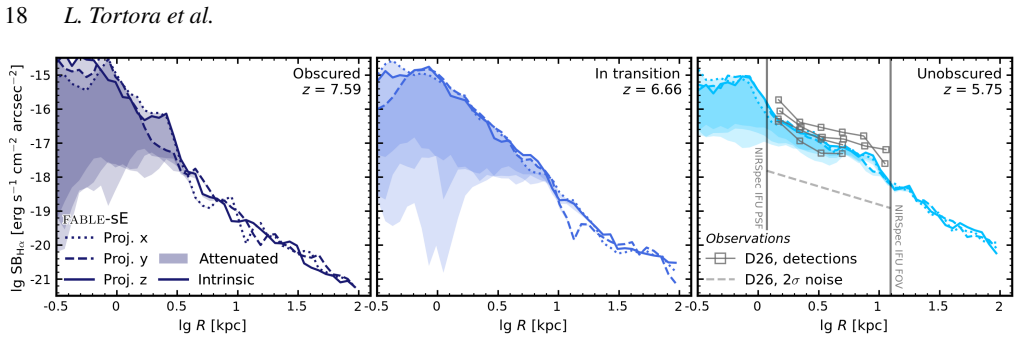
- Simulated Hα surface brightness radial profiles are consistent with current JWST NIRSpec observations of z~6 quasars (BEES sample), supporting the idea that observed quasars have undergone significant feedback.
- The energy injection rate and outflow kinetic power decouple: outflows are set by cumulative energy injection over long times, not instantaneous quasar luminosity, so short-lived or variable quasars can still launch powerful outflows.
Where Pith is reading between the lines
- If correct, Hα nebulae could be used as a 'fossil' record of past quasar activity: an extended nebula without an obvious central source might flag a recently unobscured quasar, linking nebular surveys to black hole growth histories.
- The same blow-out mechanism implies that the escape of ionizing radiation (and hence quasar proximity zones and contribution to reionization) is regulated by feedback, not just gas supply; this may connect quasar lifetime estimates from proximity zones to feedback histories.
- The prediction that cold neutral clumps are ejected to ~100 kpc suggests that some high-redshift DLA absorbers in quasar fields may be physically associated with outflows rather than cold accretion streams; future spectroscopy of DLA metallicities and kinematics could test this.
- A testable extension: compare the Hα nebula morphology (clumpy vs smooth) between unobscured and obscured quasars at fixed luminosity; the model predicts that clumpiness arises specifically from the blow-out phase.
Editorial analysis
A structured set of objections, weighed in public.
Referee Report
Summary. This paper presents an analysis of three zoom-in cosmological simulations of a massive z~6 halo: NoAGN, fable (fiducial feedback), and fable-sE (modified BH seeding, mildly super-Eddington accretion cap f_Edd=2, and reduced feedback coupling ε_f=0.05). The central result is that fable-sE, which grows a 1.3×10^10 M_sun black hole, undergoes a strong 'blow-out' episode that drives metal-enriched, cold, fast neutral clumps into the CGM, enhancing the DLA covering fraction by up to ~64% relative to NoAGN. Using a new ray-tracing code VoroLite, the authors post-process the simulations with quasar radiation and predict Hα nebulae whose spatial extent and surface brightness increase as the central engine becomes unobscured, and compare these predictions to recent JWST observations of z~6 quasars.
Significance. If the causal chain posited in the title and abstract is correct, the paper provides a valuable theoretical framework for interpreting JWST observations of z>6 quasar environments: obscuration stages are tied to feedback-induced CGM transformations and to extended Hα nebulae. The paper's strengths include a detailed description of the ray-tracing methodology on a Voronoi mesh, explicit checks against different projection axes, and a transparent enumeration of caveats in Section 4.4. The authors also make falsifiable predictions for DLA covering fractions and Hα surface brightness profiles. However, the headline attribution of the effect specifically to super-Eddington accretion is not isolated in the run design, and several acknowledged simplifications are load-bearing for the quantitative observational claims.
major comments (3)
- [§2.1; Title/Abstract] The fable-sE run modifies three parameters simultaneously: seeding halo mass threshold (M_vir>10^9 h^-1 M_sun), Eddington cap (f_Edd=2), and feedback coupling (ε_f=0.05). The paper's title and abstract claim that 'super-Eddington quasars' drive the CGM transformation, but no run varies f_Edd while holding seeding and ε_f fixed. The observed blow-out, clump population, and DLA covering enhancement could in principle be caused by earlier seeding or lower ε_f. The authors' own statement in §2.1 that the simulations 'were not designed to correctly grow extremely massive SMBHs' underscores the exploratory nature. I request either an isolation run (or at least a parameter-decomposition study) or a reframing of the central claims to 'enhanced early black hole growth' with an explicit discussion of the degeneracy. This is load-bearing because the title, abstract, and conclusions (e.g., first bul
- [§2.3 and §4.4.4] The radiative transfer is performed in post-processing on fixed density and temperature fields, with no photo-heating or radiation-hydrodynamic response. The authors acknowledge this in §4.4.4, but the quantitative predictions of Hα size/luminosity in Figs. 11–13 and the comparison with BEES observations in Fig. 13 depend on the assumption that the gas distribution remains unchanged during the ~1 Myr quasar episode. Photo-heating can expand dense clumps and alter escape channels, so the inferred agreement with observations may be fortuitous. The paper would be strengthened by a simple test (e.g., a post-processing 'puffed' density model or a comparison with an on-the-fly RT run from the literature) to show that the qualitative trends are robust.
- [§3.4 and §4.4.3] The core new observable — the clumpy CGM and the associated ~64% DLA covering fraction enhancement (Fig. 9) — is likely resolution-sensitive. The authors note in §4.4.3 that limited resolution affects the formation, survival, and properties of gas clumps. Since only a single resolution is presented, it is unclear whether the predicted enhancement is a numerical artifact or a robust physical outcome. I ask for a convergence test or at least a more explicit statement in the conclusions that the quantitative covering fractions and Hα surface brightness values should be treated as lower/upper limits pending higher-resolution simulations.
minor comments (6)
- [§1] Typo: 'Mgiilines' should be 'Mg ii lines'.
- [§2.2 / Appendix A] The temperature iteration procedure for the neutral fraction is described in Appendix A, but it would help to state in the main text why this is important for the subsequent RT; currently the reader must infer it.
- [Fig. 13] The 'black shaded area' for BEES profiles is difficult to distinguish in the printed figure; consider using a distinctly labelled envelope or a legend entry.
- [§1; §5] The paper refers to the 'Aether project (Farina et al., 2026, in prep.)' without a reference; please add a citation or remove the specific project name if it is not in the reference list.
- [§3.2] The authors use 20000 sightlines for VoroLite and ~12000 for the grid-based method; the difference in numbers is not justified. A brief note on convergence with ray count would be useful.
- [§5] The conclusions contain strong population-level statements (e.g., 'demographics of unobscured/blue quasars...') based on a single halo. Please temper these or add a caveat that the results are a case study of one extreme protocluster environment.
Circularity Check
No circularity: the CGM blow-out, clump formation, DLA covering changes, and H-alpha nebulae are emergent outputs of the hydrodynamics/radiative-transfer chain, not restatements of the input parameter choices.
full rationale
No circular step is present. The paper's chain is: (i) take the Bennett et al. (2024) fable/fable-sE zoom-in runs; (ii) let AGN feedback act hydrodynamically; (iii) post-process fixed snapshots with VoroLite to solve Eq. (7) for the ionization state and then compute H-alpha emissivity via Eq. (6). The clumpy CGM, cold outflowing clumps, blow-out episodes, and the time-dependent DLA covering fraction (Fig. 9) are diagnosed from the simulated gas distribution; they are not imposed by the adopted f_Edd=2, seeding threshold, or eps_f=0.05. Likewise, the H-alpha radial profiles (Fig. 13) are obtained by ray-tracing through the simulated density field with a specified Q_Hi, so their extent and brightness depend on the gas geometry and escape channels, not merely on the input feedback parameters. The main legitimate concern is identification rather than circularity: Section 2.1 changes three things at once in fable-sE (earlier seeding, f_Edd=2, eps_f=0.05), so attributing the transformation specifically to super-Eddington accretion is underdetermined. But underdetermination is a confound/correctness caveat, not a reduction of the prediction to its input; no equation equates H-alpha size or covering fraction to f_Edd or eps_f. The self-citation to Bennett et al. (2024) supplies the simulation suite and BH growth history, but the present paper re-analyzes the actual simulation outputs rather than invoking a self-cited uniqueness theorem, and the radiative-transfer code is independently applied. The paper also explicitly frames results as relative trends and lists limitations in Sections 2.3 and 4.4 (post-processing, fixed gas density, unresolved ISM, no on-the-fly radiation), further confirming that the claims are emergent simulation findings rather than definitions or fitted predictions.
Axiom & Free-Parameter Ledger
free parameters (9)
- Black hole seeding mass threshold (fable-sE) =
10^9 h^-1 M_sun (vs 5×10^10 in fiducial)
- Eddington cap f_Edd =
2
- Quasar-mode feedback coupling ε_f (fable-sE) =
0.05
- Bondi accretion boost factor α =
100
- Radiative efficiency ε_r =
0.1
- Radio-mode mechanical heating efficiency ε_m =
0.8
- ISM temperature floor for star-forming gas =
10^4 K
- Dust-to-metal mass fraction in cold gas =
15 per cent
- Median H-ionizing cross-section <σ_HI> =
2.126×10^-18 cm^2
axioms (7)
- domain assumption FABLE/Illustris subgrid prescriptions for cooling, star formation, and stellar feedback are a valid description of the unresolved ISM at z∼6.
- ad hoc to paper The fable-sE modifications (earlier seeding, f_Edd=2, ε_f=0.05) represent a plausible route to billion-solar-mass black holes at z∼6.
- domain assumption A homogeneous, redshift-dependent UVB (Puchwein et al. 2019) with the Rahmati et al. (2013) self-shielding fitting function describes the pre-quasar ionization state.
- domain assumption Case B recombination and the adopted Hα emissivity formula correctly convert the ionized gas distribution into Hα luminosity.
- domain assumption The qsosed SED (Kubota & Done 2018), with bolometric-correction interpolation, gives the correct ionizing photon rate for these super-Eddington black holes.
- ad hoc to paper Post-processing the radiative transfer on fixed gas density and temperature fields captures the observable Hα morphology.
- domain assumption Dust attenuation can be approximated by a foreground dust screen with a fixed dust-to-metal ratio.
invented entities (1)
-
VoroLite
no independent evidence
read the original abstract
The discovery of gargantuan black holes with masses exceeding a billion solar masses at $z\gtrsim6$ suggests rapid black hole growth and significant energy input into their host galaxies in the early Universe. With JWST probing previously unseen phases of the interstellar (ISM) and circumgalactic (CGM) medium around $z > 6$ quasars, detailed theoretical studies can now be directly confronted with observations. We use zoom-in simulations of a massive protocluster at $z\sim6$, employing both the fiducial FABLE galaxy formation model and modifications that allow earlier black hole seeding and mildly super-Eddington accretion. The central quasar remains Compton-thick throughout most of its evolution, with the obscuration arising from the ISM of its compact host galaxy. The onset of sufficiently strong quasar feedback drives a 'blow-out' episode, clearing out escape channels for ionizing radiation and leaving the central engine unobscured. This leads to a complete transformation of the CGM, whereby powerful, metal-enriched outflows produce a population of cold, fast, neutral clumps, significantly increasing the covering fraction of neutral hydrogen in the host halo. Radiative transfer calculations performed with a new ray-tracing code show that the CGM responds to quasar activity through the formation of H$\alpha$ nebulae, whose size and luminosity increase with the strength of quasar feedback and decrease with obscuration level. Enhanced early black hole growth thus fundamentally reshapes the ISM and CGM of $z\sim6$ quasars, leaving clear observable signatures in their obscuration, neutral hydrogen distribution, and extended H$\alpha$ emission.
Figures


Reference graph
Works this paper leans on
-
[1]
The Physics and Evolution of Active Galactic Nuclei
-
[2]
The large-scale structure of the universe
-
[3]
LeVeque, Randall J. , year=. Finite Volume Methods for Hyperbolic Problems , publisher=
-
[4]
Coevolution (Or Not) of Supermassive Black Holes and Host Galaxies. ARAA , keywords =. doi:10.1146/annurev-astro-082708-101811 , archivePrefix =. 1304.7762 , primaryClass =
-
[6]
RADAMESH: cosmological radiative transfer for Adaptive Mesh Refinement simulations. , keywords =. doi:10.1111/j.1365-2966.2010.17799.x , archivePrefix =. 1009.1625 , primaryClass =
arXiv 2010
-
[7]
submitted to A&A , keywords =
The hydrodynamical response of cold circumgalactic clouds to quasar radiation. submitted to A&A , keywords =
-
[9]
C ^ 2 -ray: A new method for photon-conserving transport of ionizing radiation. , keywords =. doi:10.1016/j.newast.2005.09.004 , archivePrefix =. astro-ph/0508416 , primaryClass =
Pith/arXiv arXiv 2005
-
[10]
Equation of state of the photoionized intergalactic medium. , keywords =. doi:10.1093/mnras/292.1.27 , archivePrefix =. astro-ph/9612232 , primaryClass =
-
[11]
Using 3D Voronoi grids in radiative transfer simulations. , keywords =. doi:10.1051/0004-6361/201322281 , archivePrefix =. 1310.1854 , primaryClass =
-
[12]
Core condensation in heavy halos: a two-stage theory for galaxy formation and clustering. MNRAS , keywords =. doi:10.1093/mnras/183.3.341 , adsurl =
-
[13]
Galaxy Formation through Hierarchical Clustering. ApJ , keywords =. doi:10.1086/170483 , adsurl =
-
[14]
The Connection Between Galaxies and Their Dark Matter Halos. ARAA , keywords =. doi:10.1146/annurev-astro-081817-051756 , archivePrefix =. 1804.03097 , primaryClass =
-
[15]
The Demography of Massive Dark Objects in Galaxy Centers. AJ , keywords =. doi:10.1086/300353 , archivePrefix =. astro-ph/9708072 , primaryClass =
-
[16]
The growth of the gargantuan black holes powering high-redshift quasars and their impact on the formation of early galaxies and protoclusters. MNRAS , keywords =. doi:10.1093/mnras/stad3179 , archivePrefix =. 2305.11932 , primaryClass =
-
[17]
Relations between Central Black Hole Mass and Total Galaxy Stellar Mass in the Local Universe. ApJ , keywords =. doi:10.1088/0004-637X/813/2/82 , archivePrefix =. 1508.06274 , primaryClass =
-
[18]
Monthly Notices of the Royal Astronomical Society , author=
A physical model of the broad-band continuum of AGN and its implications for the UV/X relation and optical variability , volume=. Monthly Notices of the Royal Astronomical Society , author=. 2018 , month=oct, pages=. doi:10.1093/mnras/sty1890 , number=
-
[19]
Monthly Notices of the Royal Astronomical Society , author=
Modelling the spectral energy distribution of super-Eddington quasars , volume=. Monthly Notices of the Royal Astronomical Society , author=. 2019 , month=oct, pages=. doi:10.1093/mnras/stz2140 , note=
-
[20]
Weakness of X-rays and variability in high-redshift active galactic nuclei with super-Eddington accretion , journal =. 2025 , month =. doi:10.1093/pasj/psaf050 , url =
-
[21]
The H I covering fraction of Lyman Limit Systems in FIRE haloes. MNRAS , keywords =. doi:10.1093/mnras/stae1738 , archivePrefix =. 2311.18000 , primaryClass =
-
[22]
FIREbox: simulating galaxies at high dynamic range in a cosmological volume. MNRAS , keywords =. doi:10.1093/mnras/stad1205 , archivePrefix =. 2205.15325 , primaryClass =
-
[24]
A numerical approach to the testing of the fission hypothesis. AJ , keywords =. doi:10.1086/112164 , adsurl =
-
[25]
Smoothed particle hydrodynamics: theory and application to non-spherical stars. MNRAS , keywords =. doi:10.1093/mnras/181.3.375 , adsurl =
-
[26]
Smoothed particle hydrodynamics. ARAA , keywords =. doi:10.1146/annurev.aa.30.090192.002551 , adsurl =
-
[27]
ZEUS-2D: A Radiation Magnetohydrodynamics Code for Astrophysical Flows in Two Space Dimensions. I. The Hydrodynamic Algorithms and Tests. ApJs , keywords =. doi:10.1086/191680 , adsurl =
-
[28]
Journal of Computational Physics , keywords =
Local Adaptive Mesh Refinement for Shock Hydrodynamics. Journal of Computational Physics , keywords =. doi:10.1016/0021-9991(89)90035-1 , adsurl =
-
[29]
Journal of Computational Physics , year = 1984, month = mar, volume =
Adaptive Mesh Refinement for Hyperbolic Partial Differential Equations. Journal of Computational Physics , year = 1984, month = mar, volume =. doi:10.1016/0021-9991(84)90073-1 , adsurl =
-
[30]
The FABLE simulations: a feedback model for galaxies, groups, and clusters. MNRAS , keywords =. doi:10.1093/mnras/sty1780 , archivePrefix =. 1804.05064 , primaryClass =
-
[31]
A model for cosmological simulations of galaxy formation physics. MNRAS , keywords =. doi:10.1093/mnras/stt1789 , archivePrefix =. 1305.2913 , primaryClass =
-
[32]
Introducing the Illustris Project: simulating the coevolution of dark and visible matter in the Universe. , keywords =. doi:10.1093/mnras/stu1536 , archivePrefix =. 1405.2921 , primaryClass =
-
[33]
A model for cosmological simulations of galaxy formation physics: multi-epoch validation. MNRAS , keywords =. doi:10.1093/mnras/stt2295 , archivePrefix =. 1305.4931 , primaryClass =
-
[34]
Introducing the Illustris project: the evolution of galaxy populations across cosmic time. MNRAS , keywords =. doi:10.1093/mnras/stu1654 , archivePrefix =. 1405.3749 , primaryClass =
-
[35]
The Illustris simulation: the evolving population of black holes across cosmic time. MNRAS , keywords =. doi:10.1093/mnras/stv1340 , archivePrefix =. 1408.6842 , primaryClass =
-
[36]
Cosmological smoothed particle hydrodynamics simulations: a hybrid multiphase model for star formation. MNRAS , keywords =. doi:10.1046/j.1365-8711.2003.06206.x , archivePrefix =. astro-ph/0206393 , primaryClass =
arXiv 2003
-
[37]
Simulations of the formation, evolution and clustering of galaxies and quasars. Nature , keywords =. doi:10.1038/nature03597 , archivePrefix =. astro-ph/0504097 , primaryClass =
-
[39]
Cosmological Simulations with TreeSPH. ApJs , keywords =. doi:10.1086/192305 , archivePrefix =. astro-ph/9509107 , primaryClass =
-
[40]
The effect of photoionization on the cooling rates of enriched, astrophysical plasmas. MNRAS , keywords =. doi:10.1111/j.1365-2966.2008.14191.x , archivePrefix =. 0807.3748 , primaryClass =
arXiv 2008
-
[42]
Energy input from quasars regulates the growth and activity of black holes and their host galaxies. Nature , keywords =. doi:10.1038/nature03335 , archivePrefix =. astro-ph/0502199 , primaryClass =
-
[44]
The evolution of large-scale structure in a universe dominated by cold dark matter. ApJ , keywords =. doi:10.1086/163168 , adsurl =
-
[48]
Premature supermassive black hole mergers in cosmological simulations of structure formation. , keywords =. doi:10.1093/mnras/staf1336 , archivePrefix =. 2504.17549 , primaryClass =
-
[49]
Galaxies on FIRE (Feedback In Realistic Environments): stellar feedback explains cosmologically inefficient star formation. MNRAS , keywords =. doi:10.1093/mnras/stu1738 , archivePrefix =. 1311.2073 , primaryClass =
Pith/arXiv arXiv 2073
-
[50]
Simulating galaxy formation with the IllustrisTNG model. MNRAS , keywords =. doi:10.1093/mnras/stx2656 , archivePrefix =. 1703.02970 , primaryClass =
-
[51]
The EAGLE project: simulating the evolution and assembly of galaxies and their environments. MNRAS , keywords =. doi:10.1093/mnras/stu2058 , archivePrefix =. 1407.7040 , primaryClass =
-
[52]
SIMBA: Cosmological simulations with black hole growth and feedback. MNRAS , keywords =. doi:10.1093/mnras/stz937 , archivePrefix =. 1901.10203 , primaryClass =
Pith/arXiv arXiv 1901
-
[53]
Introducing the NEWHORIZON simulation: Galaxy properties with resolved internal dynamics across cosmic time. A&A , keywords =. doi:10.1051/0004-6361/202039429 , archivePrefix =. 2009.10578 , primaryClass =
Pith/arXiv arXiv 2009
-
[54]
The ASTRID simulation: the evolution of supermassive black holes. MNRAS , keywords =. doi:10.1093/mnras/stac351 , archivePrefix =. 2110.14154 , primaryClass =
-
[55]
The FLAMINGO project: cosmological hydrodynamical simulations for large-scale structure and galaxy cluster surveys. MNRAS , keywords =. doi:10.1093/mnras/stad2419 , archivePrefix =. 2306.04024 , primaryClass =
-
[56]
Nature Reviews Physics , keywords =
Cosmological simulations of galaxy formation. Nature Reviews Physics , keywords =. doi:10.1038/s42254-019-0127-2 , archivePrefix =. 1909.07976 , primaryClass =
Pith/arXiv arXiv 1909
-
[57]
Growing the first bright quasars in cosmological simulations of structure formation. MNRAS , keywords =. doi:10.1111/j.1365-2966.2009.15452.x , archivePrefix =. 0905.1689 , primaryClass =
arXiv 2009
-
[58]
Communications in Computational Physics , author=
Upwind and High-Resolution Methods for Compressible Flow: From Donor Cell to Residual-Distribution Schemes , volume=. Communications in Computational Physics , author=. 2006 , pages=. doi:https://doi.org/2006-CiCP-7954 , number=
2006
-
[59]
SIAM Journal on Scientific and Statistical Computing , author=
On the Relation Between the Upwind-Differencing Schemes of Godunov, Engquist–Osher and Roe , volume=. SIAM Journal on Scientific and Statistical Computing , author=. 1984 , pages=. doi:10.1137/0905001 , number=
doi:10.1137/0905001 1984
-
[63]
Simulating cosmic structure formation with the GADGET-4 code. MNRAS , keywords =. doi:10.1093/mnras/stab1855 , archivePrefix =. 2010.03567 , primaryClass =
Pith/arXiv arXiv 2010
-
[64]
The cosmological simulation code GADGET-2. MNRAS , keywords =. doi:10.1111/j.1365-2966.2005.09655.x , archivePrefix =. astro-ph/0505010 , primaryClass =
arXiv 2005
-
[65]
A New Parallel N-Body Gravity Solver: TPM. ApJs , keywords =. doi:10.1086/192166 , archivePrefix =. astro-ph/9409021 , primaryClass =
-
[66]
Performance characteristics of TreePM codes. New Astronomy , keywords =. doi:10.1016/S1384-1076(03)00056-3 , archivePrefix =. astro-ph/0212129 , primaryClass =
-
[67]
A hierarchical O(N log N) force-calculation algorithm. Nature , keywords =. doi:10.1038/324446a0 , adsurl =
-
[68]
Computer Simulation Using Particles
-
[69]
Improving the convergence properties of the moving-mesh code AREPO. MNRAS , keywords =. doi:10.1093/mnras/stv2380 , archivePrefix =. 1503.00562 , primaryClass =
-
[70]
Tidal disruption of stars by black holes of 10 ^ 6 - 10 ^ 8 solar masses in nearby galaxies. Nature , keywords =. doi:10.1038/333523a0 , adsurl =
-
[71]
An ultraluminous X-ray source powered by an accreting neutron star. Nature , keywords =. doi:10.1038/nature13791 , archivePrefix =. 1410.3590 , primaryClass =
-
[72]
Supermassive Black Holes with High Accretion Rates in Active Galactic Nuclei. IV. H Time Lags and Implications for Super-Eddington Accretion. ApJ , keywords =. doi:10.1088/0004-637X/806/1/22 , archivePrefix =. 1504.01844 , primaryClass =
-
[73]
A star in a 15.2-year orbit around the supermassive black hole at the centre of the Milky Way. Nature , keywords =. doi:10.1038/nature01121 , archivePrefix =. astro-ph/0210426 , primaryClass =
-
[74]
Masses of quasars. MNRAS , keywords =. doi:10.1093/mnras/200.1.115 , adsurl =
-
[75]
ARAA , year = 1984, month = jan, volume =
Black Hole Models for Active Galactic Nuclei. ARAA , year = 1984, month = jan, volume =. doi:10.1146/annurev.aa.22.090184.002351 , adsurl =
arXiv 1984
-
[76]
An ultraluminous quasar with a twelve-billion-solar-mass black hole at redshift 6.30. Nature , keywords =. doi:10.1038/nature14241 , archivePrefix =. 1502.07418 , primaryClass =
-
[77]
Formation of supermassive black holes. AAR , keywords =. doi:10.1007/s00159-010-0029-x , archivePrefix =. 1003.4404 , primaryClass =
-
[78]
Nature , year = 1969, month = aug, volume =
Galactic Nuclei as Collapsed Old Quasars. Nature , year = 1969, month = aug, volume =. doi:10.1038/223690a0 , adsurl =
doi:10.1038/223690a0 1969
-
[79]
ApJ , year = 1964, month = aug, volume =
Accretion of Interstellar Matter by Massive Objects. ApJ , year = 1964, month = aug, volume =. doi:10.1086/147973 , adsurl =
doi:10.1086/147973 1964
-
[80]
Powerful Outflows and Feedback from Active Galactic Nuclei. ARAA , keywords =. doi:10.1146/annurev-astro-082214-122316 , archivePrefix =. 1503.05206 , primaryClass =
-
[81]
Moving-mesh cosmology: properties of neutral hydrogen in absorption. MNRAS , keywords =. doi:10.1093/mnras/sts590 , archivePrefix =. 1209.2118 , primaryClass =
-
[82]
X-Ray Weak Active Galactic Nuclei from Super-Eddington Accretion onto Infant Black Holes. , keywords =. doi:10.3847/2041-8213/ad90e1 , archivePrefix =. 2410.00417 , primaryClass =
Pith/arXiv arXiv 2041
-
[83]
The case for large-scale AGN feedback in galaxy formation simulations: insights from XFABLE. , keywords =. doi:10.1093/mnras/staf1435 , archivePrefix =. 2501.16983 , primaryClass =
-
[84]
The Assembly of the First Massive Black Holes. ARAA , keywords =. doi:10.1146/annurev-astro-120419-014455 , archivePrefix =. 1911.05791 , primaryClass =
Pith/arXiv arXiv 1911
-
[85]
Pulsing ULXs: tip of the iceberg?. MNRAS , keywords =. doi:10.1093/mnrasl/slx020 , archivePrefix =. 1702.00808 , primaryClass =
-
[86]
Slim Accretion Disks. ApJ , keywords =. doi:10.1086/166683 , adsurl =
-
[87]
Can a spherically accreting black hole radiate very near the Eddington limit?. MNRAS , keywords =. doi:10.1093/mnras/187.2.237 , adsurl =
-
[88]
A Two-Phase Model for the X-Ray Emission from Seyfert Galaxies. ApJl , keywords =. doi:10.1086/186171 , adsurl =
-
[89]
Observational appearance
Black holes in binary systems. Observational appearance. AA , year = 1973, month = jan, volume =
1973
-
[90]
Galactic Black-Hole Candidates Shining at the Eddington Luminosity. PASJ , keywords =. doi:10.1093/pasj/52.1.133 , adsurl =
-
[91]
How the super-Eddington regime regulates black hole growth in high-redshift galaxies. A&A , keywords =. doi:10.1051/0004-6361/202243170 , archivePrefix =. 2201.08766 , primaryClass =
-
[92]
Living Reviews in Relativity , keywords =
Foundations of Black Hole Accretion Disk Theory. Living Reviews in Relativity , keywords =. doi:10.12942/lrr-2013-1 , archivePrefix =. 1104.5499 , primaryClass =
Pith/arXiv arXiv 2013
discussion (0)
Sign in with ORCID, Apple, or X to comment. Anyone can read and Pith papers without signing in.