REVIEW 3 major objections 6 minor 8 references
TG-Diff: Coupling Discrete Topology Diffusion and Topology-conditioned Geometry Diffusions for B-Rep Generation
T0 review · 3 major / 6 minor · reviewed 2026-08-15 · deepseek-v4-flash
Pith's one-line read A surface-only, topology-first diffusion pipeline beats larger B-rep generators on DeepCAD and ABC validity, quality, and diversity.
desk verdict Solid two-stage diffusion system for B-rep generation; the topology-first surface-only idea is clean and the raw metrics hold up, but the headline validity gap is inflated by a repair loop and the code isn't out. read the letter →
The pith
A machine-rendered reading of the paper's core claim, the machinery that carries it, and where it could break.
The reading
What carries the argument
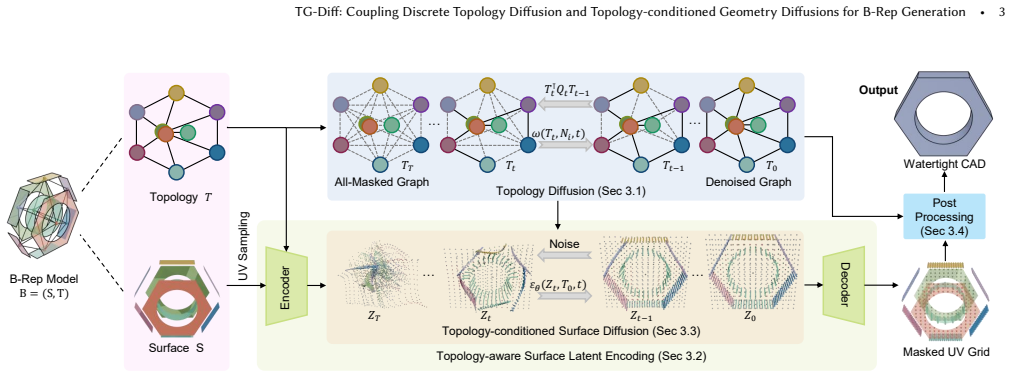
The load-bearing object is the surface-centric B-rep representation $B=(S,T)$, where $S$ stores each face as a $16\times 16$ masked UV grid with coordinates and a validity mask, and $T$ is an $N\times N$ categorical adjacency matrix with states for adjacent, not adjacent, and padding. The machinery that carries the argument is the two-stage diffusion pairing: a D3PM discrete diffusion over $T$ with an absorbing MASK state and row-wise tokenization for the topology, and a latent diffusion over VAE-encoded surface latents whose FiLM-modulated self-attention is conditioned on $T$. The final watertight solid is assembled by extending surfaces, computing pairwise intersections, extracting minimum cycles as face loops, and trimming, so vertices and edges are never generated as independent random variables.
What would settle it
Feed ground-truth B-rep surfaces and adjacency from DeepCAD-0-30 through the Section 3.4 post-processor unchanged: if validity is far below 100% on inputs whose geometry and topology are already correct, the intersection-and-trim step itself is the bottleneck and the reported validity numbers measure the repair pipeline rather than generative quality.
Extended reading notes
Core claim
On its own terms, the central claim is that B-rep generation can be decomposed into a surface-only topology $T\in\{0,1,2\}^{N\times N}$ and a set of masked UV-grid surfaces $S\in\mathbb{R}^{N\times 16\times 16\times 4}$, with edges and vertices recovered afterward by intersecting and trimming the generated surfaces. The topology is sampled by a D3PM discrete diffusion whose row-wise tokenization and symmetry constraint produce valid, diverse adjacency graphs; the surface latents are then denoised by a DiT-based network in which the predicted adjacency modulates attention through FiLM scales and biases. Under this design, every edge in the final solid lies on its parent surfaces by construction, which the paper identifies as the reason it avoids the cracks, misalignments, and orphan entities that plague joint generation. The paper reports validity of 85.6% on DeepCAD-0-30 and 61.4% on ABC-0-50, together with the best COV, MMD, and JSD scores, and attributes the gain to the surface-centric representation and topology conditioning rather than to any single architectural trick.
Load-bearing premise
The pipeline's validity rests on the post-processing premise that extending the generated surfaces, intersecting them, and extracting minimum cycles will reconstruct a correct watertight solid whenever the topology and geometry are good; the paper concedes that near-tangent surfaces, circular rings, and spheres can defeat this step, and Table 9 shows the retry budget largely determines the reported validity rate.
Editorial extensions
If this is right
- On the DeepCAD-0-30 and ABC-0-50 benchmarks the paper claims the best COV, MMD, JSD, and validity among compared diffusion baselines, with validity 85.6% and 61.4% respectively (Table 2).
- Generated topologies are valid and diverse: the D3PM route reaches 99.8% and 96.5% valid-topo on the two benchmarks and roughly doubles DTGBrepGen's uniqueness on DeepCAD (Table 4).
- Reported validity is pipeline-level, not model-level: on DeepCAD-7-30 the same generator yields 62.4% validity at one post-processing retry, 83.6% at three, and 86.9% at ten (Table 9).
- The surface-only representation cuts compute substantially: 82.18M parameters, 2.2 GFLOPs, and lower intermediate memory than all compared baselines (Table 7).
- Ablations show the representation and conditioning choices carry the gains: removing BLISS canonical labeling drops validity from 83.6% to 69.8%, and switching row-wise tokens to per-element tokens drops it to 72.4% on DeepCAD-7-30 (Table 8).
Reading between the lines
- A testable extension: because topology enters only as an attention modulation, the same two-stage design should support conditional generation (text, sketch, or image) by conditioning the surface diffusion on an externally supplied hint; the paper only demonstrates unconditional generation.
- A testable prediction: since edges are always constructed from surface intersections, any measured generation failure should be traceable either to a wrong adjacency/geometry or to a post-processor defeat (tangency, rings, spheres); classifying failures this way on the paper's 500-sample manual study would cleanly separate generative error from repair error.
- The retry-sensitivity of validity suggests a practical evaluation norm: report validity at one retry as the raw pipeline number, and treat the gap to three or ten retries as the contribution of the repair engine, not of the generative model.
Signed reviews
Editorial analysis
A structured set of objections, weighed in public.
Referee Report
Summary. The paper introduces TG-Diff, a two-stage diffusion framework for unconditional B-rep generation. Topology is represented only as a surface-adjacency matrix and generated by a D3PM discrete diffusion; surface geometry is encoded into latents by a topology-aware VAE and generated by a lightweight topology-conditioned DiT latent diffusion. Edges and vertices are not generated explicitly but are recovered by post-processing that extends surfaces, computes intersections, detects minimum cycles, and trims faces, with up to three retries that adjust angular parameters of circular surfaces. The paper reports state-of-the-art COV, MMD, JSD, and validity on DeepCAD-0-30 and ABC-0-50, along with lower parameter and GFLOP counts than baselines.
Significance. If the claims hold, the paper offers a clean surface-centric alternative to edge/vertex-level topology generation, with a compelling efficiency story and a natural mechanism for reducing geometric-topological inconsistency. The ablations are unusually complete: they test GT topology, VAE-GNN removal, BLISS, tokenization, single- vs two-stage generation, and the retry schedule, and Section 5 candidly describes failure modes. The central validity claim, however, is not yet established, because Table 9 shows that 21.2 points of validity on DeepCAD-7-30 are purchased by the second and third post-processing retries, and the paper does not decompose how much of the Table 2 margin over DTGBrepGen is due to the learned model versus the repair loop. Since no code is released, the missing breakdown cannot be filled in by reviewers. With the additional analysis requested below, the contribution would be publishable; as it stands, the headline validity result is conditional on an unquantified repair procedure.
major comments (3)
- [Section 3.4 and Table 9] The headline validity claim is not a property of the two learned diffusions alone. On DeepCAD-7-30, Table 9 shows validity increases from 62.4% with one retry to 76.2% with two and 83.6% with three (86.9% with ten). The paper does not report how often the retry loop is triggered, how many surfaces per shape are angle-adjusted, or how much these adjustments perturb the generated geometry, and no COV/MMD/JSD numbers are stratified by retry count. Section 5 concedes that near-tangent surfaces, circular rings, and spheres can defeat the intersection kernel and that some failures are irrecoverable; Section 4.2 also reports a 3.1% residual failure rate even after repair. The abstract's claim of excelling 'in the validity metric' therefore conflates generative quality with repair capability. Please report validity as a function of retry budget for the main benchmarks, the distribution of perturbed surfaces, and before/after quality metrics.
- [Section 4.2 and Table 6] The validity comparison against baselines uses unmatched post-processing. Table 6 states that BrepGen and DTGBrepGen use three thresholding attempts and 200-step edge-refinement, while TG-Diff uses three retries that adjust the angular parameters of failed surfaces. These are not equivalent repair strategies: TG-Diff's retries modify the analytic geometry of circular surfaces, whereas the baselines' threshold attempts do not change generated surface parameters. The margin in Table 2 (85.6 vs 75.6 on DeepCAD-0-30; 61.4 vs 52.9 on ABC-0-50) may therefore partly measure the aggressiveness of the post-processor. Please provide a matched comparison, such as re-running TG-Diff with one retry and with no angle adjustment, and re-running baselines with the same retry budget, or at least quantify the geometric deviation induced by the angle adjustments.
- [Tables 2 and 5] There is an unexplained internal inconsistency in the reported validity numbers. Table 2 reports 85.6% validity for Ours on DeepCAD-0-30, while Table 5 reports 95.6% for 'all' on the same dataset, with a caption that mentions 'raw data only after post-processing'. The manuscript does not define what input 'raw data' refers to. If Table 5 measures how often the post-processor converts uncut raw surfaces into valid B-reps, it is a different quantity and must be labeled as such; if it measures the full generation pipeline, the 10-point gap with Table 2 must be explained. This is load-bearing because the paper's main claimed improvement over prior work is the validity metric.
minor comments (6)
- [Section 3.2] In the paragraph defining the reconstruction loss, 'the reconstructio loss is defined' contains a typo; it should be 'reconstruction loss'.
- [Table 6 and surrounding text] The name of the baseline is written both as 'HOLA' and 'HoLa'; please standardize the spelling.
- [Section 4.2, runtime paragraph] The factors '1.76× fewer parameters, 1.59× fewer GFLOPs, and 1.85× reduction in total runtime' are not referenced to a specific baseline; from Table 7, 1.76× appears to be relative to DTGBrepGen in parameters, while 1.59× is relative to BrepDiff in GFLOPs. Please state the reference method for each factor.
- [General] No code or checkpoints are provided. For a systems paper whose central claim depends on a custom post-processor (Section 3.4), a reproducibility statement or release would substantially increase confidence in the reported numbers.
- [Section 4.1 and Table 2] The VLM-based user-study validation uses 20 participants and 110 shapes; please report how the shapes were sampled and the variance of the consistency rates, and consider adding error bars or confidence intervals to the metrics in Table 2, since all experiments are said to be run 10 times.
- [Table 3] The no-post-processing metrics are computed against a different reference (fitted B-spline patches) than the main results (GT B-rep surfaces), as noted in the text; the table caption should repeat this caveat to avoid misreading.
Circularity Check
No significant circularity: TG-Diff's learned components are trained on independently defined targets, and the disclosed post-processing and surface-count sampling are design choices, not renamed predictions.
full rationale
The paper does not derive a result from its own output. The topology D3PM is trained with the D3PM variational bound and an auxiliary denoising loss against the binarized adjacency matrix; the geometry diffusion is trained with a v-prediction objective against surface latents from a VAE trained with reconstruction, KL, and MMD losses. These targets are defined independently of the reported metrics. The post-processing repair loop (Sec. 3.4) and the empirical surface-count sampling (Sec. 4.1) are disclosed engineering choices, and the paper explicitly reports without-post-processing metrics in Table 3, so the validity claim is not a renamed fit or a value that is forced by construction. Section 5's concession about near-tangent surfaces, circular rings, and spheres is a limitation of the repair kernel, not evidence of circularity. The only author-overlapping citation, BrepGPT, appears in related work and is not load-bearing. The statement in Sec. 4.5 that successfully post-processed B-reps are topologically consistent by design is an acknowledged definitional consequence, not a claimed prediction. Hence no circular step can be exhibited.
Assumptions & free parameters
free parameters (5)
- D3PM logit temperature schedule parameters m and n (Eq. 5) =
m = 0.8, n = 0.25
- Surface-count sampling distribution for N_i =
Empirical distribution over training set surface counts
- Post-processing fitting tolerance =
0.025
- Post-processing retry count =
Three retries
- VAE balancing weights w1, w2, w3 =
1, 1e-7, 1e-4
assumptions (4)
- domain assumption A B-rep model can be described completely by its surfaces and a three-state surface adjacency matrix; vertices and edges can be recovered as intersections of adjacent surfaces during post-processing.
- domain assumption A masked 16 by 16 uniform UV grid is a sufficient geometry representation for each parametric surface.
- domain assumption The OpenCascade intersection and trimming kernel can produce consistent edge loops if surfaces are extended and angles adjusted, up to three retries.
- standard math The D3PM transition matrices and reverse posterior formulas from Austin et al. are valid for categorical diffusion.
Cite this review
Pith. "Pith review of TG-Diff: Coupling Discrete Topology Diffusion and Topology-conditioned Geometry Diffusions for B-Rep Generation." pith.science (2026). https://pith.science/paper/3BRR5ZIJ
@misc{pith2026260721928,
  author       = {Pith},
  title        = {Pith review of: TG-Diff: Coupling Discrete Topology Diffusion and Topology-conditioned Geometry Diffusions for B-Rep Generation},
  year         = {2026},
  howpublished = {\url{https://pith.science/paper/3BRR5ZIJ}},
  note         = {Machine review of arXiv:2607.21928}
}
read the original abstract
Boundary representation (B-rep) is the standard format for computer-aided design (CAD). This article proposes a lightweight two-stage diffusion-based B-rep generation framework, TG-Diff, that achieves efficient, high-quality B-rep generation by decoupling topology and geometric modeling. In contrast to previous work that generates topology as a collection of vertices, edges, and surfaces together with their relationships, TG-Diff represents topology only as a collection of surfaces and their adjacency relationships. This surface-centric representation inherently alleviates the geometric and topological inconsistencies between separately generated surfaces, edges, and vertices, simplifying the generation process. Based on the surface-centric representation, we develop two independent diffusion models that generate surface adjacency relationships and surface latents, respectively. By using topology as guidance, the surface generation process becomes more stable, leading to stronger structural completeness in the generated B-rep models. The topology diffusion model adopts a Discrete Diffusion Model (D3PM) for efficient binary sampling, avoiding the slow inference of autoregressive methods. Surface latent generation employs a conditional latent diffusion model with a lightweight DiT architecture, where surface adjacency guides geometry generation while reducing computational cost. Finally, edges and vertices are derived from the decoded adjacent surfaces via post-processing to form a final watertight B-rep. Despite its compact computational footprint (82.18M parameters and 2.2 GFLOPs), TG-Diff excels in the validity metric while achieving superior performance on all COV, MMD, and JSD metrics across the DeepCAD and ABC datasets.
Figures


Figures from the paper (11 more)


Reference graph
Works this paper leans on
-
[2]
Jinze Bai, Shuai Bai, Shuai Yang, Shuai Wang, Xuefei Tan, et al
17981–17993. Jinze Bai, Shuai Bai, Shuai Yang, Shuai Wang, Xuefei Tan, et al . 2023. Qwen-VL: A Versatile Vision-Language Model for Understanding, Localization, Text Reading, and Beyond.arXiv preprint arXiv:2308.12966(2023). Ming Chen, Zhewei Wei, Zengfeng Huang, Bolin Ding, and Yaliang Li. 2020. Simple and Deep Graph Convolutional Networks. InICML 2020, ...
arXiv 2023
-
[8]
CAD-GPT: Synthesising CAD Construction Sequence with Spatial Reasoning- Enhanced Multimodal LLMs. InAAAI 25. AAAI Press, 7880–7888. Jianyu Wu, Yizhou Wang, Xiangyu Yue, Xinzhu Ma, Jinyang Guo, Dongzhan Zhou, Wanli Ouyang, and Shixiang Tang. 2025. Cmt: A cascade mar with topology predictor for multimodal conditional cad generation. InICCV 2025. 7014–7024. ...
-
[2015]
Siyu Wang, Cailian Chen, Xinyi Le, Qimin Xu, Lei Xu, Yanzhou Zhang, and Jie Yang
2692–2700. Siyu Wang, Cailian Chen, Xinyi Le, Qimin Xu, Lei Xu, Yanzhou Zhang, and Jie Yang
-
[2018]
FiLM: Visual Reasoning with a General Conditioning Layer. InAAAI 2018. 3942–3951. ACM Trans. Graph., Vol. 1, No. 1, Article . Publication date: July 2026. TG-Diff: Coupling Discrete Topology Diffusion and Topology-conditioned Geometry Diffusions for B-Rep Generation•15 Robin Rombach, Andreas Blattmann, Dominik Lorenz, Patrick Esser, and Björn Ommer
work page 2018
- [2021]
-
[2022]
High-Resolution Image Synthesis with Latent Diffusion Models. InCVPR 2022. IEEE, 10674–10685. Tim Salimans and Jonathan Ho. 2022. Progressive Distillation for Fast Sampling of Diffusion Models. InICLR 2022. OpenReview.net. Jiaming Song, Chenlin Meng, and Stefano Ermon. 2021. Denoising Diffusion Implicit Models. InICLR 2021. Oriol Vinyals, Meire Fortunato,...
work page 2022
-
[2024]
Wonder3D: Single Image to 3D Using Cross-Domain Diffusion. InCVPR 2024. 9970–9980. Xinzhu Ma, Cheng Wang, Chen Tang, Bin Wang, Shixiang Tang, Yuan Meng, Yunhong Wang, and Di Huang. 2025. Point2Primitive: CAD Reconstruction from Point Cloud by Direct Primitive Prediction.arXiv preprint arXiv:2505.02043(2025). Wamiq Reyaz Para, Shariq Farooq Bhat, Paul Guer...
-
[2025]
BrepGiff: Lightweight Generation of Complex B-rep with 3D GAT Diffusion. InCVPR 2025. Computer Vision Foundation / IEEE, 26587–26596. Haoxiang Guo, Shilin Liu, Hao Pan, Yang Liu, Xin Tong, and Baining Guo. 2022. Com- plexGen: CAD reconstruction by B-rep chain complex generation.ACM Trans. Graph.41, 4 (2022), 129:1–129:18. Jonathan Ho, Ajay Jain, and Piete...
arXiv 2022
Reviewed August 15, 2026 · model on record in the stance chip above.
Discussion (0). Continue with ORCID to comment.