REVIEW 4 major objections 4 minor 45 references
InnoText claims that a single diffusion-transformer model can both generate and edit legible text in images across English and Chinese, outperforming task-specific systems on accuracy and visual quality.
Reviewed by Pith at T0; open to challenge. T0 means a machine referee read the full paper against a public rubric. the ladder, T0–T4 →
T0 review · deepseek-v4-flash
2026-08-01 05:45 UTC pith:FNRFZUIM
load-bearing objection A credible unified DiT for bilingual text generation and editing, but the Chinese generation benchmark is partly self-referential and the lack of error bars makes the headline gains uncertain. the 4 major comments →
InnoText: A Unified Model for Visual Text Generation and Editing
The pith
A machine-rendered reading of the paper's core claim, the machinery that carries it, and where it could break.
Core claim
The paper's central claim is that generation and editing are the same underlying operation once the model is told what to preserve. The input stacks a glyph image (the desired text, rendered) with either a masked image for editing or a blank canvas for generation, and a mask channel tells the model which half to paint. A font-size map—a grayscale image of inverse character heights—is injected into each transformer block to recalibrate features, so small characters are not neglected. A small-character augmentation and a region-weighted loss keep tiny strokes legible and focus optimization on edited pixels. Fine-tuned on 30K curated bilingual images, the model reports the best exact-text accur
What carries the argument
The central device is the Font Size-Aware Modulation (FSAM): a spatial size map encoding inverse per-character height, patchified into tokens, linearly projected, and decoded by two MLPs into per-location scale and shift parameters that multiply and add into the hidden states of each Diffusion Transformer (DiT) block. This makes the network's internal gain depend on local font scale, counteracting the degradation of tiny glyphs. Two supporting mechanisms carry the same idea further: Small-Character Aware Augmentation randomly enlarges small-character regions during training (a 'foveal' zoom), and the Task-Specific Region Weighted Loss multiplies the flow-matching loss by the size map for edi
Load-bearing premise
The whole advantage rests on the assumption that the synthetic Chinese images used for training and evaluation resemble real-world Chinese text scenes closely enough; if they contain hidden rendering artifacts, the measured gains could be an artifact of the benchmark itself.
What would settle it
Hold out a set of real-world photos containing Chinese signs and labels, with varied fonts, lighting, and perspective, and run the model without any fine-tuning on that set; if OCR sentence accuracy on these real photos drops to the level of editing-only baselines, the reported edge is tied to the synthetic distribution rather than to the architecture.
If this is right
- If the central claim holds, one trained checkpoint can switch between generation and editing by changing only the input mask, removing the need for separate pipelines and their style drift.
- The font-size map is language-agnostic, so the same recipe should transfer to other complex scripts such as Japanese or Korean with minimal re-curation.
- Applying the region-weighted loss beyond text—e.g., to logo or caption edits—becomes a natural extension for other precision-critical image editing tasks.
- The 30K dataset, if public, gives the field a common bilingual benchmark that separates text accuracy from perceptual quality.
Where Pith is reading between the lines
- A test not run in the paper: evaluating on real photographs of street signs or product labels would reveal whether the synthetic training distribution is the reason the model wins, since the proposed benchmark samples the same corpus used for fine-tuning.
- The inverse-font-height map could be reused as a general 'importance map' for any dense, small-scale visual content (charts, barcodes, fine patterns), not just text.
- If the unified model also holds up under instruction prompts (e.g., 'change X to Y'), the same architecture could evolve into a text-editing assistant rather than a two-mode tool.
Editorial analysis
A structured set of objections, weighed in public.
Referee Report
Summary. The paper proposes InnoText, a Diffusion-Transformer (DiT) model that unifies visual text generation and editing in a single network by building on Flux.1 Fill dev. Three components are introduced: Font Size-Aware Modulation (FSAM), Small-Character Aware Augmentation (SCAA), and a Task-Specific Region Weighted Loss. The authors also construct InnoText-30K, a bilingual English/Chinese dataset, and InnoText-Bench for evaluation. Experiments compare with AnyText, AnyText2, TextFlux, Flux-Fill, and, in the supplementary material, Flux-Text and EasyText, reporting sentence accuracy, NED, LPIPS, and human-preference results. The main claim is state-of-the-art performance on both generation and editing in English and Chinese.
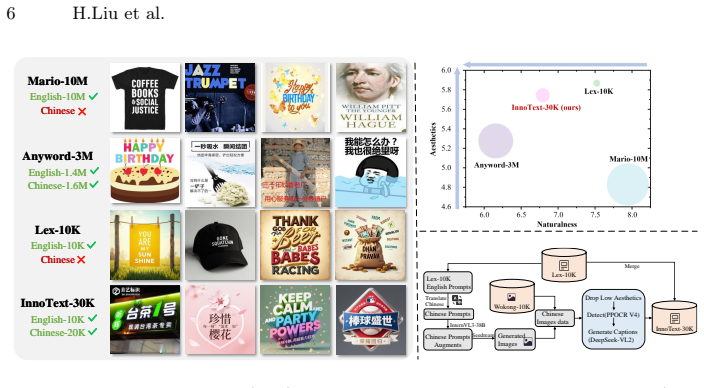
Significance. The paper addresses a relevant gap: most strong DiT-based text models are single-task. If the claimed results hold, a single model that handles both generation and editing at good accuracy, with a new bilingual dataset, would be a useful contribution. The external editing benchmark (AnyText-Bench) and MARIO-Eval results provide some independent support, and the ablation study gives evidence for the contributions of FSAM and SCAA. However, the headline generation results, especially for Chinese, are evaluated on a benchmark sampled from the authors' own training corpus, and the main baseline comparisons are not matched in training data or compute. These issues currently leave the central generalization claim insufficiently supported.
major comments (4)
- [§3.2, Table 1] InnoText-Bench is sampled from InnoText-30K, the same corpus used to train InnoText. The Chinese subset is generated by Seedream from translated/augmented Lex-10K prompts and filtered with PPOCR and DeepSeek-VL2; no evidence is provided that this synthetic distribution matches real Chinese scene text. The reported Chinese generation advantage over AnyText2 (Sen. Acc 0.5907 vs 0.5262) may therefore be inflated by train/test overlap. The NIMA/NIQE scores in Fig. 4 do not measure text realism or glyph distribution. Please add an externally curated Chinese generation test set or a cross-dataset evaluation, and clarify how the InnoText-Bench split avoids training overlap.
- [§5.1, Tables 1 and 6] The main comparisons use baselines with their officially released pretrained weights; only AnyText and AnyText2 are fine-tuned on InnoText-30K in the ablation of Table 2. TextFlux, Flux-Fill, EasyText, and Flux-Text are not trained on the same data or with the same LoRA/compute budget in the headline tables. Since data composition and training volume strongly affect text rendering, the claimed superiority may reflect data/training disparities rather than a fundamental architectural advantage. The matched comparison in Table 6 (Ours 3M vs Flux-Text 3M) is more convincing; please extend this matched design to all headline baselines, including generation, or state explicitly where this is infeasible.
- [§4.4, Eq. (10)] The Task-Specific Region Weighted Loss is underspecified. The region weight S is not defined; the text says higher weights are assigned to masked or modified areas, but no formula, normalization, or dependence on the size map/mask is given. The flow-matching loss L_FM is also not explicitly defined. Without these definitions the method cannot be reproduced, and the ablation row 'w/o L_T_SRW' in Table 2 is not interpretable. Please provide the full loss expression, including how S is computed and normalized.
- [Tables 1–6 and Fig. 10] No error bars, confidence intervals, or significance tests are reported. Several headline gaps are small: e.g., English editing Sen. Acc 0.7988 vs 0.7893 for AnyText2, Ours (3M) vs Flux-Text (3M) 0.8224 vs 0.8175, and some supplementary human-preference comparisons are near chance (e.g., 51.9% vs 48.1%). Given the evaluation set sizes (1,500 images for InnoText-Bench; 100 cases in the main human study), these differences may be within sampling noise. Please report bootstrap confidence intervals or paired significance tests for the central claims.
minor comments (4)
- [§5.1 vs §4.3] Notation is inconsistent: §4.3 defines the small-character threshold as τ, the base resize factor as λ, and the perturbation range as ε; §5.1 says 'the size threshold λ and scaling factor ε are set to 1.5 and 0.3.' Please align the notation and specify which values correspond to τ, λ, and ε.
- [§5.3] The main text refers to 'Fig. 11' and 'Fig. 12' for qualitative comparisons, but those figures appear only in the supplementary material; the corresponding main-paper figures are Fig. 6 and Fig. 7. Please fix the cross-references.
- [Supplementary §4.2] Typo: 'Nagetive Effect' should be 'Negative Effect.'
- [§3.2] Please state explicitly how the 1,500-image InnoText-Bench is split from the 30K training corpus and whether any sampled images were used during training, fine-tuning, or curation filtering. This is important for interpreting all results that use InnoText-Bench.
Circularity Check
No significant derivation-level circularity; the self-referential InnoText-Bench is an evaluation-validity concern, not an equation-level circular step.
full rationale
No equation-level circularity: the contributions are architectural modules (FSAM, SCAA, task-specific loss) and an empirical evaluation; no quantity is defined in terms of the very quantity it is used to predict, and no fitted parameter is relabeled as a prediction. The self-citations (RelaCtrl, MoFu, InnoAds-Composer, etc.) appear only in related-work enumerations and are not load-bearing for the central claims. The main potential concern is that the generation benchmark, InnoText-Bench, is sampled from the same InnoText-30K corpus used for training, and the Chinese subset is Seedream-synthesized; if these 1,500 samples were not held out, the Chinese generation numbers in Table 1 would be in-distribution and could be inflated. However, the paper also reports editing on the external AnyText-Benchmark and generation on the external MARIO-Eval (Supplementary Table 4), so the central claims have independent checks. Because the benchmark issue is an evaluation-validity concern rather than a derivation-level circularity, the circularity score is 2.
Axiom & Free-Parameter Ledger
free parameters (7)
- gamma_max
- k
- lambda_shift
- tau (small-character threshold)
- lambda (SCAA base resize factor) =
1.5
- epsilon (SCAA perturbation range) =
0.3
- LoRA rank =
128
axioms (4)
- domain assumption Flux-Fill pretrained model provides a strong generative prior and is adapted via LoRA
- domain assumption OCR bounding boxes used to build the size map are accurate
- ad hoc to paper Inverse font height is a suitable proxy for 'attention needed'
- standard math Flow matching loss is a valid training objective
read the original abstract
Diffusion models have recently achieved remarkable success in high-fidelity image synthesis, yet their application to visual text generation and editing remains relatively underexplored. Unlike general image generation, visual text tasks demand precise structural regularity and legibility, which may pose additional challenges for small-scale text and non-Latin scripts such as Chinese. Existing UNet-based models often struggle to produce clear and coherent text, while DiT-based models, though more expressive, are typically limited to a single task, which may lead to redundant training pipelines, inconsistent visual styles, and reduced cross-task generalization. To address these challenges, we propose InnoText, a unified DiT-based framework capable of performing both text generation and editing within a single model. We introduce a Font Size-Aware Modulation (FSAM) module to enhance representations across font scales, a Small-Character Aware Augmentation strategy to improve fine-grained fidelity, and a Task-Specific Region Weighted Loss for adaptive optimization. To support training and evaluation, we also construct a high-quality bilingual (English-Chinese) visual text dataset covering diverse fonts, sizes, and backgrounds. Experimental results demonstrate that our method achieves superior generation accuracy and editing quality, producing visually appealing and realistic text images.
Figures




Reference graph
Works this paper leans on
-
[1]
In: Proceedings of the AAAI Conference on Artificial Intelligence
Cao, K., Wang, J., Ma, A., Feng, J., He, X., Ling, R., Liu, H., Lu, J., Feng, W., Wang, H., et al.: Relactrl: Relevance-guided efficient control for diffusion trans- formers. In: Proceedings of the AAAI Conference on Artificial Intelligence. vol. 40, pp. 2598–2606 (2026)
2026
-
[2]
Advances in Neural Information Processing Systems36, 9353–9387 (2023)
Chen, J., Huang, Y., Lv, T., Cui, L., Chen, Q., Wei, F.: Textdiffuser: Diffusion models as text painters. Advances in Neural Information Processing Systems36, 9353–9387 (2023)
2023
-
[3]
In: European Conference on Computer Vision
Chen, J., Huang, Y., Lv, T., Cui, L., Chen, Q., Wei, F.: Textdiffuser-2: Unleashing the power of language models for text rendering. In: European Conference on Computer Vision. pp. 386–402. Springer (2024)
2024
-
[4]
arXiv preprint arXiv:2503.23461 (2025)
Du, N., Chen, Z., Chen, Z., Gao, S., Chen, X., Jiang, Z., Yang, J., Tai, Y.: Textcrafter: Accurately rendering multiple texts in complex visual scenes. arXiv preprint arXiv:2503.23461 (2025)
arXiv 2025
-
[5]
In: Forty-first international conference on machine learning (2024)
Esser, P., Kulal, S., Blattmann, A., Entezari, R., Müller, J., Saini, H., Levi, Y., Lorenz, D., Sauer, A., Boesel, F., et al.: Scaling rectified flow transformers for high-resolution image synthesis. In: Forty-first international conference on machine learning (2024)
2024
-
[6]
arXiv preprint arXiv:2503.07703 (2025)
Gong, L., Hou, X., Li, F., Li, L., Lian, X., Liu, F., Liu, L., Liu, W., Lu, W., Shi, Y., et al.: Seedream 2.0: A native chinese-english bilingual image generation foundation model. arXiv preprint arXiv:2503.07703 (2025)
Pith/arXiv arXiv 2025
-
[7]
arXiv preprint arXiv:2502.10999 (2025)
Jiang, B., Yuan, Y., Bai, X., Hao, Z., Yin, A., Hu, Y., Liao, W., Ungar, L., Tay- lor, C.J.: Controltext: Unlocking controllable fonts in multilingual text rendering without font annotations. arXiv preprint arXiv:2502.10999 (2025)
arXiv 2025
-
[8]
Labs, B.F.: Flux.https://github.com/black-forest-labs/flux(2024)
2024
-
[9]
arXiv preprint arXiv:2505.03329 (2025)
Lan, R., Bai, Y., Duan, X., Li, M., Sun, L., Chu, X.: Flux-text: A simple and advanced diffusion transformer baseline for scene text editing. arXiv preprint arXiv:2505.03329 (2025)
arXiv 2025
-
[10]
arXiv preprint arXiv:2507.01926 (2025)
Li, Y., Li, X., Zhang, Z., Bian, Y., Liu, G., Li, X., Xu, J., Hu, W., Liu, Y., Li, L., et al.: Ic-custom: Diverse image customization via in-context learning. arXiv preprint arXiv:2507.01926 (2025)
arXiv 2025
-
[11]
In: Proceedings of the AAAI Conference on Artificial Intelligence
Ling, R., Cao, K., Lu, J., Ma, A., Liu, H., He, R., Wang, C., Xu, R., Shao, Y., Zhang, Z., et al.: Mofu: Scale-aware modulation and fourier fusion for multi-subject video generation. In: Proceedings of the AAAI Conference on Artificial Intelligence. vol. 40, pp. 7033–7041 (2026)
2026
-
[12]
arXiv preprint arXiv:2209.03003 (2022)
Liu, X., Gong, C., Liu, Q.: Flow straight and fast: Learning to generate and transfer data with rectified flow. arXiv preprint arXiv:2209.03003 (2022)
Pith/arXiv arXiv 2022
-
[13]
In: European Confer- ence on Computer Vision
Liu, Z., Liang, W., Liang, Z., Luo, C., Li, J., Huang, G., Yuan, Y.: Glyph-byt5: A customized text encoder for accurate visual text rendering. In: European Confer- ence on Computer Vision. pp. 361–377. Springer (2024) 16 H.Liu et al
2024
-
[14]
arXiv preprint arXiv:2505.24417 (2025)
Lu, R., Zhang, Y., Liu, J., Wang, H., Song, Y.: Easytext: Controllable diffu- sion transformer for multilingual text rendering. arXiv preprint arXiv:2505.24417 (2025)
arXiv 2025
-
[15]
In: Proceed- ings of the IEEE/CVF International Conference on Computer Vision
Ma, A., Feng, J., Cao, K., Wang, J., Wang, Y., Zhang, Q., Zhang, Z.: Lay2story: extending diffusion transformers for layout-togglable story generation. In: Proceed- ings of the IEEE/CVF International Conference on Computer Vision. pp. 16102– 16111 (2025)
2025
-
[16]
arXiv preprint arXiv:2412.17225 (2024)
Ma, L., Yue, T., Fu, P., Zhong, Y., Zhou, K., Wei, X., Hu, J.: Chargen: High accurate character-level visual text generation model with multimodal encoder. arXiv preprint arXiv:2412.17225 (2024)
Pith/arXiv arXiv 2024
-
[17]
completely blind
Mittal, A., Soundararajan, R., Bovik, A.C.: Making a “completely blind” image quality analyzer. IEEE Signal processing letters20(3), 209–212 (2012)
2012
-
[18]
In: Proceedings of the AAAI conference on artificial intelligence
Mou, C., Wang, X., Xie, L., Wu, Y., Zhang, J., Qi, Z., Shan, Y.: T2i-adapter: Learning adapters to dig out more controllable ability for text-to-image diffusion models. In: Proceedings of the AAAI conference on artificial intelligence. vol. 38, pp. 4296–4304 (2024)
2024
-
[19]
Peebles,W.,Xie,S.:Scalablediffusionmodelswithtransformers.In:Proceedingsof the IEEE/CVF international conference on computer vision. pp. 4195–4205 (2023)
2023
-
[20]
arXiv preprint arXiv:2307.01952 (2023)
Podell, D., English, Z., Lacey, K., Blattmann, A., Dockhorn, T., Müller, J., Penna, J., Rombach, R.: Sdxl: Improving latent diffusion models for high-resolution image synthesis. arXiv preprint arXiv:2307.01952 (2023)
Pith/arXiv arXiv 2023
-
[21]
In: Proceedings of the IEEE/CVF Conference on Computer Vision and Pattern Recognition
Qin, Y., Cao, K., Liu, H., Ma, A., Li, F., Zhu, H., Zhang, Z., Ling, R., Feng, W., He, X., et al.: Innoads-composer: Efficient condition composition for e-commerce poster generation. In: Proceedings of the IEEE/CVF Conference on Computer Vision and Pattern Recognition. pp. 32988–32999 (2026)
2026
-
[22]
In: Proceedings of the IEEE/CVF conference on computer vision and pattern recognition
Rombach, R., Blattmann, A., Lorenz, D., Esser, P., Ommer, B.: High-resolution image synthesis with latent diffusion models. In: Proceedings of the IEEE/CVF conference on computer vision and pattern recognition. pp. 10684–10695 (2022)
2022
-
[23]
arXiv preprint arXiv:2504.15009 (2025)
Song, W., Jiang, H., Yang, Z., Quan, R., Yang, Y.: Insert anything: Image insertion via in-context editing in dit. arXiv preprint arXiv:2504.15009 (2025)
Pith/arXiv arXiv 2025
-
[24]
IEEE transactions on image processing27(8), 3998–4011 (2018)
Talebi, H., Milanfar, P.: Nima: Neural image assessment. IEEE transactions on image processing27(8), 3998–4011 (2018)
2018
-
[25]
arXiv preprint arXiv:2411.15098 (2024)
Tan, Z., Liu, S., Yang, X., Xue, Q., Wang, X.: Ominicontrol: Minimal and universal control for diffusion transformer. arXiv preprint arXiv:2411.15098 (2024)
Pith/arXiv arXiv 2024
-
[26]
arXiv preprint arXiv:2411.15245 (2024)
Tuo, Y., Geng, Y., Bo, L.: Anytext2: Visual text generation and editing with customizable attributes. arXiv preprint arXiv:2411.15245 (2024)
Pith/arXiv arXiv 2024
-
[27]
arXiv preprint arXiv:2311.03054 (2023)
Tuo, Y., Xiang, W., He, J.Y., Geng, Y., Xie, X.: Anytext: Multilingual visual text generation and editing. arXiv preprint arXiv:2311.03054 (2023)
Pith/arXiv arXiv 2023
-
[28]
arXiv preprint arXiv:2504.19724 (2025)
Wang, H., Xu, Y., Li, Y., Li, J., Zhang, C., Wang, J., Yang, K., Chen, Z.: Reptext: Rendering visual text via replicating. arXiv preprint arXiv:2504.19724 (2025)
Pith/arXiv arXiv 2025
-
[29]
Ad- vances in Neural Information Processing Systems38, 5388–5416 (2026)
Wang, J., Ma, A., Cao, K., Zheng, J., Feng, J., Zhang, Z., Pang, W., Liang, X.: Wisa: World simulator assistant for physics-aware text-to-video generation. Ad- vances in Neural Information Processing Systems38, 5388–5416 (2026)
2026
-
[30]
In: Proceedings of the Computer Vision and Pattern Recognition Conference
Wang,Y.,Zhang,W.,Xu,H.,Jin,C.:Dreamtext:Highfidelityscenetextsynthesis. In: Proceedings of the Computer Vision and Pattern Recognition Conference. pp. 28555–28563 (2025)
2025
-
[31]
Wu,Z.,Chen,X.,Pan,Z.,Liu,X.,Liu,W.,Dai,D.,Gao,H.,Ma,Y.,Wu,C.,Wang, B., et al.: Deepseek-vl2: Mixture-of-experts vision-language models for advanced multimodal understanding. arXiv preprint arXiv:2412.10302 (2024) InnoText: A Unified Model for Visual Text Generation and Editing 17
Pith/arXiv arXiv 2024
-
[32]
arXiv preprint arXiv:2505.17778 (2025)
Xie, Y., Zhang, J., Chen, P., Wang, Z., Wang, W., Gao, L., Li, P., Sun, H., Zhang, Q., Qiao, Q., et al.: Textflux: An ocr-free dit model for high-fidelity multilingual scene text synthesis. arXiv preprint arXiv:2505.17778 (2025)
arXiv 2025
-
[33]
In: Proceedings of the IEEE/CVF Conference on Computer Vision and Pattern Recognition
Xu, Y., Feng, W., Zhang, S., Wang, H., Qin, Y., Li, Y., Ma, A., Luo, Y., Wang, L., Ren, X., et al.: Design your ad: Personalized advertising image and text generation with unified autoregressive models. In: Proceedings of the IEEE/CVF Conference on Computer Vision and Pattern Recognition. pp. 472–483 (2026)
2026
-
[34]
Advances in Neural Informa- tion Processing Systems36, 44050–44066 (2023)
Yang, Y., Gui, D., Yuan, Y., Liang, W., Ding, H., Hu, H., Chen, K.: Glyphcontrol: Glyph conditional control for visual text generation. Advances in Neural Informa- tion Processing Systems36, 44050–44066 (2023)
2023
-
[35]
arXiv preprint arXiv:2308.06721 (2023)
Ye, H., Zhang, J., Liu, S., Han, X., Yang, W.: Ip-adapter: Text compati- ble image prompt adapter for text-to-image diffusion models. arXiv preprint arXiv:2308.06721 (2023)
Pith/arXiv arXiv 2023
-
[36]
Advances in Neural Information Processing Systems37, 138569–138594 (2024)
Zeng, W., Shu, Y., Li, Z., Yang, D., Zhou, Y.: Textctrl: Diffusion-based scene text editing with prior guidance control. Advances in Neural Information Processing Systems37, 138569–138594 (2024)
2024
-
[37]
Zhang,B.,Gao,Z.,Qu,Y.,Xie,H.:Howcontrolinformationinfluencesmultilingual text image generation and editing? Advances in Neural Information Processing Systems37, 6884–6904 (2024)
2024
-
[38]
In: Proceedings of the IEEE/CVF international conference on computer vision
Zhang, L., Rao, A., Agrawala, M.: Adding conditional control to text-to-image diffusion models. In: Proceedings of the IEEE/CVF international conference on computer vision. pp. 3836–3847 (2023)
2023
-
[39]
arXiv preprint arXiv:2503.07027 (2025)
Zhang, Y., Yuan, Y., Song, Y., Wang, H., Liu, J.: Easycontrol: Adding efficient and flexible control for diffusion transformer. arXiv preprint arXiv:2503.07027 (2025)
Pith/arXiv arXiv 2025
-
[40]
arXiv preprint arXiv:2504.20690 (2025)
Zhang, Z., Xie, J., Lu, Y., Yang, Z., Yang, Y.: In-context edit: Enabling instruc- tional image editing with in-context generation in large scale diffusion transformer. arXiv preprint arXiv:2504.20690 (2025)
Pith/arXiv arXiv 2025
-
[41]
arXiv preprint arXiv:2503.08157 (2025)
Zhang, Z., Ma, A., Cao, K., Wang, J., Liu, S., Ma, Y., Cheng, B., Leng, D., Yin, Y.: U-stydit: Ultra-high quality artistic style transfer using diffusion transformers. arXiv preprint arXiv:2503.08157 (2025)
Pith/arXiv arXiv 2025
-
[42]
arXiv preprint arXiv:2503.21749 (2025)
Zhao, S., Wu, Q., Li, X., Zhang, B., Li, M., Qin, Q., Liu, D., Zhang, K., Li, H., Qiao, Y., et al.: Lex-art: Rethinking text generation via scalable high-quality data synthesis. arXiv preprint arXiv:2503.21749 (2025)
Pith/arXiv arXiv 2025
-
[43]
In: European conference on computer vision
Zhao, Y., Lian, Z.: Udifftext: A unified framework for high-quality text synthesis in arbitrary images via character-aware diffusion models. In: European conference on computer vision. pp. 217–233. Springer (2024)
2024
-
[44]
arXiv preprint arXiv:2504.10479 (2025)
Zhu, J., Wang, W., Chen, Z., Liu, Z., Ye, S., Gu, L., Tian, H., Duan, Y., Su, W., Shao, J., et al.: Internvl3: Exploring advanced training and test-time recipes for open-source multimodal models. arXiv preprint arXiv:2504.10479 (2025)
Pith/arXiv arXiv 2025
-
[45]
Zhu,Y.,Liu,J.,Gao,F.,Liu,W.,Wang,X.,Wang,P.,Huang,F.,Yao,C.,Yang,Z.: Visual text generation in the wild. In: European Conference on Computer Vision. pp. 89–106. Springer (2024) InnoText: A Unified Model for Visual Text Generation and Editing 1 1 More Quantitative Results In addition to evaluating the visual text editing capabilities of various methods usi...
arXiv 2024
discussion (0)
Sign in with ORCID, Apple, or X to comment. Anyone can read and Pith papers without signing in.