REVIEW 5 major objections 7 minor 94 references
Distributed and recursive Bayesian inference for Big Data and complex spatio-temporal models
T0 review · 5 major / 7 minor · reviewed 2026-07-30 · grok-4.5
Pith's one-line read Partitioning data and structured latent fields inside INLA yields distributed and recursive Bayesian posteriors that stay close to full-data inference while cutting cost.
desk verdict Solid INLA-native distributed/recursive pipeline with exact Gaussian data-split identities; latent-field partition log-det surrogates are uncontrolled truncations that the examples do not isolate. read the letter →
The pith
A machine-rendered reading of the paper's core claim, the machinery that carries it, and where it could break.
The reading
What carries the argument
Block-independent and block-correlated partitions of the latent-field precision matrix (Eqs. 42–48), together with the product-of-Gaussians recombination for the conditional latent posterior (Eq. 13) and the recursive precision/mean updates (Eqs. 35–38).
What would settle it
On a non-Gaussian spatio-temporal model whose full-data INLA solution is known, increase the number or heterogeneity of partitions until the recombined hyperparameter CCD or the latent-field credible intervals diverge beyond a pre-chosen tolerance from the centralized answer.
Extended reading notes
Core claim
Inside INLA, both the data likelihood and the structured components of the latent Gaussian field can be partitioned so that the product (or recursive update) of the resulting local Gaussian approximations recovers, to usable accuracy, the same latent-field marginals and hyperparameter summaries that full-data INLA would produce, while the smaller sparse matrices sharply reduce memory and factorization cost.
Load-bearing premise
For non-Gaussian likelihoods the product of the local Gaussian approximations stays accurate enough that hyperparameter geometry and latent-field marginals do not degrade materially when the blocks are recombined.
Editorial extensions
If this is right
- Large spatio-temporal models whose precision matrices no longer fit in memory can be analyzed by automatic graph partitioning without redesigning the likelihood.
- Streaming environmental or epidemiological series can be updated recursively by feeding each new batch into the previous latent posterior as prior.
- Privacy-sensitive consortia can exchange only local posterior summaries (means, precisions, marginal likelihoods) and still obtain a joint INLA analysis.
- Meta-analysis of published studies becomes a special case of the same recursive product of approximate posteriors.
Reading between the lines
- The same partition-and-recombine algebra could be applied to other sparse latent-Gaussian engines beyond INLA, provided they expose the conditional precision and mode.
- When hyperparameter posteriors already differ across blocks (as seen in the PM2.5 example), a hierarchical hyperprior that itself varies by partition may reduce the observed CCD drift.
- Federated settings with non-overlapping latent structures (different covariates or meshes) are a direct extension once the mean and precision are expanded to a common super-field.
Signed reviews
Editorial analysis
A structured set of objections, weighed in public.
Referee Report
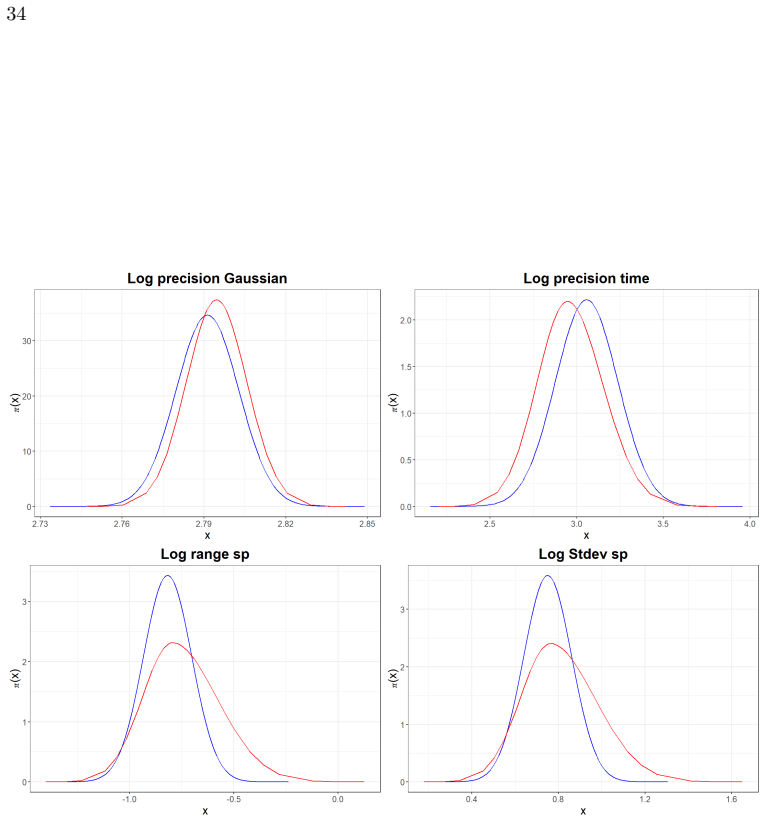
Summary. The manuscript develops a framework for distributed, recursive, and federated Bayesian inference for latent Gaussian models built on INLA/R-INLA. For data partitioning it derives exact identities for the conditional latent-field posterior under Gaussian likelihoods and conditional independence (Eqs. 9–11, 30–31), and Gaussian-approximation combinations for non-Gaussian likelihoods (Eq. 13, recursive updates Eqs. 35–38). It then constructs distributed approximations to the hyperparameter posterior (Eqs. 16–21) and several strategies for hyperparameter marginals (interpolation, asymmetric Gaussian, Laplace, integration-free, consensus MC). Section 5 partitions the latent field itself via block-independent (Eqs. 43–45) and block-correlated/halo (Eqs. 46–48) schemes with log-determinant surrogates. Two examples are given: a Gaussian simulated spatio-temporal case with 2 partitions, and a 873,762-observation PM2.5 Gamma model with space–time interaction. The simulation matches full-data inference well; the PM2.5 case recovers latent fields but shows substantial divergence in the CCD and hyperparameter marginals (Figs. 10, 13), attributed to non-Gaussianity and hyperparameter heterogeneity.
Significance. If the approximation layers hold up, this is a practically significant contribution: it makes INLA viable for massive spatio-temporal datasets, streaming updates, and privacy-constrained (federated) settings within the widely used R-INLA stack. Explicit strengths: (i) the data-partitioning and recursive identities (Eqs. 9–11, 30–31) are exact and parameter-free for Gaussian likelihoods under conditional independence; (ii) the authors are candid about non-Gaussian error accumulation (Eq. 13) and recursive non-invariance under partition reordering (§4.1); (iii) the lifted-space determinant identity (Eq. 48) makes the latent-field partitioning surrogate falsifiable, since the neglected term is computable; (iv) a real 873k-observation PM2.5 case study is attempted. The main limitation is that the two ingredients most central to the headline claim — the determinant surrogates and the complexity reduction — are asserted rather than measured.
major comments (5)
- [§5, Eqs. (43)–(48)] §5.1–5.2, Eqs. (43)–(48): the latent-field partitioning rests on two uncontrolled log-determinant surrogates: truncation of the expansion in Eq. (45) after noting tr(D^{-1}R)=0, and dropping the interface Schur-complement term log|B Q~^{-1} B^T| from the exact identity in Eq. (48). These determinants enter the hyperparameter posterior via Eq. (14), so any θ-dependent error tilts the hyperparameter geometry, the CCD support points (Eq. 21), and everything downstream. No bound, no scaling analysis in partition count or interface size, and no empirical isolation is given. This is testable: the neglected term in Eq. (48) is computable at interface dimension; please report its magnitude relative to log|Q| across θ, or run the block-correlated scheme with exact determinants to isolate the surrogate's contribution. As stated, 'preserving accuracy' for latent-field partitioning is unestablished
- [§6, Figs. 3, 10, 13] §6.1 and §6.2: the empirical section cannot currently support the partitioning claims. §6.1 uses only 2 temporal partitions with a minimal interface, precisely the regime where the neglected Schur term is small; §6.2 shows substantial divergence in the CCD and hyperparameter marginals (Figs. 10, 13), which the text attributes to non-Gaussianity and hyperparameter heterogeneity — but the determinant surrogate is an unexamined confound in that attribution. Please add a study varying partition count/interface size (e.g., 2, 4, 8 temporal cuts) in the Gaussian simulation where the rest of the machinery is exact, so the surrogate's error can be isolated, and disentangle the two error sources in §6.2.
- [§3.3, Eqs. (18)–(21)] Eqs. (18)–(21): the global Gaussian approximation sums per-partition Hessians H_{θ*_i} evaluated at partition-specific modes θ*_i (Eq. 19). A Hessian of the global log-posterior evaluated at the global mode is not the sum of Hessians at differing local modes unless the modes coincide; the product-of-Gaussians combination in Eqs. (20)–(21) is a consensus-style heuristic, not an identity. This is load-bearing because the CCD integration design (and hence the marginals in Eq. 22) is built from it. At minimum, state the regularity condition (proximity of the θ*_i) under which this is controlled, quantify the error when it fails (Fig. 10 suggests §6.2 is such a case), and consider evaluating all partition Hessians at a common reference point.
- [Abstract, §6, §7] Abstract and §7: the central claim 'reducing computational complexity while preserving accuracy' is not quantified on either axis. No runtimes, memory footprints, or factorization costs are reported anywhere in §6, despite the complexity reduction being the paper's stated motivation; and §6.2 itself exhibits clear accuracy loss in the hyperparameter posterior (Figs. 10, 13). Please (i) report timing/memory comparisons against full-data R-INLA for both examples, and (ii) temper the abstract/conclusions to match the demonstrated scope: latent-field marginals recover well, hyperparameter geometry does not in the non-Gaussian case.
- [§3.4, Eq. (29)] Eq. (29): consensus Monte Carlo with weights w_i = π̃(y_i) (per-partition marginal likelihoods) is nonstandard — the Scott et al. (2016) algorithm uses precision (inverse-covariance) weights, which is what makes it exact for Gaussian subposteriors. Marginal-likelihood weighting lacks justification here and can be dominated by partition size. Please either justify this choice or use standard precision weighting, and clarify how Eq. (29) interacts with the asymmetric-Gaussian subposteriors from the integration-free algorithm.
minor comments (7)
- [§6] Broken cross-references: §6 first paragraph cites 'Section ??' and §6.2 cites 'Algorithm ??' for the partitioning procedure; the Supplementary Material reference target must be restored.
- [§3.1, Eq. (12)] Eq. (12): the canonical-form notation is unclear and the line 'The mean is computed as b_i = w_i Q_i^{-1}(θ)µ_i' appears dimensionally inconsistent — b_i should be the linear coefficient vector (canonical potential), not a scaled mean. Please rewrite Eq. (12) with explicit canonical parameters and check the sign of the linear term.
- [§2–3] Notation: n denotes both the number of observations (Eq. 1) and the number of partitions (Eq. 6 onward); |y| in the weights below Eq. (10) is undefined; the asymmetric-Gaussian variances in Eqs. (24) and (26) are written ambiguously ((σ^-_j)^{-2} z^2 vs (z/σ)^2) and lack normalization constants.
- [Throughout] Typos and garbled text: 'previosly' (§3.2), 'hyperparamters' (§3.2), 'block-independeent', 'propoerties' (§5), 'Dendogram', 'matriz', 'highlited' (Fig. 1 caption), 'could themselves varying' (§7); the sentence defining the simulation model in §6.1 ('βcat us is a spatial component...') is broken.
- [§6, Figs. 3–13] Figures: Figs. 3 and 10 are difficult to read at print size and captions are sparse (no indication of which hyperparameter axis is which in Fig. 3). Quantitative accuracy metrics (e.g., distances between marginal posteriors, coverage comparisons) would strengthen §6 beyond visual overlay.
- [§5.2] Positioning: the block-correlated scheme is essentially a Schwarz/domain-decomposition approximation for GMRF determinants; there is existing literature on parallel and domain-decomposed inference for latent Gaussian models that should be cited and contrasted, beyond the Toselli–Widlund reference.
- [§4.3] §4.3 honestly acknowledges that integration support points cannot in general be reused across recursive steps; a brief summary of what is actually reused and the resulting per-step cost would help readers assess the practical value of the recursive scheme relative to a fresh R-INLA run.
Circularity Check
No significant circularity: distributed/recursive identities are algebraic rearrangements of the INLA/GMRF posterior, and latent-field log-det surrogates are explicit truncations benchmarked against full-data INLA.
full rationale
The paper’s load-bearing steps are (i) rewriting the conditional latent-field posterior under conditional independence (Eqs. 6–11, 30–31), which for Gaussian likelihoods is an exact algebraic identity, not a fit or a definitional loop; (ii) product-of-Gaussians and recursive mode updates for non-Gaussian likelihoods (Eqs. 12–13, 34–38), presented and used as approximations with acknowledged error accumulation; and (iii) block-independent / block-correlated latent-field partitions whose log-determinant surrogates (Eqs. 43–48) are derived as zeroth-order truncations of known matrix expansions and justified by external domain-decomposition references (Toselli & Widlund 2005; Zhang 2005), not by self-citation uniqueness theorems. Empirical claims are checked against centralized full-data INLA on the same models (§6), an external benchmark relative to the distributed procedure. Self-citations (Figueira et al. 2025a,b; Van Niekerk & Rue; Rue et al.) supply INLA background and prior sequential-consensus tooling; they do not force the distributed identities or the accuracy claim by construction. Correctness concerns about uncontrolled determinant truncations or non-Gaussian hyperparameter divergence are validity issues, not circularity. No fitted-input-as-prediction, self-definitional, or uniqueness-import patterns appear.
Assumptions & free parameters
free parameters (3)
- prior weights w_i on partitions =
user-chosen; examples use equal or size-based splits
- number and cut locations of latent-field partitions =
two temporal partitions in examples; PM2.5 uses 14+1 temporal nodes
- CCD / integration support design
assumptions (4)
- domain assumption Observations are conditionally independent given the latent field and hyperparameters (Eq. 1), allowing likelihood factorization across partitions.
- domain assumption INLA’s Gaussian / low-rank VB approximation to the conditional latent-field posterior is adequate at each partition or recursive step.
- ad hoc to paper Block-independent log|Q|≈∑log|Q_i^{(0)}| (zeroth-order perturbation) or block-correlated ∑log|Q_i| (neglecting interface Schur complement) are acceptable surrogates for the global log-determinant.
- standard math Sparse GMRF precision structure and standard INLA hyperparameter exploration (CCD/grid, numerical-integration-free marginals) remain valid after recombination.
invented entities (2)
-
Block-independent latent-field partition scheme
-
Block-correlated (halo / extended) latent-field partition scheme
Cite this review
Pith. "Pith review of Distributed and recursive Bayesian inference for Big Data and complex spatio-temporal models." pith.science (2026). https://pith.science/paper/UFTHCTKP
@misc{pith2026260723396,
  author       = {Pith},
  title        = {Pith review of: Distributed and recursive Bayesian inference for Big Data and complex spatio-temporal models},
  year         = {2026},
  howpublished = {\url{https://pith.science/paper/UFTHCTKP}},
  note         = {Machine review of arXiv:2607.23396}
}
read the original abstract
The rapid growth of massive and complex datasets in fields such as econometrics, environmental sciences, risk management, and public policy has reshaped statistical modeling while introducing significant computational and methodological challenges. These challenges arise not only from data scale and model complexity, but also from the sequential or streaming nature of modern applications and from data-privacy constraints that prevent sharing raw data and thus limit joint analysis. To address these challenges, we introduce a novel and comprehensive Bayesian framework for distributed and recursive inference, grounded in the Integrated Nested Laplace Approximations (INLA) methodology and implemented using the R-INLA software. Our contributions include the partitioning both data and structured model components, reducing computational complexity while preserving accuracy relative to centralized full-data inference. We demonstrate the effectiveness of the proposed framework through case studies that highlight its applicability in large-scale, streaming, and privacy-sensitive settings. By integrating distributed, federated, and recursive paradigms, this work offers scalable, adaptive, and generalizable tools for modern Bayesian inference.
Figures


Figures from the paper (10 more)




Reference graph
Works this paper leans on
-
[1]
SIAM Journal on Discrete Mathematics , author =
Planar. SIAM Journal on Discrete Mathematics , author =. 1994 , pages =. doi:10.1137/S0895480191198768 , language =
-
[2]
International Data Privacy Law , author =
Practical approaches to big data privacy over time , volume =. International Data Privacy Law , author =. 2018 , pages =. doi:10.1093/idpl/ipx027 , language =
-
[3]
SIAM Journal on Matrix Analysis and Applications , author =
An. SIAM Journal on Matrix Analysis and Applications , author =. 1996 , note =. doi:10.1137/s0895479894278952 , language =
-
[4]
Spatial modeling with R-INLA: A review , journal =
Bakka, Haakon and Rue, H. Spatial modeling with R-INLA: A review , journal =. doi:https://doi.org/10.1002/wics.1443 , year =
-
[5]
Numerical solution of saddle point problems , volume =. Acta Numerica , author =. 2005 , pages =. doi:10.1017/S0962492904000212 , language =
-
[6]
, year =
Bishop, Christopher M. , year =. Pattern recognition and machine learning , isbn =
-
[7]
Journal of Statistical Mechanics: Theory and Experiment , author =
Fast unfolding of communities in large networks , volume =. Journal of Statistical Mechanics: Theory and Experiment , author =. 2008 , pages =. doi:10.1088/1742-5468/2008/10/P10008 , number =
-
[8]
Bochkina, Natalia , year =. Bernstein - von. doi:10.1007/978-3-031-30114-8_10 , pages =
Show all 94 references
-
[9]
Spectral clustering and biclustering: learning large graphs and contingency tables , isbn =
Bolla, Marianna , year =. Spectral clustering and biclustering: learning large graphs and contingency tables , isbn =
-
[10]
Streaming
Broderick, Tamara and Boyd, Nicholas and Wibisono, Andre and Wilson, Ashia C and Jordan, Michael I , editor =. Streaming. Advances in
-
[11]
Computational Statistics & Data Analysis , author =
A novel method of marginalisation using low discrepancy sequences for integrated nested. Computational Statistics & Data Analysis , author =. 2021 , pages =. doi:10.1016/j.csda.2020.107147 , language =
2021
-
[12]
Statistical Science , author =
Particle. Statistical Science , author =. doi:10.1214/10-STS325 , number =
-
[13]
The Annals of Statistics , author =
On the. The Annals of Statistics , author =. doi:10.1214/14-AOS1246 , number =
-
[14]
, year =
Chung, Fan Rong K. , year =. Spectral graph theory , isbn =
-
[15]
Diggle and Paula Moraga and Barry Rowlingson and Benjamin M
Peter J. Diggle and Paula Moraga and Barry Rowlingson and Benjamin M. Taylor , title =. Statistical Science , number =. 2013 , doi =
2013
-
[16]
Duff, I. S. , collaborator =. Direct
-
[17]
Engineering Applications of Artificial Intelligence , author =
A comprehensive survey of clustering algorithms:. Engineering Applications of Artificial Intelligence , author =. 2022 , note =. doi:10.1016/j.engappai.2022.104743 , language =
2022
-
[18]
BioScience , author =
Situating. BioScience , author =. 2018 , pages =. doi:10.1093/biosci/biy068 , language =
2018 doi
-
[19]
Foundations of Data Science , author =
Smart. Foundations of Data Science , author =. 2022 , pages =. doi:10.3934/fods.2021037 , number =
2022 doi
-
[20]
2022 , journal =
Approximate Bayesian Inference for the Interaction Types 1, 2, 3 and 4 with Application in Disease Mapping , author=. 2022 , journal =. 2206.09287 , archivePrefix=
2022 arXiv
-
[21]
Czechoslovak Mathematical Journal , author =
Algebraic connectivity of graphs , volume =. Czechoslovak Mathematical Journal , author =. 1973 , pages =. doi:10.21136/CMJ.1973.101168 , language =
1973
-
[22]
Environmental and Ecological Statistics , author =
A computationally efficient procedure for combining ecological datasets by means of sequential consensus inference , volume =. Environmental and Ecological Statistics , author =. 2025 , pages =. doi:10.1007/s10651-025-00653-x , language =
2025 doi
-
[23]
2025 , eprint=
Integrating Expert Knowledge and Recursive Bayesian Inference: A Framework for Spatial and Spatio-Temporal Data Challenges , author=. 2025 , eprint=
2025
-
[24]
Physics Reports , author =
Community detection in graphs , volume =. Physics Reports , author =. 2010 , note =. doi:10.1016/j.physrep.2009.11.002 , number =
2010 doi
-
[25]
Physics Reports , author =
Community detection in networks:. Physics Reports , author =. 2016 , pages =. doi:10.1016/j.physrep.2016.09.002 , language =
2016 doi
-
[26]
The Annals of Statistics , author =
Wald. The Annals of Statistics , author =. doi:10.1214/aos/1017938917 , number =
-
[27]
Statistical Theory and Related Fields , author =
A review of distributed statistical inference , volume =. Statistical Theory and Related Fields , author =. 2022 , pages =. doi:10.1080/24754269.2021.1974158 , language =
2022
-
[28]
SIAM Journal on Numerical Analysis , author =
Nested. SIAM Journal on Numerical Analysis , author =. 1973 , note =. doi:10.1137/0710032 , language =
1973 doi
-
[29]
SIAM Journal on Numerical Analysis , author =
An. SIAM Journal on Numerical Analysis , author =. 1976 , note =
1976
-
[30]
Numerische Mathematik , author =
The analysis of a nested dissection algorithm , volume =. Numerische Mathematik , author =. 1986 , note =. doi:10.1007/bf01396660 , language =
1986 doi
-
[31]
Journal of Computer and System Sciences , author =
Planar. Journal of Computer and System Sciences , author =. 1995 , pages =. doi:10.1006/jcss.1995.1076 , language =
1995
-
[32]
Geometric approximation algorithms , isbn =
Har-Peled, Sariel , year =. Geometric approximation algorithms , isbn =
-
[33]
Journal of Visual Communication and Image Representation , author =
Graph morphology , volume =. Journal of Visual Communication and Image Representation , author =. 1992 , pages =. doi:10.1016/1047-3203(92)90028-R , language =
1992 doi
-
[34]
Stochastic variational inference , journal =
Hoffman, Matthew D and Blei, David M and Wang, Chong and Paisley, John , year =. Stochastic variational inference , journal =
-
[35]
The American Statistician , author =
Making. The American Statistician , author =. 2021 , pages =. doi:10.1080/00031305.2019.1665584 , number =
2021 arXiv
-
[36]
Sampling for
Huang, Zaijing and Gelman, Andrew , year =. Sampling for
-
[37]
Illian and Sigrunn H
Janine B. Illian and Sigrunn H. S. The Annals of Applied Statistics , number =. 2012 , doi =
2012
-
[38]
Pattern Recognition Letters , author =
Data clustering: 50 years beyond. Pattern Recognition Letters , author =. 2010 , pages =. doi:10.1016/j.patrec.2009.09.011 , language =
2010 doi
-
[39]
IEEE Transactions on Pattern Analysis and Machine Intelligence , author =
Normalized cuts and image segmentation , volume =. IEEE Transactions on Pattern Analysis and Machine Intelligence , author =. 2000 , pages =. doi:10.1109/34.868688 , number =
-
[40]
Psychometrika , author =
Hierarchical. Psychometrika , author =. 1967 , note =. doi:10.1007/bf02289588 , language =
1967 doi
-
[41]
Karypis, George and Kumar, Vipin , month = sep, year =
-
[42]
, month = mar, year =
Kaufman, Leonard and Rousseeuw, Peter J. , month = mar, year =. Finding. doi:10.1002/9780470316801 , note =
-
[43]
Entropy , author =
On. Entropy , author =. 2023 , pages =. doi:10.3390/e25060884 , language =
2023 doi
-
[44]
Statistics in Medicine , doi =
Knorr-Held, Leonhard , title =. Statistics in Medicine , doi =
- [45]
-
[46]
, year =
Kullback, S. , year =. Information
-
[47]
Journal of the Royal Statistical Society: Series B (Statistical Methodology) , volume =
Lindgren, Finn and Rue, H. Journal of the Royal Statistical Society: Series B (Statistical Methodology) , volume =. doi:https://doi.org/10.1111/j.1467-9868.2011.00777.x , year =
2011
-
[48]
Journal of Statistical Software , author =
Bayesian. Journal of Statistical Software , author =. 2015 , pages =. doi:10.18637/jss.v063.i19 , number =
2015 doi
-
[49]
SIAM Journal on Computing , author =
Applications of a. SIAM Journal on Computing , author =. 1980 , pages =. doi:10.1137/0209046 , language =
1980 doi
-
[50]
SIAM Journal on Numerical Analysis , author =
Comparative. SIAM Journal on Numerical Analysis , author =. 1976 , note =
1976
-
[51]
ACM Transactions on Mathematical Software , author =
Modification of the minimum-degree algorithm by multiple elimination , volume =. ACM Transactions on Mathematical Software , author =. 1985 , note =. doi:10.1145/214392.214398 , language =
1985
-
[52]
SORT , author =
Leave-group-out cross-validation for latent gaussian models , volume =. SORT , author =. 2025 , pages =. doi:10.57645/20.8080.02.25 , language =
2025 doi
-
[53]
Journal of the Royal Statistical Society Series C: Applied Statistics , author =
Fully. Journal of the Royal Statistical Society Series C: Applied Statistics , author =. 2013 , pages =. doi:10.1111/rssc.12007 , number =
2013 doi
-
[54]
Computers & Structures , author =
Algorithms for reducing the bandwidth and profile of a sparse matrix , volume =. Computers & Structures , author =. 1992 , pages =. doi:10.1016/0045-7949(92)90386-E , language =
1992 doi
-
[55]
Communication-
McMahan, Brendan and Moore, Eider and Ramage, Daniel and Hampson, Seth and Arcas, Blaise Aguera y , editor =. Communication-. Proceedings of the 20th. 2017 , pages =
2017
-
[56]
Journal of Statistical Planning and Inference , author =
Approximate. Journal of Statistical Planning and Inference , author =. 2007 , pages =. doi:10.1016/j.jspi.2006.07.016 , language =
2007 doi
-
[57]
and Simpson, Daniel and Lindgren, Finn and Rue, H
Martins, Thiago G. and Simpson, Daniel and Lindgren, Finn and Rue, H. Bayesian computing with. 2013 , pages =. doi:10.1016/j.csda.2013.04.014 , journal =
2013 doi
-
[58]
Parallel sparse
Monien, Burkhard and Schulze, Jürgen , isbn =. Parallel sparse. Lecture. 1997 , doi =
1997
-
[59]
, year =
Myers, Raymond H. , year =. Response
-
[60]
WIREs Data Mining and Knowledge Discovery , author =
Algorithms for hierarchical clustering: an overview , volume =. WIREs Data Mining and Knowledge Discovery , author =. 2012 , note =. doi:10.1002/widm.53 , number =
2012 doi
-
[61]
Combinatorial scientific computing , isbn =
Naumann, Uwe and Schenk, Olaf , year =. Combinatorial scientific computing , isbn =
-
[62]
A new avenue for
Van Niekerk, Janet and Krainski, Elias and Rustand, Denis and Rue, H. A new avenue for. 2023 , pages =. doi:10.1016/j.csda.2023.107692 , journal =
2023
-
[63]
Journal of Machine Learning Research , year =
Van Niekerk, Janet and Rue, H. Journal of Machine Learning Research , year =
-
[64]
Big problems in spatio-temporal disease mapping:
Orozco-Acosta, Erick and Adin, Aritz and Ugarte, María Dolores , month = apr, year =. Big problems in spatio-temporal disease mapping:. doi:10.1016/j.cmpb.2023.107403 , journal =
2023
-
[65]
A first course in random matrix theory: for physicists, engineers and data scientists , isbn =
Potters, Marc and Bouchaud, Jean-Philippe , year =. A first course in random matrix theory: for physicists, engineers and data scientists , isbn =. doi:10.1017/9781108768900 , language =
-
[66]
Journal of Computational and Graphical Statistics , author =
Global. Journal of Computational and Graphical Statistics , author =. 2021 , pages =. doi:10.1080/10618600.2020.1811105 , number =
2021
-
[67]
Online structured laplace approximations for overcoming catastrophic forgetting , publisher =
Ritter, Hippolyt and Botev, Aleksandar and Barber, David , year =. Online structured laplace approximations for overcoming catastrophic forgetting , publisher =
-
[68]
Gaussian
Rue, H. Gaussian. 2005 , doi =
2005
-
[69]
Journal of the Royal Statistical Society
Approximate. Journal of the Royal Statistical Society. Series B: Statistical Methodology , author =. doi:10.1111/j.1467-9868.2008.00700.x , language =
2008
-
[70]
and Boley, Daniel L
Savaresi, Sergio M. and Boley, Daniel L. , month = apr, year =. On the performance of bisecting. Proceedings of the 2001. doi:10.1137/1.9781611972719.5 , urldate =
2001 doi
-
[71]
Bayesian
Särkkä, Simo , month = sep, year =. Bayesian
-
[72]
IEEE Signal Processing Magazine , author =
Signal. IEEE Signal Processing Magazine , author =. 2013 , pages =. doi:10.1109/MSP.2013.2259911 , number =
2013
-
[73]
Frontiers in Environmental Science , author =
The. Frontiers in Environmental Science , author =. 2021 , pages =. doi:10.3389/fenvs.2021.619092 , urldate =
2021
-
[74]
International Journal of Management Science and Engineering Management , author =
Bayes and big data: the consensus. International Journal of Management Science and Engineering Management , author =. 2016 , pages =. doi:10.1080/17509653.2016.1142191 , number =
2016
-
[75]
and Illian, J
Simpson, D. and Illian, J. B. and Lindgren, F. and Sørbye, S. H. and Rue, H. , title =. Biometrika , volume =. 2016 , month =
2016
-
[76]
Smith, Adam and Thakurta, Abhradeep and Upadhyay, Jalaj , month = may, year =. Is. 2017. doi:10.1109/SP.2017.35 , urldate =
2017 doi
-
[77]
Journal of the Royal Statistical Society Series C: Applied Statistics , author =
Careful. Journal of the Royal Statistical Society Series C: Applied Statistics , author =. 2019 , pages =. doi:10.1111/rssc.12321 , language =
2019 doi
- [78]
-
[79]
Journal of Machine Learning Research , author =
Scalable. Journal of Machine Learning Research , author =. 2018 , pages =
2018
-
[80]
, year =
Toselli, Andrea and Widlund, Olof B. , year =. Domain decomposition methods--algorithms and theory , isbn =
-
[81]
van der , year =
Vaart, Aad W. van der , year =. Asymptotic statistics , isbn =
-
[82]
Journal of Economic Perspectives , author =
Big. Journal of Economic Perspectives , author =. 2014 , pages =. doi:10.1257/jep.28.2.3 , language =
2014 doi
-
[83]
Expectation propagation as a way of life: a framework for. J. Mach. Learn. Res. , author =. 2020 , note =
2020
-
[84]
Mathematical
Vincent, Luc , editor =. Mathematical. 1988 , pages =. doi:10.1117/12.968942 , urldate =
1988 doi
-
[85]
Bayesian Inference with INLA , year =
Virgilio Gómez-Rubio , doi =. Bayesian Inference with INLA , year =. Bayesian Inference with INLA , publisher =
-
[86]
Statistics and Computing , author =
A tutorial on spectral clustering , volume =. Statistics and Computing , author =. 2007 , pages =. doi:10.1007/s11222-007-9033-z , language =
2007 doi
- [87]
-
[88]
Japanese Journal of Statistics and Data Science , author =
Information criteria and cross validation for. Japanese Journal of Statistics and Data Science , author =. 2021 , pages =. doi:10.1007/s42081-021-00121-3 , number =
2021 doi
-
[89]
Philosophical Transactions of the Royal Society A: Mathematical, Physical and Engineering Sciences , author =
Mathematical theory of. Philosophical Transactions of the Royal Society A: Mathematical, Physical and Engineering Sciences , author =. 2023 , file =. doi:10.1098/rsta.2022.0151 , number =
2023
-
[90]
IEEE Transactions on Neural Networks , author =
Survey of. IEEE Transactions on Neural Networks , author =. 2005 , pages =. doi:10.1109/tnn.2005.845141 , language =
2005
-
[91]
Federated
Singh, Pushpa and Singh, Murari Kumar and Singh, Rajnesh and Singh, Narendra , editor =. Federated. Federated. 2022 , doi =
2022
-
[92]
SIAM Journal on Algebraic Discrete Methods , author =
Computing the. SIAM Journal on Algebraic Discrete Methods , author =. 1981 , note =. doi:10.1137/0602010 , language =
1981 doi
-
[93]
Zhang, Fuzhen , year =. The
-
[94]
Annual Review of Statistics and Its Application , author =
Distributed. Annual Review of Statistics and Its Application , author =. 2024 , pages =. doi:10.1146/annurev-statistics-040522-021241 , language =
2024 doi
Reviewed July 30, 2026 · model on record in the stance chip above.
Discussion (0). Continue with ORCID to comment.