REVIEW 3 major objections 7 minor 22 references
Traffic rule understanding is a reasoning problem, and teaching VLMs explicit chain-of-thought on MapDR raises end-to-end F1 from 0.642 to 0.723.
Reviewed by Pith at T0; open to challenge. T0 means a machine referee read the full paper against a public rubric. the ladder, T0–T4 →
T0 review · grok-4.5
2026-07-31 21:09 UTC pith:SJ3NWMWP
load-bearing objection Real F1 lift on MapDR via CoT curation + SFT→GRPO, but the ablations undercut the claim that “reasoning” is what did the work. the 3 major comments →
Reasoning to Regulate: Chain-of-Thought for Traffic Rule Understanding
The pith
A machine-rendered reading of the paper's core claim, the machinery that carries it, and where it could break.
Core claim
On MapDR, equipping a vision-language model with curated chain-of-thought supervision and a two-stage SFT-then-GRPO training schedule, driven by an answer-grounded fine-grained reward over rule understanding and rule–lane association, improves end-to-end F1 from RuleVLM’s 0.642 to 0.723 and supplies interpretable rationales for which lanes a sign governs.
What carries the argument
The CoT curation pipeline: a two-round generation (independent prediction, then revision after ground-truth lanes are revealed) followed by a VLM verifier that keeps a rationale only if it alone implies the correct answer; those pairs train the model via mixed SFT and GRPO with a half-and-half reward on attribute match and lane-association IoU.
Load-bearing premise
That rationales written after the correct lanes are shown, and kept only if another model can recover that same label from the text, are true reasoning traces rather than after-the-fact stories that fit the answer.
What would settle it
Hold out MapDR scenes, generate CoTs without ever revealing ground-truth lanes, and check whether models trained on the paper’s filtered traces still beat direct-answer baselines on rule–lane F1 and whether human judges rate the traces as faithful to the images rather than post-hoc justifications.
If this is right
- Lane–rule association on MapDR-style benchmarks should be evaluated and optimized as a reasoning task, not only as sequence labeling of final lane IDs.
- Mixed answer-only and CoT data plus GRPO with dense rule-and-association rewards can lift end-to-end consistency even when raw rule-extraction precision dips slightly.
- Deployed regulation-aware stacks can expose intermediate rationales (sign parse → spatial alignment → lane set) for audit and debugging.
- The same two-round generate-then-verify recipe can scale CoT labels for other map-linked driving rules without full human rationale annotation.
Where Pith is reading between the lines
- If Round-2 traces are mostly label-conditioned rationalizations, gains may shrink when signs or layouts leave the MapDR distribution, so open-loop CoT generation without GT reveal is a natural next stress test.
- The method’s emphasis on correspondence over pure attribute extraction suggests safety metrics should weight wrong-lane associations more heavily than missing secondary sign attributes.
- Fine-grained association rewards could transfer to related topology tasks (lane–light, lane–marking) where partial credit on structure matters.
Editorial analysis
A structured set of objections, weighed in public.
Referee Report
Summary. The manuscript addresses traffic-rule understanding on the MapDR benchmark: given a front-view image, a cropped traffic sign, and vectorized lane/BEV inputs, predict a structured rule description and the set of lanes it governs. The authors argue this is a reasoning problem rather than direct sequence prediction, and propose (i) a CoT curation pipeline in which qwen-vl-max first predicts rationales+answers, then revises them after ground-truth lanes are revealed (Round 2), with a Qwen2-VL-72B judge retaining only traces from which the ground truth can be re-derived (4,517 of 11,060 samples retained); and (ii) a two-stage training scheme on a Qwen-VL-Chat (9.6B) backbone: SFT on a mix of answer-only and CoT data, followed by GRPO with a fine-grained, answer-grounded reward combining rule-attribute match and lane-association IoU (Alg. 1). On MapDR, the method raises end-to-end F1 from RuleVLM's 0.642 to 0.723, with ablations over data type, training stage, and reward granularity, plus qualitative examples. The authors claim this is the first reasoning-based framework for regulation-aware lane–rule association and that it improves both accuracy and interpretability.
Significance. If the results hold, this is a useful contribution to an important and underexplored problem: lane-level traffic-rule association is genuinely safety-relevant, and MapDR is a recent real-world benchmark with little published methodology beyond the RuleVLM baseline. The paper ships a complete, reproducible-in-principle training recipe (LoRA configuration, optimizer schedules, GRPO group size, reward definition in Alg. 1), a sensible set of ablations (data type × training stage; fine- vs. coarse-grained reward), and a clear empirical gain (F1 0.642 → 0.723) under the benchmark's official protocol. The fine-grained joint reward over rule semantics and rule–lane association is simple but well-motivated and supported by Table 3. The work does not, however, yet establish its stronger framing claims — that the gains come from faithful reasoning, or that the model's explanations are interpretable in a sense useful for safety auditing — and the evidence base is a single dataset/split with single-run numbers.
major comments (3)
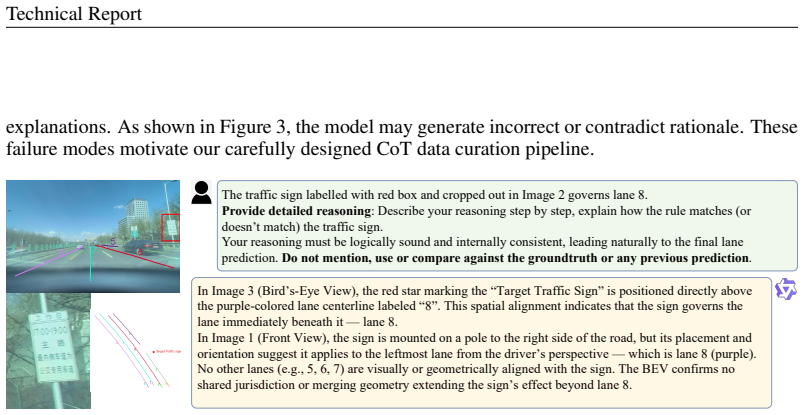
- [§3.1 (CoT Data Curation), Fig. 3–4, Abstract] §3.1 claims the two-round scheme elicits 'causally faithful rationales,' and the Abstract/§5 claim improved interpretability. The pipeline design does not support this: in Round 2 the ground-truth lanes are revealed to the generator (qwen-vl-max), and the Qwen2-VL-72B judge retains a sample iff the GT answer can be re-derived from the rationale text. This filter certifies answer-entailment, not visual faithfulness — a rationale that restates the revealed label in plausible spatial language passes. The manuscript's own Fig. 3 documents that such VLM rationales are frequently not causally faithful to the image. The CoT-only SFT result (Table 2: F1 0.518, below the 0.642 answer-only baseline) is also consistent with label-fitted rationalizations rather than teaching signals about geometry. Either provide a direct faithfulness assessment (e.g., human audit of a random sample of retained trac
- [§4.4, Table 2] The headline attribution of the 0.642→0.723 gain to CoT reasoning is weakened by the paper's own decomposition, and by an uncontrolled confound. (i) Answer-only + GRPO already reaches 0.671 (Table 2), so over a third of the total gain comes from the fine-grained answer-grounded reward (Alg. 1), which scores only parsed rule/lane correctness and ignores the rationale entirely. (ii) The CoT-only condition trains on 4,517 retained samples vs. 11,060 answer-only samples, so the CoT-only SFT drop (0.518) and the CoT-only+GRPO value (0.694) conflate rationale content with dataset size. A size-matched control (e.g., answer-only SFT on a random 4,517-subset, with and without GRPO) is needed to isolate the marginal contribution of rationale text. Without it, the statement in §4.4 that CoT 'validates our use of CoT' overstates what the ablation shows.
- [§4.3–4.4, Tables 1–3] All results appear to be single-run: no seeds, error bars, or variance estimates are reported anywhere. Several load-bearing comparisons are small enough to be within plausible run-to-run noise for LoRA fine-tuning plus GRPO sampling, notably fine vs. coarse reward (Table 3: 0.723 vs. 0.711) and the R.E. regression vs. RuleVLM in Table 1 (87.71/86.91 vs. 89.28/89.44). Please report mean ± std over at least 3 seeds for the main result and the Table 2/Table 3 ablations, or explicitly justify why this is infeasible and present the relevant comparisons as directional only.
minor comments (7)
- [§2.1] §2.1 contains a duplicated passage: the sentences 'However, OpenLane-V2 constrained by single-label classification…' and 'However, OpenLane-V2 remains limited to single-label categorization…' followed by two near-identical 'MapDR addresses this gap' sentences. Please consolidate.
- [Table 1] Table 1 reports C.R. entries as '−' for RuleVLM and Ours even though the text (§4.3) attributes the overall F1 gain to 'substantially stronger correspondence reasoning.' If C.R. values are available for these models they should be reported; this is the metric that most directly supports the paper's thesis.
- [§4.2.1] Retention statistics for the curation pipeline deserve a sentence of analysis: 4,517 of 11,060 samples (≈41%) survive the VLM-judge filter. Is the discarded 59% skewed toward particular sign types, rule categories, or lane configurations? A retention-rate breakdown would help readers assess distribution bias in the CoT subset.
- [Fig. 5] Fig. 5, second example: the displayed rationale concludes lane [1] from 'the sign is positioned above lane 1' with little intermediate structure; one of four showcased traces is thus a weak advertisement for the claimed multi-step reasoning. Consider replacing it, and state how the four examples were selected (random, cherry-picked, or representative of failure/success rates).
- [§4.1, Eq. (2)] Notation: Eq. (2) mixes P R.E./R R.E. with P ALL/R ALL and F1; the relation between the R.E./C.R. metrics and the graph-level Pall/Rall is deferred entirely to Chang et al. (2025). One sentence defining ˆGs (subgraph matching tolerance?) would make the paper more self-contained. Also 'MapDR provide' → 'MapDR provides' (Abstract), and the manuscript header 'Technical Report' appears on every page.
- [§4.2] The driving framing implies deployment constraints, but no inference cost is reported: CoT generation before the final answer increases latency substantially relative to RuleVLM's direct decoding. Please report tokens-per-decision and wall-clock latency on the eval hardware, even if only in an appendix, since this bears on the safety-critical motivation.
- [§4.2.1] LoRA configuration r=64, α=16 is unusual (α < r, effective scaling 0.25); confirm this is intended rather than a typo, since α=32 or α=64 is standard practice for this backbone. Also state whether code, the curated 4,517-pair CoT dataset, and the judge prompts will be released — this materially affects reproducibility.
Circularity Check
No derivation circularity: gains are measured on external MapDR labels; CoT curation and answer-grounded GRPO are standard supervised/RL training choices, not predictions forced by construction.
full rationale
This is an empirical VLM fine-tuning paper, not a first-principles derivation. The load-bearing claim is an end-to-end F1 lift on MapDR (0.642→0.723, Table 1) under the MapDR protocol’s external ground-truth rule and lane-association labels. Training uses (i) CoT traces bootstrapped from qwen-vl-max with GT revealed only in Round 2 and filtered by a judge VLM’s ability to re-derive that GT (Sec. 3.1), and (ii) GRPO with an answer-grounded reward that scores parsed rule attributes and lane IoU against GT (Alg. 1). Neither step makes the reported test metric equal its inputs by construction: the policy is evaluated on held-out MapDR validation labels that are independent of the sampled rollouts and of the curated rationales. Revealing GT when writing training rationales is ordinary teacher-forced / distillation supervision, not a fitted parameter renamed as a prediction, nor a self-definitional identity. Citations to MapDR/RuleVLM (Chang et al., 2025) and GRPO (Shao et al., 2024) are external works with non-overlapping authors; no uniqueness theorem or ansatz is imported from the present authors to forbid alternatives. Causal doubts about whether gains come from ‘reasoning’ versus stronger-teacher distillation plus fine-grained RL (Table 2) are attribution/correctness issues, not circular reduction of a claimed derivation. Per the rubric, self-contained evaluation on an external benchmark with no Eq. X ≡ Eq. Y by construction warrants score 0.
Axiom & Free-Parameter Ledger
free parameters (5)
- Reward mix weights (1/2 S_understand + 1/2 S_relation) =
0.5 / 0.5
- GRPO group size n =
8
- LoRA rank and alpha =
r=64, α=16, dropout=0.05
- SFT/GRPO learning rates and schedule knobs =
SFT LR 1e-5 / 10 ep; GRPO 1 ep
- CoT retention after VLM judge filter =
4517 pairs retained
axioms (5)
- domain assumption MapDR attribute and lane-association annotations are a sufficient external standard for ‘correct’ regulation understanding.
- ad hoc to paper A rationale generated after revealing ground-truth lanes, if a judge VLM can recover that GT from the text alone, is high-quality supervision for genuine multi-step reasoning.
- domain assumption Qwen-VL-Chat + MEE lane fusion is an adequate and fair backbone for comparing reasoning methods to RuleVLM.
- domain assumption GRPO group-relative advantages with the scalar reward in Alg. 1 improve final answer accuracy beyond SFT imitation.
- standard math Standard supervised sequence modeling and LoRA fine-tuning mathematics apply unchanged.
invented entities (2)
-
Two-round GT-conditioned CoT curation + VLM-judge filter for MapDR
no independent evidence
-
MapDR fine-grained joint reward (Alg. 1)
no independent evidence
read the original abstract
Understanding and complying with traffic regulations is a safety-critical requirement for autonomous driving, yet remains challenging due to the diversity and context dependence of traffic signage. Importantly, regulation understanding is not a simple recognition task, but a reasoning problem: whether a rule applies depends on interpreting the sign in relation to the spatial layout of lanes and scene context. To support such reasoning, MapDR provide fine-grained annotations that link each traffic sign's regulatory rules to the specific lanes they govern. Existing methods, however, largely treat this as direct sequence prediction, ignoring the underlying reasoning that connects sign semantics and map structure. To address this limitation, we explicitly incorporate reasoning into this task and propose a framework that equips vision-language models (VLMs) with chain-of-thought (CoT) capabilities. We first design a scalable CoT curation pipeline that bootstraps rationales from a strong LLM through a two-round strategy and employs a VLM-based verifier to filter out incorrect cases, yielding a high-quality set of (CoT, answer) pairs. Building on this foundation, we adopt a two-stage training scheme: supervised fine-tuning (SFT) to teach rationale-to-answer generation, followed by GRPO reinforcement learning with answer-grounded, fine-grained rewards to further improve final answer accuracy. Extensive experiments on MapDR show that our approach significantly improves both interpretability and accuracy, establishing the first reasoning-based framework for regulation-aware autonomous driving.
Figures




Reference graph
Works this paper leans on
-
[3]
Direct language model alignment from online ai feedback.arXiv preprint arXiv:2402.04792,
Shangmin Guo, Biao Zhang, Tianlin Liu, Tianqi Liu, Misha Khalman, Felipe Llinares, Alexandre Rame, Thomas Mesnard, Yao Zhao, Bilal Piot, et al. Direct language model alignment from online ai feedback.arXiv preprint arXiv:2402.04792,
-
[4]
URLhttps://arxiv.org/abs/2412.07689. Jyh-Jing Hwang, Runsheng Xu, Hubert Lin, Wei-Chih Hung, Jingwei Ji, Kristy Choi, Di Huang, Tong He, Paul Covington, Benjamin Sapp, Yin Zhou, James Guo, Dragomir Anguelov, and Mingxing Tan. Emma: End-to-end multimodal model for autonomous driving,
-
[5]
10 Technical Report Bo Jiang, Shaoyu Chen, Qian Zhang, Wenyu Liu, and Xinggang Wang
URL https://arxiv.org/abs/2410.23262. 10 Technical Report Bo Jiang, Shaoyu Chen, Qian Zhang, Wenyu Liu, and Xinggang Wang. Alphadrive: Unleashing the power of vlms in autonomous driving via reinforcement learning and reasoning
-
[6]
Takeshi Kojima, Shixiang Shane Gu, Machel Reid, Yutaka Matsuo, and Yusuke Iwasawa
URL https://arxiv.org/abs/2503.07608. Takeshi Kojima, Shixiang Shane Gu, Machel Reid, Yutaka Matsuo, and Yusuke Iwasawa. Large language models are zero-shot reasoners.Advances in neural information processing systems, 35:22199–22213,
-
[11]
Yueru Luo, Shuguang Cui, and Zhen Li. Dv-3dlane: End-to-end multi-modal 3d lane detection with dual-view representation.arXiv preprint arXiv:2406.16072, 2024b. Zhongxing Ma, Shuang Liang, Yongkun Wen, Weixin Lu, and Guowei Wan. Roadpainter: Points are ideal navigators for topology transformer.arXiv preprint arXiv:2407.15349,
-
[12]
Samyam Rajbhandari, Jeff Rasley, Olatunji Ruwase, and Yuxiong He
URLhttps://arxiv.org/abs/2505.15298. Samyam Rajbhandari, Jeff Rasley, Olatunji Ruwase, and Yuxiong He. Zero: Memory optimizations toward training trillion parameter models,
-
[15]
Alon Talmor, Jonathan Herzig, Nicholas Lourie, and Jonathan Berant. Commonsenseqa: A question answering challenge targeting commonsense knowledge.arXiv preprint arXiv:1811.00937,
-
[16]
Tianqi Wang, Enze Xie, Ruihang Chu, Zhenguo Li, and Ping Luo. Drivecot: Integrating chain-of- thought reasoning with end-to-end driving.arXiv preprint arXiv:2403.16996,
-
[17]
Benjamin Wilson, William Qi, Tanmay Agarwal, John Lambert, Jagjeet Singh, Siddhesh Khan- delwal, Bowen Pan, Ratnesh Kumar, Andrew Hartnett, Jhony Kaesemodel Pontes, et al. Ar- goverse 2: Next generation datasets for self-driving perception and forecasting.arXiv preprint arXiv:2301.00493,
-
[18]
Dongming Wu, Jiahao Chang, Fan Jia, Yingfei Liu, Tiancai Wang, and Jianbing Shen. Topomlp: An simple yet strong pipeline for driving topology reasoning.arXiv preprint arXiv:2310.06753, 2023a. Zeqiu Wu, Yushi Hu, Weijia Shi, Nouha Dziri, Alane Suhr, Prithviraj Ammanabrolu, Noah A. Smith, Mari Ostendorf, and Hannaneh Hajishirzi. Fine-grained human feedback ...
-
[19]
Yi Xu, Yuxin Hu, Zaiwei Zhang, Gregory P Meyer, Siva Karthik Mustikovela, Siddhartha Srinivasa, Eric M Wolff, and Xin Huang. Vlm-ad: End-to-end autonomous driving through vision-language model supervision.arXiv preprint arXiv:2412.14446, 2024a. Zhenhua Xu, Yujia Zhang, Enze Xie, Zhen Zhao, Yong Guo, Kwan-Yee K Wong, Zhenguo Li, and Hengshuang Zhao. Driveg...
-
[20]
Chen Zhang, Luis Fernando D’Haro, Yiming Chen, Malu Zhang, and Haizhou Li
URL https://arxiv.org/abs/2507.08267. Chen Zhang, Luis Fernando D’Haro, Yiming Chen, Malu Zhang, and Haizhou Li. A comprehensive analysis of the effectiveness of large language models as automatic dialogue evaluators. InPro- ceedings of the AAAI Conference on Artificial Intelligence, volume 38, pp. 19515–19524,
-
[21]
Zhuosheng Zhang, Aston Zhang, Mu Li, and Alex Smola
URLhttps:// arxiv.org/abs/2506.17211. Zhuosheng Zhang, Aston Zhang, Mu Li, and Alex Smola. Automatic chain of thought prompting in large language models.arXiv preprint arXiv:2210.03493,
- [22]
-
[2016]
11 Technical Report Zhihong Shao, Peiyi Wang, Qihao Zhu, Runxin Xu, Junxiao Song, Xiao Bi, Haowei Zhang, Mingchuan Zhang, YK Li, Yang Wu, et al. Deepseekmath: Pushing the limits of mathemati- cal reasoning in open language models.arXiv preprint arXiv:2402.03300,
-
[2017]
Ilya Loshchilov and Frank Hutter
URL https://arxiv.org/abs/1608.03983. Ilya Loshchilov and Frank Hutter. Decoupled weight decay regularization,
-
[2019]
Xuewen Luo, Fan Ding, Yinsheng Song, Xiaofeng Zhang, and Junnyong Loo
URLhttps: //arxiv.org/abs/1711.05101. Xuewen Luo, Fan Ding, Yinsheng Song, Xiaofeng Zhang, and Junnyong Loo. Pkrd-cot: A unified chain-of-thought prompting for multi-modal large language models in autonomous driving. In International Conference on Neural Information Processing, pp. 62–76. Springer, 2024a. Yueru Luo, Chaoda Zheng, Xu Yan, Tang Kun, Chao Zh...
-
[2020]
URLhttps://arxiv.org/abs/1910. 02054. Subhro Roy and Dan Roth. Solving general arithmetic word problems.arXiv preprint arXiv:1608.01413,
Pith/arXiv arXiv 1910
-
[2022]
From generation to judgment: Opportunities and challenges of llm-as-a-judge, 2025a
Dawei Li, Bohan Jiang, Liangjie Huang, Alimohammad Beigi, Chengshuai Zhao, Zhen Tan, Amrita Bhattacharjee, Yuxuan Jiang, Canyu Chen, Tianhao Wu, Kai Shu, Lu Cheng, and Huan Liu. From generation to judgment: Opportunities and challenges of llm-as-a-judge, 2025a. URLhttps: //arxiv.org/abs/2411.16594. Tengpeng Li, Hanli Wang, Xianfei Li, Wenlong Liao, Tao He...
-
[2023]
Logicot: Logical chain-of-thought instruction-tuning.arXiv preprint arXiv:2305.12147,
Hanmeng Liu, Zhiyang Teng, Leyang Cui, Chaoli Zhang, Qiji Zhou, and Yue Zhang. Logicot: Logical chain-of-thought instruction-tuning.arXiv preprint arXiv:2305.12147,
-
[2024]
Xinghao Chen, Zhijing Sun, Wenjin Guo, Miaoran Zhang, Yanjun Chen, Yirong Sun, Hui Su, Yijie Pan, Dietrich Klakow, Wenjie Li, et al. Unveiling the key factors for distilling chain-of-thought reasoning.arXiv preprint arXiv:2502.18001, 2025b. Yanping Fu, Wenbin Liao, Xinyuan Liu, Yike Ma, Feng Dai, Yucheng Zhang, et al. Topo- logic: An interpretable pipelin...
-
[2025]
Hardy Chen, Haoqin Tu, Fali Wang, Hui Liu, Xianfeng Tang, Xinya Du, Yuyin Zhou, and Cihang Xie. Sft or rl? an early investigation into training r1-like reasoning large vision-language models, 2025a. URLhttps://arxiv.org/abs/2504.11468. Li Chen, Chonghao Sima, Yang Li, Zehan Zheng, Jiajie Xu, Xiangwei Geng, Hongyang Li, Con- ghui He, Jianping Shi, Yu Qiao,...
discussion (0)
Sign in with ORCID, Apple, or X to comment. Anyone can read and Pith papers without signing in.