REVIEW 4 major objections 8 minor 32 references
Behavior signals belong inside the generator: condition decoding on the target action and train without an external reward model.
Reviewed by Pith at T0; open to challenge. T0 means a machine referee read the full paper against a public rubric. the ladder, T0–T4 →
T0 review · grok-4.5
2026-07-31 19:53 UTC pith:Y4L6RN7W
load-bearing objection Solid industrial assembly of behavior-conditioned GR plus reward-model-free post-training; pre-training and multi-surface A/B are the durable parts, EA-TOSD’s privileged prefix needs a cleaner non-leak story. the 4 major comments →
OxygenREC-v2: Internalizing Discrimination into Generative Recommendation
The pith
A machine-rendered reading of the paper's core claim, the machinery that carries it, and where it could break.
Core claim
The paper claims that discriminative behavior can be internalized into generative recommendation (IDGR): condition every decode step on a behavior instruction in pre-training, then post-train with verifiable SID-hit trajectory optimization plus entropy-aware self-distillation from a same-backbone teacher that sees near-future behaviors—yielding better candidates and online conversion without an external proxy reward.
What carries the argument
IDGR via EA-TOSD: behavior instruction Ib in the decoder prefix, plus entropy-aware trajectory optimization self-distillation that picks the best verifiable-hit rollout and routes privileged-teacher tokens by low- vs high-entropy gates (advantage-weighted distillation vs forward KL) on one shared backbone.
Load-bearing premise
That a short look-ahead of the user’s near-future clicks, carts, and orders, filtered and entropy-gated on the same model, teaches a history-only student preferences it can actually use at serve time without leftover privilege bias.
What would settle it
Ablate or replace the privileged future prefix and entropy gates: if online UCTCVR/GMV and offline HR@1/Recall@512 fall back to the external proxy-reward baseline (or worse) when the teacher sees only history or when distillation is applied to all tokens unfiltered, the internalization claim fails.
If this is right
- Behavior goals should enter generation as instructions, not only as post-hoc rerank scores, so different scenes (click vs order) get different candidate sets from the same backbone.
- Industrial GR post-training can drop the separate ranking reward model if logged future interactions supply verifiable hits and dense distillation.
- Gains concentrate on sparse high-value actions (orders), so platforms that care about conversion more than raw clicks have a direct training lever.
- A single unified backbone can carry both retrieval and behavior-aware ranking without co-training a discriminative head that leaves candidates behavior-agnostic.
Where Pith is reading between the lines
- If behavior-conditioned decoding is the real lever, similar instruction prefixes could target other business goals (diversity, margin, new-item exploration) without new reward heads.
- Entropy routing of privileged teachers may transfer to other sparse-feedback sequential systems where future labels exist in logs but not at inference.
- The method still depends on rich multi-behavior session logs; colder or single-behavior domains would need a substitute for the future-prefix teacher.
Editorial analysis
A structured set of objections, weighed in public.
Referee Report
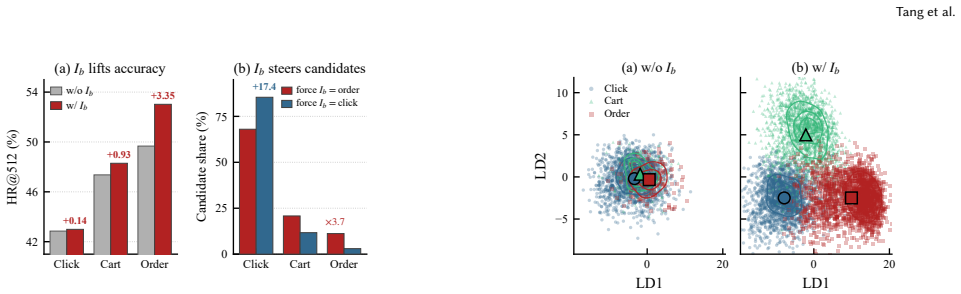
Summary. The paper presents OxygenREC-v2, an industrial generative recommender deployed on JD.com that "internalizes" behavior signals (click/cart/order) into generation rather than delegating them to an external reward model. Two mechanisms are proposed: (i) a behavior instruction I_b = ψ(Emb(b)) placed in the decoder prefix that conditions every decode step during pre-training, with behavior-weighted target expansion; and (ii) EA-TOSD, a reward-model-free post-training framework combining a verifiable SID-hit best-trajectory objective (Eqs. 5-7) with entropy-gated dual self-distillation from a privileged teacher that shares the backbone but sees a near-future SID prefix F (Eqs. 8-12, Appendix E). Offline, v2 improves over OxygenREC-v1 (PT-only) on all seven metrics and over a Proxy-RM baseline on six of seven (Table 1), with ablations for I_b/w_b (Table 2), teacher behavior threshold (Table 3), loss terms (Table 4), and entropy routing (Table 5). Online A/B on six surfaces shows UCTCVR +1.6-4.4% and GMV +2.8-6.8% (Table 6). Analyses (Figs. 3-4, Tables 7-8, Appendix C) probe whether I_b genuinely steers generation.
Significance. If the results hold, this is a credible industrial-scale demonstration that behavior conditioning on the input side, plus verifiable-reward post-training without a learned proxy, can replace the external-discriminator pattern that dominates deployed GR systems. Strengths worth naming: controlled same-backbone comparisons including a real Proxy-RM baseline; component-level ablations; behavior-steering interventions (forcing I_b, Table 8) and an LDA probe (Fig. 4) that go beyond metric-chasing; a genuinely informative negative result in Appendix C (output-side suffix variants reorder but cannot expand the candidate set); sensitivity studies over entropy gates (Fig. 5) and behavior weights (Fig. 6); and multi-surface online A/B with platform significance tests on a deployed 3B-A1B MoE. The candidate-set-vs-reranking distinction the paper draws is conceptually useful to the field. Reproducibility is limited by proprietary data, which is normal for this venue class, and the post-training half rests on assumptions (privilege construction, gate thresholds) that need the tightening requested below.
major comments (4)
- [§4.3.2 / Appendix E.1, Eq. (23)] Possible gold-target leakage into the privileged prefix F. Eq. (23) admits any engaged target with t_j > t_0 and rho(b_j) >= rho_min; since the sample's own listwise gold group Y* consists of the user's engaged items at/after t_0, nothing in the construction excludes F ∩ Y* ≠ ∅ (with m=2 and 16-20 gold items, the strongest-behavior gold items are prime candidates for F). If overlap occurs, the teacher is low-entropy exactly where it can copy the answer, the gate g^l_t selects those positions, and L_SD distills answer-copying unavailable at serving — the entropy gate would select for leakage rather than guard against privilege bias. This inflates precisely the offline gains attributed to distillation (Table 4: SD+FKL add +0.49 HR@512, +0.25 Recall@512 over VR-only). Please (a) state explicitly whether gold items are excluded from F, (b) report the measured overlap rate, and (c) if overlap
- [§6.3, Table 6 (Scenario 6)] The paper's primary novelty (EA-TOSD post-training) has online support from a single surface: Scenario 6, where UCTCVR (+0.56%) and UCTR (-0.03%) are non-significant and only GMV reaches p=0.048. Scenarios 1-5 ablate the pre-training upgrade, so the headline 'reward-model-free post-training' claim rests on one barely-significant, noise-prone metric on one surface — and the paper itself dismisses Scenario 5's GMV -2.34% (p=0.23) as day-to-day fluctuation, a standard that cuts both ways. Please either extend the post-training A/B to additional surfaces/longer windows, or scope the online claim for EA-TOSD to what Scenario 6 supports and label the rest as offline-only evidence.
- [Appendix D / Fig. 5 / Table 5] The entropy gates (tau_l=0.75, tau_h=2.6; Fig. 5) and the 20% routing ratios rho_L=rho_H (Table 5) are selected by sweeping on the same next-day evaluation set (2026-04-26) used for all reported results. The chosen operating point is thus partially fit to the test distribution, and the sensitivity curves show the metrics are responsive to these knobs (HR@512 spans 43.87-44.14 across settings). Please select thresholds on a held-out validation day and re-report the test-day numbers at the frozen setting, or at minimum quantify the gap between oracle and validation-selected thresholds.
- [§5 / Table 1] Offline deltas on several headline metrics are small and reported without any variance or significance estimate: NDCG@512 +0.0043, GAUC +0.0011, MRR@512 +0.0226 over v1 (Table 1), on a single evaluation day. The claim 'leads on six of seven metrics' (and the GAUC/MRR ordering vs Proxy-RM) could be within run-to-run or day-to-day noise. Please add seed variance, a multi-day evaluation, or a paired significance test; the retrieval gains (HR@1 +1.02pt, Recall@512 +1.44pt) look more robust and could be emphasized accordingly.
minor comments (8)
- [§5 vs Appendix G.2] Direct contradiction on backbone scale: §5 states 'All offline studies use a 3B encoder-decoder backbone,' while Appendix G.2 states 'The offline studies use a 0.7B-parameter configuration.' Please resolve; the offline tables' scale matters for interpreting the online/offline relationship.
- [Table 10 vs Table 3] Table 10 labels 'Add exposure' (rho_min=0) as the default teacher variant, but the full-model numbers in Tables 1 and 4 match the 'Click' row of Table 3 (5.64/44.14/36.39). Which threshold does the reported and deployed model actually use?
- [§4.3.1, Table 11, Table 12] Notation collision: G denotes the rollout group size in §4.3.1 and the listwise group size (16-20) in Table 11. Also Table 12 lists 'Decoding beam 512, length 4, greedy' — beam search and greedy are mutually exclusive, and length 4 is inconsistent with L=3N listwise decoding.
- [Eq. (13) / Algorithm 1] Eq. (13) omits the SFT anchor term that Algorithm 1 (line 9) includes; the weight lambda_sft is never given a default value, unlike lambda, beta, zeta. Please align the equation with the algorithm and report lambda_sft.
- [Figure 1] Figure 1 renders with unresolved placeholder glyphs (?? in panel labels), apparently a font/compilation issue; please fix for readability.
- [§2] MBGen [14] and PinRec [2] are cited as the closest behavior-conditioned generation work but only discussed in prose. A brief empirical comparison, or one sentence on why it is infeasible (e.g., no industrial-scale public baseline), would strengthen positioning.
- [§6.3] UCTR is essentially flat in all six scenarios while UCTCVR rises; the interpretation 'changes which items convert rather than inflating clicks' is plausible but would benefit from one supporting cut (e.g., per-position exposure distribution or downstream dwell metrics) to rule out cannibalization across surfaces.
- [§5 / Appendix G.1] Evaluation uses a single day (2026-04-26) after one training month; a second eval day would cheaply address day-specific effects, independent of the variance question in the major comments.
Circularity Check
No significant circularity: empirical systems method with external A/B and ablations; objectives do not force reported lifts by construction.
full rationale
OxygenREC-v2 is an industrial generative-recommendation systems paper. Its load-bearing claims are empirical lifts (offline HR/Recall/NDCG/GAUC vs PT-only and Proxy-RM; online UCTCVR/GMV vs production OxygenREC-v1), not first-principles identities. Pre-training uses standard next-token CE with a behavior prefix Ib and behavior weights wb (Eqs. 3–4); post-training uses a verifiable SID-hit trajectory reward (Eqs. 5–7) plus on-policy privileged self-distillation and high-entropy FKL (Eqs. 8–13). Aligning a hit-based RL term with hit-rate metrics is ordinary supervised/RL practice, not a fitted input renamed as a prediction, and does not make the reported deltas true by definition—Proxy-RM and component ablations (Tables 1–5) can and do move metrics independently. The behavior hierarchy is a shared design choice across instruction, loss, and teacher threshold, not a self-definitional loop. Building on the authors’ OxygenREC-v1 stack and citing related OPD/OPSD work is normal iteration; those citations are not uniqueness theorems that forbid alternatives, and online bucketed A/B tests against live production are external to the training definitions. Concerns about possible F∩Y★ overlap in the privileged prefix are methodological/leakage risks, not circularity of the derivation chain under this pass’s criteria. Steps left empty.
Axiom & Free-Parameter Ledger
free parameters (5)
- Behavior value weights wb (click/cart/order) =
{1.2, 1.5, 2.0} default; k=1
- EA-TOSD loss weights λ, β, ζ and SFT mix =
λ=0.1, β=0.01, ζ=0.01
- Entropy gates τl, τh and routing ratios ρL, ρH =
τl=0.75, τh=2.6; best ρ≈20%
- Rollout group size G, geometric decay γ, future prefix m =
m=2 default; G and γ stated as design knobs
- Behavior instruction projection ψ and placement =
insert-right default
axioms (5)
- domain assumption Logged behaviors form a total intent order exposure ≺ click ≺ cart ≺ order that should drive instruction priority, loss weights, and teacher thresholds uniformly.
- domain assumption Items are adequately represented by 3-level residual-quantization SIDs so token-level hits are a meaningful verifiable reward for recommendation quality.
- domain assumption Near-future interactions available only in training logs are valid privileged inputs for on-policy self-distillation without requiring a larger external teacher.
- standard math Standard next-token CE, REINFORCE-style trajectory weighting, and KL distillation are appropriate policy objectives for listwise SID generation.
- ad hoc to paper At inference, setting Ib to the scene’s business goal (without future F) yields the intended behavior-conditional candidate distribution.
invented entities (3)
-
IDGR (Internalizing Discrimination into Generative Recommendation)
no independent evidence
-
EA-TOSD (Entropy-Aware Trajectory Optimization Self-Distillation)
no independent evidence
-
Behavior instruction Ib = ψ(Emb(b))
independent evidence
read the original abstract
Generative recommendation unifies retrieval and ranking within a single model by autoregressively decoding semantic identifier (SID) sequences. Yet reliably incorporating behavior signals from clicks, cart additions, and orders remains challenging. Existing approaches either jointly optimize generative and discriminative objectives, requiring delicate trade-offs, or use a separate ranker as a post-hoc reinforcement-learning reward, risking out-of-distribution scoring and reward misalignment. We propose OxygenREC-v2, a generative recommender that Internalizes Discrimination into Generative Recommendation (IDGR). Rather than adding a separate discriminative objective, OxygenREC-v2 uses logged behavior to condition generation and supervise training. During pre-training, a behavior instruction conditions generation on the target behavior. During post-training, future interaction behaviors are exploited as privileged knowledge in our entropy-aware trajectory optimization self-distillation framework, enabling reward-model-free policy optimization. Throughout both training stages, OxygenREC-v2 maintains a single unified backbone. We implement OxygenREC-v2 as a 3B-parameter, 1B-activated MoE and deploy it on JD.com's large-scale e-commerce platform. Across multiple online A/B tests, OxygenREC-v2 improves user click-through conversion rate (UCTCVR) by 1.6--4.4% and GMV by 2.8--6.8% over OxygenREC-v1.
Figures




Reference graph
Works this paper leans on
-
[1]
Rishabh Agarwal, Nino Vieillard, Yongchao Zhou, Piotr Stanczyk, Sabela Ramos, Matthieu Geist, and Olivier Bachem. 2024. On-policy distillation of language models: learning from self-generated mistakes. InInternational Conference on Learning Representations (ICLR)
2024
-
[2]
Edoardo Botta, Jaewon Yang, Yi-Ping Hsu, Laksh Bhasin, Yilin Chen, Prab- hat Agarwal, Anirudhan Badrinath, Jiajing Xu, and Charles Rosenberg. 2026. PinRec: unified generative retrieval for Pinterest recommender systems. In Proceedings of the 32nd ACM SIGKDD Conference on Knowledge Discovery and Data Mining (KDD). doi:10.1145/3770855.3818462
arXiv 2026
-
[3]
Minmin Chen, Alex Beutel, Paul Covington, Sagar Jain, Francois Belletti, and Ed H. Chi. 2019. Top-k off-policy correction for a REINFORCE recommender system. InProceedings of the Twelfth ACM International Conference on Web Search and Data Mining (WSDM)
2019
-
[4]
Jiaxin Deng, Shiyao Wang, Kuo Cai, Lejian Ren, Qigen Hu, Weifeng Ding, Qiang Luo, and Guorui Zhou. 2025. OneRec: unifying retrieve and rank with generative recommender and iterative preference alignment.arXiv preprint arXiv:2502.18965. https://arxiv.org/abs/2502.18965
Pith/arXiv arXiv 2025
-
[5]
Haoran Ding et al. 2026. Rec-distill: an industrial distillation pipeline for large- scale recommendation models. (2026). https://arxiv.org/abs/2605.29755 arXiv: 2605.29755[cs.IR]
Pith/arXiv arXiv 2026
-
[6]
Leo Gao, John Schulman, and Jacob Hilton. 2023. Scaling laws for reward model overoptimization. InProceedings of the 40th International Conference on Machine Learning (ICML)
2023
-
[7]
Shijie Geng, Shuchang Liu, Zuohui Fu, Yingqiang Ge, and Yongfeng Zhang. 2022. Recommendation as language processing (RLP): a unified pretrain, personalized 8 OxygenREC-v2: Internalizing Discrimination into Generative Recommendation prompt & predict paradigm (P5). InProceedings of the 16th ACM Conference on Recommender Systems (RecSys)
2022
-
[8]
Yuxian Gu, Li Dong, Furu Wei, and Minlie Huang. 2024. MiniLLM: on-policy distillation of large language models. InInternational Conference on Learning Representations (ICLR)
2024
-
[9]
Daya Guo et al. 2025. DeepSeek-R1: incentivizing reasoning capability in LLMs via reinforcement learning.arXiv preprint arXiv:2501.12948. https://arxiv.org/a bs/2501.12948
Pith/arXiv arXiv 2025
-
[10]
Xuegang Hao et al. 2025. OxygenREC: an instruction-following generative framework for e-commerce recommendation.arXiv preprint arXiv:2512.22386. https://arxiv.org/abs/2512.22386
arXiv 2025
-
[11]
Woogyeol Jin, Taywon Min, Yongjin Yang, Dennis Wei, Yi Zhou, Swanand Ravindra Kadhe, Nathalie Baracaldo, and Kimin Lee. 2026. Entropy-aware on- policy distillation of language models.arXiv preprint arXiv:2603.07079. https: //arxiv.org/abs/2603.07079
Pith/arXiv arXiv 2026
-
[12]
Nathan Lambert et al. 2024. Tülu 3: pushing frontiers in open language model post-training.arXiv preprint arXiv:2411.15124. https://arxiv.org/abs/2411.15124
Pith/arXiv arXiv 2024
-
[13]
Doyup Lee, Chiheon Kim, Saehoon Kim, Minsu Cho, and Wook-Shin Han. 2022. Autoregressive image generation using residual quantization. InIEEE/CVF Conference on Computer Vision and Pattern Recognition (CVPR). IEEE, 11513– 11522
2022
-
[14]
Zihan Liu, Yupeng Hou, and Julian McAuley. 2024. Multi-behavior generative recommendation. InProceedings of the 33rd ACM International Conference on Information and Knowledge Management (CIKM). doi:10.1145/3627673.3679730
arXiv 2024
-
[15]
Kevin Lu and Thinking Machines Lab. 2025. On-policy distillation.Think- ing Machines Lab: Connectionism. https://thinkingmachines.ai/blog/on-policy- distillation. doi:10.64434/tml.20251026
-
[16]
Xiao Ma, Liqin Zhao, Guan Huang, Zhi Wang, Zelin Hu, Xiaoqiang Zhu, and Kun Gai. 2018. Entire space multi-task model: an effective approach for esti- mating post-click conversion rate. InProceedings of the 41st International ACM SIGIR Conference on Research and Development in Information Retrieval (SIGIR)
2018
-
[17]
Long Ouyang et al. 2022. Training language models to follow instructions with human feedback. InAdvances in Neural Information Processing Systems (NeurIPS)
2022
-
[18]
Shashank Rajput et al. 2023. Recommender systems with generative retrieval. InAdvances in Neural Information Processing Systems (NeurIPS)
2023
-
[19]
John Schulman, Filip Wolski, Prafulla Dhariwal, Alec Radford, and Oleg Klimov
-
[20]
Zhanming Shen et al. 2026. Purified OPSD: on-policy self-distillation without losing how to think.arXiv preprint arXiv:2607.02234. https://arxiv.org/abs/2607 .02234
Pith/arXiv arXiv 2026
-
[21]
Joar Skalse, Nikolaus H. R. Howe, Dmitrii Krasheninnikov, and David Krueger
-
[22]
Hongyan Tang, Junning Liu, Ming Zhao, and Xudong Gong. 2020. Progres- sive layered extraction (PLE): a novel multi-task learning (mtl) model for personalized recommendations. InProceedings of the 14th ACM Conference on Recommender Systems (RecSys)
2020
-
[23]
Ruobing Xie, Shaoliang Zhang, Rui Wang, Feng Xia, and Leyu Lin. 2022. A peep into the future: adversarial future encoding in recommendation. InProceedings of the Fifteenth ACM International Conference on Web Search and Data Mining (WSDM), 1177–1185. doi:10.1145/3488560.3498476
arXiv 2022
-
[24]
Chen Xu et al. 2020. Privileged features distillation at Taobao recommendations. InProceedings of the 26th ACM SIGKDD International Conference on Knowledge Discovery and Data Mining (KDD), 2590–2598. doi:10.1145/3394486.3403309
arXiv 2020
-
[25]
Jiaqi Zhai et al. 2024. Actions speak louder than words: trillion-parameter sequential transducers for generative recommendations. InProceedings of the 41st International Conference on Machine Learning (ICML)
2024
-
[26]
Kun Zhang et al. 2026. OneMall: one architecture, more scenarios—end-to- end generative recommender family at Kuaishou e-commerce.arXiv preprint arXiv:2601.21770. https://arxiv.org/abs/2601.21770
arXiv 2026
-
[27]
Siyan Zhao, Zhihui Xie, Mengchen Liu, Jing Huang, Guan Pang, Feiyu Chen, and Aditya Grover. 2026. Self-distilled reasoner: on-policy self-distillation for large language models.arXiv preprint arXiv:2601.18734. https://arxiv.org/abs/2 601.18734
Pith/arXiv arXiv 2026
-
[28]
Guorui Zhou et al. 2025. Onerec technical report. (2025). https://arxiv.org/abs /2506.13695 arXiv: 2506.13695[cs.IR]
arXiv 2025
-
[29]
Guorui Zhou et al. 2025. Onerec-v2 technical report. (2025). https://arxiv.org/a bs/2508.20900 arXiv: 2508.20900[cs.IR]
Pith/arXiv arXiv 2025
-
[30]
Yanyan Zou et al. 2026. GenRec: a preference-oriented generative framework for large-scale recommendation. InProceedings of the 49th International ACM SIGIR Conference on Research and Development in Information Retrieval (SIGIR). https://arxiv.org/abs/2604.14878. 9 Tang et al. A Notation Table 13 collects the symbols used in the preliminaries and method- ...
Pith/arXiv arXiv 2026
-
[2017]
https://arxiv.org/abs/1707.06347
Proximal policy optimization algorithms.arXiv preprint arXiv:1707.06347. https://arxiv.org/abs/1707.06347
-
[2022]
InAdvances in Neural Infor- mation Processing Systems (NeurIPS)
Defining and characterizing reward gaming. InAdvances in Neural Infor- mation Processing Systems (NeurIPS)
discussion (0)
Sign in with ORCID, Apple, or X to comment. Anyone can read and Pith papers without signing in.