REVIEW 5 minor 23 references
RoPE keeps spherical self-attention consensus as an equilibrium, but can slow it exponentially and lock in unstable twisted states.
Reviewed by Pith at T0; open to challenge. T0 means a machine referee read the full paper against a public rubric. the ladder, T0–T4 →
T0 review · grok-4.5
2026-07-31 13:01 UTC pith:HURPVO4X
load-bearing objection Solid math.DS package on query/key-only RoPE spherical attention: exact Bessel-aliasing consensus spectra, sharp regional rates, and twisted-branch linearization under a clearly policed idealized model.
Self-Attention Dynamics with Rotary Position Embeddings: Twisted States and Explicit Consensus Rates on the Sphere
The pith
A machine-rendered reading of the paper's core claim, the machinery that carries it, and where it could break.
Core claim
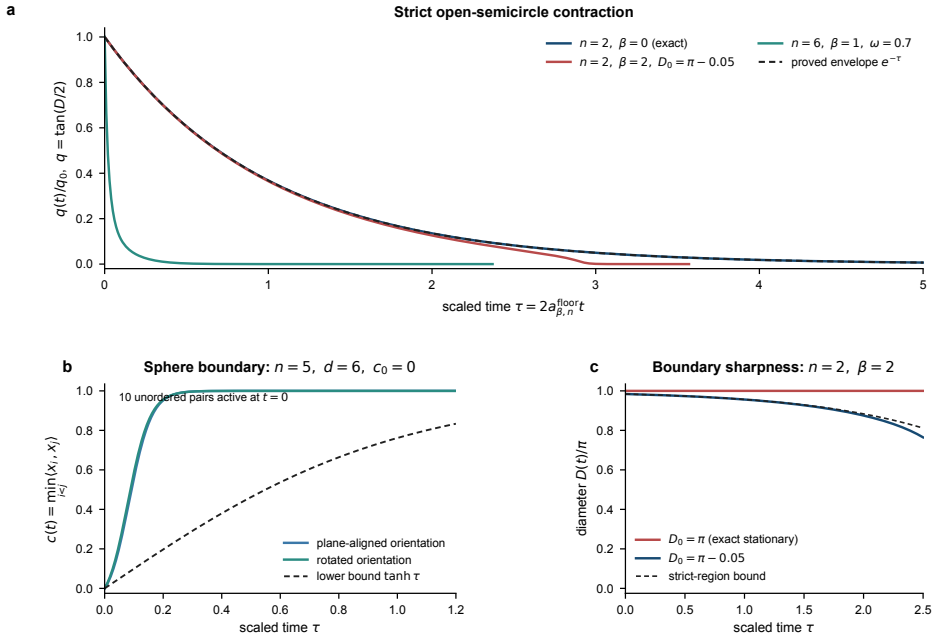
For the continuous normalized residual flow with query/key-only RoPE and unrotated values on the sphere, every consensus state is an equilibrium whose transverse linearization is a reversible Markov operator whose kernel depends on consensus only through plane energies. On a resonant single-frequency ring the consensus spectrum is given exactly by congruence-filtered modified Bessel ratios, including non-coprime frequencies and fixed-ring large-β asymptotics; regionally, closed hemispheres are invariant and pairwise non-obtuse or strict open-semicircle data contract with sharp half-angle and single-point tail bounds from the uniform RoPE softmax floor. RoPE further selects an explicit score-
What carries the argument
The continuous-time spherical flow with attention weights from RoPE-rotated scores and unrotated values, together with its consensus matrix A*: on a resonant ring A* is circulant with Bessel-aliasing eigenvalues, and globally the sharp uniform floor A_ij ≥ a_{β,n} drives kernel-generic Dini contraction estimates.
Load-bearing premise
Everything is proved for identity query, key, and value maps with RoPE only on queries and keys, in the continuous first-order residual limit, so learned matrices, multi-head structure, masks, and finite depth are left out.
What would settle it
On a resonant ring with gcd(m,n)>1, build the consensus attention matrix and check that unreachable Fourier modes are exactly zero and the remaining eigenvalues match the congruence-filtered Bessel formula to machine precision; separately, integrate the ODE from a strict open semicircle and verify that tan(D/2) stays under the proved exponential envelope set by the sharp softmax floor.
If this is right
- Local consensus speed under RoPE is completely determined by the consensus plane-energy vector and the sampled position kernel, without needing the full nonlinear flow.
- On fixed resonant contexts the gap can decay like e^{-βΔ_L}, so large inverse temperature can make consensus arbitrarily slow while still locally stable.
- Score-flattening twisted configurations selected by RoPE are not linearly attracting under the standard unrotated-value pathway.
- No position-independent ordering of frequencies by magnitude controls the consensus gap; aliasing and plane-energy mix can reverse the order.
- Inside pairwise non-obtuse or strict open-semicircle regions one obtains explicit geodesic tails to a single consensus point from the uniform floor alone.
Where Pith is reading between the lines
- Strong resonance plus large β in trained models may leave long-lived near-consensus plateaus even when linear theory still predicts eventual collapse.
- Value-rotating or oscillator-style attention variants would break this exact Markov consensus spectrum and need a separate rate theory.
- The same sharp floor and positivity argument should apply to any positional score kernel confined to [-1,1], not only RoPE.
- Center dynamics of the large neutral subspace on the generic twisted branch may organize finite-depth non-consensus transients that linear instability alone does not explain.
Editorial analysis
A structured set of objections, weighed in public.
Referee Report
Summary. The paper studies a continuous-time spherical self-attention flow in which RoPE rotations act on queries and keys while values remain unrotated, in the controlled specialization Q=K=V=I (Eqs. 3–5). Main results: (i) global well-posedness, reversibility, and a sharp uniform softmax floor a_{β,n} (Thm 3.1), together with exact same-system witnesses that the natural RoPE interaction energy has no uniform monotonic sign (Prop 3.2); (ii) consensus is always an equilibrium, with transverse linearization J_C=(A*−I)⊗I_{d−1} (Thm 4.3), and on a resonant single-frequency ring the consensus kernel is circulant with an exact congruence-filtered Bessel-aliasing spectrum that handles gcd(m,n)>1 (Thm 5.1), a Gram–Schur positivity argument giving spec(A*)⊂[0,1] (Thm 5.2), and fixed-effective-period large-β gap asymptotics γ∼2∆_L e^{−β∆_L} (Thm 5.3); (iii) regional global results: closed hemispheres forward invariant (Prop 6.1), pairwise non-obtuse and strict open-semicircle contraction with explicit half-angle rates and single-point tail bounds (Thms 6.2–6.3, Cor 6.5), with sharpness shown by a bipodal counterexample (Prop 6.4); (iv) an exact score-flattening twisted branch with full linear spectrum — non-hyperbolic and linearly unstable generically, a hyperbolic saddle after quotienting rotation in the odd antipodal case (Props 7.1–7.2) — and multi-frequency non-monotonicity counterexamples (Props 7.4–7.5). Numerical sections cross-check but are not used as proof steps.
Significance. If the results hold — and in my reading they do — the paper delivers the first exact asymptotic theory of the normalized query/key-only RoPE flow: a parameter-free, closed-form spectral theory on resonant rings (with the gcd reachability structure handled correctly), sharp regional contraction rates with an explicitly proved optimal softmax floor, and an exact classification of the RoPE-locked twisted branch including the odd antipodal saddle. The work is unusually disciplined about its own boundaries: the bipodal counterexample demonstrates sharpness of the strict-semicircle hypothesis rather than leaving it as a conjecture, the energy no-go is established by exact same-system witnesses with closed forms rather than numerics alone, the local-versus-uniform rate separation (38)–(39) is derived rather than asserted, and the authors explicitly decline to claim the dense-phase joint limit that their fixed-L analysis does not prove. The independent matrix/finite-difference/nonlinear-flow cross-checks (Table 2) at near-machine precision add confidence to the convention-sensitive formulas. The significance is bounded by the controlled specialization (Q=K=V=I, unrotated values, first-oder
minor comments (5)
- [§3, Eq. (3)] Eq. (3): as printed, the normalized residual update reads 'x^{ℓ+1}_i = x^ℓ_i + h y^ℓ_i ||x^ℓ_i + h y^ℓ_i||', which appears to be missing a fraction bar and should be (x^ℓ_i + h y^ℓ_i)/||x^ℓ_i + h y^ℓ_i||. Since this is the defining equation of the discrete model whose limit is taken in (4)–(5), the typesetting should be repaired.
- [§8 / Appendix D] The paper leans on 'independent numerical cross-checks' (Table 2, Appendix D) as part of its reliability case, and the parameter grids and tolerances are documented in detail, but no code or repository availability statement appears. Given the emphasis placed on these checks, a public code release (or an explicit statement) would substantially strengthen reproducibility.
- [Appendices A–B, passim] Numbering mismatch: the proofs in the appendices repeatedly refer to 'theorem 3.2', 'theorem 4.1', 'theorem 4.2', 'theorem 5.1', etc., for statements labeled Proposition 3.2, Proposition 4.1, Proposition 4.2, etc. in the main text. A uniform pass over the cross-references is needed.
- [§5 and §7.2] Theorem 5.2 and Theorem 7.3 overlap substantially (positive semidefiniteness of W via Gram–Schur, the similarity to D^{-1/2} W D^{-1/2}, and the invisibility equality condition are each proved twice, in B.2 and B.5). A brief consolidation or explicit cross-reference would tighten the presentation.
- [Figure 1] Figure 1b: the dashed continuum reference 1 − I_1(β)/I_0(β) is correctly labeled as unproved, but the caption would benefit from a one-line reminder in the main text near the figure that the fixed-L asymptotic (27) and the continuum 1/(2β) law are exponentially different regimes, since a casual reader could conflate them.
Circularity Check
No significant circularity: spectra, rates, and twisted-branch claims are derived from the stated ODE and standard analysis, with numerics only as cross-checks.
full rationale
The load-bearing results (consensus linearization Thm 4.3, Bessel-aliasing spectrum Thm 5.1 including non-coprime reachability, fixed-L large-β gaps Thm 5.3, regional contraction Thms 6.2–6.3 with sharp floor a_{β,n}, twisted Jacobian Props 7.1–7.2, multi-plane non-monotonicity Props 7.4–7.5) are proved from the normalized query/key-only flow (5) via row-stochasticity, circulant Fourier/Bessel expansion, Schur product positivity, active-set Dini calculus, and comparison ODEs. Appendix proofs are self-contained; no parameter is fitted to data and then re-presented as a prediction. Section 8 and Appendix D state explicitly that numerics cross-check convention-sensitive formulas and do not enter any proof. Related-work citations mark contribution boundaries rather than import uniqueness or ansatzes from the same author. The modeling specialization Q=K=V=I is declared openly, not smuggled. No self-definitional loop, fitted-input prediction, or load-bearing self-citation chain appears.
Axiom & Free-Parameter Ledger
axioms (4)
- domain assumption Continuous-time limit of normalized residual attention with Q=K=V=I except prescribed query/key RoPE rotations yields the sphere ODE (5).
- standard math Scores lie in [-1,1] on the product of unit spheres, giving the sharp softmax floor a_{β,n}.
- standard math Standard ODE existence/uniqueness on compact manifolds; Perron–Frobenius; Schur product theorem; modified Bessel expansion of e^{β cos θ}; finite active-set Dini calculus and Grönwall.
- domain assumption Regional geometric hypotheses (closed hemisphere, pairwise non-obtuse, strict open semicircle) rather than arbitrary initial data.
invented entities (2)
-
Score-flattening RoPE twisted branch (θ_j = c − ω j) and odd antipodal family
independent evidence
-
Consensus plane-energy vector a and multi-frequency kernel K_a
independent evidence
read the original abstract
Rotary position embeddings (RoPE) modify attention scores through position-dependent rotations, but their effect on normalized token dynamics is not captured by the vanilla spherical self-attention model. We study the continuous-time dynamics obtained when queries and keys are rotated while values remain on the unit sphere. The resulting attention kernel is reversible and admits a sharp uniform softmax floor, yet the natural RoPE interaction energy has derivatives of both signs within one fixed nontrivial system. Every consensus state remains an equilibrium, and its transverse linearization is a reversible Markov operator whose kernel depends on the consensus point through its energy across RoPE planes. On a resonant single-frequency ring we derive an exact Bessel-aliasing spectrum, including non-coprime frequencies and the correct fixed-ring large-$\beta$ asymptotics. Globally, closed hemispheres are invariant, while pairwise non-obtuse configurations and strict open semicircles contract with explicit half-angle and single-point tail bounds. These regional estimates instantiate a kernel-generic positivity principle with the sharp RoPE softmax floor. RoPE also selects an explicit score-flattening twisted branch; the generic resonant family is non-hyperbolic and linearly unstable, whereas an odd antipodal family becomes a hyperbolic saddle after quotienting global rotation. In multiple dimensions, the local consensus gap can depend non-monotonically on the allocation of energy across frequency planes, so no universal ordering by frequency is valid. Independent matrix, finite-difference, and nonlinear-flow computations cross-check the theorem boundaries and the reported constants.
Figures



Reference graph
Works this paper leans on
-
[1]
The asymptotic behavior of attention in transformers.arXiv preprint arXiv:2412.02682, 2024
Álvaro Rodríguez Abella, João Pedro Silvestre, and Paulo Tabuada. The asymptotic behavior of attention in transformers.arXiv preprint arXiv:2412.02682, 2024. URLhttps://arxiv. org/abs/2412.02682
arXiv 2024
-
[2]
Multistability of self-attention dynamics in transformers.arXiv preprint arXiv:2511.11553, 2025
Claudio Altafini. Multistability of self-attention dynamics in transformers.arXiv preprint arXiv:2511.11553, 2025. URLhttps://arxiv.org/abs/2511.11553
arXiv 2025
-
[3]
Martin Burger, Samira Kabri, Yury Korolev, Tim Roith, and Lukas Weigand. Analysis of mean-field models arising from self-attention dynamics in transformer architectures with layer normalization.arXiv preprint arXiv:2501.03096, 2025. URL https://arxiv.org/abs/2501. 03096. 16
Pith/arXiv arXiv 2025
-
[6]
The emergence of clusters in self-attention dynamics.arXiv preprint arXiv:2305.05465, 2023
Borjan Geshkovski, Cyril Letrouit, Yury Polyanskiy, and Philippe Rigollet. The emergence of clusters in self-attention dynamics.arXiv preprint arXiv:2305.05465, 2023. URLhttps: //arxiv.org/abs/2305.05465
Pith/arXiv arXiv 2023
-
[7]
Dynamic metastability in the self-attention model.arXiv preprint arXiv:2410.06833, 2024
Borjan Geshkovski, Hugo Koubbi, Yury Polyanskiy, and Philippe Rigollet. Dynamic metastability in the self-attention model.arXiv preprint arXiv:2410.06833, 2024. URL https://arxiv.org/abs/2410.06833
Pith/arXiv arXiv 2024
-
[8]
Borjan Geshkovski, Cyril Letrouit, Yury Polyanskiy, and Philippe Rigollet. A mathematical perspective on transformers.Bulletin of the American Mathematical Society, 62:427–479, 2025. URLhttps://arxiv.org/abs/2312.10794
Pith/arXiv arXiv 2025
-
[9]
Monica Goebel, Matthew S. Mizuhara, and Sofia Stepanoff. Stability of twisted states on lattices of kuramoto oscillators.Chaos, 2021. doi: 10.1063/5.0060095. URLhttps://arxiv. org/abs/2106.07119
Pith/arXiv arXiv 2021
-
[10]
Zihan Gu, Ruoyu Chen, Han Zhang, Hua Zhang, and Yue Hu. Deconstructing positional information: From attention logits to training biases.International Conference on Learning Representations, 2026. URLhttps://arxiv.org/abs/2505.13027
arXiv 2026
-
[11]
Clustering in causal attention masking.arXiv preprint arXiv:2411.04990, 2024
Nikita Karagodin, Yury Polyanskiy, and Philippe Rigollet. Clustering in causal attention masking.arXiv preprint arXiv:2411.04990, 2024. URL https://arxiv.org/abs/2411.04990
Pith/arXiv arXiv 2024
-
[12]
Normalization in attention dynamics.arXiv preprint arXiv:2510.22026, 2025
Nikita Karagodin, Shu Ge, Yury Polyanskiy, and Philippe Rigollet. Normalization in attention dynamics.arXiv preprint arXiv:2510.22026, 2025. URLhttps://arxiv.org/abs/2510.22026
arXiv 2025
-
[13]
Spectral selection in symmetric self-attention dynamics
Christian Kuehn and Jaeyoung Yoon. Spectral selection in symmetric self-attention dynamics. arXiv preprint arXiv:2604.26085, 2026. URLhttps://arxiv.org/abs/2604.26085
Pith/arXiv arXiv 2026
-
[14]
Feilong Liu. Rotary positional embeddings as phase modulation: Theoretical bounds on the RoPE base for long-context transformers.arXiv preprint arXiv:2602.10959, 2026. URL https://arxiv.org/abs/2602.10959
arXiv 2026
-
[16]
Kuramoto attention: Synchronizing self-attention on the torus.arXiv preprint arXiv:2606.11585, 2026
Joshua Nunley. Kuramoto attention: Synchronizing self-attention on the torus.arXiv preprint arXiv:2606.11585, 2026. URLhttps://arxiv.org/abs/2606.11585
Pith/arXiv arXiv 2026
-
[17]
Ayan Pendharkar. Gradient flow structure and quantitative dynamics of multi-head self- attention.arXiv preprint arXiv:2605.04279, 2026. URLhttps://arxiv.org/abs/2605.04279
Pith/arXiv arXiv 2026
-
[18]
URLhttps://arxiv.org/abs/2606.18694
-
[20]
RoFormer: Enhanced transformer with rotary position embedding.arXiv preprint arXiv:2104.09864, 2021
Jianlin Su, Yu Lu, Shengfeng Pan, Ahmed Murtadha, Bo Wen, and Yunfeng Liu. RoFormer: Enhanced transformer with rotary position embedding.arXiv preprint arXiv:2104.09864, 2021. URLhttps://arxiv.org/abs/2104.09864
Pith/arXiv arXiv 2021
-
[21]
Duy-Tung Pham, An The Nguyen, Viet-Hoang Tran, Nhan-Phu Chung, Xin T. Tong, Tan M. Nguyen, and Thieu N. Vo. Dynamical properties of tokens in self-attention and effects of positional encoding.arXiv preprint arXiv:2512.03058, 2025. URLhttps://arxiv.org/abs/ 2512.03058. 17
arXiv 2025
-
[23]
On the role of attention masks and LayerNorm in transformers.arXiv preprint arXiv:2405.18781, 2024
Xinyi Wu, Amir Ajorlou, Yifei Wang, Stefanie Jegelka, and Ali Jadbabaie. On the role of attention masks and LayerNorm in transformers.arXiv preprint arXiv:2405.18781, 2024. URL https://arxiv.org/abs/2405.18781. A Structural proofs A.1 Well-posedness, detailed balance, and the sharp floor Proof of theorem 3.1.The right-hand side of(5) is smooth on a neighb...
Pith/arXiv arXiv 2024
-
[2017]
URLhttps://arxiv.org/abs/1706.03762
-
[2018]
URLhttps://arxiv.org/abs/1805.02528
-
[2024]
URLhttps://arxiv.org/abs/2405.18273
-
[2025]
URLhttps://arxiv.org/abs/2512.01868
-
[2026]
URLhttps://arxiv.org/abs/2606.11275
discussion (0)
Sign in with ORCID, Apple, or X to comment. Anyone can read and Pith papers without signing in.